A D P based Search A l g o r i t h m for Statistical Machine Translation
S. N i e f l e n , S. Vogel, H. N e y ,
a n dC. T i l l m a n n
L e h r s t u h l fiir I n f o r m a t i k VIR W T H A a c h e n - U n i v e r s i t y o f T e c h n o l o g y D-52056 A a c h e n , G e r m a n y
E m a i h n i e s s e n © i n f o r m a t i k , r w t h - a a c h e n , de
A b s t r a c t
We introduce a novel search algorithm for statisti- cal machine translation based on dynamic program- ming (DP). During the search process two statis- tical knowledge sources are combined: a translation model and a bigram language model. This search al- gorithm expands hypotheses along the positions of the target string while guaranteeing progressive cov- erage of the words in the source string. We present experimental results on the Verbmobil task.
1 I n t r o d u c t i o n
In this paper, we address the problem of finding the most probable target language representation of a given source language string. In our approach, we use a DP based search algorithm which sequentially visits the target string positions while progressively considering the source string words.
The organization of the paper is as follows. Af- ter reviewing the statistical approach to machine translation, we first describe the statistical know- ledge sources used during the search process. We then present our DP based search algorithm in de- tail. Finally, experimental results for a bilingual cor- pus are reported.
1.1 S t a t i s t i c a l M a c h i n e T r a n s l a t i o n
In statistical machine translation, the goal of the search strategy can be formulated as follows: We are given a source language ('French') string fl a = fl • .- f.t, which is to be translated into a target lan- guage ('English') string
e~ = el...et
with the un- known length I. Every English string is considered as a possible translation for the input string. If we assign a probabilityPr(e~[f()
to each pair of strings (e/, f~), then we have to choose the lengthIopt
and-/opt
the English string e 1 that maximize
Pr(e f If J)
for a given French string f J . According to Bayes deci- sion rule,Iopt
and ~ ° " can be found by(Iopt,J1 °"')
=argmax{Pr(e~lf~)}
I,e{
=
argmax{Pr(e().Pr(f~Jlel)}.
(1)l , e I
Pr(e~) is the English language model, whereas
Pr(flJ[eZa)
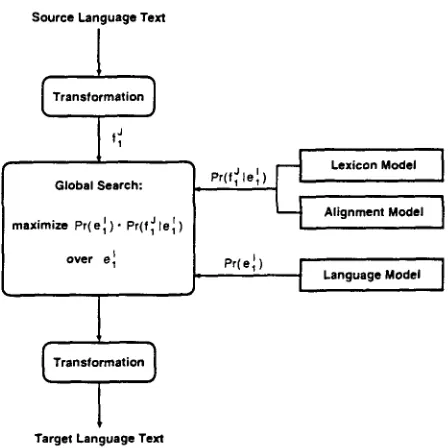
is the string translation model.The overall architecture of the statistical transla- tion approach is summarized in Fig. 1. In this figure, we already anticipate the fact that we will transform the source strings in a certain manner and that we will countermand these transformations on the pro- duced output strings. This aspect is explained in more detail in Section 3.
Source Language
Text
Transformation
1
[
Global Search:
-1_ Pr(faIel)
maximize
Pr(el). Pr(f~lel)
overe I
I
I Transformation
I
1
Target Language
Text
Lexicon Model
I
I ..o,o.o.,o°., ]
Figure 1: Architecture of the translation approach based on Bayes' decision rule.
The task of statistical machine translation can be subdivided into two fields:
1. the field of modelling, which introduces struc- tures into the probabilistic dependencies and provides methods for estimating the parameters of the models from bilingual corpora;
[image:1.612.323.547.299.523.2]1.2 A l i g n m e n t w i t h M i x t u r e D i s t r i b u t i o n Several papers have discussed the first issue, espe- cially the problem of word alignments for bilingual corpora (Brown et al., 1993), (Dagan et al., 1993), (Kay and RSscheisen, 1993), (Fung and Church, 1994), (Vogel et al., 1996).
In our search procedure, we use a mixture-based alignment model that slightly differs from the model introduced as
Model 2
in (Brown et al., 1993). It is based on a decomposition of the joint probability for f~ into a product of the probabilities for each wordd
Pr(flJle~) = p( J[I) " H p(fJl eta),
(2)3=1
where the lengths of the strings are regarded as random variables and modelled by the distribution
p(JlI).
Now we assume a sort of pairwise interac- tion between the French wordfj
and each English word ei in el i. These dependencies are captured in the form of a mixture distribution:I
p(f31ezl) = ~'~p(ilj, J,I) " p(fjlei) •
(3)i=1
Inserting this into (2), we get
J I
Pr(Y(le~) = p(JII) YI ~~p(ilj, J, i) . p(f~le,)
(4)j = l i=1
with the following components: the sentence length probability
p(JlI),
the mixture alignment probabil- ityp(ilj, J, I)
and the translation probabilityp(fle).
So far, the model allows
all
English words in the target string to contribute to the translation of a French word. This is expressed by the sum over i in Eq. (4). It is reasonable to assume that for each source string position j one position i in the target string dominates this sum. This conforms with the experience, that in most cases a clear word-to-word correspgndence between a string and its translation exists. As a consequence, we use the so-called max- imum approximation: At each point, only thebest
choice of i is considered for the alignment path:d
Pr(/( le~)
=p( JII) ~I m ~ p(ilj, J, I).p(fj]e~).
(5)j = l " e l , ]
We can now formulate the criterion to be maximized by a search algorithm:
max [p( JlI) max { Pr(e[).
I
el
H m.ax ~(ilj, J,I )
.p(f31e~)l
.
j = l ie[1,1]
(6)
Because of the problem of data sparseness, we use a parametric model for the alignment probabilities. It assumes that the distance of the positions relative to the diagonal of the (j, i) plane is the dominating factor:
r(i _ j I )
p(ilj,
J, I) = (7),
E i , = l r(i' - j )
As described in (Brown et al., 1993), the EM al- gorithm can be used to estimate the parameters of the model.
1.3 S e a r c h in S t a t i s t i c a l M a c h i n e T r a n s l a t i o n
In the last few years, there has been a number of papers considering the problem of finding an effi- cient search procedure (Wu, 1996), (Tillmann et al., 1997a), (TiUmann et al., 1997b), (Wang and Waibel, 1997). All of these approaches use a bigram language model, because they are quite simple and easy-to- use and they have proven their prediction power in stochastic language processing, especially speech recognition. Assuming a bigram language model, we would like to re-formulate Eq. (6) in the following way:
J
max[p(J]I)m~axljX~l
m a x ~ ( e i l e i - 1 ) ' l
e 1 .= iE[1,I]P(ilJ, J,I)'p(fjlei)] }] •
(8)
Any search algorithm tending to perform the max- imum operations in Eq. (8) has to guarantee, that the predecessor word ei-1 can be determined at the time when a certain word
ei
at position i in the tar- get string is under consideration. Different solutions to this problem have been studied.(Tillmann et al., 1997b) and (Tillmann et al., 1997a) propose a search procedure based on dynamic programming, that examines the source string se- quentially. Although it is very efficient in terms of translation speed, it suffers from the drawback of being dependent on the so-called monotonicity constraint: The alignment paths are assumed to be monotone. Hence, the word at position i - 1 in the target sentence can be determined when the algorithm produces
ei.
This approximation corre- sponds to the assumption of the fundamental simi- laxity of the sentence structures in both languages. In (Tillmann et al., 1997b) text transformations in the source language are used to adapt the word or- dering in the source strings to the target language grammar.by adding a word to the end of the target string while considering the source string words in any or- der. The underlying translation model is
Model 2
from (Brown et al., 1993).(Wu, 1996) formulates a DP search for stochastic bracketing transduction grammars. The bigram lan- guage model is integrated into the algorithm at the point, where two partial parse trees are combined.
2
D P S e a r c h
2 . 1 T h e I n v e r t e d A l i g n m e n t M o d e l
For our search method, we chose an algorithm which is based on dynamic programming. Compared to an A'-based algorithm dynamic programming has the fundamental advantage, that solutions of subprob- lems are stored and can then be re-used in later stages of the search process. However, for the op- timization criterion considered here dynamic pro- gramming is only suboptimal because the decompo- sition into independent subproblems is only approx- imately possible: to prevent the search time of a search algorithm from increasing exponentially with the string lengths and vocabulary sizes, local deci- sions have to be made at an earlier stage of the opti- mization process that might turn out to be subopti- mal in a later stage but cannot be altered then. As a consequence, the global optimum might be missed in some cases.
The search algorithm we present here combines the advantages of dynamic programming with the search organization along the positions of the target string, which allows the integration of the bigram in a very natural way without restricting the alignment paths to the class of monotone alignments.
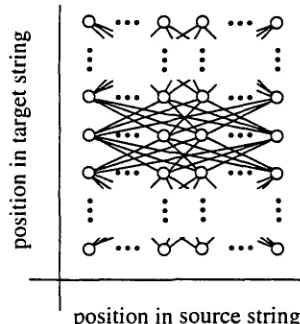
The alignment model as described above is defined as a function that assigns exactly one target word to each source word. We introduce a new interpretation of the alignment model: Each position i in e / is assigned a position
bi = j
in fl J. Fig. 2 illustrates the possible transitions in this inverted model.At each position i of el, each word of the target language vocabulary can be inserted. In addition, the
fertility l
must be chosen: A position i and the wordei
at this position are considered to correspond to a sequence of wordsf~:+1-t
in f ] . In most cases, the optimal fertility is 1. It is also possible, that a wordei
has fertility 0, which means that there is no directly corresponding word in the source string. We call this askip,
because the position i is skipped in the alignment path.Using a bigram language model, Eq. (9) specifies the modified search criterion for our algorithm. Here as above, we assume the maximum approximation to be valid.
° ~
e ~
L , . . ~
0
. N
O
: : _. •
: _" : :
c~.-... ~
...-.~
position in source string
Figure 2: Transitions in the inverted model.
I
max[p(dlI)ma:xH[p(eiJei-1)"
I el i = 1
'
J
max 1"I
j , t _{P(ilJ'J'I)'P(:31ei)}
l = j - l + l
(9)
For better legibility, we regard the second product in Eq. (9) to be equal to 1, i f l = 0. It should be stressed that the pair (I,e{) optimizing Eq. (9) is not guaranteed to be also optimal in terms of the original criterion (6).
2 . 2 B a s i c P r o b l e m : P o s i t i o n C o v e r a g e
.4. closer look at Eq. (9) reveals the most important problem of the search organization along the target string positions: It is not guaranteed, that all the words in the source string are considered. In other words we have to force the algorithm to cover all input string positions. Different strategies to solve this problem are possible: For example, we can in- troduce a reward for covering a position, which has not yet been covered. Or a penalty can be imposed for each position without correspondence in the tar- get string.
In preliminary experiments, we found that the most promising method to satisfy the position cov- erage constraint is the introduction of an additional parameter into the recursion formula for DP. In the following, we will explain this method in detail.
2 . 3 R e c u r s i o n F o r m u l a for D P
[image:3.612.360.510.49.211.2]This quantity is defined recursively. Leaving a word ei without any assignment
(skip)
is the easiest case:QS (c, i, j, e) = max {p(ele')Q1(c, i - 1, j,
d)} .Note t h a t it is not necessary to maximize over the predecessor positions jr: This maximization is sub- sumed by the maximization over the positions on the next level, as can easily be proved.
In the original criterion (6), each position j in the source string is aligned to exactly one target string position i. Hence, if i is assigned to I subsequent po- sitions in f l s, we want to verify that none of these po- sitions has already been covered: We define a control function v which returns 1 if the above constraint is satisfied and 0 otherwise. Then we can write:
fH
Qr](c,i.j,e) = max
{p(il3, J , I )
• p(f3iei)} •• l > 0 " ~ = j - - l + l
max
{p(eie')"
e j
mjax [ Q , ( c - l,i - 1 , f ,e') . v ( c , l , f ,j,e')] )] ,
We now have to find the maximum:
Q,(c, i, j, e) = max {QS(c, i, j, e), Qn(c, i, j, e)} .
The decisions made during the dynamic program- ming process (choices of l, j ' and e ~) are stored for recovering the whole translation hypothesis.
The best translation hypothesis can be found by optimizing the target string length I and requiring the number of covered positions to be equal to the source string length J:
max {P(JlI) " m a x Q 1 ( J ' I ' j ' e ) }
j,e
(10)2.4 A c c e l e r a t i o n T e c h n i q u e s
The time comple.,dty of the translation method as described above is
O(i2ax " j3 .
iSl 2)
,where I~] is the size of the target language vocab- ulary C. Some refinements of this algorithm have been implemented to increase the translation speed.
1. We can expect the progression of the source string coverage to be roughly proportional to the progression of the translation procedure along the target string. So it is legitimate to define a minimal and maximal coverage for each level i:
Cmin(i)= [ i J J - r , Cmax(i)= [i~] + r ,
where r is a constant integer number. In prelim- inary experiments we found that we could set r to 3 without any loss in translation accuracy. This reduces the time complexity by a factor J.
2. Optimizing the target string length as formu- lated in Eq. (10) requires the dynamic program- ming procedure to start all over again for each I. If we assume the dependence of the align- ment probabilities
p(ilj, J, I)
on I to be negligi- ble, we can renormalize them by using an esti- mated target string length/~ and usep(ilj , J, I).
Now we can produce one translation e~ at each level i = I without restarting the whole process:max Vi(J, I, j, e) .
(11) 3,eFor/~ we choose: /~ = ] ( J ) = J - / ~ - where p¢ and # j denote the average lengths of the target and source strings, respectively.
This approximation is partly undone by what we call
rescoring:
For each translation hypoth- esis e / with length I, we compute the "true" score (~(I) by searching the best inverted align- ment given e / and f s and evaluating the prob- abilities along this alignment. Hence, we finally find the best translation via Eq. (12):max{,(JII)
(12)
The time complexity for this additional step is negligible, since there is no optimization over the English words, which is the dominant factor in the overall time complexity
O(Imax " j2 .
[E.[2) .3. We introduced two thresholds:
SL" If e' is the predecessor word of e and e is not aligned to the source string ("skip"), then
p(eie')
must be higher than SL. ST" A word e can only be associated with asource language word f , if
p(f[e)
is higher than ST.This restricts the optimization over the target language vocabulary to a relatively small set of candidate words. The resulting time complexity is
O(Im~x. J 2 - I E I ) .
3 E x p e r i m e n t s
The search algorithm suggested in this paper was tested on the Verbmobil Corpus. The results of pre- liminary tests on a small automatically generated Corpus (Amengual et al., 1996) were quite promis- ing and encouraged us to apply our search algorithm to a more realistic task.
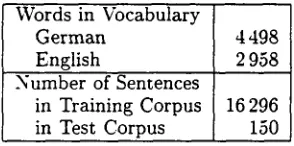
The Verbmobil Corpus consists of spontaneously spoken dialogs in the domain of appointment sche- duling (Wahlster, 1993). German source sentences are translated into English. In Table 1 the character- istics of the training and test sets are summarized. The vocabularies include category labels for dates, proper names, numbers, times, names of places and spellings. The model parameters were trained on 16 296 sentence pairs, where names etc. had been replaced by the appropriate labels.
Table 1: Training and test conditions of the Verb- mobil task.
formed sample translations (i.e. after labelling) was 13.8.
In preliminary evaluations, optimal values for the thresholds
OL
andOT
had been determined and kept fixed during the experiments.As an automatic and easy-to-use measure of the translation performance, the Levenshtein distance between the produced translations and the sample translations was calculated. The translation results are summarized in Table 2.
Table 2: Word error rates on the Verbmobil Corpus: insertions (INS), deletions (DEL) and total rate of word errors (WER) before (BL) and after (AL) rule-based translation of the labels.
before / after Error Rates (%)
INS DEL WER
BL 7.3 18.4 45.0
AL 7.6 17.3 39.6
Words in Vocabulary
German 4 498
English 2 958
Number of Sentences
in Training Corpus 16 296 in Test Corpus 150
Given the vocabulary sizes, it becomes quite ob- vious that the lexicon probabilities
p(f[e)
can not be trained sufficiently on only 16 296 sentence pairs. The fact that about 40% of the words in the lexicon are seen only once in training illustrates this. To im- prove the lexicon probabilities, we interpolated them with lexicon probabilitiespM(fle)
manually created from a German-English dictionary:{'o
~ if(e, f)
is in the dictionarypM(fle)
_ otherwise 'where Ne is the number of German words listed as translations of the English word e. The two lexica were combined by linear interpolation with the in- terpolation parameter A. For our first experiments, we set A to 0.5.
The test corpus consisted of 150 sentences, for which sample translations exist. The labels were translated separately: First, the test sentences were preprocessed in order to replace words or groups of words by the correct category label. Then, our search algorithm translated the transformed sen- tences. In the last step, a simple rule-based algo- rithm replaced the category labels by the transla- tions of the original words.
We used a bigram language model for the Eng- lish language. Its perplexity on the corpus of trans-
(Tillmann et al., 1997a) report a word error rate of 51.8% on similar data.
Although the Levenshtein distance has the great advantage to be automatically computable, we have to keep in mind, that it depends fundamentally on the choice of the sample translation. For example, each of the expressions "thanks", "thank you" and "thank you very much" is a legitimate translation of the German "danke schSn", but when calculating the Levenshtein distance to a sample translation, at least two of them will produce word errors. The more words the vocabulary contains, the more im- portant will be the problem of synonyms.
This is why we also asked five experts to classify independently the produced translations into three categories, being the same as in (Wang and Waibel, 1997):
Correct translations
are grammatical and convey the same meaning as the input.Acceptable translations
convey the same meaning but with small grammatical mistakes or they convey most but not the entire meaning of the input.Incorrect translations
are ungrammatical or con- vey little meaningful information or the information is different from the input.Examples for each category are given in Table 3. Table 4 shows the statistics of the translation performance. When different judgements existed for one sentence, the majority vote was accepted. For the calculation of the subjective sentence error rate (SSER), translations from the second category counted as "half-correct".
[image:5.612.346.520.235.284.2] [image:5.612.117.264.297.370.2]Table 3: Examples of Correct (C), Acceptable (A), and Incorrect (I) translations on Verbmobil. The source language is German and the target language is English.
C
Input: Output: Input: Output:
Ah neunter M/irz bin ich in KSln. I am in Cologne on the ninth of March. Habe ich mir notiert.
I have noted that.
A
Input: Output: Input:
Output:
Samstag und Februar sind g u t , aber der siebzehnte w~ire besser. Saturday and February are quite but better the seventeenth.
Ich kSnnte erst eigentlich jetzt wieder dann November vorschlagen. Ab zweiten November.
I could actually coming back November then. Suggest beginning the second of November. Input:
Output:
Ja, also mit Dienstag und mittwochs und so h/itte ich Zeit, aber Montag kommen wir hier nicht weg aus Kiel.
Yes, and including on Tuesday and Wednesday as well, I have time on Monday but we will come to be away from Kiel.
Input: Dann fahren wir da los. Output: We go out.
Table 4: Subjective evaluation of the translation performance on Verbmobil: number of sentences evaluated as Correct (C), Acceptable (A) or In- correct (I). For the total percentage of non-correct translations (SSER), the "acceptable" translations are counted as half-errors.
I Total Correct Acceptable Incorrect SSER I
150 61 45 44 44.3%
from search errors, occuring whenever the search algorithm misses a translation hypothesis with a higher score. Unfortunately, we can never be sure that a search error does not occur, because we do not know whether or not there is another string with an even higher score than the produced output.
Nevertheless, it is quite interesting to compare the score of the algorithm's output and the score of the sample translation in such cases in which the out- put is not correct (it is classified as "acceptable" or
"incorrect" ).
The original value to be maximized by the search algorithm (see Eq. (6)) is the score as defined by the underlying models and described by Eq. (13).
J
Pr(e~).p(JII) H max ~(ilj , J, I). p(fjlei)] • (13)
j=l ie[1,1]
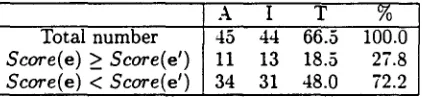
We calculated this score for the sample trans- lations as well as for the automatically generated translations. Table 5 shows the result of the com- parison. In most cases, the incorrect outputs have higher scores than the sample translations, which
leads to the conclusion that the improvement of the models (stronger language model for the target lan- guage, better translation model and especially more training data) will have a strong impact on the qual- ity of the produced translations. The other cases, i. e. those in which the models prefer the sample trans- lations to the produced output, might be due to the difference of the original search criterion (6) and the criterion (9), which is the basis of our search algo- rithm. The approximation made by the introduction of the parameters OT and OL is an additional reason for search errors.
Table 5: Comparison: Score of Reference Transla- tion e and Translator Output e ~ for "acceptable" translations (A) and "incorrect" translations (I). For the total number of non-correct translations (T), the "acceptable" translations are counted as half-errors.
A I T %
Total number 45 44 66.5 100.0
Score(e) >_ Score(C) 11 13 18.5 27.8
Score(e) < Score(C) 34 31 48.0 72.2
[image:6.612.72.536.93.273.2] [image:6.612.319.530.528.577.2]parable to our test data in terms of vocabulary sizes, domain and number of test sentences. The authors report a subjective sentence error rate which is in the same range as ours. An exact comparison is only possible if exactly the same training and test- ing data are used and if all the details of the search algorithms are considered.
4 C o n c l u s i o n a n d F u t u r e W o r k
In this paper, we have presented a new search al-
gorithm for statistical machine translation. First
experiments prove its applicability to realistic and complex tasks such as spontaneously spoken dialogs. Several improvements to our algorithm are plan- ned, the most important one being the implementa- tion of pruning methods (Ney et al., 1992). Pruning methods have already been used successfully in ma- chine translation (Tillmann et al., 1997a). The first question to be answered in this context is how to make two different hypotheses H1 and/-/2 compara-
ble: Even if they cover the same
number
of sourcestring words, they might cover
different
words, es-pecially words that are not equally difficult to trans- late, which corresponds to higher or lower transla- tion probability estimates. To cope with this prob- lem, we will introduce a heuristic for the estimation of the cost of translating the remaining source words. This is similar to the heuristics in A'-search.
(Vogel et al., 1996) report better perplexity re- sults on the Verbmobil Corpus with their HMM-
based alignment model in comparison to
Model 2
of (Brown et al., 1993). For such a model, however, the new interpretation of the alignments becomes essential: We cannot adopt the estimates for the
alignment probabilities
p(ili', I).
Instead, we haveto re-calculate them as inverted alignments. This
will provide estimates for the probabilities
P(JlJ', J).
The most important advantage of the HMM-based alignment models for our approach is the fact, that they do not depend on the unknown target string length I.
A c k n o w l e d g e m e n t . This work was partly sup- ported by the German Federal Ministry of Educa- tion, Science, Research and Technology under the Contract Number 01 IV 601 A (Verbmobil).
R e f e r e n c e s
J. C. Amengual, J. M. Benedi, A. Castafio, A. Mar- zal, F. Prat, E. Vidal, J. M. Vilar, C. Delogu, A. di Carlo, H. Ney, and S. Vogel. 1996. Example- Based Understanding and Translation Systems (EuTrans): Final Report, Part I. Deliverable of ESPRIT project No. 20268, October.
A.L. Berger, P.F. Brown, J. Cocke, S.A. Della Pietra, V.J. Della Pietra, J.R. Gillett, J.D. Laf- ferty, R.L. Mercer, H. Printz, and L. Ures. 1994. The Candide System for Machine Translation. In
Proc. ARPA Human Language Technology Work-
shop, Plainsboro, N J,
pages 152-157. Morgan Kanfmann Publ., March.P.F. Brown, S.A. Della Pietra, V.J. Della Pietra, and R.L. Mercer. 1993. Mathematics of Statisti- cal Machine Translation: Parameter Estimation.
Computational Linguistics,
19(2):263-311. I. Dagan, K. W. Church, and W. A. Gale. 1993.Robust Bilingual Word Alignment for Machine
Aided Translation. In
Proceedings of the Work-
shop on Very Large Corpora, Columbus, Ohio,
pages 1-8.
P. Fung and K.W. Church. 1994. K-vet: A new Ap-
proach for Aligning Parallel Texts. In
Proceedings
of the 15th International Conference on Compu-
tational Linguistics, Kyoto, Japan,
pages 1096- 1102.M. Kay and M. RSscheisen. 1993. Text-Trans-
lation Alignment.
Computational Linguistics,
19(1):121-142.
H. Ney, D. Mergel, A. Noll, and A. Paeseler. 1992. Data Driven Search Organization for Continuous
Speech Recognition.
IEEE Transactions on Sig-
nal Processing,
40(2):272-281, February.C. Tillmann, S. Vogel, H. Ney, H. Sawaf, and A. Zu- biaga. 1997a. Accelerated DP based Search for
Statistical Translation. In
Proceedings of the 5th
European Conference on Speech Communication
and Technology, Rhodes, Greece,
pages 2667-2670, September.C. Tillmann, S. Vogel, H. Ney, and A. Zubia- ga. 1997b. A DP-Based Search using Monotone
Alignments in Statistical Translation. In
Proceed-
ings of the ACL/EACL '97, Madrid, Spain,
pages 289-296, July.S. Vogel, H. Ney, and C. Tillmann. 1996. HMM- Based Word Alignment in Statistical Translation. In
Proceedings of the 16th International Confer-
ence on Computational Linguistics, Copenhagen,
Denmark,
pages 836-841, August.W. Wahlster. 1993. Verbmobih Translation of Face-
to-Face Dialogs. In
Proceedings of the M T Sum-
mit IV,
pages 127-135, Kobe, Japan.Ye-Yi Wang and A. Waibel. 1997. Decoding Algo-
rithm in Statistical Translation. In
Proceedings of
the ACL/EACL '97, Madrid, Spain,
pages 366- 372, July.D. Wu. 1996. A Polynomial-Time Algorithm for
Statistical Machine Translation. In
Proceedings
of the 34th Annual Conference of the Association
for Computational Linguistics, Santa Cruz, CA,
Z u s a m m e n f a s s u n g
Wir stellen einen neuartigen..Suchalgorithmus flit die statistische maschinelle Ubersetzung vor, der auf der dynamischen Programmierung (DP) beruht. W~ihrend des Suchprozesses werden.zwei statistische Wissensquellen kombiniert: Ein Ubersetzungsmo- dell und ein Bigramm-Sprachmodell. Dieser Such- algorithmus erweitert Hypothesen entlang den Posi- tionen des Zielsatzes, wobei garantiert wird, dab alle WSrter im Quellsatz berficksichtigt werden. Es wer- den experimentelle Ergebnisse auf der Verbmobil- Aufgabe angegeben.
R d s u m d
Nous prdsentons un nouveau algorithme de recherche pour la traduction automatiquestatistique qui est basde sur la programmation dynamique (DP). Pen- dant la recherche deux sources d'information statis- tiques sont combindes: Un module de traduction et un bigram language model. Cet algorithme de recherche construit des hypotheses le long des po- sitions de la phrase en langue de cible tout en garantissant la considdration progressive des mots dans la phrase en langue de source. Des rdsultats expdrimentaux sur la t~che Verbmobil sont prdsen-