SlinkET:
A Partial Modal Parser for Events
Roser Saur´ı, Marc Verhagen, James Pustejovsky
Lab for Linguistics and Computation Computer Science Department
Brandeis University
{roser,marc,jamesp}@cs.brandeis.edu
Abstract
We present SlinkET, a parser for identifying contexts of event modality in text developed within the TARSQI (Temporal Awareness and Reasoning Systems for Question Interpretation) research framework. SlinkET is grounded on TimeML, a specification language for capturing temporal and event related information in discourse, which provides an adequate foundation to handle event modality. SlinkET builds on top of a robust event recognizer, and provides each relevant event with a value that specifies the degree of certainty about its factuality; e.g., whether it has happened or holds (factive or counter-factive), whether it is being reported or witnessed by somebody else (evidential), or if it is introduced as a possibility (modal). It is based on well-established technology in the field (namely, finite-state techniques), and informed with corpus-induced knowledge that relies on basic information, such as morphological features, POS, and chunking. SlinkET is under continuing development and it currently achieves a performance ratio of 70% F1-measure.
1.
Introduction
Event recognition is at the core of diverse areas in NLP, from highly domain-oriented disciplines, such as bioin-formatics, to more topic and genre-oriented applications, like Question Answering. Recognizing events in these fields is generally accomplished by identifying predefined lists of relations or event types, possibly structured into an ontology (Brill et al., 2002; Soubbotin and Soubbotin, 2002), a strategy which makes the task feasible but domain-dependent. In Information Extraction, the most represen-tative work on event recognition is the Scenario Template task of the different Message Understanding Conference competitions (Grishman and Sundheim, 1996). Within this framework as well, event identification was restricted to specific domains relying on preestablished event templates. A main drawback of such an approach to the task is that it is not sensitive to modality, the linguistic level express-ing whether the represented events are assumed as havexpress-ing happened, or whether their factuality status is uncertain. Modality is a fundamental piece of information for subse-quent reasoning about events in discourse. The inferences that can be drawn from events introduced as holding are of a different nature than those derivable from events mentioned in a text but which have not happened, or about which we do not have enough knowledge. Consider:
(1) Putin replied that Chernomyrdin helpedto settle the problemof Ukraine’s debt to Russia.
(2) During the campaign Fox promisedto settle the Zap-atista problem, peacefully and politically, ”in 15 min-utes”.
In (1), the verbhelpin the past tense establishes a presuppo-sition that the problem of Ukraine’s debt has already been settled. This, however, is not the case of the event charac-terized as the settling of the Zapatista problem in (2), which is used in an intensional context created bypromised.
A more sophisticated approach sensitive to event modal-ity would benefit NLP tasks which require some degree of text understanding, such as QA or Narrative Understand-ing. This is supported by the impressive scores obtained in the previous TREC competitions by a system attempting a minimal interpretation of text, in contrast to more surface-based approaches (Voorhees, 2002; Voorhees, 2003). As a matter of fact, there is growing interest on event modal-ity as a necessary information component in both domain-oriented disciplines such as bioinformatics, e.g., (Light et al., 2004), and genre-based applications like Question An-swering. For example, some of the systems that partic-ipated in the Knowledge-based Inference Pilot organized within the ARDA AQUAINT program during last summer, attempted to handle modality information to some extent.1
2.
Linguistic Settings
2.1. Event ModalityEvents in discourse can be couched in terms of a veridi-cality axis that ranges from truly factual to counter-factual, passing through a whole spectrum of different modality shades, including:
(3) a. Degrees of possibility: These results indicate that Pb2+mayinhibit neurite initiation by inappropri-ately stimulating protein phosphorylation by CaM kinase.
b. Belief: Chinese analysts believe that the United States will continue to provoke North Korea.
c. Evidentiality: Subcomandante Marcos said that the Mexican government is not interested in putting an end to the conflict.
d. Expectation:Hans Blixwantsthe US to allow UN inspectors back into Iraq to verify any weapons found by coalition forces.
1
!
"$#&% (')+*
,.-0/ 132546/8789)1;:<,.9=132&: 1> [email protected] D5,6-89)1HGI1D5,69J/KA 132 ,.C3C 9LE&-0/K/ ,69)9J,GKMN7
"PO QR
Figure 1: SlinkET processing
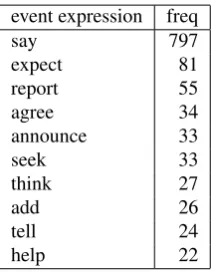
Bank (Pustejovsky et al., 2003b)3 as well as standard lin-guistic classifications of such predicates; e.g., (Kiparsky and Kiparsky, 1970; Karttunen, 1970; Karttunen, 1971; Hooper, 1975) and subsequent elaborations of that work. Table 1 gives the 10 most frequent SLINK-triggering event expression in TimeBank1.2.
event expression freq
say 797
expect 81
report 55
agree 34
announce 33
seek 33
think 27
add 26
tell 24
help 22
Table 1: SLINK-triggering events in TimeBank1.2
Next, a finite-state syntactic module identifies the sub-ordinated event in the clause based on the subcatego-rization properties of the subordinating event. Such subcategorization information has been derived largely from corpus analytics as well, and subsequently com-piled into normalized dictionary entries. For each event, the dictionary specifies its possible subordinating contexts and its SLINK types (factive, counter factive, evidential, neg evidential, ormodal). This is critical for disambiguating the modal force of such pred-icates. For example, investigateintroduces an SLINK of typemodalwhen subordinating anif/whether-clause (8), but an SLINK of typefactivewhen subcategorizing for an event-denoting NP (9):
(8) Officials are investigating whether Rudolph partici-patedin all three attacks.
(9) Officials are investigating all threeattacks.
3TimeBank can be browsed at
http://www.timeml.org/site/-timebank/browser 1.2/
Syntactic patterns can be applied forward (from the located SLINK-triggering event to its right, as in (8-9)), or back-wards (to its left), as in (10).
(10) This activity resulted in a dischargeto state waters, which was investigated by John Klauzenberg.
A simplified version of the lexical entry forinvestigateis as shown in Figure 2, where each possible syntactic structure for the complement is associated to one SLINK type:
"investigate":{
forward:{
(thatClause if, MODAL),
(indirectInterrog, FACTIVE),
(NP event, FACTIVE)},
backwards:{
(relClause, FACTIVE)}}
Figure 2: Lexical entry forinvestigate
The syntactic patterns referred to in the lexical entries are expressed using the standard syntax of regular expressions. They are then compiled into finite state automata that work with grammatical objects instead of characters. Figure 3 illustrates the syntactic patternNP event, describing NPs headed by an event-denoting noun.
NP event = [
token PREDET?
token DETERMINER?
(token ADJ|chunk Particip|token SYM)* token NUMBER*
chunk EVENT nominal ]
Figure 3: Syntactic pattern for event-denoting NPs
Figure 4: SlinkET output
1. POS tag.
2. Chunking structure.
3. Sentence boundaries.
4. Event tags obtained from EvITA. SlinkET only oper-ates on expressions that have been recognized as refer-ring to an event.
5. Finite vs. non-finite morphology. Such information is obtained from EvITA, but can be derived from the preprocessing step as well.
6. Lexical form of the subordinating expression.
7. Subordinating predicate class (e.g., reporting, eviden-tial, or intensional), as obtained from EvITA.
SlinkET uses that knowledge for identifying and wrapping the subordinated event with the appropriate modal informa-tion, as illustrated in Figure 1.
4.3. SlinkET Output
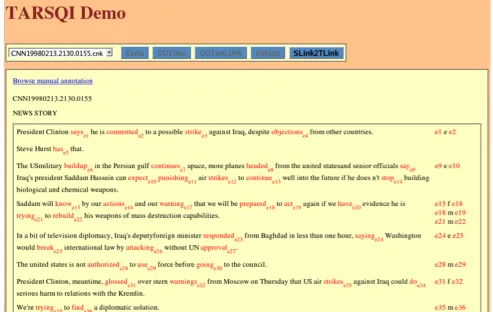
Currently, SlinkET is embedded in the TARSQI suite of tools devoted to the identification of event and temporal in-formation in real text. Figure 4 offers a screenshot of the relevant output from our TARSQI application. Event ex-pressions there are marked in red, and the SLINKs are an-notated at the right hand side of the text as relations between event IDs (wheremstands for SLINKs ofmodaltype, e forevidential, andfforfactive).
5.
Current Status and Results
SlinkET aims at introducing SLINKs from two different sources: either triggered by the presence of a specific lex-ical item (namely, an SSP), or based on the syntax, in the case of purpose clauses and conditional constructions. The part devoted to syntactically-based SLINKs is still un-der development. Yet, SlinkET already identifies purpose clauses triggered by verbs with a strong tendency to be modified by such structures, such asaddress:
(11) The President addressed the nation to announce a new election.
SlinkET dictionary contains 225 lexical forms, distributed among the different event-denoting POS categories in the following way: 150 verbs, 68 nouns, and 7 adjectives. On the other hand, there are over 40 syntactic patterns com-piled into FSAs, which cover: infinitival andthatclauses, gerundive clauses and event-referring NPs, both of which may be preceded by a specific preposition depending on the subordinating verb, relative clauses, and finally, a subset of passive structures.
6.
Acknowledgements
This work was supported by the grant number
NBCHC040027-MOD-0003 of the AQUAINT
pro-gram sponsored by ARDA, a U.S. Government entity sponsoring research to the Intelligence Community which includes but is not limited to the CIA, DIA, NSA, NIMA, and NRO.
7.
References
S. Bergler. 1992. Evidential Analysis or Reported Speech. Ph.D. thesis, Brandeis University.
E. Brill, S. Dumais, and M. Banko. 2002. An analysis of the askmsr question answering system. InProceedings of EMNLP 2002.
F. de Haan. 1999. Evidentiality and epistemic modality: Setting boundaries. Southwest Journal or Linguistics, 18:83–101.
F. de Hann. 2000. The relation between modality and ev-identiality. In R. M¨uller and M. Reis, editors,Modalit¨at und Modalverben im Deutschen. Helmut Buske Verlag, Hamburg, Sonderheft 2000.
E. Filatova and V. Hatzivassiloglou. 2003. Domain-independent detection, extraction, and labeling of atomic events. InProceedings of RANLP 2003.
R. Grishman and B. Sundheim. 1996. Message under-standing conference - 6: A brief history. InProceedings of COLING 1996, volume 1.
J. B. Hooper. 1975. On assertive predicates. In John Kim-ball, editor, Syntax and semantics, IV, pages 91–124. Academic Press, New York.
L. Karttunen. 1970. Implicative verbs. InLanguage, pages 340–358.
L. Karttunen. 1971. Some observations on factivity. In Pa-pers in Linguistics, pages 55–69.
P. Kiparsky and C. Kiparsky. 1970. Fact. In Manfred Bier-wisch and Karl Erich Heidolph, editors,Progress in Lin-guistics. A Collection of Papers, pages 143–173. Mou-ton, The Hague, Paris.
M. Light, X. Y. Qiu, and P. Srinivasan. 2004. The language of bioscience: Facts, speculations, and statements in be-tween. InBioLINK 2004: Linking Biological Literature, Ontologies, and Databases, pages 17–24.
I. Mani and B. Schiffman. forthcoming. Temporally an-choring and ordering events in news. In James Puste-jovsky and Rob Gaizauskas, editors, Event Recognition in Natural Language. John Benjamins.
I. Mani. 2005. Time expression tagger and nor-malizer. http://complingone.georgetown.edu/ lin-guist/GU TIME DOWNLOAD.HTML.
F. R. Palmer. 1986. Mood and Modality. Cambridge Uni-versity Press, Cambridge.
J. Pustejovsky, J. Casta no, R. Ingria, R. Saur´ı, R. Gaizauskas, A. Setzer, and G. Katz. 2003a. Timeml: Robust specification of event and temporal expressions in text. In IWCS-5, Fifth International Workshop on Computational Semantics.
J. Pustejovsky, P. Hanks, R. Saur´ı, A. See, R. Gaizauskas, A. Setzer, D. Radev, B. Sundheim, D. Day, L. Ferro, and
M. Lazo. 2003b. The timebank corpus. InProceedings of Corpus Linguistics 2003, pages 647–656.
J. Pustejovsky, B. Knippen, J. Littman, and R. Saur´ı. 2005. Temporal and event information in natural language text. Language Resources and Evaluation, 39(2-3):123–164. R. Saur´ı, R. Knippen, M. Verhagen, and J. Pustejovsky.
2005. Evita: A robust event recognizer for qa systems. InProceedings of the HLT/EMNLP 2005.
M. M. Soubbotin and S. M. Soubbotin. 2002. Use of pat-terns for detection of answer strings: A systematic ap-proach. InProceedings of TREC-11, pages 134–143. M. Verhagen, I. Mani, R. Saur´ı, R. Knippen, J. Littman, and
J. Pustejovsky. 2005. Automating temporal annotation with tarsqi. InProceedings of the ACL 2005.
E. M. Voorhees. 2002. Overview of the trec 2002 question answering track. InProceedings of the Eleventh Text RE-trieval Conference, TREC 2002.