Semi-Supervised Never-Ending Learning in Rhetorical Relation
Identification
Erick G. Maziero1,2, Graeme Hirst1
1Department of Computer Science University of Toronto Toronto, ON, M5S 3G4, Canada
erick,[email protected]
Thiago A. S. Pardo2
2Department of Computer Science University of S˜ao Paulo S˜ao Carlos, SP, 13566-590, Brazil
Abstract
Some languages do not have enough la-beled data to obtain good discourse pars-ing, specially in the relation identification step, and the additional use of unlabeled data is a plausible solution. A workflow is presented that uses a semi-supervised learning approach. Instead of only a pre-defined additional set of unlabeled data, texts obtained from the web are continu-ously added. This obtains near human per-fomance (0.79) in intra sentential rhetori-cal relation identification. An experiment for English also shows improvement using a similar workflow.
1 Introduction
A text is composed of coherent propositions (phrases and sentences, for example) ordered and connected according to the intentions of the au-thor of the text. This composition may be recog-nized and structured according to many theories and this type of information is valuable to many natural language processing applications. A pro-cess to recognize, automatically, the coherent or discursive (or also rhetorical) structure of a text is named discourse parsing (DP).
The most prominent theory in Computational Linguistics to structure the discourse of a text is the Rhetorical Structure Theory (RST) proposed by Mann and Thompson (1987). In this theory, the text is segmented into elementary discourse units (EDUs), which each contain a proposition (basic idea) of the text. The theory proposes a set of rhetorical relations that may hold between
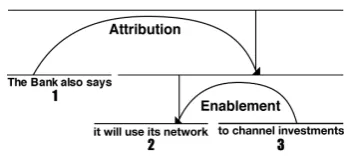
Figure 1: An example of sentence-level struc-ture according to RST. From Soricut and Marcu (2003).
the EDUs, explicating the intentions of the author. For example, consider the sentence in Figure 1. It is segmented into three EDUs, numbered from 1 to 3. EDUs 2 and 3 are related by the relation
Enablement, forming a new span of text, which is related to 1 by the relationAttribution. In each re-lation, EDUs can be Nucleus(more essential) or
Satelliteto the writer’s purpose.
Many approaches have been used in DP, the majority of them using machine learning algo-rithms, such as probabilistic models (Soricut and Marcu, 2003), SVMs (Reitter, 2003; duVerle and Prendinger, 2009; Hernault et al., 2010; Feng and Hirst, 2012) and dynamic conditional random field (Joty et al., 2012). To obtain acceptable results, these approaches need plenty of labeled data. But even more than other levels of linguistic informa-tion, such as morphology or syntax, the annotation of discourse is an expensive task. Given this fact, what can we do when there is not enough data to perform effective learning of DP, as in languages with little annotated data?
This paper describes a methodology to over-come the problem of insufficient labeled data in the task of identifying rhetorical relations between
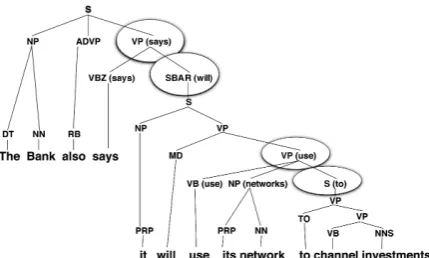
Figure 2: Lexicalized syntactic tree used by SPADE. The circles indicate the node used as the most indicative information to identify the rhetor-ical relation and structure.
EDUs, which is the most important step during DP. The language used in our work is Portuguese and two well-known systems of DP for English were adapted to this language. Portuguese is a lan-guage with insufficient annotated data to obtain a good discourse parser, but has all the tools to adapt some English discourse parsers. A framework of semi-supervised never-ending learning (SSNEL) (see Section 2.2 below) was created and evaluated with the adapted models. The results show that this approach improved the results to achieve near-human perfomance, even with the use of automatic tools (syntax parser and discourse segmenter).
2 Related Work
2.1 Supervised Discourse Parsing
Soricut and Marcu (2003) use two probabilistic models to perform a sentence-level analysis, one for segmentation and other to identify the rela-tions and build the rhetorical structure. The parser is named SPADE (Sentence-level Parsing of Dis-coursE) and the authors base their model on lex-ical and syntactic information, extracting features from a lexicalized syntactic tree. They assume that the features extracted at the jointing point of two discursive segments are the most indicative infor-mation to identify the rhetorical structure of the sentence. For example, in Figure 2, the circled nodes correspond to the most indicative cues to identify the structure and relation between each two adjacent segments.
The authors report a F-measure of 0.49 in a set of 18 RST relations. The human performance in this same task is 0.77 (measured by
inter-annotation agreement). The authors, then, use the probabilistic model with manual segmentation and syntactic trees to see the impact of this information in the parsing and the model achieves 0.75.
Hernault et al. (2010) use support vector ma-chine (SVM) classifiers to perform DP. This dis-course parser is named HILDA (HIgh-Level Dis-course Analyser). This work used a set of 41 rhetorical relations and achieves a F-measure of 0.48 in the step of relation identification, both intra-sentential and inter-sentential.
Feng and Hirst (2012) improve HILDA by incorporating new proposed features and some adapted from Lin et al. (2009). Another impor-tant decision was the specification of features for intra-sentential and inter-sentential relationships and the use of contextual features in the building of the rhetorical tree. Considering the approach to intra-sentential relation identification, with 18 RST relations this work achieves a macro aver-age measure of 0.49 and weighted averaver-age F-measure of 0.77 in relation identification.
Joty et al. (2012) use a joint modelling ap-proach to identify the structure and the relations at the sentence-level using DCRFs (dynamic condi-tional random fields) and a non-greedy bottom-up method in the construction of the rhetorical struc-ture. The features used in this work were similar to those used by HILDA. They achieve a F-measure of 0.77, using manual segmentation, and 0.65 us-ing automatic segmentation.
2.2 Semi-supervised Discourse Parsing
All the above cited approaches to DP use anno-tated data to extract discursive knowledge and are limited to the availability of this resource, which is expensive to obtain. Specially, it is important to note that, to obtain good performance in the task more data is necessary. Semi-supervised learning (SSL) is employed in scenarios in which there is some labeled data and large availability of unla-beled data, and manual annotation is an expensive task (Zhu, 2008).
Related to the use of SSL in DP, Marcu and Echihabi (2002) used naive Bayes to train binary classifiers to distinguish between some types of relations, asElaborationvs. Cause-Explanation-Evidence. For example, for this binary classifier, applying SSL, the accuracy increased from ap-proximately 0.6 to 0.95 after the use of millions of new instances. Chiarcos (2012) used SSL to develop a probabilistic model mapping the occur-rence of discourse markers and verbs to rhetori-cal relations. For Italian, Soria and Ferrari (1998) conducted work in the same direction. Sporleder and Lascarides (2005) performed similar work to Marcu and Echihabi, with similar results for a dif-ferent set of relations and a more sophisticated classifier. Building on this, there is an interest-ing idea, known as never-endinterest-ing learninterest-ing (NEL) by Carlson et al. (2010), in which they apply SSL with infinite unlabeled data. The needed data is widely and freely available on the web. Their ar-chitecture runs 24 hours per day, forever, obtaining new information and performing a learning task.
With the aim of surpassing the limitation of la-beled RST in Portuguese to develop a good DP, we employ SSNEL in the task by adapting the work of Soricut and Marcu (2003) and Hernault et al. (2010). This choice for SSLNEL was made considering the large and free availability of news texts on the web.
3 RST Corpora
RST-DT (RST Discourse TreeBank) (Carlson et al., 2001) is the most widely used corpus an-notated with RST in English. Table 1 compares it with available Portuguese corpora labeled ac-cording to RST (these corpora will be referred to as RST-DT-PT hereafter). The corpora CSTNews (Cardoso et al., 2011), Summ-it (Collovini et al., 2007) and two-thirds of Rhetalho (Pardo and Seno,
Corpus Language Documents Words
RST-DT-PT PT 340 120,847
CSTNews 140 47,240
Rhetalho 50 2,903
Summ-it 50 16,704
CorpusTCC 100 53,000
RST-DT EN 385 176,383
Table 1: Size of the RST-DT-PT and its compo-nents, and of the RST-DT.
2005) are composed of news texts, and the cor-pus Corcor-pusTCC (Pardo and Nunes, 2004) and the reminder of Rhetalho are composed of scientific texts. The RST-DT contains more documents (45) and many more words (55,536) than RST-DT-PT.
This work focuses on the identification of rhetorical relations at the sentence level, and as is common since the work of Soricut and Marcu (2003), fine-grained relations were grouped: 29 sentence-level rhetorical relations were found and grouped into 16 groups. The imbalance of the re-lations is a natural characteristic in discourse and, to avoid overfitting of a learning model on the less-frequent relations, no balancing was made. The re-lationSummary, for example, occurs only 2 times, andElaborationoccurs 1491 times, making very difficult the identification of theSummaryrelation.
4 Adapted Models
Syntactic information is crucial in SPADE (Sori-cut and Marcu, 2003) and for Portuguese the parser most similar to that used by Soricut and Marcu is the LX-parser (Stanford parser trained to Portuguese (Silva et al., 2010)). After the pars-ing of the text by the syntactic parser, the same lexicalization procedure (Magerman, 1995) was applied and adapted according to the tagset used by LX-parser. In this adaptation, only pairs of adjacent segments at sentence-level were consid-ered, and nuclearity was not considconsid-ered, in or-der to avoid sparseness in the data. Training the adapted model (here called SPADE-PT) using the RST-DT-PT achieved F-measure of 0.30. The pre-cision was 0.69, but the recall was only 0.19.
J48, an implementation of decision trees (Quinlan, 1993). The RST-DT-PT corpora was used and the adaptation (here called of HILDA-PT) achieved an F-measure of 0.548, which is much better than that of SPADE-PT. A possible explanation is that the feature set in SPADE is composed only of syntactic tags and words. The resulting proba-bilistic model is sparse and many equal instances may indicate different relations (classes). How-ever HILDA adds more features over which the classifier can work better, even when some values are absent.
Given the results of the adapted models, HILDA-PT was chosen to be incorporated into the SSNEL, explicated below.
5 Semi-supervised Never-ending Learning Workflow
Here, an adaptation of Carlson et al. (2010) self-training algorithm was used. Two different ap-proaches to relation identification are used, that is to say, a lexical pattern set LPS (the relation identification module of DiZer), and a multi-class classifierCgenerated according to some machine learning algorithm. All the new instances obtained from the lexical module are used together with the more confident classifications ofCto retrain this last. For each classification, J48 returns a con-fidence value used to choose the most confident classifications.
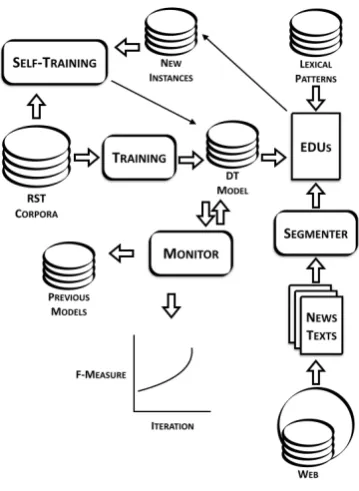
Also, there is interest in observing the be-haviour of the classifier in each iteration of the semi-supervision, searching for the best F-measure it may achieve. In this way, a workflow of never-ending learning (NEL) was proposed and is presented in Figure 3. Workflow 1 is presented as an alternative visualization to the illustration in Figure 3. Continuously, a crawler gets pages from online news on the web and performs cleaning to obtain the main text (Text). In a first iteration, a Segmenter (Maziero et al., 2007) is applied to obtain the EDUs in each sentence and, for each pair of adjacent EDUs (PairEDUs), theC1classifier (C1initially trained with theLabeledData1from the RST-DT-PT) and the lexical pattern set LPS are used to identify the relations between the segments. To retrain
C1, all the new instances from the lexical pattern set LabeledDataLPS (as LPS does not provide a confidence value, all the labelled instances are
Data:LabeledData1andText
train a classifierC1usingLabeledData1
whileexist some Textdo
get oneTextfromNewsTexts
applySegmenteronTextto obtainPairEDUs Index←1
forall thePairEDUsdo
applyLPSto obtainLabeledDataLPS
applyCIndexto obtainLabeledDataC forall theLabeledDataC as newInstanceCdo
ifconfidence of newInstanceC≥0.7then LabeledDataCCon fident←
newInstance end
end
LabeledDataIndex+1←
LabeledDataLPS+
LabeledDataCCon fident
train a new classifierCIndex+1
usingLabeledDataIndex+1 applyMonitorand obtain
FmCIndex+1
plotFmCIndex+1in the graphGif
FmCindex+1<FmCIndexthen
discardCIndex+1 CIndex+1←CIndex
end end end
Workflow 1:Workflow of the SSNEL using two models to identify rhetorical relations between eachPairEDUs.
used in the semi-supervision) and the classifi-cations LabeledDataC with confidence greater than 0.7 by C1 are joined with LabeledData1 to obtain LabeledData2 (LabeledData2 =
LabeledDataLPS+LabeledDataC). After the retraining, aMonitor verifies the new F-measure of C2 (FmC2, obtained using 10-fold cross val-idation) and, if it decreased compared with the F-measure ofC1 (FmC1),C2is discarded and, for the next iteration,C1 will continue to be used. If
FmC1 did not decrease, C2 will be used in the next iteration. Monitor also plots a graph G to present the behaviour of FmC during SSNEL. This process continues iteratively.
Figure 3: SSNEL workflow.
classifiers, instead of separating the data into three sets (training, development, and test). The total number of instances was 6163 and some relations, such asRestatementwith 28 instances, would have few relations when split into three sets.
During the semi-supervision of SPADE-PT, the model of relation identification was incrementally obtained at each iteration, since the addition of a new instance only modifies the probabilities of the instances already present in the model. If the instance is new, it is added to the model and the probabilities are adjusted. However, in the semi-supervision of the HILDA-PT, the algorithm J48 does not allow incremental learning. There are some implementations of incremental decision trees, but the resulting models are not as accurate as J48 because they work with an incomplete set of training instances. As we want the best F-measure for relation identification, the algorithm J48 was employed, even though it is not an incremental learning.
Another important decision is to monitor the concept-drift (CD) (Klinkenberg, 2004) during the SSNEL, given that a concept may change over time. In this work, CD refers to different sources and topics to which the classifier is applied. To treat CD, the algorithm may detect the evolution of the concept and be able to modify the model to accommodate the concept, avoiding the decrease
Method InitialF-measureFinal Instances
DiZer 0.22 -
-Elaboration Relation 0.26 -
-SPADE-PT 0.30 0.34 1,592
HILDA-PT 0.55 0.79 21,740
Table 2: Comparison of results considering the two adapted models (SPADE-PT and HILDA-PT) with two baselines (Elaboration Relation and DiZer).
in the performance of the model being generated. One technique to monitor the CD is statistical process control (SPC) (Gama et al., 2004). This technique constantly analyses the error during the learning: if the F-measure drops, it may indicate some changes in the concept and the model needs to be modified. In the SSNEL workflow, this is treated by the Monitor, which discards new in-stances used to retrain the model if its F-measure decreases, ensuring that the learned model always acquires correct new learning.
6 Experiments
Considering Workflow 1, the two adapted models were instantiated asC, and many iterations were executed. After 1,640 iterations and the addition of 1,592 new training instances, the F-measure of SPADE-PT increased only 0.05. HILDA-PT, af-ter 180 iaf-terations and with the addition of 21,740 new instances, increased 0.24, achieving 0.79 us-ing automatic segmentation. Table 2 presents a summary of the results. As explained in Section 4, the features used by SPADE-PT lead to a sparse model (when there is not enough initial data), and this is the reason that, during 1,640 iterations, only 1,592 new instances were acquired, compared to the number of iterations and new instances during the experiment with HILDA-PT.
To evaluate the parsers, two baselines were con-sidered. One of them (Elaboration Relation) is the labeling of all the instances with the most frequent relation in the corpus (Elaboration); the second is the use of LPS (DiZer) applied to all PairEDUs
in RST-DT-PT. SPADE-PT, even after many iter-ations in SSNEL, performed lower than the two baselines. HILDA-PT, since even before the use of SSNEL, performed better than the baselines.
The class composed of relationsInterpretation,
exam-ples, initially. After the iterations, its F-measure increased from 0.054 to 0.916. Except for Com-parison and Summary, all the other relations in-creased their F-measures. This reinforces the re-sults obtained by Marcu and Echihabi (2002), which increased (the result of a binary classifier to distinguish between two relations) from 0.6 to 0.95 after the use of millions of new instances. The relation Summary, however, with only 2 labeled instances, continued its zero F-measure.
SSNEL of HILDA-PT was executed for 23 days. Documents used had on average 28 sen-tences and 749 words. The choice of only 10 doc-uments per batch is to have a fine-grained control over the new instances, given that if a new classi-fier decreases the F-measure, it is discarded. Out of 70 generated classifiers were discarded.
As the use of 10-fold cross-validation in the SSNEL may lead to some overfitting on the data which was already classified in the workflow, two other SSNEL experiments were performed, for English and Portuguese, with separated training and test sets. These experiments had less time to run, and, in order to determine whether the im-provements during the SSNEL were statistically significant, paired T-tests were employed to com-pare initial classifier and the best classifier ob-tained during iterations in the workflow. The test shown improvements (at the level p< .1), even though they are low for both experiments. Prob-ably, with many more iterations the results would be better. Table 3 shows the improvements in the accuracy during the SSNEL, the number of itera-tions, and the number of new instances incorpo-rated in the training data. Although a direct com-parison between the experiments is not fair, due to different corpora, the improvements show that this workflow is promising to increase the accuracy of classifiers with unlabeled data.
The experiment with SSNEL for English was realized in order to see the results that could be ob-tained when large annotated corpora are available. In the SSNEL for English, only decision-tree clas-sifiers were used to classify new instances. For Portuguese, a symbolic model (lexical patterns) was also used together with the classifiers.
The improved results presented in Table 2 and 3 are very different due to differing evaluation strategies. Using separated test data, we tried to avoid possible overfitting on training data, but the size of test data may not lead to a fair evaluation
Experiment Initial FinalAccuracy Instances Iterations Portuguese 0.531 0.556 1,247 200
English 0.635 0.645 565 25
Table 3: Results of SSNEL applied to Portuguese and English languages using training and test sets.
of some relations with very few examples. We do not compare our results to those of Soricut and Marcu (2003) or Joty et al. (2012), since HILDA-PT used different corpora (RST-DT-PT instead of RST-DT), and some reported sults are for the complete DP. However, our re-sults show the potential of the SSNEL workflow when not enough labeled data is available for su-pervised learning, since the same approach for re-lation identification of Hernault et al. (2010) was used in HILDA-PT and 0.531 was initially ob-tained. These results constitute the state of art for rhetorical relation identification for Portuguese and it is believed that with more time (iterations in SSNEL), the results may increase.
7 Conclusion
Even though the results obtained in the SSNEL were satisfactory, new features will be added to the HILDA-PT, for example, types of discourse signals, beyond the discourse markers (Taboada and Das, 2013), and the use of semantic informa-tion, as synonymity. Also, given that the number of features will increase, feature selection may be applied to select the most informative features in each iteration of the SSNEL.
Since this work treats only rhetorical relations, without nuclearity, a classifier of nuclearity was trained (with the same features of HILDA-PT) and obtained a F-score of 0.86. As done by Feng and Hirst (2012), a better set of features will be se-lected to identify relations between inter-sentential spans. A procedure similar to tree building used by Feng and Hirst (2012) will be employed in the future DP.
Acknowledgments