Master of Science Thesis
University of Twente
Design and Analysis of Communication Systems
Using NSIS (Next Steps in Signaling) for
support of QoS aware multimedia services
Ruud Klaver
Februari 9, 2007
Committee:
Dr. ir. Georgios Karagiannis (UT/DACS)
Dr. ir. Pieter-Tjerk de Boer (UT/DACS)
Dr. ir. Geert Heijenk (UT/DACS)
List of Abbreviations
API Application Programming Interface
DACS Design and Analysis of Communication Systems
DCCP Datagram Congestion Control Protocol
DiffServ Differentiated Services
DoS Denial of Service
DSCP DiffServ Code Point
ECN Explicit Congestion Notification
EF Expedited Forwarding
FIFO First In First Out
GHC GIST Hop Count
GIST General Internet Signaling Transport
HTB Hierarchical Token Bucket
ICMP Internet Control Message Protocol
IETF Internet Engineering Task Force
IntServ Integrated Services
IP Internet Protocol
ISCL IntServ Controlled Load
LAN Local Area Network
MA Messaging Association
MRI Message Routing Information
MRM Message Routing Method
MTU Maximum Transmission Unit
NAT Network Address Translation
NLI Network Layer Information
NSIS Next Steps In Signaling
NTLP NSIS Transport Layer Protocol
OO Object Oriented
OS Operating System
PHB Per Hop Behaviour
qdisc Queueing Discipline
QNE QoS NSIS Entity
QNI QoS NSIS Initiator
QNR QoS NSIS Receiver
QoSM QoS Model
QoS Quality of Service
QSPEC QoS Specification
RAO Router Alert Options
RFC Request For Comment
RII Request Identification Information
RMD Resource Management in DiffServ
RMF Resource Management Function
RSN Reservation Sequence Number
RSVP Resource ReSerVation Protocol
RTT Round Trip Time
SCTP Stream Control Transmission Protocol
SFQ Stochastic Fairness Queueing
SID Session Identifier
SII Source Identification Information
SLA Service Level Agreement
TCP Transmission Control Protocol
TLS Transport Layer Security
TTL Time To Live
UDP User Datagram Protocol
UML User-Mode Linux
UT University of Twente
VM Virtual Machine
Contents
1. Introduction 8
1.1. Goals . . . 9
1.2. Implementation Requirements . . . 9
1.3. Thesis Structure . . . 10
2. NSIS Overview 11 2.1. NSIS Introduction . . . 11
2.2. NSIS Components . . . 11
2.2.1. NSIS Transport Layer Protocol . . . 12
2.2.1.1. GIST API . . . 13
2.2.1.2. Message Routing Information . . . 16
2.2.1.3. GIST Service Example . . . 17
2.2.1.4. GIST Transmission Modes . . . 18
2.2.1.5. GIST Messages . . . 19
2.2.1.6. GIST Message Exchange Example . . . 22
2.2.1.7. GIST Advanced Features . . . 24
2.2.2. QoS NSIS Signaling Layer Protocol . . . 25
2.2.2.1. QoS-NSLP Components . . . 25
2.2.2.2. QoS-NSLP Message Processing . . . 25
2.2.2.3. QoS-NSLP Example . . . 27
2.2.2.4. QoS-NSLP Layering . . . 29
2.2.3. QoS-NSLP QoS Models . . . 30
2.2.3.1. IntServ Controlled Load QoS Model . . . 30
2.2.3.2. Resource Management in Diffserv QoS Model . . . 31
3. GIST Design and Implementation 36 3.1. Previous Work . . . 36
3.2. Development Environment . . . 38
3.3. High-level Program Structure Overview . . . 39
3.3.1. Threading Model . . . 40
3.4. Network Interaction . . . 41
3.4.1. Query Mode . . . 41
3.4.2. Datagram Mode . . . 42
3.4.3. Connection Mode . . . 42
3.5. Message Processing . . . 42
3.5.2. Message Object Interface . . . 44
3.5.3. Exceptions . . . 45
3.6. State Machines . . . 45
3.6.1. Routing State . . . 46
3.6.1.1. Query Node State Machine . . . 46
3.6.1.2. Responder Node State Machine . . . 47
3.6.2. Message Association State Machine . . . 48
3.7. Program Flow . . . 49
3.7.1. Example Program Flow . . . 50
3.8. Miscellaneous Features . . . 51
3.8.1. Logging . . . 51
3.8.2. ICMP Monitoring . . . 52
3.8.3. Source Identification Information Handle . . . 52
3.8.4. Network Interface Management . . . 53
4. QoS-NSLP Design and Implementation 59 4.1. Previous Work . . . 59
4.2. QoS-NSLP and IntServ Controlled Load QoS Model Implementation . . . 60
4.2.1. Program Structure . . . 61
4.2.2. Message and Exception Processing . . . 63
4.2.3. Application API . . . 63
4.2.3.1. VLC Application API Implementation . . . 66
4.2.4. Linux Traffic Control Subsystem . . . 67
4.3. RMD Linux Traffic Control . . . 68
4.3.1. The REMARKFIFO Queueing Discipline . . . 68
4.3.2. Linux Traffic Control Subsystem . . . 71
5. Functional Experiments 75 5.1. User-Mode Linux Setup . . . 75
5.2. Early Tests . . . 75
5.3. Lab Testing . . . 77
5.3.1. Successful Reservation and Teardown . . . 78
5.3.2. Successful Reservation With NSIS-Unaware Nodes . . . 78
5.3.3. Unsuccessful Reservation . . . 79
5.3.4. Final Demonstration . . . 80
5.4. Interoperability Testing . . . 82
6. Conclusion and Future Work 84 6.1. Conclusions and evaluation . . . 84
6.2. Future Work . . . 85
1. Introduction
Transporting packet based network traffic, such as Internet Protocol [35], has tradi-tionally been a best-effort service. This means that each Internet Protocol (IP) packet receives the same treatment from routers and that any router it passes will process and transmit the packet as fast as possible, depending on the load on the router. However, in a world of IP convergence, demand has risen for different levels of services to be applied to different packets, so-called Quality of Service. In particular real-time streaming traf-fic such as multimedia services place stricter requirements on such parameters as packet loss and jitter. Over the years a number of solutions have emerged to implement QoS in IP networks in various ways, e.g. Integrated Services (IntServ) [21] and Differenti-ated Services (DiffServ) [20]. Each QoS solution defines its own set of service types and means of attributing these different service levels to different IP packets. Most of these QoS systems are based on static reservations within the own domain, used for example for Service Level Agreement (SLA)s. Several protocols, such as Resource ReSerVation Protocol (RSVP) [22], were developed to provide dynamic soft-state end-to-end reserva-tions, i.e. reservations for a flow from a sender to a receiver that may traverse several QoS domains and will expire after a certain period of time if not refreshed. This flow could be for example a Voice over IP (VoIP) session or a on-demand video stream. A conceptual depiction of this can be seen in Figure 1.1.
Figure 1.1.: Diagram of a dynamic reservation for a flow traversing several QoS network domains.
1.1. Goals
The main goal of this assignment is to optimise and expand an existing implementation of NSIS, developed at the Design and Analysis of Communication Systems (DACS) group [42, 44], in such a a manner that multimedia applications may use it to perform dynamic QoS reservations. One of the adaptations that need to be made towards this end is the development of a Application Programming Interface (API) that applications can use to request QoS from the NSIS implementation.
In particular the objectives for the assignment are:
• Studying of the current specifications and implementation of the NSIS protocol
suite and in particular the QoS-NSLP protocol.
• Optimising and expanding an existing Linux prototype implementation of NSIS.
• Designing and implementing a QoS application API that can be used between
NSIS and applications providing real-time streaming multimedia
• Setting up a demonstration of a QoS aware multimedia streaming application using
NSIS.
As NSIS is designed to perform exactly the task set to it here, i.e. allowing dynamic QoS reservations for real-time streaming multimedia applications, and it is comprised of a set of protocols specifications that are at the time of writing still under development, this thesis is in part a proof-of-concept of the applicability and implementability of those parts of NSIS that are used.
1.2. Implementation Requirements
To achieve the goals set in the previous section, said implementation should adhere to a number of requirements:
• To test the NSIS specifications thoroughly, the implementation should follow these
specification as strictly as possible. When the protocol specifications allow different choices or optional features, those options most logical to the achievement of the goals should be chosen.
• Because of the nature of this assignment the design and implementation should
be a that of an investigative prototype. What this means is that it should not be designed to operate in a production environment, rather be aimed as much as possible at studying the inner workings of the programs and the protocols they implement. A prototype implementation should for example, as opposed to a pro-duction implementation, focus less on efficiency and more on disclosure of details.
• The design and implementation should be structured in such a way that future
drafts, at least at the time of writing, updates and additions to these protocols are released over time, prompted by feedback and discussion. If the implementation is to be used in future work, a modular program structure should aid in this.
• The implementation should be both portable and configurable. What this means
is that, although a single Operating System (OS) with additional software depen-dencies may be chosen to develop the implementation for, it should be able to run easily on other systems using the same OS and software packages. As this may require alteration of configuration parameters, the implementation should allow and facilitate this.
• Error situations should be handled gracefully. The specifications foresee a lot of
different error conditions which must be dealt with appropriately and should still allow the implementation to continue functioning. Even those error conditions that are unforeseen, such as programming errors, should be handled in such a way that it is clear that something went wrong.
1.3. Thesis Structure
2. NSIS Overview
This chapter will attempt to provide a basic understanding of the concepts and compo-nents of NSIS. By no means should this be considered to be a complete and exhaustive description of the subject matter at hand, rather an informative summary that will allow the reader to understand further chapters of this report. For further details or design motivations readers are advised to consult the respective normative documents referenced.
At the time of writing, most of the NSIS specifications were still in the draft stage and so had not yet reached the status of final document. The draft versions of the specifications on which the descriptions and work in this thesis are based are indicated in the respective entries in the references section.
2.1. NSIS Introduction
The abstract of the document describing the NSIS framework [28] states the following:
The Next Steps in Signaling (NSIS) working group is considering protocols for signaling information about a data flow along its path in the network. The NSIS suite of protocols is envisioned to support various signaling applications that need to install and/or manipulate such state in the network.
This accurately describes the goal of the NSIS suite as a whole. Alternatively, it can be said to be a collection of protocols that enable end-to-end signalling pertaining to a flow or a collection of flows across heterogeneous IP based networks. In practice this means that any IP-based router within the path of a flow can communicate with other routers about this flow, and possibly install state about it. The fact that it is end-to-end also means that NSIS is meant to operate across different network domains, each with their own characterstics such as QoS provisioning, owned by different providers.
The nature of the signalling in this definition is intentionally unspecified. This is because NSIS, owing to its modular concept, decouples the signalling application from the signalling service. Examples of envisioned signalling applications, some of which are already defined, are QoS provisioning [33], NAT and firewall traversal and simple metering. Particularly the QoS application is considered to be an important part of NSIS and is the main application featured in this report.
2.2. NSIS Components
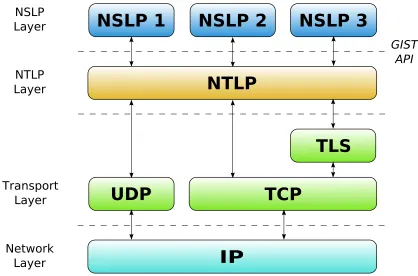
Figure 2.1.: Conceptual NSIS protocol stack.
the name would suggest, the NTLP provides a transport service for sending messages up and down a communication path, allowing routers within this path to communicate about flows. A NSIS node can have one or more NSLP applications running, each designated their own NSLP-ID. Any of these applications can make use of the NTLP service, which operates independently from the contents and nature of the NSLP data it carries. The relationship between these protocols, and their relationships with other well known network protocols, is illustrated in the protocol stack in Figure 2.1. As can be seen, the NTLP can use either User Datagram Protocol (UDP) [34] or Transmission Control Protocol (TCP) [37] for its message transport, the latter optionally making use of Transport Layer Security (TLS) [26] for security. The NTLP is not limited to the use of these protocols and can also use others, e.g. Stream Control Transmission Protocol (SCTP) [41] or Datagram Congestion Control Protocol (DCCP) [31], but because these are the only protocols used in the implementation described in this report they are the only ones pictured. Communication between the NSLP applications and the NTLP is performed through a predefined API.
2.2.1. NSIS Transport Layer Protocol
workings of GIST can be illustrated.
2.2.1.1. GIST API
GIST defines its API in terms of abstract service primitives with parameters. This means that no byte level specification is given and that, although the concept of the API remains the same, its exact implementation is undefined.
The GIST API consists of six service primitives, three from the NSLP application towards GIST, three in the opposite direction. The service primitives directed from the signalling application towards GIST are:
• SendMessage
• SetStateLifetime
• InvalidateRoutingState
The service primitives travelling in the opposite direction, from GIST to the NSLP application, are:
• RecvMessage
• MessageStates
• NetworkNotification
SendMessage
The SendMessage service primitive allows the NSLP application to send messages to its upstream or downstream peer, depending on the Message Routing Information (MRI). Its parameters are the following:
SendMessage ( NSLP-Data, NSLP-Data-Size, NSLP-Message-Handle, NSLPID, Session-ID, MRI, SII-Handle, Transfer-Attributes, Timeout, IP-TTL, GIST-Hop-Count )
NSLP-Data is the payload the NSLP application wants to transmit.
NSLP-Data-Size is the length of the NSLP-Data.
NSLP-Message-Handle is a handle that refers to this particular message. It allows GIST to refer back to it when it issues the MessageStatus service primitive.
NSLPID is 1a 6-bit unsigned integer identifying the NSLP application.
Session-ID is a 16-byte identifier unique to this session.
The following arguments are optional:
SII-Handle is the Source Identification Information Handle, which can be used to bypass state stored in GIST and directly address a node.
Transfer-Attributes allows the application to convey desired transfer properties of the message. Among others this can contain wether or not the message should be sent reliably and wether or not is should be sent securely.
Timeout is the time for which GIST should attempt to keep sending the message.
IP-TTL is the Time To Live (TTL) value GIST should put in the IP header.
GIST-Hop-Count is the initial value for the GIST Hop Count (GHC) when GIST trans-mits the message.
SetStateLifetime
The SetStateLifetime service primitive allows the NSLP application to control for how long the state retained within GIST for a particular session is valid. Its parameters are the following:
SetStateLifetime ( NSLPID, MRI, State-Lifetime )
NSLPID is a 16-bit unsigned integer identifying the NSLP application.
MRI is the Message Routing Information, which describes the flow to which the sig-nalling pertains.
State-Liftetime is the amount of time for which the application wishes the state to remain active in GIST.
InvalidateRoutingState
The InvalidateRoutingState service primitive allows the NSLP application to explicitly request GIST to remove any state associated with a particular session. Its parameters are the following:
InvalidateRoutingState ( NSLPID, MRI, Status, Urgent )
NSLPID is a 16-bit unsigned integer identifying the NSLP application.
MRI is the Message Routing Information, which describes the flow to which the sig-nalling pertains.
Status is a boolean which indicates how definite the routing state invalidation should be.
RecvMessage
The RecvMessage service primitive allows GIST to deliver incoming messages to a NSLP application. Its parameters are the following:
RecvMessage ( NSLP-Data, NSLP-Data-Size, NSLPID, Session-ID, MRI, Routing-State-Check, SII-Handle, Transfer-Attributes, IP-TTL, IP-Distance, GIST-Hop-Count, Inbound-Interface )
NSLP-Data is the NSLP payload of the message.
NSLP-Data-Size is the length of the NSLP-Data.
NSLPID is 1a 6-bit unsigned integer identifying the NSLP application.
Session-ID is a 16-byte identifier unique to this session.
MRI is the Message Routing Information, which describes the flow to which the sig-nalling pertains.
Routing-State-Check is a boolean indicating that GIST is asking the NSLP application wether or not to set up state with this peer. If it is set, the application should reply to this primitive with:
• A boolean of wether it wants to set up state or if it wants the query to be
propagated further downstream.
• Optionally a payload that the application wants GIST to include in the
re-sponse to the querying peer or in the propagating query in case it does not want to setup state.
SII-Handle is the Source Identification Information Handle of the transmitting node, which can be used to bypass state stored in GIST and directly address this node.
Transfer-Attributes are the transfer properties with which the message was transmitted, such as reliability and security.
IP-TTL is the TTL value of the IP header of the received message.
IP-Distance is the calculated distance in IP hops between this node and the sender of the message.
GIST-Hop-Count is the value of the GHC in the received GIST message.
Inbound-Interface provides information about the physical interface on which the mes-sage was received.
MessageStatus
MessageStatus (NSLP-Message-Handle, Transfer-Attributes, Error-Type)
NSLP-Message-Handle is a reference to the message that was generated earlier by the application and set using the SendMessage service primitive.
Transfer-Attributes are the transfer properties with which the message was transmitted, such as reliability and security.
Error-Type indicates, if the message could not be delivered, the reason of failure, the most important one being that this node is the last NSIS-aware node in the path.
NetworkNotification
The MessageStatus primitive allows GIST to indicate to a NSLP application any changes in network status. Its parameters are the following:
NetworkNotification ( NSLPID, MRI, Network-Notification-Type )
NSLPID is 1a 6-bit unsigned integer identifying the NSLP application.
MRI is the Message Routing Information, which describes the flow to which the sig-nalling pertains.
Network-Notification-Type indicates the type of network status change, such as a change in routing state.
2.2.1.2. Message Routing Information
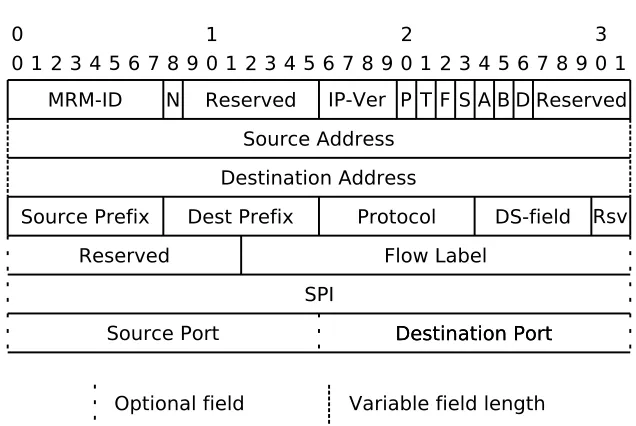
A central concept to GIST and its API is the MRI, which is used to describe a flow or a set of flows. A flow can be described in different ways by the so-called Message Routing Method (MRM), the default of which is the path-coupled MRM. The bitformat of the path-coupled MRM is illustrated in Figure 2.2. As can be seen the path-coupled MRM is based on the traditional 5-tuple of protocol, source address, source port, des-tination address and source port with some additional characteristics. The use of these characteristics can be controlled using the flags at the start of the MRI. The NSLP applications use the MRI to inform GIST about the characteristics of the flow. Another important flag is the D flag, which indicates the direction of the signalling in respect to the flow. If it is set to 0 the direction of the signalling is in the same direction of the flow, if set to 1 it is the opposite. With this a NSLP application can indicate if it wants to send a message to its downstream peer, i.e. in the same direction as the flow or towards the flow receiver, or to its upstream peer, i.e. in the opposite direction of the flow or towards the flow sender.
2.2.1.3. GIST Service Example
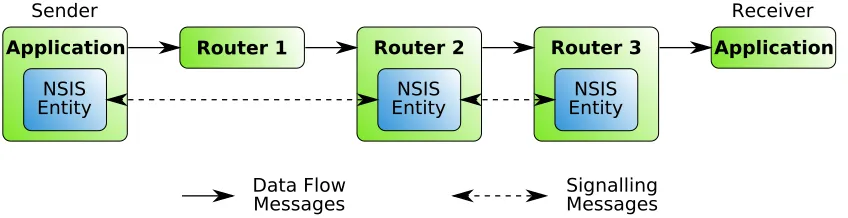
Figure 2.3.: Signalling and data flows.
exist it will attempt to discover the downstream peer. Peer discovery is performed with a UDP datagram with a preset destination port addressed towards the flow destination, gleaned from the MRI, with the Router Alert Options (RAO) [30] in the IP header set to a value corresponding to the NSLP-ID. NSIS-aware routers along the path to the flow destination actively listen out for any UDP datagrams with the preset port and the RAO set and intercept these datagrams. In this way the next downstream peer can be found and a routing state between the peers can be set up, in our example between the flow sender and router 2. What follows is a negotiation between the two nodes to either re-use an existing MA or set up a new MA with the desired properties, e.g. a TCP connection. Once this MA is found or set up, the NSLP message is transferred over it and received by router 1. Its GIST will issue a RecvMessage service primitive to the QoS-NSLP application. This application will probably decide to issue a message further downstream to complete the reservation along the path, again performing downstream peer discovery.
This process will continue until the last node on the path is found, in this case router 3. Note that, although a node may have GIST software running, it may not have the NSLP application identified by the NSLP-ID running, or the application may even choose not the participate using the response to the RecvMessage service primitive. Now if for example router 3 wants to issue a message upstream, this could be a message containing information about the success or failure of the QoS reservation, it will do this with the D flag of the MRI set to 1. Now GIST in router 3 still has state stored about its upstream peer, since that peer has just performed downstream discovery with it. It can use this to send the message upstream.
All states stored in GIST are soft. This means that after a certain period of disuse states will expire automatically.
2.2.1.4. GIST Transmission Modes
GIST has three different modes to transfer messages to its peers, each one of which will now be illustrated.
Query Mode
This mode has already been mentioned in section 2.2.1.3 and is used to discover down-stream peers. Although GIST specifies that it can also be used to discover updown-stream peers, this is not advised. This means that downstream messages should usually precede upstream messages, so that state can be installed during downstream peer discovery.
the UDP datagram can be either set to the flow source, to make sure that the message is submitted to exactly the same routing as the flow, or it can be set to the signalling source, i.e. the node sending in Query Mode, to allow interception of returned Internet Control Message Protocol (ICMP) [36] messages. The latter is important because, if the Query Mode message is not intercepted and arrives at the MRI destination and this host is not NSIS-aware, a ICMP “Port Unreachable” error is returned that can be used to determine that there are no more NSIS-aware nodes on the path.
Datagram Mode
In Datagram Mode messages are simply sent as UDP datagrams, addressed directly to the GIST node one wants to reach. The IP destination address of a node can be learnt from a message it sent in Query Mode, as in this case it should always include its IP address. Note that this may not be the same as the source IP address used for the Query Mode message. The destination UDP port should be equal to the source UDP port used in a previous Query or Datagram mode message sent from the destination node. Conversely, that means that the Datagram Mode sending node should select the source UDP port to be that port on which it is accepting Datagram Mode messages itself.
Connection Mode
In Connection Mode a Messaging Association between two nodes is used to transmit the message. A MA is a connection between two nodes using a particular connection-oriented protocol or a stack of protocols with a set of properties, such as security and reliability. In this report only TCP, for reliable connections, and TLS over TCP, for reliable and secure connections, will be used. For a particular protocol or stack of protocols GIST will maintain at most one connection between two nodes. This MA will be set up dynamically if it is not present and can be used by different sessions once present. A MA is also stored in soft state, meaning that after a certain period of disuse the connection will automatically be torn down.
2.2.1.5. GIST Messages
GIST defines four different message types, each one of which consists of a set of GIST objects. For the sake of brevity these objects will only briefly be described.
Query
Query = Common-Header
[ NAT-Traversal-Object ] Message-Routing-Information Session-Identification
Network-Layer-Information Query-Cookie
[ Stack-Proposal Stack-Configuration-Data ] [ NSLP-Data ]
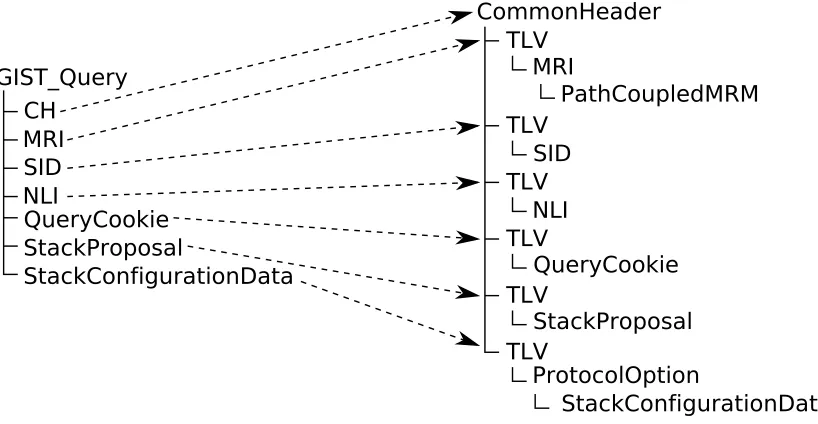
The Common-Header is an object that is included in all GIST messages and includes information such as the type of the message, the NSLP-ID and the GIST Hop Count. The GHC prevents messages from looping infinitely, much like the TTL at IP level. The NAT-Traversal-Object will not be discussed in this report because it was not implemented. As can be seen, the MRI and SID are included in the Query message. Together with the NSLP-ID from the Common-Header this can be used to match state within the GIST node. The Network Layer Information object contains among others a token uniquely identifying the node sending the Query message and its IP address so that other nodes can reach it in Datagram and Connection mode. The Query-Cookie is a security measure to prevent certain Denial of Service (DoS) attacks and contains random data. The Stack-Proposal and Stack-Configuration-Data contain a list of MA protocol stacks and corresponding options, such as port numbers, that the querying node can use based on the transfer attributes submitted to its API by the NSLP application. The responding node should only use this information in case it is considering reusing an existing MA. Finally, the querying node can decide to piggyback NSLP payload onto a Query message, provided that the transfer attributes of the message allow this, i.e. it may be sent unreliably and insecurely.
Response
A GIST Response message should only be sent in reply to a received Query message, so will only be used in initial peer discovery and during refreshes. If the responding node already has a MA with the querying node, the protocol stack is in the stack proposal included in the Query message, the responding node should send its response over this MA to indicate that it will reuse it. Otherwise, the Response message should be sent in Datagram Mode. The objects included in a GIST Response message are the following:
Response = Common-Header
[ NAT-Traversal-Object ] Message-Routing-Information Session-Identification
[ Network-Layer-Information ] Query-Cookie
[ Responder-Cookie
The first four objects are the same as in the Query message. The Network Layer Information (NLI) should only be included if the message is sent in Datagram mode, i.e. if a MA is not being reused. The Query-Cookie object sent in the Query message should be echoed in the response. Additionally, the responding node should include its own cookie and protocol stacks when a new MA needs to be set up. The responding node should always include all protocol stacks it supports regardless of the protocol stacks included in the Query message. Again, NSLP payload can be piggybacked if the transfer attributes submitted to the API allow this.
Confirm
A GIST Confirm message can be sent in reply to a Response message. When a new MA is setup, a Confirm message must be sent as the first message on this connection, otherwise transmission of a Confirm message is controlled by a flag known as the R flag in the common header of the response message. The Confirm message must be sent in Connection mode when a MA is reused or setup and in Datagram mode otherwise. The objects included in a GIST Confirm message are the following:
Response = Common-Header
Message-Routing-Information Session-Identification
Network-Layer-Information [ Responder-Cookie
[ Stack-Proposal
[ Stack-Configuration-Data ] ] ] [ NSLP-Data ]
Again, the common header, MRI, SID and NLI are included. The Responder-Cookie should always be echoed if the Response message carried that cookie. The Stack-Proposal should only be included if the message was sent in Connection mode, i.e. over a new or reused MA. The Stack-Configuration-Data in an abbreviated form should only be included if this Confirm is the first message on a new MA. Again, NSLP payload can be piggybacked. Because the Confirm message should always have the desired transfer properties, NSLP data can be carried in any case.
Data
This message is simply used to transfer NSLP data between nodes. It can be sent in any of the three transfer modes, in Connection mode over a MA, unreliably and insecurely in Datagram mode and in special cases in Query mode, allowing NSLP data to be sent downstream without installing state within the nodes. The objects included in a GIST Data message are the following:
Data = Common-Header
[ NAT-Traversal-Object ] Message-Routing-Information Session-Identification
The MRI and SID are included for state matching. The NLI should not be included in Connection mode, otherwise it should.
Error
Error messages are generated in response to an error condition and sent back to the node that sent the message that caused the error. GIST Error messages can be sent both in Datagram and Connection mode, depending on the transfer mode of the message that caused the error. The objects included in a GIST Error message are the following:
Error = Common-Header
[ NAT-Traversal-Object ] [ Network-Layer-Information ] GIST-Error-Data
The NLI should only be included in Datagram mode.
MA-Hello
The MA-Hello message is just used to refresh a MA, indicating that the sending node wants to keep the MA open. A GIST MA-Hello message only consists of a common header:
MA-Hello = Common-Header
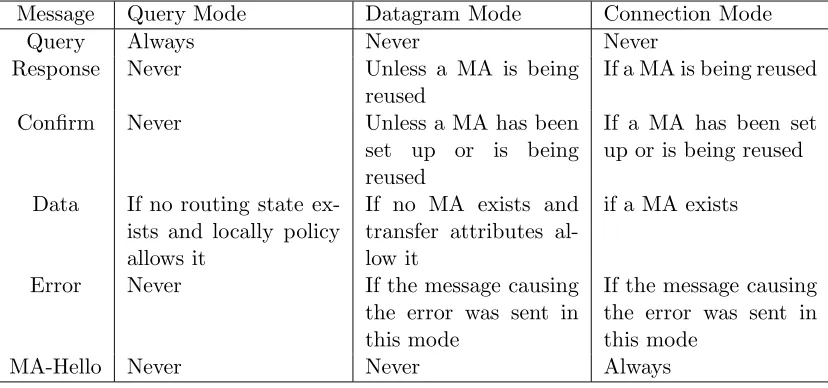
In conclusion, table 2.1 lists which messages can be sent in which modes and for which situations.
Message Query Mode Datagram Mode Connection Mode
Query Always Never Never
Response Never Unless a MA is being reused
If a MA is being reused
Confirm Never Unless a MA has been set up or is being reused
If a MA has been set up or is being reused
Data If no routing state ex-ists and locally policy allows it
If no MA exists and transfer attributes al-low it
if a MA exists
Error Never If the message causing the error was sent in this mode
If the message causing the error was sent in this mode
MA-Hello Never Never Always
Table 2.1.: Combinations of GIST messages and transmission modes.
2.2.1.6. GIST Message Exchange Example
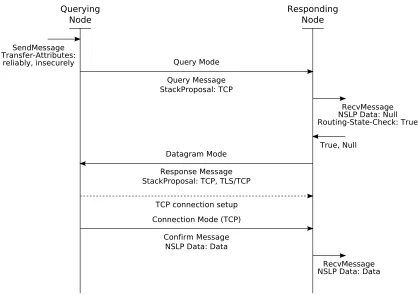
Figure 2.4.: Example of a GIST message exchange between two nodes.
The first thing that happens in the interaction between these two nodes is that a NSLP application located at the querying node wants to send some data to its downstream peer according to some MRI. This can be either an asynchronous message or a part of a chain of downstream messages. To indicate this desire, the application performs an API call to the GIST instance running at that node, including the NSLP payload, the NSLP-ID of the application, the MRI of the flow the signalling is about with the direction bit set to downstream and a SID value. Since in this case the NSLP application has not communicated downstream about this flow before, the SID is a newly generated value. This is because SID’s are only of local significance between peers, i.e. not end-to-end. The application also indicates the desired transfer characteristics of the message, which can be seen in Figure 2.4. In the case of this example the application wants for the message to be sent reliably, but does not need it to be sent securely.
message, it will send it towards the MRI destination with a RAO included in the IP header.
The first node directly downstream from the Querying node with respect to the MRI, which in this example will be the responding node, will intercept the Query message. The first thing the GIST instance at this node will do is look up if it has any state installed for this combination of NSLP-ID, MRI and SID. Once it has found that it does not, it will issue an API call to the relevant NSLP application with no NSLP data and with the Routing-State-Check parameter set to True. In this way GIST will ask the NSLP application if it wants to send up routing state. In this example the application answers that it does want to set up state and that it does not have any payload to include in the Response message. GIST then uses the NLI included in the Query message to determine the identity of the querying node and looks up if it has a MA installed to this node that uses any of the protocol stacks included in the Query message. Simply put, it checks to see if it already has a TCP connection with this node. Once it has determined that it does not, it will conclude that a new MA will need to be set up and include all protocol stacks it supports in the response message, including the port numbers on which it is listening. In this example it will include both TCP and TLS over TCP. It does this as a security measure, for details see section 8.6 of [39]. Because a MA is not being reused, the responding node will send the Response message in Datagram mode to the querying node, having learnt the destination IP address from the NLI in the Query message and the UDP destination port from the source UDP port of the Query message. GIST will also make sure to set the R flag of the common header of the Response message, as a Confirm message is required when a new MA is set up.
Once the querying node receives the Response message, it will match this with the state present within GIST and choose the MA it wants to use based on the Stack-Proposal of the Response message, in this case TCP. Based on the NLI and Stack-Configuration-Data from the Response message it will make a TCP connection to the responding node and send a Confirm message over this new MA. Included in the Confirm message is the NSLP payload that GIST had internally queued up for this routing state. The NSLP payload can then finally be delivered to the correct application at the responding node. What follows is probably that the NSLP application at the responding node processes the message and propagates it downstream, in which case the process is repeated with this node now acting as the querying node, or it will reply with an upstream message, in which case the routing state and MA now installed at the responding node will be reused.
2.2.1.7. GIST Advanced Features
This section has provided a description of the basic functionality of GIST. Further details of this functionality will be described in chapters concerning the design of the implementation.
2.2.2. QoS NSIS Signaling Layer Protocol
As NSIS is meant to be at least a replacement for RSVP [22], which was designed to perform QoS reservations, the QoS-NSLP application is a core part of the suite. It uses the services provided by GIST to install QoS reservations along the entire path of a flow, informing every NSIS capable router on this path of the parameters of the QoS that is required. Like GIST, the QoS-NSLP uses soft-state to install these reservations, meaning that, unless they are refreshed, the reservations will expire after a predetermined amount of time. The reservations are performed end-to-end, meaning one reserve message is propagated along the entire path, while the refreshes are done peer-to-peer, with each pair of peers having their separate refresh and expiry timers. A reservation may also be removed explicitly by an end-to-end reservation teardown.
2.2.2.1. QoS-NSLP Components
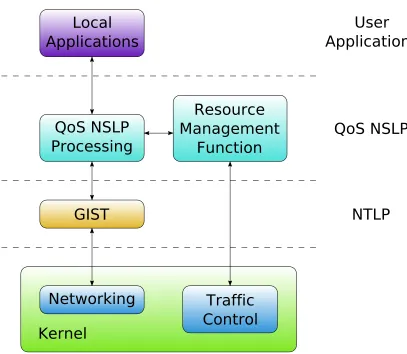
Unlike RSVP, the QoS-NSLP is not bound to a particular type of QoS, rather it operates independently from this. It does this by decoupling the reservation processing from both the contents of the QoS parameters, called the QSPEC (QoS Specification) [18], and the addition and removal of actual reservations within the traffic control subsystem of the node, called the Resource Management Function (RMF). The idea is that a flow and thus a reservation can travel through several network domains, each implementing their own QoS Model (QoSM), e.g. IntServ [21] or DiffServ [20], and receive the required QoS in each of these domains, signalled by the QoS Specification (QSPEC) in the reserve message. This QSPEC attempts to provide a number of common QoS parameters that can be used across different QoSM domains.
This subdivision of the QoS-NSLP into a processing part and the RMF is illustrated in Figure 2.5. The former is responsible for communicating with GIST and any user applications requesting Quality of Service, processing messages and storing state about them and passing any reservation instructions to the RMF. Note that a concrete def-inition of any interaction with user applications is beyond the scope of the QoS-NSLP specifications. The latter is responsible for interpreting the QSPEC, which is opaque to the processing part, authorising and admitting reservations and actually performing them, interacting with the traffic control subsystem provided by the operating system of the host. This means that the functionality of the RMF is fully dependent upon the QoSM used, while the functionality of the message processing part remains constant. Two of these QoS models are described in sections 2.2.3.1 and 2.2.3.2.
2.2.2.2. QoS-NSLP Message Processing
The QoS-NSLP processing part as described in the last section is defined in [33], which dictates four different message types:
Figure 2.5.: Components within the QoS-NSLP system and their interactions.
depend on the situation in which the RESERVE is sent. Among the objects are two sequence numbers, one unique for the end-to-end reservation request, called the Request Identification Information (RII), the other unique in the sequence of message exchanges between two peers and having local significance only, called the Reservation Sequence Number (RSN). This last sequence number is the only mandatory object in the message. Also included are some refresh timer informa-tion in the REFRESH PERIOD object, a PACKET CLASSIFIER to mask out particular parameters of the MRI and an object which allows binding a different session to this one called BOUND SESSION ID, the function of which will be ex-plained in section 2.2.2.4. Also included of course is a QSPEC describing the QoS parameters of the reservation in question. Besides this there can also be a second QSPEC that allows for layering, which will also be explained later.
is that a QUERY message just gathers information and does not modify reservation state in any way. It can be used to probe the availability of QoS parameters along the path, such as bandwidth available within a certain traffic class. It also provides a means to perform receiver-initiated reservations, where the flow receiver first sends a QUERY message towards the sender, which in turn sends the required RESERVE message. A QUERY message may include RII, BOUND SESSION ID, and PACKET CLASSIFIER objects, as well as one or two QSPEC objects. The first QSPEC is the only mandatory object in this message type.
RESPONSE This message is sent in reply to either a RESERVE or QUERY message to convey the results of the requested action. The most important and only manda-tory object of this message type is the INFO SPEC object, which contains this result by means of and error class and code, some identification information about the node that generated the RESPONSE and optionally additional information. Note that this object need not represent and error condition, as there is also an er-ror class indicating success for different types of actions, e.g. successful reservation setup or teardown. Other objects that may be included are either a RII or RSN and one or two QSPEC objects. In case of an error these QSPECs can contain information about which parameter caused this error.
NOTIFY This message is similar to the RESPONSE message, with the main difference that it occurs asynchronously, i.e. it is not sent in response to any previous message. It typically conveys error information in the INFO SPEC object, which is again mandatory. Apart from this it can also contain one or two QSPEC objects, which can convey additional information about the error that occurred.
2.2.2.3. QoS-NSLP Example
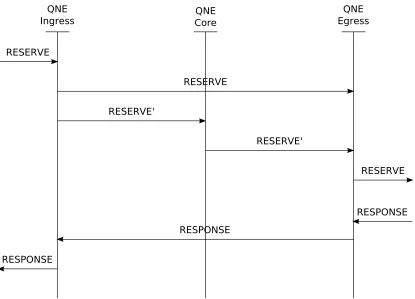
Figure 2.6.: Example of a sender-initiated QoS-NSLP reservation.
other things contains the RSN for the downstream peer, to generate the downstream RESERVE message, which it will pass to GIST. Included in this RESERVE is a RII which is unique to this reservation request. The QoS-NSLP will record this RII value to watch for in RESPONSE messages.
message indicating this success in the INFO SPEC. It will also include the RII of the reserve, so that nodes receiving the RESPONSE know which reservation this pertains, and a QSPEC returned from the RMF. The latter is used to indicated what was actually reserved. This response message is send back upstream and each node will forward it until it reaches the QNI. This node determines that it was the originator for this RII and will stop forwarding it.
If the reservation had failed anywhere along the path, a similar RESPONSE would have been sent from the node where the failure occurred, but with a INFO SPEC object indicating this failure. In this case the QNI would receive this RESPONSE and send a tearing RESERVE message to remove the state from those nodes that already have it installed.
The reservation is then in place along the entire path. Because this reservation is soft state it will need to be refreshed periodically, which happens asynchronously between peers. What this means is that, unless its own state expires, every node will send refreshing RESERVE messages to its downstream peer, which will not be propagated further downstream. Each set of peer has its own timers governing refresh intervals. If the downstream node has indicated that it supports reduced refreshes, the upstream peer for this node need only include the RSN of the last full RESERVE message in the refreshing RESERVE. The downstream node will see that the RSN is the same as the last RESERVE message and will conclude that the same QoS parameters still apply.
Two other features can be highlighted at this point. Suppose that the flow is in the opposite direction, i.e. from the QNR to the QNI, and that the QNI wants a certain QoS for this flow to be applied. In this case, which is a receiver-initiated reservation instead of the sender-initiated reservation of the example, the QNI can send a QUERY message with a specific flag requesting the QNR to send a RESERVE message. The QNR originated RESERVE message will then behave in much the same way as the one in the example.
Another possibility is a bidirectional reservation. Although reservations in the QoS-NSLP are always unidirectional, session binding between two separate session can be performed, one for the downstream flow and one for the upstream flow. Each RESERVE or QUERY belonging to one of the two sessions contains a reference to the other session through the use of the BOUND SESSION ID object. This allows for events such as errors pertaining to one of the sessions to be signalled to the other session as well.
2.2.2.4. QoS-NSLP Layering
To support local QoSM domains, a number of facilities exist within QoS-NSLP that allow use of different QSPECs or transfer properties. Although they are not part of the implementation described in chapter 4, they will briefly be described here.
QSPEC Stacking
second QSPEC can be “stacked” on the end-to-end QSPEC, while at the exit point it can be removed.
Session Tunnelling
As an alternative to the previous approach of QSPEC section, a whole new session can be started at the entry point of a domain. This tunnelling session is then bound to the end-to-end session using a BOUND SESSION ID object. The end-to-end session generally skips over the domain in this case using a different NSLP-ID value.
Aggregate Sessions
This is actually a special case of Session Tunnelling. A local QoSM may want to aggregate several reservations into one local session, to reduce load on the local domain. Again, the local session is bound to the end-to-end session using BOUND SESSION ID. This case is used for example in Resource Management in DiffServ (RMD).
2.2.3. QoS-NSLP QoS Models
As already indicated in section 2.2.2.1, the RMF conceptually performs all QoSM specific operations. Each particular QoSM has its own specification document, which perscribes which QoS-NSLP features specifically are used, how the QSPEC should be formated and interpreted, and how these parameters should be mapped onto the specific properties inherent to the QoSM. Two such QoSMs will be described here, one for IntServ and one for DiffServ.
2.2.3.1. IntServ Controlled Load QoS Model
Integrated Services [21] is a QoS architecture that allows per-flow reservations to be in place in routers, with flow characteristics being described using a so-called token bucket. Wikipedia describes a token bucket in the following way [16]:
The idea is that there is a token bucket which slowly fills up with tokens, arriving at a constant rate. Every packet which is sent requires a token, and if there are no tokens, then it cannot be sent. Thus, the rate at which tokens arrive dictates the average rate of traffic flow, while the depth of the bucket dictates how ’bursty’ the traffic is allowed to be.
IntServ defines several types of QoS that can be applied to a flow, of which the “Con-trolled load” [43] is the only one that will be discussed here. “Con“Con-trolled load” means that a flow receives the equivalent treatment of a best-effort flow in a lightly loaded network, i.e. a network were there may be other traffic, but no heavy congestion. This definition is intentionally vague in that it does not define hard parameters in terms of packet loss or latency.
The second parameter, which is optional, prescribes what what action should be taken when a flow exceeds the given parameters, e.g. dropping or reclassifying, the so-called “Excess treatment” parameter. Both of these parameters are defined in the QSPEC document [18]. Note that any interaction with the traffic control subsystem of the host is beyond the scope of the QoSM document.
2.2.3.2. Resource Management in Diffserv QoS Model
Flow-based QoS systems such as IntServ have scalability issues, as each router needs to keep track of one reservation per flow. In response to this Differentiated Services [20] was created, which is a class-based system. DiffServ assumes that a domain of routers, called a DiffServ cloud, is under control of the same entity. Upon entry into this domain flows are classified into a certain predefined Per Hop Behaviour (PHB), a QoS class, and marked accordingly in the DiffServ Code Point (DSCP) field of the IP header. The core routers of them domain need then only concern themselves with the different traffic classes, while the burden of per-flow processing is shifted towards the edge routers exclusively. The only PHB discussed here is the Expedited Forwarding (EF) PHB. This PHB guarantees that flows receive a certain minimum rate over a period of time.
RMD [19] defines a QoSM that adapts the QoS-NSLP of NSIS to this concept, allowing dynamic reservations for DiffServ with a minimum number of resources required in the core routers. As few of the activities performed and described in this report involve RMD, this section provides only a very brief description.
RMD makes use of either the session tunnelling or aggregate session layering mentioned in section 2.2.2.4. This means that for each flow there are two sessions, the end-to-end session initiated by the QNI, which will skip the DiffServ domain and go directly from the ingress to the egress node when a reservation is performed, and a related intra-domain session that travels from the ingress to the egress. In case of aggregate reservations there is one intra-domain session per PHB per ingress/egress pair, otherwise there is one intra-domain session for each end-to-end session. The intra-domain session carries its own QSPEC with contents specific to RMD, derived from the parameters in the end-to-end QSPEC. The interior nodes in the DiffServ domain maintain a minimum of state, operating statelessly at the GIST level by refusing to install state in response to a RecvMessage API call as described in section 2.2.1.1 and by sending data messages in Query mode as described in section 2.2.1.5, and optionally maintaining per-PHB state at the NSLP level. In this way the DiffServ paradigm of shifting the burden of processing to the edges of the domain only is carried through for its QoS-NSLP adaptation.
Figure 2.7.: Example of a sender-initiated RMD QoS-NSLP reservation.
RMD Features Overview
In summary, RMD has a number of features, some of which have already been mentioned:
• In addition to the successful and unsuccessful reservation described above, RMD
also supports reservation refreshes and explicit reservation teardown
• RMD also has its own means of providing bi-directional reservations.
• As already highlighted, the edge nodes of the RMD domain have the choice of either
maintaining per-flow inter-domain state or maintaining aggregate inter-domain flow state. Note that end-to-end state is always maintained per-flow.
• In contrast to the example of the previous section, the interior RMD nodes can
be allowed to operate fully statelessly. The first method of reservation admission control, as used in the example, is called the reservation-based method, because the interior nodes maintain per-PHB reservation state. The stateless method is called the measurement-based method, as admission is based on continually performed measurements of traffic volume passing through the node, which can be further subdivided into two methods. In the NSIS-aware measurement-based admission control the interior nodes operate much like those in the reservation-based method. They intercept and process the RMD intra-domain RESERVE message, but instead of consulting reservation state, reservations are admitted based on traffic volume measurements. In the probing measurement-based method however, the interior nodes need not be NSIS-aware, i.e. they do not have a GIST and QoS-NSLP application running. Instead, they are configured to remark traffic within one PHB exceeding a certain preset rate, giving all packets within that PHB a different DSCP value. This will be noticed by the egress node, which will inform the ingress node about the failed reservation.
• In case a link or node within the RMD domain fails and traffic gets rerouted and
overloads another node, a form of severe congestion notification can be used, also making use of the remarking of packets. This feature is expanded upon in the next section.
RMD Severe Congestion Handling
this means that per PHB a total number of three additional DSCP values used for marking may be defined:
Notified DSCP This is the DSCP value used for the probing measurement-based ad-mission control described previously. As other methods of adad-mission control may be used, this DSCP remarking value is optional.
Encoded DSCP This value is used to notify the egress node of the amount of congestion experienced in the congested interior node, by using this marking proportionally. This means that for a certain preset time period the amount of traffic is monitored and during the next time period the number of bytes that were over the preset limit and thus dropped are marked in the packets leaving the node according to a certain preset ratio. This means that for example if there were 64 kilobytes overlimit in the last period and the ratio is two-to-one, in the next period 32 kilobytes worth of packets will be marked. Note that for this and the previous marking the same DSCP value can be used, if the egress node can properly determine if the interior node is experiencing severe congestion, possibly with aid of the next DSCP value.
Affected DSCP This DSCP value is optional and can be used in the situation where the node is congested, but has already transmitted enough packets with the Encoded DSCPmarking to convery the level of congestion. This is allows the egress node to determine which flows passed congested nodes, ever if packets in those flows were not marked with theEncoded DSCPvalue.
Note that each PHB will need its own set of additional DSCP values, as the interior nodes processing marked packets still need to be able to determine the PHB of the traffic.
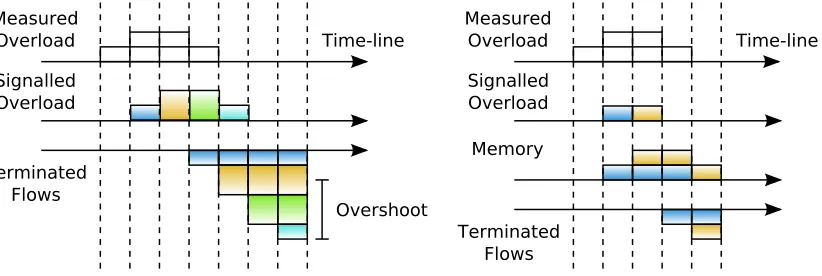
Figure 2.8.: Example of RMD Severe Congestion handling. In the left figure no sliding window memory is applied, in the right figure it is applied.
will subtract any marked bytes from previous time periods in its memory from the total number of bytes over the congestion limit. This will give the egress node enough time to be notified of the congestion and terminate the flow reservation, causing the traffic volume to be under the congestion limit, before the sliding window memory runs out and the congestion is signalled again. This is illustrated in Figure 2.8, which is taken from [24].
3. GIST Design and Implementation
This chapter will attempt to describe and motivate the design choices made during the implementation of GIST and illustrate the process and structure of this implementation. Before this, the work performed by others at the start of this assignment will be discussed.
3.1. Previous Work
As already mentioned in the introduction in chapter 1, the work done in this master’s assignment is a continuation of work performed by previous students at the DACS group of the University of Twente (UT). The part of the assignment that involved GIST consisted of bringing up-to-date, both in terms of features and specification draft version, the GIST implementation started by Mayi Zoumaro-Djayoon [44], to achieve the goals of the assignment set out in section 1.1. She made her implementation conforming to draft version 5 of the specification [39] and, partly because of time constraints and partly because of the incomplete draft specification, only included basic functionality.
The first objective of the assignment, after reading all of the relevant specifications, was inspecting the implementation that was delivered at the end of Mayi’s assignment. During this stage it became apparent that this implementation, apart from the known omissions, contained a number of severe deficiencies and poor design choices which con-flicted with the requirements set in section 1.2, a number of which will be expanded on here:
• It proved no trivial task to migrate the implementation from the workstation it was
developed on to a different one. Development was performed on a Debian Linux [1] system in the Python [10] programming language. The program made a number of assumptions about its environment, such as being able to resolve network interface names to IP addresses, e.g. eth0, using the system’s /etc/hosts file, which is not the usual way. Although a lot of parameters of the implementation could be set using a configuration file, several of them were still hardcoded in different places in the code, including parameters such as network interfaces and IP addresses used. These issues resulted in having to modify the program quite extensively to even be able to run it on a different computer than the one it was written on.
• Python is a class-based language and the design of the implementation intended
• Related to the previous point of using global variables, the program was
writ-ten without no regard for thread-safety, although the program quite rightly made uses of threads. There was no guarantee that another class might not use the global variables used for communication. The only means implemented to avoid race conditions was setting a static delay in one of two threads known to occur simultaneously.
• The implementation made no clear distinction between network packet contents
and network packet logic. What is meant by network packet contents in this case is the actual bit-level contents of packets of the packets sent or received. Packet logic is about which packet should be sent in response to some event. The separation of the two is needed so that, when the bit-level format is changed, such as in the case of new specifications, only one part of the code needs updating, which is part of the requirements set. It also prevents the need for using the same code several times over, since in this implementation packet generation and decoding was mostly done in-place, i.e. in the location of the code where the packet logic needed it. In this case it also meant that decoding of all possible packet contents dictated by the specifications was not implemented, i.e. the implementation only expected the type of packet contents it itself could generate. This could prove a big problem for interoperability.
• It contained little error checking and exception handling, which is an important
requirement. This is somewhat related to the previous item, as most error check-ing and error message generation should be done on message reception. To add a decent level of error checking the code would have to undergo a complete overhaul, as error checking is tightly coupled with such parts of the program. Those er-rors that were caught were often not handled gracefully, with the implementation continuing an exchange of known erroneous messages.
• Several functionalities that should have been implemented appeared to have been
hardly implemented at all, such as MA functionality, which just consisted simply of setting up a TCP connection.
• Such debugging output that was available was cryptic and sometimes even in binary
format, which tended to cause the terminal window to which it was output to malfunction. This made it hard to determine what exactly the implementation was doing during runtime and afterwards.
3.2. Development Environment
Like the previous implementation, this implementation of GIST was made using the Python [10] programming language on a Linux operating system, partly so that the concepts in this previous implementation could easily be re-used.
Linux was chosen because, combined with the large number of applications available, it provides an ideal testbed for developing new network applications and protocols. Because of its open nature, any adjustments that may need to be made to allow GIST to operate can be made. For example, the highly flexibleiptables [9] framework that Linux provides was used extensively to influence network traffic in different ways. A feature of Linux that was primarily used for the QoS-NSLP was the traffic control subsystem, which allows shaping of traffic flows. Another reason for using Linux is the User-Mode Linux [14] testing setup, which will be described in chapter 5. The particular Linux distribution that was used was Gentoo Linux [3], because of the amount of past experience in using it.
Initially there was no choice but to use Python, as the previous implementation was also done in this language. When it became apparent that the implementation would have to be made from scratch however, Python proved to be an excellent choice for the development of a prototype implementation of GIST, as it can potentially fulfil a lot of the requirements set in section 1.1. Wikipedia has the following to say about Python [17]:
Python is a programming language created by Guido van Rossum in 1990. Python has a fully dynamic type system and uses automatic memory manage-ment; (...) Python is notable amongst current popular high-level languages for having a philosophy that emphasises the importance of programmer ef-fort over that of computers and for rejecting more arcane language features, readability having a higher priority than speed or expressiveness.
and:
In contrast to some lower-level languages, Python’s design does not empha-sise runtime speed. While Python implementations are generally comparable to that of other bytecode interpreted languages, a concern for clarity of code always comes first in Python’s design.
This philosophy is well suited to the requirements, both in code readability and extensi-bility and in the fact that it should serve as a prototype, as a prototype implementation should prioritise clarity in the workings of the implementation over performance.
3.3. High-level Program Structure Overview
The GIST implementation uses the Object Oriented (OO) programming paradigm fea-tures offered by Python, as this provides support for a modular architecture, which is inherent to the requirements. The main server class is named gistServer.Server, one instance of which should me made to create a running GIST server. This server class contains instances of several other classes, which work as threads and provide certain types of services to the server. The threads of the service classes monitor their specific domain and notify the GIST server of these incoming events. This model matches the conceptual model of a server, in the sense that any action is reactionary, i.e. it is caused by a certain external or internal event, with each type of event monitored by a thread. The server can also use the service classes for outbound communication that should use the domain of the service class. Although this is not strictly necessary, it provides a grouping of functionality within the same class. As can be seen in the diagram in Figure 3.2, the service classes are:
gistAPI.APIService This class provides communication to and from the NSLP applica-tions running locally. The GIST server can perform the outbound service prim-itives described in section 2.2.1.1 on the API service as function calls, and the API service in turn can perform the inbound service primitives on the server. The API service is responsible from maintaining a list of running NSLP applications and delivering the service primitives received to the right application. This can be either another Python module, in which case the API service is responsible for running the application, or an external application.
gistRaw.RawService This class is responsible for sending and receiving message in Query Mode. Its name is derived from the method of sending, i.e. using raw sockets.
gistUDP.UDPService This class is responsible for sending and receiving messages in Datagram Mode, i.e. using normal UDP encapsulation.
gistICMP.ICMPService This class monitors ICMP traffic sent to the node. As explained in section 2.2.1.4, a certain ICMP message in response to a Query message allow a node to deduce that it is the last NSIS capable node on the path.
gistTCP.TCPService This class is responsible for handling incoming and outgoing new TCP connections, one of the Connection Mode protocols used in this
implementa-tion. Note that every active TCP connection is managed by its owngistTCP.TCPConnection
class, which also has its own thread and relays incoming data to the server object.
Although the server can communicate with the network service classes directly, in typi-cal cases this is performed through certain state machines that the server contains. These state machines handle state changes and set timers, but also store state information. The rules of the state machines are dictated by the GIST specification and are further de-scribed in section 3.6. There are two types of states stored by the GIST server, routing state in the form of either agistQuerySM.QuerySM or agistResponderSM.ResponderSM
instance, which as stated in 2.2.1.3 is keyed by the pair of NSLP-ID, MRI and SID, and MA state in the form of agistMASM.MASM instance. The routing state state machine used depends on the role of the node during the initial discovery procedure and subse-quent refreshes. In the case of the Query state machine it contains a timer to perform refreshes and both contain state expiry timers, implementing the soft state principle. As a timer expiry is an event they are also implemented as threads, notifying the GIST server class of the relevant event. There is one MA state machine per MA, which also contains refresh and expiry timers.
The implementation also contains a message decoding and encoding subsystem, decou-pled from the service classes and state machines. This subsystem allows any part of the program to treat messages as hierarchical objects and read, write and modify messages independently from their coding structure. This allows for flexibility on changes to the bit-format and makes sure that there is only one place in the program where messages are encoded and decoded. Tightly coupled with the message subsystem is strict error checking on decoding, providing a certain amount of robustness. GIST defines a number of error messages that can be sent in response to a malformed or erroneous message, possibly including information about the error. Python provides exceptions and every GIST error is mapped to its own exception class. If an error occurs on decoding, the message subsystem raises the correct error class, instantiated with parameters contain-ing details about the error. The GIST server can catch this exception, use it to produce a complete error message and send it back to the node that caused the error.
3.3.1. Threading Model
As already pointed out, there are two types of execution threads and thus two sources for events occurring that the server needs to respond to, i.e. external and internal events. External events are generated by the service classes pictured in Figure 3.2. These can be either received API service primitives or received network traffic. Additionally, each established TCP or TLS connection has its own object and corresponding thread, re-ceiving network traffic for that connection. A single thread per connection is needed, as reading data from a connection on which nothing is received results in a so-called block-ing call, haltblock-ing program execution at that point. This could be handled from within the same thread by for example using theselect system call, but since the Pythonthreading
module provides multi-threading in a high-level OO model, this fits better within the structure of this program. Internal events are generated by timers belonging to state machines, each timer executing in its own thread, also using the Python library [11]
threading.Timer class.
main-tained within the GIST server. To provide thread-safety, each thread will need to acquire a threading lock provided by the server, implemented using the Python threading.Lock
object, before doing any such actions. Acquiring the lock guarantees that only one event at a time is handled. If another event is already being processed, acquiring the lock will block the calling event thread until the executing thread releases the lock. To be able to reach the lock any threading class within the GIST implementation maintains a reference to the main server object, an instance ofgistServer.Server. Using a single lock to prevent several threads from accessing and possibly changing state stored within the GIST implementation greatly simplifies safe multi-threaded programming, allowing the code to access and change objects in the same way it would in a single-threaded program, as long as it has acquired the lock. Any alternative method, e.g. passing messages in a thread-safe way between different parts of the program, would require more complexity. The only requirement for using this single lock is that any operation performed while the lock is acquired is dealt with as quickly as possible and does not sleep or block in any way. This was taken into account while implementing the program.
Fatal programming errors are generally represented by Python exceptions. To prevent one thread from having a fatal exception while other threads continue to operate, all threads are executed in a try statement, in which any unexpected exceptions can be caught. If this occurs, the exceptions handler will make sure to append the exception in question to the log, see section 3.8.1, and terminate the program. This greatly helps debugging, as errors cannot be overlooked.
3.4. Network Interaction
The three modes of transmission used in GIST each have their own service class or classes, the implementation of which will be described in this section.
3.4.1. Query Mode
Query Mode transmission and reception is provided by the gistRaw.RawService class. Transmission is performed using so-called raw sockets, which allows the program to construct its own network and transport layer header, in this case a IP and UDP header. The reason for doing this is that, by default, Linux does not allow a program to transmit a IP packet with a source address that is not among the IP addresses of its own interfaces. While constructing the IP header, the gistRaw.RawService class also inserts the RAO, with as parameter the NSLP-ID. Note that, although the specifications state that there is no one to one relationship between the RAO parameter and the NSLP-ID, at this point in time there is no clear mapping mandated between the two. Using raw sockets in Linux is something that is allowed for theroot user only. Because of this is the GIST server should only be run as root.