A structural analysis and comparison of DHV practice with the
Prince2 method
July, 2007
Alex Korver
Daan Seesing
Preface
To finish my Bachelor Program Civil Engineering at the University of Twente, The Netherlands, I
have been given the opportunity to do a three month internship at DHV Engineering
Consultancy Shanghai. In these three months I have done a research in close cooperation with
Daan Seesing on how to improve project management practice of Building and Industry projects
within the company. All needed information was collected through a set of interviews, site‐visits
and available literature in the field of project management. This paper contains all relevant
knowledge and the results of this research. Next to this paper, a Project Managers Manual was
written to make all acquired knowledge accessible for use during the execution of projects
managed by DHV Shanghai.
I will take this occasion to thank all people who supported us during our assignment. My special
attention goes out to Ruud Beekhuis and Thomas Wang for their role as mentors and for their
help and support during our research. Furthermore I am grateful to Chris Shi for his supervision
and giving me the opportunity to come to Shanghai. I would also like to thank all project
managers and staff, and Wim Jansen in particular, for sharing their knowledge with us. From the
University Twente I would like to thank Andreas Hartmann for his support concerning the
content of our assignment. And last but not least I would like to thank Daan Seesing for his
critical comments and good cooperation during the internship.
Enschede, October 2007
Summary
This paper states the results from my research in cooperation with Daan Seesing, on the
improvement of project management practice within DHV Engineering Consultancy Shanghai.
Shortly we will describe the process of the research and the important recommendations in this
Using the knowledge mentioned above and combined with the characteristics of normal
practice at DHV, a framework was set up in order to gather and analyze information on all
relevant aspects. The main chapters of this framework exist of the project phases in a typical
DHV project; the Feasibility Study, Program of Requirements and Initial Design, Design
(Preliminary and Detailed Design), Tendering, Construction, Testing & Commissioning and Hand‐
over. Beside these eight phases used in common practice a ninth ‘General’ chapter was added to
the framework, covering all information used throughout several phases or aspects which
cannot be placed in a certain phase. Within each chapter, a subdivision is made on the six main
knowledge areas as they are used in the PMBOK method; Scope, Organization, Communication,
Time, Cost and Quality. After the framework was constructed information about project
management practice at DHV Shanghai was gathered using semi‐structured interviews with
project managers, site visits and information from the local intranet.
The general impression of project management at DHV was positive. Projects are managed
thorough, though not always optimal structured. The difficulty on finding structured
documentation on a specific subject was a possible improvement which came across right away.
Other points of improvement were conducted through a comparison of the current practice
with the project management method Prince2. Possible improvements that derived from this
comparison are mainly on the field of procedures. The set up of overall quality procedures,
Health Safety and Environment procedures and a structural project evaluation are examples of
the suggested improvements.
Another challenge was the non‐optimal access to available knowledge. As we already analyzed
and structured the information on current practice we used this information to set up a Project
Management Manual. This manual contains all information on different processes, methods and
Contents
2.1.4
Similarities
and
differences
... 14
2.2
Context
... 15
2.2.1
Project
management
of
building
and
industry
construction
projects
... 15
2.2.2
Construction
Project
Management
in
China
... 16
4
Challenges
&
possible
improvements
... 29
4.1
Comparing
practice
using
Prince2
... 29
4.2
Challenges
&
possible
improvements
... 30
4.3
Additional
challenges
... 31
5
Implementation
... 33
5.1
General
procedures
... 33
6
Conclusions
&
Recommendations
... 36
List
of
abbreviations
... 40
Appendix
A:
PM
Manual
... 41
Appendix
B:
Structure
ShareWork
... 42
Appendix
C:
Interview
questions
... 43
Appendix
D:
Information
Interviews
and
Site
Visits.
... 46
1
Problem
description
1.1
Problem
description
DHV Shanghai is as an engineering consultancy company part of the global DHV Group. One of
the core businesses of DHV Shanghai is project management. Especially ECPM (Engineering
Construction Project Management) of high end factories, office buildings and special buildings
such as international schools, mostly, in and around Shanghai, China. Most of its clients are
western companies.
To perform these tasks DHV Shanghai has a project management team of professionals
(approximately 10 people) supported by a secretary, finance and a HR department. The project
managers are assigned for the duration of a project to be the overall coordinator, representing
the client and manage all aspects of the project. Their task varies from representing the client
and the client’s demands throughout the design phase to controlling time and cost in the
construction phase. Especially in the construction phase a project manager works partly at the
office and partly on site.
The key to success for a project manager is to keep close track of every stage within the project
and thereby apply his personal skills, tools and techniques whenever necessary. There has to be
made a difference between the project manager’s personal skills (acquired mostly by experience
and education) and the tools and techniques which are available to him to use them whenever
they are required. As DHV Shanghai has managed numerous projects in its ‘relatively short’ life
most of its project managers are very experienced. Projects are almost always a success.
After our arrival at the office in Shanghai it seemed there was not a real concrete problem, but
the general opinion was that the current practice of project management, although often
successful, was not optimal. So the real problem was not about knowledge itself but to gain
insight into the current knowledge.
To get a better understanding of all available knowledge, the information on DHV’s project
management skills had to be structured in an organized way. This became our fist challenge.
After the completion of the analysis it will become possible to point out possible fields of
1.2
Objective
&
research
questions
Using the information of the previous paragraph our main objective can be read as followed:
“The objective of this research is to reveal and structure current project management knowledge
at DHV Shanghai and point out possible fields of improvement by comparing current knowledge
with project management standards.”
To clarify our objective it is useful to define Project management knowledge. Project
management knowledge can be defined as all locally available written knowledge and
experience of managing ‘Engineering Procurement and Construction Management’ projects at
DHV Shanghai Engineering Consultancy Company.
The research questions that have to be answered to reach the objective are as followed:
- 1) Which structure can be used to reveal the available knowledge?
Which different phases can be distinguished in common building and
industry projects?
Which areas of knowledge can be distinguished within the field of
project management?
- 2) What are the characteristics of project management at DHV Shanghai?
- 3) Which are the fields of improvement for DHV’s project management practice?
The outcomes of the analysis are suitable to be used as a general handbook for project
1.3
Methodology
In order to have a better understanding of the PM practice at DHV Shanghai and to have some
insight in general project management procedures, a literature study was performed in advance
to our bachelor assignment. With this new acquired information we had our first exploratory
interviews at the office of DHV in Shanghai.
To determine the characteristics of project management practice at DHV Shanghai, first a
framework had to be made to process the gathered information in a structured way. This
framework was made by dividing the construction projects into seven phases. From the
feasibility study up to the hand‐over phase each separate phase is divided again using the
PMBOK methodology. For further details about the theoretical background and the final
framework we refer to chapter 2.
Using the information from the exploratory interviews and the information we gathered from
other internal knowledge sources, like the intranet, the questions for semi‐structured interviews
with project managers and related staff were made. In total, ten people were interviewed. A
listing of our interviewees can be found in Appendix D, Appendix C contains the standard
interview questions that were used during these interviews. Other sources of information are a
number of visits to construction sites. At the construction sites, we analyzed the project
manager doing his daily tasks. These observations were used as extra input next to the
interviews. The gathered information of each interviewee was structured and compared with
the answers of the others. As said before, a manual (or other structured document) wasn’t
available but written information about recently finished and running project was. This was also
input for our analysis. All gathered information led to a first version of a PM’s practice document
and was discussed with all the PM’s in a workshop. Their input was used to update the
information and filter out any flaws. As a last step, this structured analysis was compared with
the Prince2 methodology from which recommendations for further improvement were derived.
To divide this assignment between the two researchers a split up was made. Each researcher
analyzed three of the six control areas in every phase.
General PM Characteristics
Characteristics Construction
projects PMBOK Characteristics
Characteristics DHV Shanghai
projects Characteristics
Chinese construction
projects
Framework Inventory current PM practice
Current PM practice DHV
PRINCE2 theory
Recommendations for improvement of PM practice at DHV Interviews
project managers
Documentation Site-visits current projects
Figure 1: Research Model
The discussed research method is schematically represented in the research model in figure 1.
This model shows that both the characteristics from standard literature and the characteristics
from the context lead to the set up of a framework. This framework is then used to structure all
information of current PM practice leading to an inventory of current practice. The results from
this inventory are confronted with theory using the Prince2 method and this analysis finally
leads to a set of recommendations for improvements of project management practice at DHV
Shanghai.
1.4
Structure
Chapter two of this paper will start off with the creation of a project framework to structure all
information. First, some general theory about project management is given. From this general
theory on project management, two commonly used methods have been chosen and examined
further. This theoretical information will be used to determine for example the phases and
knowledge areas which are used in project management methods. When a clear image of the
theory is created we will proceed to the context. The context exists of the cultural context, in
this case China, and the business context. The latter contains the characteristics of DHV
Shanghai. Combining both the context and theory makes it possible to construct a fitting
framework for this particular case.
In the third chapter an inventory of PM practice at DHV will be structured using the given
framework. This inventory will be made by using the local intranet containing the previous
knowledge database called ´ShareWork´ and interviews with project managers or PM related
staff.
The fourth chapter will give an analysis on the inventory made in the third chapter by using the
Prince2 methodology. The outcome of this analysis is stated in a set of challenges and possible
improvements. The fifth chapter contains possible implementations of the different challenges
stated in chapter four. In the sixth and final chapter the conclusion and recommendations for
the improvement of project management practice will be drawn up.
2
Creating
a
framework
burdened with complexity, uncertainties and difficulties. Planning and cost control became
more complex and demanded a specific approach.1
Al‐Jibouri, S. (2000).Dictaat Planning, beheersing en risicomanagement. Enschede: University of Twente.
2
Wikipedia search on project management. (n.d.). Retrieved February 18, 2007, from
methodology and therefore less suitable for complex projects.3 This leaves PMBOK and PRINCE2
as most suitable to successfully manage a construction project. Both will be mentioned briefly.
2.1.2
PRINCE2
Prince2 is an acronym for Projects in Controlled Environments 2 and is a PM methodology which
has become an often used standard since its introduction in 1996. Originally designed for
managing IT projects, it now can (and is) readily be applied to non‐IT projects as well. In fact, this
methodology is so popular that some companies hire only Prince2‐certified project managers.
Prince2 is designed to provide a framework covering the wide variety of disciplines and activities
required within a project. The focus throughout Prince2 is on the business case, which describes
the rationale and business justification for the project. The business case drives all the Project
Management processes, from initial project set‐up through to the finish of the project.
Prince2 provides a tool which can be used to keep track of the valuable information of
resources. This is especially useful within project team situations. The project team will become
more efficiently and effectively working together.4 Prince2 can be seen as; “a structured
checklist on how to manage a project”.5 The way Prince2 is structured is through processes,
components and techniques. The processes can proceed more than once and are shown in the
figure below.
3
Charvat, J.P. (2003). Project Management Methodologies: selecting, implementing and supporting methodologies and processes for projects. Hoboken, New Jersey: Wiley
4
Office of Government Commerce (2002).Managing Successful Projects with PRINCE2. London: The Stationery Office.
5
APM Group Limited (2005).PRINCE2 Case Study, PRINCE2 and PMI/PMBOK a Combined Approach at Getronics.
Retrieved June 20, 2007, from http://www.Prince2.org.uk/web/site/PRINCE2Resources/Case‐Studies.asp.
During these processes the components; Business Case, Organization, Plans, Controls,
Management of Risk, Quality in a project environment, Configuration Management and Change
Control are used.
Prince2 is capable of working with most techniques that implement best practices of project
management, but three are described explicitly; Product‐based Planning, Change control and
Quality reviews.
benefits the project results deliver.
• The method integrates change management that controls the changing
environment.
enough knowledge, experience and continue to think.
• Human factor or soft issues are not within the scope of the methodology but
definitely needed for project success.
2.1.3
PMBOK
The Project Management Body of Knowledge is a standard knowledge document first brought
out in 1983 by the Project Management Institute (PMI), USA. Next to a code of ethics and a
certification for project managers (PMP certificate) it includes also a standard baseline. This
baseline consists of six major functions (or knowledge areas): scope, cost, time, quality, human
resources and communications6.
The PMBOK creates a framework which splits the
project processes into five distinct process groups:
initiating, planning, executing, controlling and closing. It
has to be noted that these groups do not imply that the
project is executed in this order; they are only provided
in order to be able to structure and categorize these
different processes.
PMBOK also identifies several project knowledge areas:
Integration management, scope management, time
management, cost management, quality management,
6
Duncan, W.R. (1995).Developing a PMBOK document: the US Project Management Institute’s approach.
International journal of project management, 13, 89‐94.
human resource management, communications management, risk management and
procurement management.7 By using this twin categorization in process groups and knowledge
areas, it can be used to classify project processes. Generally accepted this does not mean that
• File all available information in a structured manner. Extra information about processes,
tool and techniques can easily be added to the body of knowledge. 8
Disadvantages
• The extensiveness of a PMBOK , it can be too complex for small projects
• PMBOK has to be adapted to the application area, industry, project size and scope, time
and budget and quality constraints.
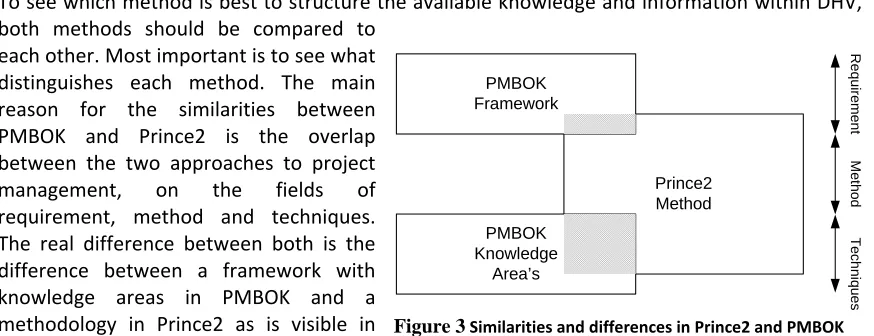
• No guideline about how to use this information
distinguishes each method. The main
reason for the similarities between
PMBOK and Prince2 is the overlap
between the two approaches to project
management, on the fields of
requirement, method and techniques.
The real difference between both is the
difference between a framework with
knowledge areas in PMBOK and a
methodology in Prince2 as is visible in
7
Project Management Institute (2004). A guide to the project management body of knowledge: PMBOK guide.
Newtown Square, Pennsylvania: Project Management Institute, Inc.
8
Duncan, W.R. (1995).Developing a PMBOK document: the US Project Management Institute’s approach.
figure 4. The so called ‘Framework’ of the PMBOK can be seen as a collection of principles to
which a method for project management should comply. This ‘Framework’ could be seen as a
‘Project Brief’ for the development of a method for project management in Prince2 terms.
The Knowledge Areas of PMBOK overlap with the Components of Prince2. The difference
between both is in techniques. PMBOK discusses several techniques while Prince2 pays
considerably less attention to techniques and focuses more on process. Thus, PMBOK can be
assignment, it therefore seems legitimate to structure the available knowledge on PM practice
into a Body of Knowledge for DHV. Therefore our framework will be built using the PMBOK
2.2.1
Project
management
of
building
and
industry
construction
projects
Construction projects are becoming more and more complex. With an increasing number of
specialized contributors, stakeholders and subcontractors proper integration of many disciplines
becomes necessary. Therefore a project organization is inevitable.
A construction process simply consists of the three following main phases; program, design and
construction. During these phases the functions, characteristics and form become more clear
with every step. Problem and solution must come together during this process. The program
phase is all about getting the demanded functions clear and determining the feasibility of
possible solutions. In the design phase the characteristics of the object are derived from the
functions. The construction or realization phase includes the transformation from the
characteristics to a usable object.10
9
APM Group Limited (2005).PRINCE2 Case Study, PRINCE2 and PMI/PMBOK a Combined Approach at Getronics.
Retrieved June 20, 2007, from http://www.Prince2.org.uk/web/site/PRINCE2Resources/Case‐Studies.asp.
10
Construction project management differs from ‘normal’ project management because of the
fact that building projects aren’t executed within an organization. Instead they temporarily form
a construction organization with the use of different external parties. This characteristic brings
extra complexity, but it doesn’t mean that the processes, instruments, tools and techniques
from general project management are useless. Unfortunately their use often becomes more
complicated. Other specific characteristics of a construction project are the commitment to a
specific location, the change of coalition (partners) during the project, the extensive
administrational regulations, the long life cycle of the product and the relatively high economical
value.
A more detailed (standard) phasing of a construction project is the sequential phasing below:
Initiation phase: determine the need for construction
Feasibility study: analysis of project possibilities
Project Definition: defining the goals and objectives
Design phase: This can be separated again into the general design, preliminary design,
and definite design
Tendering: defining the price, by making an inventory of the needed materials and
inviting contractors for a bidding
Work preparation: further detail design for execution
Execution: the construction of the object
Hand over: approval of client and closing the project11.
2.2.2
Construction
Project
Management
in
China
Like other sectors in the Chinese economy, the construction industry is also dependent on
foreign capital, technology and expertise. The industry has some similarities with western
projects but there are also some important differences. Some of these distinguishing
characteristics are mentioned below.12 13
conditions. Contract documents used are frequently bureaucratic and extensive. Foreign project
managers should therefore be extra careful when dealing with procurement matters.
One of the characteristics concerning the government is the extensive amount of regulations. In
together with two experienced project managers in a first orientating conversation.
Construction: The actual realization of the object which also includes the work
country in which it operates; China. The most important characteristics that influence project
management are Governmental regulations and bureaucracy.
In China as many other countries there are government regulations to take into account when
already mentioned general stages from the literature;
No initiation phase: This is because DHV is always doing a project for their client.
building the projects, but merely responsible for managing the project construction on
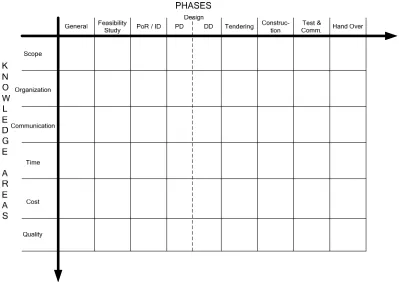
2.3
Framework
To build a framework to structure the available information we will use six of the knowledge
area’s of the PMBOK method in combination with the main characteristics of the context; the
project phases. This framework is presented schematically in the figure below.
Figure 4: Schematic Framework
We built up the framework using the DHV phases as main structure in the next chapter. Next to
this an extra paragraph is added to discuss general procedures that are used throughout more
than one phase. For the design phase we split the paragraph into two sub‐paragraphs. This main
structure, in phases, is presented on the horizontal line.
As substructure the knowledge areas, based on PMBOK, are used. Though we changed the HRM
knowledge area into organization, because this is better applicable in projects DHV manages for
their client. Within the knowledge area ‘Communication’ an extra paragraph will be devoted to
authority, due to the special attention this subject needs in China. The substructure, in
knowledge areas, is presented on the vertical line.
During our research we used this structure to analyze and categorize all available knowledge. In
this paper we have chosen however to merge the different knowledge areas per phase. We have
3
Project
management
in
practice
To answer our second research question; “What are the characteristics of project management
process at DHV Shanghai?” we have to take a look at the current practice at DHV and describe it.
An easy and structured way to do so is to fill the framework set up in chapter two. As mentioned
before the information in this chapter is mainly gathered through interviews.
Until this point of this research thesis we worked together, but we divided our tasks in different
activities it involves such as management, needs analysis, purchasing, testing,
installation and training
- Achievement‐oriented: this involves breaking down the overall project objective into
achievements such as having fully trained users, and acceptance of a system
By defining these boundaries clear together with the expectations of the client, DHV can set up a
clear project scope for their own project (management). This is required, because the goals of
the client and DHV are usually exactly the same.
Whether DHV contacts a company first or the client contacts DHV first, they always want to
write a good proposal, which outlines the project and work scope and responsibilities.
3.1.2
Organization
The organization of projects contains of an internal organization (DHV team) and an external
organization (DHV team with client, contractor, design institute etc.).
Figure 5: DHV’s project team internal organization chart
The internal team usually has a Project Director as end‐responsible of usually more than one
project at the same time. He is a troubleshooter and helps the Project Manager with important
milestones; like contracts, handover etc. The daily project work is done by the Project Manager,
who is usually dedicated to one project. He controls day to day communication with the client
and manages the control area’s (cost, time, quality etc.). The Project Manager is assisted by the
staff functions of his secretary and his HSE (health, safety and environment) personnel. In
smaller projects the Project Manager also is the Design Manager (DM) and/or the Construction
Manager (CM). Normally the DM is the LDI contact person and oversees the technical aspects in
all design stages. The Construction Manager is the contact person for the General Contractor.
Both of them will have a team of engineers within DHV working for them.
Figure 6: DHV’s external organization chart
The external project organization in projects DHV is involved in usually exists of the parties
mentioned above. The contact person from the client’s side is usually a Project Manager who
directly communicates to the project manager of DHV. The Project Manager of DHV will manage
the other parties mentioned in the figure above. This type of organization is common within the
entire industry. It is however important to mention that the contractual lines differ from the
organizational lines. Within DHV contractual lines are almost always directly between the client
and other parties.
3.1.3
Communication
Though communication is not always recognized as an important area to control, in practice it is
essential. Good communication can prevent a lot of misunderstanding. Within DHV the main
focus is on external communication, because internal communication is very well controllable
due to the location of the team members being on the same office floor and the ease internal
meetings can be held.
Figure 7: Communication lines
This is the communication‐map for a typical project. The client, or actually the Project Manager
of the client, communicates with DHV’s Project Manager. The Project Manager of DHV manages
his team and all the parties involved in the project process.
To be able to monitor all agreements that are made throughout a project, all communication
will have to pass through the Project Manager (see the ‘hourglass’ model in figure 9). This might
look like a ‘bottleneck’ in the conversation process, but actually the Project Manager can keep
all parties up‐to‐date and can clarify any obscurities if they occur.
In China the authorities also play an important role in the communication process. Because al lot
of permits need to be acquired from the local authority or the government, good
communication with the authority can speed up the project process, but maybe even more
important, if it is neglected it can lead to huge delays of the project.
DHV acknowledges the difficulties of authority handling in China and therefore DHV can assist
the client in dealing with the authorities by preparing the necessary documents for a permit
Within DHV a distinction is made into three types of
meetings; internal meetings (DHV team), external
(with LDI, contractor or other external party) or
project documentation’. The secretaries usually
take a big share of the work of filing and archiving.
The secretaries have a manual of their own (‘project
& construction document control manual’) for
documenting. They keep copies of all written
sketching is a difference with common project practice. As said this is done to streamline the
process and due to governmental permits.
A kick‐off meeting is held as the formal start of the project with the client. DHV uses interviews
and questionnaires to make a complete and structured inventory of the client’s needs. The PoR
& ID phase does not need an approval by the authorities or a third party. Approval from the
client is crucial however because the PoR is seen as the base of each project.
3.4
Design
The design phase is subdivided into the Preliminary Design (PD) phase and the Detailed Design
phase (DD). Within the design phase DHV always uses a Local Design institute (LDI) for the PD
and DD. Due to government regulations foreign companies are not certified to draw the PD and
DD. Therefore they need a local design institute to make these drawings, the LDI will ask the
government to approve these design drawings and ‘chop’ the designs. There also is a third party,
a Design Review Company (DRC) who also needs to approve the drawings before continuation.
Figure 10: Steps in preliminary design phase
Figure 11: Steps in detailed design phase
In the design phase it is very important to keep close track of the design process and especially
of any changes or modifications in the design. Within DHV these requests for change are
structured using a ‘design change notification’ (DCN) document. The client needs to fill in such a
document and sign it for the extra time and cost the change will probably take. This will prevent
There can be different forms of contract. The normal form of contract in the design phase is a
contract signed by the client and the LDI. Sometimes however, a contract for the design is
signed by DHV and the LDI.
To select the right LDI for a certain project the key factors are the location of the LDI (is it based
in the same city as where the project will be located) and the right knowledge. These factors are
important because culture and governmental regulations can vary greatly between different
provinces and even cities in China. Also designer‐expertise in a specific field can make the
concrete. To streamline communication the preferable way
Surveyor (QS). At the end of this phase, the final construction budget will be prepared in close
cooperation with the DHV QS. Finally the tenders will be evaluated, clarified and negotiated,
resulting in finalization of contracts with one General Contractor (GC). This contractor will
usually manage both CAS (Civil, Architectural, and Structural) and MEP (Mechanical, Electrical,
and Process) works.
For the tendering phase a contract has already been set up by DHV together with the client in
the design phase. These were called the IFB and the IFC; the actual contract will be based on the
bidding of the GC on the IFC. The contracts are based on the FIDIC (International Federation of
Consulting Engineers) general conditions.
There are two forms of contract generally used within DHV; a Lump Sum and a Re‐measurement
contract. The Lump Sum contract means one price for the whole contract. This is the easiest
form for DHV to manage, though design changes are more difficult to integrate and will need
new negotiations with the contractor for the price of the change. A Re‐measurement contract is
usually preferred by the GC. The GC gets paid per unit which goes into the building (e.g. steel
beams). The advantage is that design and construction changes can be easily made without
changing the contract. The disadvantage is that all the work that is actually put in to the building
must be checked, this causes extra work for the QS and the Project Manager.
The authorities are also involved in the tendering phase. Before the construction phase can be
started a formal document called the ‘construction permit’ needs to be acquired from the
authorities. Sometimes DHV uses a ‘authority specialist’ to speed up this process since the
Chinese system is quite bureaucratic and the regulations concerning permits can be interpreted
in many ways.
3.6
Construction
In the construction phase all the designs and preparations will be put into work. The
construction phase is all about making sure the GC completes the building according to the
agreed design. The main focus in this phase is on time, to complete the project within the
deadline with of course no or minimum of extra costs, while maintaining the pre‐defined level of
quality.
Figure 14: Steps in construction process
For the DHV PM the main task is to smoothen the work of the GC. One of the company motto’s
which surely applies to this phase is; ‘you can not be responsible for what you can not control’.
So the DHV PM is not responsible for work carried out by the GC, but should create an optimal
Throughout the construction phase DHV’s main responsibility is to monitor the construction
processes to assist in ensuring that all the requirements of the client for such processes have
been met.
Client
DHV
Supervisor Co. (Jianli) Contractor
LDI
The communication in this phase is quite similar
to the design phase. When there are questions
from for example the GC about the design this will
go through the PM. But when the GC just needs
specifications he can ask the LDI directly.
The in chapter 2.2.2 already mentioned Jianli is
the on‐site authority during the construction
phase. The filing and archiving of the documents
by DHV is especially important in the construction
phase, because they need to be available for the
3.7
Testing
&
Commissioning
In the testing and commissioning phase the structure (whether it is a building or plant) is tested
to see if everything works properly. There is a checking on building errors, installation errors, as
well as details like scratches on doors etc.
Figure 16: Steps in testing & commissioning phase
In the testing phase the different smaller items are first tested separately followed by the
testing of a complete system, like the fire‐fighting system. After the testing phase the
commissioning phase starts, this means putting to whole building ‘into work’ and checking for
errors in for example building temperature (heating, AC). DHV accompanies the commissioning
for the crucial systems on which government approval is needed (e.g. fire fighting). During
testing and commissioning all tests are documented in the testing and commissioning report.
3.8
Hand
‐
over
After testing and commissioning, the building or plant will be handed over to the client. This is
the last phase with responsibility for DHV. After this hand‐over the client is responsible. DHV will
merely assist in the communication with the GC in the defect information period.
Figure 17: Steps in hand over
Alex: In the hand‐over phase DHV will be responsible for the actual hand‐over to the client.
Before DHV can hand‐over the building or plant, they first need a completion approval from the
4
Challenges
&
possible
improvements
extracted from the comparison directly.
therefore seems justifiable to choose Prince2 when making a comparison. When comparing this
method with current practice, Prince2’s disadvantages must be kept in mind. The method’s
situated. This includes the cultural characteristics, national and local governmental characteristic
and the company culture. Second, the sector of industry, in which DHV operates, can demand a
specific approach. This includes the characteristics of Building and Industry projects, the
project’s scale, its complexity and the ‘special’ field in which DHV operates being a consultant
challenges and improvements. Wherever Prince2 terminology is used, the accompanying
Prince2‐abbreviation will be given as well.
17
‐ Akker, van den, A. (2002). PRINCE2 Compact. Heeswijk: Lagant Management Consultants BV.
‐ Office of Government Commerce (2002).Managing Successful Projects with PRINCE2. London: The Stationery Office. ‐ Fredrikz, B., Hedeman, B.,& Vis van Heemst, G. (2004). Projectmanagement, een introductie op basis van PRINCE2.
Zaltbommel: van Haren Publishing. 18
APM Group Limited (2005).PRINCE2 Case Study, PRINCE2 and PMI/PMBOK a Combined Approach at Getronics.
4.2
Challenges
&
possible
improvements
assurance and a Quality planning. The quality system includes the different procedures,
processes and organization to implement quality. Such a system is the basis of a quality plan but
consuming and is integrated into the existing time schedules. Summarizing, project quality
management can be improved by the set up of an overall quality system fitting the quality
tolerances and reporting demands. The only current possibility to clearly state such agreements
manager. A small risk can undermine a whole project. Prince2 supports this view and pays great
attention to the assessment of risks. Within Prince2 its importance is represented by the
component; Management of Risk. Management of Risk can be divided again into a risk analysis,
which contains the search and assessment of different risks, and risk management, containing
the execution of risk‐reducing measures. Although the DHV project managers pay great
lessons learnt report after the projects closure.
4.3
Additional
challenges
Next to the challenges stated above there are also challenges that emerge parallel and
independent of the analysis made in the previous chapter. These, often more concrete,
challenges were gathered during site‐visits, observations and especially interviews. Some of
these ‘parallel emerged’ challenges are definitely worth mentioning.
Health, Safety and Environment: Partially overlapping the challenge concerning quality, ‘Health,
Safety and Environment’, or HSE, is becoming an increasingly important term in construction
projects. Especially western companies and chemical companies increasingly demand a certain
Maintenance: This challenge looks obvious but is certainly worth to be mentioned. When a
comparison is made between the different phases in a DHV project and the phasing in standard
literature about construction it immediately becomes clear that maintenance is not included in
DHV Shanghai practice. This ‘gap’ can be partly explained by a lack of interest in this subject in
the whole of China. Nonetheless is seems worthwhile to explore the possibilities on this field as
it can be an extra service to the client and an extra source of income for DHV itself. As this
challenge is purely the content of a project and not about project management itself this
challenge is not in our scope. This challenge will therefore not be analyzed.
Design Integration: Before discussing this challenge we will first define the term design
integration. Design integration, in this context, is the whole process of integrating all different
fields of knowledge and requirements during designing. This challenge is especially important in
complex projects as engineers often tend to work on their own subject and do not look over
their task boundaries. Another challenge in design integration is the communication between
the DHV office (engineers) and the external designers (LDI). This also influences design
integration and is non‐optimal because of the lack of standard rules. Now different people have
a different understanding of some drawings or terms. This challenge is, similar to the previous
challenge, not directly about project management but is related to the content of each project
itself. It therefore is left out the analysis as well.
As we overlook all challenges and possible improvements listed above a certain type of
improvement can be recognized. This type of improvement can be found in the field of
procedures. The challenges which mainly concern procedures are: ‐ Formal start‐up document
‐ Quality procedures
‐ Handing over tasks/assignments ‐ Risk Assessment
‐ Project Evaluation
‐ Health safety and Environment ‐ Knowledge sharing
As mentioned above the following two challenges are not in the scope of this research and
therefore not further addressed.
‐ Maintenance
5
Implementation
knowledge database Sharework for example impossible. Therefore a simple solution like adding
quality procedures, this document could develop similar to the General Project Management
Manual. This means that the current practice is analyzed and written down first after which
fitting procedures are (gradually) added filling the ‘gaps’ in quality management practice. This
improvement depends mainly on the effort and time that is put into it. This implementation can
be performed by either a DHV employee or a student during an internship.
For the overall HSE procedures it will be best to create a manual to write down the procedures,
though a careful distinction has to be made between different construction projects. Building
better to have a short and simple evaluation that is easy to perform, than an extensive one that
is never used.
Implementation of the formal start up and task hand over are relatively simple and can be
implemented by writing a basic procedure, making a template and explaining the use of both in
the Project Management Manual and during, for example, a workshop.
6
Conclusions
&
Recommendations
Project Management is well executed at DHV Shanghai. This is the main conclusion that can be
drawn from this analysis. Although project management is well executed, there still is room for
further improvement of this practice. In this chapter a recommendation for the implementation
of the improvements is given.
regulates the explicit assessment and monitoring of all possible threats and
ShareWork, as it is done right now, are perfect examples on how to do so. So our final and most
important recommendations can be stated as:
- Keep a continues focus on Developing & Sharing knowledge by keeping the
documents ‘alive’ and supporting initiatives on this field.
Especially the last recommendation is crucial as it is actually a strict condition to develop the
other recommendations.
References
Akker, van den, A. (2002). PRINCE2 Compact. Heeswijk: Lagant Management Consultants BV.
Al‐Jibouri, S. (2000).Dictaat Planning, beheersing en risicomanagement. Enschede: Univsersity of
Twente.
Charvat, J.P. (2003). Project Management Methodologies: selecting, implementing and
supporting methodologies and processes for projects. Hoboken, New Jersey: Wiley
Dalkowski, A., Lohnert, G., & Sutter, W.(2003). Integrated Design Process. Berlin: International
energy agency.
Doree, A.G., Suurenbroek, Y.E., & Van der Veen, B. (2000).Dictaat Bouwprocessen, Enschede:
University of Twente.
Ducan, W.R. (1995).Developing a PMBOK document: the US Project Management Institute’s
approach. International journal of project management, 13, 89‐94.
Fredrikz, B., Hedeman, B.,& Vis van Heemst, G. (2004). Projectmanagement, een introductie op
basis van PRINCE2. Zaltbommel: van Haren Publishing.
Kerzner, H. (2001). Project Management, A systems approach to Planning, Scheduling, and
Controlling. New York, NY: John Wiley & Sons, Inc.
Office of Government Commerce (2002).Managing Successful Projects with PRINCE2. London:
The Stationery Office.
Pheng, L.S., & Leong, C.H.Y. (2000). Cross‐cultural project management for international
construction in China, International Journal of Project Management, 18, 307‐316.
Project Management Institute (2004). A guide to the project management body of knowledge:
PMBOK guide. Newtown Square, Pennsylvania: Project Management Institute, Inc.
Self‐study management training.(n.d.). Retrieved April 30, 2007, from http://mindtools.com
Wawruck, W.A. (1987). A Neglected Dimension of Effective Performance on Diverse Projects.
PM Northwest Regional Symposium.
Wikipedia search on project management. (n.d.). Retrieved February 18, 2007, from
http://en.wikipedia.org/wiki/Project_Management.
You‐Jie, L., & Fox, P.W. (2001). The construction industry in China: its image, employment
prospects and skill requirements. Geneva: International Labour Office.
List
of
abbreviations
AC Air Conditioning
BD Basic Design
BEEC Beijing Environmental Engineering Company
BOQ Bill Of Quantities
CC Current Copy
CAS Civil, Architectural, Structural
CPA Critical Path Analysis
DD Detailed Design
DCN Design Change Notification
DIN Deutsches Istitut für Normung (German, like ISO)
DRC Design Review Company
EPCM Engineering Procurement Construction Management
FIDIC International Federation of Consulting Engineers (this acronym stands
for the French version of the name)
IEC International Electrotechnical Commission
IQ Installation Quality
ISO International Standardization Organization
LDI Local Design Institute
M&E Mechanical & Engineering
MEP Mechanical Electrical Process
MoM Minutes of Meeting
SMART Specific Measurable Accurate Realistic Time
Appendix
C:
Interview
questions
General Questions per knowledge area
Organization
- How do you determine responsibilities?
- You have a team member who is not meeting his commitments, what do you do?
- How do you determine the project budget? o Do you use WBS to estimate?
- What do you do when a client budget isn’t sufficient?
- Do you have a standard method to keep track of the cash flow?
- Which procedures of payment are there? o Certification?
o Contract?
- Which procedures do you use in procurement control?
Quality Control
- What is quality control to you?
- How would you define it?
- Which tasks does it contain? In which phase is it used / changed?
- Which tools do you use for quality control?
- How do you see to it that the requirements actually can be lived up to?
- What is the review and approval procedure on quality control?
- Are there any standards? o Regulations?
o Check list?
HSE (only during construction phase)
- What is HSE to you?
- How would you define it?
- Which tasks does it contain?
- Which tools do you use for controlling HSE?
- Which requirements are commonly given by: o The government
Appendix
D:
Information
Interviews
and
Site
Visits.
Interviews
Name Interviewee: Tim Jeanne
Function: General Manager DHV Shanghai / Project Management
Current project(s):‐‐‐‐
Topics of interview: Project Organization, Contract Management, Scope and Cost
Date Interview: May 16, 2007
Name Interviewee: Chris Shi Yu Cheng
Function: Deputy General Manager DHV Shanghai / Project Management
Current project(s):‐‐‐‐
Topics of interview: Project Organization, Contract Management
Date Interview: May 15, 2007
Name Interviewee: Wim Jansen
Function: Senior Project Manager / Project Director
Current project(s):DSM China Campus, Smit & Zoon Leather Chemicals
Topics of interview: Project Organization, Contract Management
Date Interview: May 18, 2007
Name Interviewee: Frans van Gunsteren
Function: Chairman DHV China Advisory Board
Current project(s):‐‐‐‐‐
Topics of interview: Overall advice
Date Interview: various teleconferences
Name Interviewee: Ruud Beekhuis
Function: Project Manager
Current project(s): DSM China Campus,
Topics of interview: Scope, Cost and Quality
Date Interview: May 14, 2007
Name Interviewee: Thomas Wang
Function: Project Manager
Current project(s): Philips R&D Campus
Topics of interview: Quality, Time, Communication, Tendering phase and Design phases
Name Interviewee: Kong Zhen
Function: Project Manager
Current project(s): Smit & Zoon Leather Chemicals, Eurocampus International School, Semperit
Rubber & Plastic Products.
Topics of interview: Governmental permits and Cost, Quality, Time, Communication,
Organization in the Construction phase.
Date Interview: May 14, 2007
Name Interviewee: Dai Xin
Function: Project Manager
Current project(s): Siemens Shanghai Medical Equipment.
Topics of interview: Construction phase, Testing and Commissioning phase, Hand‐over phase.
Date Interview: May 21, 2007
Topics of interview: Filing and Archiving, Communication
Date Interview: May 16, 2007
Name Interviewee: Li Hua
Function: Architect, Design coordinator and construction coordinator
Current project(s): DSM R&D Campus
Topics of interview: Design phase and Construction phase.
Date Interview: May 18, 2007
Project: Siemens Shanghai Medical Equipment
Phase: this project was in the Testing and Commissioning phase / Handover phase.