Practical Evaluation of Human and Synthesized Speech
for Virtual Human Dialogue Systems
Kallirroi Georgila
†, Alan W. Black
‡, Kenji Sagae
†, David Traum
††Institute for Creative Technologies, University of Southern California ‡Language Technologies Institute, Carnegie Mellon University
{kgeorgila,sagae,traum}@ict.usc.edu, [email protected]
Abstract
The current practice in virtual human dialogue systems is to use professional human recordings or limited-domain speech synthesis. Both approaches lead to good performance but at a high cost. To determine the best trade-off between performance and cost, we perform a systematic evaluation of human and synthesized voices with regard to naturalness, conversational aspect, and likability. We also vary the type (in-domain vs. out-of-domain), length, and content of utterances, and take into account the age and native language of raters as well as their familiarity with speech synthesis. We present detailed results from two studies, a pilot one and one run on Amazon’s Mechanical Turk. Our results suggest that a professional human voice can supersede both an amateur human voice and synthesized voices. Also, a high-quality general-purpose voice or a good limited-domain voice can perform better than amateur human recordings. We do not find any significant differences between the performance of a high-quality general-purpose voice and a limited-domain voice, both trained with speech recorded by actors. As expected, in most cases, the high-quality general-purpose voice is rated higher than the limited-domain voice for out-of-domain sentences and lower for in-domain sentences. There is also a not statistically significant trend for long or negative-content utterances to receive lower ratings.
Keywords:speech synthesis, professional and amateur human recordings, dialogue systems, virtual humans
1.
Introduction
Virtual humans are artificial conversational agents designed to mimic the behavior of real humans (Gratch et al., 2002; Swartout et al., 2006; Traum, 2008; Traum et al., 2008). The perceived naturalness of a virtual human is a mixture of aspects, such as appearance, voice, gestures, etc. In fact studies have shown that behavior can be more important than appearance (Cassell and Tartaro, 2007). In this paper we focus on the aspect of voice. In order for virtual humans to successfully simulate real humans, they need to sound natural and also give the impression that they are engaged in the conversation when interacting with real humans. When building a virtual human dialogue system, a major decision is whether to use human recordings or synthesized speech. The advantage of using human recordings is ob-viously performance. But this high quality comes at the high cost of hiring a professional actor to record the lines that the virtual human will utter. Furthermore, once we de-cide to expand the system by adding more lines, the actor has to be hired again to record the new lines. The alter-native is to use speech synthesis. Current state-of-the-art speech synthesizers have reached high levels of naturalness and intelligibility for neutral read aloud speech. However, synthesized speech generated using neutral read aloud data lacks all the attitude, intention, and spontaneity associated with everyday conversations (Andersson et al., 2010). Note that building a synthesized voice usually requires hiring an actor to record a large number of sentences plus the addi-tional effort of processing these recordings. To improve the quality of speech synthesis in a particular domain, an al-ternative approach to general-purpose speech synthesis is limited-domain speech synthesis (Black and Lenzo, 2000). A limited-domain synthesized voice is trained using
mate-rial from the domain where it will be deployed in order to achieve high-quality speech synthesis within this domain. Note that recently there have been attempts to build syn-thesized voices especially for conversational purposes (An-dersson et al., 2010; Marge et al., 2010; An(An-dersson et al., 2012).
For the above reasons, the current practice in virtual hu-man dialogue systems (especially systems that are targeted to real users) is to use professional human recordings or limited-domain speech synthesis. The problem is that, as previously discussed, both approaches can be very costly and time consuming. The question that arises is whether the performance of professional human recordings or limited-domain synthesized speech justify their cost. Are profes-sional human recordings and limited-domain synthesized voices better than amateur human recordings or general-purpose synthesized voices? And if yes, how much better are they? Furthermore, how does the performance of hu-man and synthesized voices vary depending on the length and content of the utterance? Also, what is the importance of the age of the listeners, their native language, and their familiarity with speech synthesis?
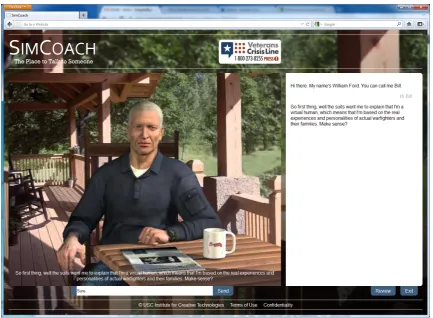
Figure 1: The Simcoach web interface.
In this paper we aim to answer these questions. We per-form two studies, one small-scale pilot study and one large-scale study on Amazon’s Mechanical Turk (MTurk,http: //www.mturk.com), and compare a variety of human and synthesized voices based on several criteria, i.e. natu-ralness, conversational aspect, and likability. We also vary the type (in-domain vs. out-of-domain), length, and content of utterances (see section 2), and we take into account the age and native language of the participants as well as their familiarity with speech synthesis.
The paper is structured as follows. In section 2, we de-scribe our corpus of sentences that were spoken by humans or synthesized by speech synthesis engines. In section 3 we present the voices that we compared. Section 4 is about our experimental setup and sections 5 and 6 present our re-sults. Finally, section 7 discusses our findings and section 8 concludes.
2.
Our Corpus of Sentences
Our virtual human dialogue system called Simcoach (Rizzo et al., 2011) aims to motivate military personnel and family members to take the first step and seek information and ad-vice with regard to their health care, in particular depression and post-traumatic stress disorder. The system and the user communicate with natural language. More specifically, the user types text and the system responds using speech and non-verbal behavior. The current Simcoach system uses professional human recordings for the system utterances. In Figure 1 we can see the web interface of Simcoach.
We selected 200 sentences in the Simcoach domain, out of which 100 were included in the data set used for training our two limited-domain synthesized voices (see section 3). We also selected 30 out-of-domain sentences. An exam-ple of an in-domain sentence is “well I’m just trying to get some info so I can help you better” and an example of an out-of-domain sentence is “this TV show is hilarious, don’t you think so?”. The sentences (both in-domain and out-of-domain) varied in length (long, i.e.>5 words and short, i.e. up to 5 words) and content (positive, neutral, and negative). An example of positive content is “that was the best meal ever”, an example of neutral content is “I prefer reading the news online”, and an example of negative content is “it makes me feel unhappy and hopeless”. To measure inter-annotator agreement, two experienced inter-annotators annotated 400 sentences for their content. For 332 sentences (83%) there was agreement between the annotators, i.e. the anno-tators agreed that these sentences had positive or neutral or negative content. From the sentences where there was dis-agrement (68 in total, 17%) only 4 were short in length. For our evaluation we selected only sentences where there was agreement between the annotators. In Table 1 we can see the distribution of sentences used in our evaluation with re-spect to the domain, length, and content. In our pilot study we used only sentences with positive content.
3.
Human and Synthesized Voices
limited-Abbreviation Domain Used for training the Length Content Number of limited-domain voices? sentences dom-train-lg-pos in-domain yes long positive 30 dom-train-lg-neu in-domain yes long neutral 30 dom-train-lg-neg in-domain yes long negative 20 dom-train-sh-pos in-domain yes short positive 10 dom-train-sh-neu in-domain yes short neutral 10 dom-notrain-lg-pos in-domain no long positive 35 dom-notrain-lg-neu in-domain no long neutral 35 dom-notrain-lg-neg in-domain no long negative 30
gen-lg-pos out-of-domain no long positive 6
gen-lg-neu out-of-domain no long neutral 5
gen-lg-neg out-of-domain no long negative 5
gen-sh-pos out-of-domain no short positive 4
gen-sh-neu out-of-domain no short neutral 5
gen-sh-neg out-of-domain no short negative 5
Table 1: Our corpus of sentences.
domain ones). One professional actor and one speech synthesis expert recorded approximately 1300 sentences in our Simcoach domain plus some general sentences to im-prove coverage. These recordings were used for building our two limited-domain unit-selection synthesized voices (Black and Taylor, 1997; Black and Lenzo, 2000). More specifically, for our studies we use the following human and synthesized voices:
• Professional actor’s voice (PROF): The 100 in-domain sentences of our corpus (see section 2) were recorded by a professional actor. These were a subset of the recorded sentences used for training the first limited-domain voice (see below).
• Amateur person’s voice (AMAT): The 230 sentences of our corpus were recorded by an amateur, neither ac-tor nor speech synthesis expert. Due to some problems with these amateur recordings (low audio volume) we only kept 67 in-domain utterances for our pilot study.
• High-quality general-purpose voice (GEN-HIGH): The 230 sentences of our corpus were synthesized us-ing a custom high-quality commercial unit-selection voice developed by CereProc Ltd (Aylett et al., 2006) for USC/ICT. This voice was trained on material un-related to our domain. This material was recorded by a professional actor (different from the actor whose speech was used for our professional human record-ings and one of the limited-domain voices).
• First limited-domain voice (LD1): The 230 sentences of our corpus were synthesized using a limited-domain unit-selection voice. This voice was trained with the recordings of the professional actor (PROF); ap-proximately 1300 recorded sentences in our domain. Also, this voice works with the Flite speech syn-thesis engine (http://www.speech.cs.cmu. edu/flite/) developed at CMU.
• Second limited-domain voice (LD2): The 230 sen-tences of our corpus were synthesized using a second
limited-domain unit-selection voice. This voice was trained with the recordings of a speech synthesis ex-pert; approximately 1300 recorded sentences in our domain plus some additional general material to im-prove coverage. Again, this voice works with Flite.
• Lower-quality general-purpose voice (GEN-LOW): The 230 sentences of our corpus were synthesized us-ing a lower-quality diphone-based voice (Microsoft Sam).
Note that for our pilot study we used only sentences with positive content, which means that we ended up with 40 utterances for PROF, 30 for AMAT, and 85 for each of the synthesized voices. For our MTurk experiment we used utterances from all content categories.
4.
Experimental Setup
We performed two studies, one small-scale pilot study and one large-scale study run on Amazon’s Mechanical Turk (MTurk). Below we provide details about our experimental setup in both studies.
4.1. Pilot Study
In our pilot study each participant was asked to listen to 12 utterances (2 from each human or synthesized voice cat-egory) and answer the following 3 questions on a 5-point Likert scale:
• Question 1: Does this utterance sound natural? (1=very unnatural, 2=somewhat unnatural, 3=neither natural nor unnatural, 4=somewhat natural, 5=very natural)
• Question 2: Is this an isolated prompt or taken from a conversation? (1=definitely isolated prompt, 2=maybe isolated prompt, 3=cannot decide, 4=maybe taken from a conversation, 5=definitely taken from a con-versation)
PROF AMAT GEN-HIGH LD1 LD2 GEN-LOW
mean mean mean mean mean mean
CI CI CI CI CI CI
All questions combined
dom-train-lg-pos 3.96 4.06 2.88 3.17 2.74 2.08
3.30-4.23 3.89-4.23 2.37-3.39 2.65-3.69 2.23-3.25 1.67-2.49
dom-train-sh-pos 3.60 3.38 3.07 2.84 2.42
3.33-3.87 2.93-3.82 2.56-3.57 2.45-3.23 1.95-2.90
dom-notrain-lg-pos 3.07 2.33 2.63 2.04
2.61-3.52 1.84-2.83 2.09-3.17 1.49-2.58
gen-lg-pos 2.94 2.36 2.77 1.78
2.53-3.36 1.99-2.73 2.28-3.25 1.38-2.18
gen-sh-pos 2.82 2.30 2.09 1.78
2.41-3.23 1.88-2.72 1.65-2.53 1.38-2.18 all utterances combined 3.79 4.06 2.99 2.60 2.62 2.03
3.60-3.98 3.89-4.23 2.80-3.18 2.40-2.80 2.42-2.83 1.83-2.22
Question 1 3.94 4.42 2.80 2.28 2.31 1.40
all utterances combined 3.60-4.29 4.17-4.68 2.45-3.14 1.91-2.66 1.96-2.67 1.21-1.58
Question 2 3.70 3.87 3.31 3.15 3.20 2.96
all utterances combined 3.34-4.06 3.54-4.19 2.96-3.67 2.82-3.48 2.85-3.55 2.58-3.35
Question 3 3.74 3.88 2.85 2.36 2.35 1.72
all utterances combined 3.44-4.03 3.60-4.17 2.54-3.17 2.04-2.68 2.04-2.67 1.46-1.97
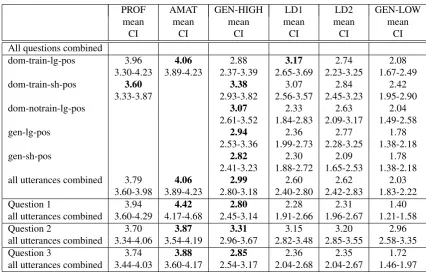
Table 2: Results for all participants in our pilot study (CI: 95% confidence interval).
PROF AMAT GEN-HIGH LD1 LD2 GEN-LOW
mean mean mean mean mean mean
CI CI CI CI CI CI
native 4.08 4.14 2.78 2.65 2.41 1.91
(16 raters) 3.85-4.30 3.94-4.35 2.53-3.03 2.34-2.95 2.15-2.66 1.66-2.17
non-native 3.39 3.94 3.29 2.53 2.94 2.18
(11 raters) 3.08-3.71 3.65-4.23 2.98-3.59 2.29-2.77 2.61-3.27 1.88-2.49
all 3.79 4.06 2.99 2.60 2.62 2.03
(27 raters) 3.60-3.98 3.89-4.23 2.80-3.18 2.40-2.80 2.42-2.83 1.83-2.22
Table 3: Results for native vs. non-native participants in our pilot study, all questions combined (CI: 95% confidence interval).
and AMAT was rated higher than GEN-HIGH (not signif-icant). GEN-HIGH was perceived as better than LD1 (not significant), and LD1 as better than LD2 (marginally sig-nificant). GEN-LOW was rated as the worst voice (signifi-cant). For UK English speakers, PROF was also perceived as the best voice but not as significantly better than GEN-HIGH, which in turn was not perceived as significantly bet-ter than AMAT. GEN-HIGH was rated higher than LD1 (not significant). LD1 was perceived as significantly better than LD2, and GEN-LOW was rated higher than LD2 (sig-nificant). For Indian English speakers, PROF was judged as the best voice (significant), GEN-HIGH and LD1 as better than AMAT (significant), and GEN-HIGH as better than LD1 (not significant). Also, GEN-LOW performed the worst (significant). Non-native speakers (Other) preferred the PROF and GEN-HIGH voices, which were both judged as significantly better than the rest of the voices. LD1 was perceived as better than AMAT (not significant) and LD2 (significant), and GEN-LOW was rated as the worst voice (significant).
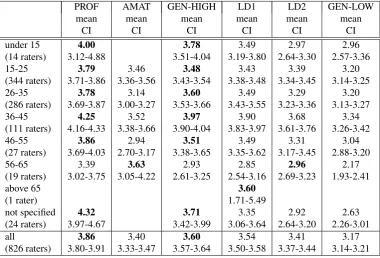
In Table 6 we can see the results with regard to the age
of the participants. In total we had 14 participants under the age of 15, 344 between 15 and 25, 286 between 26 and 35, 111 between 36 and 45, 27 between 46 and 55, 19 between 56 and 65, and 1 above 65, whereas 24 partici-pants did not provide information about their age. In all age groups, except for the age group 56-65, PROF is perceived as the best voice. GEN-HIGH is consistently rated as better than AMAT apart from the age group 56-65. Participants of the age groups 26-35, 36-45, and 46-55 prefer LD1 to AMAT, and generally the consensus is that LD1 performs better than LD2, which in turn performs better than GEN-LOW. The exception to this rule is that LD2 is perceived as slightly better than LD1 for the age group 56-65 (not sig-nificant).
an-PROF AMAT GEN-HIGH LD1 LD2 GEN-LOW
mean mean mean mean mean mean
CI CI CI CI CI CI
All questions combined
dom-train-lg-pos 3.89 3.51 3.77 3.75 3.63 3.22
3.80-3.98 3.41-3.61 3.67-3.87 3.66-3.85 3.53-3.73 3.11-3.32
dom-train-lg-neu 3.83 3.34 3.61 3.71 3.51 3.22
3.73-3.92 3.23-3.45 3.52-3.71 3.62-3.81 3.40-3.61 3.11-3.32
dom-train-lg-neg 3.66 3.22 3.40 3.69 3.29 3.26
3.55-3.78 2.99-3.44 3.28-3.53 3.58-3.81 3.16-3.42 3.14-3.38
dom-train-sh-pos 4.13 3.91 4.06 3.82 3.57
3.98-4.28 3.75-4.08 3.90-4.22 3.64-4.00 3.40-3.74
dom-train-sh-neu 3.96 3.98 3.91 3.69 3.10
3.80-4.13 3.82-4.14 3.75-4.07 3.51-3.87 2.92-3.28
dom-notrain-lg-pos 3.68 3.56 3.38 3.16
3.59-3.77 3.47-3.65 3.29-3.47 3.06-3.26
dom-notrain-lg-neu 3.56 3.32 3.26 3.12
3.47-3.65 3.22-3.41 3.17-3.36 3.03-3.22
dom-notrain-lg-neg 3.37 3.22 3.13 3.06
3.27-3.47 3.12-3.33 3.03-3.24 2.96-3.16
gen-lg-pos 3.68 3.38 3.55 2.99
3.45-3.90 3.15-3.61 3.32-3.78 2.75-3.23
gen-lg-neu 3.56 3.10 3.06 3.09
3.32-3.80 2.84-3.37 2.81-3.31 2.84-3.33
gen-lg-neg 3.14 3.50 3.25 3.01
2.88-3.40 3.26-3.74 3.01-3.49 2.76-3.25
gen-sh-pos 3.82 3.19 3.43 3.14
3.56-4.09 2.92-3.46 3.13-3.72 2.86-3.42
gen-sh-neu 3.69 3.53 3.70 3.36
3.46-3.93 3.30-3.77 3.45-3.95 3.10-3.61
gen-sh-neg 3.26 3.05 3.40 3.06
3.03-3.49 2.78-3.31 3.15-3.65 2.81-3.31 all utterances combined 3.86 3.40 3.60 3.54 3.41 3.17
3.80-3.91 3.33-3.47 3.57-3.64 3.50-3.58 3.37-3.44 3.14-3.21
Question 1 3.97 3.43 3.71 3.57 3.41 3.10
all utterances combined 3.89-4.06 3.30-3.56 3.65-3.77 3.50-3.63 3.34-3.47 3.03-3.16
Question 2 3.57 3.25 3.34 3.37 3.27 3.13
all utterances combined 3.47-3.67 3.13-3.37 3.27-3.41 3.30-3.43 3.20-3.34 3.07-3.20
Question 3 3.99 3.50 3.72 3.66 3.52 3.28
all utterances combined 3.90-4.07 3.39-3.62 3.66-3.77 3.60-3.72 3.46-3.58 3.22-3.34
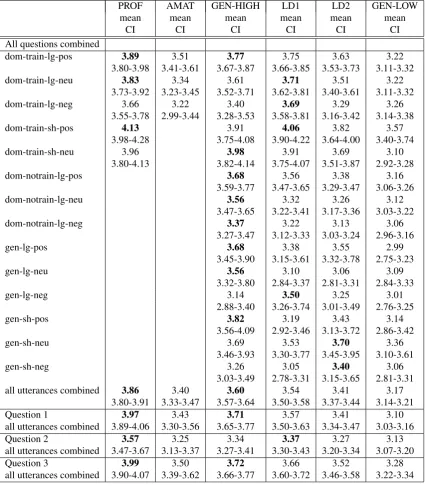
Table 4: Results for all participants and all questions in the MTurk study (CI: 95% confidence interval).
swering “yes/no” would disqualify them. However, it is unclear whether participants understood the question. For example, the results for TTS developers (18 in total) were surprising; GEN-LOW was rated as better than all voices, except for LD2, which raises questions about how different people perceive the term “familiarity with TTS”. It could be the case that these participants thought that synthesized voices were supposed to sound like TTS rather than human-like. The rest of the results were consistent with our overall results, i.e. PROF was perceived as the best voice, followed by GEN-HIGH and LD1. LD2 was rated higher than LD1 by the participants who often use TTS (not significant).
7.
Discussion
The trends that we see in our results are more or less ex-pected. What is surprising though is that in the MTurk
study on average GEN-HIGH and LD1 were perceived as significantly better than AMAT. It is hard to generalize be-yond the voices that we included in our study but this re-sult shows that speech synthesis has reached a high level of quality. As our results show, even the best synthesized voices cannot reach the level of professional voices, how-ever, the differences in scores were not very large. This suggests that investing on a high-quality voice rather than using professional or amateur human recordings can be a good trade-off between performance and cost.
ses-PROF AMAT GEN-HIGH LD1 LD2 GEN-LOW
mean mean mean mean mean mean
CI CI CI CI CI CI
US English 3.88 3.51 3.46 3.42 3.30 3.15
(173 raters) 3.78-3.97 3.39-3.64 3.39-3.53 3.36-3.49 3.23-3.37 3.08-3.23
UK English 3.46 3.13 3.27 3.24 2.75 3.07
(62 raters) 3.24-3.69 2.77-3.49 3.14-3.40 3.10-3.37 2.61-2.88 2.92-3.21 Indian English 3.83 3.46 3.67 3.65 3.61 3.36 (264 raters) 3.76-3.90 3.36-3.56 3.62-3.72 3.60-3.70 3.56-3.66 3.31-3.41
Other 3.71 3.35 3.60 3.49 3.28 3.04
(303 raters) 3.62-3.80 3.22-3.47 3.54-3.67 3.43-3.55 3.22-3.35 2.98-3.11
not specified 4.32 3.71 3.35 2.92 2.63
(24 raters) 3.97-4.67 3.42-3.99 3.06-3.64 2.64-3.20 2.26-3.01
all 3.86 3.40 3.60 3.54 3.41 3.17
(826 raters) 3.80-3.91 3.33-3.47 3.57-3.64 3.50-3.58 3.37-3.44 3.14-3.21
Table 5: Results for native vs. non-native participants in the MTurk study, all questions combined (CI: 95% confidence interval).
PROF AMAT GEN-HIGH LD1 LD2 GEN-LOW
mean mean mean mean mean mean
CI CI CI CI CI CI
under 15 4.00 3.78 3.49 2.97 2.96
(14 raters) 3.12-4.88 3.51-4.04 3.19-3.80 2.64-3.30 2.57-3.36
15-25 3.79 3.46 3.48 3.43 3.39 3.20
(344 raters) 3.71-3.86 3.36-3.56 3.43-3.54 3.38-3.48 3.34-3.45 3.14-3.25
26-35 3.78 3.14 3.60 3.49 3.29 3.20
(286 raters) 3.69-3.87 3.00-3.27 3.53-3.66 3.43-3.55 3.23-3.36 3.13-3.27
36-45 4.25 3.52 3.97 3.90 3.68 3.34
(111 raters) 4.16-4.33 3.38-3.66 3.90-4.04 3.83-3.97 3.61-3.76 3.26-3.42
46-55 3.86 2.94 3.51 3.49 3.31 3.04
(27 raters) 3.69-4.03 2.70-3.17 3.38-3.65 3.35-3.62 3.17-3.45 2.88-3.20
56-65 3.39 3.63 2.93 2.85 2.96 2.17
(19 raters) 3.02-3.75 3.05-4.22 2.61-3.25 2.54-3.16 2.69-3.23 1.93-2.41
above 65 3.60
(1 rater) 1.71-5.49
not specified 4.32 3.71 3.35 2.92 2.63
(24 raters) 3.97-4.67 3.42-3.99 3.06-3.64 2.64-3.20 2.26-3.01
all 3.86 3.40 3.60 3.54 3.41 3.17
(826 raters) 3.80-3.91 3.33-3.47 3.57-3.64 3.50-3.58 3.37-3.44 3.14-3.21
Table 6: Results for all age ranges of participants in the MTurk study, all questions combined (CI: 95% confidence interval).
sion (rather than just listen to isolated utterances). Another issue is that a virtual human that uses human recordings will be able to generate a limited number of phrases, which could make people perceive it as unrealistic and boring.
8.
Conclusions
We performed a systematic evaluation of human and syn-thesized voices with regard to naturalness, conversational aspect, and likability. We also varied the type (in-domain vs. out-of-domain), length, and content of utterances, and took into account the age and native language of the raters as well as their familiarity with speech synthesis. Our re-sults suggest that professional human voices are perceived as better than both amateur human voices and synthesized voices. Also, a high-quality general-purpose voice or a good limited-domain voice can perform better than amateur
human recordings. There were not any significant differ-ences between the performance of a high-quality general-purpose voice and a limited-domain voice, both trained with speech recorded by actors. As expected, in most cases, the high-quality general-purpose voice was rated higher than the limited-domain voice for out-of-domain sentences and lower for in-domain sentences. We also found a not statistically significant trend for long or negative-content utterances to receive lower ratings. There was some vari-ation in the ratings with regard to whether the raters were native or non-native speakers of English, and results were generally consistent across age groups.
9.
Acknowledgements
re-PROF AMAT GEN-HIGH LD1 LD2 GEN-LOW
mean mean mean mean mean mean
CI CI CI CI CI CI
TTS developer 3.20 3.27 2.68 3.02 3.70 3.45
(18 raters) 2.50-3.90 2.37-4.16 2.20-3.15 2.61-3.42 3.28-4.12 3.11-3.79
often use TTS 4.02 3.68 3.95 3.79 3.82 3.60
(72 raters) 3.91-4.12 3.52-3.84 3.87-4.02 3.71-3.87 3.75-3.89 3.53-3.68 sometimes use TTS 3.88 3.31 3.68 3.64 3.47 3.27 (298 raters) 3.81-3.95 3.20-3.41 3.63-3.72 3.59-3.69 3.42-3.52 3.22-3.31
never use TTS 3.74 3.38 3.48 3.43 3.26 3.07
(414 raters) 3.68-3.81 3.29-3.47 3.43-3.53 3.38-3.48 3.21-3.31 3.03-3.12
not specified 4.32 3.71 3.35 2.92 2.63
(24 raters) 3.97-4.67 3.42-3.99 3.06-3.64 2.64-3.20 2.26-3.01
all 3.86 3.40 3.60 3.54 3.41 3.17
(826 raters) 3.80-3.91 3.33-3.47 3.57-3.64 3.50-3.58 3.37-3.44 3.14-3.21
Table 7: Results for the TTS expertise of participants in the MTurk study, all questions combined (CI: 95% confidence interval).
flect the position or the policy of the United States Govern-ment, and no official endorsement should be inferred.
10.
References
Sebastian Andersson, Kallirroi Georgila, David Traum, Matthew Aylett, and Robert A. J. Clark. 2010. Predic-tion and realisaPredic-tion of conversaPredic-tional characteristics by utilising spontaneous speech for unit selection. InProc. of Speech Prosody, Chicago, IL, USA.
Sebastian Andersson, Junichi Yamagishi, and Robert A. J. Clark. 2012. Synthesis and evaluation of conversational characteristics in HMM-based speech synthesis. Speech Communication, 54(2):175–188.
Matthew P. Aylett, Christopher J. Pidcock, and Mark E. Fraser. 2006. The Cerevoice Blizzard Entry 2006: A prototype small database unit selection engine. InProc. of the Blizzard Challenge, Pittsburgh, PA, USA. Alan W. Black and Kevin A. Lenzo. 2000. Limited domain
synthesis. InProc. of the International Conference on Spoken Language Processing (ICSLP), Beijing, China. Alan W. Black and Paul Taylor. 1997. Automatically
clus-tering similar units for unit selection in speech synthesis. InProc. of the European Conference on Speech Commu-nication and Technology (Eurospeech), Rhodes, Greece. Justine Cassell and Andrea Tartaro. 2007. Intersubjec-tivity in human-agent interaction. Interaction Studies, 8(3):391–410.
Robert Dickerson, Kyle Johnsen, Andrew Raij, Benjamin Lok, Amy Stevens, Thomas Bernard, and D. Scott Lind. 2006. Virtual patients: Assessment of synthesized ver-sus recorded speech. In Studies in Health Technology and Informatics.
Kate Forbes-Riley, Diane Litman, Scott Silliman, and Joel Tetreault. 2006. Comparing synthesized versus pre-recorded tutor speech in an intelligent tutoring spoken dialogue system. In Proc. of the International Florida Artificial Intelligence Research Society Conference, Mel-bourne Beach, FL, USA.
Jonathan Gratch, Jeff Rickel, Elisabeth Andre, Norman Badler, Justine Cassell, and Eric Petajan. 2002.
Creat-ing interactive virtual humans: Some assembly required.
IEEE Intelligent Systems, 17(4):54–63.
Matthew Marge, Joao Miranda, Alan W. Black, and Alexander I. Rudnicky. 2010. Towards improving the naturalness of social conversations with dialogue sys-tems. InProc. of the Annual SIGdial Meeting on Dis-course and Dialogue (SIGdial), Tokyo, Japan.
Albert A. Rizzo, Belinda Lange, John G. Buckwalter, E. Forbell, Julia Kim, Kenji Sagae, Josh Williams, Bar-bara O. Rothbaum, JoAnn Difede, Greg Reger, Thomas Parsons, and Patrick Kenny. 2011. An intelligent virtual human system for providing healthcare information and support. InStudies in Health Technology and Informat-ics.
William R. Swartout, Jonathan Gratch, Randall W. Hill Jr., Eduard H. Hovy, Stacy Marsella, Jeff Rickel, and David R. Traum. 2006. Toward virtual humans. AI Magazine, 27(2):96–108.
David Traum, Stacy Marsella, Jonathan Gratch, Jina Lee, and Arno Hartholt. 2008. Multi-party, multi-issue, multi-strategy negotiation for multi-modal virtual agents. In Proc. of the International Conference on Intelligent Virtual Agents (IVA), Tokyo, Japan.