Versatile Speech Databases for High Quality Synthesis for Basque
I. Sainz, D. Erro, E. Navas, I. Hernáez, J. Sanchez, I. Saratxaga, I. Odriozola
Aholab – Dep. of Electronics and Telecommunications. Faculty of Engineering University of the Basque Country, Urkijo zum z/g 48013 Bilbo E-mail: {inaki, derro, eva, inma, ion, ibon, igor}@aholab.ehu.es
This paper presents three new speech databases for standard Basque. They are designed primarily for corpus-based synthesis but each database has its specific purpose: 1) AhoSyn: high quality speech synthesis (recorded also in Spanish), 2) AhoSpeakers: voice conversion and 3) AhoEmo3: emotional speech synthesis. The whole corpus design and the recording process are described with detail. Once the databases were collected all the data was automatically labelled and annotated. Then, an HMM-based TTS voice was built and subjectively evaluated. The results of the evaluation are pretty satisfactory: 3.70 MOS for Basque and 3.44 for Spanish. Therefore, the evaluation assesses the quality of this new speech resource and the validity of the automated processing presented.
Keywords:Speech Corpus, Speech Synthesis, Evaluation
1.
Introduction
The most successful TTS (text-to-speech) systems nowadays are the corpus-based ones (i.e. unit selection and statistical parametric). In unit selection concatenative systems (Hunt & Black, 1996) the most appropriate natural units are selected from a speech database and joined together trying to reduce the concatenation artifacts. In statistical parametric systems average models are trained from acoustically similar natural units, building decision trees with linguistic features. While the concatenative approach offers a higher naturalness (especially in limited domains), the statistical one provides more stability and flexibility to create new voices through adaptation or interpolation techniques (Zen, Tokuda, & Black, 2009). And even though the size of the database is not that important for statistical systems, both technologies benefit from a large size phonetically rich corpus in the generation of high quality synthetic speech. The development of such a corpus is especially important for languages with limited resources as it is the case of the Basque language (less than 700.000 speakers). In fact, there was already a TTS database for Basque (Saratxaga, Navas, Hernaez, & Luengo, 2006), but its small size did not permit the construction of high quality prosodic and acoustic modules. In Concatenative TTS, if all the remaining aspects are kept unchanged (e.g. Voice quality within sessions) the broader the phonetic coverage, the better the performance of the system is. As far as HMM-based TTSs are concerned, though they provide a sufficient quality even for small databases, a larger corpus would certainly yield more accurate models. Besides, once you have good models for a voice, adaptation techniques would allow building new ones from already existing o newly recorded small databases of less than 100 sentences.
In this paper, the recording and annotation process of three new databases for Basque language is detailed. In section 2 we describe the specifications of the text corpus and how the recording sessions were organized. Section 3 is focused on the automatic annotation process of each database. In section 4 a subjective evaluation of an HMM-based TTS voice is run in order to assess the
quality of the new speech resource. Finally, some conclusions are drawn in section 5.
2.
Corpus Building
The corpus building process involves several steps that must be approached carefully in the goal of achieving a high quality speech database. First, the text corpus has to be designed taking into account the possible purposes of the TTS. Then, appropriate speakers must be chosen. And finally the recording must take place in proper conditions.
2.1 Corpus Design
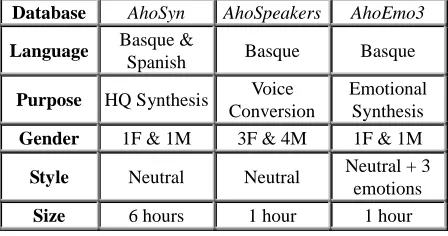
Table 1 resumes the characteristics of each of the databases recorded that, together with the unrestricted domain requirement, composed our initial specifications to design an appropriate corpus. AhoSyn has been designed for high quality speech synthesis and includes one female voice and one male voice. AhoSpeakers will be used for voice conversion and includes 3 female speakers and 4 male speakers. The purpose of AhoEmo3 is emotional speech synthesis and includes speech from one male and one female speaker. The only overlapping that exists among speakers and databases is the following one: The neutral part of AhoEmo3 is also included in AhoSpeakers database.
Database AhoSyn AhoSpeakers AhoEmo3
Language Basque &
Spanish Basque Basque
Purpose HQ Synthesis Voice
Conversion
Emotional Synthesis
Gender 1F & 1M 3F & 4M 1F & 1M
Style Neutral Neutral Neutral + 3
emotions
Size 6 hours 1 hour 1 hour
Table 1: Main characteristics of the databases.
sequences of phonemes and orthographical pauses were generated. This phoneme sequences along with the normalized signals were used to perform an automatic speaker dependent segmentation based on forced alignment.
The HTK toolkit (Young et al., 2006) was used during the segmentation process. First, tied-state triphone models were trained from a plain start, allowing the insertion of short pauses at word boundaries. Then, an automatic process was run to remove too short pauses and insert new ones. The decision of inserting new pauses was made taking into account the power envelope, the minimum duration of the pause itself as well as the duration outliers at word boundaries for each phoneme class. For example, if a duration outlier was detected at a word boundary and the amplitude around that region was below a certain threshold, a new pause was inserted. After “definitive” pauses were set, triphone models were retrained, not allowing the insertion of short pauses this time. Finally, the segmentation boundaries of the phonemes adjacent to pauses were refined by means of a simple but effective algorithm that uses power envelope and durational outliers.
As a final step, segmentation and linguistic information was automatically synchronized, removing or inserting pauses in the former files.
4.
Evaluation of Ahosyn
In order to assess the quality of the recordings and the automatic annotation procedure, statistical parametric voices were built from scratch for the female voice of AhoSyn databases.
4.1 Voice building
First, speech signals were analyzed with AhoCoder, a high-quality vocoder developed in our lab (Erro, Sainz, Navas, & Hernaez, 2011). Then, proper linguistic labels were prepared (Erro et al., 2010) and the HTS system (Zen et al., 2006) was used to train HMM models. Taking advantage of having recordings uttered by the same speaker in Basque and Spanish, and having in mind that we were using the same label structure and that both languages share most of their voiced phonemes, a single bilingual voice was built from the available material. In order to distinguish both languages an additional label was added to the statistical system at sentence level. Besides, 2 monolingual systems for Basque and Spanish were also built.
4.2 Evaluation design
An online evaluation campaign was organized. Listeners had to score the naturalness of synthetic sentences from the female voice of AhoSyn within a 5 point scale ranging from 1 – It sounds completely unnaturalto 5 – It sounds completely natural. Ten texts not included in the recorded corpus were randomly selected for each language, and sentences were synthesized for two configurations: monolingual and bilingual voice. Each listener evaluated up to 20 signals: 5 out of 10 signals for each language and
configuration. 18 subjects took part in the campaign, none of which had any hearing impairment. Almost all of the subjects were fluent in both languages and half of them had no experience with speech technologies. The evaluation was held in a quiet environment and all of the listeners used high quality headphones.
Before the test was conducted, some natural recordings of the speaker were presented, so as to implicitly fix the ceiling naturalness quality.
4.3 Evaluation results
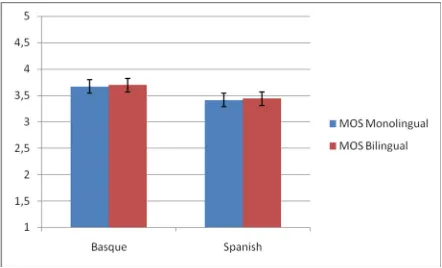
Figure 2 shows the results of the evaluation for each method and language, including the 95% CI (Confidence Interval). Quite good results are obtained for both languages: 3.70 MOS (Mean Opinion Score) for Basque and 3.44 for Spanish. There are no significant differences in naturalness between the monolingual and bilingual approach, but the bilingual voice is 12.34% smaller than the monolingual one. It must be noted that no manual correction was performed during the automatic annotation of this voice.
Figure 2: Subjective evaluation results.
5.
Conclusion
Three new speech resources for Basque language have been presented. They have allowed the development of a high quality neutral TTS voice and have the potential to adapt it to a variety of new styles and voices. The design and recording of the corpus has been described in depth. Additional information about the automatic annotation process has also been included. And the subjective results of the synthetic voice built show the high quality of this new resource.
6.
Acknowledgements
This work has been partially supported by the Spanish Ministry of Science and Innovation (Buceador Project, TEC2009-14094-C04-02) and the Basque Government (Saiotek Project, PE11UN081).
7.
References
Coelho, L., Hain, H. U., Jokisch, O., & Braga, D. (2009). Towards an Objective Voice Preference Definition for the Portuguese Language. I Iberian SLTech 2009, 67. Cowie, R., & Cornelius, R. R. (2003). Describing the
emotional states that are expressed in speech. Speech Communication, 40(1-2), pp. 5-32.
Erro, D., Sainz, I., Luengo, I., Odriozola, I., Sánchez, J., Saratxaga, I., Navas, E., et al. (2010). HMM-based Speech Synthesis in Basque Language using HTS.
Fala2010, pp. 67-70. Vigo.
Erro, D., Sainz, I., Navas, E., & Hernaez, I. (2011). HNM-Based MFCC+f0 Extractor Applied to Statistical Speech Synthesis. ICASSP 2011, pp. 4728-4731. Hernaez, I., Navas, E., Murugarren, J. L., & Etxebarria, B.
(2001). Description of the AhoTTS conversion system for the Basque language. Proceedings of 4th ISCA Tutorial and Research Workshop on Speech Synthesis. Hunt, A. J., & Black, A. W. (1996). Unit selection in a
concatenative speech synthesis system using a large speech database. ICASSP 1996: Proceedings of the Acoustics, 1, pp. 373-376.
Navas, E., Hernaez, I., & Luengo, I. (2006). An objective and subjective study of the role of semantics and prosodic features in building corpora for emotional TTS. IEEE Transactions on Audio, Speech and Language Processing, 14(4), 1117-1127.
Saratxaga, I., Navas, E., Hernaez, I., & Luengo, I. (2006). Designing and recording an emotional speech database for corpus based synthesis in Basque. Proc. of fifth international conference on Language Resources and Evaluation (LREC), pp. 2126-2129.
Scherer, K. R. (2003). Vocal communication of emotion: A review of research paradigms. Speech Communication, 40(1-2), pp. 227-256.
Sesma, A., & Moreno, A. (2000). CorpusCrt 1.0: Diseño de corpus orales equilibrados. [Computer Program]: http://gps-tsc.upc.es/veu/personal/sesma/CorpusCrt.ph p3
Syrdal, A. K., Conkie, A., & Stylianou, Y. (1998). Exploration of acoustic correlates in speaker selection for concatenative synthesis. Fifth International Conference on Spoken Language Processing. ISCA. Tachibana, M., Yamagishi, J., Onishi, K., Masuko, T., &
Kobayashi, T. (2004). HMM-Based Speech Synthesis with Various Speaking Styles Using Model Interpolation. Proc. Speech Prosody.
Young, S., Evermann, G., Gales, M., Hain, T., Kershaw, D., Moore, G., Odell, J., et al. (2006). The HTK Book, version 3.4.
Zen, H., Nose, T., Yamagishi, J., Sako, S., Black, A. W., Masuko, T., & Tokuda, K. (2006). The HMM-based speech synthesis system (HTS) version 2.0. The 6th International Workshop on Speech Synthesis, pp. 294-299.
Zen, H., Tokuda, K., & Black, A. W. (2009). Statistical parametric speech synthesis. Speech Communication,