Annotating and Learning Morphological Segmentation of
Egyptian Colloquial Arabic
Emad Mohamed, Behrang Mohit, Kemal Oflazer
Carnegie Mellon University-Qatar Doha, Qatar
[email protected], [email protected], [email protected]
Abstract
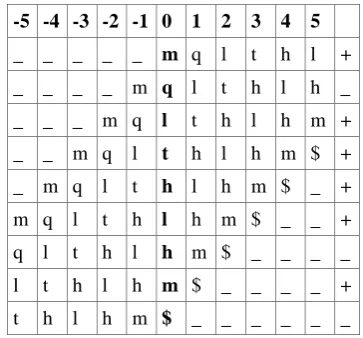
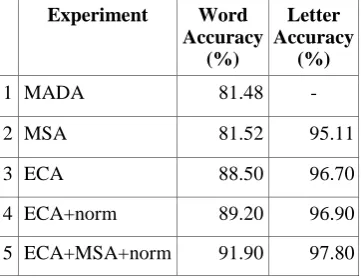
We present an annotation and morphological segmentation scheme for Egyptian Colloquial Arabic (ECA) with which we annotate user-generated content that significantly deviates from the orthographic and grammatical rules of Modern Standard Arabic and thus cannot be processed by the commonly used MSA tools. Using a per letter classification scheme in which each letter is classified as either a segment boundary or not, and using a memory-based classifier, with only word-internal context, prove effective and achieve a 92% exact match accuracy at the word level. The well-known MADA system achieves 81%, while the per letter classification scheme using the ATB achieves 82%. Error analysis shows that the major problem is that of character ambiguity, since the ECA orthography overloads the characters which would otherwise be more specific in MSA, like the differences between y (ي) and Y (ى) and A (أ ( > , ا)), and < (إ) which are collapsed to y (ي) and A (ا) respectively or even totally confused and interchangeable. While normalization helps alleviate orthographic inconsistencies, it aggravates the problem of ambiguity.
Keywords: morphological segmentation, Egyptian Arabic, memory-based learning, colloquial Arabic annotation
1.
Introduction
Egyptian Colloquial Arabic (ECA) is the most widely used dialect of the language and is usually written in informal discourse. ECA deviates from Modern Standard Arabic (MSA) at the lexical, morphological, and syntactic levels. Although there is an abundance of MSA resources, they do not seem to be adequate for handling ECA. We present data and a segmentation scheme for ECA that can be used either for lexical research or as a basis for other NLP tasks including part-of-speech tagging and syntactic parsing. We have annotated a corpus of ECA user-generated comments and jokes, segmented by two annotators with a Kappa score of 99.27%. Moreover, we have built a memory-based segmenter for ECA text. We demonstrate that a simple ECA segmenter outperforms the state-of-the-art MSA segmenter on ECA text. These results are motivating for further investment in the creation of specific datasets and tools for processing colloquial Arabic. We plan to release our annotated corpus to the research community.1
2.
Segmenting Egyptian Arabic
Currently there is a rich set of annotated data and processing tools for MSA. The performance of these resources for robust processing of colloquial Arabic is expected to vary. We start with examining ECA text to characterize the differences between MSA and ECA and their effects on ECA processing. We see that the differences are distributed to different linguistic layers
1 The segmented corpus, as well as supporting scripts and this paper, is available at http://www.qatar.cmu.edu/~emohamed/
which make processing ECA a hard problem. The following differences illustrate (part of) the problem:
1. The prefix preposition l+ (ل, for; to) is treated as a suffix when preceded by a verb and followed by an object pronoun. For example, the word msmEtlhm$ (صوهلتعوسه, I did not listen to them) comprises a negation circumfix (m … $, … م ش), a perfective verb (smE, عوس), a first person singular subject prefix (t, ت), a preposition (l+, ل), and a third person plural object pronoun (hm, نه).2
2. Morpheme boundaries assimilate when the last letter of one morpheme is the same as the first letter of the next morpheme, in what in MSA are two separate words. For example, when the verb qAl (said, لاق) is followed by the preposition l+ (to, ل), one of the two l's disappears: qAlhA (He said to her, اهلاق). The missing letter is compensated for by means of consonant gemination, which is hardly discernible in the orthography.
3. The writing system is not standardized and there is plenty of variation. The forms qlh (هلق), qAlw (ولاق), qAlwA (اولاق), and even sometimes AlwA (اولا), have been found to represent the same linguistic unit, translated as “He said to him” in English.
4. The Arabic glottal stop, known as the hamza, is written in different ways in MSA and the
an Arabic Treebank: Methods, Guidelines, Procedures, and Tools, In Proceedings of the Workshop on Computational Approaches to Arabic Script-based Languages, COLING 2004, Geneva, August 28, 2004. Mohamed, Emad (2010). Orthographic Enrichment for
Arabic Grammatical Analysis. PhD Dissertation, Indiana University, USA.