178
Classifying Author Intention for Writer Feedback in Related Work
Arlene Casey School of Informatics University of Edinburgh
Edinburgh, UK [email protected]
Bonnie Webber School of Informatics University of Edinburgh
Edinburgh, UK [email protected]
Dorota Głowacka Dept. of Computer Science
University of Helsinki Helsinki, Finland [email protected]
Abstract
The ability to produce high-quality pub-lishable material is critical to academic success but many Post-Graduate students struggle to learn to do so. While recent years have seen an increase in tools de-signed to provide feedback on aspects of writing, one aspect that has so far been neglected is the Related Work section of academic research papers. To address this, we have trained a supervised classifier on a corpus of 94Related Work sections and evaluated it against a manually annotated gold standard. The classifier uses novel features pertaining to citation types and co-reference, along with patterns found from studying Related Works. We show that these novel features contribute to clas-sifier performance with performance be-ing favourable compared to other similar works that classify author intentions and consider feedback for academic writing.
1 Introduction
Argument structures are key in allowing an au-thor to construct a persuasive message that real-izes the author’s intention. The automatic identi-fication of such intentions has been shown to be a valuable resource in areas such as summarising information (Teufel and Moens,2002;Cohan and Goharian,2015), and understanding citation func-tion and sentiment (Teufel et al., 2006; Jurgens et al., 2018). Recent years have seen more aca-demic writing tools focused on content that use an understanding of expected author intentions to assist in feedback. This is an important resource for Post-Graduate (PG) students who struggle to gain the necessary skills in academic writing that are critical to their success (Aitchison et al.,2012;
Paltridge and Starfield,2007). Automating under-standing of author intentions is challenging as re-search articles, whilst classed in their own genre, are known to differ in content and linguistic style across disciplines (Hyland,2008).
Despite these challenges, previous work using author intentions has been successful in automat-ing writautomat-ing feedback though largely focused on the Abstract (Feltrim et al.,2006) or the Introduction (Cotos and Pendar,2016;Abel,2018). One reason for this focus on a single section of a research pa-per is that each section has its own purpose, which encourages different linguistic practices. Existing tools may concentrate on the Introduction due to formative work done by Swales (1990). Swales was one of the first to recognise these intentions in academic writing calling themrhetoric intentions. Swales showed how linguistic patterns in the In-troduction could be matched to intentions, such as establishing a territoryordefining the problem.
One section of academic papers that has not yet been explored for automated content feed-back is the Related Work section. One particu-lar challenge students have when learning to write is to find and project their own viewpoint ( Kam-ler and Thomson, 2006). Often their lack of ex-perience and confidence in projecting their own voice amongst established scholars results in stu-dents making bland statements about others’ work. Such bland statements in theRelated Worksection do nothing more than provide a list of work with no real critical commentary or attempt to relate it to the author’s own work. We address this gap of content feedback for Related Workby building a model of author intentions that one expects to find inRelated Work.
representa-tion of author intenrepresenta-tions and show that the novel features we introduce contribute significantly to the classifier performance, improving on perfor-mance of existing writer feedback tools.
2 Related Work
Automating Author Intentions –Previous mod-els of author intentions in research articles have been successfully automated. One of the first and widely used is Teufel (1999) who proposed Ar-gument Zoning (AZ) which labels sentences with zones representing the rhetoric purpose (author intent) within the global context of a document e.g. background, aim or conclusion. Further work has applied this schema to biology papers (Mizuta and Collier,2004), with a modified, finer grained approach applied to papers on chemistry (Teufel et al.,2009). Liakata et al.(2012) took a different approach to labelling author intentions, studying the conceptual structure of biology articles treat-ing the article as an investigation. Fisas et al.
(2015) develop a schema based on both Liakata and Teufel’s work to represent scientific concepts that appear in computer graphics articles. These works have successfully identified author inten-tions, but they differ from our work by seeking intentions in a global context across a whole ar-ticle. For example, AZ was developed to support summarisation and information access. The au-thor intentions that these activities would be asso-ciated with are rarely found in aRelated Work sec-tion and are unlikely to be helpful in writing feed-back for this section. They are nevertheless useful in supporting writing feedback on Abstracts and summaries of PhDs (Feltrim et al.,2006).
Related Workdoes have in common with other sections the fact that it should contain citations. Understanding the motivations or function of a citation can help determine an author intention (Teufel et al.,2006). Work on citation function has been an area of research for several decades ( We-instock,1971;Oppenheim and Renn,1978;Teufel et al.,2006;Angrosh et al.,2012), with more re-cent work considering how this recognition can be automated. Jurgens et al.(2018) investigates the framing of citations and how this can be used to study the evolution of a field. Teufel et al.(2006) work on automated recognition of citation tion and show a strong relationship between func-tion and sentiment. One work that specifically looks at context identification of sentences in
Re-lated Work is (Angrosh et al., 2010). This work focuses on sentences in terms of their ability to support intelligent information retrieval in digital library services. While aspects of this work and the previous works on citation function are rele-vant, what is missing is the need to identify where an author talks about their own work in context to other work, showing why it is different or how it fills a gap. As discussed in the Introduction, one of the problems with poor writing inRelated Work is bland statements that provide lists of citations. Cited works should be ones that have implications for the author’s work (Maxwell, 2006). To pro-vide such feedback, we must capture this context in addition to citation function.
Recognising Author Intentions – Specific phrasing has been shown to function in structuring discourse by guiding readers through a text ( Hy-land,2012) and can be found to align to sections, such as the Introduction or Results. Most pre-vious work in automating author intentions have utilised these patterns as part of their feature set. The early work of Teufel (1999) (in the domain of computational linguistics) uses cue phrases and lexical patterns that involve parts of speech and ci-tation markers as features. Jurgens et al. (2018) shows how applying bootstrapping to Tuefel’s lex-icon improves citation function recognition.
Verbs have been shown to have a role in under-standing citation function by determining rhetori-cal and semantic levels. Verbs used to report can show positive and negative aspects of evaluation in cited works and differentiate between intentions e.g in Angrosh et al. (2010) they use reporting verbs that describe (examine, propose), refer to an outcome (develop, show) or show a strength (improve). Citation forms (Swales, 1990) of in-tegral and non-inin-tegral have been shown to be a contributing feature to author intention recogni-tion, with studies of novice writers showing that they use a limited range of citation types ( Thomp-son and Tribble, 2001). Our approach also uses linguistic patterns, verb types and citation types to support building our feature set, and we do this within one domain, computational linguistics (cf. Section4).
V. Lashkia,2003;Abel,2018). The Criterion on-line writing service, focuses on automated persua-sive essay evaluation and uses recognition of dis-course elements based on aspects such as support-ing ideas, introductions and conclusion (Burstein et al.,2003,2004). Several other works have fo-cused on identifying argument components and re-lations and how these relate to essay scores (Ghosh et al.,2016;Song et al.,2014). Recognizing argu-ment components in this case focuses on premises and claims largely based on the Toulmin model of argumentation (Toulmin,2003) which is a differ-ent approach to ours. In addition, all this work focuses on feedback for persuasive essays which will differ in linguistic practices found in scien-tific papers and from the author intention structure of aRelated Work. Overall, whilst aspects may be relevant in general, these methods would not facil-itate the kind of content feedback that would help a writer withRelated Work.
3 Author Intentions to Support Feedback
3.1 Annotation Schema for Data
The need for annotated data is something that pre-vious methods have in common, each using an an-notation schema that supports the intentions they seek. It is known that annotation schemas benefit from being task-orientated (Guo et al.,2010). We use an annotation schema developed to recognise author intentions in Related Work sections and provide authors with useful feedback (Casey et al.,
2019). This schema uses qualities that should be present inRelated Worksections, following ( Kam-ler and Thomson, 2006). Qualities group into four areas: Background– helps the author locate their work in the field, demonstrating they under-stand their field and its history through indicating seminal works and relevant research fields;Cited works – in addition to generally identifying the field, the author should demonstrate specifically (i) which works are most pertinent to their work, (ii) how these works have influenced them and (iii) if and how the current works build on or use these methods; Gap– make clear what the gap is and what has specifically not been addressed; Con-tribution – having exposed the gap, the author should identify their contribution. This schema tries to isolate neutral citations that provide mere description, compared to those that highlight gaps or problems, along with identifying where an au-thor talks about their own work and how this
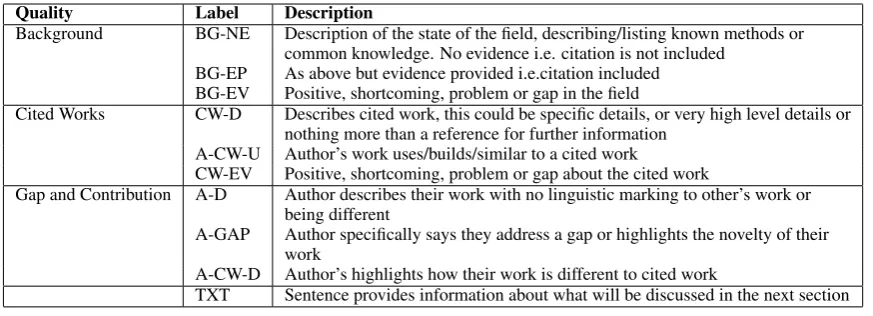
re-lates to the cited work or background in general. The sentence label schema we use can be found in Table1, and we indicate which of the qualities each label falls into.
3.2 Annotated Dataset
The annotated dataset in (Casey et al., 2019) is composed of papers from the ACL anthology (Bird et al., 2008) that have been pre-annotated for citations and co-reference to the author’s own work by (Sch¨afer et al., 2012). We use 94 pa-pers with Related Work sections after removing one due to OCR issues. All papers were confer-ence papers 6-8 pages in length. The authors re-port annotator agreement, based on Cohen Kappa (Cohen,1960) at 0.77, which increased to 0.85 fol-lowing a round of discussion.
3.3 Challenges and Changes to the Schema to Support Automation
Previous works have largely been based on anno-tating at a sentence level but some works have con-sidered a smaller discourse unit such as (Shatkay et al., 2008). This smaller discourse unit does allow for instances where an author may encode two intentions in one sentence. The data we use is labelled on a sentence basis. The authors in (Casey et al.,2019) acknowledge that this may not be satisfactory as some sentences could be multi-labelled, such as where an author highlights a gap then state their contribution. Just as this is chal-lenging for an annotator to label, it may be more so for an automated classifier.
Quality Label Description
Background BG-NE Description of the state of the field, describing/listing known methods or common knowledge. No evidence i.e. citation is not included
BG-EP As above but evidence provided i.e.citation included BG-EV Positive, shortcoming, problem or gap in the field
Cited Works CW-D Describes cited work, this could be specific details, or very high level details or nothing more than a reference for further information
A-CW-U Author’s work uses/builds/similar to a cited work
CW-EV Positive, shortcoming, problem or gap about the cited work
Gap and Contribution A-D Author describes their work with no linguistic marking to other’s work or being different
A-GAP Author specifically says they address a gap or highlights the novelty of their work
A-CW-D Author’s highlights how their work is different to cited work
TXT Sentence provides information about what will be discussed in the next section
Table 1: Sentence Labels
Sentence Label Count
BG-EV 90
BG-NE 257
BG-EP 171
CW-EV 133
CW-D 707
A-CW-U 59
A-D 107
TXT 21
A-CW-D 151
A-GAP 59
Total 1755
Table 2: Label class distribution
4 Methods
4.1 Classifiers
All models are trained using LibSVM (Chang and Lin,2011) with a linear kernel and default settings. SVM’s are known to be robust to over-fitting, and perform well in document classification tasks when features are sparse and the set of them is large. SVM does not assume statistical indepen-dence, making it a more suitable method when fea-tures may be overlapping or interdependent. Ini-tially, we experimented with decision trees. How-ever, when we tested multiple iterations for reli-ability, both Random Forest (Breiman,2001) and C4.5 (Sumner et al.,2005) were not only consis-tently lower in performance (12%) but rare cate-gories showed large variation (15%) between iter-ations and in some instances labels would not clas-sify. We believe this was due to feature overlap and the problem previously discussed with some labels being multi-class. Due to the unreliability of its performance, we did not pursue the decision tree approach further.
4.2 Features
Features were motivated by other works that clas-sify author intention and citation function, and were extracted on a sentence basis. We use a vec-tor of sentence features as the input to our clas-sifier. The following list summarises the features used in this work.
• Structural Positional information, such as relative sentence position, has been useful for identifying background sentences, as these are more likely to occur in an Introduction or Related Workthan a Results section (Teufel,
1999; Jurgens et al., 2018; Liakata et al.,
2012). We do not include relative sentence position but instead use a binary indicator for paragraph start and end sentence, man-ually added from the original PDF. This is similar to the feature in (Teufel and Moens,
2002) of paragraph structure. We expect this to work like a sentence relative position, as many background statements will come at the start of paragraphs, and towards the end of paragraphs authors will be more likely to re-late their own work.
will help to discriminate between background sentences with citation evidence and citation description sentences. We also take a count of type 1 and 2 citations and a separate count of type 3 citations.
• N-gramsWork based on a much larger cor-pus than ours show that n-grams contribute significantly to the performance of their clas-sifier. Liakata et al. (2012) show a 40% contribution and Cotos and Pendar (2016) work is mainly based on n-gram features of 650 Introductions. While our corpus is much smaller (Related Work from 94 arti-cles), we nevertheless include binary values for bigrams and trigrams occurring with a fre-quency of≥5. We do not remove stop words.
• Co-referencing Features Often discussion about a work or the author’s work will be carried out over several sentences. The later sentences can have co-references to the orig-inal citation such as‘this paper’ ‘this model’ However, asTeufel(1999) shows, determining what she calls agents (e.g US AGENT -‘our paper’), these co-reference phrases can be ambiguous. For example does‘this paper’ mean the previously cited paper or it is ref-erencing the author’s work. We take a differ-ent approach and use the annotations in our corpus for (i) references to the authors own work, (ii) cited work. In addition, we man-ually mark co-reference to multiple works in background sentences e.g’previous work has been done in the area of ..’ and co-reference to previously cited work e.g. ’these previ-ously mentioned works above’
• Verb FeaturesWe use part of speech (POS) tags to identify verbs, treating the six possi-ble VB tags (VB, VBD, VBG, VPN, VBP, VBZ) as binary features of being present or not in a sentence. Having substituted the co-references, described above, in a sentence we then parse for dependency extracting subject and object verb pairs in every sentence.
• Linguistic Patterns Teufel (1999) makes available a list of patterns containing cue phrases/words, lexical categories, constrained by PoS tags, developed on computational linguistic literature. Like (Jurgens et al., 2018) we use this list and
adapt it manually using patterns we observe in Related Work. For example, one aspect we consider is contrasts that occur at the be-ginning of a sentence and those that happen mid sentence, creating lexical expressions to capture these. We also produce finer grained lexicon patterns for discourse connectives as these are indicative of a continuation sentence. Within those patterns we include citation types and co-references as described above.
• Sentiment We use our adapted version of Teufel’s list to identify positive and negative words (e.gadvantageous- positive adjective, inaccurate- negative adjective ). In addition, we use the 82 polar phrases found in (Athar,
2014). We parse each sentence and count the positive and negative words.
• CountsCounts of sentence words, nouns, ad-verbs, discourse connectives.
• Subject We assign a sentence subject label before assigning a sentence label to decide if the sentence is about a citation, background or field information, author’s work, or a com-bination of author’s work and cited work. This subject feature is based on rules of sen-tence and previous sensen-tence features e.g our finer grained approach to discourse connec-tives in conjunction with co-reference mark-ers help us to undmark-erstand subject.
5 Experimental Setup and Evaluation
5.1 Baseline
We provide two baselines, one with n-gram fea-tures only and one with all feafea-tures based on the majority class.
5.2 Evaluation
Features Prec Recall F1 Acc% ALL .69 (.005) .7 (.004) .7 (.005) 70 (.48) Cotos(2016) .686 .549 .61 72.9% Teufel(2011) .478 .376 .4142 66.8%
Table 3: Classifier Performance, Mean scores after 10 iterations, Variance in brackets
System Macro F1/Range Label No.
(Teufel and Kan,2011) 0.41 (0.19-0.81) 8 (Jurgens et al.,2018) 0.53 6 (Teufel,1999) 0.68 (0.28-0.86) 12 (Cotos and Pendar,2016) 0.61 (0.36-0.85) 17
Our Work
-all feat 0.70 (.25 -0.88) 10
- no novel feat 0.54 (.15-.87)
Baseline
Ngram(B,T) 0.39 (.02-.68) Majority 0.57 (-)
Table 4: Classifier Comparison, * significant 0.01
4). Also included is the work of (Cotos and Pen-dar, 2016) which focuses on writer feedback for Introductions. This is a much larger corpus using 650 annotated Introductions but fewer features, fo-cusing on unigram and trigrams. However, it also uses SVM for classification. Where available, we also report Precision, Recall and Accuracy from these works to compare against our best perform-ing model in Table3.
Reliability of our model is important to ensure consistent results. Therefore, in addition to 10-fold cross validation, we carry out 10 iterations of the All features model, reporting on mean preci-sion, recall, F1, Accuracy and variance in Table
3. None of our iterations produced significantly different results, demonstrating reliability and low variation. Significance, where noted, is tested with corrected t-test, p <0.01, (Nadeau and Bengio,
1999).
We also look at the features in our model and how they influence the label F1 scores with leave one out (LOO), which highlights the performance decrease when a single feature is omitted and sin-gle features (SF), which highlights the contribu-tion of a single feature to performance. Looking at individual label features is important as having just one label perform poorly, such as being able to recognise an author gap sentence or where an au-thor says how their work is different, will impact our goal of giving writer feedback.
6 Results
6.1 Classifier Performance
We compare our results to those mentioned in Sec-tion5, Table4. Comparing F1 scores overall, we outperform the other systems by a reasonable mar-gin. In addition, the range of F1 scores for our la-bels are also similar to other systems. We outper-form the work ofCotos and Pendar(2016), who looks at classification for Introduction feedback, despite their work being based on a bigger anno-tated corpus. We significantly outperform both our baselines of n-grams and majority class. We re-run our classification (no novel feat) removing the manual additions we added to the original pattern list ofTeufel(1999), removing co-references and subject labels. This results in lower performance, significant (p<0.01) than our all features and our majority baseline.
6.2 Feature Contribution
Here we examine feature contributions by single feature and leave one out cross validation runs (Ta-ble5). For each category, we highlight the lowest score in bold, which corresponds to the feature be-ing left out. We place in brackets any scores higher than the All features model.
More frequently occurring categories, cited work description (CW-D), background sentences with and without evidence (BG-NE, BG-EP) are more robust to feature omissions. Features are not independent, so many of the patterns cover the n-gram features which may be why leaving out n-grams has less impact than expected. In the lower part of the table, n-grams as a single feature contributes most to labels TEXT and CW-DESC. Compared to other works that have used n-grams, our size is much smaller at <3000, whereas Li-akata et al. (2012) used ∼42000 and Cotos and Pendar(2016) had∼27000. It would be expected in a much larger corpus that n-grams will con-tribute more as a feature.
con-Features BG-EV BG-NE BG-EP CW-EV CW-D A-CW-U A-D TXT A-CW-D A-GAP ALL .39 .72 .73 .53 .84 .48 .47 .88 .63 .25 Feat-(LOO)
-subject .33 .62 .71 .51 .81 .49 .41 .85 .64 .22
-n-grams .33 .70 .70 .53 .84 (.50) .39 .83 .62 .25 -verbtense .35 .71 .72 .51 .84 .48 .46 .88 .66 .32 -sentiment .34 .71 .71 .50 .84 .46 .43 .67 .61 (.28) -counts (.40) .72 .73 .52 .84 (.50) .46 .87 (.64) .26 -Tot cit count .38 .71 (.74) (.54) (.85) .49 (.48) .88 .64 .26 -paragraph (.40) .71 .73 (.54) .84 .49 .47 .87 .62 .22
Features BG-EV BG-NE BG-EP CW-EV CW-D A-CW-U A-D TXT A-DIFF A-GAP ALL .39 .72 .73 .53 .84 .48 .47 .88 .63 .25 Feat-(SF)
-patterns .30 .54 (.74) .41 .77 (.57) (.48) .80 (.65) .26
-subject - .58 - - .80 - .45 .75 .46
--sub+patt+dep .31 .72 .73 .47 .83 (.55) .46 .84 .63 (.27) -n-grams .11 .31 .21 .24 .62 .23 .04 .68 .39 .02
Table 5: F-Measures for Features and Labels,10 cross validation
tributes here. Neither of our evaluations labels (BG-EV, CW-EV) perform as well as expected. These two labels are merged from the annotation schema, positive and shortcoming/problem into one evaluation label. These original labels are both quite different linguistically and we speculate that this might prove difficult for the classifier.
Total citation counts and counts of adverbs, words, nouns and discourse connectives seem to actually make the performance of the classifier worse on many of the labels, although not sig-nificantly so. There is an overlap in total citation counts with the count of our citation types perhaps indicating this feature could be omitted.
We note that the features we add to the pat-tern list, dependencies and subject label show very close to performance of the All features model. We observe better performance on the rare label author gap (A-GAP) with just these features alone.
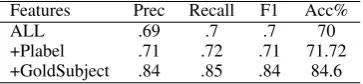
Most categories are negatively impacted by the removal of the subject label with the exception of author uses/build/similar to cited work CW-U) and authors work differs from cited work (A-CW-D). As a single feature we see that sub-ject is important to the classifier performance and contributes to several of the labels - background with no evidence (BG-NE), cited work description (CW-D), author description (A-D) and author and cited work differ (A-CW-D). Leaving out subject label was the only feature to cause a drop in clas-sifier performance that was significant. In Table6
and Table7experiments from using a gold subject label and using a history feature of previous label are presented. History label was previously shown
by (Liakata et al.,2012) to contribute to sentence classification. Our gold subject label was deter-mined from the annotated label. We see that de-termining this label accurately has an almost 15% increase in the performance of our classifier and an increase in F1 score for all label categories. In-cluding a previous label also increases the classi-fier performance, but this increase was not signifi-cant.
7 Discussion and Conclusions
Features BG-EV BG-NE BG-EP CW-EV CW-D A-CW-U A-D TXT A-D A-G ALL .39 .72 .73 .53 .84 .48 .47 .88 .63 .25 +Plabel .50 .60 .70 .60 .86 .51 .46 .63 .61 .27 +GoldSubject .61 .86 .88 .67 .94 .68 .72 1 .88 .4
Table 6: Mean F-Measures for Labels All features and All with Gold Subject and Previous label
Features Prec Recall F1 Acc%
ALL .69 .7 .7 70
+Plabel .71 .72 .71 71.72 +GoldSubject .84 .85 .84 84.6
Table 7: Classifier Performance, Mean scores after 10 iterations
avenue that may assist in transitioning our pattern list to another domain.
In future work, we intend to investigate aug-menting our pattern set further. Jurgens et al.
(2018) implement a bootstrapping pattern that identifies over four times the manually curated patterns, identifying new patterns that apply in a citing sentence, the preceding or following sen-tence. Bootstrapping to expand seed cue phrases based on rhetorical relations (Abdalla and Teufel,
2006) has also been successful. Incorporating more information from a preceding or following sentence we believe could help classify sentences where there is no linguistic clue as to the subject e.g. those that carry on describing a cited work but their is no co-reference to signal the subject. Understanding sentence subject is important, cur-rently it contributes to the classifier performance but we show an almost 15% increase in perfor-mance that could occur using a gold sentence sub-ject label. Having a way to improve our cur-rent implementation of sentence subject assign-ment would be beneficial.
Our overall intention for this work is to support writer feedback and so we intend to investigate how well our current level of automatic recogni-tion of author intenrecogni-tions can support feedback and how useful this is to novice writers.
References
Rashid M. Abdalla and Simone Teufel. 2006. A bootstrapping approach to unsupervised detec-tion of cue phrase variants. In Proceedings of the 21st International Conference on Compu-tational Linguistics and the 44th Annual Meet-ing of the Association for Computational LMeet-inguis- Linguis-tics. Association for Computational Linguistics, Stroudsburg, PA, USA, ACL-44, pages 921–928.
https://doi.org/10.3115/1220175.1220291.
Sophie Kitto Kirsty Knight Simon Buckingham Shum Simon Abel. 2018. Designing personalised, automated feedback to develop students research writing skills. InProceedings of 2018 Australasian Society for Computers in Learning in Tertiary
Edu-cation. pages 15–24.
Claire Aitchison, Janice Catterall, Pauline Ross, and Shelley Burgin. 2012.’Tough love and tears’: learn-ing doctoral writlearn-ing in the sciences. Higher
Ed-ucation Research & Development 31(4):435–447.
https://doi.org/10.1080/07294360.2011.559195.
Mandya A. Angrosh, Stephen Cranefield, and Nigel Stanger. 2010. Context identification of sen-tences in related work sections using a condi-tional random field: Towards intelligent digi-tal libraries. In Proceedings of the 10th
An-nual Joint Conference on Digital Libraries. ACM,
New York, NY, USA, JCDL ’10, pages 293–302.
https://doi.org/10.1145/1816123.1816168.
Mandya A. Angrosh, Stephen Cranefield, and Nigel Stanger. 2012. A citation centric annotation scheme for scientific articles. In Proceedings of the Aus-tralasian Language Technology Association
Work-shop 2012. Dunedin, New Zealand, pages 5–14.
https://www.aclweb.org/anthology/U12-1003.
Laurence Anthony and George V. Lashkia.
2003. Mover: A Machine Learning Tool
to Assist in the Reading and Writing of Technical Papers. Professional
Communi-cation, IEEE Transactions on 46:185 – 193.
https://doi.org/10.1109/TPC.2003.816789.
Nasrin Asadi, Kambiz Badie, and Maryam Tayefeh
Mahmoudi. 2019. Automatic zone
identifi-cation in scientific papers via fusion tech-niques. Scientometrics 119(2):845–862.
https://doi.org/10.1007/s11192-019-03060-9.
Awais Athar. 2014. Sentiment analysis of scien-tific citations. Technical Report UCAM-CL-TR-856, University of Cambridge, Computer Labora-tory. https://www.cl.cam.ac.uk/techreports/UCAM-CL-TR-856.pdf.
Steven Bird, Robert Dale, Bonnie Dorr, Bryan Gibson, Mark Joseph, Min-Yen Kan, Dongwon Lee, Brett Powley, Dragomir Radev, and Yee Fan Tan. 2008. The ACL Anthology Reference Corpus: A Refer-ence Dataset for Bibliographic Research in Compu-tational Linguistics. InLREC 2008.
Hagit Shatkay, Fengxia Pan, Andrey Rzhetsky, and W John Wilbur. 2008. Multi-dimensional clas-sification of biomedical text: toward automated, practical provision of high-utility text to di-verse users. Bioinformatics 24(18):2086–2093.
https://doi.org/10.1093/bioinformatics/btn381.
Yi Song, Michael Heilman, Beata Beigman Kle-banov, and Paul Deane. 2014. Applying ar-gumentation schemes for essay scoring. In
Proceedings of the First Workshop on
Argu-mentation Mining. Association for Computational
Linguistics, Baltimore, Maryland, pages 69–78.
https://doi.org/10.3115/v1/W14-2110.
Marc Sumner, Eibe Frank, and Mark A Hall.
2005. Speeding up logistic model tree in-duction. PKDD LNCS 3721:675–683.
https://hdl.handle.net/10289/1446.
John M Swales. 1990. Genre Analysis: English in
aca-demic and research settings. Cambridge University
Press.
Simone Teufel. 1999. Argumentative zoning:
Infor-mation extraction from scientific text. Ph.D. thesis,
University of Edinburgh.
Simone Teufel and Minyen Kan. 2011. Robust Ar-gumentative Zoning for Sensemaking in Scholarly Documents. InIn Advanced Language Technologies
for Digital Libraries. Springer, pages 154–170.
Simone Teufel and Marc Moens. 2002.
Sum-marizing scientific articles: Experiments with relevance and rhetorical status.
Com-putational Linguistics 28(4):409–445.
https://doi.org/10.1162/089120102762671936.
Simone Teufel, Advaith Siddharthan, and Colin Batch-elor. 2009. Towards domain-independent argu-mentative zoning: Evidence from chemistry and computational linguistics. In Proceedings of the 2009 Conference on Empirical Methods in
Natu-ral Language Processing. Association for
Compu-tational Linguistics, Singapore, pages 1493–1502.
https://www.aclweb.org/anthology/D09-1155.
Simone Teufel, Advaith Siddharthan, and Dan Tid-har. 2006. Automatic classification of citation function. In Proceedings of the 2006 Con-ference on Empirical Methods in Natural
Lan-guage Processing. Association for Computational
Linguistics, Sydney, Australia, pages 103–110.
https://www.aclweb.org/anthology/W06-1613.
Paul Thompson and Chris Tribble. 2001. Looking at citations: Using corpora in english for academic pur-poses. Language Learning Technology 5(3):91 – 105.
Stephen E Toulmin. 2003. The Uses of Argument. Cambridge University Press.