Proceedings of Recent Advances in Natural Language Processing, pages 750–757,
Streaming Text Analytics for Real-Time Event Recognition
Philippe Thomas, Johannes Kirschnick, Leonhard Hennig, Renlong Ai, Sven Schmeier,Holmer Hemsen,Feiyu Xu,Hans Uszkoreit Deutsches Forschungszentrum f¨ur K¨unstliche Intelligenz, Germany
Abstract
A huge body of continuously growing written knowledge is available on the web in the form of social media posts, RSS feeds, and news articles. Real-time in-formation extraction from such high ve-locity, high volume text streams requires scalable, distributed natural language pro-cessing pipelines. We introduce such a system for fine-grained event recognition within the big data framework Flink, and demonstrate its capabilities for extracting and geo-locating mobility- and industry-related events from heterogeneous text sources. Performance analyses conducted on several large datasets show that our sys-tem achieves high throughput and main-tains low latency, which is crucial when events need to be detected and acted upon in real-time. We also present promising experimental results for the event extrac-tion component of our system, which rec-ognizes a novel set of event types. The demo system is available at http://
dfki.de/sd4m-sta-demo/.
1 Introduction
In the last few years text analytics has assumed a very important role in the area of large scale data processing, in particular, big data analytics of un-structured textual data. Its applications range from fulfilling very specific information needs to build-ing up knowledge resources servbuild-ing a variety of purposes (e.g. social media monitoring, business intelligence, and knowledge organization). An im-portant task of text analytics is detection and mon-itoring of events reported in various texts. For ex-ample, mobility providers may wish to better serve their customers by incorporating real-time
infor-mation about short-term disruptions across the general mobility infrastructure (e.g. accidents, de-lays, roadblocks), whereas supply chain managers require timely information about critical supplier events (e.g. liquidity problems, strikes, disasters).
While general text analytics pipelines for event detection focus on detecting and tracking “news topics”, such as earthquakes or crisis events (
Al-lan et al., 1998; Osborne et al., 2014),
monitor-ing fine-grained events, such as strikes at a par-ticular facility of a company, or a traffic accident on a specific road crossing, raises additional chal-lenges. It requires more extensive linguistic anal-ysis of texts, including named entity recognition (NER) for non-standard entity types such as roads or facility locations, entity linking (EL) (Dredze
et al., 2010) and relation extraction (RE) (Mintz
et al.,2009). Furthermore, much larger and more
domain-specific knowledge bases for NER and EL have to be incorporated, as opposed to ex-isting systems (Ji et al., 2014). For real world applications, it is also necessary to combine in-formation extracted from unstructured texts with (semi-)structured information provided by domain databases such as public transport timetables, and traffic information systems.
The ever-increasing volume and velocity of tex-tual data available on the web raises additional challenges from an engineering point of view, es-pecially if we aim for real-time processing. Data must be processed and transformed “on the fly” so that, when it reaches a persistent data store, it is immediately available for querying and interpre-tation (Orenstein et al., 2015). The system also needs to be able to handle the burstiness of input data streams, i.e. it must be capable of adapting to the high variability in input volume and handle the resulting back-pressure appropriately. Existing NLP pipeline frameworks, such as UIMA (
Fer-rucci and Lally,2004), often only allow for some
degree of parallelization, but are not designed to handle big data streams.
In this paper, we introduce a scalable, dis-tributed linguistic analysis pipeline to detect fine-grained events from heterogeneous text sources. The pipeline’s main functionalities include en-tity recognition, enen-tity linking to well established knowledge bases and event recognition. To en-sure scalability, robustness, and near real-time distributed processing, our platform is imple-mented within the big data analytics framework Flink (Alexandrov et al.,2014). Our contributions in this paper are as follows:
• A linguistic analysis pipeline for detecting and localizing events, including NER for fine-grained and non-standard entity types, and a novel entity linking approach for re-solving highly ambiguous geo-entities such as street or train station names
• A scalable, distributed architecture for fault-tolerant processing of data streams in (near) real-time and a performance analysis in terms of throughput and scalability
• Experimental results on the event extraction quality of the pipeline, based on a dataset col-lected over a 3 month period
Moreover, we will discuss some observations on the performance of our NER, EL and RE ap-proaches (see Section4).
2 NLP Pipeline
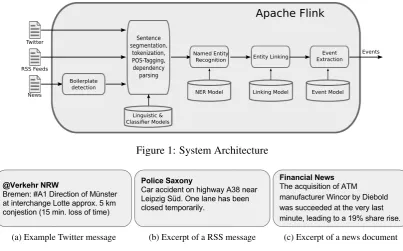
We give an overview of the pipeline architecture, which is shown in Figure 1. The current system is designed to deal with various text types such as Twitter messages, RSS feeds, and web pages, and simultaneously handles German- and English-language documents. For each resource type, an example is shown in Figure2.
2.1 Preprocessing
Preprocessing consists of the following steps: boilerplate detection, language detection, sentence segmentation and tokenization, POS tagging and dependency parsing.
Due to the high heterogeneity of website con-tents, processing HTML websites is an inher-ent challenge. Boilerplate detection is used to retain the main content of an HTML docu-ment (Kohlsch¨utter et al., 2010), langid.py (Lui
and Baldwin, 2012) for language detection –
Type Size Resource Examples
Company 112,347 Internal BMW, Bayer AG City 27,075 OSM Berlin, Hof Street 104,598 OSM Hauptstrasse, A1 Station 9,860 Dt. Bahn S+U Hauptbahnhof Route 25,907 Dt. Bahn ICE 557, U2, M47
Table 1: Named entity types and size of the cor-responding gazetteers recognized by our pipeline.
Routerefers to public transport identifiers.
which achieves high accuracy for various text types and short documents. In our current imple-mentation, we focus on English and German doc-uments. POS tagging and dependency parsing is performed by the Mate Tools suite (Bohnet,2010) for German, and with Stanford CoreNLP (
Man-ning et al.,2014) for English.
2.2 Named Entity Recognition
Table 1 represents the main entity types covered by our system, besides standard types such as date and time expressions. NER is realized by a combination of Stanford CoreNLP (Manning
et al.,2014) and the general purpose entity
recog-nition toolkit SProUT (Drozdzynski et al.,2004). SProUT is a rule-based framework that unifies an-alyzed features of each module (e.g. tokenizer, morphology, and gazetteer) as typed feature struc-tures and applies grammar rules based on regular expressions to recognize entities.
Besides some general rules for recognizing organizations and datetime expressions, we im-plemented particular rules to deal with frequent morphologic variations of names (e.g. German “Strasse” and “Straße” for “street”) and abbre-viations (e.g. “Pl.” for “Platz” (“place”)), as well as special time or date formats often used in RSS feeds and news articles. We construct gazetteers for companies, cities, streets, public transport stations, and routes from existing knowl-edge resources. The gazetteers store informa-tion about naming variants, database identifiers, and geospatial shapes1. For geographic entities
(i.e., cities and streets) we utilize data from Open-StreetMap (OSM). The public transport datasets provided by Deutsche Bahn AG contain informa-tion and geo-shapes for public transport stainforma-tions, timetables, and interconnecting routes within Ger-many. The company gazetteer is constructed from
1Shapes consist of a set of geo-coordinates describing a
Boilerplate detection
Sentence segmentation,
tokenization, POS-Tagging, dependency parsing
Named Entity
Recognition Entity Linking
Event Extraction
Linguistic & Classifier Models RSS Feeds
News NER Model Linking Model Event Model
Events
Apache Flink
Figure 1: System Architecture
(a) Example Twitter message (b) Excerpt of a RSS message (c) Excerpt of a news document Figure 2: Examples for the three different data sources covered by our pipeline.
a large dataset of enterprises, which includes small and medium-sized enterprises, and thus consider-ably extends the data available e.g. in Wikipedia or Freebase (Bollacker et al.,2008).
2.3 Entity Linking
An entity linking step is required after NER to disambiguate the recognized candidate entities. Since our system utilizes a large set of company and geo-location entities, entity linking is particu-larly challenging. For example, many public trans-port route names are synonymous across German cities (e.g. ”S1” for ”suburban train line #1” exists in more than 15 metropolitan regions) and street names are also very often re-used in different mu-nicipalities (see Table2).
We implemented a novel geo-location based disambiguation strategy. For ambiguous entities the algorithm chooses the candidate whose coor-dinates are contained or intersect with the geo-shape of “larger” entities co-occurring in the same text. For example, a street name is typically re-solved to the correct database entry by testing if the street’s shape is contained in the geo-shape of a city mentioned in the same document. In turn, unambiguous stop or street entities can also some-times be used to disambiguate other entities, e.g. transit routes, using a similar strategy. In other words, we combine document context and geo-location context to link entity mentions to their
Streetname # concepts
Hauptstraße 6,889 Schulstraße 5,190 Dorfstraße 5,138 Gartenstraße 4,918 Bahnhofstraße 4,761
Table 2: List of the five most frequently found street names in our dataset of German cities.
correct knowledge base entry.
Additionally, Twitter allows users to tag loca-tions in a message. This can either be a precise location (longitude, latitude) or a general location label (e.g. a city name with geo-shape). In our cor-pus of more than 3.8 million tweets, we observe 2.7 % to be tagged with a location shape. For tweets with a location label, we prioritize recog-nized entities within the user tagged region.
Name Arguments
Accident Street, route, loc, trigger, time Delay Street, route, cause, loc, time Disaster Type, trigger, casualties, loc, time Traffic Jam Street, loc, trigger, direction, time Rail Replac. Route, loc, trigger, direction, time Road Closure Street, cause, trigger, loc, time Acquisition Buyer, acquired, seller, trigger, time Merger Old, new, trigger, loc, time Spin-off Parent, child, trigger, loc, time Layoffs Company, trigger, number, loc, time Strike Company, trigger, number, loc, time Insolvency Company, trigger, cause, loc, time
Table 3: Event types and their arguments recog-nized by our pipeline.
2.4 Event Detection
In this work, we define events in the spirit of the definitions of ACE (Automatic Content Extrac-tion) guidelines (Doddington et al.,2004) as n-ary relations with a set of required and optional argu-ments, including location and time. For example, a
strikeevent has a required argumentcompany, one or multiplelocationarguments, and an optional ar-gumenttime(see Table 3). We hence use a more fine-grained definition of what constitutes an event than the document-level view typically assumed in topic detection and tracking (Allan et al.,1998).
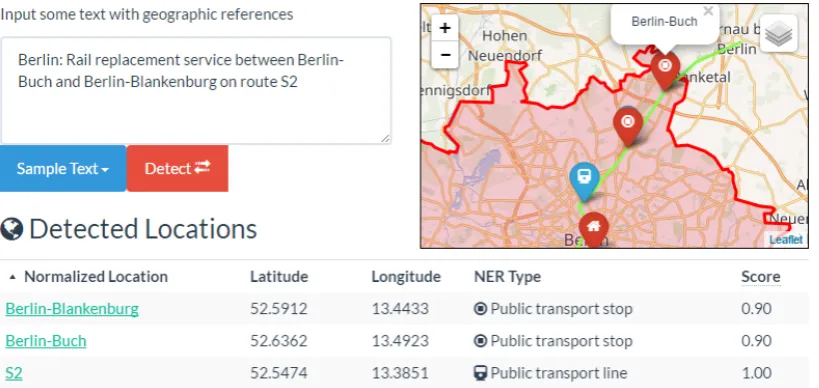
We detect events by matching dependency parse trees of sentences to relation-specific patterns, as described by Xu et al. (2007). The dependency patterns for each relation are extracted automat-ically from a set of 2,000 training documents, which have been manually annotated for event type, argument types, and roles. For Twitter, we additionally implement a keyword-based event de-tection strategy, since dependency parsing is likely to often produce erroneous results given the very informal language of many tweets. We define a set of relation-specific trigger phrases to detect events, which are matched both to hashtags and general tweet text. By carefully selecting the trig-ger phrase set, we can identify events with high precision. Figure3shows a screenshot of our web demo for NER, EL and RE.
3 Stream Processing Architecture
Our system is separated into three distinct func-tions: document retrieval, processing and annota-tion, and data storage - which are connected via a distributed message queue system, Kafka2.
2kafka.apache.org
Retrieval is handled by individual data source adapters that fetch a continuous stream of new documents and forward the results into the mes-sage bus. This relieves the annotation proces-sor from source specific data handling as well as buffers documents in case of large traffic bursts. A similar, less versatile, message–based archi-tecture, has been presented by Kirschnick and
Thomas (2017) for NER in the biomedical
do-main.
The core processing itself is handled by Apache Flink, a distributed, streaming data flow engine that provides data distribution, communication, and fault tolerant stream computation. We mod-eled the NLP pipeline within Flink as a series of transformations, that each wrap one NLP as-pect. Flink connects to the message bus and for-wards each new document through the pipeline. Fault tolerance, using check-pointing, guarantees exactly once processing, avoiding to double pro-cess the same document in case of failures. Fur-thermore, with adaptive back pressure handling, Flink will back off from retrieving new documents when the pipeline itself falls behind in processing, which guarantees the fastest possible processing across all compute nodes.
Together, these frameworks can handle back pressure in case of data stream peaks, and pro-vide high throughput. Our system thus can easily scale to larger and faster data streams than those we currently handle, for example when extending the system to monitor more data streams, other languages, or a wider range of events.
Transformations subsequently enrich an inter-nal document representation whose schema is in-spired by the Common Analysis Structure imple-mented in UIMA. This schema defines major el-ements, such as sentences, tokens, concepts, rela-tions and generic attributes, including provenance information, consisting of annotator, confidence and license information for traceability. Other an-notations are either realized as attributes of these classes, or in a generic fashion using a labeled span scheme. The data schema is extensible and allows us to easily integrate additional annotation components, as well as multiple different annota-tors for the same annotation type (e.g. when us-ing both Stanford and SProUT for NER). We use Avro3, a compact binary data format, to efficiently
serialize documents between pipeline processing
Figure 3: Screenshot of our web based demo system for location detection.
steps.
Finally, annotated documents are pushed back to the message system, where they can be read by multiple consumers. In our implementation we archive all results for offline analysis and index a rolling window of the results for immediate query-ing through a dashboard. The dashboard can be used to serve alerts and notifications of extracted events in near real-time, as they are happening.
4 Observations and Insights
In this section we share observations made during the development of our linguistic pipeline.
Preprocessing: During preprocessing we ob-served that boilerplate detection sometimes retains navigational text, which impacts the subsequent linguistic steps. Twitter and RSS feeds are easier to process due to the structured and well-defined format they are provided in (JSON and XML).
Named entity recognition: Our current ap-proach substantially relies on gazetteers and gram-matical rules implemented in SProUT. This ap-proach provides some inherent difficulties for NER: First, we are unable to detect specific-type entities not covered by the gazetteers (since Stan-ford only detects ‘larger’ locations). To amelio-rate this problem, we implemented a fuzzy match-ing strategy, but lower than desirable recall is still an issue. Second, cross-type ambiguity of e.g. public transport stop names sharing the name with the street or borough they are located in, remains a challenge. For example, “Baumschu-lenweg” can refer to a public transport train sta-tion in Berlin, a street in more than 15 cities,
or a locality in Berlin. Third, we observe a high ambiguity between smaller cities and Ger-man nouns, e.g. Regen (rain), Dom (cathedral), or Strom (stream/river, but also electricity). In this work we utilize a blacklist of frequent terms to identify and remove such entities. As an alter-native to SProUT, we plan to incorporate condi-tional random field models (Lafferty et al.,2001), trained for non-standard entity types in the future
(Schwarzenberg et al.,2017).
Entity linking: Entity linking is implemented using a geo-location based disambiguation strat-egy. This strategy works best for documents, men-tioning the larger area (e.g. a city) and smaller locations contained within this area in the same sentence. In cases where multiple cities match a named entity, we require a popularity measure to rank target concepts. A simple measure currently implemented is the surface area of a shape. How-ever, this measure can sometimes be misleading in case of relatively large but sparsely populated places (e.g. Frankfurt (Oder) is only 40 % smaller than Frankfurt (Main), but with only 8 % of the inhabitants). A potentially helpful measure is the number of inhabitants in a specific area, which is only provided for approximately 4.6 % of all areas contained in OSM.
Event extraction: Event extraction uses relation-specific dependency patterns for RSS-feeds and news articles. For Twitter we define a set of relation-specific trigger phrases. The lat-ter event detection strategy poses a problem for metaphoric word usage. For instance, “a
of distributing the processing across multiple ma-chines. We observed that the volume of messages is not constant across each source, instead these sources show a bursty behavior. Large events, for example, can generate huge temporary spikes in message volume – but at the same time we would like to retain the ability to process all messages in near real-time by scaling out. The experiment setup consisted of a cluster of 4 machines (32 logical CPUs and 256 GB RAM each), running Ubuntu 14.04 and Flink v1.1.2. We varied the de-gree of parallelism by specifying the number of task managers that Flink could utilize to distribute the processing and measured the overall runtime to process each dataset sample.
Figure 5 shows the results of the scaling ex-periment, varying the parallelisms from 2 to 20. For both datasets the processing time drops sig-nificantly when more and more tasks managers are added. The performance gains are smaller for larger degrees of parallelism, due to a cor-responding increase in communication costs be-tween worker nodes. In the highest setting, we measured a throughput of 530 docs/sec and 123
docs/sec for Twitter and RSS respectively.
The price for the gained throughput is a modest processing overhead introduced by Flink itself as well as the time it takes to transport the documents over the network. With20task managers we ob-served an overall processing overhead of10%.
7 Related Work
The ReDites real-time event detection and track-ing system presented by Osborne et al. (2014) fo-cuses on events from the security domain, and uses Twitter as its sole data source. As our system, it is fully automatic, geo-locates events, and supports multiple languages. Its scope, however, does not encompass deep linguistic analyses of input doc-uments for NER, EL and RE, since it uses a shal-low definition of event detection in the spirit of Topic Detection and Tracking (TDT). The system can therefore not be used e.g. for knowledge base population. Other TDT-like systems include Trend Miner (Preot¸iuc-Pietro and Cohn, 2013) and the Social Sensor system (Aiello et al.,2013).
Most similar to our system is the approach pre-sented by Tanev et al. (2008). Their system also extracts ACE-style events together with their ar-guments from news texts. They utilize, in their own words, a ‘linguistically poor’ approach that
relies on simple 1 and 2-slot extraction patterns that are acquired by bootstrapping. The system focuses on security-related events, employs TDT-style clustering techniques, but for efficiency rea-sons processes only the first sentence of each doc-ument. Our system scales to full documents, and can hence detect a much larger set of events from each document. Piskorski and Atkinson (2011) later extend the approach of Tanev et al. to more fine-grained event schemas, and to support event detection in 7 languages.
8 Conclusion
In this work we introduced a system for scal-able, realtime event extraction. Our system cur-rently implements both German and English anal-ysis pipelines that include components for NER, EL and RE. It processes different input text data streams, including high-volume, high-velocity sources such as Twitter, but also continuous crawls of web documents and RSS feeds. A performance analysis conducted on several large datasets shows that processing large volumes in near-realtime is possible when running on the distributed stream processing platform Flink – not only achieving high throughput, but also maintaining low latency, crucial when extracted events need to be moni-tored and acted upon. The demo is available at
http://dfki.de/sd4m-sta-demo/.
We find that linking fine-grained geo-entities (such as street or route names) is especially chal-lenging, and will require better models. Further-more, in future work we would like to extend our relation extraction component to handle more rela-tions and event types, and to correctly distinguish between factual and future (or rumored) events, such as for example planned road works, or com-pany acquisition offers.
Acknowledgments
References
L. M. Aiello, G. Petkos, C. Martin, D. Corney, S. Pa-padopoulos, R. Skraba, A. Gker, I. Kompatsiaris,
and A. Jaimes. 2013. Sensing Trending
Top-ics in Twitter. IEEE Transactions on Multimedia
15(6):1268–1282.
A. Alexandrov, R. Bergmann, S. Ewen, J. Freytag, F. Hueske, A. Heise, O. Kao, M. Leich, U. Leser, V. Markl, F. Naumann, M. Peters, A. Rheinl¨ander, M. Sax, S. Schelter, Ma. H¨oger, K. Tzoumas, and D. Warneke. 2014. The Stratosphere Platform for
Big Data Analytics. The VLDB Journal23(6).
J. Allan, J. Carbonell, G. Doddington, J. Yamron, and Y. Yang. 1998. Topic detection and tracking pilot
study: Final report. InProc. of DARPA Broadcast
News Transcription and Understanding Workshop. B. Bohnet. 2010. Top accuracy and fast dependency
parsing is not a contradiction. InProc. of COLING. pages 89–97.
K. Bollacker, C. Evans, P. Paritosh, T. Sturge, and J. Taylor. 2008. Freebase: A Collaboratively Cre-ated Graph Database for Structuring Human
Knowl-edge. InProc. of SIGMOD. pages 1247–1250.
G. Doddington, A. Mitchell, M. Przybocki, L. Ramshaw, S. Strassel, and R. Weischedel. 2004. The Automatic Content Extraction (ACE)
Program - Tasks, Data, and Evaluation. InProc. of
LREC.
M. Dredze, P. McNamee, D. Rao, A. Gerber, and T. Finin. 2010. Entity disambiguation for
knowl-edge base population. InProc.of COLING 2010.
W. Drozdzynski, H. Krieger, J. Piskorski, U. Sch¨afer, and F. Xu. 2004. Shallow processing with unifica-tion and typed feature structures — foundaunifica-tions and applications. K¨unstliche Intelligenz1:17–23. D. Ferrucci and A. Lally. 2004. UIMA: An
archi-tectural approach to unstructured information pro-cessing in the corporate research environment. Nat. Lang. Eng.10(3–4):327–348.
H. Ji, J. Nothman, and B. Hachey. 2014. Overview of TAC-KBP2014 Entity Discovery and Linking Tasks. InProc. of the Text Analysis Conference.
J. Kirschnick and P. Thomas. 2017. SIA: Scalable In-teroperable Annotation Server. InProc. of BeCalm. pages 138–145.
C. Kohlsch¨utter, P. Fankhauser, W. Nejdl,
C. Kohlsch¨utter, P. Fankhauser, and W. Nejdl. 2010. Boilerplate Detection Using Shallow Text
Features. InProc. of WSDM. pages 441–450.
J. D. Lafferty, A McCallum, and F .C. N. Pereira. 2001. Conditional Random Fields: Probabilistic Models for Segmenting and Labeling Sequence Data. In Proc. of ICML. pages 282–289.
M. Lui and T. Baldwin. 2012. langid.py: An off-the-shelf language identification tool. InProc. of ACL: System Demonstrations. pages 25–30.
C. D. Manning, M. Surdeanu, J. Bauer, J. Finkel, S. J. Bethard, and D. McClosky. 2014. The Stanford CoreNLP Natural Language Processing Toolkit. In Proc. of ACL: System Demonstrations. pages 55–60. M. Mintz, S. Bills, R. Snow, and D. Jurafsky. 2009. Distant Supervision for Relation Extraction
With-out Labeled Data. InProc. of ACL-IJCNLP. pages
1003–1011.
G. Orenstein, C. Doherty, K. White, and S. Cami˜na. 2015.Building Real-Time Data Pipelines. O’Reilly. M. Osborne, S. Moran, R. McCreadie, A. Von Lunen, M. Sykora, E. Cano, N. Ireson, C. Macdonald, I. Ou-nis, Y. He, T. Jackson, F. Ciravegna, and A. O’Brien. 2014. Real-time detection, tracking, and monitoring of automatically discovered events in social media. InProc. of ACL: System Demonstrations.
J. Piskorski and M. Atkinson. 2011. Frontex real-time
news event extraction framework. InProc. of KDD.
KDD ’11, pages 749–752.
D. Preot¸iuc-Pietro and T. Cohn. 2013. A temporal model of text periodicities using gaussian processes. InProc. of EMNLP. pages 977–988.
R. Schwarzenberg, L. Hennig, and H. Hemsen. 2017. In-Memory Distributed Training of Linear-Chain Conditional Random Fields, with an Application to
Fine-Grained Named Entity Recognition. InProc.
of GSCL.
H. Tanev, J. Piskorski, and M. Atkinson. 2008. Real-time news event extraction for global crisis
monitor-ing. InProc. of NLDB 2008. pages 207–218.
F. Xu, H. Uszkoreit, and H. Li. 2007. A Seed-driven Bottom-up Machine Learning Framework for
Ex-tracting Relations of Various Complexity. InProc.