Known-key Distinguisher on Full
PRESENT
C´eline Blondeau1, Thomas Peyrin2and Lei Wang2,3? 1
Department of Computer Science, School of Science, Aalto University, Finland 2 Nanyang Technological University, Singapore
3
Shanghai Jiao Tong University, China
[email protected], [email protected], [email protected]
Abstract. In this article, we analyse the known-key security of the stan-dardizedPRESENTlightweight block cipher. Namely, we propose a known-key distinguisher on the fullPRESENT, both 80- and 128-bit key versions. We first leverage the very latest advances in differential cryptanalysis on
PRESENT, which are as strong as the best linear cryptanalysis in terms of number of attacked rounds. Differential properties are much easier to handle for a known-key distinguisher than linear properties, and we use a bias on the number of collisions on some predetermined input/output bits as distinguishing property. In order to reach the full PRESENT, we eventually introduce a new meet-in-the-middle layer to propagate the differential properties as far as possible. Our techniques have been im-plemented and verified on the small scale variant ofPRESENT. While the known-key security model is very generous with the attacker, it makes sense in practice sincePRESENThas been proposed as basic building block to design lightweight hash functions, where no secret is manipulated. Our distinguisher can for example apply to the compression function obtained by placingPRESENTin a Davies-Meyer mode. We emphasize that this is the very first attack that can reach the full number of rounds of the
PRESENTblock cipher.
Key words:PRESENT, known-key model, distinguisher, differential crypt-analysis, linear cryptanalysis.
1
Introduction
The pervasive deployment of tiny computational devices brings with it many interesting, and potentially difficult, security issues. Recently, lightweight tography has naturally attracted a lot of attention from the symmetric-key cryp-tography community and many lightweight block ciphers [8,10,18] and hash func-tions [2,17,7] have been proposed in the past few years. Among these primitives, PRESENT[8] is probably the one which has been the most scrutinized. It remains unbroken, even though many lightweight block ciphers have been successfully attacked. As such, it has become an ISO/IEC standard [19] and is now expected to be deployed in many industrial applications.
?
It is well known that block ciphers and hash functions are very close crypto-graphic primitives, as the latter can be built from the former and vice versa. For example, the Davies-Meyer construction or the Miyaguchi-Preneel construction can transform a secure block cipher into a secure compression function (which can in turn be used to build a secure hash function by plugging it into some domain extension algorithm). However, while the security is usually guaranteed with a security proof that considers the internal block cipher as a black-box, it is very important that this internal primitive presents no flaw whatsoever. A classical example is the devastating effect on the compression function security of weak keys for a block cipher [33], which are usually considered as a minor flaw for a block cipher if the set of these weak-keys is small.
Therefore, the security notions to consider for a block cipher will vary de-pending if this block cipher will be used in a hash function setting or not. In a hash setting, block cipher security models such as the known-key [22] (the attacker can know the key) or the chosen-key model (the attacker can choose the key) make sense since in practice the attacker has full access and control over the internal computations. Moreover, an attack in these models depicts a structural flaw of the cipher, while it should be desired to work with a primitive that does not have any flaw, even in the most generous security model for the attacker. Several known-key or chosen-key attacks on reduced-round AES-128 were published [22,16,21,14], and Gilbert [15] eventually exhibited a known-key attack on the full 10 rounds with 264 computations.
by knowing or choosing the key will not greatly help the attacker to improve linear attacks [25].
Our contribution. In this article, we exhibit the very first known-key
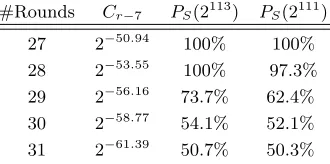
at-tack on the full PRESENT cipher. More precisely, using the framework from [5], we avoid the issues when trying to improve linear attacks with more freedom degrees. We start from some of the best differential distinguishers from [5] and we managed to extend them by several rounds by adding a meet-in-the-middle layer. Overall, storing 235.58bytes, we can distinguish the full 31-roundPRESENT in the known-key model in a time corresponding to 256encryptions. The success of our known-key distinguisher on the fullPRESENTis 50.5% and is equal to 100% when considering a version reduced to 27 rounds. More details are provided in Table 3. The distinguishing attacks presented in this paper are independent of the key-size and are valid for bothPRESENT-80 andPRESENT-128.
In order to validate our results, we have implemented and verified our dis-tinguisher on a small scale variant of PRESENT proposed in [26]. Our findings indicate that one should avoid using PRESENTas building block to create com-pression functions and hash functions, as it was proposed in [9]. Actually, our distinguisher can also apply toDM-PRESENT (both 80 and 128-bit versions) and toH-PRESENT. We emphasize that this cryptanalysis is the very first non-random property found for the fullPRESENT.
In Section 2 we first describe thePRESENT block cipher and then we intro-duce our attack model in Section 3. Then, we explain the method to build our distinguisher in Section 4 and finally provide experiments and summarize our results in Section 5. Section 6 concludes this paper.
2
The
PRESENT
block cipher
2.1 Description of PRESENT
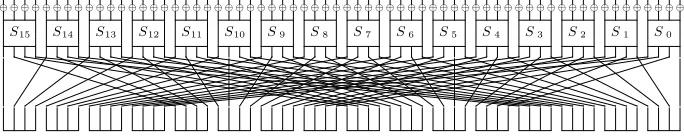
PRESENT [8] is a 64-bit lightweight block cipher proposed at CHES 2007. It is composed of 31 rounds and the 64-bit 32 round-keys are derived from a 80-bit or a 128-bit master key (we will respectively refer toPRESENT-80 orPRESENT-128). The round function is composed of a round-key XOR, an Sbox layer and a simple linear bit permutation layer, as depicted in Figure 1.
The permutation layer operates linearly on the 64 bits as follows: the bitiof the state is moved to the bit positionP(i) where
P(i) =
16×i mod (63) for 0≤i <63,
63 fori= 63.
⊕ ⊕ ⊕ ⊕ ⊕ ⊕ ⊕ ⊕ ⊕ ⊕ ⊕ ⊕ ⊕ ⊕ ⊕ ⊕ ⊕ ⊕ ⊕ ⊕ ⊕ ⊕ ⊕ ⊕ ⊕ ⊕ ⊕ ⊕ ⊕ ⊕ ⊕ ⊕ ⊕ ⊕ ⊕ ⊕ ⊕ ⊕ ⊕ ⊕ ⊕ ⊕ ⊕ ⊕ ⊕ ⊕ ⊕ ⊕ ⊕ ⊕ ⊕ ⊕ ⊕ ⊕ ⊕ ⊕ ⊕ ⊕ ⊕ ⊕ ⊕ ⊕ ⊕ ⊕
S15 S14 S13 S12 S11 S10 S9 S8 S7 S6 S5 S4 S3 S2 S1 S0
Fig. 1.One round ofPRESENT.
SboxSi, 0≤i≤15, corresponds to the bits 4i,4i+ 1,4i+ 2,4i+ 3 denoted by [4i,4i+ 3]. The 4-bitPRESENTSbox can be described with the following table in hexadecimal display:
S[] ={0xC,0x5,0x6,0xB,0x9,0x0,0xA,0xD,0x3,0xE,0xF,0x8,0x4,0x7,0x1,0x2}.
We do not describe the key schedule ofPRESENT as it has no impact on our attack, yet we refer to [8] for a more complete description of the cipher.
2.2 Previous results on PRESENT
In the last couple of years, various analyses [12,31,1,13,3,27,32,4,5] on reduced versions ofPRESENTin the (secret)-single-key model have been proposed. Among these analyses, the most important one remains the multidimensional linear attack from Cho [12], which takes advantage of the easy-to-trace linear trails with large correlations, and eventually threatens the security ofPRESENT up to 26 rounds. Until 2014, as shown in Table 1, linear cryptanalysis-based attacks were much more powerful against PRESENT, as only 19 rounds were reachable using differential cryptanalysis-based attacks. Some of these key-recovery attacks take advantage of the key-schedule and their time complexity have often been computed for a single version.
However, based on a link between differential probability and linear corre-lation, it has recently been shown in [5] that one can convert a multidimen-sional linear distinguisher into a truncated differential one. In Section 4.2 we will provide more details on this technique, which permitted to push truncated differential attacks up to 26 rounds ofPRESENT.
Table 1. Relevant attacks onPRESENTin the (secret)-single-key model
#roundsVersion Attack Data Time Mem. Ref. Year 16 80 differential 264.0 264.0 232.0 [31] 2008 19 128 algebraic differential 262.0 2113.0 n/r [1] 2009 19 128 multiple differential 262 2120 260 [4] 2013 25 128 linear 264.0 296.7 240.0 [28] 2009 26 80 multidimensional linear 264.0 272.0 232.0 [12] 2010 26 80 truncated differential 263.16 276.0 229.0 [5] 2014
the model provided in [5] to take advantage of much longer truncated differential distinguishers.
Very recently, Lauridsenet al.[25] combined linear cryptanalysis and rebound attacks to obtain known-key distinguishers on thePRESENTcipher, for both 80-bit and 128-80-bit versions. Eventually, they managed to reach 27 rounds, that is one more round than the best (secret)-single-key model attack on PRESENT. Their distinguisher on 27 rounds ofPRESENT-128 requires 210computations and 261.67 steps of verification, but works only with probability 2−56.2since the dis-tinguisher is considered valid for 271.8 keys among the 2128 possible. The issue
with this method is that it seems not very well fit for known-key or chosen-key scenarios, as only one extra round is reached compared to the best attack in the (secret)-single-key model.
In the next sections, we will describe a meet-in-the-middle approach that fits very well with differential-based attacks, and that will allow us to reach 5 more rounds compared to the best attack in the (secret)-single-key model. Moreover, our distinguishers can apply to DM-PRESENTandH-PRESENT[9] as well.
3
Known-key distinguisher
The known-key model has been introduced by Knudsen and Rijmen [22] to analyse the security ofAES-128and some Feistel-based ciphers. The goal of this model was to get a better estimation of the security margin of a cipher, but also to encompass the scenario of block cipher-based hashing, where the key is known and even chosen by the attacker. The property exhibited for their distinguisher was an integral structure on the input and output of a set of plaintext/ciphertext pairs, for a given known key. Several other types of known-key distinguishers were subsequently proposed, such as the subspace distinguisher [24], the limited-birthday distinguisher [16,20], and more recently a quite complex property re-lated to an integral structure was described by Gilbert [15] to reach the full AES-128.
and decryption oracles of the cipher should not be able to obtain the same prop-erty with equal or lower complexity than for the distinguisher. In our case, the property we will exhibit is quite trivial: we will observe a bias on the number of collisions on some predetermined input and output bits for a set of many plain-text/ciphertext pairs. More precisely, let the cipher block size to be nbits and lets(respectivelyq) denote the number of bits from the input (respectively the output) on which we will observe these collisions. We will generateN messages, such that they all have the same value on thes input bits and such that there is a bias on the number of collisions observed on theqoutput bits.
When having blackbox access to encryption/decryption oracles, an attacker would maximise his success rate by asking only encryption queries. Indeed it is much harder for him to ensure that he will get exactly the required value on the s input bits (which is basically the strongest bias possible) when ask-ing decryption queries, than tryask-ing to obtain a weak bias on theq output bits when asking encryption queries. In other words, the best strategy for him is to ensure that the strongest bias is pre-verified when building its queries, and then hoping to observe the weakest bias on the outputs of the oracle. Moreover, to further maximize his success rate, all its encryption queries should have the same value on the s input bits. Indeed, since the encryption oracle is a black-box to him, all the queries which have different value on the s input bits can be considered completely independent, and therefore will not help him (this is similar to the reasoning given in the limited-birthday problem proof [20]). To summarize, in order to validate our distinguisher, we must compare with the generic attack that consists in simply picking N random inputs (all having the same value on the s predefined bits), querying them to the encryption oracle, and counting the number of collisions obtained on the q predefined bits of the output. In Section 4.2, we will explain the details regarding the computation of the distinguisher’s success probability against this type of generic attacker.
Moreover, it is important that this exhibited property can be checked ef-ficiently, and one should count this cost in the overall complexity of the dis-tinguisher. Our distinguishing property can be very easily checked by simply verifying that all theN plaintext/ciphertext pairs have indeed the same value on the s predefined input bits, and by maintaining counters for each possible value taken by theq predefined ciphertext bits. Then, according to these coun-ters, the distinguisher will compute a simple scoring function and decide if he believes to be communicating withPRESENTor with a random permutation (see Section 4.2). We note that our known-key distinguishers will work for any key choice. Thus, one can actually have the key value used as challenge for the at-tacker, which further confirms the validity of our model.
4
Distinguishing full
PRESENT
4.1 Distinguisher overview
least in a straightforward way). Typically, those distinguishers are built upon a differential characteristic with desired input/output differences such that extra short differential characteristics with high probability can be pre- and post-added in order to attack as many rounds as possible. The start-from-the-middle approach is then to firstly find solutions of the intermediate differential charac-teristic. Although such a characteristic usually has a very low probability, thanks to the degrees of freedom obtained from knowing or choosing the key and the internal state values, the distinguisher is able to efficiently compute its solu-tions. After that, the distinguisher propagates these solutions backwards and forwards to probabilistically satisfy the pre- and post-added extra characteris-tics. As demonstrated in [23], a rather straightforward application of the start-from-the-middle approach works on very limited number of rounds ofPRESENT. The difficulty comes from the impossibility to find an intermediate differential characteristic with a large number of rounds, while maintaining an affordable time complexity to find its solutions even leveraging the degree of freedom from knowing or choosing the key and the internal state values. We refer the interested readers to [31,23].
Instead of differential characteristic, our distinguisher on PRESENT is built based on the truncated differential of [5]. This is motivated by the fact that truncated differential attack reaches the maximum number of attacked rounds so far as shown in Table 1. Moreover, as far as we know, it is much easier to han-dle than multidimensional linear attack. Hence, the distinguishing property is a statistical bias of the number of collisions on a few predetermined output bits, where the inputs collide on a few predetermined input bits. We note that such a bias is a very small value and thus cannot be observed with a non-negligible success probability unless a very large set of input/output pairs are provided. Moreover, the necessary number of input/output pairs increases with the num-ber of attacked rounds of truncated differential in order to have a non-negligible success probability. Therefore, there are two issues when adding extra rounds to the truncated differential to extend the number of attacked rounds of the distinguisher. The first one is that we cannot post-add extra rounds, because the predetermined colliding output bits of truncated differential will be input to different Sboxes in the next round and as a result the bias cannot be observed any more from the final outputs. The second one is that if we pre-add a dif-ferential characteristic, it sets extra constraints on the inputs of the truncated differential,i.e.the inputs must satisfy the extra differential characteristic, which consequently reduces the total number of available inputs to the truncated dif-ferential and, a fortiori, lowers the success probability of the distinguisher. On one hand, one surely prefers to use a longer extra characteristic in order to at-tack more rounds. On the other hand, a longer extra characteristic sets more constraints on the inputs of the truncated differential path. Particularly, if the total number of the available inputs of truncated differential is lower than the necessary number to observe the statistical bias, the overall distinguisher fails.
the truncated differential. It sets constraints only at its input bits and its output bits, but not at any of its internal state bits. More precisely, the constraints on its input bits is trivially due to defining the distinguishing property.4 The
constraints on its output bits are coming from the truncated differential,i.e.the output difference of the MitM layer must satisfy the input constraints of the truncated differential.
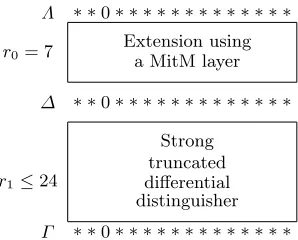
Before providing the details of our known-key distinguisher onPRESENT, we give a general overview. As illustrated in Figure 2, the main idea is to take advantage of a strong truncated differential distinguisher (∆ → Γ) over the
r1≤24 last rounds. We denote bypthe probability of this distinguisher. From
the knowledge of the key, using a MitM approach, we are able to generate a large number of plaintexts which fulfill the following property: for all plaintexts with input difference in the setΛ, their differences after 7 rounds is in the set∆. The truncated differential distinguisher is described in Section 4.2, the MitM layer in Section 4.3.
Strong truncated differential distinguisher Extension using
a MitM layer
r1≤24
r0= 7
Λ
∆
Γ
∗ ∗0∗ ∗ ∗ ∗ ∗ ∗ ∗ ∗ ∗ ∗ ∗ ∗ ∗
∗ ∗0∗ ∗ ∗ ∗ ∗ ∗ ∗ ∗ ∗ ∗ ∗ ∗ ∗
∗ ∗0∗ ∗ ∗ ∗ ∗ ∗ ∗ ∗ ∗ ∗ ∗ ∗ ∗
Fig. 2. Distinguisher overview. Each symbol represents 4 bits.
4.2 A statistical bias on reduced-round PRESENT
Given an n-bit permutation F, splitting the input space into s+t bits and the output space into q+r bits, we have the following results which link the probability of a truncated differential with the capacity of a multidimensional linear approximation.
Theorem 1 ([5]). Let Fn
2 =Fs2×Ft2=F
q
2×Fr2 and
F :Fn2 →Fn2, x= (xs, xt)7→(yq, yr).
Given a multidimensional approximation[(as,0),(bq,0)]as∈Fs2, bq∈Fq2 with capacity
C= X
(as,bq)6=(0,0)
cor2(as·xs⊕bq·yq),
and a truncated differential composed of2t input differences (0, δ
t)∈ {0} ×Ft2, and2r output differences(0, γ
r)∈ {0} ×Fr2 with probability
p= 1 2q
X
δt,γr∈Ft2×Fr2
P[(0, δt)→(0, γr)],
where P[(0, δt) F
→ (0, ∆r)] = 2−n#{x ∈ Fn2|F(x)⊕F(x⊕(0, δt)) = (0, γr)}.
We have
p= 2−q(C+ 1). (1)
Truncated differential with strong bias. While the previous attack on
DM-PRESENT [23] is derived from a differential with high probability, in this pa-per, we take advantage of the strong relation between differential probability and capacity to derive a large truncated differential over up to 24 rounds with large bias.
Throughout this paper, we make a distinction on the set of output differ-ences depending if we want to distinguish PRESENT or DM-PRESENT. For our distinguisher on thePRESENTcipher, the sets of differencesΛandΓ do not need to be similar and the last permutation can be omitted which is not the case if we want to distinguish DM-PRESENT or H-PRESENT. Depending of the context, the set of considered output differences will be denoted Γ if it is placed after the last permutation layer andΓ0 if it is placed after the last Sbox layer.
We denote byI(resp.J) the number of Sboxes in the first round (resp. last round) with no difference in their input. In the context of the distinguishing attack on PRESENT, we express Theorem 1 as follows.
Corollary 1. Given a multidimensional linear approximation involving the
in-put bits ∪i∈{i1,···,iI}[4i,4i+ 3] and the output bits ∪j∈{j1,···,jJ}[4j,4j+ 3] with
capacityC, we have a truncated differential with input difference
∆=
δ= (δ0,· · ·, δ63)∈F642 |δb= 0 forb∈ ∪i∈{i1,···,iI}[4i,4i+ 3] ,
and output difference
Γ =
γ= (γ0,· · ·, γ63),∈F642 |γb= 0forb∈ ∪j∈{j1,···,jJ}[4j,4j+ 3] .
The probability of this differential is given as p= 2−4J(C+ 1) = 2−4J+ 2−4JC.
Following the notation of Theorem 1, we have s = 4I and q = 4J. We call
While in classical truncated differential attacks only few differentials are in-volved, for this distinguisher derived from a multidimensional linear distinguisher the number of involved differentials is 2128−4I−4J (asPRESENTis a 64-bit cipher). Part of the analysis consists at selecting a truncated differential with high relative bias. To understand the meaning of high relative bias we first study the success of a distinguishing truncated differential attack.
Success of the distinguishing attack. Given a truncated differential with
probabilityp= 2−q(C+1), we use the following method with data complexityN, time complexityN encryptions and negligible memory complexity to distinguish the cipher from a random permutation.
1. Set a tableT of size 2q to 0
2. For allN messagesxwith same value on the bits∪i∈{i1,···,iI}[4i,4i+ 3] (a) Compute y=EK(x)
(b) Givenyq the truncation ofy reduced toqbits, incrementT[yq] 3. ComputeD=P
0≤`≤2q−1T[`](T[`]−1)/2 4. IfD > τ, consider that this is the cipher
Without comparing the pairs directly, the scoring functionDgives us number of pairs which fulfill the differential [5]. FromN messages with same values on the bits∪i∈{i1,···,iI}[4i,4i+ 3] we can generateNS =N
2/2 pairs of message with no
difference on these bits, meaning that for a random permutation the expected number of pairs fulfilling the truncated differential should be µW =NS·2−q =
NS·2−4J. We can show [6] that the random variable DR corresponding to this scoring function for the given permutation follows a normal distribution with meanµR=NS·2−q(1 +C) and varianceσ2R≈NS·2−q(1 +C)≈NS·2−q. On the other hand we haveµW =NS ·2−q andσ2W ≈NS·2−q. We can show that when using NS pairs, the success probabilityPS of the distinguishing attack is given by,
PS(NS) =Φ
µ
R−µW
σR+σW
≈Φ
√2−qN S·C 2
(2)
whereΦthe cumulative distribution function of the central normal distribution. This success probability corresponds to a threshold τ =µR−σR·Φ−1(PS) =
µW +σW·Φ−1(PS).
Strong truncated differential onPRESENT. For a fixedNS number of pairs,
we derive from (2) that the best truncated differentials are the ones which max-imize 2−q/2C. As explained in the previous section the numberN
As explained in [12], the capacity of a multidimensional linear approximation can be obtained from the 1-bit linear trails. Given the multidimensional linear input space involving the bits [4i,4i+ 3], 0≤i≤15 and an output space after the Sbox layer involving the bits [4j,4j+ 3], 0≤j≤15, we denote byU the set {P(4i), P(4i+1), P(4i+2), P(4i+3)}andV the set{4j,4j+1,4j+2,4j+3}. We can show (see the explanation in [12]) that an estimate of the capacityCr01 over
r1 rounds without the last linear layer is obtained from the following formula
Cr01 = X
u∈U,v∈V
Mr1−2[u, v], (3)
where M denotes the 64×64 matrix with coefficients the square correlation of the 1-bit linear approximations over one round in rest of the paper. On the other hand, when the last linear layer is included, since the linear trails activate different Sboxes in the last round, we can estimate the capacity Cr1 over r1
rounds as follows
Cr1 = X
u∈U,v∈V
Mr1−1[u, v]. (4)
From our computation we found that when selecting∆ ={δ|δb = 0 forb∈ [52,55]}, the best truncated differentials are obtained forΓi0={γ0|γb= 0 forb∈ [4i,4i+ 3]} and i= 5,7,13,15. For instance such truncated differential distin-guisher on 24 rounds has a probability of 2−4(1 + 2−58.77) = 2−4+ 2−62.77 to be
fulfilled. By using 256 messages (the reason of this number is due to the MitM layer explained in Section 4.3), we can distinguish 24-round of PRESENTfrom a random permutation in 50.5% of the cases.
In the next section we explain how in the known-key model we can extend this distinguisher to reach more rounds. More explicitly we explain how we can ensure that all the generated messages have a fixed value over the bits [52,55] after 7 rounds.
4.3 The meet-in-the-middle layer
small Sbox and the bit-permutation linear layer of PRESENT. More precisely, for two rounds of computations, an input bit (or four input bits of an Sbox) interacts with only few other bits, and with those bits together can determine partial output bits. Thus we carry out a forward computation to get partial internal state bits for the first two rounds of the MitM layer by guessing just few bits. Similarly we carry out an independent backward computation to get partial internal state bits for the last one and half round of the MitM layer. Finally we carry out a gradually matching process to link and meanwhile fully determine the internal states obtained from the forward and from the backward computations, which can work up to 3 rounds.
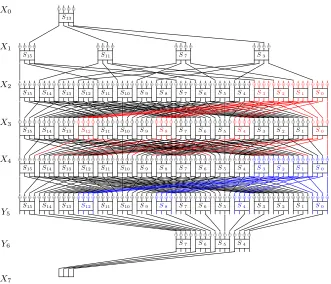
We describe in detail the concrete MitM procedure that is used in our attack on fullPRESENT. It consists of 7 rounds. The constraints on the inputs are that they share the same values at bits [52,55], i.e.the input bits to S13. The
con-straints on the outputs are that they share the same values at bits [52,55],i.e.
the input bits toS13for next round. In this section, we denote byXithe internal state after i-th round of PRESENT, and by Yi the internal state after applying Sbox layer to Xi.
Firstly, we set the bits [52,55] of plaintext to a randomly chosen 4-bit value, and compute bits 13, 29, 45 and 61 ofX1in the forward direction. These bits are
input to SboxesS3,S7,S11 andS15in the second round. Then we exhaustively
guess the other 12 bits input to these Sboxes, that include bits 12, 14, 15, 28, 30, 31, 44, 46, 47, 60, 62 and 63 ofX1, and continue to compute in the forward
direction to get 16 bits ofX2, i.e.bits 4i+ 3 for 0≤i≤15. It is also depicted
as the first two rounds in Figure 3. In total we get a set of 212such values ofX 2
and each value has 16 bits determined.
Secondly, we set the bits [52,55] ofX7 to a randomly chosen 4-bit value, and
compute bits 19, 23, 27 and 31 ofY6 in the backward direction. These bits are
input to compute the inversion of Sboxes S4,S5,S6 andS7 in sixth round. We
guess the other 12 bits input to the inversion of these Sboxes, that include bits [16,18], [20,22], [24,26] and [28,30], and continue to compute in the backward direction to get 16 bits ofY5, i.e.bits 4i+ 1 for 0≤i≤15. It is also depicted
as the last two rounds in Figure 3. In total we get a set of 212 such values ofY5
and each value has 16 bits determined.
Finally, we carry out a gradually-matching algorithm for each pair of X2
andY5obtained from the forward and the backward computations respectively.
Recall that each ofX2andY5has 16 bits fixed, which will be namedfixed bitsin
the following description. The algorithm is to find a set of internal state values of
X4, whose corresponding values of X2 andY5 can satisfy all the fixed bits, and
in turn the corresponding plaintexts can satisfy the constraints on the input and output of the MitM layer. In details, at the third round of the MitM layer, we re-group the bits ofX2into 4 groups; thei-th group contains bits [16i,16i+ 15]
for 0 ≤i ≤3. Hence each group contains input bits to 4 consecutive Sboxes, and has 4 bits fixed, i.e. bits 16i+ 3, 16i+ 7, 16i+ 11 and 16i+ 15 for the
⊕ ⊕ ⊕ ⊕
S13
⊕ ⊕ ⊕ ⊕ ⊕ ⊕ ⊕ ⊕ ⊕ ⊕ ⊕ ⊕ ⊕ ⊕ ⊕ ⊕
S15 S11 S7 S3
⊕ ⊕ ⊕ ⊕ ⊕ ⊕ ⊕ ⊕ ⊕ ⊕ ⊕ ⊕ ⊕ ⊕ ⊕ ⊕ ⊕ ⊕ ⊕ ⊕ ⊕ ⊕ ⊕ ⊕ ⊕ ⊕ ⊕ ⊕ ⊕ ⊕ ⊕ ⊕ ⊕ ⊕ ⊕ ⊕ ⊕ ⊕ ⊕ ⊕ ⊕ ⊕ ⊕ ⊕ ⊕ ⊕ ⊕ ⊕⊕ ⊕ ⊕ ⊕ ⊕ ⊕ ⊕ ⊕ ⊕ ⊕ ⊕ ⊕ ⊕ ⊕ ⊕ ⊕
S15 S14 S13 S12 S11 S10 S9 S8 S7 S6 S5 S4 S3 S2 S1 S0
⊕ ⊕ ⊕ ⊕ ⊕ ⊕ ⊕ ⊕ ⊕ ⊕ ⊕ ⊕⊕ ⊕ ⊕ ⊕⊕ ⊕ ⊕ ⊕ ⊕ ⊕ ⊕ ⊕ ⊕ ⊕ ⊕ ⊕⊕ ⊕ ⊕ ⊕⊕ ⊕ ⊕ ⊕ ⊕ ⊕ ⊕ ⊕ ⊕ ⊕ ⊕ ⊕⊕ ⊕ ⊕ ⊕⊕ ⊕ ⊕ ⊕ ⊕ ⊕ ⊕ ⊕ ⊕ ⊕ ⊕ ⊕⊕ ⊕ ⊕ ⊕
S15 S14 S13 S12 S11 S10 S9 S8 S7 S6 S5 S4 S3 S2 S1 S0
⊕ ⊕ ⊕ ⊕ ⊕ ⊕ ⊕ ⊕ ⊕ ⊕ ⊕ ⊕ ⊕ ⊕ ⊕ ⊕ ⊕ ⊕ ⊕ ⊕ ⊕ ⊕ ⊕ ⊕ ⊕ ⊕ ⊕ ⊕ ⊕ ⊕ ⊕ ⊕ ⊕ ⊕ ⊕ ⊕ ⊕ ⊕ ⊕ ⊕ ⊕ ⊕ ⊕ ⊕ ⊕ ⊕ ⊕ ⊕⊕ ⊕ ⊕ ⊕ ⊕ ⊕ ⊕ ⊕ ⊕ ⊕ ⊕ ⊕ ⊕ ⊕ ⊕ ⊕
S15 S14 S13 S12 S11 S10 S9 S8 S7 S6 S5 S4 S3 S2 S1 S0
⊕ ⊕ ⊕ ⊕ ⊕ ⊕ ⊕ ⊕ ⊕ ⊕ ⊕ ⊕⊕ ⊕ ⊕ ⊕⊕ ⊕ ⊕ ⊕ ⊕ ⊕ ⊕ ⊕ ⊕ ⊕ ⊕ ⊕⊕ ⊕ ⊕ ⊕⊕ ⊕ ⊕ ⊕ ⊕ ⊕ ⊕ ⊕ ⊕ ⊕ ⊕ ⊕⊕ ⊕ ⊕ ⊕⊕ ⊕ ⊕ ⊕ ⊕ ⊕ ⊕ ⊕ ⊕ ⊕ ⊕ ⊕⊕ ⊕ ⊕ ⊕
S15 S14 S13 S12 S11 S10 S9 S8 S7 S6 S5 S4 S3 S2 S1 S0
⊕ ⊕ ⊕ ⊕ ⊕ ⊕ ⊕ ⊕ ⊕ ⊕ ⊕ ⊕ ⊕ ⊕ ⊕ ⊕
S7 S6 S5 S4
X0
X1
X2
X3
X4
Y5
Y6
X7
Fig. 3.MitM over the 7 first rounds ofPRESENT
is bits 4j+i, 0 ≤j ≤15, for the i-th group. We store the values of partially determined X4 computed from the i-th group in a table T Fi. See Figure 3 for an example group in red color. Independently and similarly, at the sixth round of the MitM layer, we also re-group the bits of Y5 to 4 groups; the i-th group
contains bits [4i,4i+ 3]S[4i+ 16,4i+ 19]S[4i+ 32,4i+ 35]S[4i+ 48,4i+ 51] for
0≤i≤3. Then for each group independently, we exhaustively guess the unfixed 12 bits, and compute in the backward direction to get 16 bits ofX4, that is bits
[16i,16i+ 15], for thei-th group. We store the values of partially determinedX4
computed from thei-th group in a tableT Bi. See Figure 3 for an example group in blue color. After that, we merge those tables to find a set of fully-determined values of X4. To begin with, we merge T Fi and T Bi, and the merged table is denoted asTi, independently for each 0≤i≤3. By merging these two tables, we mean to merge every two partially-determined values of X4, each from a table
and sharing the same bit values at the common determined bit positions, into a new (partially-determined) value ofX4 with all their determined bits, and then
to include this new value ofX4in tableTi. Note that each value ofT Fiand each value of T Bi share 4 determined bit positions. Hence table Ti has on average 220values. Then, we mergeT
0andT1 and mergeT2 andT3independently, and
shares 8 common bits with T1 (respectively T3), we get that each of resulted
tables has on average 232values. In the end, we mergeT
0,1andT2,3, which gives
on average 232 values of fully-determinedX
4since they share 32 common bits.
Overall, there are 224pairs of partially-determinedX
2andY5 obtained from
the forward and the backward computations respectively, and each pair results on average 232fully-determined values ofX
4. Thus in total we can get on average
256(=24+32) plaintexts by inversely computing from the fully-determined values
ofX4, and these plaintexts can satisfy the constraints on the input and output
of the MitM layer.
It is important to note that by running over all pairs ofX2 andY5, we have
filtered out all the plaintexts that can satisfy the constraints on both input and output of the MitM layer. In fact it is trivial to evaluate the expected number of such plaintexts. Since there are 4 bit-constraints at bits [52,55] of plaintext and 4 bit-constraints at bits [52,55] ofX7, the expected number of desired plaintexts
should be 256(=64−4−4). This means that on average (at most) 256values can be input to the truncated differential, which contributes to 2111 pairs, to observe
the bias. It has an impact to the success probability of overall distinguisher. More details are given in Section 5.
Complexity. The complexities of both the forward computation and the
back-ward computations are 212computations of 2PRESENT-rounds. For the
gradually-matching phase, the algorithm is executed 224times since there are 212X
2 from
the forward computation and 212Y
5from the backward computations. The
com-plexity of each execution is obviously dominated by mergingT0,1andT2,3, which
needs 232table lookups. Hence in total the complexity of the gradually-matching
phase is 256 table lookups.
Once a match of the MitM layer has been found, we can encrypt this value
X4 over ther1+ 3 rounds and increment the counterD given in the previous
section. Therefore the memory complexity of this attack is dominated by the storage of the tableT0,1andT2,3which is 2·232·6 bytes. Overall the total time
complexity of the distinguisher is 256table lookups and 256 encryptions.
5
Results
5.1 Experiments
To confirm the validity of the distinguisher presented in this paper, we imple-mented a similar known-key distinguisher onSMALLPRESENT-[8], a 32-bit scaled-version ofPRESENT[26]. A general overview of the cipher as well as a description of the parameters for this known-key distinguishing attack are provided in Fig-ure 4.
For this experimental attack with I = 2 and J = 2, the expected number of messages obtained from the MitM layer should be 232−4I−4J = 216. We
⊕ ⊕ ⊕ ⊕ ⊕ ⊕ ⊕ ⊕
S5 S1
⊕ ⊕ ⊕ ⊕ ⊕ ⊕ ⊕ ⊕ ⊕ ⊕ ⊕ ⊕ ⊕ ⊕ ⊕ ⊕⊕ ⊕ ⊕ ⊕ ⊕ ⊕ ⊕ ⊕ ⊕ ⊕ ⊕ ⊕ ⊕ ⊕ ⊕ ⊕
S7 S6 S5 S4 S3 S2 S1 S0
⊕ ⊕ ⊕ ⊕⊕ ⊕ ⊕ ⊕⊕ ⊕ ⊕ ⊕⊕ ⊕ ⊕ ⊕⊕ ⊕ ⊕ ⊕⊕ ⊕ ⊕ ⊕⊕ ⊕ ⊕ ⊕⊕ ⊕ ⊕ ⊕
S7 S6 S5 S4 S3 S2 S1 S0
⊕ ⊕ ⊕ ⊕ ⊕ ⊕ ⊕ ⊕ ⊕ ⊕ ⊕ ⊕ ⊕ ⊕ ⊕ ⊕⊕ ⊕ ⊕ ⊕ ⊕ ⊕ ⊕ ⊕ ⊕ ⊕ ⊕ ⊕ ⊕ ⊕ ⊕ ⊕
S7 S6 S5 S4 S3 S2 S1 S0
MitM
truncated differential * * 0 * * * 0 *
* 0 0 * * * * *
* * 0 * * * 0 *
r1 r0= 4
Λ
∆
Γ0
Fig. 4. Left: The MitM part of our experiments on SMALLPRESENT-[8]. Right:
Description of the differential involved in our experimental attacks.
standard deviation of these experiments, which was 212.73. Based on this
de-viation, we got that for more than 99.9% of the experiments, the number of messages generated by the MitM phase was greater than 215. Therefore we take
the value N = 215 (N
S = N2/2 = 229) into consideration to compute a con-servative success probability of the attack. A resume of the obtained results for 5 ≤r1 ≤8 and a comparison with the theoretical success probability obtained
by formula (2) are given in Table 2.
Table 2. Experimental attacks onSMALLPRESENT-[8]
#Rounds C PS(229) Exp.PS
overr−4 rounds
9 2−5.42 100% 100%
10 2−8.46 98.0% 96.6% 11 2−10.30 75.6% 78.9% 12 2−16.17 54.3% 54.6%
As expected, these results confirm the validity of the known-key distinguish-ing model presented in this paper.
5.2 Results
Distinguisher onPRESENT. The results of our known-key distinguishing attack
As from the MitM phase we can extend the truncated differential distin-guisher over 7 rounds, its probability has been computed over r−7 rounds. As explained in Section 4.3, from the MitM phase we can generate in average 2111 plaintext pairs with difference in the setΛ leading after 7 rounds to 2111
pairs with difference in ∆. As from the MitM phase the number of generated pairs is not the always same, we computed a conservative success probability assuming that from the MitM phase only 2109 pairs are generated. Note that
we have conducted experiments on the 7 first rounds ofPRESENT showing that when merging T Fi and T Bi, 0 ≤i ≤3, the expected number of matches was, as expected, 220 and the standard deviation was dependent of the group and lower than 214.5. These experiments support the fact that assuming that only 2109 pairs are generated should gives us an underestimate of the success of the attack. The memory complexity of this distinguishing attack is dominated by
Table 3. Success probability of the known-key distinguisher (Λ → Γ0) on
PRESENT. The probability of the truncated differential over r−7 rounds is ob-tained from the formulap= 2−4(Cr0−7+ 1) with Cr0−7computed from (3).
#Rounds Cr0−7 PS(2111) PS(2109)
27 2−48.33 100% 100% 28 2−50.94 99.8% 93.0% 29 2−53.55 68.6% 59.5% 30 2−56.16 53.2% 51.5% 31 2−58.77 50.5% 50.3%
the storage of the tables in the MitM phase and corresponds to the storage of 235.58 bytes. The time complexity of this known-key distinguisher on the full
PRESENTis 256table lookups plus 256encryptions.
Using multiple truncated differentials. In contrary to the distinguishers
of such multiple truncated differential distinguisher is
PS≈Φ
N
S·4·2−4C 2√NS·4·2−4
=Φ2−2pNSC
.
Using this multiple truncated differential distinguisher, having 2109 plaintext pairs the success of the attack on 31 rounds is 50.5%. Using different distribution table Ti and different counter valuesDi for each set of differentials 1 ≤i≤4, the time complexity of this attack remains the same than that of the simple distinguisher.
Distinguisher on DM-PRESENT and H-PRESENT. For these two compression
functionsDM-PRESENTandH-PRESENT, the last linear layer has to be considered. In particular, as explained in Section 4.2 the probability of a truncated differ-ential distinguisher with output difference equal to 0 on the bits [52,55] after the last linear layer can be computed from the capacity of the related multi-dimensional linear approximation using (4). From the linear properties of the Sbox ofPRESENT, we derive the particularity that for allv∈ {4j}0≤j<16we have
M[u, v] = 0. Meaning that (4) is equivalent to
Cr1 = X
u∈U,v∈V
Mr1−1[u, v],
whereV ={4j+ 1,4j+ 2,4j+ 3}. Reducing the output multidimensional linear space from 24 values to 23 values we can increase the success of our distinguish-ing attack on PRESENT. In this case we define the set ˜Γ = {γ|γb = 0 forb ∈ [53,55]}. Our truncated differential distinguisher (∆ → Γ˜) has a probability
p= 2−3(Cr1+ 1).
In this case the value of X0[52] does not have to be fixed and the MitM
presented in Section 4.3 can be repeated for the two values ofX0[52], meaning
that in average 257 messages (2113 pairs) with fixed X
0[53,55] and X7[52,55]
can be generated. The setΛis now equal to{λ|λb= 0 forb∈[53,55]}. Meaning that an attack on 31-round DM-PRESENT and H-PRESENT can be performed in time 257table lookups and 257 encryptions with success probability 50.3%. This
distinguishing attack requires the storage of 235.58 bytes. The success of this
distinguishing attack on reduced-round DM-PRESENTand H-PRESENTis given in Table 4.
The same attack with same success probability could also be performed on PRESENT. However, the time complexity of this new known-key distinguishing attack on PRESENTis twice the one of the previous attack.
6
Conclusion
Table 4. Success probability of the known-key distinguisher (Λ → Γ0) on DM-PRESENT and H-PRESENT. The probability of the truncated differential over
r−7 rounds is obtained from the formulap= 2−3(C
r−7+1) withCr−7computed
from (4). NS = 2111 has been chosen in a conservative way to have a good estimate of the success probability.
#Rounds Cr−7 PS(2113) PS(2111)
27 2−50.94 100% 100% 28 2−53.55 100% 97.3% 29 2−56.16 73.7% 62.4% 30 2−58.77 54.1% 52.1% 31 2−61.39 50.7% 50.3%
an interesting future work to analyse what an attacker would be able to do when not only knowing the key, but when he can actually choose it (chosen-key model). Similarly to the previous strange situation that no attack improvement could be obtained when switching from the secret-key model to the known-key model, it would be surprising that no further improvement could be obtained in the chosen-key model.
Acknowledgements. The authors would like to thank the anonymous referees
for their helpful comments. The second and third authors are supported by the Singapore National Research Foundation Fellowship 2012 (NRF-NRFF2012-06). Lei Wang is also supported by Major State Basic Research Development Program (973 Plan) (2013CB338004), National Natural Science Foundation of China (61472250), and Innovation Plan of Science and Technology of Shanghai (14511100300).
References
1. Albrecht, M., Cid, C.: Algebraic Techniques in Differential Cryptanalysis. In: Dunkelman, O. (ed.) FSE. Lecture Notes in Computer Science, vol. 5665, pp. 193– 208. Springer (2009)
2. Aumasson, J.P., Henzen, L., Meier, W., Naya-Plasencia, M.: Quark: A Lightweight Hash. In: Mangard, S., Standaert, F.X. (eds.) CHES. Lecture Notes in Computer Science, vol. 6225, pp. 1–15. Springer (2010)
3. Blondeau, C., G´erard, B.: Multiple Differential Cryptanalysis: Theory and Prac-tice. In: Joux, A. (ed.) FSE. Lecture Notes in Computer Science, vol. 6733, pp. 35–54. Springer (2011)
4. Blondeau, C., Nyberg, K.: New Links between Differential and Linear Cryptanaly-sis. In: Johansson, T., Nguyen, P.Q. (eds.) EUROCRYPT. Lecture Notes in Com-puter Science, vol. 7881, pp. 388–404. Springer (2013)
In: Nguyen, P.Q., Oswald, E. (eds.) EUROCRYPT. Lecture Notes in Computer Science, vol. 8441, pp. 165–182. Springer (2014)
6. Blondeau, C., Nyberg, K.: Links Between Truncated Differential and Multidimen-sional Linear Properties of Block Ciphers and Underlying Attack Complexities. In: Oswald, E., Nguyen, P.Q. (eds.) Eurocrypt 2014. vol. 8441. Springer-Verlag (2014) 7. Bogdanov, A., Knezevic, M., Leander, G., Toz, D., Varici, K., Verbauwhede, I.: SPONGENT: A Lightweight Hash Function. In: Preneel and Takagi [29], pp. 312– 325
8. Bogdanov, A., Knudsen, L.R., Leander, G., Paar, C., Poschmann, A., Robshaw, M.J.B., Seurin, Y., Vikkelsoe, C.: PRESENT: An Ultra-Lightweight Block Cipher. In: Paillier, P., Verbauwhede, I. (eds.) CHES. Lecture Notes in Computer Science, vol. 4727, pp. 450–466. Springer (2007)
9. Bogdanov, A., Leander, G., Paar, C., Poschmann, A., Robshaw, M.J.B., Seurin, Y.: Hash Functions and RFID Tags: Mind the Gap. In: Oswald, E., Rohatgi, P. (eds.) CHES. Lecture Notes in Computer Science, vol. 5154, pp. 283–299. Springer (2008)
10. Canni`ere, C.D., Dunkelman, O., Knezevic, M.: KATAN and KTANTAN - A Family of Small and Efficient Hardware-Oriented Block Ciphers. In: Clavier, C., Gaj, K. (eds.) CHES. Lecture Notes in Computer Science, vol. 5747, pp. 272–288. Springer (2009)
11. Canteaut, A. (ed.): Fast Software Encryption - 19th International Workshop, FSE 2012, Washington, DC, USA, March 19-21, 2012. Revised Selected Papers, Lecture Notes in Computer Science, vol. 7549. Springer (2012)
12. Cho, J.Y.: Linear Cryptanalysis of Reduced-Round PRESENT. In: Pieprzyk, J. (ed.) CT-RSA. Lecture Notes in Computer Science, vol. 5985, pp. 302–317. Springer (2010)
13. Collard, B., Standaert, F.: A Statistical Saturation Attack against the Block Ci-pher PRESENT. In: Fischlin, M. (ed.) CT-RSA 2009. Lecture Notes in Computer Science, vol. 5473, pp. 195–210. Springer (2009)
14. Fouque, P.A., Jean, J., Peyrin, T.: Structural Evaluation of AES and Chosen-Key Distinguisher of 9-Round AES-128. In: Canetti, R., Garay, J.A. (eds.) CRYPTO (1). Lecture Notes in Computer Science, vol. 8042, pp. 183–203. Springer (2013) 15. Gilbert, H.: A Simplified Representation of AES. In: Sarkar, P., Iwata, T. (eds.)
ASIACRYPT 2014, Part I. Lecture Notes in Computer Science, vol. 8873, pp. 200–222. Springer (2014)
16. Gilbert, H., Peyrin, T.: Super-Sbox Cryptanalysis: Improved Attacks for AES-Like Permutations. In: Hong, S., Iwata, T. (eds.) FSE 2010. Lecture Notes in Computer Science, vol. 6147, pp. 365–383. Springer (2010)
17. Guo, J., Peyrin, T., Poschmann, A.: The PHOTON Family of Lightweight Hash Functions. In: Rogaway [30], pp. 222–239
18. Guo, J., Peyrin, T., Poschmann, A., Robshaw, M.J.B.: The LED Block Cipher. In: Preneel and Takagi [29], pp. 326–341
19. ISO/IEC: Information Technology – Security Techniques –Lightweight cryptography– Part 2: Block ciphers. ISO/IEC 29192-2:2012 (2012)
20. Iwamoto, M., Peyrin, T., Sasaki, Y.: Limited-Birthday Distinguishers for Hash Functions - Collisions beyond the Birthday Bound Can Be Meaningful. In: Sako, K., Sarkar, P. (eds.) ASIACRYPT (2). Lecture Notes in Computer Science, vol. 8270, pp. 504–523. Springer (2013)
Cryptography. Lecture Notes in Computer Science, vol. 8282, pp. 533–550. Springer (2013)
22. Knudsen, L.R., Rijmen, V.: Known-Key Distinguishers for Some Block Ciphers. In: Kurosawa, K. (ed.) ASIACRYPT. Lecture Notes in Computer Science, vol. 4833, pp. 315–324. Springer (2007)
23. Koyama, T., Sasaki, Y., Kunihiro, N.: Multi-differential Cryptanalysis on Reduced DM-PRESENT-80: Collisions and Other Differential Properties. In: Kwon, T., Lee, M.K., Kwon, D. (eds.) ICISC. Lecture Notes in Computer Science, vol. 7839, pp. 352–367. Springer (2012)
24. Lamberger, M., Mendel, F., Rechberger, C., Rijmen, V., Schlffer, M.: Rebound Distinguishers: Results on the Full Whirlpool Compression Function. In: Matsui, M. (ed.) ASIACRYPT. Lecture Notes in Computer Science, vol. 5912, pp. 126–143. Springer (2009)
25. Lauridsen, M.M., Rechberger, C.: Linear Distinguishers in the Key-less Setting: Application to PRESENT. In: Leander, G. (ed.) Fast Software Encryption - FSE 2015 - to appear. Lecture Notes in Computer Science, Springer (2015)
26. Leander, G.: Small Scale Variants Of The Block Cipher PRESENT. Cryptology ePrint Archive, Report 2010/143 (2010),https://eprint.iacr.org/2010/143
27. Leander, G.: On Linear Hulls, Statistical Saturation Attacks, PRESENT and a Cryptanalysis of PUFFIN. In: Paterson, K.G. (ed.) EUROCRYPT. Lecture Notes in Computer Science, vol. 6632, pp. 303–322. Springer (2011)
28. Nakahara, J., Sepehrdad, P., Zhang, B., Wang, M.: Linear (Hull) and Algebraic Cryptanalysis of the Block Cipher PRESENT. In: Garay, J.A., Miyaji, A., Otsuka, A. (eds.) Cryptology and Network Security, CANS 2009, Proceedings. Lecture Notes in Computer Science, vol. 5888, pp. 58–75. Springer (2009)
29. Preneel, B., Takagi, T. (eds.): Cryptographic Hardware and Embedded Systems -CHES 2011 - 13th International Workshop, Nara, Japan, September 28 - October 1, 2011. Proceedings, Lecture Notes in Computer Science, vol. 6917. Springer (2011) 30. Rogaway, P. (ed.): Advances in Cryptology - CRYPTO 2011 - 31st Annual Cryp-tology Conference, Santa Barbara, CA, USA, August 14-18, 2011. Proceedings, Lecture Notes in Computer Science, vol. 6841. Springer (2011)
31. Wang, M.: Differential Cryptanalysis of Reduced-Round PRESENT. In: Vaude-nay, S. (ed.) Progress in Cryptology - AFRICACRYPT 2008. Lecture Notes in Computer Science, vol. 5023, pp. 40–49. Springer (2008)
32. Wang, M., Sun, Y., Tischhauser, E., Preneel, B.: A Model for Structure Attacks, with Applications to PRESENT and Serpent. In: Canteaut [11], pp. 49–68 33. Wei, L., Peyrin, T., Sokolowski, P., Ling, S., Pieprzyk, J., Wang, H.: On the
![Fig. 4. Left: The MitM part of our experiments on SMALLPRESENT-[8]. Right:Description of the differential involved in our experimental attacks.](https://thumb-us.123doks.com/thumbv2/123dok_us/7932574.1317128/15.612.205.411.424.502/experiments-smallpresent-right-description-dierential-involved-experimental-attacks.webp)