A preliminary version of this paper appears in 2015 IEEE Symposium on Security and Privacy, S&P 2015.
How Secure and Quick is QUIC?
Provable Security and Performance Analyses
Robert Lychev∗ Samuel Jero† Alexandra Boldyreva‡
Cristina Nita-Rotaru§
Abstract
QUIC is a secure transport protocol developed by Google and implemented in Chrome in 2013, currently representing one of the most promising solutions to decreasing latency while intending to provide security properties similar with TLS. In this work we shed some light on QUIC’s strengths and weaknesses in terms of its provable security and performance guarantees in the presence of attackers. We first introduce a security model for analyzing performance-driven protocols like QUIC and prove that QUIC satisfies our definition under reasonable assumptions on the protocol’s building blocks. However, we find that QUIC does not satisfy the traditional notion of forward secrecy that is provided by some modes of TLS, e.g., TLS-DHE. Our analyses also reveal that with simple bit-flipping and replay attacks on some public parameters exchanged during the handshake, an adversary could easily prevent QUIC from achieving minimal latency advantages either by having it fall back to TCP or by causing the client and server to have an inconsistent view of their handshake leading to a failure to complete the connection. We have implemented these attacks and demonstrated that they are practical. Our results suggest that QUIC’s security weaknesses are introduced by the very mechanisms used to reduce latency, which highlights the seemingly inherent trade off between minimizing latency and providing ‘good’ security guarantees.
1
Introduction
The proliferation of mobile and web applications and their performance requirements have exposed the limitations of current transport protocols. Specifically, protocols like TLS [18] have a relatively high connection establishment latency overhead, causing user unhappiness and often resulting in a decreased number of customers and financial losses. As a result, several efforts [33, 22, 38, 24]
∗
MIT Lincoln Laboratory. E-mail: [email protected]. Most of his work on this paper done while at Georgia Institute of Technology.
†
Purdue University. E-mail: [email protected]. ‡
Georgia Institute of Technology. E-mail: [email protected]. §
have gone into designing new transport protocols that have low latency as one of the major design goals, in addition to basic security goals such as confidentiality, authentication, and integrity.
One of the most promising protocols is QUIC [33], a secure transport protocol developed by Google and implemented in Chrome in 2013 [34]. QUIC integrates ideas from TCP, TLS, and DTLS [31] in order to provide security functionality comparable to TLS, congestion control comparable with TCP, as well as minimal round-trip costs during setup/resumption and in response to packet loss. Some of the major design differences from TLS are not relying on TCP in order to eliminate redundant communication and the use of initial keys to achieve faster connection establishment. However, the exact security and performance advantages and disadvantages of QUIC are not clear when compared to existing protocols such as TLS and DTLS. Shedding light on this problem is the main focus of our work.
The way to assess and compare security is by providing a provable security analysis. However, while the importance of provable security analysis for practical protocols is gaining wider accep-tance, it is still common for a protocol to be deployed first and analyzed later. For example, the complete provable security results for TLS remained elusive for many years and have only recently been identified [26, 27, 12]. Not surprisingly, no formal guarantees of the provided services existed for QUIC, with the exception of informal arguments in its design specifications, before the recent (concurrent) work by Fischlin and G¨unter [23] and our work. Even though [23] assesses QUIC’s security, its results do not overlap with ours and its analysis is limited to the key exchanges rather than the entire protocol. We provide a detailed comparison of these works in Section 2.
Furthermore, even if certain security properties about a protocol may be proven to hold, its usefulness in real-life deployments can be undermined by attacks that prevent connections from being established in the first place, especially in ways that are more subtle than just dropping traffic, e.g. TCP reset attacks against TLS. Such types of attacks have gained notoriety since it became known that they have been used for censorship by some governments to deter users from viewing certain content on the Internet [17].
As QUIC has been deployed widely among Google servers, and may eventually be deployed outside of Google, it is critical to provide its provable security analysis and to understand its performance guarantees in the presence of attackers before it becomes more widely used. Under-standing its performance guarantees is particularly important considering that QUIC is envisioned mainly for web content delivery and mobile applications.
Our contributions. We provide the provable-security analysis of QUIC and assess its
per-formance guarantees in the presence of attackers. Our study is suitable for a general class of performance-driven communication protocols that employ an initial session key to enable data ex-change even before the final session key is set. We call such protocols Quick Communications (QC) protocols. While QUIC is our main focus, the recently announced version 1.3 of TLS [30] also fits the QC framework.
and packet re-ordering. Hence, it makes sense to model additional attacks such as IP spoofing or packet re-ordering. Also, we cannot analyze the key and data exchange phases separately using the established security definitions and then compose them to get a composition result implying the security of the whole protocol, because in QUIC these phases use common parameters (such as IV) and can overlap (data can be exchanged while the final session key is being set).
Our security definition is an extension of the ACCE definition to fit QC protocols. We call our model QACCE for Quick ACCE. We consider a very powerful attacker who knows all servers’ public keys, can initiate and observe the communications between honest parties, and can intercept, drop, misorder, or modify the contents of the exchanged packets. We also consider DoS attacks such as IP spoofing. The adversary can adaptively corrupt servers and learn their (long-term) secret keys and secret states. It can also, again adaptively, learn parties’ initial and final session keys. The adversary can also have partial knowledge of the data being exchanged by the parties. Given such strong adversarial capabilities, the attacker should not be able to prevent the parties from establishing session keys (without the parties noticing that something went wrong) and using these keys to achieve data exchange with privacy and integrity. We note that the sender authentication can only be achieved one-way, as only servers hold public keys.
Our security model formally captures the different levels of security guaranteed for data en-crypted under the initial and final session keys.1 While the attacker can cause honest parties to agree on distinct initial keys (something which is not possible in TLS), we still require that data exchanged under either key is protected. For the final session keys, the security requirement is similar to that for session keys in TLS: if one party sets the key, it is guaranteed that the other party sets the same key, and moreover, that the key is “good enough” to securely exchange data. Finally, we also consider forward secrecy. Unlike TLS-RSA, currently the most commonly deployed mode of TLS, QUIC provides certain forward secrecy guarantees such that corrupting a server dur-ing one time period does not let the attacker break the security of the data sent in previous time periods. On the other hand, because the initial keys, used for initial data exchange, are derived using parameters that change only once per time period, QUIC does not provide forward secrecy guarantees against attackers that may corrupt the server after, but in the same time period as, the data that was sent. Thus, QUIC’s overall forward secrecy guarantees are not as strong as those of TLS-DHE, a TLS mode that has recently gained popularity. However, in practice, TLS SessionTickets [36] are often used to minimize round trips. Their use in some sense cancels the forward secrecy guarantees provided by TLS because the SessionTicket key, which must be retained for sufficiently long periods of time for resumption to be effective, can be used to decrypt previous communication. In addition to the formal model, we provide extensive explanations and discussions to help practitioners understand the security level we target.
We then analyze the security of the cryptographic core of QUIC, which we extracted from [33, 34, 28]. We prove that QUIC satisfies our security model assuming strong unforgeability of the underlying signature scheme, security of the underlying symmetric authenticated encryption scheme with associated data, and the strong Diffie-Hellman assumption, in the random oracle model.
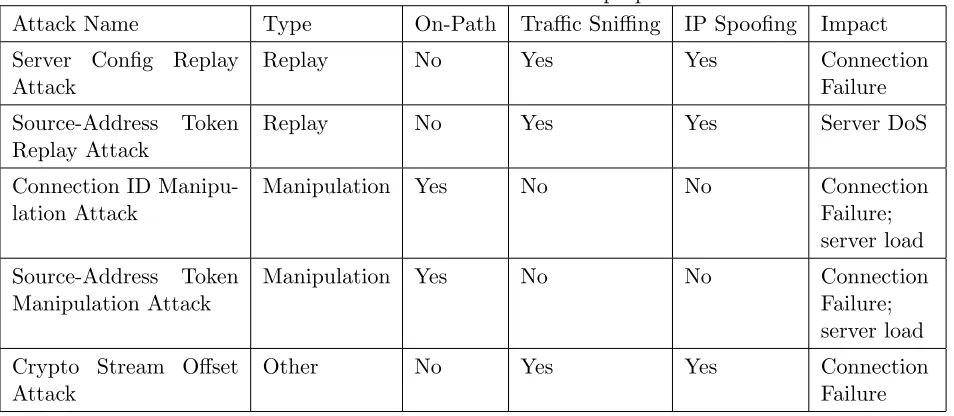
We also analyze QUIC’s latency goals in the presence of attackers. We show that the very mechanisms used in QUIC to minimize latency, such as unprotected fields on handshake packets and the use of publicly available information on both client and server sides, can be exploited by an adversary during the handshake to introduce extra latencies and possibly lead to DoS attacks. We implemented five attacks against QUIC. Four of these attacks prevent a client from establishing
1
a connection with a server while the fifth is a DoS attack against QUIC servers. In all cases, we found the attacks easy to implement and completely effective. In many cases, the client is forced to wait for QUIC’s ten-second connection establishment timeout before giving up.
Our results suggest that the techniques that QUIC uses to minimize latency may not be useful in the presence of malicious parties. Although these weaknesses are not completely unexpected, they are of significant concern to the QUIC team at Google who have been developing a dedicated monitoring infrastructure to try to address them [39]. However, we have found that there may be fundamental limitations to effectively mitigating these weaknesses.
We note that similar types of attacks have been used against TLS and TCP (recall that TLS runs on top of TCP). However, TLS and TCP made no general promises about their performance in the presence of adversaries. We find that even if QUIC’s performance may not be perfect, it is not worse than that of TLS in the worst case, and is much better in the absence of adversaries.
To summarize, our contributions are:
• A security model for QC protocols that formally captures the different levels of security guaranteed for data encrypted under the initial and final session keys in the presence of a very strong adversary, Section 6;
• A provable-security analysis for QUIC under the considered security model, Section 7; • A quantitative analysis of the performance properties of QUIC under adversarial settings,
Section 8;
• A practicality demonstration of attacks, Section 9.
Our study has shed some light on QUIC’s security guarantees and weaknesses that would be useful for practitioners and protocol developers. On a high level, our provable security analysis study confirms the soundness of QUIC’s security protection design. And by doing so, our study details the exact level of security the protocol provides, e.g., for data encrypted under the initial and final session keys; something which the protocol description did not specify in sufficient detail. Our performance analysis results confirm yet again that there is no free lunch: either practitioners have to put up with the extra latencies inherent in setting up TLS connections with TCP, or they have to figure out how to deal with the additional security risks introduced by the very mechanisms used to reduce those latencies. Similar tradeoffs were observed with respect to a performance-driven key exchange protocol proposed in [3]. Although in principle QUIC outperforms TLS in terms of latency when there are no attackers, there seems to be a fundamental tradeoff between minimizing latency and providing ‘good’ security guarantees that practitioners should keep in mind when considering whether to deploy and/or work to improve QUIC or other performance-driven protocols such as TLS 1.3 and TLS with SessionTicket resumption.
Future Directions. It would be interesting to see if analyses permitting machine-checked or even
automatically-generated proofs using systems like Coq, CryptoVerif [13], EasyCrypt [4] or a type system by Fournet et al. [25] used in TLS analyses [11, 10] could be applied to performance-oriented protocols such as QUIC or TLS 1.3.
2
Related Work
Concurrent and Independent Work. In (concurrent) work, Fischlin and G¨unter [23] analyze
notion of security. However, this notion does not “compose” with the notions for data exchange, meaning that even if one uses a secure authenticated encryption scheme for data exchange, the security of the QUIC protocol as a whole is not guaranteed. For such a desirable composition to hold, QUIC has to be slightly modified. Traditionally, it has proved very hard to convince practitioners to change implementations unless a serious attack has been deployed. While we believe Google may be more agreeable to tweak the protocol to make it suitable for modular analysis, until that happens, the security of QUIC as a whole is not known.
Furthermore, the change proposed in [23] will not suffice because the way authenticated encryp-tion is used in QUIC prevents its security from generically composing with secure key exchange. Specifically, part of the nonce IV used for encryption is not picked at random independently from everything else but is derived in the same way as the party’s secret keys, fixed, and not given to the adversary. To enable a result about the composed security, Google would need to modify its use of encryption. Although we fully support complex protocol design that allows for modular security treatment, we also realize that it is often done differently in practice. So far, our analysis is the only one suitable for the unmodified QUIC.
Another limitation of the analysis in [23] is that it does not address packet-level attacks and IP spoofing. The security model of [23] also does not consider time periods and refreshments of the server configuration. The latter is treated as the long term secret of the server, and the communication of the public portion of it to the client is not considered; i.e., they do not consider 1-RTT connections. Hence, while [23] gives a good insight in the design of multi-stage protocols in a way supporting modular security analyses, our work captures more accurately the current implementation of QUIC and the corresponding practical threats.
Follow-up Work. Recently Sakurada et al. [35] used an automated security verification tool
ProVerif and found a couple of mistakes in our security proof. First, the proofs assumed without the explanation that the ciphertexts created in the key and data exchange stages are independent. If they were not, this could have lead to the attacks (we discuss such attacks in Section 4). But in QUIC, it is indeed the case that the ciphertexts sent as part of key exchange and the ciphertexts encrypting the data cannot be confused with one another by the parties. This is because QUIC implements multiple independent byte-streams that can be used to exchange messages, and this information is contained in an additional header within the encrypted and authenticated portion of the packet. Key exchange messages are sent on a special byte-stream (stream 0) that is reserved for this purpose and cannot be used by normal applications. Similarly, only messages sent on this special stream will be interpreted as key-exchange messages. This means that key exchange messages are always different from data messages after decryption. As a result, In the security definition we model such distinction by making the domains for messages from the key exchange phase and data exchange phases disjoint. We also added the clarification to the proofs.
3
Preliminaries
Notation and conventions. We denote by {0,1}∗ the set of all binary strings of finite length.
Ifx, yare strings then (x, y) denotes the concatenation ofx andyfrom which xandyare uniquely decodable. If κ∈Nthen 1κ denotes the string consisting of κ consecutive “1” bits. If Sis a finite set, thens←$ Sdenotes thatsis selected uniformly at random fromS. All algorithms are assumed to be randomized and efficient (i.e. polynomial in the size of the input). For anyn∈N, [n] denotes
the set of integers {1, . . . , n}.
PKI. Whenever we use public keys, we also (implicitly) assume that a public key infrastructure
(PKI) is supported, i.e. the public keys are valid, bound to users’ identities, and publicly known. Thus, we omit certificates and certificate checking of public keys in our analysis.
Base primitives and assumptions.
Digital Signature Scheme. A digital signature scheme is used in QUIC by servers to au-thenticate certain data, so we define the primitive and its security here.
Adigital signature schemeSS = (Kg,Sign,Ver) with associatedmessage space MsgSpis defined by three algorithms. The randomized key generation algorithm Kg takes the security parameter λ and outputs a public–secret key pair: (pk,sk) ←$ Kg(λ). The signing algorithm Sign takes the secret key and message m ∈ MsgSp and outputs a signature: σ ←$ Sign(sk, m). The verification algorithmVertakes the public key, a message and a signature and outputs a bitb∈ {0,1}indicating whether the signature is deemed valid or not: b←Ver(pk, m, σ).
For correctness, it is required that for every (pk,sk) output by Kg(λ) and every m ∈ MsgSp,
Ver(pk, m,Sign(sk, m)) = 1.
To recall the security notion, consider the experimentExpufSS(A) associated with an adversary A. First, a pair of keys is generated: (pk,sk)←$ Kg(λ). ThenA is givenpk, the oracleSign(sk,·), and it has to output a message and a forgery: (M, σ) ←$ ASign(sk,·)(pk). The adversary wins and the experiment returns 1 iff Ver(pk, m, σ) = 1, m ∈ MsgSp and m was never queried to the Sign(sk,·) oracle. We say that SS is unforgeable against chosen message attack (uf-cma) if
Advuf
SS(A) = Pr
ExpsufSS(A) = 1
is negligible inλ, for all efficient algorithmsA.
Authenticated Encryption with Associated Data. After the parties using QUIC
estab-lish the shared key, they should be able to use the secure channel to exchange data in a secure manner. The secure channel is implemented by using an authenticated encryption with associated data scheme, which we now define. We adopt the definition of an authenticated encryption with associated data scheme and its corresponding security definition from [32].
An authenticated-encryption with associated-data scheme AEAD consists of two algorithms AEAD = (E,D) and is associated with key space{0,1}λ, nonce space {0,1}n, additional authenti-cated data space {0,1}∗ and message space {0,1}∗. The key is generated via κ ← {0$ ,1}λ. E is a deterministic encryption algorithm that takes inputs keyκ, nonce IV∈ {0,1}n, additional authen-ticated dataH∈ {0,1}∗and plaintextm∈ {0,1}∗, and outputs a ciphertextc. Dis a deterministic decryption algorithm that takes inputs key κ, nonce IV ∈ {0,1}n, additional authenticated data H∈ {0,1}∗, and ciphertext c, and outputs either the plaintextm or⊥.
For correctness, it is required that D(κ,IV, H,E(κ,IV, H, m)) = m for all κ ∈ {0,1}λ, IV ∈ {0,1}n, H, m∈ {0,1}∗.
Message privacy. To define message privacy letAbe an adversary and consider the experiment
encryption oracleE(κ,·,·, LR(·,·, b)), whereLR(·,·, b) on inputsm0, m1∈ {0,1}∗ with|m0|=|m1|
returns mb. At the end A outputs a bit b0, and we define A’s advantage to be Advind-cpaAEAD(A) =
2 Pr [b0 =b]−1.
Authenticity. To define message integrity and authenticity let A be an adversary and consider
the experiment ExpauthAEAD(A). It first generates the key κ ← {0$ ,1}λ. A has access to oracle E(κ,·,·,·). ExpauthAEAD(A) outputs 1 iff A outputs (IV, H, c) such that D(κ,IV, H, c) 6= ⊥ and A did not query E(κ,IV, H, m) for somem that resulted in a response c. We define AdvauthAEAD(A) = PrExpauthAEAD(A) = 1.
We say that A is nonce-respecting, if it never repeats IV in its oracle queries. We say that an AEAD scheme is indistinguishable under chosen plaintext attack (ind-cpa-secure) ifAdvind-cpaAEAD(A) is negligible inλfor any efficient, nonce-respecting adversary A. We say that an AEAD scheme is auth-secure if AdvauthAEAD(A) is negligible in λfor any efficient, nonce-respecting adversary A. We say that any AEAD is secure if it is ind-cpa- and auth-secure.
Strong Computational Diffie-Hellman (SCDH) Assumption. We define the SCDH
assumption [1], on which security of QUIC will rely. This assumption was commonly used for analyses of other protocols, including TLS [27].
Consider the experiment ExpSCDH(A) associated with an adversary A and security parameter λ. A is given (g, q, ga, gb), where q is prime of size λ, g is a generator of a cyclic group of order q, and a, b are picked uniformly at random from Zq. A is also given access to verification oracle
V(g, ga,·,·), which returns 1 iff queried on gx, gax for some x ∈ Z
q. ExpSCDH(A) returns 1 iff A outputs gab. We define AdvSCDH(A) = Pr [ExpSCDH(A) = 1 ]. We say that the SCDH problem is hard ifAdvSCDH(A) is negligible inλ, for all efficient adversariesA.
4
Quick Connections Protocol Definition
In this section we formally define a Quick Connections (QC) protocol, which is a communication protocol between a client and a server (the latter holds a public key and the corresponding secret key). The parties first agree on an initial session key, which can be used to exchange data until the final key is set. After the final key is set, it is used for further data exchange . The QC definition fits QUIC and is also applicable to other protocols, such as TLS 1.3. This formal definition is necessary for the provable-security analysis.
The protocol is associated with the security parameter λ, a server key generation protocol Kg
that on input λ returns public and secret keys, an authenticated encryption with associated data scheme AEAD = (E,D) with key space {0,1}λ, header space {0,1}∗, message space {0,1}∗, an IV-extraction function get iv that takes a key and a header and outputs an IV ∈ {0,1}n for each message to be encrypted or decrypted via the associated AEAD, and a scfg gen function that the server can use to update part of its global statescfg. The server can maintain global state other than its scfg. All global state is initially set to ε. We associate a protocol’s execution with the universal notion of time, which is divided into discrete periods τ1, τ2, . . .. The keys are generated
via (pk,sk) ←$ Kg(λ). The input of each party (representing what parties know at the beginning) consists of the public key of the serverpk and the list of messagesMsend =M1, . . . , Mm for some m ∈ N and where each Mi ∈ MsgSp, that a party needs to send securely (Msend can also be ε).
The server has an additional input: the secret key. All parties can keep global state.
the messages that the parties exchange may depend on each other, for simplicity we chose not to complicate the protocol syntax. This decision has no implications on our overall security analysis. Data is exchanged between the parties via packets that must consist of source and destination IP addresses and port numbers followed by the payload associated with the protocol.2 Each party gets a 32-bit IP address associated with 216−1 port numbers as part of its input. We say that all received and sent packets by a client party belong to that client party’sconnection with a particular server party if the source IP address and port number (as well as any other protocol-specific source information included in packets) of all packets received by that client party correspond to that server and are the same as the destination IP address and port number (as well as any other protocol-specific destination information included in packets) of all packets sent by that client party. We define a server party’s connection with a particular client analogously.
Note that different protocols may establish connections based on parameters other than just IP and port numbers (e.g.,cidin QUIC as will be described in Section 5), which is why our definition allows for other protocol-specific parameters contained in packets to be included. The notion of a connection is relevant to the notion of one party setting a key with another party which we will establish below and use in our security analysis.
The first packet of data is sent from the client to the server, and we refer to this packet as the connection request.
The interactive protocol consists of four phases. Each message exchanged by the parties must belong to some unique stage, but the second and third stages may overlap:
Stage 1: Initial Key Agreement. At the end of this stage each party sets the initial key variableik = (ikc, iks, iaux), where iaux∈ {0,1}∗ (initially set to ε) is any additional information used for encryption and decryption.
Stage 2: Initial Data Exchange. In this stage, messages from the input data list can be transmitted using the associated AEAD scheme and the key ik. The server uses ikc to encrypt and iks to decrypt, whereas the client uses iks to encrypt and ikc to decrypt. At the end of this stage, each party outputs the list of messages Miget =M1, . . . , Mm0 for some m0 ∈ N and where eachMi ∈ {0,1}∗, (Miget can also beε), representing the messages the party received in the initial data exchange phase.
Stage 3: Key Agreement. At the end of this stage, each party sets the session key variable k = (kc, ks, aux), where aux ∈ {0,1}∗ (initially set to ε) is any additional information used for encryption and decryption.
Stage 4: Data Exchange. In this stage, messages from the input data list can be sent using the associated AEAD scheme and the keyk. The server useskcto encrypt andksto decrypt, whereas the client usesksto encrypt andkcto decrypt. At the end of this stage, each party outputs the list of messages Mget =M
1, . . . , Mm00 for some m00 ∈ N and where each Mi ∈ {0,1}∗, (Mget can also beε), representing the messages the party received in the final stage.
We say that a party rejects a packet if it outputs ⊥, and accepts it otherwise.
refer to parties that set ik’s in Stage 1 with each other as each other’s peers.
The correctness of the protocol requires that the input data of one party’s Msend be equal to outputs of the other party’sMiget, Mget. In other words, the protocol is correct if it allows the par-ties to exchange the data that they intended to exchange with their corresponding communication partners in the protocol, while preserving the order of the messages.
5
The QUIC Protocol
In this section we present the QUIC protocol. Our description follows the definition for a QC protocol primitive.
In QUIC, the parties associate a connection IDcidwith the source and destination IP addresses and port numbers of every packet corresponding to that connection. Every incoming packet is checked to see if the source and destination IPs and port numbers correspond to those previously observed for that connection, and that connection is closed if they do not match. For simplicity of presentation, we omit this check in our description below.
Let AEAD = (E,D) be an authenticated encryption with associated data scheme, let SS = (Kgs,Sign,Ver) be a digital signature scheme, and let λ be a security parameter. The signature algorithms supported by QUIC are ECDSA-SHA256 and RSA-PSS-SHA256. AES Galois-Counter mode (GCM) scheme [29] is used as AEAD. QUIC’s key generation protocol runs (pk,sk)←$ Kg(λ), kstk
$
← {0,1}128, and returns pk as the server’s public key and (sk, k
stk) as the server’s secret key.3
We assume that the server’s scfg is refreshed every time period using the scfg gen function described below.4
scfg gen(sk, τt, λ):
q ← {primes of size$ λ}, g← {generators of$ Zq}
xs←$ Zq−1,ys←gxs,pubs←(g, q, ys),secs ←xs
expy←τt+1,scid← H(pubs,expy)
str←“QUIC server config signature”
prof←Sign(sk,(str,0x00,scid,pubs,expy))
scfgtpub←(scid,pubs,expy)
scfg←(scfgtpub,prof,secs)
His the SHA-256 hash function. Note that the generation ofscfg and the signing of its public parameters are done independently of clients’ connection requests. Although in QUIC there may be several distinct configuration parameters scfg that are valid at any given time, we omit this detail in our analysis, and we do not consider the problem of them expiring during the initial or session key agreement stages.
3
In QUIC,kstk is derived using similar methods as the initial and session keys and may depend on user-supplied inputs. Poorly chosen user inputs could lead to IP-spoofing opportunities, but we do not address this weakness because quantifying the predictability of user inputs is out of scope. For simplicity, we assume that users setting up QUIC servers provide unpredictable inputs, and treatkstk as a random string in our analysis.
Client(Mc, pkj) Server(Ms)
Mc= (Mc1, M
2
c,· · · , M u
c) Ms= (Ms1, M
2
s,· · · , M w s)
(1) Initial Key Agreement
m1←c i hello(pkj) m1
m2 m2←s reject(m1)
m3←c hello(m2) m3
ik←get i key c(m3) ik←get i key s(m3)
(2) Initial Data Exchange
for eachα∈[ı] for eachβ ∈[]
sqnc←α+ 2 sqns←β+ 1
mα4 ←pak(ik,sqnc, M α
c) mβ5 ←pak(ik,sqns, Msβ)
m4←(m14,· · · , mı4) m4 m5←(m15,· · · , m
5)
process packets(ik, m5) m5 process packets(ik, m4)
(3) Key Agreement
sqns←2 + m6 m6←s hello(m3, ik,sqns)
k←get key c(m6,sqns) k←get key s(m6)
(4) Data Exchange
for eachα∈ {ı+ 1, . . . , u} for eachβ∈ {+ 1, . . . , w}
sqnc←α+ 2 sqns←β+ 2
mα7 ←pak(k,sqnc, M α
c) mβ8 ←pak(k,sqns, Msβ)
m7←(mı7+1,· · ·, m
u
7) m7 m8←(m8+1,· · ·, mw8)
process packets(k, m8) m8 process packets(k, m7)
Figure 1: Summary of QUIC’s 1-RTT Connection Establishment
QUIC supports two connection establishment schemes: 1-RTT handles the case when the client tries to achieve a connection with a server for the first time in a particular time period. 0-RTT considers the case when the client is trying to connect to a server that it has already established at least one connection with in that time period.
5.1 1-RTT Connection Establishment
the users. For simplicity we assume that MsgSp consists of bitstrings starting with a 1, while key exchange messages to be encrypted start with a 0.
BothCandSknow that the current time period isτt. C’s input message isMc= (Mc1, Mc2,· · ·, Mcu), while S’s input message is Ms = (Ms1, Ms2,· · · , Msw), where each message is in the message space
MsgSp. S generates keys (pk, sk)←$ Kg(λ) andkstk $
← {0,1}128.
Initial Key Agreement consists of three packets m1, m2, m3. C initiates a connection by
sending the initial connection-request packetm1 which contains a randomly generated connection
id cid, used later by both parties to identify this session. Specifically, C runs c i hello(pk) which outputs a packet with sequence number 1.
c i hello(pk):
cid← {0$ ,1}64
return (IPc,IPs,portc,ports,cid,1)
S responds withm2 by running s reject(m1). m2 contains a source-address tokenstkthat will
be used later byCto identify itself toS for this and any other additional sessions in 0-RTT connec-tion requests (which we discuss below). An stkis similar to a TLS SessionTicket [36]. It consists of an authenticated-encryption block of the client’s IP address and a timestamp. To generate an
stk, the server uses the same E algorithm associated with the AEAD withkstk. The initialization
vector ivstk is selected randomly. stk can be used by the client in later connection requests as
long as it does not expire and the client does not change its IP address. For simplicity, we take the range of validity of stk to be bound by the time period during which it was generated or set up. m2 also contains S’s current state scfgtpub, which contains S’s Diffie-Hellman (DH) public values
with an expiration date and a signature prof over all the public values under the server’s secret key sk.
s reject(m):
ivstk $
← {0,1}96
stk←(ivstk,E(kstk,ivstk, ε,0k(IPc,current times)))
return (IPs,IPc,ports,portc,cid,1,scfgtpub,prof,stk)
After receiving m2,C checks thatscfgtpub is authentic and not expired. Note that we assume
here that a proper PKI is in place, so C possesses the public key of S and is able to perform this check. C then generates a nonce and its own DH values by running c hello(m2). C then sends its
nonce and public DH values to the server in m3.
c hello(m):
abort ifexpy≤τt or
Ver(pk,(str,0x00,scid,pubs,expy),prof)6= 1, where str←“QUIC server config signature” r← {0$ ,1}160,
nonc←(current timec, r)
xc←$ Zq−1,yc←gxc,pubc←(g, q, yc)
pkt info ←(IPc,IPs,portc,ports)
After this point, C and S derive the initial key material ik by running get i key c(m3) and
get i key s(m3) respectively. The server has to make sure that it does not process the same
connec-tion twice, so it keeps track of used nonces with a mechanism called the strike-register or strike. The client includes a timestamp in its nonc, such that servers only need to maintain state for a limited amount of time, this requires a clock sync between client and server. A server rejects a con-nection request from a client if itsnonc is already included in itsstrikeor contains a timestamp that is outside the allowed time range called strikerng. We consider strikerng to be bound by the time period during which it was generated or set up.
ik = (ikc, iks,iv) consists of two parts: the two 128-bit application keys (ikc, iks) and the two 4-byte initialization vector prefixes iv = (ivc,ivs). C uses iks and ivs to encrypt data that it
sends toS, while using ikc and ivc to decrypt data it receives fromS, and vice versa. This stage
needs to take place only once per each time period τt for whichscfgtpub and stkare not expired. We model theHMAC with a random oracle in our analysis.
get i key c(m):
ipms←yxcs
return xtrct xpnd(ipms,nonc,cid, m,40,1) get i key s(m):
(ivstk,tk)←stk
dec← D(kstk,ivstk, ε,tk)
abort if either dec = ⊥, or the first bit of the message is not 0, or first 4 bytes of dec 6= IPc,
or
last 4 bytes correspond to a timestamp outside allowed time, orr∈strike, orτt∈/ strikerng, or
scid is unknown or corresponds to an expiredscfgtpub0<t
org, q of pubc are not the same as g, q ofpubs ipms←yxsc
return xtrct xpnd(ipms,nonc,cid, m,40,1) xtrct xpnd(pms,nonc,cid, m, `,init):
ms←HMAC(nonc,pms)
ifinit= 1, then str ←”QUIC key expansion” else, str ←”QUIC forward secure key expansion”
info←(str,0x00,cid, m,scfgtpub) return the first`octets (i.e. bytes) of
T= (T(1),T(2),· · ·), where for alli∈N,
T(i) =HMAC(ms,(T(i−1),info,0x0i)) andT(0) =ε
Initial Data Exchange consists of two packet sequencesm4 and m5. C andS exchange their
get iv in QUIC outputs the ivwhich is the concatenation of eitherivc and sqns when S sends a packet or ivs and sqnc when C sends a packet. ivc and ivs are each 4 bytes in length, while
sqncand sqns are each 8 bytes in length. Thus, each iv is 12 bytes in length.
Note that the sequence numbers in QUIC are generated per packet, always start with 1, and are independent of what that packet is carrying. ıandcorrespond to the maximal number of message blocks that C and S can send prior to the Key agreementstage. Upon receipt of packets from S, C decrypts them, checks that the messages start with a 1, and outputs their respective payloads concatenated together in the order of their sequence numbers with function process packets. S does the same with packets it receives fromC.
get iv(H, κ):
(kc, ks,ivc,ivs)←κ
if this is a client, then src←cand dst←s elsesrc←sand dst←c
(cid,sqn)←H return (ivdst,sqn) pak(κ,sqn, m):
(kc, ks,ivc,ivs)←κ
if this is a client, then src←cand dst←s elsesrc←sand dst←c
pkt info ←(IPsrc,IPdst,portsrc,portdst) H←(cid,sqn)
iv←get iv(H, κ)
return (pkt info,E(kdst,iv, H,1km)) process packets(κ, p1, ..., pv):
(kc, ks,ivc,ivs)←κ
if this is a client , thensrc←c and dst←s elsesrc←sand dst←c
for each γ ∈[v] (Hγ, cγ)←pγ
ivγ←get iv(Hγ, κ) mγ ← D(ksrc,ivγ, Hγ, cγ) Ifmγ ∈/MsgSp, then abort return (m1, . . . , mv)
Key Agreement consists of one message m6. Specifically, S generates new DH values and
sends its new public DH values to the client by running s hello(m3, ik,sqn), encrypted and
authen-ticated using AEAD withik. s hello(m3, ik,sqn):
(ikc, iks,ivc,ivs)←ik
˜ xs
$
←Zq−1, ˜ys←g˜xs,p˜ubs ←(g, q,y˜s) H←(cid,sqn)
e ← E(ikc,(ivc,sqn), H,0k(p˜ubs,stk))
The client verifies the authenticity of the server’s new DH public values upon receipt of this packet using ik and both parties at this point can derive the session key material k by running get key s(m6) and get key c(m6), which both use the xtrct xpnd function defined earlier.
get key s(m):
pms←yc˜xs
return xtrct xpnd(pms,nonc,cid, m,40,0) get key c(m):
(IPs,IPc,ports,portc,cid,sqn, e)←m
abort ifD(ikc,(ivc,sqn),(cid,sqn), e) =⊥or the first bit of the message is not 0
pms←y˜sxc
return xtrct xpnd(pms,nonc,cid, m,40,0)
Data Exchange consists of two packet sequences m7 and m8. C and S will use k to encrypt
and authenticate their remaining data fromMsgSpMcı+1, . . . , Mcu andMs+1, . . . , Msw, respectively, instead ofik for the rest of this session.
Similar to ik, k = (kc, ks,iv) consists of two parts: the two 128-bit application keys (kc, ks) and the two 4-byte initialization vector prefixesiv= (ivc,ivs). Cuses ks andivsto encrypt data
that it sends to S, while using kc and ivc to decrypt data received from S, and vice versa. The
decryption algorithm rejects if the messages do not start with a 1. 5.2 0-RTT Connection Establishment
If the clientC has already had a connection with a server S in the time periodτt, thenC does not need to send the c i hello, but can instead initiate another connection request with the server via a c hello packet containing the previously obtainedstkandscid, as well as newcid,nonc, andpubc
(which should contain its new DH ephemeral public value). In this case, the c hello function will be: c hello(stk,scfgtpub):
cid← {0$ ,1}64
r← {0$ ,1}160,nonc←(current time c, r)
xc←$ Zq−1,yc←gxc,pubc←(g, q, yc)
pkt info ←(IPc,IPs,portc,ports)
return (pkt info,cid,1,stk,scid,nonc,pubc)
6
Security Model
We formally define the security model for QC protocols, which is one of our main technical contri-butions. Our model is an extension of the Authenticated and Confidential Channel Establishment (ACCE) security model for TLS to accommodate performance-driven protocols that do not run on top of TCP and have two stages for key agreement and data exchange. We call our model QACCE for Quick ACCE.
We consider a very strong attacker who can initiate possibly concurrent rounds of a protocol between various clients and servers and see the exchanged communication. Moreover, an attacker can corrupt servers, control clients, and drop or modify the packets exchanged by the honest parties. Our definition targets the major security goal of a communication protocol: secure channel, which means that data is exchanged in a private and authentic manner and cannot be re-ordered. The necessary goal of key security and (unilateral) authentication is also captured by the definition. Furthermore, the model addresses particular attacks such as IP spoofing attacks.
After presenting the formal definition (with informal explanations) we discuss the differences from the existing security models and the reasons for them.
In Section 6.2 we explain how our formal model captures server impersonation attacks, attacks on secure channel, and such malicious behaviors as eavesdropping, man-in-the-middle attacks, forgeries, and DDoS attacks (e.g. due to IP spoofing). We also explain the levels of forward secrecy a protocol can provide. We hope our informal discussions help make our analyses useful for practitioners.
6.1 Security Definition
Security Experiment. Fix the security parameterλand a QC protocol Π with associated server
key generation protocol Kg, scfg gen, an authenticated encryption with associated data scheme AEAD = (E,D) with key space {0,1}λ and additional authenticated data (which we will denote by H) space{0,1}∗.
We define the experimentExpQACCEΠ (A) associated with the adversaryA. We consider two sets of parties, clients and servers, C ={C1, . . . , C`} and S ={S1, . . . , S`}, for parameter `∈Ndenoting
the maximum possible number of servers or clients. The experiment first generates server key pairs (pki, ski)
$
← Kg(λ), kstk $
← {0,1}128, and
scfgti ←$ scfg gen(ski, τt, λ), for all time periods, for all i∈[`].
To capture several sequential and parallel executions of the protocol we follow the standard approach and associate each party Pi ∈ {C∪S} with a set of stateful oracles π1p,i, . . . , πp,id , for parameter d ∈ N and p ∈ {c, s}, where each oracle πr∈p,i[d] represents a process that executes one single instance of the protocol at partyPi and pindicates whether the party in question is a client or server. Intuitively, each oracleπisof some partyPi ∈ {C∪S}models that party’s IP address and a unique port number. We discuss the importance of this part more in Section 6.2. The experiment flips a bit bqp,i← {0$ ,1} for each oracleπp,iq .
model the initial data exchange and data exchange phases are modeled by queries separate from queries modeling the initial key exchange and key exchange phases, and for the former we do need to keep state of the oracle. Hence we assume that each oracle that enters the initial data exchange phase immediately proceeds to the key exchange phase. Even though the server keeps local state and knows which stage it is in, it may have inaccurate view of the stage of the protocol because it is not guaranteed to know the correct identity of the party it is talking with.
We refer to oracles that set ik with each other as peers.
The adversary A is given the public keys of all servers pk1, . . . ,pk` and can interact with all oracles of all parties by issuing queries. The values in parentheses are supplied byA, except when they are bold face. If the parameter in parentheses is an oracle, e.g. πqp,i, this means thatA needs to supply the indicesp, i, q specifying the oracle.
• connect(πcq,i, πsr,j), fori, j∈[`], q, r∈[d].
As a result, πqc,i outputs the initial connection request packet (first connection for that client party for that particular time period) that it would send specifically to oracleπs,jr according to the protocol. The output of this query is not delivered to the recipient oracle, but is just given toA.
This query allows the adversary to ask a client oracle to start communicating with a particular server party for the first time between those parties for a particular time period.
• resume(πqc,i, πsr,j), for i, j∈[`], q, r∈[d].
This query returns ⊥ if ik corresponding to oracle πqc,i is not set. Otherwise, πqc,i outputs the 0-RTT connection request packet that it would send to an oracle πs,jr according to the protocol. The output is given toA, who can deliver it to the destination oracle, modify it, or drop it.
This query allows the adversary to ask a particular client oracle to request a 0-RTT connection with a particular server party, if the client party corresponding to that oracle has communicated before with that server in a particular time period. Recall that every server party is aware of its communication status with respect to every client oracle that may contact it.
• send(πp,jr , m), forp∈ {c, s},j∈[`], r∈[d] and m∈ {0,1}∗.
As a result, m is sent to πp,jr , which will respond with ⊥ if the oracle is in data exchange phase. Otherwise,A gets the response, which is defined according to the protocol.
This query allows the adversary to send a specified packetmto a specified destination oracle. Note that the attacker must provide a header for the packet that specifies the source and destination IP addresses and port numbers as well as packet sequence numbers of its choice. The destination oracle can check this information. The adversary gets control of the resulting packet and can choose to modify, drop, or deliver it to an oracle.
• revealik(πqp,i), forp∈ {c, s},i∈[`], q∈[d].
As a result,A receives the contents of variableik for oracle πqp,i.
This query allows the adversary to learn the initial key set by the oracle of its choice. • revealk(πp,iq ), for p∈ {c, s},i∈[`], q∈[d].
As a result,A receives the contents of variablek for oracleπp,iq .
This query allows the adversary to learn the final key set by the oracle of its choice. • corrupt(Si), fori∈[`].
A gets back ski and the current scfgti and any other state ofSi.
• encrypt(πp,jr , m0, m1, H,init), for p∈ {c, s},j ∈[`], r∈[d], m0, m1 ∈MsgSp, H ∈ {0,1}∗, and
init∈ {0,1}:
return⊥ if|m0| 6=|m1|
p0← {c, s} \ {p} ifinit= 1
IV←get iv(ik, H), return⊥ if IV was used return (H,E(ikp0,IV, H, mbq
p,j)) ifinit= 0
IV←get iv(k, H), return ⊥if IV was used return (H,E(kp0,IV, H, mbq
p,j)) Above,ik, k, ikp0, p0 belong toπr
p,j.
This query, unlike the previous ones, deals with the initial and final data exchange phases (flag
init specifies which), while the previous ones concerned the initial and final key exchange phases. It is designed to follow the standard approach of capturing message privacy under chosen-message attack. It allows the adversary to obtain a randomly chosen ciphertext out of the two messages provided by the adversary. Just like in the security definition for AEAD, the attacker can select the header H. For QUIC it means that the adversary can specify the source and destination IP addresses and port numbers as well as packet sequence numbers of its choice. Unlike the AEAD security model, however, we do not let the adversary select the IV because in QUIC the IV depends on the secrets of a party and is not under the attacker’s control. get iv is the function that we require to produce initialization vectors used for encryption and appropriate headers. The initialization vector is not given to the adversary. The adversary is restricted to providingH whose destination IP address and port number correspond to πp,jr and whose source IP address and port number correspond to an oracleπqp0,i in the experiment, for p0 ∈ {c, s} \ {p}.
• decrypt(πp,jr ,C, H,init), forp∈ {c, s},j∈[`], r∈[d], C, H ∈ {0,1}∗, and
init∈ {0,1}: return⊥ ifinit= 1 andπrp,i is not in the initial data exchange phase,
orinit= 0 andπrp,j is not in the data exchange phase, or (H,C) was output before by encrypt(πr
p,j,∗,∗,∗,init) ifinit= 1
IV←get iv(ik, H),
ifD(ikp,IV, H,C)6=⊥, and is inMsgSp, then returnbrp,j else return⊥ ifinit= 0
IV←get iv(k, H),
ifD(kp,IV, H,C)6=⊥, and is in MsgSp, then returnbrp,j else return ⊥ Above,ik, k, ikp0, p0 belong toπr
p,j.
This query also concerns the initial and final data exchange phases. It follows the standard approach to capture authenticity for AEAD schemes. The adversary’s goal is to create a “new” valid ciphertext. If it succeeds, it is given the challenge bit and thus can win.
• connprivate(πqc,i, πs,jr ), for i, j∈[`], q, r∈[d].
As a result, the initial connection request is sent toπr
A.
This query is not part of the existing definitions. It models IP spoofing attacks, which the previous models did not consider. We explain its importance below when we discussA’s advantage.
After the adversary is done with queries it may output a tuple (p, i, q, b), for p∈ {c, s}.
Before we proceed with the security definition we define the notion of a matching conversation taking place between a client and a server. The scope of this concept is the initial and final key exchange phases only.
Matching Conversations. For p∈ {c, s},p0 ∈ {c, s} \ {p}, i, j ∈[`], q, r ∈[d], we say that πp,iq has a matching conversation with πpr0,j, if the following two conditions are both true:
• either p=cand p0 =s, orp0 =c and p=s;
• The last message sent by the client oracle in stage 1 (m3) is the same as the last message received
by the server oracle and the first message sent by the server oracle in stage 3(m6) is the same as
the first message received by the client oracle in stage 3.
We remark that our notion is QUIC-specific and differs from the general definition proposed in [6]. The difference is that we allow some substrings in the transcripts to differ. We do this in order to capture that some (ideally very few short) messages in a protocol do not have to match bit-by-bit to avoid any security consequences. For QUIC, we will allow signatureprofto change as long it stays valid for the same message. Similarly,stk that is sent by the server does not have to matchstkreceived by the server, as long as they are both valid. In the original version of the paper we did not have such relaxation, and that required us to rely on the stronger notion of security for signature schemes (SUF-CMA). Also, requiring stk sent by the server to be the same as the one received by server to be the same led to an artificial attack pointed out by [35]. Our notion is closer to the session ID definition, but we use the term “matching conversation” similarly to [27].
We also note that the notion of a matching conversation is not sufficient to define peers because, unlike in TLS, communicating parties in QUIC may set initial keys without having a matching conversation. This is why throughout our analysis the notion of peers is instead equivalent to the notion of one partysetting a key with another party.
Measures of A’s attack success.
• The server impersonation advantage of A Advs-impΠ (A) is the probability that there exists an oracle πqc,i such that k of this oracle is set and there is no oracle πs,jr corresponding to a server party Sj such that πqc,i has a matching conversation to πs,jr , no revealik containedik possibly set in the optional initial key agreement stage betweenπqc,i and πrs,j, and Sj was not corrupted. The above captures the attack when the adversary impersonates an honest server and makes a client think it sets a key shared with the server, but the adversary may have the shared key instead. • The channel-corruption advantage ofA Advch-corrΠ (A) is 2 Pr
h
b=bqp,i
i
−1,
where if p = s, then it must be the case that πs,iq has a matching conversation with some client oracleπrc,j, such that the following conditions hold
1. if Si was corrupted, then no encrypt(πs,iq ,∗,∗,∗,1) and encrypt(πrc,j,∗,∗,∗,1) queries were made for any ∗after or during the same time periodτt that Si was corrupted,
3. no revealik(πs,iq ) and revealik(πc,jr ) or revealk(πqs,i) and revealk(πc,jr ) queries returned the key used to answer anyencrypt(πqs,i,∗,∗,∗,∗) andencrypt(πr
c,j,∗,∗,∗,∗) queries for any ∗ respectively;
and if p=c, then let πrs,j be peer of πc,iq . The following conditions must be satisfied.
1. if Sj was corrupted, then no encrypt(πqc,i,∗,∗,∗,1) and encrypt(πrs,j,∗,∗,∗,1) queries were made for any ∗after or during the same time periodτt that Sj was corrupted,
2. if Sj was corrupted, then no encrypt(πqc,i,∗,∗,∗,∗) and encrypt(πrs,j,∗,∗,∗,∗) queries were made for any ∗after Sj was corrupted, and
3. no revealik(πc,iq ) and revealik(πrs,j) or revealk(πqc,i) and revealk(πrs,j) queries returned the key used to answer anyencrypt(πqc,i,∗,∗,∗,∗) andencrypt(πs,jr ,∗,∗,∗,∗) queries for any ∗ respectively.
The above captures the attacks in which information about groups of messages exchanged between the client and the server is leaked without the adversary corrupting the server party (1) before or (2) during the same time period as attempting the breach as well as without (3) revealing the initial and session keysik and k. Thus, we capture a slightly weaker notion of forward secrecy by restricting the adversary to corrupt the appropriate server only after the time period when the adversary attempts the breach. We explain this subtlety further in Section 6.2.
• TheIP spoofing ofAAdvipsΠ (A) is the probability that there exist oracles πqc,i andπs,jr such that at some time period τt A makes a send(πrs,j, m0) query, where m0 is the message sent to start session resumprion, πr
s,j does not reject this query, Sj was not corrupted, m0 is not an output resulting from any previous connection request query (done via connect or resume queries for these oracles), and the only other query Ais allowed to make concerning πc,ix for any xduring τt is the connprivate(πx
c,i, π y
s,j) query, for anyy.
This goal captures attacks in which the adversary wins if it succeeds in having the server accept a connection request on behalf of a client who either did not request connection to that server or previously requested only an initial connection but did not request any further connections in the same time period. The adversary issues a connection query hoping it gets accepted by the server, possibly preceded by the only other allowed query in that time period: connection request (connprivate) whose output it cannot see.
Security definition. We say that a QC protocol Π is QACCE-secure if its advantageAdvQACCEΠ (A),
defined asAdvs-impΠ (A) +AdvipsΠ (A) +Advch-corrΠ (A), is negligible (inλ) for any polynomial-time adversaryA.
6.2 Security Model Discussion
Comparison to the existing models. Existing models do not fit QUIC. Namely, we could
Therefore, similarly to recent analyses of protocols such as TLS [26, 27] and EMV [15, 21] we chose to work with a dedicated definition that assess the security of a protocol as a whole. We followed the ACCE model for TLS but had to modify it to accommodate for dealing with setting and using the initial key, which was not present in TLS. Moreover, QUIC handles novel security goals that TLS did not address, such as some cryptographic protection for network packet handling and protection against IP spoofing. We comment on these in more detail below.
On securing packets. Any communication protocol that does not run on top of TCP risks having its packets be misordered and/or not delivered at all. QUIC, unlike TLS, does not run on top of TCP but instead runs on top of UDP, which does not provide any delivery guarantees. Since QUIC adds cryptographic protection to some tasks usually handled by TCP, it makes sense to capture this in our model. Thus, in our security definition we allow the adversary to intercept, delay, misorder, modify, and selectively drop any communication between a client and a server. Our model captures the fact that data in real life is transmitted in packets and that the adversary could in principle modify such packet fields as source and destination IP addresses and port numbers. Specifically, we give the adversary the ability to specify the precise oracles associated with certain parties as subjects of its queries to send and/or receive messages of the adversary’s choice. Our security model does not, however, capture adversaries that simply drop (or delay for an unreasonably long time) all possible traffic because mitigating such attacks would require more sophisticated protocols than those captured by our QC protocol model that could detect and avoid failures.
On server impersonation. The server impersonation goal in our model captures attacks in which
the adversary attempts to convince the client to set a session key that is in any way inconsistent with the key set by the server. That is, when using a secure protocol, a client knows that the final session key is shared only with the server the client talked to and no one else. We do not capture attacks of the same type with respect to initial keys in this goal. This is because it may not be possible in general, since the client may have to derive the initial key from the semi-permanent
scfg that could be used for many client connection requests while it persists. This would allow, for example, the adversary to replay the values ofscfg to clients that have not yet contacted the corresponding server, which could lead to some clients establishing an initial key without the server being aware of their connection request. This weakness may also be relevant to TLS variants that allow for stateless connection resumption, and we discuss it in more detail in Section 8. Although for simplicity we do not to address this directly in our analysis, the requirement of having a matching conversation captures the basic mandate that the communicating parties may need to agree not only on the session key, but also on any other important communication parameters such as congestion control, key generation, encryption algorithms, etc. Thus, in principle, this goal not only captures the traditional man-in-the-middle attacks, but also more subtle attacks where the adversary may be interested in degrading the communication security and performance due to parties having inconsistent views of session parameters. For example, when the two parties disagree on congestion-avoidance parameters, a server may end up sending content at much lower or higher rates than requested by the client.
On channel security. The channel corruption goal in our model captures the expected goals of
time threshold (possibly dictated by the congestion-avoidance parameters that may be optionally negotiated by the communicating parties that we discuss below) could be retransmitted unless its receipt is positively acknowledged by the receiver. Thus, to prevent content delivery an adversary could in principle positively acknowledge the receipt of packets on behalf of the receiver, which is captured by the authenticity goal in our model. This security goal also captures positive ACK attacks, which involve the adversary or a rogue receiver sending acknowledgments for content that was not actually received to cause the sender to send too much content and overwhelm the resources of intermediate and/or receiving network(s).
On forward secrecy. A QACCE-secure protocol guarantees that the final session keys are
forward secure, i.e. obtaining a server’s long-term secrets does not leak any information about the data that was previously exchanged and encrypted under these keys. However, the guarantees with respect to the initial keys are weaker because, for them, forward secrecy holds only if the server does not get corrupted during the time period when the scfg that was used to derive those keys is valid. This is because, in QUIC, servers use the samescfg to derive initial keys with all clients for the duration of that scfg’s validity.
Unlike in previous models used to study TLS, we also impose some additional restrictions on the adversary that prevent it from revealing the initial key and corrupting the server during the same time period as its encryption queries. This restriction is imposed on the adversary because initial keys are not forward secure, as they could be derived using semi-permanent values stored by the server in its correspondingscfg, which is changed only once per time period, during which it could be used for all client connection requests in that period. Thus, to account for this weakness, it is important that the adversary does not learn of any semi-permanent state captured in the server’s
scfgthat could be used for establishing initial keys during its lifetime. This weakness may also be relevant to TLS variants that allow for stateless connection resumption [36].
On re-ordering attacks. As we mentioned before, strong security for secure channel, in addition
to data privacy and authenticity, must guarantee security against re-ordering attacks. In the ACCE model for TLS [26, 27] this is captured by requiring the authenticated encryption scheme satisfy the notion of stateful decryption [5]. That definition requires each ciphertext delivered out of order to be rejected.
This notion is not suitable for QUIC analysis. In TLS, if the adversary tampers with the packet order at the TCP level, all re-ordered packets will be rejected as the receiver will detect re-ordering by comparing the order with the one indicated by the TLS-layer sequence numbers. Hence, the notion of stateful decryption can be met. In QUIC, this is impossible, because it does not run on top of TCP. The receiver gets all information about the packet order from the sequence numbers. The receiver in QUIC cannot reject any packet, even if it “looks” out of order, until the end, when the messages could be sorted and the proper order could be determined. Thus, re-ordering the existing packets is prevented in TLS but cannot be prevented in QUIC. Yet, the final order of the messages should still be correctly determined by the receiver in QUIC. This difference calls for different treatment in the security model.
more explicitly, but this would require making the model less general and more involved as we will have to fit the sequence numbers into the syntax and security definition.
On IP spoofing. Since it may not be possible to authenticate a client, attacks where the adversary
initiates multiple connections to a server on behalf of honest clients by spoofing its IP address are possible. Such DoS attacks can lead to exhaustion of a server’s resources resulting from prohibitively high rates of superfluous derivations of session keys. Because TCP provides protection against such attacks with its three-way handshake, they are not considered when analyzing protocols that rely on TCP, such as TLS. However, such attacks must be addressed for protocols that do not run on top of TCP, such as QUIC, and the third goal in our security model captures them. In the IP spoofing goal, the adversary wins if it can trick the server into establishing a session key with a client that did not request it.
On the importance of separating key and data exchange messages. Note that if the
protocol cannot differentiate between data and key exchange messages, then the attacks pointed out in [35] are possible. In particular, note that in QUIC, m6 returned by the server contains a
ciphertext created using the initial key. Without the above restriction, the attacker could obtain m6 from the server oracle, then create a different m06 with the help of an encrypt query, and
forward the latter to the client oracle. This can break the matching conversation and/or let the attacker some information about the plaintext underlying the ciphertext (by checking whether the client oracle accepts or rejects m06. In addition, the attacker could make a decrypt query with the ciphertext fromm6 and win. Such attacks are not possible for QUIC because, as we explained
in the Introduction, parties can always distinguish between “key exchange” and “data exchange” messages.
7
QUIC Security Analysis
We state our main result about the security of QUIC.
Theorem 7.1. Consider the cryptographic core ofQU IC, as defined in Section 5, associated with the base signature schemeSS = (Kgs,Sign,Ver), and an authenticated-encryption with associated-data scheme AEAD = ({0,1}λ,{0,1}n,E,D). Then QUIC is QACCE if SS is uf-cma and AEAD is ind-cpa- and auth-secure and the SCDH problem is hard, in the random oracle model.
On security of the building blocks. We look at the QUIC’s choices for the building blocks
and their security. Galois-Counter Mode (GCM) authenticated encryption has been proven to be a secure authentication encryption scheme (ind-cpa- and auth-secure) assuming AES is a pseudo-random function[29]. RSA-PSS-SHA256 and ECDSA-SHA256 signature schemes are uf-cma under the RSA assumption, in the random oracle model, [8]. ECDSA was only proven uf-cma secure in the generic group model [14]. But proofs in the generic group model are limiting, in that the model disallows some adversarial capabilities possible in practice. The Chromium QUIC implementation uses either the NSS5 or boringSSL6 libraries, depending on configuration, to provide ECDSA. It is outside of the scope of this paper to verify these implementations.
We treat HMAC as the random oracle. This is a very common assumption for security analyses. While it may not be appropriate in every case, as cautioned in [19], the standard use of HMAC
5
Mozilla Network Security Services: https://developer.mozilla.org/en-US/docs/Mozilla/Projects/NSS
with fixed keys for the key derivation function here seems fine. There are two uses of HMAC in the key derivation function, and it is important for the analysis that the first occurrence is the random oracle. The second one may satisfy a weaker notion, but we treat it as the random oracle for simplicity. It does not seem possible to get rid of the reliance on the random oracle in the first case though.
The Theorem follows from the following three lemmas.
Let ` be the number of servers (and clients), let d be the maximum number of oracles corre-sponding to any party (i.e. the maximum number of connection sessions a party can initiate), let T be the number of time periods and let Q be the maximum number of decryption queries the adversary does inExpQACCEΠ .
Lemma 7.2. For any efficient adversaryA there exist efficient adversariesB, C, D, E such that
Advch-corrQU IC (A) ≤ `AdvufSS(B) + 2d`2TAdvSCDH(C) + 4`dT QAdvauthAEAD(D)
+ 4`dTAdvind-cpaAEAD(E).
Lemma 7.3. For any efficient adversaryA there exist efficient adversariesB, C, D such that
Advs-impQU IC(A) ≤ `Advuf
SS(B) + 2d`2TAdvSCDH(C) + 7`dT QAdvauthAEAD(D).
Lemma 7.4. For any efficient adversaryA there exists an efficient adversary B such that
AdvipsQU IC(A)≤`AdvauthAEAD(B). The detailed proofs of the Lemmas can be found in Appendix A .
8
Performance Issues and Malice
In this section we discuss how simple attacks on QUIC packets during the handshake can introduce latencies, essentially countering one of the primary goals of the protocol: 0-RTT connection estab-lishment. Persistent failure to establish a QUIC session could further result in a fall-back to TCP, defeating QUIC’s purpose of minimizing latency while securing the transport layer. We discuss two types of attacks: the first exploits public, cachable information from either the server or client side, the second exploits unprotected fields on packets exchanged during the handshake protocol. 8.1 Replay Attacks
Once at least one client establishes a session with a particular server, an adversary could learn the public values of that server’s scfg as well as the source-address token value stkcorresponding to that client during their respective validity periods. The adversary could then replay the server’s
scfg to the client and the source-address token stk to the server, misleading in either case the other party. To launch both attacks an adversary would have to have access to the communication channel.
requests from clients. Thus, these clients establish an initial key without the server’s knowledge, and when they attempt to communicate with the server, the server would not be able to recognize them and would reject their packets. While data confidentiality is not affected, the clients would experience additional latencies and waste computational resources deriving an initial key.
Source-Address Token Replay Attack. An attacker can replay the source-address token
stkof a client to the server that issued that token on behalf of the client many times to establish additional connections. This action would cause the server to establish initial keys and even final forward-secure keys for each connection without the client’s knowledge. Any further steps in the handshake would fail, but an adversary could create a DoS attack on the server by creating many connections on behalf of a many different clients and possibly exhausting the server’s computational and memory resources.
Ironically, these attacks stem from parameters whose main purpose was to minimize latency. These attacks are more subtle than simply dropping QUIC handshake packets because they mislead at least one party into “believing” that everything is going well while causing it to waste time and resources deriving an initial key.
Resolving these types of attacks seems to be infeasible without reducing scfg and stk pa-rameters to one-time use, because as long as these papa-rameters persist for more than just a single connection, they could be used by the adversary to fake multiple connections while they remain valid. However, such restriction would prohibit QUIC from ever achieving 0-RTT connection es-tablishment.
8.2 Packet Manipulation Attacks
Not all fields of QUIC packets are protected against adversarial manipulation. An attacker with access to the communication channel used by a client to establish a session with a particular server could flip bits of the unprotected parameters such as the connection id cidand the source-address token stk and lead the server and client to derive different initial keys which would ultimately lead connection establishment to fail. For a successful attack, the adversary has to make sure that all parameters modified in this way seem consistent across all sent and received packets with respect to any single party but inconsistent from the perspective of both parties participating in the handshake.
As shown in Section 7 this type of attack does not raise concerns over the confidentiality and authenticity of communication that is encrypted and authenticated under the initial key, because even though the initial keys are different, they are not known by the adversary. Note also that if parties do not agree on an initial key, they cannot establish a session key in QUIC because the final server hello packet is encrypted and authenticated under the initial key. Therefore, these attacks also do not compromise the confidentiality and authenticity of communication encrypted and authenticated under the final key.
These packet manipulation attacks are smarter than just dropping QUIC handshake packets because the client and server progress through the handshake while having a mismatched conver-sation, resulting in the establishment of inconsistent keys. This causes both parties to waste time and resources deriving keys and other connection state. In particular, the server performs all the processing required for a successful connection, unlike in attacks that simply drop QUIC handshake packets.