Skill Based Learning Environment: using
Semantic Annotation with Mapping Method
K. Priyanka1, S.Sarika2
M.E Computer Science and Engineering1, Faculty of Computing2 Sathyabama University, Sathyabama University
Chennai-600119, India
Abstract-Skill-Based learning environment is used in learning
process for decision making, communication and problem-solving. The semantic annotation used in real-time annotations of these simulations for debriefing of the persons, person study and better analysis of the learning approaches of mentors.A ubiquitous learning surroundings are provided an inter-operable, persistent and faultless learning architecture to connect, add and share three major dimensions of learning resources such as education collaborator, education contents and education services. Ubiquitous learning is characterized for identifying right education collaborators, right education contents and right education services in the right place at the right time. As a result, environment promote the gaining of practical skills as well as decision making, communication, and problem solving with help of Skills-based learning environment. The environments are an important to give feedback about the students from the practically conducted sessions and observations of students actions can notify to the estimation of their quality process. And also, those learning environments are helping to the researchers for better understand the learning process. The proposed system is examined the utilization of semantic annotation in the recording of those types of simulated learning environments. Also, achieve the better student feedback as well as improve the understanding of learning environments, proposed a new mechanism such as semantic based approach (An Domain based Ontology with various annotation methods and their combinations) is used. Consequently, improve the efficiency of the global linked data (meta-data) in the semantic annotation system i.e. the simulation environments recording in different ontologies with different observers, mentors can miss any important information about the subject, for avoided the issue, a new mapping method is used and also our system display the symbols annotations for easier understanding.
Keywords: Mapping method, Ontology, Semantic annotation
I. INTRODUCTION
To provide an effective learning environments to the students (for self study) using learning materials such as videos, audios etc. To offer an efficient learning materials to the students and researchers with help of semantic based annotations of the recording of simulated environments and with effective mapping method.
Simulations are used to promote the acquisition of practical skills as well as decision making, group working, communication, and difficulty solving. Mentors are incorporated into evaluation of student performance, which brings a requirement that the approaches for evaluation and feedback need to be sound, suitable, reliable, possible, educational, and of course suitable to practitioners. According the simulation, the student experiences are
designed to be exactly as they would experience in the workplace in real time.
One approach is to make annotations “live,” in the teaching session, although this is unlikely to be a comprehensive record of events and precludes the full engagement in the action itself. Ubiquitous computing technology and method are provided us with an additional mechanism to capture annotations on events that take place in the clinical skills laboratory and from sources that have a low impact and overhead on client.
Annotations are at simplest, just metadata, but by providing annotations with significance, defined by ontology— semantic annotations—we aim to fuse metadata sources together. The various linked data sets could include: annotations made by educators observing the unfolding scenarios; linked data automatically produced from the SimMan system logs as annotation records its progress through its programmed sequence and any sensed interactions with it; annotations made by observing students; and location information recorded from a tracking system.
By combining both automatic annotations gathering with manual annotation techniques, user aim to provide much richer data sets to help shed new light on how and why students are learning. According to a series of demonstrator, explained how the grouping of location-based semantic information with manually authored semantic annotations can begin to provide answers to questions such as what did the student act? Allowing the clear connection of person and activity into a machine readable form. The annotation process is lead to improved assessment of student education, services for person self-reflection, and additional research into understanding person learning in skills-based environments.
II. RELATED ARTICLES
Ballan et al. (2011) developed a paper for detection and recognition of events and actions in videos. Event refers “what happening in the video in a particular time at exacting location”. For event modelling techniques and knowledge management technologies survey the field of event identification, from interest point detectors and descriptors. Provide the methods for categorising them according to video construction method and video domain, and according to types of events and actions that are typical of the domains.
activities and actions. The methods are used to several different domains, from sport to surveillance videos. The real time based event detection is very complicated. The research does not discuss about any observer’s audio. Also, the location identification of objects is very difficult. Tiropanis et al. (2009) developed a paper for establishes the availability of a number of semantic tools and services. The semantic tools and services are used for Collaborative authoring and annotation, penetrating and corresponding, repository and semantic infrastructure development. The related things are learning, teaching and institutional challenges for higher education. The related things are used for semantic tools and services. The tool does not provide an efficient semantic link between the other videos.
McDonald et al. (2008) developed a paper for how Semantic Grid technologies can be used to generate enhanced tools for data collection that provide enabling technologies for interdisciplinary work, thus enhancing the capability to address substantive social science research. Semantic annotation is used to capture and work with the digital evidence, in support of successive qualitative and quantitative analysis. Search and mark video for student feedback purposes, the researcher can use this facility to guide the direction of any subsequent transcriptions required for analysis.
The research work focus on only simulation environments. The research work is not suitable for visual and textual videos.
Lindgren et al. (2008) developed a paper for describe a policy considered to solve a set of core challenges we have identified in supporting video collaboratories. Characterize five Collaboration Design Patterns (CDPs) for video-based practices.
CDPs used for characterizing interaction patterns in the uses of collaboration technology. Propose a three-dimensional design matrix for incorporating these observed patterns. A vision for the generative promise of video research and education platforms for supporting the work practices of collaborative groups.
The DIVER video platform embodies a new kind of communication infrastructure for video conversations by providing persistent and searchable records of video pointing activities by participants to specific time and space moments. The learning technologies community to refine and advance our conceptualizations of collaboration design patterns for video platform uses in research and education and the creation of systems that support the important needs for video conversations in the work practices of educators and researchers.
Michaelides et al. (2007) developed a paper for describing initial work on developing a semantic annotation system for the augmentation of skills-based learning for Healthcare. The semantic annotation is used in real-time annotations of these simulations for debriefing of the persons, learner self study and better analysis of the education approaches of mentors.
The Annotation System has two ways time sequenced observation and established observational schedules. Semantic Web technologies are used for skills-based learning by facilitating information reuse.
Students are used the system in the longer term by allowing the students to make annotations of their activities during their placements. Ontology is provided a link between their placement and the knowledge acquired in the university learning environment.
The research work is not feasible for all simulation environments. For example, clinical ward environment is very complicated.
J.A. Muras et al. (2006) developed a paper for creation of novel smart environment, context-aware assistive plans and activity monitoring systems have the capacity to provide people with great opportunities to improve their quality of life and increase independence in daily living. Pervasive computing is used in developing area.
A novel taxonomy is used for pervasive healthcare systems. The taxonomy is used hierarchy structure of the properties of pervasive healthcare systems and can be used as a framework for system classification. The taxonomy is identified a set of fundamental properties, that properties are used in a system to be described according to its user’s features, its reason and situation of use, as well as the technology employed.
The properties of pervasive healthcare system are arranged in hierarchical manner starting from the root of the taxonomy. The root is described the relationships between all seven main feature categories. Novel taxonomy is based on the ICF.ICF provides standard language and a framework for the description of health and disability. Novel taxonomy is considered the attributes of the users in a number of different ways. Taxonomy is extended for novel system properties without reorganisation of existing structure.
K.R. Page et al. (2005) developed a paper for hypertext and knowledge based
Tools which have been deploy to enhance existing collaborative environment, and ontology which is used to swap arrangement, promote enhanced process tracking, and aid navigation of resources before, after, and while a collaboration occurs.
Paper supporting e-Science, also explores the similarities and application of Collaborative Advanced Knowledge Technologies in the Grid technologies as part of a human-centred design approach to e-Learning.
Introduced the tools that have been developed by the Collaborative Advanced Knowledge Technologies in the Grid project and identified how they are typically used in meeting, and in support of collaborative knowledge in the Semantic Grid.
III. SUMMARY OF EXISTING SYSTEM
The Task Computing project applies Semantic Web technologies (Resource Description Framework, Ontology Web Language) and Web Services (Simple Object Access Protocol, Web Service Description Language) to pervasive computing, aiming to “fill the gaps between tasks and services.” User is seen the responsibilities that are possible in their current context and are assisted in creating complex tasks from simpler tasks, which can then be reuse.
Drawbacks of learning environments are cannot offer effective way of learning. Time usage is high. Issues in accessing the learning related material to by the research team. The collection, storage, and dissemination of staff and student data could not be anonymized.
IV. PROPOSED SYSTEM
A proposed system is constructed an ontology that contains all the entities describing the videos, sessions, and participants. The ontology is allowed the underlying video annotation framework to be independent of the specific context of annotation. The system is taken a domain ontology that includes the following situation of simulation videos such as a series of workshops, observational session and conversation group.
The proposed system is identified the types of annotation (manual textual, audio, location based are shows how to create annotations in the recorded video with semantic based), the constructed ontology representing the range of annotations applicable in the scenario. The ontology is provided the source for the annotation interface development. For annotation to be successful, it is significant to propose cue/prompt that are easily recognizable and familiar to the users (learning students). Two ways of achieving this are through naturalistic time sequenced observation or through the use of established observational schedules. The proposed system is used naturalistic time sequenced observation. Finally, the new mapping method is used to link the entire semantic video annotations for the effective learning purpose. Textual annotations with symbol annotation are used to enhance proposed system.
BLOCK DIAGRAM
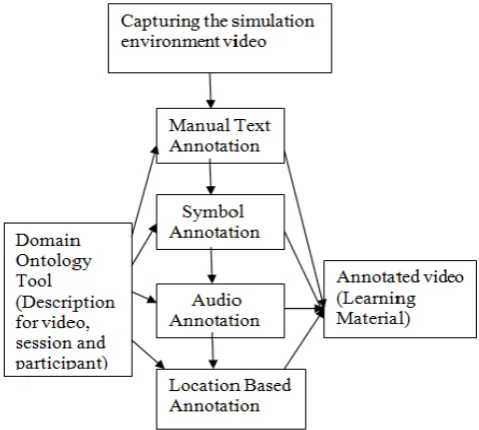
Figure 1 shows ontology is represented in various forms. Figure 1 is represented in four forms. The figure has Manual Text Annotation, Symbol Annotation, Audio Annotation and Location Base Annotation.
In Manual Text Annotation video is came with description of what the activities are going in the video. The description is displayed based on movements in that video. The description is entered manually by using ontology interface tool. Symbol Annotation is specified the symbols which are not mentioned in the keyboard. The Symbol Annotation is more useful in the lecture videos.
The Text annotations are used for debriefing the students, providing response to the students during self-reflection at a later time, or for examination of the performance by researchers interested in student learning. An event is time stamped and recorded when selected using a mouse in the tool.
In Audio Annotation the video is came with the audio based on the actions of persons in the video. Observers are watched the same video of a session and performed a think
aloud annotation of what they were seeing in the video accompanied by clicking on participants in the video.
Figure 1: General Block Diagram
The observer can then play the audio recorded for the different observers at that point in the video to investigate what it is that is catching their attention and add textual annotations. The system is allowed the annotator to attach textual annotations to segments of the video in a post processing mode.
The Location Based Annotation is the important for identifying the person in the video when he is moving from one place to another place within the video.
Location based annotation is combined the manually authored annotations with information gathered from a location tracking system.
Provide location accuracy down to 15 cm in three dimensions and real-time sub second response.
Domain ontology is developed for contain the domain specific annotation information. Ontology Tool is constructed that contains all the entities describing the videos, sessions, and participants. Domain ontology tool is created through a series of workshops, observational session, and conversation group.
Specific annotations are created by using domain ontology which to contain the domain specific annotation information. The domain ontology interface tool is familiar to the users.
V. IMPLEMENTATION DETAILS
The implementation part is explained about phases of annotation such as Manual text annotation, Symbol annotation, Audio annotation and Location based annotation. For implementing the phases of annotation developed one domain ontology tool.
A.MANUAL TEXT ANNOTATION
The manual text annotation is used for debrief the students. Based on the Domain ontology tool text annotation will be prepared.
The text annotation is used in learning environments for understanding purpose. The text annotation is displayed on the video. Based on the movements of the person in the video user will generate the text annotation by using domain ontology.
Annotation is used for analyze the video how they are performing. The annotation is more useful for medical students. The text annotation is used by the mentors for explaining the concept to the students.
B.SYMBOL ANNOTATION
The symbol annotation is used for display the symbols which are not present in the keyboard. The symbol annotation is more useful in learning environments.
The symbol annotation is also used the domain ontology tool. Symbol annotation is also displayed the symbols on the videos for expressing the formulas. This mostly used in lecture videos.
Actually for representing the formulas in class room lecture videos Symbol annotation was used by the domain ontology. Symbol annotation is improved the students analysing capacity by using the annotated videos.
C.AUDIO ANNOTATION
The audio annotation is provided the audio for the videos based on the activities performed by the persons.
By using audio student can easily understand the video what they are doing in the video. For preparing the audio annotation student can get some audio files.
In audio based annotation also user can use the domain ontology. In audio annotation user is used the user audio for preparing the audio annotation. By using audio annotation mentors are easily understand how much students understand about their session.
D.LOCATION BASED ANNOTATION
In Location based annotation user can track the persons in the video. Tracking is most important for understanding the video.
In Location based annotation user is provided the tags to the locations. Each location is allotted by the unique tags. By using the tags user can easily identify the person movements.
The location based annotation is used in the medical laboratories. The location based annotation is used in the student laboratories for tracking the student movements in the respected video.
E.DOMAIN ONTOLOGY TOOL
The domain ontology used in every annotation such as manual text annotation, symbol annotation, audio
annotation and location based annotation. According to the domain ontology only user is given the annotations.
Figure 2: Domain ontology tool
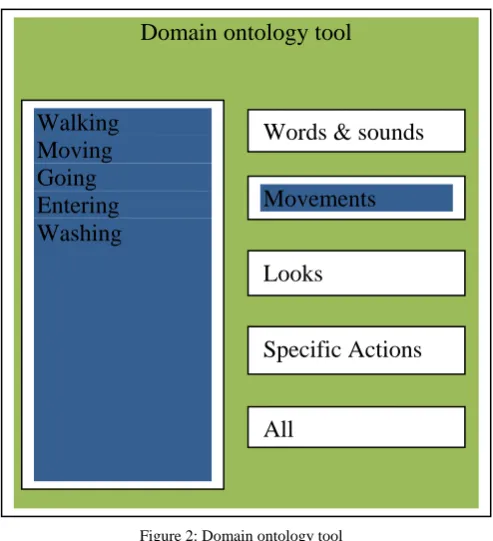
From above fig 2 users are annotated the video based on the actions.
In above domain ontology tool the actions are divided into set of groups that are words/sounds, movements, looks and specific actions. The movements have the actions walking, entering, moving, going and washing. Like that user is divided the actions.
VI. PERFORMANCE EVALUTION
The proposed system contains the symbol annotation for improving performance of the lecture videos. In existing the video contains only text annotation, audio annotation and location based annotation. In text annotation user can give text only keyboard related letters and symbols.
Figure 3: Performance of existing and proposed systems
The above fig 3 shows how the proposed system and existing system performed.
The proposed system is contained the symbol annotation so the system having more performance than existing system.
0 1 2 3 4 5 6
Existing system Proposed system
with symbol
annotation
without
symbol
annotation
Domain ontology tool
Walking
Moving
Going
Entering
Washing
Words & sounds
Movements
Looks
Specific Actions
From the graph user is taken the y-axis as number of videos.
By seeing number of videos user can easily analyse the class room lecture videos with symbol annotation which is proposed in the proposed system.
VII. CONCLUSION
Semantic annotation is used in understanding learning activities taking place within a simulated ward environment. Annotations are developed with the intention of student feedback were generally less useful for purposes of research analysis and vice versa.
The outcomes of proposed work could offer insights into new and better ways of working; tools to train and educate staff to be more effective and self-reflective; strategies and tools to measure, collect, and analyze different data streams; and modelling of clinical environments to better reflect the activities within the environments.
The ontology is provided a link between their placement and the knowledge acquired in the university learning environment. The potential of video analysis in the assessment of student performance indicates that an annotation facility could help realize effective formative and assessment strategies.
ACKNOWLEDGMENT
We would like to thank Dr.B.Bharathi, Head of the Department, Department of Computer Science and Engineering, Ms.S.Sarika for her encouragement and support.
REFERENCES
[1] M.J. Weal, D. Michaelides, K.R. Page, D.C. De Roure, E. Monger, and M. Gobbi, “Semantic Annotation of Ubiquitous Learning Environments,” IEEE Trans. Learning Technologies, vol. 5, no. 2, pp. 143-156, Apr.-June 2012.
[2] L. Ballan, M. Bertini, A. Del Bimbo, L. Seidenari, and G. Serra, “Event Detection and Recognition for Semantic Annotation of
Video,” Multimedia Tools and Applications, vol. 51, pp. 279-302, 2011.
[3] T. Tiropanis, H. Davis, D. Millard, and M. Weal, “Semantic Technologies for Learning and Teaching in the Web 2.0 Era—A Survey,” Proc. Society On-Line (WebSci ’09), http://eprints.ecs. soton.ac.uk/17106, 2009.
[4] J.W. McDonald, M.O. Gobbi, D. Michaelides, E. Monger, M.J.Weal, and D. De Roure, “Grid-Enabled Data Collection and Analysis: Semantic Annotation in Skills-Based Learning,” Proc.Fourth Int’l Conf. E-Social Science, June 2008.
[5] R. Pea and R. Lindgren, “Video Collaboratories for Research and Education: An Analysis of Collaboration Design Patterns,” IEEE Trans. Learning Technologies, vol. 1, no. 4, pp. 235-247, Oct.-Dec. 2008.
[6] M.J. Weal, D.T. Michaelides, D.C. De Roure, M. Gobbi, E. Monger, and J.W. McDonald, “Semantic Annotation in Ubiquitous Healthcare Skills-Based Learning Environments,” Proc. Workshop Semantic Web in Ubiquitous Healthcare (ISWC), Nov. 2007. [7] J.A. Muras, V. Cahill, and E.K. Stokes, “A Taxonomy of Pervasive
Healthcare Systems,” Proc. First Int’l Conf. Pervasive Computing Technologies for Healthcare, pp. 1-10, 2006.
[8] K.R. Page, D.T. Michaelides, S.J.B. Shum, Y.-H. Chen-Burger, J.Dalton, D.C. De Roure, M. Eisenstadt, S. Potter, N.R. Shadbolt, A.Tate, M. Bachler, and J. Komzak, “Collaboration in the Semantic Grid: A Basis for E-learning,” Applied Artificial Intelligence, vol. 19, nos. 9/10, pp. 881-904, Nov. 2005.
[9] Y. Li, J.I. Hong, and J.A. Landay, “Topiary: A Tool for Prototyping Location-Enhanced Applications,” Proc. Symp. User Interface Software and Technology (UIST ’04), pp. 217-226, Oct. 2004. [10] L. G, “Urban Tapestries: Wireless Networking, Public Authoring and
Social Knowledge,” Personal Ubiquitous Computing, vol. 7, nos. 3/4, pp. 169-175, July 2003.
[11] O. Lassila and M. Adler, “Semantic Gadgets: Ubiquitous Computing Meets the Semantic Web,” Spinning the Semantic Web, D. Fensel, ed., MIT, pp. 363-376, 2003.
[12] T. D. of Health, “Delivery 21st Century IT Support for the NHS: National Strategic Programme,” technical report, The Stationary Office, June 2002.
[13] F. Nack and W. Putz, “Designing Annotation Before it’s Needed,” Proc. Ninth ACM Int’l Conf. Multimedia (MULTIMEDIA ’01), pp. 251-260, 2001.