SECURITY PROOF FOR QUANTUM KEY RECYCLING WITH NOISE Daan Leermakers and Boris ˇSkori´c
Quantum Key Recycling aims to re-use the keys employed in quantum encryption and quantum authentication schemes. QKR protocols can achieve better round complexity than Quantum Key Distribution. We consider a QKR protocol that works with qubits, as opposed to high-dimensional qudits. A security proof was given by Fehr and Salvail [1] in the case where there is practically no noise. A high-rate scheme for the noisy case was proposed by ˇSkori´c and de Vries [2], based on eight-state encoding. However, a security proof was not given. In this paper we introduce a protocol modification to [2]. We provide a security proof. The modified protocol has high rate not only for 8-state encoding, but also 6-state and BB84 encoding. Our proof is based on a bound on the trace distance between the real quantum state of the system and a state in which the keys are completely secure. It turns out that the rate is higher than suggested by previous results. Asymptotically the rate equals the rate of Quantum Key Distribution with one-way postprocessing.
1 Introduction
1.1 Quantum Key Recycling
Quantum cryptography uses the properties of quantum physics to achieve security feats that are impossible with classical communication. Best known is Quantum Key Distribution (QKD), first described in the famous BB84 paper [3]. QKD establishes a random secret key known only to Alice and Bob, and exploits the no-cloning theorem for unknown quantum states [4] to detect any manipulation of the quantum states. Already two years before the invention of QKD, the possibility of Quantum Key Recycling (QKR) was considered [5]. Let Alice and Bob encrypt classical data as quantum states, using a classical key to determine the basis in which the data is encoded. If they do not detect any manipulation of the quantum states, then Eve has learned almost nothing about the encryption key, and hence it is safe for Alice and Bob to re-use the key. A QKR protocol can achieve better round complexity than QKD, since communication about basis choices is avoided. After the discovery of QKD, interest in QKR was practically nonexistent for a long time. QKR received some attention again in 2003 when Gottesman [6] proposed an Unclonable Encryption scheme with partially re-usable keys. In 2005 Damg˚ard, Pedersen and Salvail introduced a scheme that allows for complete key recycling, based on mutually unbiased bases in a high-dimensional Hilbert space [7, 8]. Though elegant, their scheme unfortunately needs a quantum computer for encryption and decryption. In 2017 Fehr and Salvail [1] introduced a qubit-based QKR scheme (similar to [5]) that does not need a quantum computer, and they were able to prove its security in the regime of extremely low noise. ˇSkori´c and de Vries [2] proposed a variant with 8-state encoding, which drastically reduces the need for privacy amplification and tolerates higher noise levels, but the security was not proven. Attacks on the qubit-based QKR schemes of [1, 2] were studied in [9], but that did not yield a security proof.
1.2 Contributions and outline
We investigate qubit-based Quantum Key Recycling.
• We introduce a number of modifications in the QKR protocol of ˇSkori´c and de Vries [2]. (i) The basis key now gets refreshed even in case of an Accept; the key update is done by hashing the payload of the qubits into the old key. (ii) We modify the privacy amplification: instead of deriving a classical one-time pad from the qubits’ payload solely, we compress the payload and the old basis key together. For technical reasons we combine the privacy amplification and the key refreshment into a single hashing operation. This simplifies the security proof. (iii) The message contains keys for the next round. Consequently our scheme does not consume key material.
• We provide a security proof. Our proof technique differs from [1]. We treat all keys on the same footing. Our approach is as follows. We work with an EPR formulation of the protocol. The permutation invariance of the protocol allows us to invoke Post-selection [10]. In order to prove security against general attacks we only need to demonstrate security against ‘collective’ attacks, i.e. attacks where Eve collects quantum side information from individual EPR pairs, in exactly the same way for each EPR pair. We apply symmetrisation of the individual noisy EPR pairs as introduced in [11, 12]. The only remaining degree of freedom in the attack is a single scalar, the bit error probability. We provide an upper bound on the diamond distance between the real protocol and an idealised version in which the keys are completely decoupled from Eve’s side information. We do this for one QKR round. The security of multiple rounds follows inductively by universal composability.
For asymptotically large n(number of qubits) the steps in our derivation are very similar to [13, 14]; we make use of smooth R´enyi entropies, which asymptotically tend to the von Neumann entropy. For finite nwe present a separate result without smoothing, based on straightforward diagonalisation.
• The QKR rate is defined as the message length divided by n. We obtain an expression for the QKR rate as a function ofn and the tolerated bit error rate (β). Forn→ ∞the rate equals the rate of QKD with one-way postprocessing (i.e. without two-way advantage distillation). This means that whenever it is possible to do one-way-postprocessing-QKD, it is also possible to do QKR at the same asymptotic rate and hence get the benefit of reduced communication complexity.
For finiten, our approach without smoothing yields a rate≈1−h(β)−2 log[q(1−3
2γ)(1−γ)
+q3
2γ(1 +γ)], where h is the binary entropy function. Both these results are more
favourable than what one would expect based on the min-entropy analysis in [9] and straightforward generalisations of [1] to the noisy case.
It is interesting to note that the asymptotic equivalence of the QKR and QKD rate holds not only for 8-state encoding. For 6-state and 4-state (BB84) encoding there is a severe leakage of the qubit payload if Eve intercepts the whole cipherstate. From [2] and [9] it would seem that this leakage necessarily implies low QKR rate. However, in our protocol the leak is masked by the secret key that is used for privacy amplification.
bits in qubits, and we summarise known results regarding Eve’s optimal extraction of infor-mation from a qubit into a four-dimensional ancilla state. In Section 3 we motivate why we depart from the entanglement-monogamy based proof technique. In Section 4 we present the modified QKR protocol. Section 5 states the main theorems and discusses rates and optimal parameter choices. In Section 6 we compare to existing results, discuss erasures, and suggest topics for future work.
2 Preliminaries
2.1 Notation and terminology
Classical Random Variables (RVs) are denoted with capital letters, and their realisations with lowercase letters. The probability that a RV X takes value xis written as Pr[X =x]. The expectation with respect to RV X is denoted as Exf(x) = Px∈XPr[X = x]f(x). Sets are denoted in calligraphic font. We write [n] for the set{1, . . . , n}. For a stringxand a set of indices I the notation xI means the restriction ofx to the indices in I. The notation ‘log’ stands for the logarithm with base 2. The notation hstands for the binary entropy function h(p) =plog1
p+ (1−p) log 1
1−p. Sometimes we will writeh({p1, . . . , pk}) meaning P
ipilogp1i. Bitwise XOR of binary strings is written as ‘⊕’. The Kronecker delta is denoted asδab. The inverse of a bit b∈ {0,1} is written as ¯b= 1−b. The Hamming weight of a binary stringx is written as |x|. We will speak about ‘the bit error rate γ of a quantum channel’. This is defined as the probability that a classical bitg, sent by Alice embedded in a qubit, arrives at Bob’s side as ¯g.
For quantum states we use Dirac notation, with the standard qubit basis states |0i and |1i represented as 10
and 01
respectively. The Pauli matrices are denoted as σx, σy, σz. The standard basis is the eigenbasis ofσz, with|0iin the positivez-direction. We write1 for the identity matrix. The notation ‘tr’ stands for trace. The Hermitian conjugate of an operatorA is written asA†. The complex conjugate ofzis denoted asz∗. LetAhave eigenvaluesλi. The 1-norm ofA is written askAk1= tr
√
A†A=P
i|λi|. The trace distance between matricesρ andσis denoted asδ(ρ;σ) =12kρ−σk1. It is a generalisation of the statistical distance and
represents the maximum possible advantage one can have in distinguishingρfromσ. Consider uniform classical variables X, Y and a quantum system labeled ‘E’ (under Eve’s control) that depends on X and Y. The combined classical-quantum state is ρXYE =
Exy|xyihxy| ⊗ρExy. The state of a sub-system is obtained by tracing out a subspace, e.g.
ρYE= tr
XρXYE=Ey|yihy| ⊗ρyE, withρEy =ExρExy. The fully mixed state of subsystemX is denoted asµX. The security of the variableX, given that Eve holds the ‘E’ subsystem, can be expressed in terms of a trace distance as follows [13],
d(X|E)def= δρXE; µX⊗ρE (1)
i.e. the distance between the true classical-quantum state and a state in whichX is completely unknown to Eve.
We write S(HA) to denote the space of density matrices on Hilbert space HA, i.e. positive semi-definite operators acting onHA. Any quantum channel can be described by a Completely Positive Trace-Preserving (CPTP) map E: S(HA)→ S(HB) that transforms a mixed state
ρA∈ S(H
A) to another mixed stateρB ∈ S(HB). We writeE(ρA) =ρB. The diamond norm of a map is defined askEkdef= 1
can be considered to be of the same dimension as HA. For a map E: S(HA) → S(HB), the notation E(ρAC) means (
E ⊗1C)(ρAC), i.e.E acts only on the ‘A’ subsystem. A natural
distance measure between two CPTP maps E1 and E2 is given by kE1 − E2k; this is the
maximum possible advantage that one can have in distinguishing between the two maps given one observation of their action.
A family of hash functions H = {h : X → T } is called pairwise independent (a.k.a. 2– independent or strongly universal) [15] if for all distinct pairsx, x0∈ X and all pairsy, y0∈ T it holds that Prh∈H[h(x) =y∧h(x0) =y0] =|T |−2. Here the probability is over randomh∈H. Pairwise independence can be achieved with a hash family of size|H|=|X |.
2.2 Smooth R´enyi entropies
Letρbe a mixed state. The von Neumann entropy of ρis S(ρ) =−trρlogρ. Theε-smooth R´enyi entropy of orderαis defined as [13]
Forα∈(0,1)∪(1,∞) : Sαε(ρ) def
= 1
1−αlogρ¯:kρ¯min−ρk1≤ε
tr ¯ρα, (2)
where the density operator ¯ρmay be sub-normalised. FurthermoreSε
0(ρ) = limα→0Sαε(ρ) and
Sε
∞(ρ) = limα→∞Sαε(ρ). It has been shown that the smooth R´enyi entropy of factor states asymptotically approaches the von Neumann entropy.
Lemma 1 Let σbe a density matrix. It holds that
S2ε(σ⊗n) ≥ nS(σ)−(2 log rank(σ) + 3) q
nlog2ε (3)
Sε
0(σ⊗n) ≤ nS(σ) +O( q
nlog1
ε). (4)
This lemma follows from [11] (Corollary 3.3.7 and the comment above Theorem 3.3.6), com-bined withSε
2≥S∞ε .
2.3 QKR security definition and proof structure
We use the universal composability framework [11][16]. LetEbe the CPTP map that describes one round of the QKR protocol. LetFdenote an ‘ideal’, perfectly secure version ofE. We say that one round of the QKR protocol isε-secure whenkE − Fk≤ε. Since the diamond norm is a composable security measure, the key material that is to be re-used can be considered uniform in the second round except with probabilityε. By an induction argument the scheme is thenN ε-secure afterN rounds. This can be seen as follows. The security of two rounds is
kE ◦ E − F ◦ Fk = kE ◦ E − E ◦ F +E ◦ F − F ◦ Fk=kE ◦(E − F) + (E − F)◦ Fk ≤ kE ◦(E − F)k+k(E − F)◦ Fk (triangle ineq.)
≤ kE − Fk+kE − Fk≤2ε. (5)
A QKR protocol has to satisfy two requirements:
• The encrypted message must be secure.
• If Alice and Bob don’t detect disturbance on the quantum channel, it must be safe to re-use keys, even if Eve knows the plaintext.
A QKR security proof needs to demonstrate kE − Fk ≤ ε for two different definitions of “ideal F”. In the case where Eve does not know the plaintext, the ideal mapping F is constructed to mimic E except that the message and the next-round keys are replaced by completely random variables. In the case of known plaintext, this replacement is done only for the next-round keys.
Some technical complications may arise in the security proof due to the imperfection of the MAC function used by Alice and Bob. An elegant way to avoid computational complications is to describe the classical channel as a channel that is perfectly authenticated (Eve only listens) except with probabilityη, whereη is the failure probability of the MAC. If the protocol has securityε in case of a perfectly authenticated classical channel, then the real-life security is ε+η. For QKD this method was written out in detail in Appendix D of [16].
2.4 Post-selection
Attacks where Eve acts on individual qubits identically in all positions are called collective attacks. For protocols that are invariant under permutation of the input states, a post-selection argument [10] can be used to show thatε-security against collective attacks implies ε0-security against general attacks, with ε0 = ε(n+ 1)d2
−1. Here d is the dimension of the
combined Alice-Bob subsystem (d= 4 for qubits).
A mappingEis called permutation-symmetric if for all permutationsπthere exists a mapping Kπ such that E ◦π=Kπ◦ E. (Any protocol that starts with a random permutation pand afterwards applies no operation that depends on p is obviously permutation-symmetric. It hasKπ=1.) In [10] the following result was provenafor any permutation-symmetric protocol E acting onS(H⊗ABn),
kE − Fk ≤ (n+ 1)d2−1 max σ∈S(HABE)
(E − F)(σ
⊗n)
1. (6)
Practically this means it is possible to upgrade from security against collective attacks to security against general attacks by paying a modest price in terms of privacy amplification, namely changing the usual privacy amplification term 2 log1ε to 2 log1ε+ 2(d2−1) log(n+ 1).
2.5 Encoding a classical bit in a qubit
We briefly review methods for embedding a classical bit g ∈ {0,1} into a qubit state. The standard basis is |0i,|1i with |0i the positive z-direction on the Bloch sphere. The set of bases used is denoted as B, and a basis choice asb∈ B. The encoding of bit valueg in basis b is written as |ψbgi. In BB84 encoding we write B ={0,1}, with |ψ00i=|0i, |ψ01i=|1i,
|ψ10i= |0i√+2|1i, |ψ11i= |0i−|√21i. In six-state encoding [17] the vectors are±x,±y,±zon the
Bloch sphere. For 8-state encoding [2] we have B ={0,1,2,3} and the eight states are the
corner points of a cube on the Bloch sphere. We writeb = 2u+w, withu, w ∈ {0,1}. The states are
|ψuwgi= (−1)gu h
(−√i)gcosα
2|g⊕wi+ (−1)
u(√i)1−gsinα 2|g⊕wi
i
. (7)
The angleαis defined as cosα= 1/√3. For giveng, the four states|ψuwgiare the Quantum One-Time Pad (QOTP) encryptions [18, 19, 20] of|ψ00gi. The ‘plaintext’ states|ψ000i,|ψ001i
correspond to the vectors±(1,1,1)/√3 on the Bloch sphere.
2.6 Eve’s auxiliary state
Consider Eve preparing noisy EPR pairs for Alice and Bob. Let one noisy singlet state be denoted as σAB. Eve holds the purifying ‘auxiliary’ state σE = tr
AB|ΨABEihΨABE|. One
of the results of [9] was an expression for Eve’s auxiliary state after the symmetrisation technique of [11] is applied to σAB. The pure state is
|ΨABE
i = q1−3
2γ|Ψ−i ⊗ |m0i+ pγ
2 −|Φ−i ⊗ |m1i+i|Ψ+i ⊗ |m2i+|Φ+i ⊗ |m3i
, where Ψ±,Φ± are the Bell basis states in the AB subsystem, and |mii is an orthonormal basis in Eve’s four-dimensional ancilla space. The single remaining degree of freedom γ is the bit error probability caused by Eve.b Letv = (v1, v2, v3) be a 3-component vector on the Bloch sphere. Let |v·mi be shorthand
notation forv1|m1i+v2|m2i+v3|m3i. Alice and Bob do a measurement in thev-basis, such
that |vistands for ‘0’ and| −vifor ‘1’. Let x∈ {0,1}be the bit value that Alice measures, and y ∈ {0,1} Bob’s bit value. (In the noiseless case we have y = ¯x because of the anti-correlation in the singlet state.) After these measurements have taken place, Eve’s auxiliary system is in stateσv
xy, given by
σv xy
def
= |Ev
xyihExyv |, (8)
|Ev 01i =
1 √
1−γ
q
1−3
2γ|m0i+ q
γ 2|v·mi
|Ev 10i =
1 √
1−γ
q
1−3
2γ|m0i − q
γ 2|v·mi
(9)
|Ev 00i =
1
p
2(1−v2 3)
(−v1v3−iv2)|m1i+ (−v2v3+iv1)|m2i+ (1−v23)|m3i
|E11vi =
1
p
2(1−v2 3)
(−v1v3+iv2)|m1i+ (−v2v3−iv1)|m2i+ (1−v23)|m3i.
The E-vectors are not all orthogonal. We have hEv
01|E10vi = 11−−2γγ. (The rest of the inner products are zero.) It holds that|−v√1v3−iv2
1−v2 3 |
2= 1−v2
1 and|−√v2v13+−viv21 3 |
2 = 1−v2
2. We have
|Ev
10i = |E− v
01 i and |E11vi = |E− v
00 i. The state |E00vi looks complicated, but the projector
is given by the more simple expression |Ev
00ihE00v| = 12 P3
j=1|mjihmj| − 21|v·mihv·m|+ i
2 P3
jkp=1εjkpvj|mkihmp|,where εjkp stands for the antisymmetric Levi-Civita symbol. For a given basis set B andb ∈ B we will writeσb
xy instead of σxyv , as the vector v is implicitly
defined by the pair (B, b). The following useful identity holds,
Exyσxyb = (1−32γ)|m0ihm0|+γ2 3 X
j=1
|mjihmj|. (10)
3 Motivation
It is possible to add noise tolerance to the construction of Fehr and Salvail [1], but this leads to a result that is unsatisfactory in two respects. (i) For 4-state and 6-state encoding the scheme has a low rate. Even at zero noise the rate is below 1. (ii) For 8-state encoding it is known [9] that the zero-noise rate should be 1, but the proof technique of [1] does not show it. We explain this below.
A straightforward way of adding more noise tolerance to the construction of Fehr and Salvail [1] is as follows. Alice sends to Bob an encrypted syndrome. The encryption is done with a one-time pad, i.e. a certain amount of existing key material has to be spent. Let the number of qubits ben; the length of the secret after privacy amplification is`; the tolerated bit error rate isβ. The proof technique in [1] is based on an entanglement monogamy game [21]. It yields a trace distancep2`p
winbetween ideality and reality, wherepwinis the winning probability,
pwin ≤ µn2nh(β) (asymptotically), where µ = |B|1 + |B|−|B|1 q
maxbb0∈B:b06=bmaxxx0kFxbFb 0 x0k∞.
HereFb
xis the projection operator that corresponds to data bitx∈ {0,1} in the basisb. The value ofµis given byµ4=12+12
q 1
2 ≈0.85,µ6= 1 3+
2 3
q 1
2 ≈0.80,µ8= 1 4+
3 4
q 2
3 ≈0.86 for
4-state, 6-state and 8-state encoding respectively.cGiven that an amountnh(β) of key material has to be spent, the asymptotic QKR rate`−expendituren is upper bounded by 1−log(2µ)−2h(β). This bound on the rate is unfavourable for the 8-state case, even though it is known that QKR with 8-state encoding has good properties [9], e.g. no leakage of the qubit payload at zero noise. Our aim is to obtain a tighter bound on the rate, for all encoding schemes.
4 Protocol
4.1 Our adapted QKR protocol
In this paper we consider the QKR scheme #2 proposed in [2], which is a slightly modified version of the QEMC∗ scheme of Fehr and Salvail [1]. We introduce several changes:
• Some key refreshment of the basis key occurs even in case of an Accept.
• We derive the one time pad not only from the qubits’ payload but also from the basis key. It turns out that with this construction it becomes evident that rate 1 (at zero noise) can be achieved not only using 8-state encoding but also using 6-state encoding.
• For technical reasons we combine the privacy amplification and the key refreshment into a single hashing operation. This simplifies the security proof.
• Part of the message is used to communicate keys for the next round. Consequently the scheme does not consume existing key material.
cWe mention that thep
The key material shared between Alice and Bob consists of several parts: a basis sequence b ∈ Bn, two MAC keys k1
MAC, k2MAC ∈ {0,1}λ, an extractor keydu ∈ U, and a classical
OTP ksyn ∈ {0,1}a for protecting the syndrome. The plaintext is mbare ∈ {0,1}` 0
, with `0 def= `−2λ−a.
Alice and Bob have agreed on a pairwise independent hash functionExt:U × {0,1}n × Bn
→ {0,1}`×Bn, a MAC function Γ :{0,1}λ×{0,1}n+`+a→ {0,1}λ, and a linear error-correcting code with syndrome functionSyn:{0,1}n
→ {0,1}a and decoderSynDec: {0,1}a
→ {0,1}n. For efficiency reasons we take a one-time MAC function whose key size does not exceed the tag size.e
The basis setBand the functionsExt,Γ,Syn,SynDecare publicly known. Encryption
Alice performs the following steps. Generate randomx∈ {0,1}n, k∈ {0,1}2λ+a. Concatenate
m=mbare||kto form augmented messagem∈ {0,1}`. Computes=ksyn⊕Syn(x) andz||b0=
Ext(u, x||b). Compute the ciphertextc=m⊕zand authentication tagτ = Γ(kMAC, x||c||s).
Prepare the quantum state|Ψi=Nn
i=1|ψbixiiaccording to Section 2.5. Send|Ψi,s, c,τ to Bob.
Decryption
Bob receives|Ψ0i,s0,c0,τ0. He performs the following steps. Measure|Ψ0iin the b-basis. This yieldsx0 ∈ {0,1}n. Recover ˆx=x0⊕SynDec(k
syn⊕s0⊕Synx0). Compute ˆz||ˆb0 =Ext(u,xˆ||b)
and ˆm = c0 ⊕zˆ. Accept only if τ0 = Γ(k
MAC,xˆ||c0||s0) holds and the syndrome decoding
was successful. Communicate Accept/Reject to Alice (publicly but with authentication using k2
MAC). In case of Accept parse ˆmas ˆmbare||ˆk.
Key update
Alice and Bob perform the following updates for the next round.
• In case of Reject: Take completely new keysk1
MAC, kMAC2 , ksyn, b, u.
• In case of Accept: Setb←b0, (k1
MAC||k2MAC||ksyn)←k. The keyuis re-used.
The protocol uses up 2λ+abits of key material (the two MAC keys andksyn) but also delivers
the same amount in the augmented messagem; hence the net effect in case of Accept is that Alice and Bob expend no key material. The value of the parametera(size of the syndrome) depends on the noise level and on the choice of error-correcting code. See Section 5.5 for a discussion of the balance between message length and syndrome length.
4.2 EPR version of the protocol
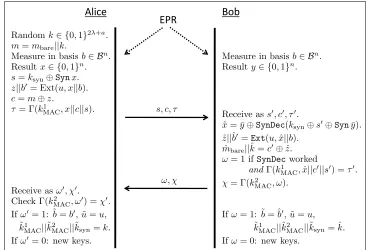
We work with the EPR version of the protocol (Fig. 1). The protocol steps are practically the same as in Section 4.1. The only difference is that Alice does not prepare the state|Ψi; instead Alice performs a measurement in theb-basis on one half of an EPR pair, resulting in a state |Ψi with random payloadx. This EPR pair does not have to be produced by Alice herself but can come from an outside source. Most generally this is described by an attacker Eve creating an 8-dimensional quantum state ρABE and sending 2-dimensional subspaces to
dThe extractor key was not mentioned explicitly in [2].
both Alice and Bob. If Eve is to have any hope of being undetected theρABsubsystem should
be close to an EPR state.
D. Leermakers and B. ˇSkori´c 9
Alice
Bob
EPR
Randomk2 {0,1}2 +a. m=mbare||k.
Measure in basisb2 Bn.
Resultx2 {0,1}n. s=ksyn Synx.
z||b0= Ext(u, x||b). c=m z.
⌧= (k1
MAC, x||c||s). s, c, ⌧
Measure in basisb2 Bn.
Resulty2 {0,1}n.
Receive ass0, c0, ⌧0. ˆ
x= ¯y SynDec(ksyn s0 Syny¯).
ˆ
z||ˆb0=Ext(u,ˆx||b).
ˆ
mbare||ˆk=c0 ˆz.
!= 1 ifSynDecworked
and (k1
MAC,xˆ||c0||s0) =⌧0.
= (k2
MAC, !).
!,
If!= 1: ˜b= ˆb0, ˜u=u,
˜
k1
MAC||˜kMAC2 ||k˜syn= ˆk.
If!= 0: new keys.
Receive as!0, 0.
Check (k2
MAC, !0) = 0. If!0= 1: ˜b=b0, ˜u=u,
˜
k1
MAC||˜kMAC2 ||k˜syn=k.
If!0= 0: new keys.
• In case of Accept: Setb b0, (k1
MAC||kMAC2 ||ksyn) k. The keyuis re-used.
The protocol uses up 2 +abits of key material (the two MAC keys andksyn) but also delivers
the same amount in the augmented messagem; hence the net e↵ect in case of Accept is that
Alice and Bob expend no key material. The value of the parametera(size of the syndrome)
depends on the noise level and on the choice of error-correcting code. See Section 5.5 for a discussion of the balance between message length and syndrome length.
4.2 EPR version of the protocol
We work with the EPR version of the protocol (Fig. 1). The protocol steps are practically
the same as in Section 4.1. The only di↵erence is that Alice does not prepare the state| i;
instead Alice performs a measurement in theb-basis on one half of an EPR pair, resulting in
a state| i with random payloadx. This EPR pair does not have to be produced by Alice
herself but can come from an outside source. Most generally this is described by an attacker
Eve creating an 8-dimensional quantum state⇢ABE and sending 2-dimensional subspaces to
both Alice and Bob. If Eve is to have any hope of being undetected the⇢ABsubsystem should
be close to an EPR state.
Fig. 1. EPR version of the QKR protocol. The EPR pairs are in the singlet state.
Fig. 1.EPR version of the QKR protocol. The EPR pairs are in the singlet state.
4.3 Invariances
We argue that our QKR protocol is statistically equivalent to a protocol that additionally does a random permutationfof the input EPR particles. The argument is as follows. In the original prepare-and-measure protocol of Section 4.1 the basis sequence B and the payload X are uniform; therefore it does not matter if Alice performs a random permutationb7→π(b), x7→ π(x) (and Bob the corresponding permutation). The effect is still a uniform payload encoded in a uniform basis. The above action is identical to keeping b, x untouched but permuting the qubits: Alice appliesπ, and Bobπ−1. In the EPR version Alice and Bob both apply the
same permutation, i.e. the EPR pairs get permuted.
In a similar fashion, we argue that the EPR protocol is statistically equivalent to a protocol where Alice and Bob first apply the random-Pauli transform as introduced by [11] in every qubit position. The argument is analogous to the one in [11]. Before measuring theiri’th qubit in basisbi Alice and Bob both apply the same random Pauli operationAi ← {$ 1, σx, σy, σz} and then forgetAi. The effect on each mixed EPR state isρAB7→ 14Pα(σα⊗σα)ρAB(σα⊗σα), which gives a huge simplification and allows one to use a single-parameter description of noisy EPR states as in Section 2.6. Applying a uniformly chosen Pauli operation on a qubit state and then measuring in basis bi has exactly the same effect as keeping the qubit unmodified and measuring in a uniformly transformed basis. But as b was completely random, this is
statistically equivalent to doing no transform at all.
By this line of reasoning we have a sequence of equivalences E ≡ EEPR
≡ EEPR
π ≡ EπEPRΣ
showing that the original prepare-and-measure protocol E behaves statistically the same as the EPR version with random permutation (‘π’) and noise symmetrisation (random Pauli transformations, ‘Σ’). We will give a security proof for EEPR
πΣ . Security of EπEPRΣ implies
security ofE.
5 Security proof
5.1 Attacker model and proof steps
The attacker model is the one used in most works on QKD. Eve is able to manipulate the classical channel and the quantum channel between Alice and Bob in any way. Eve has no access to the private computations taking place in Alice and Bob’s devices. Eve has unbounded (quantum) computation power and unbounded quantum memory.
The security proof consists of the following steps. We specify the CPTP mapEEPR
πΣ and the
idealised version F, both for the known plaintext and unknown plaintext case. Then we invoke Post-selection and noise symmetrisation. This means we can start from (6), and for the single-position noisy EPR statesσuse the symmetrised states as described in Section 2.6, i.e. parametrised only by the bit error probability γ. We derive an upper bound on the trace norm appearing in (6). We do this for the limit n→ ∞ (Theorem 1) as well as non-asymptotically (Theorem 2). For the asymptotic result we follow proof steps as in [13, 14]. Smoothing is introduced, after which the trace distance is upperbounded in a number of steps. First the average over the hashing key uis pulled into the square root using Jensen’s inequality; then the properties of pairwise independent hashes are used to evaluate the average overu; then the trace is pulled into the square root as well; this results in an expression that can be written in terms of smooth R´enyi entropies Sε
0 andSε2. Finally Lemma 1 is invoked
to make the transition from smooth R´enyi entropies to non-smooth von Neumann entropies, which are then easily evaluated.
The proof of the non-asymptotic result follows similar steps up to and including the average overu, but does not make use of smoothing. The operator square root is evaluated explicitly, which is feasible because of the diagonal form of the operator. No use is made of entropies. We always model Eve’s ability to interfere on the classical channel as a failure probability 2−λ on a channel without any interference.
5.2 The CPTP maps
The action of one QKR round on the n noisy EPR states is denoted as EEPR
πΣ . The output
consists of Eve’s auxiliary states as well as all the classical variables shown in Fig. 1, some of which are observed by Eve. The EEPR
πΣ comprises initialisation I, measurement M and
post-processingP,
EEPR
πΣ =P ◦ M ◦ I ◦Σ◦π. (11)
In the initialisation step the message and all the keys are fetched and put in working memory. Mathematically this action can be written as tensoring the ABE stateσ⊗nwith a fully mixed state of the formEkeys|keysihkeys|.
σ∈ S(HABE) (for a single positioni∈ {1, . . . , n}) be of the form|ΨABEihΨABE|as specified
in Section 2.6. Then the action ofMis
MEb|bihb| ⊗σ⊗n
= EbExy|bxyihbxy| ⊗ρEbxy,
ρE bxy
def
= n O
i=1
σbi
xiyi, (12)
where Eve’s auxiliary states σbi
xiyi are as defined by (8) with v equal to the appropriate basis vector corresponding to bi. The notation Exy(·) stands for Px2−n
P
ypy|x(·), with
py|x=γ|x⊕y¯|(1−γ)|x⊕y|.
The post-processingP generates all the remaining classical variables occurring in Fig. 1. We distinguish between output variables and internal variables. The list of output variables comprises the keys for the next round (˜u,˜b, k) and the transcripts, c, τ, ω, χvisible to Eve. We also includembarein the output list. The internal variables are traced over in the computation
of the output.
We will ignore the authentication tags τ andχ since we handle the possibility of each MAC failure by adding 2−λto the trace distance. We sets0 =s,c0=c,ω0=ωfor the same reason. We introduce an indicator variable θxy ∈ {0,1} which indicates whether error correction succeeds,
θxy def
=
1 if Hamm(x⊕y¯)≤t
0 otherwise , (13)
and automatically set the value of the Accept/Reject bit to ω = θxy. When ω = 1 each ‘hatted’ variable equals the variable without hat.
Formally, the above tweaks define a CPTP mapEEPR
πΣAuth that uses a perfectly authenticated
classical channel. This map is close toEEPR πΣ ,
kEEPR
πΣAuth− EπEPRΣ k≤2·2−λ. (14)
By the triangle inequality we have
kEEPR
πΣ − Fk≤2·2−λ+kEπEPRΣAuth− Fk. (15)
For didactic purposes we write down the intermediate state including internal variables and then trace them out. We have
ρ
internal
z }| {
XY U BZB0K syn
output
z }| {
˜
BU M SC˜ ΩE
=Exyubksyn X
zb0s
|xyubzb0ksynihxyubzb0ksyn| ⊗Em X
˜bucω˜
|˜bumscω˜ ih˜bumscω˜ | ⊗ρEbxy
δs,ksyn⊕Synxδz||b0,Ext(u,x||b)δc,m⊕z
ωθxyδuu˜ δ˜bb0+ ¯ωθxy 1 |B||U|
. (16)
Here the expectations overu, b, ksynare uniform. TheEmis not necessarily uniform because
EEPR
πΣAuth(σ⊗n) = trXY U BZB0K synρ
XY U BZB0K
synB˜U M SC˜ ΩE =ρB˜U M SC˜ ΩE.
ρB˜U M SC˜ ΩE = E˜bums˜ X
cω
2−`|˜bumscω˜ ih˜bumscω˜ | ⊗[ωρ˜Ebumc,˜ [ω=1]+ ¯ωρ E
˜bumc,˜ [ω=0]] (17)
ρE˜bumc,˜ [ω=1] = Exyθxy2` X
b
δ(m⊕c)||˜b,Ext(˜u,x||b)ρ E
bxy (18)
ρE˜bumc,˜ [ω=0] = ExyθxyEbρ E
bxy. (19)
Note thatS is completely decoupled from the rest, since it is a one-time-pad encryption. Next we describe the action of the ideal protocol F0 in the case of unknown plaintext. We write F0 =R0◦ EEPR
πΣ , whereR0 replaces ˜bum˜ with randomgvalues that have no coupling to
Eve’s state,
F0(σ⊗n) =R0(ρB˜U M SC˜ ΩE) =Eb˜um˜ |˜bum˜ ih˜bum˜ | ⊗ρSCΩE. (20)
In the case of known plaintext we writeF =R ◦ EEPR
πΣ . We have to split up m=mbare||k.
TheRreplaces ˜b˜ukwith random values that have no coupling to Eve’s state,
F(σ⊗n) =R(ρB˜U M SC˜ ΩE) =E˜buk˜ |˜buk˜ ih˜buk˜ | ⊗ρMbareSCΩE. (21)
We note that F0(σ⊗n) =
F(σ⊗n). This is seen as follows. Taking the partial trace tr ˜ U of (17) leads to an expectation Eu˜δ(m⊕c)||˜b,Ext(˜u,x||b) which evaluates to the constant 2`1|B| due to the properties of the pairwise independent hash function Ext. This entirely decouples M from Eve’s auxiliary state.
Consequently we do not have to provide two security proofs but only one. We will derive an upper bound onk(EEPR
πΣAuth−F)(σ⊗n)k1. By taking a partial trace of (17) we findρMbareSCΩE,
ρMbareSCΩE = E
mbare|mbareihmbare| ⊗µ SC
⊗X
ω
|ωihω| ⊗[ωρE[ω=1]+ ¯ωρE[ω=0]], (22)
ρE[ω=1] = ExyθxyEbρEbxy (23)
ρE[ω=0] = ExyθxyEbρEbxy. (24)
The states with subscript [ω= 1] are sub-normalised and their trace isPcorr, the probability
that error correction succeeds,
Pcorr(t, γ) =Exyθxy= t X
a=0 n
a
γa(1−γ)n−a. (25)
The states with subscript [ω = 0] have trace 1−Pcorr. The quantity that we now have to
bound is
k(EπEPRΣAuth− F)(σ⊗n)k1=kρ ˜
BU KM˜ bareCΩE−µB˜U K˜ ⊗ρMbareCΩEk
1= 2d( ˜BU K˜ |MbareCΩE).
(26) The S has dropped out of this expression sinceS is completely decoupled. The expression (26) makes sense of course; we are interested in the security of all the next-round keys given the data and auxiliaries in the hands of Eve.
Note that the maximisation maxσ in (6) has become maximisation overγ. We will first derive bounds as a function ofγ and then study the implications at a given bit error rate β =t/n tolerated by the error-correcting code. Asymptotically the optimal value ofγ equalsβ. It is important to remark that the two ‘Reject’ case expressions (19) and (24) are identical. In the differenceρB˜U KM˜ bareCΩE−µB˜U K˜ ⊗ρMbareCΩE we see that theω= 0 part vanishes.
5.3 Asymptotic result
Theorem 1 Consider one round of the QKR protocol (Section 4.1) with 6-state or 8-state encoding. Let Eve cause noise described by parameterγ as discussed in Section 2.6. Let t be the number of errors that can be corrected by the error-correcting code. In the limit n→ ∞ it holds that
d( ˜BU K˜ |MbareCΩE)≤min
Pcorr(t, γ), q
2`−2−n+nh({1−32γ, γ 2,
γ 2,
γ
2})−nh(γ)
(27)
with Pcorr as defined in (25).
Letβ def= t/n. Forγ > β the probabilityPcorris exponentially small. Forγ ≤β, the second
expression can be made exponentially small for` < n+nh(γ)−nh({1−3 2γ,
γ 2,
γ 2,
γ 2}).
Asymptotically the length of the syndrome isa=nh(β), and theO(logn) contribution from post-selection (Section 2.4) becomes negligible compared ton. The QKR rate `0−On(logn) goes to
asymptotic rate = 1−h({1−3 2β,
β 2,
β 2,
β
2}), (28)
which is exactly the asymptotic rate of 6-state QKD.
Proof of Theorem 1: We writeD def= kρB˜U KM˜ bareCΩE−µB˜U K˜ ⊗ρMbareCΩEk
1. We introduce
smoothing as in [13, 11, 14] by allowing states ¯ρthat areε-close toρin terms of trace distance. This yields D ≤2ε+ ¯D, with ¯D def= kρ¯B˜U KM˜ bareCΩE−µB˜U K˜ ⊗ρ¯MbareCΩEk
1. Substituting
(17,22) into this expression gives
¯
D = E˜bumc˜ kρ¯˜Ebumc,˜ [ω=1]−ρ¯ E
[ω=1]k1. (29)
In slight abuse of notation we have writtenEc(· · ·) def
= P
c2−`(· · ·). The ¯ρb˜Eumc,˜ [ω=1]and ¯ρ E [ω=1]
are both sub-normalised states with trace Pcorr(t, γ). Hence it holds that ¯D ≤2Pcorr(t, γ).
This corresponds to the first expression in the ‘min’ in (27). We derive the second expression as follows.
¯
D = E˜bumc˜ tr q
(¯ρE
˜bumc,˜ [ω=1]−ρ¯E[ω=1])2 (30)
Jensen
≤ E˜bmctr q
Eu˜(¯ρ˜Ebumc,˜ [ω=1]−ρ¯E[ω=1])2 (31)
= E˜bmctr q
From the properties of two-universal hash functions we get
Eu˜(¯ρ˜Ebumc,˜ [ω=1])2−(¯ρE[ω=1])2
=Exx0 X
bb0
[22`Eu˜δm⊕c||˜b,Ext(˜u,x||b)δm⊕c||˜b,Ext(˜u,x0||b0)]¯ρEbx,[ω=1]ρ¯Eb0x0,[ω=1]−(¯ρE[ω=1])2 (33)
=Exx0 X
bb0
[|B|−2n+δbb0δxx0(2`|B|−n− |B|−2n)]¯ρbx,E [ω=1]ρ¯Eb0x0,[ω=1]−(¯ρE[ω=1])2 (34)
= (2`|B|n−1)Exx0Ebb0δbb0δxx0ρ¯Ebx,[ω=1]ρ¯bE0x0,[ω=1] (35)
≤(2`|B|n−1)Exx0Ebb0δbb0δxx0ρ¯Ebxρ¯Eb0x0 (36)
= (2`|B|n−1)EbxEb0x0trBX|bxihbx||b0x0ihb0x0| ⊗ρ¯Ebxρ¯Eb0x0 (37)
= (2`|B|n
−1)trBX(¯ρBXE)2. (38)
Line (36) should be read as an operator inequality for a sum of positive semidefinite matrices; we usedθxy≤1. Substituting (38) into (32) gives
¯
D < q2`|B|ntr E
q
trBX(¯ρBXE)2 (39)
Jensen
≤ q2`|B|nqrank(tr
BX(¯ρBXE)2) q
trBXE(¯ρBXE)2 (40)
=
q
2`|B|nrank(¯ρE)tr (¯ρBXE)2. (41)
=
q
2`|B|n2S0( ¯ρE)−S2( ¯ρBXE) =
q
2`|B|n2Sε
0(ρE)−Sε2(ρBXE) (42)
=
q
2`|B|n2Sε
0([Ebxyσxyb ]⊗n)−Sε2([Ebxy|bxihbx|⊗σxyb ]⊗n) (43)
Lemma1
→
q
2`|B|n2nS(Ebxyσxyb )−nS(Ebxy|bxihbx|⊗σbxy). (44)
(In the last two lines we havex, y ∈ {0,1} and b ∈ B in contrast to the previous lines.) In line (40) we used a rank equality that is further detailed in Appendix A. From (10) we have S(Ebxyσbxy) =h({1−32γ,
γ 2,
γ 2,
γ
2}) =−(1− 3
2γ) log(1− 3 2γ)−3
γ 2log
γ 2 and
S(Ebxy|bxihbx| ⊗σbxy) = S(BX) +EbxS(Eyσxyb ) (45) = log|B|+ 1 +EbxS([1−γ]σxbx¯+γσxxb ) (46)
= log|B|+ 1 +h(γ). (47)
In the last line we used that the projectorsσb
xx¯ andσxxb are orthogonal to each other. Note that the description of Eve’s ancilla state in Section 2.6 is valid for 4-state (BB84) encoding under the condition that test states are used which probe the whole Bloch sphere; then the QKR rate is given by (28). If only the xz-plane of the Bloch sphere is involved in the protocol, then (44) still holds, but with differentσb
xymatrices, yielding a QKR rate equal to the BB84 QKD rate.
5.4 Non-asymptotic result without smoothing
We want to have a security proof also for finiten. One approach would be to start from (43) and analyse the smooth entropiesSε
0 andS2εfor finitenandε, and minimise overε. However,
Theorem 2 Consider one round of the QKR protocol (Section 4.1). Let Eve cause noise described by parameter γ as discussed in Section 2.6. Let t be the number of errors that can be corrected by the error-correcting code. Let the function f be defined as
f(γ)def= q(1−3
2γ)(1−γ) + q
3
2γ(1 +γ). (48)
The trace distance between the actual state and the ideal state can be bounded as
d( ˜BU K˜ |MbareCΩE)≤min n
Pcorr(t, γ), 12 p
2`−n+2nlogf(γ)o. (49)
For largeγthe probabilityPcorr(t, γ) is exponentially small inn. Note that 2 logf(γ)∈[0,1)
forγ∈[0,12). For anyγ < 12 it is possible to choose` < n−n·2 logf(γ), so that the√· · · in (49) becomes exponentially small inn.
Proof of Theorem 2: We follow the proof of Theorem 1 up to (39) but without smoothing (ε= 0).
D < √2`−ntrqE
bx(ρEbx)2. (50)
Next we show that the expression under the square root is diagonal. Using ρE bx=
N i{(1−
γ)σbi
xixi+γσ
bi
xixi}and the orthogonalityσ
b
x¯xσbxx= 0 we get
Ebx(ρEbx)2 = n O
i=1 n
(1−γ)2Ebi σbi
01+σb10i
2 +γ
2E bi
σbi
00+σ11bi
2
o
(51)
= n(1−γ)h(1−3
2γ)|m0ihm0|+ γ 6
3 X
j=1
|mjihmj| i
+γ32
3 X
j=1
|mjihmj| o⊗n
(52)
= n(1−γ)(1−3
2γ)|m0ihm0|+ γ(1+γ)
6 3 X
j=1
|mjihmj| o⊗n
(53)
from which it follows that
tr
q
Ebx(ρEbx)2= q
(1−γ)(1−32γ) +q32γ(1 +γ)
n
. (54)
Theorem 3 Consider the context of Theorem 2. Letβ=t/n. Letν be a security parameter. Let ` be chosen as
` ≤ n−2nlogf(β)−2ξ√νn−2ν−1 (55)
ξ def= min
(
f0(β) f(β)
"r
2β ln 2+
ν n+ r ν n # , √ 3 ln 2 ) . (56) Then
Proof: See Appendix B.
If according to (55) the length ` becomes smaller than 2λ+a (negative size of the message mbare) then this means that the desired security levelν cannot be achieved.
A typical choice for the tag length would beλ=ν, yielding securityk(EEPR
πΣ − F)(σ⊗n)k1≤
2·2−λ+ 2·2−ν = 2−ν+2 . Several things are worth noting.
• Theξis of order 1. Hence the termξ√νnscales as√n.
• Analysis of QKD instead of QKR using the same technique yields a result similar to Theo-rem 2, but with a slightly more favourable function instead off(γ), namelyq(1−γ)(1−3
2γ)+ q
1
2γ(1−γ)+γ
√
2. (We mention this without showing the proof.) Nevertheless, the asymp-totics of QKD and QKR are the same.
As explained in Section 2.4, by invoking post-selection we can ‘buy’ security against general attacks by reducing the message length`a bit. The bound (49) changes by a factor (n+ 1)15,
which can be compensated by shrinking`from (55) to
`≤n−2nlogf(β)−2ξ√νn−2ν−1−30 log(n+ 1). (58)
5.5 Non-asymptotic QKR rate; Choosing the parameter values
We want to characterize the non-asymptotic performance of our QKR scheme under ideal circumstances. Consider a sequence of QKR rounds with a large number of consecutive Accepts. Letη= 2·2−λ+ 2·2−ν be the ‘imperfection’ induced by one round of QKR. Letθ be the maximum distance that Alice and Bob are willing to tolerate between reality and the ideal state. After N =bθ/ηcrounds they have to refresh all their key material. We define the amortised QKR rate as
A def= total message data sent inN rounds−expended key material
N·n (59)
= `
0
n −
log|U × Bn |
N·n , (60)
namely the usual definition of rate (`n0) minus the amortised cost of completely replacingu and b after N rounds. The A is an operational quantity that measures how much useful classical payload is sent per qubit. The subtraction can be understood as the cost of putting enough key material into all thembareto compensate for the eventual replacement ofu, b.
The total message size is N `0 = N(`−2λ−a), with ` specified in (58). The total key expenditure consists of log|Bn
| bits of basis key b, and log|U| = log|{0,1}n × Bn
| bits of extractor key u. This gives
A= 1−a
n−2 logf(β)− 2ξ√ν
√n −30 log(nn+ 1) −2λ+ 2n ν −1 + 2 logN |B|. (61)
0.00 0.02 0.04 0.06 0.08 0.10 0.12 0.14 0.0
0.2 0.4 0.6 0.8 1.0
β rate
without
smoothing withsmoothing EM6
EM8
Fig. 2. Asymptotic QKR rates. The ‘with smoothing’ curve is the result (28). The ‘without smoothing’ curve is the result1−h(β)−2 logf(β)obtained without smoothing. The ‘EM6’ and ‘EM8’ curves correspond to the bound1−log(2µ)−2h(β)based on Entanglement Monogamy, with constantsµ=µ6 andµ=µ8 respectively (see Section 3).
well as the ε = 0 rate (61) in the limit n → ∞, N → ∞ and the rates obtained from the Entanglement Monogamy approach (Section 3). Obviously smoothing improves the tightness of the provable bounds significantly. Furthermore it is also clear that the Entanglement Monogamy bounds are very far from tight.
Instead of pairwise independent hashing one may use ‘δ-almost pairwise independent’ hash functions. A small security penalty δ is incurred, but the length of the extractor key u is reduced fromn+nlog|B|to approximatelyn−`+ 2 log1δ.
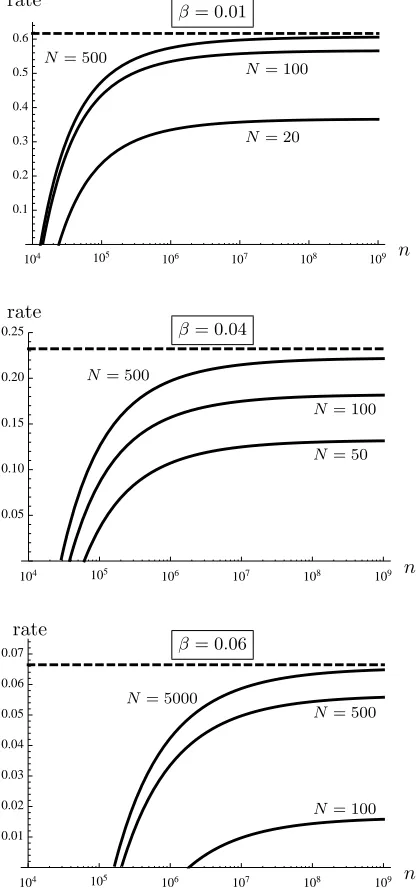
Typicallyθ is fixed. Then it remains to tuneN (which viaη =θ/N fixesν) and nfor fixed (θ, β) so as to optimise the rate. In Fig. 3 the non-asymptotic rate is plotted for θ = 2−256
104 105
106 107 108 109 0.1
0.2 0.3 0.4 0.5 0.6
β= 0.01
β= 0.04
β= 0.06
N= 500
N= 100
N= 20 rate
n
104 105 106 107 108 109 0.05
0.10 0.15 0.20 0.25
N= 500
N= 100
N= 50 rate
n
104 105
106 107 108 109 0.01
0.02 0.03 0.04 0.05 0.06 0.07
N= 5000
N= 500
N= 100 rate
n
Fig. 3. Non-asymptotic bound on the amortised QKR rate as a function of the number of qubits (n), for various values of the design parameterN and tolerated noiseβ. The dashed lines indicate the ε = 0 limit 1−h(β)−2 logf(β). λ = ν; θ = 2−256; the syndrome length ais set tonh(β) +√nΦinv(10−6)p
β(1−β) log1−ββ (see e.g. [22]), where Φ is defined as Φ(z)def= R∞
z (2π)
6 Discussion
6.1 Comparison to existing results
The proof technique of [1] requires a special ‘key privacy’ property of the MAC function, and has to keep track of the security of the MAC key. We avoid this requirement at the cost of shortening `0. An interesting difference with respect to [1] is that we capture the security of the basis keyB and the extractor keyU in a single quantity (a single trace distance), whereas [1] uses a min-entropy result forB and a trace distance forU.
We compare our result to the min-entropy analysis of attacks in [9]. For the ‘K2 attack’ (a known-plaintext attack onb) a min-entropy loss of log(1 +q6β(1−3
2β)) bits per qubit was
found for 8-state encoding; that is more than our leakage result 2 logf(β). We conclude that non-smooth min-entropy is too pessimistic as a measure of security in this context.
It was pointed out in [2, 9] that with 8-state encoding there is no leakage about the qubit payloadX, whereas 6-state and BB84 encoding allow Eve to learn a lot aboutX in case of a Reject. One may conclude that more privacy amplification is needed for 6-state and BB84 encoding than for 8-state. However, it turns out that the situation is the same for all encoding schemes: the privacy amplification keyU adequately masksX and gets replaced upon Reject. Upon Accept, our protocol does not reduce the stack of shared key material that Alice and Bob have. A difference with respect to [1] is that the ‘top’ keys on the stack are modified upon Accept. We do not see this as a significant drawback; the key modification is just some additional data processing.
6.2 Dealing with erasures
Our analysis has not taken into account quantum channels with erasures. (Particles failing to arrive.) Consider a channel with erasure rate η and bit error rate β for the non-erased states. The Alice-to-Bob channel capacity is (1−η)(1−h(β)). A capacity-achieving linear error-correcting code that is able to deal with such a channel has a syndrome of sizenh(β) + nη[1−h(β)]. Imagine the QKR scheme of Section 4.1 employing such an error-correcting code. On the one hand, the parameteraincreases fromnh(β) tonh(β) +nη[1−h(β)]. On the other hand, the leakage increases. Every qubit not arriving at Bob’s side must be considered to be in Eve’s possession; since an erasure can be parametrised as a qubit withβ= 12, the leakage is 1 bit per erased qubit. Hence the leakage termn·2 logf(β) changes ton(1−η)2 logf(β) +nη. The combined effect of the syndrome size and the leakage increase has a serious effect on the QKR rate. The asymptotic rate becomes 1−h(β)−η[1−h(β)]−(1−η)2 logf(β)−η. For β = 0 this is 1−2η; at zero bit error rate no more than 50% erasures can be accommodated by the scheme. In long fiber optic cables the erasure rate is often larger than 90%. Under such circumstances the QKR scheme of Section 4.1 simply does not work. (Note that continuous-variable schemes do not have erasures but instead have large β.)
One can think of a number of straightforward ways to make the QKR protocol erasure-resistant. Below we sketch a protocol variant in which Alice sends qubits, and Bob returns an authenticated and encrypted message.
1. Alice sends a random stringx∈ {0,1}q encoded inqqubits, withq(1
−η)> n.
He constructs a string y0 = x0
J0. He computes s0 = ksyn⊕S(y0), z0||b0 = Ext(u, y0||b),
c0=m⊕z0,t0= Γ(k1
MAC,J0||y0||c0||s0). He sendsJ0, s0, c0, t0.
3. Alice receives this data as J, s, c, t. She computes y by doing error correction on xJ aided by the syndrome ksyn⊕s. Then she computes z||b00 =Ext(u, y||b), ˆm=z⊕c and
τ = Γ(k1
MAC,J ||y||c||s). Alice Accepts the message ˆmifτ=tand Rejects otherwise.hKey
refreshment is as in the original protocol.
The security is not negatively affected by the existence of erasures. Assume that Eve holds all the qubits that have not reached Bob. Since the data in the qubits is random, and does not contribute to the computation ofz0, it holds that (i) it is not important if Eve learns the content of these bits, (ii) known plaintext does not translate to partial knowledge of the data content of these qubits, which would endanger the basis keyband the extractor keyu.
6.3 Future work
It is possible to evaluate or bound the Sε
0(ρE) and S2ε(ρBXE) in (42) for finite nand ε ‘by
hand’, i.e. specifically for ρE
bxy =⊗ni=1σbxiiyi. That would yield a non-asymptotic result for ` that is more favorable than Theorem 3.
It is interesting to note that QKR protocols which derive an OTPz from the qubit payload and then use z for encryption look a lot like Quantum Key Distribution, but with reduced communication complexity. This changes when the message is put directly into the qubits, e.g. as is done in Gottesman’s Unclonable Encryption [6]. It remains a topic for future work to prove security of such a QKR scheme.
The QKR scheme of Section 4.1 can be improved and embellished in various ways. For instance, the λ-bit space in m reserved for the new k1
MAC may not be necessary. Alice’s
authentication tag may simply be generated as part of the Extfunction’s output, and then the security of the MAC key can be proven just by proving the security of the extractor keyu (similar to what is done in [1]).
Another interesting option is to deploy the Quantum One Time Pad with approximately half the key length, which still yields information-theoretic security. This would reduce the cost of refreshingbfrom 2nbits tonbits.
Finally, various tricks known from QKD may be applied to improve the noise tolerance of QKR, e.g. artificial noise added by Alice.
Acknowledgements
We thank Serge Fehr, Niek Bouman, Benne de Weger and Aart Blokhuis for helpful discus-sions. We thank the anonymous reviewers of Asiacrypt for pointing out a flaw in a previous version. Part of this research was funded by NWO (CHIST-ERA project ID IOT).
Appendix A: Rank equality
Here we show that rank(trBX(¯ρBXE)2) = rank(¯ρE). We write ¯ρBXE in its spectral decom-position, ¯ρBXE = P
jrj|vjihvj|, where the vj are the eigenvectors in the BXE space, and
rj >0. We have ¯ρE = trBXρ¯BXE =PjrjVj, with Vj def
= trBX|vjihvj|. Similarly we write
trBX(¯ρBXE)2 = Pjrj2Vj. Since Vj > 0 we can write Vj = A†jAj. We construct a ma-trix A = [√r1A1;√r2A2;√r3A3;· · ·] by concatenating the matrices Aj under each other. It holds that P
jrjVj = A†A. Similarly we construct Q = [r1A1;r2A2;r3A3;· · ·], so that P
jrj2Vj =Q†Q. We use the fact that rank(A†A) = rank(A) and rank(Q†Q) = rank(Q). By the construction of AandQ, the rows ofAspan the same space as the rows ofQ.
Appendix B: Proof of Theorem 3
We (implicitly) define a function γmax(t, ν) as Pcorr(t, γmax) = 2−ν. Forγ ≥γmax eq. (57)
clearly holds. Next we need to bound the expression logf(γ) for γ ≤ γmax. Taking the
Chernoff boundPcorr(t, γ)≤exp[−2nγ(γ−nt)2] and solving forγ we get
γmax(t, ν)≤γ0(t, ν) def
= t n+
νln 2 n +
r
2t n
νln 2 n + (
νln 2 n )
2. (B.1)
We will bound the expression logf(γ0) in two different ways: for ‘large’β and for ‘small’ β.
• As f is a concave function we havef(γ0)≤f(β) + (γ0−β)f0(β). This yields
logf(γ0) ≤ logf(β) + log[1 +
f0(β)
f(β)(γ0−β)]≤logf(β) + f0(β)
f(β) γ0−β
ln 2
= logf(β) +ν n+
r
2β ν nln 2 + (
ν n)
2. (B.2)
• We write logf(γ0) = logf(β) + logff((γβ0)) ≤logf(β) + log f(γ0)
f(β)
β=0. The inequality follows
from the fact thatf(γ0)/f(β) is a decreasing function ofβ. This yields
logf(γ0)≤logf(β)+logf(
2ν
n)≤logf(β)+ log[1+
q 3 2(
2ν
n)]≤logf(β)+ 1 ln 2
q 3ν
n. (B.3)
From (B.2) and (B.3) we conclude nlogf(γmax(t, ν))≤nlogf(β) +ξ√νn withξ as defined
in (56). With `chosen according to (55), the expression√2`−n+2nlogf(γmax)in (49) is upper
bounded by 2−ν/√2. Hence the second expression in the min
{·,·}(49) is upper bounded by
2−ν
2√2+ 2−ν
2 + 2−2ν
2√2 <2
−ν.
References
1. S. Fehr and L. Salvail. Quantum authentication and encryption with key recycling. InEurocrypt, pages 311–338, 2017.
2. B. ˇSkori´c and M. de Vries. Quantum Key Recycling with eight-state encoding. (The Quantum One Time Pad is more interesting than we thought). Int. J. of Quantum Information, 2017. 3. C.H. Bennett and G. Brassard. Quantum cryptography: Public key distribution and coin tossing.
IEEE Int. Conf. on Computers, Systems and Signal Processing, pages 175–179, 1984.
4. W.K. Wootters and W.H. Zurek. A single quantum cannot be cloned. Nature, 299:802–803, 1982. 5. C.H. Bennett, G. Brassard, and S. Breidbart. Quantum Cryptography II: How to re-use a one-time
pad safely even if P=NP. Natural Computing, 13:453–458, 2014. Original manuscript 1982. 6. D. Gottesman. Uncloneable encryption. Quantum Information and Computation, 3(6):581–602,
7. I.B. Damg˚ard, T.B. Pedersen, and L. Salvail. A quantum cipher with near optimal key-recycling. InCRYPTO, pages 494–510, 2005.
8. I.B. Damg˚ard, T.B. Pedersen, and L. Salvail. How to re-use a one-time pad safely and almost optimally even if P = NP. Natural Computing, 13(4):469–486, 2014.
9. D. Leermakers and B. ˇSkori´c. Optimal attacks on qubit-based Quantum Key Recycling.Quantum Information Processing, 2018.
10. M. Christandl, R. K¨onig, and R. Renner. Postselection technique for quantum channels with applications to quantum cryptography. Phys. Rev. Lett., 102:020504, Jan 2009.
11. R. Renner. Security of quantum key distribution. PhD thesis, ETH Z¨urich, 2005.
12. R. Renner, N. Gisin, and B. Kraus. Information-theoretic security proof for quantum-key-distribution protocols. Phys.Rev.A, 72:012332, 2005.
13. R. Renner and R. K¨onig. Universally composable privacy amplification against quantum adver-saries. InTheory of Cryptography, volume 3378 ofLNCS, pages 407–425, 2005.
14. M. Tomamichel, C. Schaffner, A. Smith, and R. Renner. Leftover hashing against quantum side information. IEEE Transactions on Information Theory, 57(8):5524–5535, 2011.
15. M.N. Wegman and J.W. Carter. New hash functions and their use in authentication and set equality. Journal of computer and system sciences, 22:265–279, 1981.
16. Christopher Portmann and Renato Renner. Cryptographic security of quantum key distribution. 2014.
17. D. Bruß. Optimal eavesdropping in quantum cryptography with six states. Phys. Rev. Lett., 81(14):3018–3021, 1998.
18. A. Ambainis, M. Mosca, A. Tapp, and R. de Wolf. Private quantum channels. InAnnual Sympo-sium on Foundations of Computer Science, pages 547–553, 2000.
19. D.W. Leung. Quantum Vernam cipher.Quantum Information and Computation, 2(1):14–34, 2002. 20. P.O. Boykin and V. Roychowdhury. Optimal encryption of quantum bits. Phys. Rev. A,
67(4):042317, 2003.
21. M. Tomamichel, S. Fehr, J. Kaniewski, and S. Wehner. One-sided device-independent QKD and position-based cryptography from monogamy games. In EUROCRYPT 2013, volume 7881 of LNCS, pages 609–625, 2013.