Clinical Interventions in Aging
Dovepress
R e v I e w
open access to scientific and medical research
Open Access Full Text Article
Spirometry use: detection of chronic obstructive
pulmonary disease in the primary care setting
Thomas A Barnes1
Len Fromer2
1Department of Cardiopulmonary Sciences, Northeastern University, Boston, MA, USA; 2David Geffen School of Medicine at UCLA, Los Angeles, CA, USA
Correspondence: Thomas A Barnes Northeastern University, 316 Robinson Hall, Boston, MA 02115-5000, USA Tel +1 617 373 3666
Cell +1 617 851 3529 email [email protected]
Objective: To describe a practical method for family practitioners to stage chronic obstructive pulmonary disease (COPD) by the use of office spirometry.
Methods: This is a review of the lessons learned from evaluations of the use of office spirometry in the primary care setting to identify best practices using the most recent published evalua-tions of office spirometry and the analysis of preliminary data from a recent spirometry mass screening project. A mass screening study by the American Association for Respiratory Care and the COPD Foundation was used to identify the most effective way for general practitioners to implement office spirometry in order to stage COPD.
Results: A simple three-step method is described to identify people with a high pre-test probability in an attempt to detect moderate to severe COPD: COPD questionnaire, measure-ment of peak expiratory flow, and office spirometry. Clinical practice guidelines exist for office spirometry basics for safety, use of electronic peak flow devices, and portable spirometers.
Conclusion: Spirometry can be undertaken in primary care offices with acceptable levels of technical expertise. Using office spirometry, primary care physicians can diagnose the presence and severity of COPD. Spirometry can guide therapies for COPD and predict outcomes when used in general practice.
Keywords: chronic obstructive pulmonary disease, spirometry, family practice, primary care physician
Introduction
Spirometry is the most reproducible, standardized, and objective way of measuring airflow obstruction for the diagnosis and management of chronic obstructive pulmonary
disease (COPD).1 The spirogram, first described by John Hutchinson in 1846, is the
oldest clinical test still in use today to measure patients’ maximum exhalations from total
lung capacity.2 In obstructive pulmonary disease, the changes seen in spirometry are a
reduction in forced expiratory volume in the first second (FEV1) – commonly referred
to as “airflow” in primary practice – with respect to forced vital capacity (FVC). Using these measurements, the primary care physician can diagnose the presence and
sever-ity of airway obstruction3,4 and assess the risk of COPD, lung cancer, coronary artery
disease, and stroke.5 Spirometry can be incorporated into family practice with acceptable
levels of technical adequacy and accurate interpretations,6 the results of which have
been shown to influence general practitioner management of patients with previously
diagnosed asthma and COPD.3 A recent evidence-based review project7 concluded that
spirometry by primary care physicians should be reserved for high-risk subjects, eg,
smokers aged .40 years with symptoms, who would benefit from in-depth evaluation
Clinical Interventions in Aging downloaded from https://www.dovepress.com/ by 118.70.13.36 on 20-Aug-2020
For personal use only.
Number of times this article has been viewed
This article was published in the following Dove Press journal: Clinical Interventions in Aging
Dovepress
Barnes and Fromer
and management.4,8,9 All smokers should be encouraged to
stop smoking, regardless of whether or not they have COPD. Although it has been argued that office spirometry should not be used to encourage smokers to stop, because a normal spirogram in an active smoker may encourage continuation of the behavior and give a patient a false sense of being disease
free,10–12 it has been demonstrated that abnormal spirometry
and informing a patient of their “lung age” are effective strategies in encouraging smoking cessation.7,13
The exact definition of COPD can be complex but should be considered in a patient who has dyspnea, chronic cough, or sputum production and/or a history of exposure to risk factors (eg, smoking/second-hand smoke, or biomass fuels) with airflow obstruction that is partially reversible
with acute use of bronchodilators.1 Typically, patients with
asthma respond more fully to bronchodilators than those with COPD, but there is no clear-cut presentation; for example, patients with well established COPD have been shown to have better responsiveness to acute use of
bron-chodilators than previously expected,14 and asthmatics may
have very little airway dilation, especially if they have used their bronchodilator therapy before arriving for spirometry. Some asthma patients will not exhibit substantial airway responsiveness to bronchodilators until their therapy has
the asthma under better control.15 Basing clinical decisions
and plans on airway response to bronchodilators is therefore often controversial.
The severity of COPD should be assessed once the diagnosis has been made using the 2009 updated guidelines from the Global Initiative for Chronic Lung Disease (GOLD) to determine the degree of spirometric abnormality and by the presence of complications, such as respiratory failure
and/or right-sided heart failure.1,16,17 The GOLD guidelines
propose four stages of COPD based on spirometry: FEV1/
FVC ratio , 0.70 and FEV1. 80% predicted (Stage 1 Mild),
FEV1 of 50%–80% predicted (Stage 2 Moderate), FEV1 of
30%–50% predicted (Stage 3 Severe), and FEV1 , 30%
predicted or FEV1, 50% predicted plus chronic respiratory
failure (Stage 4 Very Severe). Patients with symptoms of GOLD Stage 1 COPD can have significant abnormalities of ventilatory mechanics with greater exertional symptoms and
exercise limitation than age-matched healthy subjects.18
Is screening spirometry a waste
of resources?
Spirometry should be used to stage COPD and to guide therapy. Diagnosing airflow obstruction is important because there are effective therapeutic interventions in asthma and
COPD that improve outcomes.1,16 Staging COPD using the
GOLD guidelines for FEV1/FVC ratio and FEV1 in general
practice with office spirometry provides a logical framework to guide therapy. Examples of interventions include smoking cessation,19 drugs,20,21 oxygen,22 rehabilitation,23 and surgical
options.24 Treatment goals should include improving quality
of life and exercise tolerance and decreasing the number of exacerbations. If exacerbations can be reduced, then health care costs will be reduced by fewer hospitalizations and vis-its to the emergency department. It is important to confirm that respiratory symptoms suggest COPD and are the result of airflow obstruction. A decision will need to be made regarding whether a bronchodilator via an inhaler should be administered to improve airflow.
The prevalence of COPD in a primary care setting in patients with a smoking history and self-reported bronchitis has been studied.25,26 A recent multicenter, cross-sectional
study by Yawn et al determined the percentage of patients
with airway obstruction (post-bronchodilator FEV1/FVC
ratio # 0.70) compared with those without airway obstruction
(post-bronchodilator FEV1/FVC ratio . 0.70) and confirmed
26% patients with airflow obstruction consistent with COPD.
This latter group had a mean age of 52.9 years, an FEV1 of
81.4% predicted, a smoking history of 39.8 pack-years, and
reported chronic bronchitis symptoms.26 Airflow obstruction
has been observed to increase with age and smoking history, and Yawn et al noted that slight or moderate dyspnea was reported by 68% of the patients with a post-bronchodilator FEV1/FVC ratio # 0.70.26 The majority of the patients with
newly diagnosed COPD had not discussed their coughing
with their doctor and continued to smoke.26 Several studies
around the globe have found that many patients with COPD remain undiagnosed in the primary care setting.8,25,26 Use of
spirometry in patients with a smoking history and chronic bronchitis symptoms can aid in the diagnosis of COPD, allowing early treatment;8,25,26 however, screening patients at
risk of COPD remains controversial,1 and the US Preventive
Services Task Force (USPSTF) recommends against screen-ing adults for COPD usscreen-ing spirometry followscreen-ing a systematic review of evidence of the benefits and harms and an assess-ment of the net benefit.27 Each patient needs to be evaluated
individually, according to their smoking history, lifestyle, and comorbidities, prior to a decision to perform spirometry.
Lessons learned from mass
screening experience
The lessons learned from mass screening of people out-side of primary care offices have led to the following
Clinical Interventions in Aging downloaded from https://www.dovepress.com/ by 118.70.13.36 on 20-Aug-2020
Dovepress Spirometry use in COPD
recommendations by the American Association for
Respiratory Care (AARC) and the COPD Foundation:28
1. Use a COPD questionnaire to identify those at risk. 2. Use an electronic device to detect those likely to have
a low peak flow.
3. Only perform spirometry on those at higher risk of COPD (smoking, biomass fuel exposure).
4. Take the time to perform good spirometry.
The AARC, the COPD Foundation, and Columbia
University have completed a pilot study,29 which screened
4901 people for COPD using a shortened version of the Martinez et al population screening questionnaire,30 peak
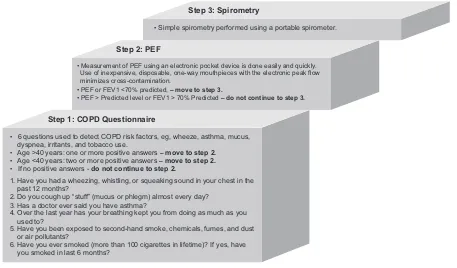
expiratory flow measurement (PEF), and spirometry. The study used a three-step method (Figure 1)29 to identify
people with a high pre-test probability in an attempt to detect
moderate to severe COPD.28,29
Spirometry basics
Spirometry is the gold standard for the diagnosis and assess-ment of COPD, as it is the most reproducible, standardized,
and objective way of measuring airflow obstruction.1 It also
detects airway obstruction in people with poorly controlled
asthma. If PEF is ,70% predicted, simple spirometry should
be performed on a portable spirometer.
Spirometry can be undertaken in primary care offices with acceptable levels of technical adequacy and accurate
interpretations, and can alter clinical decisions in the management of asthma and COPD.6,31 In April 2010, the
Office Spirometry Certificate (OSC) was presented to the AARC state representatives meetings; it was presented again at the American Thoracic Association meeting (ATS) in May 2010. The OSC is a national initiative whose aim is to
“teach practitioners to obtain good quality spirometry .90%
of the time, standardize testing performed in the office setting, assure test accuracy and validity and to ensure staff competency” (http://www.aarc.org/osc/). The process consists of an Internet-based online exam and additional direct competency-based testing, and is intended to provide a way for people outside the traditional pulmonary function laboratory setting to demonstrate understanding and receive quality feedback on performance. Having two trained and certified spirometer experts as part of a practice team is the ideal situation in which to provide the most readily available and reliable spirometry.
The National Lung Health Education Program (NLHEP) has recommended that all smokers aged 45 years and older have a screening lung function measured by simple
spirometry;32 however, PEF is quicker to measure than
spirometry,33 although this would require two devices and
would not be supported by all health authorities. Older patients often have multiple chronic health problems that can magnify the impact of COPD on a patient’s health status
Step 1: COPD Questionnaire Step 2: PEF
Step 3: Spirometry
6. Have you ever smoked (more than 100 cigarettes in lifetime)? If yes, have you smoked in last 6 months?
5. Have you been exposed to second-hand smoke, chemicals, fumes, and dust or air pollutants?
4. Over the last year has your breathing kept you from doing as much as you used to?
3. Has a doctor ever said you have asthma?
2. Do you cough up “stuff” (mucus or phlegm) almost every day?
1. Have you had a wheezing, whistling, or squeaking sound in your chest in the past 12 months?
• If no positive answers - do not continue to step 2.
• Age >40 years: one or more positive answers –move to step 2. • Age <40 years: two or more positive answers –move to step 2.
• 6 questions used to detect COPD risk factors, eg, wheeze, asthma, mucus, dyspnea, irritants, and tobacco use.
• Measurement of PEF using an electronic pocket device is done easily and quickly. Use of inexpensive, disposable, one-way mouthpieces with the electronic peak flow minimizes cross-contamination.
• PEF or FEV1 <70% predicted, –move to step 3.
• PEF > Predicted level or FEV1 > 70% Predicted – do not continue to step 3.
• Simple spirometry performed using a portable spirometer.
Figure 1 Three-step method to identify people with a high pre-test probability for moderate to severe COPD.29
Abbreviations: COPD, chronic obstructive pulmonary disease; Fev1, forced expiratory volume in the first second; PEF, peak expiratory flow measurement.
Clinical Interventions in Aging downloaded from https://www.dovepress.com/ by 118.70.13.36 on 20-Aug-2020
Dovepress
Barnes and Fromer
and can complicate the management of COPD. Confirming the diagnosis of COPD is an important first step. The preva-lence of airway obstruction in the US increases in smokers
aged .40 years and reaches a peak of 31% in all men aged
65–75 years who are currently smoking.34 In 2004, the NLHEP
implemented a spirometer review process to encourage the development of simple office-based spirometers for use in the primary care setting.35 The goal of this process is to clarify the
elements required to make a device appropriate for use in the primary care physician’s office and to provide a checklist of these elements for use by companies and reviewers to validate the device. As of January 2010, the NLHEP has approved four outpatient spirometers, which are reliable, accurate, and affordable; these are listed on the NLHEP website with links to the manufacturers of the devices.35 They comprise the NDD
EasyOne Frontline 2000–2, the EasyOne Diagnostic 2001–2 (www.nddmed.com), the CP200 models (CP2AS-1E1 and CP2S-1E1 [Welch Allyn; www.welchallyn.com]), and the Astra300 (SDI Diagnostics; www.sdidiagnostics.com).
Safety
Members of the practice office staff trained to carry out spirometry should take the precautions described in Table 1.
Pocket spirometry for PeF
An inexpensive (US$50) electronic device with dispos-able mouthpieces should be used.36 The first step is for
the practice office staff to write down the predicted PEF using age and height from gender- and race-specific tables. The maneuver should be demonstrated with the mouthpiece (after a deep breath, coaching the patient to “blast” out the air). The practice office staff should attach a clean mouthpiece without touching it, and encourage a deep breath from the patient and then a 1-second blast. The maneuver should be repeated in cases of low or poor effort by the patient.
Spirometry to measure only
Fev
1and Fev
1/FvC ratio
In the US, Medicare payments for office spirometry aver-aged about US$40 during 2009 and allowed the cost to be covered after 25 tests. The office staff administering spirom-etry should dramatically demonstrate the three steps for the FVC maneuver: 1) “deep” inhalation, 2) “blast” out, and 3) “keep blowing” for 6 seconds. A procedure for spirometry is described in Table 2.
Table 2 A procedure for spirometry
1. wash hands (staff person and patient). 2. Reassure the patient.
3. Review pre-test questionnaire. 4. Carefully enter data into the spirometer. 5. “Demonstrate” the maneuver.
6. Coach and observe body language. 7. Obtain three good maneuvers.
Table 4 Overall spirometry test session quality goals
1. Three good FvC maneuvers (minimal start hesitation and forced exhalation .6 seconds)
2. Two best Fev1 3. Quality grades
4. eight maneuvers maximum
Abbreviations: Fev1,forced expiratory volume in the first second; FVC, forced
vital capacity.
Table 1 Precautions to be taken during spirometry
1. Consider spirometry contraindications, eg, hemoptysis of unknown origin (forced expiratory maneuver may aggravate the underlying condition); pneumothorax; unstable cardiovascular status (forced expiratory maneuver may worsen angina or cause changes in blood pressure), or recent myocardial infarction, or pulmonary embolus; thoracic, abdominal, or cerebral aneurysms (danger of rupture due to increased thoracic pressure); recent eye surgery; presence of an acute disease process that might interfere with test performance (nausea, vomiting); recent surgery of thorax or abdomen.
2. Ask the patient to sit in a comfortable chair (prevent falls and fatigue). 3. wash your hands, keep hands away from your nose and mouth, and
stay home if you have a cold or the flu. 4. wipe the spirometer with an alcohol pad.
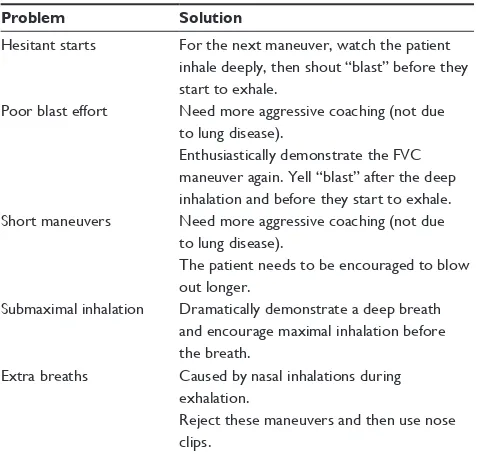
Table 3 Common problems during office spirometry and the
appropriate solutions
Problem Solution
Hesitant starts For the next maneuver, watch the patient inhale deeply, then shout “blast” before they start to exhale.
Poor blast effort Need more aggressive coaching (not due to lung disease).
enthusiastically demonstrate the FvC maneuver again. Yell “blast” after the deep inhalation and before they start to exhale. Short maneuvers Need more aggressive coaching (not due
to lung disease).
The patient needs to be encouraged to blow out longer.
Submaximal inhalation Dramatically demonstrate a deep breath and encourage maximal inhalation before the breath.
extra breaths Caused by nasal inhalations during exhalation.
Reject these maneuvers and then use nose clips.
Abbreviation: FvC,forced vital capacity.
Clinical Interventions in Aging downloaded from https://www.dovepress.com/ by 118.70.13.36 on 20-Aug-2020
Dovepress Spirometry use in COPD
Common mistakes or problems encountered during office spirometry and the appropriate solutions can be found in Table 3.
Overall test session quality goals for spirometry
tech-nique should include those described in Table 4.37 Modern
portable spirometers are programmed to apply the ATS recommendations for good maneuvers, and this, together with certification (OSC) of well trained spirometry experts, will help to improve the quality of office spirometry.
Quality spirometry is best achieved by gaining rapport with the patient and by dramatically demonstrating the maneuver, closely observing the patient’s body language during the maneuver, repeating the demonstration as needed, and repeating the maneuver after a rest. Submaximal maneuvers will frequently cause falsely high and falsely low results. There can be a wide range of quality among staff who administer the spirometry tests; however, with a quality assurance program, spirometry can be performed and interpreted for asthma and COPD patients, and the spirometry
results used to modify care.35 Even the elderly can perform
good spirometry.37
Conclusion
Staging of COPD is driven by percent predicted FEV1 and
FEV1/FVC ratio (providing the spirometry is carried out correctly); however, this takes only one piece of informa-tion into account. The authors advise that the reality of concordance of symptoms (according to the validated
St Georges Respiratory Questionnaire38 and the newly
developed short Clinical COPD Questionnaire)39 and the
impact of COPD on a patient’s daily living according to their individual needs/occupation should be taken into account. Although it has been suggested that PEF can be used rather than spirometry,33 this is not the case in primary care, as
the gold standard in diagnosing and tracking the path of
COPD is spirometry, FEV1, and the FEV1/FVC ratio. Using
spirometry, primary care physicians can diagnose the pres-ence and severity of COPD. In summary, spirometry can guide therapies for COPD and predict outcomes when used in a primary care setting.
Acknowledgments
This article was developed on the basis of the authors’ presentations and discussions at “Overcoming Barriers to COPD Identification and Management”, held in New York, NY, USA, 23–24 March 2009. This meeting, the authors’ participation, and manuscript preparation were supported by Boehringer Ingelheim Pharmaceuticals Inc.
and Pfizer Inc. Medical writing assistance was provided by
Gill Sperrin CBiol MSB of Envision Scientific Solutions.
The article reflects the concepts of the authors and is their sole responsibility. It was not reviewed by Boehringer Ingelheim Pharmaceuticals Inc. or Pfizer Inc., except to ensure medical and safety accuracy.
Disclosures
Tom Barnes has received consultation fees from Boehringer Ingelheim Pharmaceuticals Inc. and Pfizer. Len Fromer has received honoraria for speakers’ bureau from Boehringer Ingelheim Pharmaceuticals Inc. and Pfizer.
References
1. Global Initiative for Chronic Obstructive Lung Disease (GOLD). Global strategy for the diagnosis, management and prevention of chronic obstructive pulmonary disease, 2009. Available from: http://www. goldcopd.org. Accessed Jan15 2010.
2. Petty TL. John Hutchinson’s mysterious machine revisited. Chest. 2002; 121 Suppl 5:S219–S223.
3. Chavannes N, Schermer T, Akkermans R, et al. Impact of spirometry
on GPs’ diagnostic differentiation and decision-making. Respir Med.
2004;98(11):1124–1130.
4. Dales RE, Vandemheen KL, Clinch J, et al. Spirometry in the primary care setting: influence on clinical diagnosis and management of airflow
obstruction. Chest. 2005;128(4):2443–2447.
5. Young RP, Hopkins R, Eaton TE. Forced expiratory volume in one second: not just a lung function test but a marker of premature death
from all causes. Eur Respir J. 2007;30(4):616–622.
6. Yawn BP, Enright PL, Lemanske RF Jr, et al. Spirometry can be done in family physicians’ offices and alters clinical
deci-sions in management of asthma and COPD. Chest. 2007;132(4):
1162–1168.
7. Lin K, Watkins B, Johnson T, et al. Screening for chronic obstructive pulmonary disease using spirometry: summary of the evidence for the
US Preventive Services Task Force. Ann Intern Med. 2008;148(7):
535–543.
8. Bednarek M, Maciejewski J, Wozniak M, et al. Prevalence, severity
and underdiagnosis of COPD in the primary care setting. Thorax. 2008;
63(5):402–407.
9. Lusuardi M, de Benedetto F, Paggiaro P, et al. A randomized controlled trial on office spirometry in asthma and COPD in standard general practice: data from spirometry in asthma and COPD: a comparative
evaluation Italian study. Chest. 2006;129(4):844–852.
10. Buffels J, Degryse J, Decramer M, et al. Spirometry and smoking cessa-tion advice in general practice: a randomised clinical trial. Respir Med. 2006;100(11):2012–2017.
11. Enright P. Does screening for COPD by primary care physicians have the potential to cause more harm than good? Chest. 2006;129(4): 833–835.
12. Stratelis G, Molstad S, Jakobsson P, et al. The impact of repeated spirometry and smoking cessation advice on smokers with mild COPD.
Scand J Prim Health Care. 2006;24(3):133–139.
13. Tashkin DP, Murray RP. Smoking cessation in chronic obstructive
pulmonary disease. Respir Med. 2009;103(7):963–974.
14. Tashkin DP, Celli B, Decramer M, et al. Bronchodilator responsiveness
in patients with COPD. Eur Respir J. 2008;31(4):742–750.
15. McCormack MC, Enright PL. Making the diagnosis of asthma. Respir
Care. 2008;53(5):583–590; discussion 590–592.
16. Gold PM. The 2007 GOLD Guidelines: a comprehensive care
framework. Respir Care. 2009;54(8):1040–1049.
Clinical Interventions in Aging downloaded from https://www.dovepress.com/ by 118.70.13.36 on 20-Aug-2020
Clinical Interventions in Aging
Publish your work in this journal
Submit your manuscript here: http://www.dovepress.com/clinical-interventions-in-aging-journal
Clinical Interventions in Aging is an international, peer-reviewed journal focusing on evidence-based reports on the value or lack thereof of treat-ments intended to prevent or delay the onset of maladaptive correlates of aging in human beings. This journal is indexed on PubMed Central, MedLine, the American Chemical Society’s ‘Chemical Abstracts
Ser-vice’ (CAS), Scopus and the Elsevier Bibliographic databases. The manuscript management system is completely online and includes a very quick and fair peer-review system, which is all easy to use. Visit http://www.dovepress.com/testimonials.php to read real quotes from published authors.
Dovepress
Dovepress
Barnes and Fromer
17. Macintyre NR. Spirometry for the diagnosis and management of
chronic obstructive pulmonary disease. Respir Care. 2009;54(8):
1050–1057.
18. O’Donnell DE, Laveneziana P, Ora J, et al. Evaluation of acute bronchodilator reversibility in patients with symptoms of GOLD stage I
COPD. Thorax. 2009;64(3):216–223.
19. Goodfellow LT, Waugh JB. Tobacco treatment and prevention: what
works and why. Respir Care. 2009;54(8):1082–1090.
20. Celli BR, Thomas NE, Anderson JA, et al. Effect of pharmacotherapy on rate of decline of lung function in chronic obstructive pulmonary
disease: results from the TORCH study. Am J Respir Crit Care Med.
2008;178(4):332–338.
21. Restrepo RD. A stepwise approach to management of stable COPD with inhaled pharmacotherapy: a review. Respir Care. 2009;54(8): 1058–1081.
22. Tarpy SP, Celli BR. Long-term oxygen therapy. N Engl J Med. 1995;
333(11):710–714.
23. Lacasse Y, Goldstein R, Lasserson TJ, et al. Pulmonary rehabilitation for
chronic obstructive pulmonary disease. Cochrane Database Syst Rev.
2006;4:CD003793.
24. Fishman A, Martinez F, Naunheim K, et al; National Emphysema Treatment Trial Research Group. A randomized trial comparing lung-volume-reduction surgery with medical therapy for severe emphysema.
N Engl J Med. 2003;348(21):2059–2073.
25. Leuppi JD, Miedinger D, Chhajed PN, et al. Quality of spirometry in primary care for case finding of airway obstruction in smokers.
Respiration. 2010;79(6):469–474.
26. Yawn B, Mannino D, Littlejohn T, et al. Prevalence of COPD among
symptomatic patients in a primary care setting. Curr Med Res Opin.
2009;25(11):2671–2677.
27. US Preventive Services Task Force. Screening for chronic obstructive pulmonary disease using spirometry: US Preventive Services Task
Force recommendation statement. Ann Intern Med. 2008;148(7):
529–534.
28. COPD Foundation. Mobile spirometry unit, 2010. Available from: http:// www.copdfoundation.org/Programs/MobileSpirometryUnit/tabid/104/ language/en-US/Default.aspx. Accessed Nov 24 2010.
29. Nelson SB, Thomashaw BM, Enright P, et al. A tiered, economical
approach for COPD case-finding in the general population. Am J Respir
Crit Care Med 2010;181:A5949.
30. Martinez FJ, Raczek AE, Seifer FD, et al. Development and initial validation of a self-scored COPD Population Screener Questionnaire
(COPD-PS). COPD. 2008;5(2):85–95.
31. Lamprecht B, Schirnhofer L, Tiefenbacher F, et al. Six-second spirom-etry for detection of airway obstruction: a population-based study in
Austria. Am J Respir Crit Care Med. 2007;176(5):460–464.
32. The National Lung Health Education Program (NLHEP). Strategies in preserving lung health and preventing COPD and associated diseases.
Chest. 1998;113 Suppl 2:S123–S163.
33. White P. Spirometry and peak expiratory flow in the primary care
management of COPD. Prim Care Respir J. 2004;13(1):5–8.
34. Mannino DM. COPD: epidemiology, prevalence, morbidity and
mortal-ity, and disease heterogeneity. Chest. 2002;121 Suppl 5:S121–S126.
35. American Association for Respiratory Care Dallas Texas. National Lung Health Education Program – Spirometer Review Process, 2007. Available from: http://www.nlhep.org/spirometer-review-process.html. Accessed 2010 Nov 24.
36. Vitalograph Ltd Buckingham England. Electronic peak flow meters, 2009. Available from: http://www.vitalograph.co.uk/products/ asma-1.php. Accessed Nov 24 2010.
37. Enright PL. How to make sure your spirometry tests are of good quality.
Respir Care. 2003;48(8):773–776.
38. Engstrom CP, Persson LO, Larsson S, et al. Reliability and validity of a Swedish version of the St. George’s Respiratory Questionnaire.
Eur Respir J. 1998;11(1):61–66.
39. Stallberg B, Nokela M, Ehrs PO, et al. Validation of the Clinical COPD Questionnaire (CCQ) in primary care. Health Qual Life Outcomes. 2009;7:26.
Clinical Interventions in Aging downloaded from https://www.dovepress.com/ by 118.70.13.36 on 20-Aug-2020