(or: Learning from the Masters)
Eleftheria Makri1,2, Dragos Rotaru1,3, Nigel P. Smart1,3, and Frederik Vercauteren1
1 imec-COSIC, KU Leuven, Belgium. 2
ABRR, Saxion University of Applied Sciences, The Netherlands.
3 University of Bristol, UK. [email protected]
Abstract. Outsourcing an image classification task raises privacy con-cerns, both from the image provider’s perspective, who wishes to keep their images confidential, and from the classification algorithm provider’s perspective, who wishes to protect the intellectual property of their clas-sifier. We propose EPIC, an efficient private image classification system based on support vector machine (SVM) learning, secure against mali-cious adversaries. EPIC builds upon transfer learning techniques known from the Machine Learning (ML) literature and minimizes the load on the privacy-preserving part. Our solution is based on Multiparty Com-putation (MPC), it is 34 times faster than Gazelle (USENIX’18) –the state-of-the-art in private image classification– and it improves the com-munication cost by 50 times, with a 7% higher accuracy on CIFAR-10 dataset. For the same accuracy as Gazelle achieves on CIFAR-10, EPIC is 700 times faster and the communication cost is reduced by 500 times.
1
Introduction
Visual object recognition is an important machine learning application, deployed in numerous real-life settings. Machine Learning as a Service (MLaaS) is becom-ing increasbecom-ingly popular in the era of cloud computbecom-ing, data minbecom-ing, and knowl-edge extraction. Object recognition is such a machine learning task that can be provided as a cloud service. However, in most application scenarios, straightfor-ward outsourcing of the object recognition task is not possible due to privacy concerns. Generally, theimage holder who wishes to perform the image classifi-cation process, requires their input images to remain confidential. On the other hand, the classification algorithm provider wishes to commercially exploit their algorithm; hence, requires the algorithm parameters to remain confidential.
about the private images of the image holder, nor about the parameters of the classification algorithm. Unlike previous work [4,5,20], we can fully outsource the task at hand, in such a way that the classification algorithm provider does not need to be the same entity as thecloud computing provider. Although any of the involved parties (i.e., the classification algorithm provider, and the image holder) can play the role of one of the MPC servers, this is not a requirement for guaranteeing the security of our proposal. MPC allows distribution of trust to two or more parties. As long as the image holder (resp. the classification algo-rithm provider) trusts at least one of the MPC servers, their input images (resp. their classification algorithm parameters) remain secret.
MPC allows a set of mutually distrusting parties to jointly compute a func-tion on their inputs, without revealing anything about these inputs (other than what can be inferred from the function output itself). Currently, MPC allows one to compute relatively simple functions on private data; arbitrarily complex functions can be supported, but with an often prohibitive computational cost. EPIC, our privacy-preserving image classification solution, combines the tech-niques of transfer learning feature extraction, support vector machine (SVM) classification, and MPC. In this work we use recently developed techniques for generic image classification (within the ImageNet competition) such as trans-fer learning to extract powerful generic features. Transtrans-fer learning using raw Convolutional Neural Network (CNN) features has been studied extensively by Azizpour et al. [3], and Yosinski et al. [54]. Then, the computation done in the MPC setting is minimized to only evaluate a simple function with secret shared inputs.
We focus on classification via SVM, as opposed to using more sophisticated techniques, such as Neural Networks (NNs), in the privacy-preserving domain to minimize the computational cost. While the field of private image classification is shifting towards NN-based approaches [25,33,42], we show that it is not necessary to use private NNs, as we can achieve classification with better accuracy by using generic NNs to improve the feature extraction techniques used. Although CNNs are the state-of-the-art for image classification [23], we confirm that SVMs can achieve high accuracy, as long as they are provided with good quality features. Transforming a NN to a privacy-preserving one results in inefficient solutions (e.g., 570 seconds for one image classification by CryptoNets [20]).
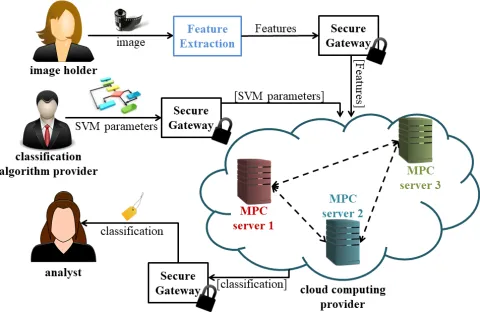
A schematic representation of the application scenario treated by EPIC is given in Fig. 1. Using additive secret sharing techniques both theclassification algorithm provider, and theimage holder share their inputs to then≥2 MPC servers. Note that no information about the actual secret inputs can be gained by the individual shares alone. Thus, each MPC server learns nothing about the inputs of the two parties. The cluster of the MPC servers comprise the
Fig. 1.A schematic representation of the private image classification scenario.
combining the received shares. This party can be theimage holder, or an external
analyst, assigned to examine the classification results, without getting access to the underlying private images. The involved parties (image holder, classification algorithm provider, and –potentially– analyst), may play the role of the MPC servers themselves, avoiding completely the outsourcing to the cloud provider(s). A key aspect of our work is how the data is processed before the MPC engine is used to perform the classification. The SVM classification is performed on so-called feature vectors, and not directly on the images. The way one determines these feature vectors not only affects accuracy, but it also has an impact on security. As shown in Fig. 1 the image holder performs the feature extraction on the input image before it is passed to the secure gateway. Thus this feature extaction must not be specific to the algorithm classification provider; otherwise the extracted features could reveal information about exactly what is being classified. We apply a generic feature extraction method, which is independent of the underlying classification task.
We also present a second variant of EPIC, which aims at allowing a tradeoff between the accuracy of the classifier’s predictions, and its performance. It does so by deploying a kernel approximation method, on top of Inception-v3 features for dimensionality reduction.
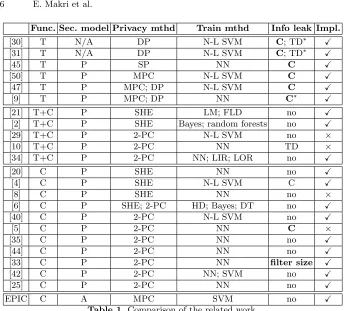
We implemented our solution using SPDZ [7], which was introduced by Damg˚ard et al. [12,13]; it is based on additive secret sharing, and it is proven secure in the active security model, in the full versions of the papers [12,13]. We assume the reader to be familiar with MPC, but we discuss preliminaries on the techniques used by EPIC for completeness in Appendix A. EPIC outperforms the state-of-the-art in secure neural network inference [25], both in terms of ef-ficiency, and in terms of prediction accuracy. Our implementation shows that privacy-preserving image classification has become practical. As shown in Ta-ble 1, we are the only provably secure work in the active security model, which is a property we inherit by the chosen implementation frameworks. A system like EPIC could find application in numerous real-life cases, such as in purchase scenarios where visual insepction is performed, or when targeted surveillance is required without compromising non-targets’ privacy.
Our contributions are thus four fold: i) We enable full outsourcing of privacy-preserving image classification to a third independent party using a simple tech-nique yet much faster and accurate than others, which require complicated ma-chinery. ii) Our solution does not leakany information about the private images, nor the classifier, while being the first to provide active security. iii) We show how to deploy a data-independent feature extraction method to alleviate the privacy-preserving computations, while increasing accuracy and efficiency. iv) We demonstrate the practicality of our approach, both in terms of efficiency, and in terms of accuracy, by conducting experiments on realistic datasets.
2
Related Work
Privacy-preserving machine learning can focus either on providing a secure train-ing phase, a secure classification phase, or both secure traintrain-ing and classifica-tion phases. The first research works in the field aimed at designing a privacy-preserving training phase. Recently, due to the advent of cloud computing, and Machine Learning as a Service, more and more works focus on the design of a privacy-preserving classification phase. Fewer works have attempted to address both the training, and the classification phases in a privacy-preserving manner. To facilitate an easy comparison of the related work, we summarize the main features of each proposal in Table 1.
• The first column of Table 1 is the reference to the corresponding paper. • The second column indicates whether the work considers secure training (T),
secure training and classification (T+C), or only secure classification (C). • The third column indicates the security model, under which the proposed
outputs, and thus are orthogonal to the issue of securing the computation which we deal with.
• The fourth column denotes the method used to preserve privacy. DP stands for differential privacy; SP stands for selective privacy, and refers to the unique characteristic of the work of Shokri and Shmatikov [45] allowing the users to decide how much private information about their learned models they wish to reveal. SHE stands for Somewhat Homomorphic Encryption, 2-PC for 2-Party Computation, and M2-PC stands for Multiparty Computation (which could include 2-PC).
• The fifth column lists the training method(s) used. N-L SVM stands for non-linear SVM, NN for Neural Networks, LM for Linear Means, FLD for Fisher’s Linear Discriminant, HD for hyperplane decision, LIR for linear regression, LOR for logistic regression, and DT for decision trees.
• The sixth column lists the information that is revealed by the protocol exe-cution. C stands for information about the classifier, and TD for information about the training data. We note with boldface letters the information that is intentionally revealed by the protocol execution, and we mark with an asterisk the information that is protected by means of differential privacy techniques. Information that can potentially, and unintentionally be leaked is noted with normal, non-boldface letters.
• The last column indicates whether the work provides an implementation. Training an SVM in a privacy-friendly way, has been previously considered based on techniques of differential privacy [30,31]. Despite the little overhead that these techniques incur, which makes them competitive from an efficiency perspective, they do not consider the security of the actual computationduring the training or classification. Shokri and Shmatikov [45] achieve such privacy-preserving collaborative deep learning with multiple participants, while refrain-ing from usrefrain-ing cryptographic techniques. Their work focuses on learnrefrain-ing the NN, but they also consider protecting the privacy of each individual’s NN, allowing the participants to decide how much information to share about their models.
A lot of research has been devoted to provable privacy-preserving techniques for training a classifier. Privacy-preserving data mining has been an active re-search area since the seminal work of Lindell and Pinkas [32]. More recently, Vaidya et al. [50] showed how to train a SVM classifier, in a privacy-preserving manner, based on vertically, horizontally, and arbitrarily partitioned training data. In follow-up work, Teo et al. [47] improved upon the efficiency of the solution of Vaidya et al. [50], and showed that their approach scales well to ad-dress the challenges of data mining on big data. Chase et al. [9] combine MPC techniques with differential privacy techniques to achieve private neural net-work learning. Their net-work provides provable security guarantees for the learning phase (in the passive security model), and adds noise to the resulting network to protect its privacy during classification.
Func. Sec. model Privacy mthd Train mthd Info leak Impl.
[30] T N/A DP N-L SVM C; TD∗ X
[31] T N/A DP N-L SVM C; TD∗ X
[45] T P SP NN C X
[50] T P MPC N-L SVM C X
[47] T P MPC; DP N-L SVM C X
[9] T P MPC; DP NN C∗ X
[21] T+C P SHE LM; FLD no X
[2] T+C P SHE Bayes; random forests no X
[29] T+C P 2-PC N-L SVM no ×
[10] T+C P 2-PC NN TD ×
[34] T+C P 2-PC NN; LIR; LOR no X
[20] C P SHE NN no X
[4] C P SHE N-L SVM C X
[8] C P SHE NN no ×
[6] C P SHE; 2-PC HD; Bayes; DT no X
[40] C P 2-PC N-L SVM no X
[5] C P 2-PC NN C ×
[35] C P 2-PC NN no X
[44] C P 2-PC NN no X
[33] C P 2-PC NN filter size X
[42] C P 2-PC NN; SVM no X
[25] C P 2-PC NN no X
EPIC C A MPC SVM no X
Table 1.Comparison of the related work.
al. [43], but only recently fully homomorphic encryption was devised [19]. This type of homomorphic encryption allows the computation of any polynomial func-tion on the encrypted data, and unlike MPC, it does not require communicafunc-tion, as the task can be outsourced to one single party. Since the seminal work of Gentry [19], somewhat homomorphic encryption schemes have been proposed, allowing computations of polynomial functions of a limited degree. Graepel et al. [21] consider both machine learning training, and classification based on en-crypted data, with their solutions being secure in the passive model. Due to the selected homomorphic encryption scheme, Graepel et al. [21] cannot treat comparisons efficiently, which excludes SVM-based solutions. Addressing both learning, and classification based on extremely random forests, and na¨ıve Bayes networks, Aslett et al. [2], also work on homomorphically encrypted data.
privacy-preserving algorithms. While Dahl [10] is deploying CNNs instead of SVM, he needs to apply them in a non-black-box fashion. The protocol of Dahl [10] allows some leakage of information during the training phase, which is not the case with our approach. SecureML [34] also considers both training and classification in the 2-PC setting, and the passive security model. These approaches [29,10,34] can only treat the two-party setting, and cannot be trivially extended to allow the classifier provider to be a different entity than the cloud provider.
Other works focus particularly on the private image classification problem, instead of the training of the model. Gilad-Bachrach et al. [20] propose a solu-tion applicable to the image classificasolu-tion problem, based on homomorphically encrypted data. The resulting CryptoNets [20] provide an accuracy of 99% for the MNIST dataset, and can make on average 51739 predictions per hour. How-ever, this is only the case when the predictions are to be made simultaneously; for a single prediction the task takes 570 seconds to complete.
Recent work by Barnett et al. [4] demonstrated the potential of polynomial-kernel SVM to be used for classification in a privacy-preserving manner. Specif-ically, Barnett et al. apply SVM techniques for the classification –as in our work– but on encrypted data. Although they mention the potential of an MPC approach to be more efficient in this setting, they do not consider it, because direct translation of the protocols to MPC would require interaction between the client and the classification algorithm provider during the computations. We overcome this limitation by extending the application scenario in a way that allows the classification task to be fully outsourced to a cluster of independent third parties. We implement their approach using SPDZ in a more secure way by keeping the PCA components private (they choose to make them public). This implementation is more expensive than EPIC, due to the non-linearity of the polynomial SVM, and it is also less accurate. Albeit inefficient and inaccurate, it provides an initial benchmark, and it shows the gap between an FHE and an MPC approach (see details in Section 4). Chabanne et al. [8] attempted to approximate commonly used functions used in NN-based classification in a SHE-friendly manner. Despite the high prediction accuracy that their work achieves, Chabanne et al. do not provide any performance evaluation results.
The recently proposed MiniONN [33] is one of the latest NN-based data clas-sification approaches in the 2-PC setting. MiniONN demonstrates a significant performance increase compared to CryptoNets, without loss of accuracy, as well as better accuracy compared to SecureML [34], combined with increased perfor-mance. However, it still operates in the 2-PC setting, which is more restricted than the MPC setting we consider, and it only offers passive security. Under a comparable configuration as MiniONN, and still in the passive security model, Chameleon [42] achieves a 4.2 times performance improvement. Chameleon oper-ates in the 2-PC setting, under the assumption that a Semi-Honest Third Party (STP) is engaged in the offline phase to generate correlated randomness. Despite the strong STP assumption, Chameleon does not need the third party for the online phase, while it gets a significant performance increase from this STP.
Gazelle [25], the latest work on secure NN classification, outperforms, in terms of efficiency, the best previous solutions in the literature [20,33,42], by carefully selecting which parts of the CNN to carry out using a packed additively homomorphic encryption, and which parts using garbled circuits. EPIC performs better than Gazelle, while also being secure in the active security model. This is because EPIC only treats linear computations in the privacy-preserving domain. To the best of our knowledge, we are the first to provide a privacy-preserving image classification tool combining SVM classification with transfer learning feature extraction, offering active security. EPIC is more efficient than previous work and achieves prediction accuracy higher than that of the related work on the same datasets, although it does not deploy sophisticated NN-based classification on the private inputs. Interestingly, EPIC is not limited to the 2-PC setting, allowing a broad range of application scenarios to be treated by our solution.
3
EPIC
activation of a deep convolutional network. Our work shows that powerful fea-ture extraction is essential to the quality of the final classification accuracy. In fact, we demonstrate that the high-complexity (CNN) tasks can be learned on non-private datasets, and still use their power for feature extraction of unrelated tasks. Eventually, this allows us to deploy only linear functions for the actual classification, which enables accurate, and efficient privacy-preserving solutions. SVM Classification.Despite the increasing popularity and high effectiveness of CNN classification techniques, the direct deployment of CNN techniques re-quires large training datasets [14] that are potentially difficult to obtain when the underlying data is privacy sensitive. In addition, black-box transformation of CNN-based methods to their privacy-preserving equivalents will result in clas-sifiers that are computationally prohibitive to use. Thus using a light-weight classification method such as SVMs can be beneficial in privacy sensitive envi-ronments, and their evaluation can be done (as we show) in a secure manner. With the CNN features, an SVM can learn quickly from very few positive exam-ples, which shows that they are useful to perform one-shot learning [15]. Thus, we opted for the design of a private SVM classifier, while using the techniques of CNN-basedtransfer learning in the context of feature extraction, which does not raise privacy concerns.
To classify a new unlabeled input with our classifier trained with a linear SVM, we need to securely evaluate the following equation:
class(h) = arg max i
(xi·h+bi), (1)
where:
• his the vector representing the client’s image, and has been provided to the MPC servers in shared form;
• biis the model intercept (aka bias), calculated by the classification algorithm provider during the learning phase and secret shared to the MPC servers; • xiare thensupport vectors.
One of the first successful approaches for kernel approximations, achieving high accuracy, was proposed by Rahimi and Recht [38], and is based on random features, which are independent of the training data. To the contrary, Nystr¨om based kernel approximations [52,16], are data dependent. Although Nystr¨om ap-proximations outperform randomly extracted features [53] in terms of accuracy, being data dependent makes them unfit for our purposes, as they require ap-plying non-linear functions on the private inputs. From a computational, and storage efficiency perspective, data independent approximations are favored.
We discovered that a variant of the method proposed by Rahimi and Recht [39] is presented in the scikit-learn package [36]. This implements an RBF (Radial Basis Function) sampler, which allows to transform the features without using the training data. This dimensionality reduction (like the feature extraction) is deployed both for the training, and for the data classification. Since the feature selection is random (i.e., data independent), it can be performed on the cleartext data, both by the classification algorithm provider, and by the client, without raising privacy concerns.
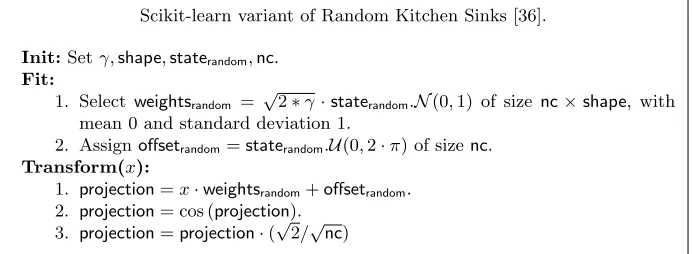
Our second variant of EPIC (see below) supports dimensionality reduction for free, by placing all the computational load on the cleartext. This variant makes use of an algorithm implementing the RBF sampler listed in Fig. 2. In our application scenario, the algorithm provider broadcasts the RBF sampler parameters, namely theγparameter and the feature size. Theγparameter does not reveal any information about the dataset. Note that γ is a floating point number, which is varied to match a cross-validation score on the training data. Theshapevariable is the feature size of a point (set to 2048), which is the output of Inception-v3.
Scikit-learn variant of Random Kitchen Sinks [36].
Init:Setγ,shape,staterandom,nc.
Fit:
1. Select weightsrandom = √2∗γ·staterandom.N(0,1) of size nc×shape, with mean 0 and standard deviation 1.
2. Assignoffsetrandom=staterandom.U(0,2·π) of sizenc.
Transform(x):
1. projection=x·weightsrandom+offsetrandom. 2. projection= cos (projection).
3. projection=projection·(√2/√nc)
Fig. 2.RBF Sampler.
never revealed to the image holder (nor the analyst). The image holder applies the Inception-v3 feature extraction to their image, and takes the second to last layer, which has a feature size of 2048, as their output. The resulting features are then shared (via the secure gateway) to the MPC servers by the image holder, and thus are kept secret from the classification algorithm provider. We indicate secret shared data in square brackets (Fig. 1). The MPC engine then evaluates the SVM securely on the features and outputs the result to the analyst (or image holder).
Note that although EPIC does not allow any information leakage about the private SVM parameters, recent work by Tramer et al. [49] showed that only black-box access to the classifiers can still serve to recover an (near-)equivalent model. We consider this problem to be out of this work’s scope, as it can easily be tackled by restricting the number of queries an external party is allowed to perform on the MPC Engine. This type of attacks has not been averted by any of the secure computation solutions in the related work.
EPIC – Complex Variant:The second variant of the EPIC protocol is summa-rized in Fig. 3. This EPIC variant trades a small percentage of the classification accuracy to increase efficiency. It achieves this tradeoff by deploying the kernel approximation dimensionality reduction explained above, and in particular the kernel approximation sub-step is also considered to be part of the feature ex-traction phase. Here the algorithm provider needs to publish the feature size of a point (in our case 2048) and the parameterγfrom above. At first sight it might seem thatγreveals information about the training data, but we noticed that for our datasets one can fixγ= 2−13to a small value and modify the regularization parameterC of the SVM. This parameterC will always remain private to the algorithm provider, hence there is no information leakage. We stress again that for both cases, the CNN feature extraction is input independent, so privacy is maintained for the image holder and algorithm provider.
Specifically, the protocol starts with the Setup phase, where the algorithm provider (AP) performs the kernel approximation (from Fig. 2) on its own dataset, and broadcasts the type of CNN used, and the Init parameters neces-sary for the feature reduction at the image holder (IH) side. Then, the algorithm provider secret shares the SVM parameters to the MPC Engine (Eng). Secret shared values are denoted in double square brackets. In the evaluation phase, the image holder performs the feature extraction locally (given the previously obtained parameters), and secret shares the new point to be classified byEng. Then, the MPC protocol computes Eq. 1.
4
Experiments
ex-EPIC Protocol with kernel approximation as feature reduction
Setup:
1. Algorithm Provider (AP) broadcasts the type of CNN used for feature extraction.
2. APcomputesγ from Fig.2 on its own training data. ThenAP broadcasts the Init variables from Fig. 2 and secret shares the support vectorsxi, bi
to the MPC engine (Eng). These are stored onEngasJxiK,JbiK. Evaluate:
1. Image Holder (IH) uses public CNN to extract featuresh0 from its image. ThenIHmapsh07→hlocally using the RBF sampler initialized with theγ
broadcasted byAPto obtain a smaller number of features. The new point
his further secret shared to theEngand stored asJhK.
2. EngusesJxiK,JbiK,JhKto compute Eq. 1 with a shared result:Jclass(h)K.
Fig. 3.Protocol for SVM classifcation with RBF sampler.
ecution between the MPC servers. The inputting parties do not need to be aware, nor contribute to this phase. The preprocessing creates the randomness needed to boost the efficiency of the online phase, and allows the inputting parties (image holder and classification algorithm provider) to securely share their inputs.
The online phase begins with the image holder, and the algorithm provider sharing their inputs (reduced CNN features, and SVM parameters, resp.) to the MPC servers. This is performed by executing an interactive protocol between each inputting party and the two MPC servers, as Damg˚ard et al. [11] proposed. Then, the actual private image classification task is executed only between the two MPC servers, as in the Evaluate phase of Fig. 3. In the end, each MPC server sends their resulting share to the image holder, or the analyst, who can combine the shares and reconstruct the cleartext result, which is the desired class label.
From Fixed Point Arithmetic to Integers. For the secure integer com-parison sub-protocols that EPIC deploys, we selected the statistical security parameter to be κ= 40 bits. We stress that everywhere the computational se-curity parameter is set to λ = 128. We observed experimentally after running the scikit-learn’s RBF (see Fig. 2) on top of Inception-v3 that each feature is bounded byabs(xi)≤15 wherelen(x)≤2048.
To avoid the costly fixed point arithmetic, we scale each featurexiby a fac-tor f, and then perform arithmetic on integers. Particularly, we computexi·f and then floor it to the nearest integer. We varied f, and evaluated the SVM’s accuracy. We experimentally concluded that setting f = 28 gives sufficient ac-curacy, as if working on floating point numbers, while lowering the scale factor
f decreased the accuracy by more than 1%. Iff = 28 then to compute a class score from Eq. 1 becomes: s =P2048
j=1(2 8·x
to scale both the support vectors xi as well the featuresh. Using the fact that each component is bounded by 15 then clearlys≤235.
To improve the underlying MPC performance we wanted to aim for using a 64-bit prime modulus for the underlying linear secret sharing scheme. Unfortu-nately, if our inputs are of 35 bit size then there is no room left to perform the secure comparisons in arg max with 40 bits statistical security, as 35 + 40>64. Since some of thexij’s are negative and roughly uniform around zero then we can conclude thatsis bounded by 20 bits which was confirmed for all our datasets. Hence, we could run everything modulo a 64-bit prime with 40-bit statistical security, while ensuring there is no information leak from the comparisons. We can achieve an even tighter bounding by normalizing the features using the L2-Norm, after the RBF-Sampler invocation. In our setting this is not necessary, since the expected bound onsis already low (20 bits). We also experimented (see later) with higher statistical security of 100 bits by using 128-bit prime fields.
For the feature reduction we considered whether to use RBF or PCA, and concluded that RBF is more suitable for our purposes. Despite the accuracy loss that RBF incurs compared to PCA, it is justified to use RBF for reasons of computational and communication efficiency. For a more detailed comparison between RBF and PCA feature reduction in our setting, we refer the reader to Appendix B.
Datasets. We selected three image datasets: CIFAR-10, MIT-67, and Caltech-101, to show how EPIC scales in terms of performance, when increasing the number of classes, and to illustrate its classification accuracy.
• CIFAR-10[28]: This is a dataset of 60000 32x32 color images, out of which 50000 are training images and 10000 are test images. CIFAR-10 features 10 classes of objects, with 6000 images per class. The accuracy metric is the quotient between correctly classified samples and total number of samples. • MIT-67[37]: MIT-67 has 15620 indoor images from 67 scene categories. We
used 80 images per class for training, and the rest of the pictures for testing. The accuracy metric used here is the mAP (mean Accuracy Precision), which consists of calculating the average over the accuracies of each class.
• Caltech-101[17]: This dataset contains pictures of objects of 102 categories. Each class has at least 31 images and we chose to use 30 images from each class for the training. The accuracy metric is mAP, just as in MIT-67.
We stress that EPIC achieves a sufficient classification accuracy. Given that EPIC workings have been purposely kept simple to allow for efficient secure com-putations, we consider the classification accuracy of EPIC comparable to that achieved by the state-of-the-art (non-privacy-preserving) works in the ML com-munity. The best classification accuracy in-the-clear on the CIFAR-10 dataset is 97.14% [18], while EPIC achieves 88.8%. On the MIT-67 dataset, EPIC achieves 72.2% accuracy, while the state-of-the-art in-the-clear solution [27] reports an accuracy of 83.1%. More interestingly, on Caltech-101, the state-of-the-art accu-racy in-the-clear is still 93.42% [22], while EPIC achieves 91.4%.
Classification Accuracy and Performance Evaluation. We executed our experiments, simulating the two MPC servers on two identical desktop computers equipped with Intel i7-4790 processor, at 3.60 GHz over a 1Gbps LAN with an average round-trip ping of 0.3ms.
Our algorithm hand matches the one listed in Fig. 3, where the Evaluate step from Fig. 3 was implemented using the SPDZ software [7]. The preprocessing phase for this step was estimated using the LowGear protocol by Keller et al. [26], which is the fastest known protocol to produce triples for multiple parties with active security. We do not report on the timings for the feature extraction and reduction, since they can be done in the clear, locally by the external parties, which provide inputs to the MPC engine, and they are not privacy-sensitive.
EPIC – Simple Variant: We evaluated the computational performance,
data sent over the network, and classification accuracy of EPIC on the default 2048 length feature from the output of Inception-v3. We report these experiment results in Table 2. Increasing the number of classes n (from 10, to 67, to 102) has a worsening effect on the performance, as the amount of data sent over the network scales linearly withn. The runtime of the online phase is affected less as n increases. Going from 10 classes (CIFAR-10) with 0.005 seconds runtime, to 102 classes (Caltech) with 0.03 seconds, is an increase factor of six, whereas for all other metrics it is roughly ten (i.e., linear in the number of classes).
In Table 3 we show that EPIC improves over Gazelle [25] in terms of every relevant metric on CIFAR-10: accuracy with 7%, total communication by 50x, and total runtime by 34x. This is because we start with secret shared (power-ful) features obtained from public CNNs, whereas Gazelle [25] starts with an encrypted image. We expect Gazelle’s timings to considerably improve, if they adopt our approach, starting from encrypted features produced by a public CNN.
EPIC – Complex Variant: To increase the performance of EPIC even
one considered by Gazelle [25], but we see more the similarities, since the end goal is the same, namely to classify secret shared (or encrypted) images.
Our results indicate that general image recognition, and user’s privacy can go well together. In fact we showed that securing the private classification comes nearly for free. A stronger case for why CNN features with a Linear SVM should be considered, as a baseline benchmark is done by Razavian et al. [41].
Other optimizations:Note that one of the major improvements came from
running the dot products on multiple threads, and doing the argmax operation in a tree-wise manner to decrease the number of communication rounds required.
Dataset Runtime (s) Communication (MB) Accuracy
Offline Online Total Offline Online Total %
CIFAR 0.36 0.005 0.37 24 0.33 24.33 88.8 MIT 2.43 0.02 2.45 161.94 2.24 164.18 72.2 Caltech 3.71 0.03 3.74 246.59 3.41 250 91.4
Table 2.1 Gbps LAN timings for EPIC – Simple Variant on different datasets with a Linear SVM.
Framework Runtime (s) Communication (MB) Accuracy
Offline Online Total Offline Online Total %
MiniONN [33]472 72 544 3046 6226 9272 81.61 Gazelle [25] 9.34 3.56 12.9 940 296 1236 81.61 EPIC 0.36 0.005 0.37 24 0.33 24.33 88.8
Table 3. 1 Gbps LAN timings for CIFAR-10 dataset on different frameworks. The EPIC – Simple Variant is compared to the state-of-the-art private classification solu-tions, and outperforms them in all metrics.
Dataset Runtime (s) Communication (MB) Accuracy
Offline Online Total Offline Online Total %
CIFAR 0.037 0.0003 0.037 2.472 0.027 2.5 81.74 MIT 0.259 0.002 0.261 17.22 0.180 17.4 64.4 Caltech 0.395 0.004 0.399 26.27 0.273 26.543 85.56
Table 4.1 Gbps LAN timings for EPIC – Complex Variant on different datasets with a RBF-SVM and a 128 feature size.
2 3 4 5
101 102 103 104
Number of parties
Throughput
(/s)
Online Offline
Fig. 4. Throughput of CIFAR-10 evaluations of secret features with RBF-128 EPIC for multiple parties.
Barnett et al. [4] in SPDZ, after fixing some security bugs such as cleartext PCA coefficients. They report 124s for one binary classification thus to extrapolate this to 10 classes takes roughly 1240s. To translate the work for Barnett et al. in SPDZ we used a feature extraction algorithm based on Histogram of Oriented Gradients (HOG) and then reduced their dimension using PCA. The reduced points were then plugged into a polynomial SVM to classify the inputs. This methodology yielded a 6.7s execution time of the online phase, and an expensive preprocessing phase of 12 hours for CIFAR-10. The classification accuracy was also poor (58%). This showed that the input dependent phase in MPC is faster than in FHE, by at least two orders of magnitude, confirming that our EPIC solution outperforms traditional attempts at classifying images using SVMs.
statisti-cal security of 100 bits. In Table 5 the method of Bost et al. [6] is benchmarked with the recent libraries (NTL-11.3.0, HElib, etc.). We then compare with EPIC using the same parameters as the ones used in the experiments of Bost et al., namely statistical securityκ= 100 and computational security λ= 128, where the shares live in Fp andp≈2128 –see Appendix C for more details. EPIC has a faster online phase than Bost et al., by at least a factor of 20, at the cost of a slower preprocessing phase. This shows that the main bottleneck in the entire protocol is the triple generation, which deploys expensive cryptographic tools.
Method Classes Runtime (s) Communication (MB)
Offline Online Total Offline Online Total
[6] 10 0 0.48 0.48 0 5.36 5.36
EPIC 10 1.04 0.014 1.054 46.35 0.66 47.01
[6] 67 0 1.32 1.32 0 36.02 36.02 EPIC 67 7.04 0.058 7.09 312 4.42 316.42
[6] 102 0 1.67 1.67 0 54.85 54.85 EPIC 102 10.72 0.083 10.8 475.96 6.68 482.64
Table 5.1 Gbps LAN timings for EPIC – Simple Variant and Bost et al. with different number of classes.
5
Conclusion and Future Work
We have introduced EPIC, a private image classification system, trained with SVM, while having the input features extracted based on the techniques of trans-fer learning. We showed how to achieve privacy-preserving image classification in such a way that the task can be fully outsourced to a third, independent party. For our solution we deployed generic MPC tools and showed how to avoid the restricted two-party setting. Unlike all previous work, our approach provides ac-tive security, does not leak any information about the private images, nor about the classifier parameters, and it is orders of magnitude more efficient than the privacy-preserving classification solutions proposed in the literature.
since performing the linear operations has depth 1, and the costlier operation is computing the argmax, which requires to branch on secret comparisons.
Our experiments confirmed that there is a tradeoff between the complex-ity, and therefore also accuracy of the classification algorithms used, versus the efficiency of the privacy-preserving variants of the proposed solutions. In the ac-tive security model that we consider in this work, deploying CNNs in the same manner as they are used on cleartext data, is computationally prohibitive with current privacy-preserving methods.
Acknowledgements
This work has been supported in part by ERC Advanced Grant ERC-2015-AdG-IMPaCT, by the Defense Advanced Research Projects Agency (DARPA) and Space and Naval Warfare Systems Center, Pacific (SSC Pacific) under contract No. N66001-15-C-4070. This work has been supported in part by the Research Council KU Leuven grants C14/18/067 and STG/17/019.
References
1. Abadi, M., Barham, P., Chen, J., Chen, Z., Davis, A., Dean, J., Devin, M., Ghe-mawat, S., Irving, G., Isard, M., Kudlur, M., Levenberg, J., Monga, R., Moore, S., Murray, D.G., Steiner, B., Tucker, P., Vasudevan, V., Warden, P., Wicke, M., Yu, Y., Zheng, X.: TensorFlow: A System for Large-Scale Machine Learning. In: OSDI. pp. 265–283 (2016)
2. Aslett, L.J., Esperan¸ca, P.M., Holmes, C.C.: Encrypted Statistical Machine Learn-ing: New Privacy Preserving Methods. arXiv:1508.06845 (2015)
3. Azizpour, H., Razavian, A.S., Sullivan, J., Maki, A., Carlsson, S.: Factors of Trans-ferability for a Generic Convnet Representation. IEEE transactions on pattern analysis and machine intelligence38(9), 1790–1802 (2016)
4. Barnett, A., Santokhi, J., Simpson, M., Smart, N.P., Stainton-Bygrave, C., Vivek, S., Waller, A.: Image Classification using non-linear Support Vector Machines on Encrypted Data. IACR Cryptology ePrint Archive: 2017/857 (2017)
5. Barni, M., Orlandi, C., Piva, A.: A Privacy-Preserving Protocol for Neural-Network-Based Computation. In: Multimedia and security workshop. pp. 146–151. ACM (2006)
6. Bost, R., Popa, R.A., Tu, S., Goldwasser, S.: Machine Learning Classification over Encrypted Data. In: Network and Distributed System Security Symposium (2015) 7. Bristol Crypto: SPDZ-2: Multiparty computation with SPDZ, MASCOT, and
Overdrive offline phases.https://github.com/bristolcrypto/SPDZ-2(2018) 8. Chabanne, H., de Wargny, A., Milgram, J., Morel, C., Prouff, E.:
Privacy-Preserving Classification on Deep Neural Network. IACR Cryptology ePrint Archive: 2017/35 (2017)
9. Chase, M., Gilad-Bachrach, R., Laine, K., Lauter, K., Rindal, P.: Private Col-laborative Neural Network Learning. IACR Cryptology ePrint Archive: 2017/762 (2017)
11. Damg˚ard, I., Damg˚ard, K., Nielsen, K., Nordholt, P.S., Toft, T.: Confiden-tial Benchmarking based on Multiparty Computation. IACR Cryptology ePrint Archive: 2015/1006 (2015)
12. Damg˚ard, I., Keller, M., Larraia, E., Pastro, V., Scholl, P., Smart, N.P.: Practical Covertly Secure MPC for Dishonest Majority–or: Breaking the SPDZ Limits. In: ESORICS. pp. 1–18. Springer (2013)
13. Damg˚ard, I., Pastro, V., Smart, N., Zakarias, S.: Multiparty Computation from Somewhat Homomorphic Encryption. In: CRYPTO, pp. 643–662. Springer (2012) 14. Deng, J., Dong, W., Socher, R., Li, L.J., Li, K., Fei-Fei, L.: Imagenet: A Large-Scale
Hierarchical Image Database. In: CVPR. pp. 248–255. IEEE (2009)
15. Donahue, J., Jia, Y., Vinyals, O., Hoffman, J., Zhang, N., Tzeng, E., Darrell, T.: DeCAF: A Deep Convolutional Activation Feature for Generic Visual Recognition. In: ICML. pp. 647–655 (2014)
16. Drineas, P., Mahoney, M.W.: On the Nystr¨om Method for Approximating a Gram Matrix for Improved Kernel-Based Learning. Journal of Machine Learning Re-search6(Dec), 2153–2175 (2005)
17. Fei-Fei, L., Fergus, R., Perona, P.: Learning Generative Visual Models from Few Training Examples: An Incremental Bayesian Approach Tested on 101 Object Cat-egories. In: CVPR. pp. 178–178. IEEE (2004)
18. Gastaldi, X.: Shake-Shake Regularization. arXiv:1705.07485 (2017)
19. Gentry, C.: Fully Homomorphic Encryption using Ideal Lattices. In: STOC. pp. 169–178 (2009)
20. Gilad-Bachrach, R., Dowlin, N., Laine, K., Lauter, K., Naehrig, M., Wernsing, J.: CryptoNets: Applying Neural Networks to Encrypted Data with High Throughput and Accuracy. In: ICML. pp. 201–210 (2016)
21. Graepel, T., Lauter, K., Naehrig, M.: ML Confidential: Machine Learning on En-crypted Data. In: ICISC. pp. 1–21. Springer (2012)
22. He, K., Zhang, X., Ren, S., Sun, J.: Spatial Pyramid Pooling in Deep Convolutional Networks for Visual recognition. In: ECCV. pp. 346–361. Springer (2014) 23. Huang, G., Liu, Z., van der Maaten, L., Weinberger, K.Q.: Densely Connected
Convolutional Networks. In: CVPR. pp. 4700–4708. IEEE (2017)
24. Jia, Y., Shelhamer, E., Donahue, J., Karayev, S., Long, J., Girshick, R., Guadar-rama, S., Darrell, T.: Caffe: Convolutional Architecture for Fast Feature Embed-ding. In: ACMMM. pp. 675–678. ACM (2014)
25. Juvekar, C., Vaikuntanathan, V., Chandrakasan, A.: GAZELLE: A Low Latency Framework for Secure Neural Network Inference. In: USENIX. pp. 1651–1668 (2018)
26. Keller, M., Pastro, V., Rotaru, D.: Overdrive: Making SPDZ great again. In: EU-ROCRYPT. pp. 158–189. Springer (2018)
27. Khan, F.S., van de Weijer, J., Anwer, R.M., Bagdanov, A.D., Felsberg, M., Laak-sonen, J.: Scale Coding Bag of Deep Features for Human Attribute and Action Recognition. Machine Vision and Applications29(1), 55–71 (2018)
28. Krizhevsky, A., Hinton, G.: Learning Multiple Layers of Features from Tiny Images. Technical report, University of Toronto (2009)
29. Laur, S., Lipmaa, H., Mielik¨ainen, T.: Cryptographically Private Support Vector Machines. In: SIGKDD. pp. 618–624. ACM (2006)
30. Lin, K.P., Chen, M.S.: Privacy-Preserving Outsourcing Support Vector Machines with Random Transformation. In: SIGKDD. pp. 363–372. ACM (2010)
32. Lindell, Y., Pinkas, B.: Privacy Preserving Data Mining. In: CRYPTO. pp. 36–54. Springer (2000)
33. Liu, J., Juuti, M., Lu, Y., Asokan, N.: Oblivious Neural Network Predictions via MiniONN Transformations. In: SIGSAC. pp. 619–631. ACM (2017)
34. Mohassel, P., Zhang, Y.: SecureML: A System for Scalable Privacy-Preserving Machine Learning. In: S&P. pp. 19–38. IEEE (2017)
35. Orlandi, C., Piva, A., Barni, M.: Oblivious Neural Network Computing via Homo-morphic Encryption. EURASIP Journal on Information Security p. 18 (2007) 36. Pedregosa, F., Varoquaux, G., Gramfort, A., Michel, V., Thirion, B., Grisel, O.,
Blondel, M., Prettenhofer, P., Weiss, R., Dubourg, V., Vanderplas, J., Passos, A., Cournapeau, D., Brucher, M., Perrot, M., Duchesnay, E.: Scikit-learn: Machine Learning in Python. Journal of Machine Learning Research12, 2825–2830 (2011) 37. Quattoni, A., Torralba, A.: Recognizing Indoor Scenes. In: CVPR. pp. 413–420.
IEEE (2009)
38. Rahimi, A., Recht, B.: Random Features for Large-Scale Kernel Machines. In: NIPS. pp. 1177–1184 (2008)
39. Rahimi, A., Recht, B.: Weighted Sums of Random Kitchen Sinks: Replacing Min-imization with Randomization in Learning. In: NIPS. pp. 1313–1320 (2009) 40. Rahulamathavan, Y., Phan, R.C.W., Veluru, S., Cumanan, K., Rajarajan, M.:
Privacy-Preserving Multi-Class Support Vector Machine for Outsourcing the Data Classification in Cloud. Dependable and Secure Computing11(5), 467–479 (2014) 41. Razavian, A.S., Azizpour, H., Sullivan, J., Carlsson, S.: CNN Features off-the-shelf: An Astounding Baseline for Recognition. In: CVPRW. pp. 512–519. IEEE (2014) 42. Riazi, M.S., Weinert, C., Tkachenko, O., Songhori, E.M., Schneider, T.,
Koushan-far, F.: Chameleon: A Hybrid Secure Computation Framework for Machine Learn-ing Applications. In: ASIACCS. pp. 707–721. ACM (2018)
43. Rivest, R.L., Adleman, L., Dertouzos, M.L.: On Data Banks and Privacy Homo-morphisms. Foundations of secure computation4(11), 169–180 (1978)
44. Rouhani, B.D., Riazi, M.S., Koushanfar, F.: DeepSecure: Scalable Provably-Secure Deep Learning. In: ACM/ESDA/DAC. pp. 1–6. IEEE (2018)
45. Shokri, R., Shmatikov, V.: Privacy-Preserving Deep learning. In: SIGSAC. pp. 1310–1321. ACM (2015)
46. Szegedy, C., Vanhoucke, V., Ioffe, S., Shlens, J., Wojna, Z.: Rethinking the Incep-tion Architecture for Computer Vision. In: CVPR. pp. 2818–2826. IEEE (2016) 47. Teo, S.G., Han, S., Lee, V.C.: Privacy Preserving Support Vector Machine using
non-linear Kernels on Hadoop Mahout. In: CSE. pp. 941–948. IEEE (2013) 48. Thrun, S.: Is Learning the n-th Thing any Easier than Learning the First? In:
NIPS. pp. 640–646 (1996)
49. Tram`er, F., Zhang, F., Juels, A., Reiter, M.K., Ristenpart, T.: Stealing Machine Learning Models via Prediction APIs. In: USENIX. pp. 601–618 (2016)
50. Vaidya, J., Yu, H., Jiang, X.: Privacy-Preserving SVM Classification. Knowledge and Information Systems14(2), 161–178 (2008)
51. Vapnik, V.N.: Statistical Learning Theory, vol. 3. Wiley New York (1998) 52. Williams, C.K., Seeger, M.: Using the Nystr¨om Method to Speed up Kernel
Ma-chines. In: NIPS. pp. 682–688 (2001)
53. Yang, T., Li, Y.F., Mahdavi, M., Jin, R., Zhou, Z.H.: Nystr¨om Method vs Random Fourier Features: A Theoretical and Empirical Comparison. In: NIPS. pp. 476–484 (2012)
A
Preliminaries on Secure Multiparty Computation
Secure Multiparty Computation (MPC) is a cryptographic method allowing a set of parties to jointly compute a function on their inputs, without revealing the inputs to the rest of the parties. The two main security models used to realize MPC are thepassive, andactive security model. In the passive security model, we assume that the protocol participants follow the protocol specification honestly, but they try to learn as much information as possible about the private inputs, during the protocol execution. In the active security model, we assume that the protocol participants may actively, and arbitrarily deviate from the protocol specification. Clearly, the active security model offers stronger security guarantees. In both models we can construct protocols that require an honest majority of the protocol participants to guarantee security, or protocols that guarantee security assuming a dishonest majority of the protocol participants. Our solution offers strong security guarantees, providing active static security, with a dishonest majority. This means that an adversary may corrupt, prior to the protocol execution, up ton−1 out of thenprotocol participants, without leaking any private information, and without allowing any false protocol output to be accepted as correct.
Our solution is implemented using the SPDZ MPC framework [12,13], and that is why it enjoys the aforementioned security properties. The computational and communication costs of the constructed protocols increase linearly in the number of protocol participants. SPDZ is based on additive secret sharing, al-lowing the participants to share their private inputs, in such a way that no information about the private inputs is revealed to the individual participants. Additive secret sharing enjoys an additively homomorphic property, meaning that any linear function can be directly computed on the shares that each pro-tocol participant holds, without requiring interaction amongst the parties. Upon reconstruction of the shared output (which requires all parties to send their shares of the secret), the result will be the correct result of the linear function, as if it had been applied on the secret input. Thus, we can perform additions, and multiplications with non-secret constant values on the secret shared inputs. To perform multiplications between secret shared inputs, or any other non-linear operation, we need to execute a secure interactive protocol between the MPC servers.
of the function prescribed by the protocol transcript. For more details on the MPC techniques used, we refer the reader to the work of Damg˚ard et al. [13,12].
B
Feature reduction: RBF or PCA?
From the algorithm provider’s point of view the goal is to keep the training data private, so we choose to make public only the parameters of the RBF-Init (Fig. 2). Publishingγleaks no information about the training data, since if one fixesγ in advance, they can vary the regularization parameterC to modify the accuracy of the linear SVM. In our case we always keptγ= 2−13, and then just tunedC accordingly.
Our experiments showed that the RBF technique reduces the prediction ac-curacy, which was expected as it decreases the number of components remaining after reduction (see Table 4). On the other hand, PCA requires to compute the equation:z=A|·(h−mh), which takes as input a pointhand outputs a pointz
with a length equal to the number of columns inA(denote this asnc). Note that
A, h, mh are all secret shared across the MPC engine. If we reduce the number of components with PCA tonc= 256, then we observed that we get around 5% better accuracy than using RBF with the same feature reduction parameternc. The main caveat of PCA is that we need to perform (shape·nc) secure multi-plications to convert our features, and then another (nc·n) secure multiplications for computing the SVM probabilities. Hence, PCA incurs a total ofnc(shape+n) multiplications in the privacy-preserving domain, whereas RBF just (nc·n). In application scenarios where the performance is of higher importance, and clas-sification accuracy can be sacrificed (up to < 8%), our RBF approach is still slightly more accurate than other private CNN’s (Table 4: CIFAR-10 accuracy, versus Table 3: accuracy of MiniONN [33], and Gazelle [25]).
C
Security parameters in SPDZ
The traditional way to split the computation in SPDZ is an input independent preprocessing phase, where we produce triples, and an online phase, where we plug in secret or public inputs and perform multiplications using the generated triples.
Offline Phase: Since we use the LowGear [26] protocol to produce triples there are two different flavors of parameters: a statistical κand a computational λ. These are reflected in different instances such as:
• Computational securityλFHE is given by the FHE parameter selection. • Statistical securityκzkused as the soundness parameter in proofs of plaintext
knowledge.
Online Phase: In the online phase we have no computational security param-eters but we do have different statistical security paramparam-eters:
• Statistical security for the MAC-check κmac which ensures that an active adversary can pass a check with probability 2−κmac. When the inputs are
shared within a fieldF with one MAC per triple then κmac = log2F. This can be increased at the expense of introducing more MAC values.
• Statistical security κcomp for integer arithmetic (especially comparisons). When ak-bit integer value is opened during comparison it is masked with at leastκcomp bits to guarantee that the output is within statistical distance of 2−κcomp of a uniform distribution. Thus, to do a comparison in a field
Fwe
need to make sure the value ofkis less than log2F−κcomp.
Global Statistical Security: We define the global statistical security param-eters as
κ= min(κzk, κsac, κmac, κcomp). In our paper we use two different settings for benchmarking:
• Standard benchmarks.These correspond to the experiments reported in Table 2 and Table 4. Here the task was to aim for at least 40 bit statistical security. Hence we first fixedλFHE = 128 andκzk =κcomp = 40. Since the secret inputs are integers of at most 24 bits the other parameters such as log2F, κsac, κmac can all be set to 64.