Copyright to IJIRSET www.ijirset.com 5671
MHD Flow past an Accelerated Vertical Plate
with Variable Heat and Mass Diffusion in the
Presence of Rotation
R.Muthucumaraswamy
1, Tina Lal
2and D.Ranganayakulu
3Professor & Head, Department of Applied Mathematics, Sri Venkateswara College of Engineering,
Irungattukottai 602117, Sriperumbudur Taluk, India. E-mail : [email protected]
Lecturer, Department of Mathematics, Central Polytechnic, Taramani, Chennai 600113, India2
Associate Professor, Department of Mathematics, SIVET College, Gowrivakkam, Chennai 600073, India3
Abstract: Laplace transform solution of MHD flow past an incompressible fluid past a uniformly accelerated infinite vertical plate with variable heat and mass transfer, in the presence of rotation has been studied. The plate temperature as well as cocentration level near the plate are raised linearly with time. The velocity profiles, temperature and concentration are studied for different physical parameters. It is observed that the velocity increases with decreasing magnetic field parameter.
Keywords:Rotation, accelerated, vertical plate, vertical plat, magnetic field.
I. INTRODUCTION
MHD plays an important role in agriculture, petroleum industries, geophysics and in astrophysics. MHD flow has application in metrology, solar physics and in motion of earth’s core. Also it has applications in the field of stellar and planetary magnetospheres, aeronautics, chemical engineering and electronics. In the field of power generation, MHD is receiving considerable attention due to the possibilities it offers for much higher thermal efficiencies in power plants.
Gupta et al [2] studied free convection on flow past a linearly accelerated vertical plate in the presence of viscous dissipative heat using perturbation method. Kafousias and Raptis [3] extended the above problem to include mass transfer effects subjected to variable suction or injection. Free convection effects on flow past an accelerated vertical plate with variable suction and uniform heat flux in the presence of magnetic field was studied by Raptis et al [7].
Copyright to IJIRSET www.ijirset.com 5672 Hence, it is proposed to study the effects of rotation on the hydromagnetic free convection flow of an incompressible viscous and electrically conducting fluid past a uniformly accelerated infinite vertical plate in the presence of variable heat and mass diffusion. The dimensionless governing equations are solved using the Laplace transform technique. The solutions are in terms of exponential and complementary error function. Such a study is found useful in magnetic control of molten iron flow in the steel industry, liquid metal cooling in nuclear reactors, magnetic suppression of molten semi-conducting materials and meteorology.
II. ANALYSIS
Consider the unsteady hydromagnetic flow of an electrically conducting fluid induced by viscous incompressible fluid past a uniformly acceleratedmotion of an infinite vertical plate when the fluid and the plate rotate as a rigid body with a uniform angular velocity Ω′ about z′-axis in the presence of an imposed uniform magnetic field B0 normal to the plate. Initially, the
temperature of the plate and concentration near the plate are assumed to be T∞ and C′∞. At time t′ > 0, the plate starts
moving with a velocity u = u0t′ in its own plane and the temperature of the plate as well as wall concentration near the plate are raised linearly with time. Since the plate occupying the plane z′ = 0 is of infinite extent, all the physical quantities
depend only on z′ and t′. It is assumed that the induced magnetic field is negligible so that
B
= (0, 0, B0). Then theunsteady flow is governed by free-convective flow of an electrically conducting fluid in a rotating system under the usual Boussinesq’s approximation in dimensionless form are as follows:
) 4 ( '
' '
) 3 ( '
) 2 ( '
' '
2 '
'
) 1 ( )
' ' ( )
( '
' 2 '
2 2 2 2
2 0 2
2
2 0 2
2 *
z C D t C C
z T k t T C
V B z
V u
t V
u B z
u C
C g T T g V t
u
p p
With the following initial and boundary conditions:
u = 0, T = T∞, C′ = C′∞ for all y, t′ ≤ 0
t′ > 0 : u = u0t′, T = T′+(T′w - T′)A t′ , C′ = C′+(C′w - C′)A t′ at y = 0 u → 0, T →
Copyright to IJIRSET www.ijirset.com 5673 On introducing the following non-dimensional quantities:
=
A
,
,
Pr
,
)
6
(
)
'
'
(
,
'
'
'
'
,
)
(
,
,
,
'
,
)
(
'
,
)
(
3 1 2 0 3 1 2 0 2 0 0 * 0 3 1 2 0 3 1 2 0 3 1 0 3 1 0
v
u
D
v
Sc
k
C
u
v
B
M
u
C
C
g
Gc
C
C
C
C
C
u
T
T
g
Gr
T
T
T
T
v
u
z
Z
v
u
t
t
vu
V
V
vu
u
U
p w w w w
we arrive at
)
10
(
1
)
9
(
Pr
1
)
8
(
2
)
7
(
2
2 2 2 2 2 2 2 2Z
C
Sc
t
C
Z
t
MV
Z
V
U
t
V
MU
Z
U
C
Gc
Gr
V
t
U
The initial and boundary conditions in non-dimensional quantities are
q = 0, θ = 0, C = 0 for all Z, t ≤ 0
t > 0 : q = t, θ = t, C = t at Z = 0 (11)
q → 0, θ → 0, C → 0 as Z → ∞
Copyright to IJIRSET www.ijirset.com 5674 is described by coupled partial differential equations (7) to (10) with the prescribed boundary conditions (11). To solve the equations (7) and (8), we introduce a complex velocity q = U + iV, equations (7) and (8) can be combined into a single equation:
)
12
(
2 2mq
Z
q
C
G
G
t
q
C r
where m = M + 2iΩ.
Solution Procedure
The dimensionless governing equations (9, (10) and (12),subject to the initial and boundary conditions (11), are solved by the usual Laplace-transform technique and the solutions are derived as follows:
)
13
(
,
)
2
exp(
2
)
(
2
2
1
2
Pr)
2
exp(
Pr
2
)
Pr
(
Pr
2
2
1
2
)]
(
)
2
exp(
)
(
)
2
[exp(
)
exp(
)]
)
(
(
)
)
(
2
exp(
)
)
(
(
)
)
(
2
[exp(
)
exp(
)]
Pr
(
)
Pr
2
exp(
)
Pr
(
)
Pr
2
exp(
[
)
exp(
)
(
2
)]
)
(
(
)
)
(
2
(
exp
)
)
(
(
)
)
(
2
(
exp
[
)
exp(
)
Pr
(
2
)
(
)
2
(
exp
)
(
)
2
(
exp
2
1
)
(
)
2
(
exp
)
(
)
2
(
exp
)
(
2
Sc
Sc
Sc
erfc
Sc
bdt
erfc
act
bt
Sc
erfc
btSc
bt
Sc
erfc
btSc
bt
d
t
b
m
erfc
t
b
m
t
b
m
erfc
t
b
m
bt
d
at
erfc
at
at
erfc
at
at
c
Sc
erfc
d
t
a
m
erfc
t
a
m
t
a
m
erfc
t
a
m
at
c
erfc
c
mt
erfc
mt
mt
erfc
mt
bd
ac
m
t
mt
erfc
mt
mt
erfc
mt
t
bd
ac
d
c
t
q
1
2
2Pr
(
Pr
)
2
Pr
exp(
2Pr)
(
14
)
t
erfc
t
1
2
2Sc
erfc
(
Sc
)
2
Sc
exp(
2Sc
)
C
Copyright to IJIRSET www.ijirset.com 5675 where
)
1
(
2
,
)
Pr
1
(
2
,
1
,
1
Pr
2 2Sc
b
G
d
a
G
c
Sc
m
b
m
a
r C
andt
Z
2
In order to get the physical insight into the problem, the numerical values of q have been computed from (13). While evaluating this expression, it is observed that the argument of the error function is complex and, hence, we have separated it into real and imaginary parts by using the following formula:
(
,
)
(
,
)
(
,
)
4
)
4
/
(
exp
)
(
exp
2
)
2
sin(
)
2
cos(
1
2
)
(
exp
)
(
)
(
1 2 2 2 2 2b
a
b
a
g
i
b
a
f
a
n
n
a
ab
i
ab
a
a
a
erf
ib
a
erf
n nn
where)
2
sin(
)
sinh(
)
2
cos(
)
cosh(
2
2
a
a
nb
ab
n
nb
ab
f
n
and
)
(
10
)
,
(
)
2
cos(
)
sinh(
)
2
sin(
)
cosh(
2
16ib
a
erf
b
a
ab
nb
n
ab
nb
a
g
n
III. RESULTS AND DISCUSSION
For physical understanding of the problem, numerical computations are carried out for different physical parameters Gr, Gc, Sc, Pr, m and t upon the nature of the flow and transport. The value of the Schmidt number Sc is taken to be 2.01 which correspond to Ethyl Benzene. Also, the values of Prandtl number Pr are chosen such that they represent air (Pr = 0.71) and water (Pr = 7.0). The numerical values of the velocity, temperature and concentration fields are computed for different physical parameters like Prandtl number, rotation parameter, magnetic field parameter, thermal Grashof number, mass Grashof number, Schmidt number and time.
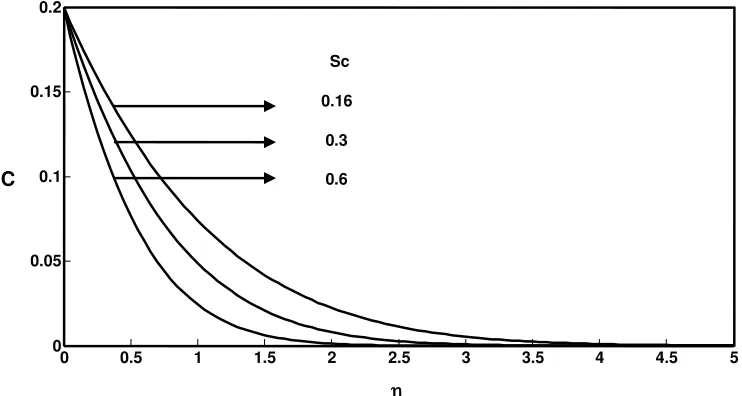
Copyright to IJIRSET www.ijirset.com 5676 Figure 2 represents the effect of concentration profiles at time t = 0.2 for different Schmidt number (Sc = 0.16, 0.3, 0.6). The effect of concentration is important in concentration field. The profiles have the common feature that the concentration decreases in a monotone fashion from the surface to a zero value far away in the free stream. It is observed that the wall concentration increases with decreasing values of the Schmidt number.
0 0.5 1 1.5 2 2.5 3 3.5 4 4.5 5
0 0.05 0.1 0.15 0.2
Figure 2 Concentration Profiles for different Sc Sc
0.16
0.3
0.6
Copyright to IJIRSET www.ijirset.com 5677 Figure 3. demonstrates the effects of different thermal Grashof number (Gr =2, 5), mass Grashof number (Gc = 2, 5), M = 5, Ω = 0.5 and Pr = 7, on the primary velocity at time t = 0.4. It is observed that the velocity increases with increasing values of the thermal Grashof number or mass Grashof number.
Copyright to IJIRSET www.ijirset.com 5678 magnetic field parameter (M=0,5,10) are presented in figure 5. The trend is just reversed with respect to magnetic field
parameter
The secondary velocity profiles for different rotation parameter (Ω = 0.5, 1), Gr = Gc = 5, Pr = 7, M = 10 and t = 0.4 are shown in figure 6. It is observed that the velocity increases with decreasing values of the rotation parameter. The secondary velocity profiles for different thermal Grashof number (Gr = 2, 5), mass Grashof number (Gc = 2, 5), Ω = 0.5, M = 5, Pr = 7
0 0.5 1 1.5 2 2.5
-0.04 -0.035 -0.03 -0.025 -0.02 -0.015 -0.01 -0.005 0 0.005
V 5
0
Figure 5 Secondary Velocity Profiles for different M 10
Copyright to IJIRSET www.ijirset.com 5679 and t = 0.4 are presented in figure 7. The trend shows that the velocity increases with increasing values of thermal Grashof number or mass Grashof number.
0 0.5 1 1.5 2 2.5
-16 -14 -12 -10
-8 -6 -4 -2 0 2x10⁻³
V
Figure 7 Secondary Velocity Profiles for different Gr and Gc Gr Gc
2 2
2 5
5 5
0 0.5 1 1.5 2 2.5
-16 -14 -12 -10 -8
-6 -4 -2 0 2x10 -3
V
0.5
1
Copyright to IJIRSET www.ijirset.com 5680 IV. CONCLUSION
The closed form solution of rotation effects on unsteady hydromagnetic flow past a uniformly accelerated infinite vertical plate in the presence of variable temperature and mass diffusion has been studied. The effect of different parameters like thermal Grashof number, mass Grashof number and t are studied graphically. It is observed that the velocity increases with increasing values of Gr, Gc and t. But the trend is just reversed with respect to the rotation parameter or magnetic field parameter M.
REFERENCES
[1] Basanth Kumar Jha, Ravindra Prasad, “Free convection and mass transfer effects on the flow past an accelerated vertical plate with heat sources”, Mechanics Research Communications Vol.17, pp.143-148, 1990.
[2] Gupta AS, Pop I, Soundalgekar VM, “Free convection effects on the flow past an accelerated vertical plate in an incompressible dissipative fluid”, Rev. Roum. Sci. Techn.-Mec. Apl. Vol.24, pp.561-568, 1979.
[3] Kafousias NG, Raptis A, “Mass transfer and free convection effects on the flow past an accelerated vertical infinite plate with variable suction or injection”, Rev. Roum. Sci. Techn.-Mec. Apl. Vol.26, pp.11-22, 1981.
[4] Muthucumarswamy R, Tina Lal, Ranganayakulu D, “Effects of rotation on MHD flow past an accelerated isothermal vertical plate with heat and mass transfer”, Theoretical Applied Mechanics, Vol.37, pp. 189-202, 2010.
[5] Raptis A, Singh A K, “MHD free convection flow past an accelerated vertical plate”, Letters in Heat and Mass Transfer. Vol.8, pp.137-143, 1981.
[6] Raptis A, Singh AK,. “Rotation effects on MHD free convection flow past an accelerated vertical plate”, Mechanics Research Communications, Vol.12, pp.31-40, 1985.
[7] Raptis A, Tzivanidis G J, Peridikis C P, “Hydromagnetic free convection flow past an accelerated vertical infinite plate with variable suction and heat flux”, Letters in heat and mass transfer, Vol.8, pp.137-143, 1981.
[8] Singh AK, Singh J, “Mass transfer effects on the flow past an accelerated vertical plate with constant heat flux”, Astrophysics and Space Science, Vol.97, pp.57-61, 1983.
[9] Singh AK, “Hydromagnetic free-convection flow past an impulsively started vertical plate in a rotating fluid”, International Communications in Heat and Mass transfer, Vol.11, pp.399-406, 1984.
Copyright to IJIRSET www.ijirset.com 5681
Dr R Muthucumaraswamy, received his B.Sc. degree in Mathematics, from Gurunanank College, University of Madras in 1985, M.Sc. degree in Applied Mathematics from Madras Institute of Technology, Anna University in 1987, M.Phil. degree in Mathematics from
Pachaiyappas’ College, University of Madras in
1991 and Ph.D. degree in Mathematics from
Anna University in 2001. His area of
specialization in Theoretical and Computational Fluid Dynamics. He published 180 papers in
National/International journals and in
conferences. He completed two funded projects from Defence Research and Developmental Organization in 2009 and 2012. He received best teacher award in the year 2001. Currently, working as a Professor and Head, Department of Applied Mathematics, Sri Venkateswara College of Engineering, Sriperumbudur, India.
Ms Tina Lal, received his B.Sc. degree in Mathematics from Ethiraj College for women, University of Madras in the year 1999, M.Sc. degree in Mathematics from Stella Maris College, University of Madras in 2001 and M.Phil. degree in Mathematics, from Anna University 2002. She is She served in Sri Venkateswara College of Engineering from 2002 to 2012. Currently, she is working in Central Polytechnic, Chennai.
Her area of specialization is theoretical fluid dynamics, in particular heat and mass transfer studies in rotating fluid. She published three research papers in reputed international journals.
Dr D. Ranganayakulu, received his B.Sc. degree in Mathematics, from University of Madras in 1979, M.Sc. degree in Mathematics from Sri Venkateswara University, Tirupathi, in 1981, M.Phil. degree in Mathematics from Presidency College in 2000 and Ph.D. degree in Mathematics from Madras Christian College in 2004. His area of specialization is Theoretical Computer Science, Graph Theory and Fluid
Dynamics. He published 15 papers in
National/International journals and in