Volume 2010, Article ID 893184,13pages doi:10.1155/2010/893184
Research Article
VLSI Implementation of a Fixed-Complexity Soft-Output MIMO
Detector for High-Speed Wireless
Di Wu (EURASIP Member),
1, 2Johan Eilert,
1, 2Rizwan Asghar,
1and Dake Liu
11Department of Electrical Engineering, Link¨oping University, 58183 Link¨oping, Sweden
2ST-Ericsson AT AB, Lund, Sweden
Correspondence should be addressed to Di Wu,[email protected]
Received 30 September 2009; Revised 17 May 2010; Accepted 23 June 2010
Academic Editor: Tas¸kin Kocak
Copyright © 2010 Di Wu et al. This is an open access article distributed under the Creative Commons Attribution License, which permits unrestricted use, distribution, and reproduction in any medium, provided the original work is properly cited.
This paper presents a low-complexity MIMO symbol detector with close-Maximum a posteriori performance for the emerging multiantenna enhanced high-speed wireless communications. The VLSI implementation is based on a novel MIMO detection algorithm called Modified Fixed-Complexity Soft-Output (MFCSO) detection, which achieves a good trade-off between performance and implementation cost compared to the referenced prior art. By including a microcode-controlled channel preprocessing unit and a pipelined detection unit, it is flexible enough to cover several different standards and transmission schemes. The flexibility allows adaptive detection to minimize power consumption without degradation in throughput. The VLSI implementation of the detector is presented to show that real-time MIMO symbol detection of 20 MHz bandwidth 3GPP LTE and 10 MHz WiMAX downlink physical channel is achievable at reasonable silicon cost.
1. Introduction
Multi-antenna or multi-in and multiout (MIMO) tech-nologies have been widely adopted by the latest wireless standards such as 3GPP LTE and WiMAX to enhance the spectrum efficiency. For MIMO systems, a major challenge is the symbol detection at the receiver. In particular, as channel coding (e.g., Turbo) is used, soft output (the log-likelihood ratio, LLR) must be computed as the input to the channel decoder. Consider a MIMO system with nTX
transmit antennas and nRX receive antennas. Let s be a
transmitted vector of lengthnTX, obtained by mapping a set
of information bits onto anM-QAM constellationL. Then the received vector of lengthnRXis given by
r=Hs+n, (1)
where H is an nRX ×nTX complex-valued channel matrix
which is assumed to be known.sis the transmitted symbol vector.nis noise vector andr is the received symbol vector.
The optimum soft detector is Maximum-A-Posteriori (MAP) detector which computes
L(bi|r)=log
⎛ ⎝
s:bi(s)=1exp
−1/σ2r−Hs2
s:bi(s)=0exp
−1/σ2r−Hs2
⎞ ⎠. (2)
Here “s:bi(s)=β” means allsfor which theith bit ofsis
equal toβ. Computing (2) requires enumeration of the entire set of possible transmitted vectors. The complexity of doing this is usually not affordable in practice.
As a trade-off between performance and complexity, various MIMO detection methods such as sphere decoding [1,2], fixed complexity sphere decoding [3,4], and MFCSO decoding [5] have been proposed to reach near-MAP performance with lower complexity than MAP. In [6], VLSI implementation of a complexity reduced K-best detector for 2×2 MIMO and 16-QAM is presented for WiMAX/WiFi. In [7], VLSI implementation of a soft-output MIMO detector
for 2 × 2 MIMO in WLAN is presented. Without QR
Sync
Figure1: Functional flow of a 3GPP LTE/WiMAX receiver.
Layer
(a) Spatial multiplexing (SM), nTX=2.
Layer
(b) Space-frequency block coding (SFBC), nTX=2. Figure2: Downlink multi-antenna transmission schemes.
4×4 MIMO is implemented in a Xilinx Virtex-5 FPGA. How-ever, the complexity of sphere decoding grows exponentially with the number of transmit antennas and polynomially in the size of the signal constellation. More importantly, the tree search used in sphere decoding is in principle a sequential procedure which is difficult to parallelize. In [3], a fixed-throughput sphere detector is proposed with fixed complexity and parallelism for hard decision. In [5], a low-complexity near-MAP detection method is proposed for high-order modulation (e.g., 64-QAM). The performance loss from MAP due to the suboptimal search introduced in MFCSO is proven by simulation to be small in [5]. However, in [5], the complexity of MFCSO is only presented in number of arithmetic operations without the silicon cost and processing latency being addressed and no comparison with prior art is made. Most importantly, none of these methods proposed have taken the system specific features of LTE (e.g., OFDMA and H-ARQ) into consideration and are mostly based on very simple channel models (e.g., AWGN). In [9], limited evaluation of MFCSO is carried out with a focus on LTE system.
In this paper, with the aid of more realistic LTE and WiMAX simulation chains and different channel models,
several MIMO detection algorithms are applied to LTE and WiMAX systems and with their performance quantitatively evaluated. Second, although the MFCSO detection algorithm proposed by the authors in [5] has a very low detection com-plexity, under random AWGN channels, it requires relatively strong channel coding to maintain a near-MAP performance in frame error ratio [5]. In this paper, its performance with the aid of H-ARQ is investigated. In order to validate MFCSO from VLSI implementation perspectives, both FPGA and ASIC implementation of an MFCSO detector is presented. Note that most commercial terminals are limited by cost and power consumption, especially the power consumption of the analog part of each antenna chain. According to the LTE
and WiMAX standards, 4×2 and 2×2 MIMO schemes
are included as a good trade-offbetween performance gain and complexity (or power consumption). Hence, only these schemes are considered in here. The result is compared with a state-of-the-art soft-output sphere decoding (SSD) [1] and the K-best detector presented in [10] from both performance and cost aspects.
The remainder of the paper is organized as follows. In
Section 2, the application of MIMO techniques in LTE and WiMAX is presented. Section 3 introduces the linear and MFCSO MIMO detection algorithms. Section 4 addresses the detection flow. The architecture of the detector is addressed in Section 5. The link-level simulation results are presented in Section 6. Section 7 analyzes the imple-mentation complexity, and Section 8 presents the adap-tive method used to optimize power efficiency. Section 9
presents both the FPGA-and ASIC-based implementa-tion of the detector. Finally, Section 10 concludes the paper.
2. MultiAntenna in LTE and WiMAX
Wireless standards such as 3GPP LTE and WiMAX have incorporated MIMO transmission schemes to boost the peak data rate. Meanwhile, software-defined radio (SDR) technologies allow both of them to be supported by the same piece of hardware.
Channel preprocessing MMSE:W=(HHH+σ2I)−1HH
MFCSO: QR decompositionH1,H2
LLR demapping
Figure3: Task flow of soft-output MIMO detection.
Frequency Division Multiple Access (OFDMA) as the mul-tiple access scheme in downlink. MIMO technologies are also mandatory in LTE to achieve the LTE bit-rate targets (e.g 100 Mbit/s peak data rate for downlink). As part of the receiver chain depicted inFigure 1, MIMO symbol detection is a significant challenge for VLSI implementation.
The input to the MIMO detector presented in this paper includes the estimated channel matrix
H= h11 h12
h21 h22
, (3)
the received symbol vector r, and the estimated noise varianceσ2. The output of the detector is the LLR values of
the demodulated bits.
In both LTE and WiMAX, spatial multiplexing (SM) and transmit diversity have been adopted as the two major MIMO schemes. SM is a MIMO technique aimed at maximizing the data throughput by exploiting the degrees of freedom in MIMO channels. Since the multiplexing gain is only available for high SNR region, spatial multiplexing is usually used when high SNR is available. STBC/SFBC [11] assumes the channel is stationary among adjacent time intervals or subcarriers so that a single codeword is mapped to these adjacent intervals or subcarriers to benefit from either time or frequency diversity in transmission. The most widely used STBC/SFBC scheme is Alamouti scheme in space or frequency domain. Since STBC/SFBC only requires a linear detector to achieve diversity, the detector design is easier. Note that in this paper, only open-loop MIMO is considered without feedback from the terminal.
2.1. Spatial Multiplexing. Spatial multiplexing is a MIMO technique aimed at maximizing the data throughput by
exploiting the degrees of freedom in MIMO channels. Since the multiplexing gain is only available in high SNR region, spatial multiplexing is usually used when high SNR is available. As depicted in Figure 2(a), spatial multiplexing usually requires bothnRX andnTX to be large. In general,
the degree of freedom (multiplexing gain) is determined by min(nTX,nRX) which is the rank of the channel matrix
H. In case H is badly conditioned (e.g. when line-of-sight occurs,H becomes a singular matrix), the pseudoinversion of H in (15) using linear detection will be very difficult which requires very large dynamic range. In other words, the gain of spatial multiplexing heavily depends on the multipath fading. A dual-stream spatial multiplexing scheme is depicted inFigure 2(a).
2.2. Transmit Diversity. Transmit diversity schemes that exploit the diversity gain of multi-antenna transmission have also been adopted by LTE and WiMAX. The Space-Time Block Coding (STBC) in WiMAX and Space-Frequency Block Coding (SFBC) in LTE [11] are both transmit diversity schemes to transmit data for guaranteed diversity while requiring only a low-complexity symbol detector on the receiver side. In both cases, the Alamouti matrix [12] is used because it is the only full-rate linear STBC (or SFBC) code with a diversity gain of 2. In other words, the transmit diversity schemes considered in this paper are Alamouti schemes in the space and frequency domains. This assumes the channels of either adjacent symbol intervals or subcarriers are identical, so that either time or frequency diversity will be achieved when a single codeword is mapped to different antennas within two adjacent time or frequency intervals. The basic 4×2 space-frequency channel matrix is defined as
3. Soft-Output MIMO Detection
The optimum soft-output MIMO detector computes the Log-Likelihood Ratio (LLR) in (2). Commonly the sums in (2) are approximated by their largest terms (“log-max”) which requires the solution of problems of the type minr −Hs2, subject to s ∈ L. Since MAP provides
the best theoretical performance, it is commonly used as a benchmark when comparing other algorithms
Channel
pr
epr
o
ce
ssing
unit
Control interface H
y
PE
PE
L(bi k)
Coefficient memory
Q R
W
Program
memory Detectionunit . . .
Figure4: Block diagram of the dual-mode MIMO detector.
3.1. Linear Detection. In linear detection such as Zero-forcing (ZF) and Minimum Mean Squared Error (MMSE), the receiver symbol vectorris multiplied with a linear filter:
ZF :s=HHH−1HHr=s+n
ZF, (6)
MMSE :s=HHH+σ2I−1HHr=s+n
MMSE. (7)
The correlation between the elements in the noise vector
n... is neglected and the symbols in s are demodulate
individually, treating the output of the model (6) as nTX
independent scalar channels. Although linear detectors will incur a severe performance loss in slow fading channels [4], they have very low implementation cost compared to more advanced MIMO detection algorithms which makes them suitable for low-cost real-time implementations. As depicted inFigure 3, the linear detection procedure involves two parts: channel preprocessing and symbol demapping. The channel preprocessing procedure mainly consists of matrix multiplication and inversion as shown in (6) and (7).
3.2. Fixed-Complexity Soft Output (FCSO). The Layered Orthogonal Lattice Detector (LORD) proposed in [13] and the FCSO MIMO detector presented in [4] are similar and use a suboptimal method to reduce the complexity at the cost of negligible performance loss. A generalnTX×nRX MIMO
system using 64-QAM is taken as a case study. Here each complex-valued symbol is considered to be one layer and only the top layer is exactly marginalized with the remaining three layers approximately marginalized. The channel-rate processing of FCSO involves the QRD ofnTX rank-reduced
channel matrices
Hk=
h1,. . .,hk−1,hk+1,. . .,hnTX
, (8)
which generates an upper triangular matrixRk, and a unitary
matrixQkso that
Hk=QkRk. (9)
HerenTXQRD is needed for differentHk.
μ
Cc
o
n
tr
o
l
RF
CMAC CMAC 1/x
Figure5: Channel preprocessing unit.
The symbol-rate processing consists of the following steps.
(1) Pick one transmitted symbol si,i ∈ (1,. . .,nTX) as
the top layer. The entire constellationL is enumerated in the exact marginalization (in (5)) only forsi. For thekth
candidate ski in L, by canceling its effect on the received
symbol vectorr, a new vector
r=r−hiski (10)
is computed.
(2) By multiplyingrwithQH
k from (9), compute
r=QH
kr. (11)
(3) Based on r andR, using DFE,sb = [s2s3· · ·snTX]
T
can be estimated using hard decision. From this, compute the Euclidean distance
δk=r−Rksb2 (12)
and eventually the log-likelihood ratio (LLR). Taking a 64-QAM system as an example, as shown in the following:
μ(b1,. . .,b24)=exp
−1 σ2δk
(13)
Fro
Figure6: PE in detection unit.
L(bir)≈log
3.3. Modified FCSO (MFCSO). Although the FCSO detector has substantially reduced the complexity compared to MAP detector, further reduction is still needed for a practical implementation with large signal constellations. In the following, further approximations and improvements to FCSO detection, namely Modified FCSO (MFCSO) detector [5], are elaborated. In [4], the entire constellation L is enumerated in the exact marginalization ( in (5)). In this paper, instead of searching the full constellation L,
we propose to sum over only a subset Ls ⊂ L of
constellation points around an initial estimates. This initial estimate will be obtained by zero-forcing detection. The size of Ls, denoted by N, is chosen to be 16 and 8 in this
paper for the complexity and performance comparisons. In effect, the proposed detector is a further approximation of that in [4], which consists of only partially enumerating the symbols selected for exact marginalization (the set Lin (5)).
Similar to FCSO, the channel-rate processing of MFCSO involves computing QRDnTXtimes, as shown in (9) and (8).
As an overhead compared to FCSO, the coefficient matrix
W=HHH+σ2I−1HH (15)
is needed to perform the ZF/MMSE-based initial estimate of
sin (16) below. The symbol-rate processing of MFCSO is the following
(1) Linear detection (ZF/MMSE) is carried out to estimate the initial symbol vector
s=min
sk∈L
Hs−r2
. (16)
Heresis the transmitted symbol vector,skis thekth symbol
in it.
(2) For each initially estimated symbol sk,k ∈ {1,. . .,nTX}, a candidate setLk is created. Lk contains N
lattice points close tosk.
(3) For each pointl∈Lk, approximate marginalization
is applied to the rest of the layers either via ZF or ZF-DFE. According to (17), a multiplication ofQHk andris needed for eachrwhich is updated proportionally to the size ofLkand
the symbol rate. However, note that
34 BLER of the 1st retransmission of H-ARQ.
(4) Using back substitution [14], sb can be estimated
ted symbol vector which has an Euclidean distance
δl=Rksb−r2. (19)
(6) In total, there will beNdifferentl∈Lvalues for each layer, and there will be four layers each being the top layer once. Therefore, for a 4×4 system, 4Ndifferentδlvalues need
to be computed. In caseN=16, there will be 64 differentδl
values which is 1/4 compared to the FCSO proposed in [4]. (7) For the sake of low complexity, instead of MAP detection, the following approximation can be used, so that
L(bi(sk))≈ −
As presented in [5], the performance gap between MAP
and MFCSO for 4 × 4 MIMO using 64-QAM and 3/4
convolutional coding was proven to be small whenN =16 (0.5 dB when FER=10−2). The gap increases to 2 dB when
N = 8. On the other hand, the complexity of the detector whenN=16 is already feasible for VLSI implementation.
3.4. MFCSO in LTE and WiMAX. As a simplification of the general MFCSO algorithm presented in Section 3.3,
a 2 × 2 MFCSO method for SM is elaborated in the
following. Considering each complex-valued symbol as one layer, only one of them is exactly marginalized and the other
is approximately marginalized (using DFE hard decision). The channel rate processing of MFCSO involves the QR decomposition (QRD) of two 2×2 channel matrices which areH1=Hin (3) and
H2= hh12 h11
22 h21
. (21)
The QRD generates an upper triangular matrix R, and a unitary matrixQaccording to (9).
The detection procedure for 2×2 SM described in the following text is slightly different from the MFCSO presented in [5].
(1) Linear detection in (16) is carried out to estimate the 2×1 initial symbol vector
sinit= min
sinit,k∈L
H1s−r2. (22)
Heresis the transmitted symbol vector, within which,sk is
thekth symbol.
(2) For each initially estimated symbolsinit,k,k∈ {1, 2},
a candidate setLk is created. Lk containsN constellation
points close tosinit,k.
(3) Firsts2is chosen as the top-layer symbol. In order to
perform DFE,
r=QH1. (23)
needs to be computed. The same operation is needed once again whens1is chosen as the top layer later.
(4)For thenthconstellation pointζ
n∈L2, its effect onr1
will have to be canceled out.
r1=r1−R1(1, 2)ζn (24)
Based onζn, the partial Euclidean distance
δn=R1(2, 2)ζn−r22 (25)
computed for the top-layer.
(5) DFE is applied to detect the other layer. Using back substitution [14],s1can be estimated from
complete possible transmitted symbol vectors, from which an accumulated full Euclidean distance
δn=δn+R1(1, 1)s1−r12 (27)
can be computed.
(7) In total, there will beNdifferentδncomputed when s2 is chosen as the top layer. Thens1is chosen as the
top-layer symbol as well. Based on Q2,R2, and sinit,1, the same
procedure needs to be done once again to compute another
Ndifferentδn. Hence, for the 2×2 system, 2N differentδn
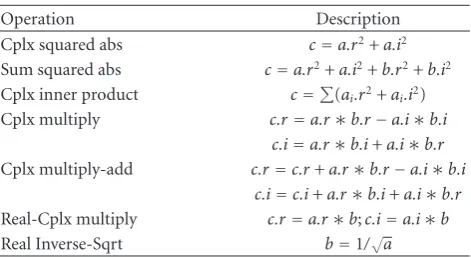
Table1: Operations supported by ChPU.
Operation Description
Cplx squared abs c=a.r2+a.i2 Sum squared abs c=a.r2+a.i2+b.r2+b.i2 Cplx inner product c=(ai.r2+ai.i2) Cplx multiply c.r=a.r∗b.r−a.i∗b.i
c.i=a.r∗b.i+a.i∗b.r
Cplx multiply-add c.r=c.r+a.r∗b.r−a.i∗b.i
c.i=c.i+a.r∗b.i+a.i∗b.r
Real-Cplx multiply c.r=a.r∗b;c.i=a.i∗b
Real Inverse-Sqrt b=1/√a
4. Flow Analysis of MIMO Detection
Independent of the detection method, the processing flow of MIMO symbol detection can always be partitioned into two parts, namely channel-rate processing and symbol-rate processing as depicted inFigure 3.
4.1. Channel-Rate Preprocessing. The channel preprocess-ing is about the precalculation of equalization coefficient matrices from the estimated channel matrixH. According to (15)), the computation involved in linear detection is mainly matrix manipulation including matrix multiplication
and inversion. Here the matrix H can be a
complex-valued matrix of arbitrary size. As mentioned in [15], in practice, the size ofHis typically between 2×2 and 4×4. Although larger matrices (e.g., 8×8) can still be managed [15], the cost of real-time implementation will be much higher. For MFCSO, channel-rate processing includes the QR decomposition in (9). For MFCSO, aside from computingW, QR decomposition is also needed according to (9).
4.2. Symbol-Rate Processing. The symbol-rate processing in soft-output linear detection [16] is to demap the equalized complex values to soft bits. In case of near-MAP detection methods such as MFCSO, layered processing is involved which requires substantially more computational effort. As described in Section 3.3, the symbol-rate processing in MFCSO involves the multiplication, subtraction, and com-puting the Euclidean distance based on estimated symbols.
5. Architecture of the MIMO Detector
The block diagram of the MFCSO detector is depicted in
Figure 4. The detector contains two major parts, the channel preprocessing unit (ChPU) and the detection unit (DU). As presented in Section 3.3 and [5], it is decided that the candidate set sizeN = 16 for 64-QAM. It allows real-time detection of both 2×2 STBC/SFBC and SM for LTE and WiMAX. Modulation schemes from QPSK to 64-QAM are supported.
5.1. Channel Preprocessing Unit. The ChPU as depicted in Figure 5 handles channel-rate processing tasks such as
computation of W in (15) and the QR decomposition in (9). These are performed every time the estimated channel is updated. The computed coefficient matrices W will be stored in the coefficient buffer and fed to the LLR demapper as input. As depicted in Figure 5, ChPU contains two Complex-valued Multiply-and-ACcumulate (CMAC), an inverse-square-root unit and a 32-bit register file containing 24 registers. The ChPU is a programmable unit controlled by microcode. The operations supported by the ChPU are listed inTable 1. The method presented in [16] has been used to computeW, and the Modified Gram-Schmidt method [14] is used to computeQandRmatrices in (9).
5.2. Detection Unit. The DU computes the LLR values using the method presented inSection 3and the Log-Max approximation in (20)
Lbik
= −1 σ2
min l∈Lk:bi
k=0
δ− min l∈Lk:bik=1δ
. (28)
The DU consists of a number of processing elements (PE) as illustrated inFigure 6which can utilize the parallelism in the MFCSO algorithm. The computed LLR valuesL(bik) can
be either directly passed to the channel decoder or combined with previously stored LLR values in the soft-buffer for H-ARQ. Since the processing in DU is at symbol rate which is much higher than the channel-rate processing in ChPU, a fully pipelined architecture is used in DU to allow the computation of 16 differentδnin (27) to be finished within
16 clock cycles. DU is configured by a control register and can bypass the functions defined inSection 3to only enable MMSE detection with soft output. The MMSE mode can be used in power saving mode to reduce the power consumption with a loss of detection performance. A 16-bit fixed-point datatype with proper scaling is adopted in DU, the output LLR values are quantized to be 6-bit signed integers. The number of PE in the DU is decided at design time according to the processing load and latency analysis. In this paper, it is chosen to be two based on the latency analysis in
Section 9.3.
34
Figure8: LTE coded frame Error rate (rate 0.926, 64-QAM).
34
Figure9: LTE coded throughput (rate 0.926, 64-QAM).
6. Performance Evaluation
In order to evaluate the performance of various MIMO detection algorithms, simulation is carried out using link-level 3GPP LTE and WiMAX simulators [17, 18]. The simulators are developed using MATLAB and C.
It includes the complete physical layer signal processing such as timing/frequency synchronization, channel esti-mation, subcarrier demapping, rate-matching, and turbo decoding. H-ARQ based on CRC of coded blocks is also enabled to support chase combine (CC) with up to three retransmissions. The bandwidth is set to be 5MHz in the simulation, the velocity of UE is 3 km/h and the scenario is urban micro [19]. Perfect synchronization and channel estimation are assumed to focus the simulation on detection
30 Uncoded (CQI=15) 0
Figure10: Throughput (2×2 SFBC, MMSE).
30
Figure11: Block error ratio (2×2 SFBC, MMSE).
performance. The Turbo decoder runs at most six iterations with early stopping. The WiMAX simulator [17] also works on 5MHz bandwidth. Two channel coding methods used in the simulation are Reed-Solomon with Convolutional (RS-Conv) and Low-Density Parity-Check (LDPC) coding. Two channel models namely the 3GPP SCME [19] and ITU Pedestrian B (PedB) [17] channel models are used in this paper. It is assumed the channel is quasistatic within one OFDM symbol duration. Note that the 1-TTI latency is introduced for uplink ACK/NACK in the simulation.
35 Coded throughput (2×2 SM MFCSO) Coded throughput (2×2 SM MMSE) Coded throughput (2×2 SFBC MMSE) 0
Figure12: Coded throughput with 2-level AMC (CQI 15 and 9).
35
Figure13: WiMAX coded frame error rate (rate 0.75, 64-QAM).
methods. The blue curves are the BLER of the first transmission while the red ones represent that of the first retransmission in H-ARQ. The figure shows that the BLER of the retransmission is drastically reduced compared to the first transmission which improves the throughput as shown later.
The result in Figures8and9shows that in case of 64-QAM and the weakest (rate 0.926) channel coding defined in LTE is used, for 2×2 SM, the FER performance of MAP is always better than that of MFCSO and K-best. MFCSO achieves lower FER than theK-best (K =16) used in [10] until very high SNR. MMSE has the worst FER performance.
35
Figure14: WiMAX coded throughput (rate 0.75, 64-QAM).
34 MFCSO Det, LS channel Est SSD Det, LS channel Est MAP Det, LS channel Est MFCSO Det, Perf channel Est SSD Det, Perf channel Est MAP Det, Perf channel Est 10−3
10−2 10−1 100
BLER
BLER, 5 MHz, open-loop MIMO, PedB, 5000 subframes
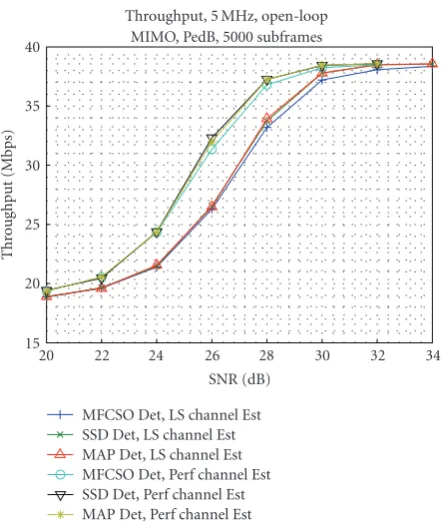
Figure15: LTE bLock error rate with H-ARQ (CQI=14), PedB.
34 32 30 28 26 24 22 20
SNR (dB) MFCSO Det, LS channel Est SSD Det, LS channel Est MAP Det, LS channel Est MFCSO Det, Perf channel Est SSD Det, Perf channel Est MAP Det, Perf channel Est 15
20 25 30 35 40
Thr
o
ug
hpu
t
(Mbps)
Throughput, 5 MHz, open-loop MIMO, PedB, 5000 subframes
Figure16: LTE throughput with H-ARQ (CQI=14), PedB.
Table2: Minimum SNR to reach FER=0.01.
CQI SFBC (MMSE) SM (MFCSO) SM (MMSE)
9 10 dB 17 dB 24 dB
15 24 dB 36 dB N/A
throughput in comparison to that of FER mainly owes to the H-ARQ retransmission with chase combining. The result shows that even with a sub optimal detector (with much lower complexity than the optimal detector) and almost no channel coding, a throughput that is close to the one achievable by MAP detectors can still be reached when H-ARQ is used. The throughput gain of MFCSO over the K-best is as significant as 5 Mbits/s (14%), when SNR is 26 dB.
Figures 10 and11 show the BLER and throughput of 2 × 2 SFBC with two different CQI values (9 and 15). The simulation shows that SFBC reaches FER = 0.01 at much lower SNR than SM as depicted inTable 2, though the throughput is half.
Figure 12depicts the achievable throughput using two-level adaptive modulation and coding (AMC). The result shows that when SNR is worse than 10 dB, SFBC achieves both higher throughput and lower BLER than SM even if MAP detector is used.
6.2. WiMAX. The result in Figures 13 and 14 shows that when mild channel coding (e.g., RS-Conv 3/4) is used without H-ARQ in the WiMAX system, MFCSO still achieves near-MAP performance in FER and MAP performance in throughput. It has a gain of more than 9 dB compared to the MMSE detector. The use of stronger code (e.g. LDPC) will bring a gain of 4 dB in throughput compared
to RS-Conv. This shows that MFCSO has a very promising performance/complexity trade-off taking the advance of channel coding into consideration. The result also shows that once FER reaches 0.01, any further improvement of FER gives only negligible increase in throughput.
6.3. Impact of Channel Estimation Error. In most of the literatures [1,3,5], perfect channel state information (CSI) is assumed which is never true in reality. In [4], channel estimation error is emulated with a randomly generated error constrained by the value of its average power, and the affected FER is plotted. However, how the channel estimation error affects the link-level performance of MIMO detection with the presence of H-ARQ has not been studied according to the best knowledge of the authors. In this paper, based on the least square (LS) channel estimation, the impact of channel estimation error on link-level performance is investigated, which provides a realistic measurement of the achievable performance of the MFCSO detector in a practical
system. In this paper, an LTE system with CQI = 14
(coding rate 0.8547, 64-QAM) and open-loop 2×2 MIMO scheme is simulated using PedB channel. For comparison purposes, the MFCSO detector is benchmarked against the soft-output sphere decoding (SSD) in [1] and the MAP detector. However, note that no complexity reduction of SSD as used in [1] is applied in this paper, thus, the SSD performance reaches the upper bound. As depicted in Figure 15 and 16, regardless of the channel estimation error, SSD always achieves the same BLER and throughput performance as MAP detection. InFigure 15, the slope of the BLER curve of MFCSO will decrease when SNR reaches 28 dB. Considered from traditional point of view, the BLER performance of MFCSO is significantly worse than SSD and MAP (more than 2 dB). However, as shown inFigure 16, the throughput performance of MFCSO is only negligibly lower (0.3 dB) than that of SSD and MAP. This further proves that MFCSO has a better performance/complexity trade-offwhen taking system-level impact into consideration.Figure 16also shows the throughput gap between the case assuming perfect CSI and the one with realistic LS estimated CSI is 1.5 dB in the active region for CQI = 14. In principle, channel estimation error will only cause the throughput curve to shift right by 1.5 dB.
7. Implementation Considerations
In LTE [11], taking a 5 MHz bandwidth LTE system as an example, up to 7 OFDM symbols need to be processed within one slot (0.5 ms) which contain 1900 data subcarriers. This means that there will be no more than 0.26μsto finish the detection of each subcarrier on average. Therefore, proper detection methods have to be chosen in order to maximize the data rate at reasonable implementation cost.
Table3: Complexity analysis for ASIC implementation (65 nm).
MMSE MFCSO FCSO MAP
Num nodes 16-QAM 1 18 32 256
64-QAM 1 32 128 4096
Logic (mm2) 64-QAM 0.08 0.2 0.6 20
Coefficient memory
Data memory
Channel preprocessing unit
Detection unit
Figure17: Layout of the MIMO Detector.
search of a number of trellis nodes as depicted inTable 3. The FCSO detector always visits the complete constellation (e.g., 16 for 16-QAM and 64 for 64-QAM), while MFCSO only visits a subset of it (e.g., 9 for 16-QAM and 16 for 64-QAM). Note that MFCSO requires MMSE detection to compute the initial estimate (22) which is an extra cost compared to FCSO. To the knowledge of the author, SSD with complexity reduction [1] has a similar complexity compared to FCSO, which is not analyzed in this paper due to the limited space.
In practice, the hardware is usually implemented taking both the cost and performance issues into consideration. Based on the complexity analysis in Table 6 and the per-formance analysis inSection 6, MFCSO falls into the favor of the authors to be chosen as the target algorithm for ASIC implementation. Using ST 65 nm CMOS process, while meeting the 0.26μs constraint, the implemented detector supporting both MMSE and MFCSO for 2×2 SM and up to 64-QAM modulation occupies less than 0.2 mm2as proven
later.
8. Adaptive Transmission and Detection
As depicted in Table 3, a detector supporting dual-mode MFCSO/MMSE detection consumes 2.5 times the area of the one only supporting MMSE. Hence, the former one is assumed to target high-end users willing to pay more in area and power for performance (e.g., laptops). The MMSE single-mode detector is in favor of low-end users for connec-tivity with minimum cost (e.g., smartphones). Note that the user cares about latency as well as throughput, and latency is partly determined by the number of retransmissions. Hence, it is also important to keep the retransmissions to a minimum (which requires low FER). Figure 12shows that with AMC, SM using MFCSO detector always brings higher throughput when SNR is greater than 10 dB. For both types of users, when SNR is worse than 10 dB (as inFigure 12), SFBC is preferred instead of SM. For low-end users, SM can
Table4: Adaptive transmission and detection.
SNR range SFBC SM
High-end (MFCSO/MMSE) −2 dB → 10 dB ≥10 dB Low-end (MMSE only) −2 dB → 26 dB ≥26 dB
Table5: FPGA implementation result for real-time processing. This work Ref [10]
Algorithm MFCSO K-best LSD
Modulation supported up to 64-QAM
FPGA type Virtex2
Datatype fixed-point
Wordlength (bits) 16
Num of slices 4381 15662
Num of MULT18X18s 48 108
Block RAMs 3 61
Frequency (MHz) 85 70
Throughput for 64-QAM (Mbps) 67.5 6
be used when SNR ≥ 25 dB while SFBC is still preferable (due to the low FER thus fewer retransmissions resulting in low latency) to be used from 10 to 25 dB. For high-end users, SM is preferred when SNR is at least higher than 10 dB. On the other hand, the MMSE mode will consume substantiately lower power than the MFSCO mode, the high-end users might only want to switch to MFCSO-mode when there is enough battery power and high SNR (e.g.,≥25 dB). When SNR is very low, SFBC is also preferred due to its robustness (as depicted inFigure 12). The SNR ranges suggested for the mode switching of two types of detector hardware are shown inTable 4. The adaptive scheme brings power efficiency and can supply best-effort performance in an economic way.
9. Final VLSI Implementation
The implementation of our design is done in two steps. First, for fast prototype and to compare with the prior art in [10], the symbol detector is implemented using Xilinx FPGA. Second, ASIC flow including synthesis, floorplan, placement, and routing is carried out using ST 65 nm process libraries and Synopsys low-power design flow.
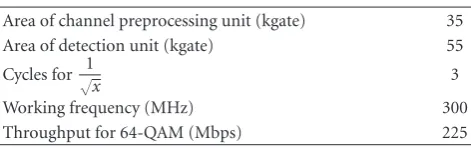
Table6: ASIC implementation result.
Area of channel preprocessing unit (kgate) 35
Area of detection unit (kgate) 55
Cycles for√1
x 3
Working frequency (MHz) 300
Throughput for 64-QAM (Mbps) 225
9.2. ASIC Implementation. Table 6 depicts the gate count, and working frequency of the ASIC implementation. In reality, the channel coefficients are updated less frequently than the received symbols, thus, they are saved in the coefficient memory which is not counted in [10]. In order to compare the area consumed by memory and the detector itself, a demo chip including a 172800 bit coefficient memory and a 19200 bit data memory for 5 MHz bandwidth is implemented using Cadence backend flow. As depicted in
Figure 17, the total area of the detector is 0.37 mm2with half
of it consumed by the actual logic (≈0.2 mm2) of the detector
and the other half by the memory. Note that the microcode memory is implemented as a piece of logic in the chip. The size of the memories depends on the number of subcarriers (or bandwidth) to be supported. TheK-best detector in [20] supports 4×4 MIMO and 100 Mbps data rate. As mentioned inSection 3.3, the complexity of MFCSO is proportional to
n2
RX. Hence, the area of the detection part for 4×4 will be
four times of the presented 2×2 solution. Compared to the 31 mm2figure of aK-best detector for 4×4 MIMO in
0.13-μm running at 270 MHz (which is 7.5 mm2without memory
in 65-nm according to CMOS scaling), the solution in this paper is 0.8 mm2without memory. Also note that [20] does
not include the channel preprocessing part which is expected to give a major contribution in area (it already consumes half of the area of this solution).
9.3. Processing Throughput. Taking the assumption made in [10], for LTE system with 5 MHz bandwidth, there will be at most 300 data subcarriers to be processed within one OFDM symbol duration which is 83μs. This requires the detection of each data subcarrier to be finished within 277ns. For the FPGA implementation which has a clock frequency of 90 MHz, this amount of time is equal to around 25 clock cycles. Note that the detector can process two subcarriers in parallel which means each subcarrier can be finished within 16 cycles. For 2×2 spatial multiplexing and 64-QAM (12 bits per subcarrier), this corresponds to (90/16)×12=67.5 Mbps processing throughput.
The ASIC implementation can easily run at a clock frequency of 300 MHz which means 1570 data subcarriers can be computed within 83μs. This corresponds to 225 Mbps processing throughput which allows real-time detection of 20 MHz bandwidth LTE downlink (containing up to 1200 data subcarriers) to be supported. Since the WiMAX 2004 [17] only uses 10 MHz bandwidth, it has a lower peak data rate than LTE, thus can be easily supported.
Note that the MFCSO detector can be switched to MMSE mode by poweringdown the major part of the DU. The
detection in SFBC/STBC transmission schemes is in fact MMSE detection which can be handled by the MMSE mode. Since the MMSE mode will consume substantially less power than the MFCSO mode, the detector is switched to MMSE mode when the terminal enters power-saving mode.
10. Conclusion
In this paper, the VLSI implementation of a fixed com-plexity near-MAP MIMO detector ASIC is presented for multistandard wireless terminals. It achieves near-MAP throughput during LTE simulations, even with a relatively weak channel code and with high-order modulation (e.g., CQI = 15). Furthermore, based on the adaptive scheme proposed inSection 8, a good performance and power trade-off can be achieved. In comparison to prior art such as theK-best solution in [10], the detector presented achieves better performance and lower silicon cost. The impact of realistic channel estimation on detection performance is also presented.
Acknowledgments
The work of D. Wu, J. Eilert, R. Asghar, and D. Liu is supported by the Multibase Project from European Commis-sion’s 7th Framework in partner with Ericsson AB, Infineon AG, IMEC, Lund University, and KU-Leuven. The authors would like to thank ST Microelectronics for supplying 65nm process, ProfessorErik G. Larsson for discussion on MIMO detection, and Christian Mehlf¨uhrer and the Christian Doppler Laboratory for Design Methodology of Signal Processing Algorithms at Vienna University of Technology, for contributions on the LTE simulation chain.
References
[1] C. Studer, M. Wenk, A. Burg, and H. B¨olcskei, “Soft-output sphere decoding: performance and implementation aspects,” inProceedings of the 40th Asilomar Conference on
Signals, Systems, and Computers (ACSSC ’06), pp. 2071–2076,
November 2006.
[2] M. Li, B. Bougard, W. Xu, D. Novo, L. Van Der Perre, and F. Catthoor, “Optimizing Near-ML MIMO detector for SDR baseband on parallel programmable architectures,” in
Proceedings of the Conference on Design, Automation and Test
in Europe (DATE ’08), pp. 444–449, March 2008.
[3] L. G. Barbero and J. S. Thompson, “Rapid prototyping of a fixed-throughput sphere decoder for MIMO systems,” in
Proceedings of the IEEE International Conference on
Commu-nications (ICC ’06), pp. 3082–3087, June 2006.
[4] E. G. Larsson and J. Jald´en, “Fixed-complexity soft MIMO detection via partial marginalization,”IEEE Transactions on
Signal Processing, vol. 56, no. 8, pp. 3397–3407, 2008.
[5] D. Wu, E. G. Larsson, and D. Liu, “Implementation aspects of fixed-complexity soft-output MIMO detection,” in Proceed-ings of the 69th IEEE Vehicular Technology Conference (VTC ’09), April 2009.
on Design, Automation and Test in Europe (DATE ’10), pp. 1637–1640, Dresden, Germany, March 2010.
[7] T. Cupaiuolo, et al., “Low-complexity high throughput VLSI architecture of soft-output ML MIMO detector,” in
Proceed-ings of the IEEE Dessign, Test and Automation in Europe,
Dresden, Germany, March 2010.
[8] K. Amiri, J. R. Cavallaro, C. Dick, and R. M. Rao, “A high throughput configurable SDR detector for multi-user MIMO wireless systems,”Journal of Signal Processing Systems. In press. [9] D. Wu, J. Eilert, and D. Liu, “Evaluation of MIMO symbol detectors for 3GPP LTE terminals,” in Proceedings of the
17th European Signal Processing Conference (EUSIPCO ’09),
Glasgow, Scotland, 2009.
[10] J. Ketonen and M. Juntti, “SIC and K-best LSD receiver implementation for a MIMO-OFDM system,” inProceedings of the 16th European Signal Processing Conference (EUSIPCO ’08), August 2008.
[11] 3GPP, “Evolved Universal Terrestrial Radio Access (EUTRA): physical channels and modulation,” Technical Specifications 36.211 V8.4.0, September 2008.
[12] S. M. Alamouti, “A simple transmit diversity technique for wireless communications,”IEEE Journal on Selected Areas in
Communications, vol. 16, no. 8, pp. 1451–1458, 1998.
[13] M. Siti and M. P. Fitz, “A novel soft-output layered orthogonal lattice detector for multiple antenna communications,” in
Proceedings of the IEEE International Conference on
Commu-nications (ICC ’06), pp. 1686–1691, June 2006.
[14] G. H. Golub and C. F. Van Loan,Matrix Computations, The Johns Hopkins University Press, Baltimore, Md, USA, 3rd edition, 1996.
[15] D. Wu, J. Eilert, D. Liu, D. Wang, N. Al-Dhahir, and H. Minn, “Fast complex valued matrix inversion for multi-user STBC-MIMO decoding,” inProceedings of the IEEE Computer Society Annual Symposium on VLSI: Emerging VLSI Technologies and
Architectures (ISVLSI ’07), pp. 325–330, March 2007.
[16] D. Wu, J. Eilert, and D. Liu, “Implementation of a high-speed MIMO soft-output symbol detector for software defined radio,”Journal of Signal Processing Systems. In press.
[17] C. Mehlf¨uhrer, S. Caban, and M. Rupp, “Experimental evaluation of adaptive modulation and coding in MIMO WiMAX with limited feedback,”EURASIP Journal on Advances
in Signal Processing, vol. 2008, Article ID 837102, 2008.
[18] C. Mehlf¨uhrer, M. Wrulich, J. C. Ikuno, D. Bosanska, and M. Rupp, “Simulating the long term evolution physical layer,” in
Proceedings of the 17th European Signal Processing Conference
(EUSIPCO ’09), Glasgow, Scotland, 2009.
[19] D. S. Baum, J. Salo, M. Milojevic, P. Ky¨osti, and J. Hansen, “MATLAB implementation of the interim channel model forbeyond-3G systems (SCME),” May 2005.
[20] S. Chen, T. Zhang, and Y. Xin, “Relaxed K-best MIMO signal detector design and VLSI implementation,”IEEE Transactions
on Very Large Scale Integration (VLSI) Systems, vol. 15, no. 3,