
Integrity Analysis of Authenticated Encryption Based on
Stream Ciphers
∗Kazuya Imamura1, Kazuhiko Minematsu2, and Tetsu Iwata3 1 Nagoya University, Japan,[email protected]
2 NEC Corporation, Japan,[email protected] 3 Nagoya University, Japan,[email protected]
Abstract. We study the security of authenticated encryption based on a stream cipher and a universal hash function. We consider ChaCha20-Poly1305 and generic constructions proposed by Sarkar, where the generic constructions include 14 AEAD (authenticated encryption with associated data) schemes and 3 DAEAD (deterministic AEAD) schemes. In this paper, we analyze the integrity of these schemes both in the standard INT-CTXT notion and in the RUP (releasing unverified plaintext) setting called INT-RUP notion. We present INT-CTXT attacks against 3 out of the 14 AEAD schemes and 1 out of the 3 DAEAD schemes. We then show INT-RUP attacks against 1 out of the 14 AEAD schemes and the 2 remaining DAEAD schemes. We next show that ChaCha20-Poly1305 is provably secure in the INT-RUP notion. Finally, we show that 4 out of the remaining 10 AEAD schemes are provably secure in the INT-RUP notion.
Keywords: authenticated encryption, stream cipher, universal hash function, provable security, integrity, releasing unverified plaintext
1
Introduction
Background. An authenticated encryption (AE) scheme is a symmetric encryption primitive where the
goal is to achieve both privacy and integrity of plaintexts. Examples of AE include GCM [11], CCM [19], and EAX [6], and they are widely used in practice. There are several ways to construct AE, and the construction by the generic composition (GC), which was formalized by Bellare and Namprempre [3], is to combine existing primitives, one for encryption and the other for authentication, to obtain AE. The security notion for integrity, called INT-CTXT, requires that an adversary is unable to produce a ciphertext that is accepted in verification, where the adversary has access to an encryption oracle. Authenticated encryption with associated data (AEAD) was formalized in [15], where associated data (AD) is the input that is authenticated but not encrypted. Nonce-based encryption was formalized in [16], where a nonce is the input of the scheme which is supposed to be used only once, meaning that it is not repeated. Implementation of a nonce is non-trivial in practice, and a repeat of a nonce in AEAD is often devastating. To address this issue, deterministic authenticated encryption (DAE) was formalized in [17]. More precisely, DAEAD is DAE that supports AD, which is AE that remains secure without the use of a nonce and does not leak information about a plaintext from a ciphertext, except for the repetition of the input. In this sense DAEAD has the nonce-reuse misuse resistance, but on a downside, DAEAD requires off-line computation. The GC in [3] was refined by Namprempre, Rogaway, and Shrimpton [12] by explicitly treating the use of a nonce.
Another direction of GC was put forward by Sarkar [18], where a stream cipher is used for encryption and a universal hash function is used for authentication. In [18], a total of 17 AEAD/DAEAD schemes are proposed. There are 14 AEAD schemes, called AEAD-{1,2,2a,2b,3,4,4a,4b,5,6,6a,7,8,8a}, and 3 DAEAD schemes, calledDAEAD-{1,2,2a}. It was proved that all these schemes achieve both privacy and integrity under the assumption that the stream cipher is a pseudo-random function (PRF) and that the hash function is a universal hash function.
Related AEAD which we call ChaCha20-Poly1305 was proposed by Nir and Langley [13]. A stream cipher ChaCha20 [8] is used for encryption and a universal hash function Poly1305 [7] is used for authenti-cation, which were designed by Bernstein. ChaCha20-Poly1305 is practically used in IETF protocols [13]. The scheme is similar to one of the GC calledAEAD-2b of [18], but there is a subtle difference and it does
∗A proceedings version of this paper appears in [10]. The final publication is available at Springer via
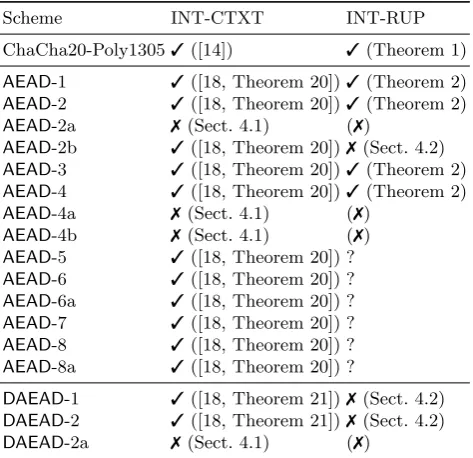
Table 1.INT-CTXT and INT-RUP security of AEAD and DAEAD schemes. The mark3means secure,7means insecure, (7) follows from the INT-CTXT result, and ? remains open.
Scheme INT-CTXT INT-RUP
ChaCha20-Poly13053([14]) 3(Theorem 1)
AEAD-1 3([18, Theorem 20])3(Theorem 2)
AEAD-2 3([18, Theorem 20])3(Theorem 2)
AEAD-2a 7(Sect. 4.1) (7)
AEAD-2b 3([18, Theorem 20])7(Sect. 4.2)
AEAD-3 3([18, Theorem 20])3(Theorem 2)
AEAD-4 3([18, Theorem 20])3(Theorem 2)
AEAD-4a 7(Sect. 4.1) (7)
AEAD-4b 7(Sect. 4.1) (7)
AEAD-5 3([18, Theorem 20]) ?
AEAD-6 3([18, Theorem 20]) ?
AEAD-6a 3([18, Theorem 20]) ?
AEAD-7 3([18, Theorem 20]) ?
AEAD-8 3([18, Theorem 20]) ?
AEAD-8a 3([18, Theorem 20]) ?
DAEAD-1 3([18, Theorem 21])7(Sect. 4.2)
DAEAD-2 3([18, Theorem 21])7(Sect. 4.2)
DAEAD-2a 7(Sect. 4.1) (7)
not exactly follow the composition. Procter [14] proved that ChaCha20-Poly1305 achieves both privacy and authenticity in the model of [4] under the assumption that ChaCha20 block function is a PRF.
Another security notion called the releasing unverified plaintext (RUP) was formalized by Andreeva et al. [1]. This notion is motivated to cover the situation in which there is not enough memory in decryption devices to store the entire decrypted plaintext and decrypted plaintexts are immediately required in real time. The corresponding integrity notion is called RUP, and the goal of an adversary under the INT-RUP notion is to produce a new ciphertext which is accepted in the verification, where the adversary has access to the oracle that returns unverified plaintexts. We remark that the notion is often referred to as the decryption-misuse setting.
Our Contributions. In this paper, we study the integrity of AEAD and DAEAD based on a stream cipher
and a universal hash function in the standard INT-CTXT notion and in the decryption-misuse, INT-RUP notion.
Our results are summarized in Table 1. We first show that there are INT-CTXT attacks against 4 out of 17 schemes in [18], invalidating the original INT-CTXT security claims. In addition to this, we show RUP attacks against 3 out of the 17 schemes, showing a sort of tightness of the original INT-CTXT claims. All our attacks need only a few queries, and are hence practical. Specifically, we show INT-CTXT attacks againstAEAD-{2a,4a,4b} andDAEAD-2a, and INT-RUP attacks againstAEAD-2b andDAEAD-{1,2}. We note that INT-RUP security is not claimed in [18], as [18] predates [1].
A universal hash function, or more precisely an almost XOR universal (AXU) hash function, is used in these schemes, and our observation is that the definition of an AXU hash function does not exclude a case where it has a fixed point, which is the input X and the output Y of the hash function Hsuch thatHL(X) =Y holds independent of the keyL. Our INT-CTXT attacks againstAEAD-{2a,4a,4b}and
DAEAD-2a, and INT-RUP attacks againstDAEAD-{1,2}make use of the existence of the fixed point. The INT-RUP attack against AEAD-2b is based on a different observation. We show that an adversary can recover the hash key from the unverified plaintext and hence break the INT-RUP security with probability 1. The attacks are described in Sect. 4. We remark that our attacks imply the existence of a universal hash function that makes these schemes insecure, and the attacks do not imply the non-existence of a universal hash function that makes the schemes secure.
Finally, we show that AEAD-{1,2,3,4}are INT-RUP secure under the assumption that a stream cipher is a PRF. Our security bounds of these schemes are shown in Sect. 5.
2
Preliminaries
2.1 Notation
We write {0,1}∗ for the set of all finite bit strings, and for an integer l≥0, we write{0,1}l for all the l-bit strings. We write εfor the empty string. ForX ∈ {0,1}∗,|X|is its length in bits. For X ∈ {0,1}∗
and an integerl such that |X| ≥l,msbl(X) denotes the most significant (the leftmost)l bits of X, and
lsbl(X) denotes the least significant (the rightmost) l bits ofX. ForX, Y ∈ {0,1}∗, their concatenation
is written as X k Y. The bit string of m zeros is written as 0m ∈ {0,1}m, and m ones is written as
1m∈ {0,1}m. For a finite set X, we write X $
← X for a procedure of assigning X an element sampled uniformly at random fromX.
2.2 AEAD and DAEAD
Authenticated Encryption with Associated Data (AEAD) [3,15]. The goal of AEAD is to achieve both
privacy and integrity of a plaintext, and integrity of associated data. We consider that AEAD consists of three deterministic algorithms, and letAEAD= (AEAD.Enc,AEAD.Dec,AEAD.Ver). LetK∈ Kbe the underlying secret key that fixes the three algorithms, whereKis the key space. The encryption algorithm AEAD.EncK takes input a nonce N, associated data A, and a plaintextM, and outputs a ciphertext C
and a tag T. The decryption algorithm AEAD.DecK takes input N, A, C, and T, and always outputs M. The verification algorithm AEAD.VerK takes inputN, A,C, and T, and outputs >or ⊥, where >
means that the verification is accepted, and ⊥means that the verification is rejected. The correctness requirement must be satisfied, that is, the following requirements are satisfied.
(
AEAD.DecK(N, A,AEAD.EncK(N, A, M)) =M
AEAD.VerK(N, A,AEAD.EncK(N, A, M)) =>
Deterministic AEAD (DAEAD) [17]. DAEAD is AEAD that does not require a nonce. LetDAEAD=
(DAEAD.Enc,DAEAD.Dec,DAEAD.Ver), where the encryption algorithmDAEAD.EncKtakes inputAand M, and outputsCandT, the decryption algorithmDAEAD.DecK takes inputA,C, andT, and outputs M, and the verification algorithm DAEAD.VerK takes input A, C, and T, and outputs > or ⊥. As in
AEAD, the following correctness requirement must be satisfied.
(
DAEAD.DecK(A,DAEAD.EncK(A, M)) =M
DAEAD.VerK(A,DAEAD.EncK(A, M)) =>
2.3 Security Definitions
Ciphertext Integrity. For AEAD and DAEAD, privacy and integrity are the main two security notions.
In this paper, we focus on the latter, and describe two notions called CTXT and RUP. INT-CTXT is a standard, classical notion that captures the integrity of ciphertext under chosen ciphertext attacks. INT-RUP considers a more powerful adversary that has access to an oracle that returns unverified plaintexts. We note that INT-RUP is a stronger notion than INT-CTXT, and if a scheme is INT-RUP secure, then it is also INT-CTXT secure.
Definition 1 (INT-CTXT Advantage [3,4]). Let Abe an adversary that has access to two oracles
AEAD.EncK andAEAD.VerK. Then we define the INT-CTXT advantage ofA againstAEADas
Advint-ctxtAEAD (A)def= Pr[AAEAD.EncK,AEAD.VerK forges],
where K ← K$ and A forges is the event that AEAD.VerK returns > toA. We assume that A does not
repeat a query, and if A receives a response (C, T)for an encryption query (N, A, M), then Adoes not
subsequently make a verification query(N, A, C, T). We assume thatAis nonce-respecting with respect to
encryption queries, that is, if (Ni, Ai, Mi)denotes the i-th encryption query, then it holds that Ni6=Ni0
We note thatAmay repeat a nonce within verification queries, may reuse a nonce used for an encryption query as a nonce for a subsequent verification query, and may reuse a nonce used for a verification query as a nonce for a subsequent encryption query.
The INT-CTXT advantage forDAEADis similarly defined as
Advint-ctxtDAEAD(A) def
= Pr[ADAEAD.EncK,DAEAD.VerK forges].
We assume that Adoes not repeat a query, and ifAreceives a response (C, T) for an encryption query (A, M), thenAdoes not subsequently make a verification query (A, C, T). SinceDAEADdoes not take a nonce N as input, Ahas no nonce-respecting restriction.
Definition 2 (INT-RUP Advantage [1]). Let A be an adversary that has access to three oracles
AEAD.EncK,AEAD.DecK, andAEAD.VerK. Then we define the INT-RUP advantage ofAagainstAEAD
as
Advint-rupAEAD (A)def= Pr[AAEAD.EncK,AEAD.DecK,AEAD.VerK forges],
whereK← K$ andAforgesis the event thatAEAD.VerK returns>toA.Adoes not repeat a query, and
if A receives a response (C, T) for an encryption query (N, A, M), then A does not subsequently make
a verification query (N, A, C, T). A is nonce-respecting with respect to encryption queries. However, a
nonce can be repeated within decryption queries and within verification queries, and the same nonce can be reused across encryption, decryption, and verification queries.
The INT-RUP advantage ofDAEADis defined as
Advint-rupDAEAD(A)def= Pr[ADAEAD.EncK,DAEAD.DecK,DAEAD.VerK forges].
As in the INT-CTXT definition, since DAEAD does not take a nonce N as input, A has no nonce-respecting restriction. However, we assume that Adoes not repeat a query, and ifAreceives a response (C, T) for an encryption query (A, M), thenAdoes not subsequently make a verification query (A, C, T).
Pseudo-Random Function (PRF). Following [18], we consider a stream cipher as a function SC: K ×
{0,1}n → {0,1}`, where K is the set of keys, ndenotes the length of IV in bits, and ` is a sufficiently
large and fixed integer. For a key K ∈ K, the corresponding functionSCK takes an IV N ∈ {0,1}n as
input, and outputs the keystreamZ ←SCK(N)∈ {0,1}`. Let Rand(n, `) be the set of all functions from
{0,1}n to{0,1}`, and letAbe an adversary. Then we define the PRF-advantage ofAagainstSCas
AdvprfSC(A)def= Pr[K← K$ : ASCK⇒1]−Pr[F $
←Rand(n, `) :AF ⇒1],
where A ⇒1 denotes the event thatAoutputs 1.
We note that in the above formalization,SCK is a function with fixed-input length and fixed-output
length, and we assume that the output ofSCK is always`bits. However, in the actual usage ofSCK, we
abuse the notation and for instance we writeC←M⊕SCK(N) to meanC←M⊕msb|M|(SCK(N)), or RkZ←SCK(N), where|R|=nand|Z|is clear from the context (such as the length of the plaintext),
to meanY ←SCK(N), R←msbn(Y), andZ←lsb|Z|(msbn+|Z|(Y)).
Hash Function. LetH:L × DH→ {0,1}n be a hash function, whereL is a set of hash keys,DH denotes
the domain, andnis the length of the output in bits. The function specified by L∈ Lis written asHL.
Let{HL} be a family of keyed hash functions. For any distinctX0, X ∈ DH and anyY ∈ {0,1}n, if
the differential probability Pr[HL(X)⊕HL(X0) =Y] is at most, then HL is defined to be an
-almost-XOR-universal (-AXU) hash function, where the probability is taken over the choice ofL← L.$
We observe that the definition of an -AXU hash function does not exclude a case where the hash function has a fixed point. That is, there may existX ∈ DHandY ∈ {0,1}n such thatH
L(X) =Y holds
independently of the keyL, since the requirement is about the differential probability, and the uniformity of a single input is irrelevant of the definition. Indeed, practical hash functions like GHASH and Poly1305 have a fixed point. For GHASH, it takes (A, C)∈ {0,1}∗× {0,1}∗ as input and outputsY ∈ {0,1}n, and
it holds that GHASHL(A, C) = Y with probability 1 for (A, C) = (ε, ε) and Y = 0n. Poly1305 has the
same fixed point. We will exploit the existence of a fixed point in our attacks.
3
Schemes
In this section, we present the specifications of AEAD and DAEAD schemes that are proposed in [18], and ChaCha20-Poly1305 [13].
AEAD in [18]. LetfStr be an arbitrary fixedn-bit string. For instancefStrcould be 0n. AEAD schemes
in [18] are specified by a stream cipherSC and a hash functionH, and we write AEAD[SC,H] for AEAD that usesSCandHas parameters. We also writeAEAD[Rand(n, `),H] forAEADwhere we use a random functionF ←$ Rand(n, `) as the stream cipherSCK. The encryption algorithms of the schemes are defined
in Fig. 1. See Fig. 2 for the overall structure of the encryption algorithms. The decryption and verification algorithms are described in Appendix A. We note that these schemes have the convention on the length of the input. Specifically, the encryption algorithms take any plaintextM which is not empty, and|M|= 0 is not allowed [18].
We also note thatAEAD-{1,2,2a,2b,3,4,4a,4b} useHas a double-input hash function, butAEAD -{5,6,6a,7,8,8a}useHas a hash function that can take both double-input and single-input. See [18] for more details on this matter.
ChaCha20-Poly1305 [13]. LetKCC ={0,1}256 and KPoly ={0,1}128× {0,1}128. We denote ChaCha20
block function byCC:KCC× {0,1}32× {0,1}96→ {0,1}512, and denote Poly1305 authentication function by Poly:KPoly× {0,1}∗ → {0,1}128. The functions specified by K ∈ KCC and (r, s)∈ KPoly are written as CCK andPolyr,s, respectively. We writeCC&Polyfor ChaCha20-Poly1305.
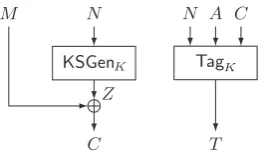
With these functions, the encryption algorithm of ChaCha20-Poly1305 is defined in Fig. 3. See Fig. 4 for the overall structure of the encryption algorithm. The decryption and verification algorithms are defined in Appendix A. See [7,8] for further details of the specifications of ChaCha20 and Poly1305.
Observe the similarity toAEAD-2b.SCK(N) inAEAD-2b corresponds toCCK(0, N),CCK(1, N), . . . ,
CCK(d|M|/512e, N), where (L, R) inAEAD-2b corresponds to (r, s) in ChaCha20-Poly1305. The difference
is thatLis taken from the rightmost bits ofSCK(N), thus the starting position can be moved depending
on the length ofM, whileris always taken from the same position.
DAEAD in [18]. The encryption algorithms of DAEAD schemes are defined in Fig. 5. See Fig. 6 for the
overall structure. We note that the basic idea of DAEAD schemes follows the SIV construction in [17]. The decryption and verification algorithms are described in Appendix A.
4
Negative Results
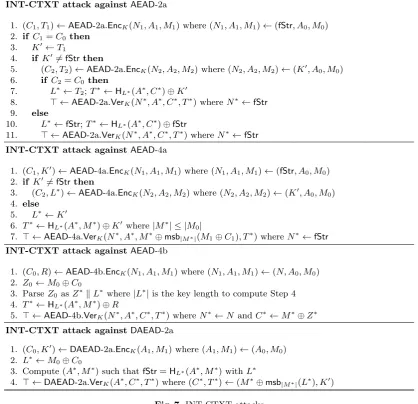
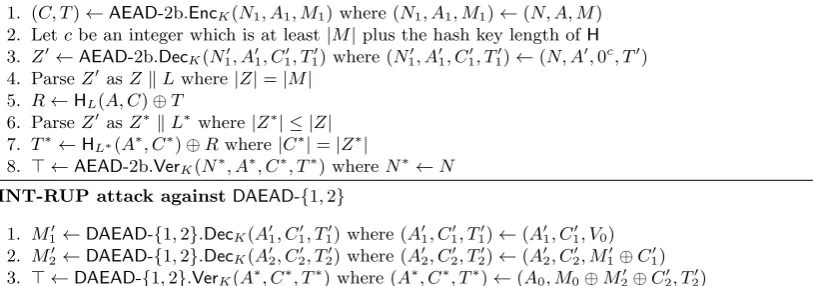
In this section, we show that AEAD-{2a,4a,4b} and DAEAD-2a are not INT-CTXT secure and that AEAD-2b and DAEAD-{1,2} are not INT-RUP secure. Our forgery attacks against these schemes are presented in Fig. 7 and Fig. 8.
Before describing the details of our attacks, we present the following proposition showing that the fixed point can be “moved” to any desired point without changing the value of.
Proposition 1. Let HeL:DH → {0,1}n be a hash function,ϕ:DH → DH be an injective function, and
c ∈ {0,1}n be a constant. LetH
L: DH → {0,1}n be a hash function, where HL(X) =HeL(ϕ(X))⊕c. If
AEAD-1.EncK,L(N, A, M)
1. RkZ←SCK(N)
2. C←M⊕msb|M|(Z) 3. T ←HL(A, C)⊕R
4. return(C, T)
AEAD-2.EncK,K0(N, A, M)
1. L←SCK(K0)
2. RkZ←SCK(N)
3. C←M⊕msb|M|(Z) 4. T ←HL(A, C)⊕R
5. return(C, T)
AEAD-2a.EncK(N, A, M)
1. K0←msbn(SCK(fStr))
2. L←SCK(K0)
3. RkZ←SCK(N)
4. C←M⊕msb|M|(Z) 5. T ←HL(A, C)⊕R
6. return(C, T)
AEAD-2b.EncK(N, A, M)
1. RkS←SCK(N)
2. ParseSasZkLwhere|Z|=|M|
3. C←M⊕Z
4. T ←HL(A, C)⊕R
5. return(C, T)
AEAD-3.EncK,L(N, A, M)
1. RkZ←SCK(N)
2. C←M⊕msb|M|(Z) 3. T ←HL(A, M)⊕R
4. return(C, T)
AEAD-4.EncK,K0(N, A, M)
1. L←SCK(K0)
2. RkZ←SCK(N)
3. C←M⊕msb|M|(Z) 4. T ←HL(A, M)⊕R
5. return(C, T)
AEAD-4a.EncK(N, A, M)
1. K0←msbn(SCK(fStr)) 2. L←SCK(K0)
3. RkZ←SCK(N)
4. C←M⊕msb|M|(Z) 5. T ←HL(A, M)⊕R
6. return(C, T)
AEAD-4b.EncK(N, A, M)
1. RkS←SCK(N)
2. ParseSasZkLwhere|Z|=|M|
3. C←M⊕Z
4. T ←HL(A, M)⊕R
5. return(C, T)
AEAD-5.EncK,L(N, A, M)
1. V ←HL(A, N)
2. RkZ←SCK(V)
3. C←M⊕msb|M|(Z) 4. T ←HL(C)⊕R
5. return(C, T)
AEAD-6.EncK,K0(N, A, M)
1. L1kL2←SCK(K0)
2. V ←HL1(A, N)
3. RkZ←SCK(V)
4. C←M⊕msb|M|(Z) 5. T ←HL2(C)⊕R
6. return(C, T)
AEAD-6a.EncK(N, A, M)
1. K0←msbn(SCK(fStr)) 2. L1 kL2←SCK(K0)
3. V ←HL1(A, N)
4. RkZ←SCK(V)
5. C←M⊕msb|M|(Z) 6. T ←HL2(C)⊕R
7. return(C, T)
AEAD-7.EncK,L(N, A, M)
1. V ←HL(A, N)
2. RkZ←SCK(V)
3. C←M⊕msb|M|(Z) 4. T ←HL(M)⊕R
5. return(C, T)
AEAD-8.EncK,K0(N, A, M)
1. L1 kL2←SCK(K0)
2. V ←HL1(A, N)
3. RkZ←SCK(V)
4. C←M⊕msb|M|(Z) 5. T ←HL2(M)⊕R
6. return(C, T)
AEAD-8a.EncK(N, A, M)
1. K0←msbn(SCK(fStr))
2. L1kL2←SCK(K0)
3. V ←HL1(A, N)
4. RkZ←SCK(V)
5. C←M⊕msb|M|(Z) 6. T ←HL2(M)⊕R
7. return(C, T)
AEAD-1.EncK,L,AEAD-2.EncK,K,AEAD-2a.EncK
HL
N M A
R Z C T K fStr SCK K SCK L SCK
AEAD-2b.EncK L
HL
N M A
R Z
C T
SCK
AEAD-3.EncK,L,AEAD-4.EncK,K,AEAD-4a.EncK
HL
N M A
R Z C T K fStr SCK K SCK L SCK
AEAD-4b.EncK L
HL
N M A
R Z
C T SCK
AEAD-5.EncK,L HL N M R Z C T SCK V HL A V
AEAD-6.EncK,K,AEAD-6a.EncK
K fStr
SCK K SCK HL1
N M R Z C T SCK V A V L1L2 HL2
AEAD-7.EncK,L HL N M R Z C T SCK V HL A V
AEAD-8.EncK,K,AEAD-8a.EncK
K fStr
SCK K SCK HL1
N M R Z C T SCK V A V L1L2 HL2
Fig. 2.Illustration of the encryption algorithms ofAEADschemes [18]. InAEAD-2 andAEAD-4,L=SCK(K0). In
AEAD-2a andAEAD-4a,L=SCK(msbn(SCK(fStr))). InAEAD-6 andAEAD-8,L1kL2=SCK(K0). InAEAD-6a
CC&Poly.EncK(N, A, M)
1. Z←KSGenK(N,|M|)
2. C←M⊕Z
3. T ←TagK(N, A, C)
4. return(C, T)
KSGenK(N, l)
1. m← dl/512e
2. fori←1tomdo 3. Z[i]←CCK(i, N)
4. l∗←lmod 512 5. Z[m]←lsbl∗(Z[m])
6. Z←Pm
i=1Z[i]·2512(i−1) 7. returnZ
TagK(N, A, C)
1. skr←lsb256(CCK(0, N)) where|r|=|s|= 128
2. l1←128d|A|/128e 3. l2←l1+ 128d|C|/128e 4. l3←l2+ 64
5. Y ←A
6. Y ←Y +C·2l1
7. Y ←Y +d|A|/8e ·2l2
8. Y ←Y +d|C|/8e ·2l3
9. T ←Polyr,s(Y)
10. returnT
Fig. 3.Pseudocode of the encryption algorithm of ChaCha20-Poly1305. The arithmetics are usual integer addition and multiplication.
KSGenK TagK
C N
Z
A C N M
T
Fig. 4.Illustration of the encryption algorithm of ChaCha20-Poly1305
Proof. For any distinctX, X0∈ DH and anyY ∈ {0,1}n,ϕ(X) andϕ(X0) are distinct, and we have
Pr[HL(X)⊕HL(X0) =Y] = Pr[HeL(ϕ(X))⊕c⊕HeL(ϕ(X0))⊕c=Y]
= Pr[HeL(ϕ(X))⊕HeL(ϕ(X0)) =Y]≤.
Therefore,{HL} is also-AXU. ut
There exists an-AXU hash functionHeL such thatHeL(A, M) = 0n for (A, M) = (, ), e.g., GHASH
function in GCM and Poly1305, and we use the proposition to respect the non-empty plaintext convention of the schemes in [18].
We are now ready to present the details of our attacks.
4.1 AEAD-{2a,4a,4b} and DAEAD-2a Are Not INT-CTXT Secure
Attack againstAEAD-2a. The hash function inAEAD-2a takes associated dataAand a ciphertextC as
input. Suppose thatHeL is an-AXU hash function such thatHeL: (ε, ε)7→0n. LetA0 be any associated data and C0 be any ciphertext such that |C0|= 1, i.e., C0 is a bit. We also assume that, given a hash key of lengthnbits, the adversary can compute the hash value for any input, e.g., Type-I hash functions like GHASH function. Define an injective functionϕas follows.
ϕ(A, C) =
(ε, ε) if (A, C) = (A0, C0) (A0, C0) if (A, C) = (ε, ε) (A, C) otherwise
LetHL(A, C) =HeL(ϕ(A, C)). ThenHL is an-AXU function from Proposition 1.
Now in the attack in Fig. 7, the adversary receives (C1, T1) for the first encryption query (N1, A1, M1) = (fStr, A0, M0), where |M0| = 1. We see that Pr[C1 = C0] is approximately 1/2. If C1 6= C0, then the adversary fails to make a forgery. If C1 = C0, from K0 = msbn(SCK(fStr)), ϕ(A0, C0) = (ε, ε), and
e
HL(ε, ε) = 0n, the adversary receives K0 as the tag. Suppose that K0 6= fStr. For the second
DAEAD-1.EncK,L(A, M)
1. V ←HL(A, M)
2. T ←msbn(SCK(V))
3. Z←SCK(T)
4. C←M⊕Z
5. return(C, T)
DAEAD-2.EncK,K0(A, M)
1. L←SCK(K0)
2. V ←HL(A, M)
3. T ←msbn(SCK(V))
4. Z←SCK(T)
5. C←M⊕Z
6. return(C, T)
DAEAD-2a.EncK(A, M)
1. K0←msbn(SCK(fStr))
2. L←SCK(K0)
3. V ←HL(A, M)
4. T ←msbn(SCK(V))
5. Z←SCK(T)
6. C←M⊕Z
7. return(C, T)
Fig. 5.Pseudocode of the encryption algorithms ofDAEADschemes [18]
Z C
SCK
V
HL A
K
fStr
SCK K
SCK
L
SCK
T M
Fig. 6.Illustration the encryption algorithms ofDAEADschemes [18]. InDAEAD-2,L=SCK(K0). InDAEAD-2a,
L=SCK(msbn(SCK(fStr))).
HL(A0, C0) = 0n, the adversary receives the firstn bits of the hash key L, called L∗. IfK0 =fStr, the hash keyL∗isfStr. Therefore, the forgery (N∗, A∗, C∗, T∗), whereN∗=fStr, is accepted with probability approximately 1/4.
Attack againstAEAD-4a. InAEAD-4a, the hash function takesA andM as input. LetHeL be an-AXU
hash function such thatHeL: (ε, ε)7→0n. Given a hash key of lengthnbits, we assume that the adversary
can compute the hash value for any input. Let A0 be any associated data and M0 be any non-empty plaintext that will be used in the attack. Define an injective functionϕas follows.
ϕ(A, M) =
(ε, ε) if (A, M) = (A0, M0) (A0, M0) if (A, M) = (ε, ε) (A, M) otherwise
(1)
LetHL(A, M) =HeL(ϕ(A, M)). ThenHL is an-AXU function from Proposition 1.
For the first encryption query (N1, A1, M1) = (fStr, A0, M0), fromK0=msbn(SCK(fStr)),ϕ(A0, M0) = (ε, ε), andHeL(ε, ε) = 0n, the adversary receivesK0 as the tag. Suppose thatK0 6=fStr. For the second
encryption query (N2, A2, M2) = (K0, A0, M0), the adversary receives the firstnbits of the hash keyL, which we write L∗, and can compute the tagT∗←HL∗(A∗, M∗)⊕K0 without access to the encryption
oracle. Here the length of M∗ should be at most the length of M0. If fStr =K0, then the hash key L∗ is fStr. Therefore the forgery (N∗, A∗, C∗, T∗), whereN∗ =fStr and C∗ ←M∗⊕msb|M∗|(M1⊕C1), is accepted with probability 1.
Attack against AEAD-4b. The hash function in AEAD-4b takes A and M as input. Suppose that HeL
is an -AXU hash function such that HeL: (ε, ε) 7→ 0n. Let A0 be any associated data and M0 be any non-empty plaintext. Define an injective functionϕ as in (1). Let HL(A, M) =HeL(ϕ(A, M)). Then HL
is an-AXU function from Proposition 1. LetN ∈ {0,1}n be an arbitrary nonce.
INT-CTXT attack againstAEAD-2a
1. (C1, T1)←AEAD-2a.EncK(N1, A1, M1) where (N1, A1, M1)←(fStr, A0, M0) 2. if C1=C0then
3. K0←T1
4. if K06=fStrthen
5. (C2, T2)←AEAD-2a.EncK(N2, A2, M2) where (N2, A2, M2)←(K0, A0, M0) 6. if C2=C0 then
7. L∗←T2;T∗←HL∗(A∗, C∗)⊕K0
8. > ←AEAD-2a.VerK(N∗, A∗, C∗, T∗) whereN∗←fStr
9. else
10. L∗←fStr;T∗←HL∗(A∗, C∗)⊕fStr
11. > ←AEAD-2a.VerK(N∗, A∗, C∗, T∗) whereN∗←fStr
INT-CTXT attack againstAEAD-4a
1. (C1, K0)←AEAD-4a.EncK(N1, A1, M1) where (N1, A1, M1)←(fStr, A0, M0) 2. if K06=fStrthen
3. (C2, L∗)←AEAD-4a.EncK(N2, A2, M2) where (N2, A2, M2)←(K0, A0, M0) 4. else
5. L∗←K0
6. T∗←HL∗(A∗, M∗)⊕K0where|M∗| ≤ |M0|
7. > ←AEAD-4a.VerK(N∗, A∗, M∗⊕msb|M∗|(M1⊕C1), T∗) whereN∗←fStr INT-CTXT attack againstAEAD-4b
1. (C0, R)←AEAD-4b.EncK(N1, A1, M1) where (N1, A1, M1)←(N, A0, M0) 2. Z0←M0⊕C0
3. ParseZ0 asZ∗kL∗where|L∗|is the key length to compute Step 4 4. T∗←HL∗(A∗, M∗)⊕R
5. > ←AEAD-4b.VerK(N∗, A∗, C∗, T∗) whereN∗←N andC∗←M∗⊕Z∗
INT-CTXT attack againstDAEAD-2a
1. (C0, K0)←DAEAD-2a.EncK(A1, M1) where (A1, M1)←(A0, M0) 2. L∗←M0⊕C0
3. Compute (A∗, M∗) such thatfStr=HL∗(A∗, M∗) withL∗
4. > ←DAEAD-2a.VerK(A∗, C∗, T∗) where (C∗, T∗)←(M∗⊕msb|M∗|(L∗), K0)
Fig. 7.INT-CTXT attacks
M0. For anyM∗∈ {0,1}|Z
∗|
, the adversary can compute the tagT∗. Hence the forgery (N∗, A∗, C∗, T∗), where N∗=N andC∗=M∗⊕Z∗, is accepted with probability 1.
Attack against DAEAD-2a. Suppose thatHeL is an -AXU hash function such thatHeL: (ε, ε)7→0n. We
also assume that, given a hash keyL∗andY, we can compute some (A∗, M∗) such thatY =HL∗(A∗, M∗).
LetA0 be arbitrary associated data andM0 be a plaintext. Define an injective functionϕas in (1). We have a restriction on |M0|, which is discussed below. Let HL(A, M) =HeL(ϕ(A, M))⊕fStr. ThenHL is -AXU from Proposition 1.
For the encryption query (A1, M1) = (A0, M0), fromϕ(A0, M0) = (ε, ε) andHeL(ε, ε) = 0n, it follows
that HL(A0, M0) = fStr. From K0 = msbn(SCK(fStr)), the adversary receives K0 as the tag. From
SCK(K0) =LandM0⊕C0, it obtains the first|M0|bits ofL. LetL∗be the value ofmsb|M0|(L). The length
ofL∗ has to be long enough so that the adversary can compute (A∗, M∗) such thatfStr=HL∗(A∗, M∗).
Therefore, (A∗, C∗, T∗), where (C∗, T∗) = (M∗⊕msb|M∗|(L∗), K0), is always accepted.
Comments. We note that, since the above schemes are not INT-CTXT secure, they are not INT-RUP
INT-RUP attack againstAEAD-2b
1. (C, T)←AEAD-2b.EncK(N1, A1, M1) where (N1, A1, M1)←(N, A, M) 2. Letcbe an integer which is at least|M|plus the hash key length ofH
3. Z0←AEAD-2b.DecK(N10, A01, C10, T10) where (N10, A01, C10, T10)←(N, A0,0c, T0) 4. ParseZ0asZkLwhere|Z|=|M|
5. R←HL(A, C)⊕T
6. ParseZ0asZ∗kL∗where|Z∗| ≤ |Z|
7. T∗←HL∗(A∗, C∗)⊕Rwhere|C∗|=|Z∗|
8. > ←AEAD-2b.VerK(N∗, A∗, C∗, T∗) whereN∗←N
INT-RUP attack againstDAEAD-{1,2}
1. M10←DAEAD-{1,2}.DecK(A01, C10, T10) where (A01, C10, T10)←(A01, C10, V0) 2. M20←DAEAD-{1,2}.DecK(A02, C20, T20) where (A02, C20, T20)←(A02, C20, M10⊕C10) 3. > ←DAEAD-{1,2}.VerK(A∗, C∗, T∗) where (A∗, C∗, T∗)←(A0, M0⊕M20⊕C20, T20)
Fig. 8.INT-RUP attacks
possible for the adversary to actually learn the value ofK0. This type of discrepancy explains the success
of the above attacks.
4.2 AEAD-2b and DAEAD-{1,2}Are Not INT-RUP Secure
Attack against AEAD-2b. Suppose that HL is -AXU. The values N ∈ {0,1}n, A ∈ {0,1}∗, and M ∈
{0,1}∗ can be arbitrarily chosen, where|M| 6= 0.
For the encryption query (N1, A1, M1) = (N, A, M), the adversary receives (C, T). For the decryption query (N10, A01, C10, T10) = (N, A0,0c, T0), whereA0 ∈ {0,1}∗ and T0 ∈ {0,1}n may be arbitrarily chosen, the adversary receivesZ0 as the plaintext. Z0 can be parsed into the keystream Z and the hash key L.
Then the adversary can compute R = HL(A, C)⊕T with L. We observe that Z0 can also be parsed
into another keystreamZ∗ and another hash keyL∗. For anyA∗∈ {0,1}∗ and anyC∗∈ {0,1}|Z∗|
, the adversary can compute the tag asT∗=HL∗(A∗, C∗)⊕R. Therefore, (N∗, A∗, C∗, T∗), whereN∗=N, is
accepted with probability 1. Note that this attack does not rely on the fixed point of the hash function.
Attacks againstDAEAD-{1,2}. Suppose thatHL is an-AXU hash function such thatHL(A0, M0) =V0
for anyL, whereA0∈ {0,1}∗ andM0∈ {0,1}n denote special input to produce the fixed pointV0. The valuesA01, A02∈ {0,1}∗ andC0
1, C20 ∈ {0,1}
n can be arbitrarily chosen.
For the first decryption query (A01, C10, T10) = (A01, C10, V0), the adversary receives the plaintext M10. Then the keystream is computed as M10⊕C10. In fact, it is computed as the tag fromSCK(V0). For the second decryption query (A0
2, C20, T20) = (A02, C20, M10⊕C10), the adversary receives the plaintextM20. For the verification query (A∗, C∗, T∗) = (A
0, M0⊕M20⊕C20, T20), fromHL(A0, M0) =V0andT20 =SCK(V0), the forgery (A∗, C∗, T∗) is accepted with probability 1.
5
Positive Results
5.1 ChaCha20-Poly1305 Is INT-RUP Secure
LetAbe an adversary. Suppose thatAmakesqencryption queries (N1, A1, M1), . . . ,(Nq, Aq, Mq),q0
de-cryption queries (N10, A01, C10, T10), . . . ,(Nq00, A0q0, Cq00, Tq00), andq00verification queries (N100, A001, C100, T100), . . . , (Nq0000, A00q00, Cq0000, Tq0000). Define the maximum byte length of the message for the encryption queries and the
verification queries as
16
1max≤i≤q
1≤j≤q00
|Ai|
128
+
|Mi|
128
∪
|A00 j|
128
+
|C00 j|
128
+ 1
.
The security bound of ChaCha20-Poly1305 is given as follows. We note that we consider the case where CCK is a random function and focus on the information theoretic case. However, it is standard to derive
Theorem 1. ConsiderCC&Poly, where a random functionF :{0,1}32× {0,1}128→ {0,1}512 is used as
CCK. Let Abe an INT-RUP adversary that makes at most q encryption queries, q0 decryption queries,
andq00 verification queries, and the maximum byte length of the message for the encryption queries and
the verification queries is at most `max bytes. Then we have
Advint-rupCC&Poly(A)≤q008d`max/16e
2106 .
A proof is presented in Appendix B. We note that the INT-CTXT security was proved by Procter in [14]4. The above theorem shows that the security does not change even if the adversary is given access to the decryption oracle. We see that the adversary learns the keystreamMi⊕Ciby making an encryption
query (Ni, Ai, Mi). Intuitively, there is no additional information that the adversary can learn from the
decryption oracle, since the decryption oracle simply allows the adversary to learn the keystream, which is already available from the encryption oracle.
5.2 AEAD-{1,2,3,4} Are INT-RUP Secure
The following theorem shows the security bounds of AEAD-{1,2,3,4}. We focus on the information theoretic result, but the corresponding complexity theoretic result can be obtained in a standard way [2].
Theorem 2. Let Rand(n, `) and H be the parameters of each AEAD scheme. Suppose that {HL} is
-AXU. Let Abe an INT-RUP adversary that makes at most q encryption queries,q0 decryption queries,
andq00 verification queries. Then we have the following security bounds:
Advint-rupAEAD-1[Rand(n,`),H](A)≤q00, (2) Advint-rupAEAD-3[Rand(n,`),H](A)≤q00, (3) Advint-rupAEAD-2[Rand(n,`),H](A)≤ q+q
0+q00
2n +q
00, and (4)
Advint-rupAEAD-4[Rand(n,`),H](A)≤ q+q
0+q00
2n +q
00. (5)
A proof is presented in Appendix C.
6
Conclusions
In this paper, we analyzed the integrity of the authenticated encryption schemes that are based on stream ciphers and universal hash functions. Our attacks indicate that the use of fStr to reduce the number of secret keys requires careful handling in the security proof.
It would be interesting clarify the INT-RUP security of the remaining AEAD schemes shown as open in Table 1.
Acknowledgments. We thank the anonymous ProvSec 2016 reviewers and participants of Early Sym-metric Crypto (ESC) 2015 for helpful comments. We also thank Palash Sarkar for insightful feedback on an earlier version of this paper. The work by Tetsu Iwata was supported in part by JSPS KAKENHI, Grant-in-Aid for Scientific Research (B), Grant Number 26280045, and was carried out in part while visiting Nanyang Technological University, Singapore.
4We remark that there is a minor gap in the proof in [14]. The proof introduces a hybrid (E1, D1) where the
References
1. Andreeva, E., Bogdanov, A., Luykx, A., Mennink, B., Mouha, N., Yasuda, K.: How to Securely Release Unverified Plaintext in Authenticated Encryption. In: Iwata, T., Sarkar, P. (eds.) ASIACRYPT 2014 (1). LNCS, vol. 8873, pp. 105–125. Springer (2014)
2. Bellare, M., Kilian, J., Rogaway, P.: The security of the cipher block chaining message authentication code. J. Comput. Syst. Sci. 61(3), 362–399 (2000)
3. Bellare, M., Namprempre, C.: Authenticated Encryption: Relations among Notions and Analysis of the Generic Composition Paradigm. In: Okamoto, T. (ed.) ASIACRYPT 2000. LNCS, vol. 1976, pp. 531–545. Springer (2000)
4. Bellare, M., Rogaway, P.: Encode-Then-Encipher Encryption: How to Exploit Nonces or Redundancy in Plaintexts for Efficient Cryptography. In: Okamoto, T. (ed.) ASIACRYPT 2000. LNCS, vol. 1976, pp. 317– 330. Springer (2000)
5. Bellare, M., Rogaway, P.: The Security of Triple Encryption and a Framework for Code-Based Game-Playing Proofs. In: Vaudenay, S. (ed.) EUROCRYPT 2006. LNCS, vol. 4004, pp. 409–426. Springer (2006)
6. Bellare, M., Rogaway, P., Wagner, D.: The EAX Mode of Operation. In: Roy, B.K., Meier, W. (eds.) FSE 2004. LNCS, vol. 3017, pp. 389–407. Springer (2004)
7. Bernstein, D.J.: The Poly1305-AES Message-Authentication Code. In: Gilbert, H., Handschuh, H. (eds.) FSE 2005. LNCS, vol. 3557, pp. 32–49. Springer (2005)
8. Bernstein, D.J.: ChaCha, a variant of Salsa20 (2008),http://cr.yp.to/papers.html#chacha, Document ID: 4027b5256e14b6796842e6d0f68b0b5e
9. Black, J., Halevi, S., Krawczyk, H., Krovetz, T., Rogaway, P.: UMAC: Fast and Secure Message Authentica-tion. In: Wiener, M. (ed.) CRYPTO ’99. LNCS, vol. 1666, pp. 216–233. Springer (1999)
10. Imamura, K., Minematsu, K., Iwata, T.: Integrity Analysis of Authenticated Encryption Based on Stream Ciphers. In: Chen, L., Han, J. (eds.) ProvSec 2016. LNCS, vol. 10005, pp. 257–276. Springer (2016)
11. McGrew, D.A., Viega, J.: The Security and Performance of the Galois/Counter Mode (GCM) of Operation. In: Canteaut, A., Viswanathan, K. (eds.) INDOCRYPT 2004. LNCS, vol. 3348, pp. 343–355. Springer (2004) 12. Namprempre, C., Rogaway, P., Shrimpton, T.: Reconsidering Generic Composition. In: Nguyen, P.Q., Oswald,
E. (eds.) EUROCRYPT 2014. LNCS, vol. 8441, pp. 257–274. Springer (2014)
13. Nir, Y., Langley, A.: ChaCha20 and Poly1305 for IETF protocols. IRTF RFC 7539 (May 2015), https: //tools.ietf.org/html/rfc7539
14. Procter, G.: A Security Analysis of the Composition of ChaCha20 and Poly1305. Cryptology ePrint Archive, Report 2014/613 (2014),http://eprint.iacr.org/
15. Rogaway, P.: Authenticated-Encryption with Associated-Data. In: Atluri, V. (ed.) ACM Conference on Com-puter and Communications Security. pp. 98–107. ACM (2002)
16. Rogaway, P.: Nonce-Based Symmetric Encryption. In: Roy, B.K., Meier, W. (eds.) FSE 2004. LNCS, vol. 3017, pp. 348–359. Springer (2004)
17. Rogaway, P., Shrimpton, T.: A Provable-Security Treatment of the Key-Wrap Problem. In: Vaudenay, S. (ed.) EUROCRYPT 2006. LNCS, vol. 4004, pp. 373–390. Springer (2006)
18. Sarkar, P.: Modes of operations for encryption and authentication using stream ciphers supporting an initial-isation vector. Cryptography and Communications 6(3), 189–231 (2014)
19. Whiting, D., Housley, R., Ferguson, N.: Counter with CBC-MAC (CCM). Submission to NIST (2002),http: //csrc.nist.gov/
A
Definitions of Decryption and Verification Algorithms of AEAD and
DAEAD Schemes
AEAD in [18]. Decryption algorithms of AEAD schemes are defined in Fig. 9. In each scheme, the mask
Rgenerated from the output ofSCis never used, and the tagT, which is a part of the input, is not used. The associated dataAis not used in AEAD-{1,2,2a,2b,3,4,4a,4b}.
Verification algorithms of AEAD schemes are defined in Fig. 10. Since the hash function takes input a plaintext inAEAD-{3,4,4a,4b,7,8,8a}, we use bothR andZ.
ChaCha20-Poly1305 [13]. The decryption and verification algorithms are defined in Fig. 11. The functions
KsGenK andTagK are defined in Fig. 3.
DAEAD in [18]. Decryption and verification algorithms of DAEAD schemes are defined in Fig. 12. The
AEAD-1.DecK,L(N, A, C, T)
1. RkZ←SCK(N)
2. M ←C⊕Z
3. returnM
AEAD-2.DecK,K0(N, A, C, T)
1. RkZ←SCK(N)
2. M ←C⊕Z
3. returnM AEAD-2a.DecK(N, A, C, T)
1. RkZ←SCK(N)
2. M ←C⊕Z
3. returnM
AEAD-2b.DecK(N, A, C, T)
1. RkS←SCK(N)
2. ParseSasZkLwhere|Z|=|C|
3. M ←C⊕Z
4. returnM AEAD-3.DecK,L(N, A, C, T)
1. RkZ←SCK(N)
2. C←M⊕Z
3. returnM
AEAD-4.DecK,K0(N, A, C, T)
1. RkZ←SCK(N)
2. M ←C⊕Z
3. returnM AEAD-4a.DecK(N, A, C, T)
1. RkZ←SCK(N)
2. M ←C⊕Z
3. returnM
AEAD-4b.DecK(N, A, C, T)
1. RkS←SCK(N)
2. ParseSasZkLwhere|Z|=|C|
3. M ←C⊕Z
4. returnM AEAD-5.DecK,L(N, A, C, T)
1. V ←HL(A, N)
2. RkZ←SCK(V)
3. M ←C⊕Z
4. returnM
AEAD-6.DecK,K0(N, A, C, T)
1. L1kL2←SCK(K0)
2. V ←HL1(A, N)
3. RkZ←SCK(V)
4. M ←C⊕Z
5. returnM AEAD-6a.DecK(N, A, C, T)
1. K0←msbn(SCK(fStr))
2. L1 kL2←SCK(K0)
3. V ←HL1(A, N)
4. RkZ←SCK(V)
5. M ←C⊕Z
6. returnM
AEAD-7.DecK,L(N, A, C, T)
1. V ←HL(A, N)
2. RkZ←SCK(V)
3. M ←C⊕Z
4. returnM
AEAD-8.DecK,K0(N, A, C, T)
1. L1 kL2←SCK(K0)
2. V ←HL1(A, N)
3. RkZ←SCK(V)
4. M ←C⊕Z
5. returnM
AEAD-8a.DecK(N, A, C, T)
1. K0←msbn(SCK(fStr)) 2. L1kL2←SCK(K0)
3. V ←HL1(A, N)
4. RkZ←SCK(V)
5. M ←C⊕Z
6. returnM
AEAD-1.VerK,L(N, A, C, T)
1. RkZ←SCK(N)
2. T∗←HL(A, C)⊕R
3. if T∗=T then return> 4. return⊥
AEAD-2.VerK,K0(N, A, C, T)
1. L←SCK(K0)
2. RkZ←SCK(N)
3. T∗←HL(A, C)⊕R 4. if T∗=T then return>
5. return⊥ AEAD-2a.VerK(N, A, C, T)
1. K0←msbn(SCK(fStr))
2. L←SCK(K0)
3. RkZ←SCK(N)
4. T∗←HL(A, C)⊕R
5. if T∗=T then return>
6. return⊥
AEAD-2b.VerK(N, A, C, T)
1. RkS←SCK(N)
2. ParseSasZkLwhere|Z|=|C|
3. T∗←HL(A, C)⊕R
4. if T∗=T then return>
5. return⊥
AEAD-3.VerK,L(N, A, C, T)
1. RkZ←SCK(N)
2. M ←C⊕Z
3. T ←HL(A, M)⊕R
4. if T∗=T then return>
5. return⊥
AEAD-4.VerK,K0(N, A, C, T)
1. L←SCK(K0)
2. RkZ←SCK(N)
3. M ←C⊕Z
4. T∗←HL(A, M)⊕R
5. if T∗=T then return>
6. return⊥ AEAD-4a.VerK(N, A, C, T)
1. K0←msbn(SCK(fStr))
2. L←SCK(K0)
3. RkZ←SCK(N)
4. M ←C⊕Z
5. T∗←HL(A, M)⊕R
6. if T∗=T then return>
7. return⊥
AEAD-4b.VerK(N, A, C, T)
1. RkS←SCK(N)
2. ParseSasZkLwhere|Z|=|C|
3. M ←C⊕Z
4. T∗←HL(A, M)⊕R 5. if T∗=T then return>
6. return⊥
AEAD-5.VerK,L(N, A, C, T)
1. V ←HL(A, N)
2. RkZ←SCK(V)
3. T∗←HL(C)⊕R
4. if T∗=T then return> 5. return⊥
AEAD-6.VerK,K0(N, A, C, T)
1. L1kL2←SCK(K0)
2. V ←HL1(A, N)
3. RkZ←SCK(V)
4. T∗←HL
2(C)⊕R
5. if T∗=T then return>
6. return⊥ AEAD-6a.VerK(N, A, C, T)
1. K0←msbn(SCK(fStr))
2. L1 kL2←SCK(K0)
3. V ←HL1(A, N)
4. RkZ←SCK(V)
5. T∗←HL
2(C)⊕R
6. if T∗=T then return>
7. return⊥
AEAD-7.VerK,L(N, A, C, T)
1. V ←HL(A, N)
2. RkZ←SCK(V)
3. M ←C⊕Z
4. T∗←HL(M)⊕R
5. if T∗=T then return> 6. return⊥
AEAD-8.VerK,K0(N, A, C, T)
1. L1 kL2←SCK(K0)
2. V ←HL1(A, N)
3. RkZ←SCK(V)
4. M ←C⊕Z
5. T∗←HL
2(M)⊕R
6. if T∗=T then return>
7. return⊥
AEAD-8a.VerK(N, A, C, T)
1. K0←msbn(SCK(fStr))
2. L1kL2←SCK(K0)
3. V ←HL1(A, N)
4. RkZ←SCK(V)
5. M ←C⊕Z
6. T∗←HL2(M)⊕R
7. if T∗=T then return> 8. return⊥
CC&Poly.DecK(N, A, C, T)
1. Z←KSGenK(N,|C|)
2. M ←C⊕Z
3. returnM
CC&Poly.VerK(N, A, C, T)
1. T∗←TagK(N, A, C)
2. if T∗=T then return> 3. return⊥
Fig. 11.Pseudocode of the decryption and verification algorithms of ChaCha20-Poly1305 [13]
DAEAD-1.DecK,L(A, C, T)
1. Z←SCK(T)
2. M ←C⊕Z
3. returnM
DAEAD-2.DecK,K0(A, C, T)
1. Z←SCK(T)
2. M ←C⊕Z
3. returnM
DAEAD-2a.DecK(A, C, T)
1. Z←SCK(T)
2. M ←C⊕Z
3. returnM DAEAD-1.VerK,L(A, C, T)
1. Z←SCK(T)
2. M ←C⊕Z
3. V ←HL(A, M)
4. T∗←msbn(SCK(V)) 5. if T∗=T then return>
6. return⊥
DAEAD-2.VerK,K0(A, C, T)
1. L←SCK(K0)
2. Z←SCK(T)
3. M ←C⊕Z
4. V ←HL(A, M)
5. T∗←msbn(SCK(V))
6. if T∗=T then return> 7. return⊥
DAEAD-2a.VerK(A, C, T)
1. K0←msbn(SCK(fStr))
2. L←SCK(K0)
3. Z←SCK(T)
4. M ←C⊕Z
5. V ←HL(A, M)
6. T∗←msbn(SCK(V)) 7. if T∗=T then return>
8. return⊥
Fig. 12.Pseudocode of the decryption and verification algorithms ofDAEADschemes [18]
B
Proof of Theorem 1
We evaluate Advint-rupCC&Poly(A) following the game playing proof technique in [5]. Without loss of gener-ality, we assume that Ais deterministic and makes exactlyq encryption queries, q0 decryption queries, and q00 verification queries. Let (Ni, Ai, Mi) for i = 1, . . . , q, (Ni00, A0i0, Ci00, Ti00) for i0 = 1, . . . , q0, and
(Nj00, A00j, Cj00, Tj00) forj= 1, . . . , q00 denote the queries. The internal variables are written analogously. We define GameG0in Fig. 13. In Fig. 13, GameG0 simulates the real oracles of ChaCha20-Poly1305 based on the random function F. Then we have
Advint-rupCC&Poly(A) = Pr[AG0 setsforge].
We next define GameG1in Fig. 14. GameG1simulates the oracles using the lazy sampling ofF, where
F is regarded as an array, and the arrayF(X, Y) is initially undefined for all (X, Y)∈ {0,1}32× {0,1}96. Now since the function F produces the random values and the values are perfectly indistinguishable between GameG0 and GameG1, these games are identical. Hence
Pr[AG0 setsforge] = Pr[AG1 sets forge]. (6)
We consider Pr[AG1setsforge]. In Fig. 14, the authentication keys in verification queries are generated
independently of the keystreams in decryption queries, and hence there are two cases to consider. We denote the polynomial hash function in Poly1305 [7] byHr. If for thej-th verification query, it holds that Nj006=Nifor alli, then (r00j, s00j) is uniformly distributed and independent of (ri, si). Hence
Pr[Tj∗=Tj00] = Pr[Hr00j(Yj00) +s 00 j mod 2
128=T00 j] =
1 2128. Suppose that for the j-th verification query, we have N00
j = Ni for some i. Then it follows that
(r00
j, s00j) = (ri, si). The eventTj∗=Tj00is equivalent to
Hri(Y
00
j )−Hri(Yi) mod 2
128=T00
j −Ti mod 2128. (7)
Now if (A00j, Cj00) = (Ai, Ci), then we necessarily have Tj00 6= Ti and hence (7) cannot hold. Therefore
let (A00j, Cj00)6= (Ai, Ci). Then, since Hr is -A∆U [7, Sect. 3], meaning that it has a small differential
probability with respect to modulo 2128, we have Pr[Tj∗=Tj00] = Pr[Hri(Y
00
j )−Hri(Yi) mod 2
128=T00
GameG0 Initialize
1. forge←false;F← {$ f|f:{0,1}32× {0,1}96 → {0,1}512}
Oracle Encrypt(N, A, M)
2. Z←KSGen(N,|M|) 3. C←M⊕Z
4. T ←Tag(N, A, C) 5. return(C, T)
Oracle Decrypt(N, A, C, T)
6. Z←KSGen(N,|C|) 7. M←C⊕Z
8. returnM
Oracle Verify(N, A, C, T)
9. T∗←Tag(N, A, C)
10. if T∗=T thenforge←true;return> 11. return⊥
Subroutine KSGen(N, l)
12. m← dl/512e
13. fori←1tomdo 14. Z[i]←F(i, N)
15. Z[m]←lsblmod 512(Z[m]) 16. Z←Pm
i=1Z[i]·2 512(i−1) 17. returnZ
Subroutine Tag(N, A, C)
18. skr←lsb256(F(0, N)) where|r|=|s|= 128 19. l1←128d|A|/128e
20. l2←l1+ 128d|C|/128e 21. l3←l2+ 64
22. Y ←A
23. Y ←Y +C·2l1
24. Y ←Y +d|A|/8e ·2l2
25. Y ←Y +d|C|/8e ·2l3
26. T ←Polyr,s(Y)
27. returnT
GameG1 Initialize
1. forge←false;N ← ∅
Oracle Encrypt(N, A, M)
2. Z←KSGen2(N,|M|) 3. C←M⊕Z
4. T ←Tag(N, A, C) 5. return(C, T)
Oracle Decrypt(N, A, C, T)
6. Z←KSGen2(N,|C|) 7. M←C⊕Z
8. returnM
Oracle Verify(N, A, C, T)
9. T∗←Tag2(N, A, C)
10. if T∗=T thenforge←true;return> 11. return⊥
Subroutine KSGen2(N, l)
12. m← dl/512e
13. fori←1tomdo 14. Z[i]← {$ 0,1}512
15. if (i, N)∈ N thenZ[i]←F(i, N) 16. elseN ← N ∪ {(i, N)}
17. F(i, N)←Z[i]
18. Z[m]←lsblmod 512(Z[m]) 19. Z←Pm
i=1Z[i]·2 512(i−1) 20. returnZ
Subroutine Tag2(N, A, C)
21. Ukskr← {$ 0,1}512 where|r|=|s|= 128 22. if (0, N)∈ N thenU kskr←F(0, N) 23. elseN ← N ∪ {(0, N)}
24. F(0, N)←U kskr
25. l1←128d|A|/128e 26. l2←l1+ 128d|C|/128e 27. l3←l2+ 64
28. Y ←A
29. Y ←Y +C·2l1
30. Y ←Y +d|A|/8e ·2l2
31. Y ←Y +d|C|/8e ·2l3
32. T ←Polyr,s(Y)
33. returnT
Therefore, for eachj= 1, . . . , q00, we have Pr[Tj∗=Tj00]≤. Following [7, Sect. 3],= (8d`max/16e)/2106. Hence we have
Pr[AG1 sets forge]≤q008d`max/16e
2106 . (8)
The claimed bound is obtained from (6) and (8). ut
C
Proof of Theorem 2
C.1 Proof of (4)
We evaluateAdvint-rupAEAD-2[Rand(n,`),H](A) following [5], whereAEAD-2[Rand(n, `),H] isAEAD-2 that is based on a random functionF ←$ Rand(n, `), andAis a deterministic adversary that makes exactlyqencryption queries,q0 decryption queries, andq00 verification queries.
We define two games, Game G0 and Game G1, in Fig. 15, where Game G1 includes the boxed statements and GameG0 does not. GameG1 simulates theAEAD-2 encryption oracle in lines 3–10, the decryption oracle in lines 11–17, and the verification oracle in lines 18–25 using the lazy sampling of F. We initialize the two flags,badandforge, tofalse. We letN be the set of the input values ofF that have already been defined.
Game G0 is obtained from Game G1 by removing the boxed statements, and we see that GameG0 and Game G1 are identical until one of the flags gets set. Therefore, from the fundamental lemma of game playing, we have
Advint-rupAEAD-2[Rand(n,`),H](A)≤Pr[AG0 setsbadorforge].
We consider Pr[AG0setsbadorforge]. We write theqencryption queries as (N
i, Ai, Mi),q0decryption
queries as (N0
i0, A0i0, Ci00, Ti00), andq00verification queries as (Nj00, A00j, Cj00, Tj00). Observe that GameG0always returns a random string of |Mi|+nbits for the i-th encryption query based on the randomnessRi and Zi chosen for this query, or based onZi00 andRi00 chosen in the prior decryption query. We also see that
it returns a random string of|Ci00|bits for thei0-th decryption query based on the randomnessZi00 chosen
for this query, or based on Zi in the prior encryption query. The verification oracle always returns ⊥.
From these observations, we may fix the queries and focus on the non-adaptive strategy.
We first consider Pr[AG0 sets bad]. The flagbadmeans that the secret keyK0 is equal to one of the
nonces Ni,Ni00, orNj00, where i= 1, . . . , q,i0= 1, . . . , q0, andj = 1, . . . , q00. Hence we have
Pr[AG0 setsbad]≤ q+q
0+q00
2n . (9)
Next, we consider Pr[AG0 setsforge]. The flagforgemeans that a tag computed in theOracle Verify
is equal to a tag queried for theOracle Verify. There are two cases to consider. If for thej-th verification query, Nj006=Ni for alli, the valueR00j is uniformly distributed and independent of (Ri, Zi) for alli. We
note that whetherNj00=Nh0 for somehholds or not does not matter, since this only revealsZj00from the result ofh-th decryption query. The valueR00j is also independent of the hash keyL. Hence
Pr[Tj∗=Tj00] = Pr[Rj00=HL(A00j, C 00 j)⊕T
00 j] =
1 2n.
Suppose that for thej-th verification query, we haveN00
j =Ni for somei. Then the value (R00j, Zj00) is
independent of (Rk, Zk) for alli6=k, and Rj00=Ri. Hence the eventTj∗=Tj00 is equivalent to
HL(A00j, Cj00)⊕HL(Ai, Ci) =Tj00⊕Ti. (10)
From the restriction on the adversary, we have (Nj00, A00j, Cj00, Tj00) 6= (Ni, Ai, Ci, Ti), and this implies
(A00j, Cj00, Tj00) 6= (Ai, Ci, Ti). If (A00j, Cj00) = (Ai, Ci), then we have Tj00 6= Ti and (10) cannot hold. If
(A00j, Cj00)6= (Ai, Ci), then
Pr[Tj∗=Tj00] = Pr[HL(A00j, Cj00)⊕HL(Ai, Ci) =Tj00⊕Ti]≤.
Therefore, for eachj= 1, . . . , q00, we have Pr[T∗
j =Tj00]≤, and hence we obtain
Pr[AG0 sets forge]≤q00. (11)
GameG0, GameG1 Initialize
1. bad←forge←false;N ← ∅
2. K0← {$ 0,1}n;L← {$ 0,1}`;F(K0)←L
Oracle Encrypt(N, A, M)
3. R← {$ 0,1}n;Z← {$ 0,1}`−n
4. if K0=N thenbad←true; RkZ←F(N) 5. else if N∈ N thenRkZ←F(N)
6. elseN ← N ∪ {N}
7. F(N)←RkZ
8. C←M⊕msb|M|(Z) 9. T ←HL(A, C)⊕R
10. return(C, T)
Oracle Decrypt(N, A, C, T)
11. R← {$ 0,1}n;Z $
← {0,1}`−n
12. if K0=N thenbad←true; RkZ←F(N) 13. else if N∈ N thenRkZ←F(N)
14. elseN ← N ∪ {N}
15. F(N)←RkZ
16. M←C⊕msb|C|(Z) 17. returnM
Oracle Verify(N, A, C, T)
18. R← {$ 0,1}n;Z← {$ 0,1}`−n
19. if K0=N thenbad←true; RkZ←F(N) 20. else if N∈ N thenRkZ←F(N)
21. elseN ← N ∪ {N}
22. F(N)←RkZ
23. T∗←HL(A, C)⊕R
24. if T∗=T thenforge←true; return> 25. return⊥
GameG0, GameG1 Initialize
1. forge←false;N ← ∅
2. L← L$
Oracle Encrypt(N, A, M)
3. R← {$ 0,1}n;Z $
← {0,1}`−n
4. if N ∈ N thenRkZ ←F(N) 5. elseN ← N ∪ {N}
6. F(N)←RkZ
7. C←M⊕msb|M|(Z) 8. T ←HL(A, M)⊕R
9. return(C, T)
Oracle Decrypt(N, A, C, T)
10. R← {$ 0,1}n;Z← {$ 0,1}`−n
11. if N ∈ N thenRkZ ←F(N) 12. elseN ← N ∪ {N}
13. F(N)←RkZ
14. M←C⊕msb|C|(Z) 15. returnM
Oracle Verify(N, A, C, T)
16. R← {$ 0,1}n;Z← {$ 0,1}`−n
17. if N ∈ N thenRkZ ←F(N) 18. elseN ← N ∪ {N}
19. F(N)←RkZ
20. T∗←HL(A, C)⊕R
21. if T∗=T thenforge←true; return>
22. return⊥
Fig. 16.GameG0andG1 for the proof of (3) in Theorem 2
C.2 Proof of (3)
AEAD-3 has the hash key Las the secret key and hashes the plaintext instead of the ciphertext. As in the proof of (4), we assume thatAis deterministic and makes exactlyqencryption queries,q0decryption queries, andq00 verification queries.
Two games Game G0 and Game G1 are defined in Fig. 16, where Game G1 includes the boxed statements and Game G0 does not. GameG1 simulates theAEAD-3 encryption oracle in lines 3–9, the decryption oracle in lines 10–15, and the verification oracle in lines 16–22 using the lazy sampling ofF.
GameG0is obtained from GameG1 by removing the boxed statements, and GameG0and GameG1 are identical until the flag forgegets set, and we therefore have
Advint-rupAEAD-3[Rand(n,`),H](A)≤Pr[AG0 setsforge]
from the fundamental lemma of game playing.
We consider Pr[AG0 sets forge]. The flag forge means that a tag computed in theOracle Verify is
equal to a tag queried for the Oracle Verify.
By following a similar argument to the proof of (4), we focus on the non-adaptive strategy and fix theqencryption queries (Ni, Ai, Mi),q0 decryption queries (Ni00, A0i0, Ci00, Ti00), andq00verification queries
(Nj00, A00j, Cj00, Tj00).
We consider three cases. If for thej-th verification query,Nj006=Ni for alli, andNj006=Ni00 for alli0,
valueR00j is also independent of the hash keyL. Hence
Pr[Tj∗=Tj00] = Pr[R00j =HL(A00j, Mj00)⊕Tj00] =
1 2n.
If for thej-th verification query, Nj00 6=Ni for all i, andNj00 =Ni00 for some i0, then the keystreams
Zj00 andZi00 have an overlap. Suppose that|Mj00| ≤ |Mi00|. In this case,Zj00 is a prefix ofZi00, and let this
value bezj00. Then the event Tj∗=Tj00 is equivalent to
HL(A00j, C 00 j ⊕z
00 j)⊕R
00
j =T
00 j.
Now sinceR00j is independent ofz00j, we have
Pr[Tj∗=Tj00] = Pr[HL(A00j, C 00 j ⊕z
00 j)⊕R
00
j =T
00 j] =
1 2n.
The other situation where Zi00 is a proper prefix ofZj00 can be shown in a similar way.
Suppose that for thej-th verification query,Nj00=Nifor somei. Then the value (Rj00, Zj00) is
indepen-dent of (Rk, Zk) for all i6=k, andRj00 =Ri. The keystreams Zj00 and Zi have an overlap. Suppose that
|Mj00| ≤ |Mi|, i.e.,Zj00 is a prefix ofZi. Note that the other case of|Mj|<|Mj00|follows similarly. Let this
value bezj00. The event Tj∗=Tj00 is equivalent to
HL(A00j, Cj00⊕zj00)⊕HL(Ai, Mi) =Tj00⊕Ti. (12)
Now if (A00j, Cj00) = (Ai, Ci), it follows that Mj00 =Mi and Zj00 =Zi. We have Tj006=Ti and (12) cannot
hold. If (A00j, Cj00)6= (Ai, Ci), then (A00j, Cj00⊕zj00) = (A00j, Mj00)6= (Ai, Mi). Hence we have
Pr[Tj∗=Tj00] = Pr[HL(A00j, Cj00⊕zj00)⊕HL(Ai, Mi) =Tj00⊕Ti]≤.
Therefore, for eachj= 1, . . . , q00, we have Pr[Tj∗=Tj00]≤. It follows that
Pr[AG0 sets forge]≤q00, (13)
and the bound (3) follows from (13). ut
C.3 Proof Outlines of (2)and (5)
We briefly discuss how other bounds of (2) and (5) are obtained.
We first consider the security bound ofAEAD-1 in (2). WhileAEAD-2 derivesLfromSCK(K0),AEAD
-1 uses independent keyL. Thus the bound ofAEAD-1 is derived from Appendix C.1 by removing the bad event regarding a collision betweenK0 and other inputs toSCK, which has probability (q+q0+q00)/2n.
ForAEAD-4 in (5), we see that it is similar to bothAEAD-2 andAEAD-3. It derives the hash key from
K0as inAEAD-2, and it hashes the plaintext instead of the ciphertext as inAEAD-3. We need to consider a collision between K0 and other inputs to SCK as a bad event. We obtain the bound (5) by following
![Fig. 1. Pseudocode of the encryption algorithms of AEAD schemes [18]](https://thumb-us.123doks.com/thumbv2/123dok_us/7951940.1319630/6.595.126.474.94.720/fig-pseudocode-encryption-algorithms-aead-schemes.webp)
![Fig. 2. Illustration of the encryption algorithms ofandAEAD AEAD schemes [18]. In AEAD-2 and AEAD-4, L = SCK(K′)](https://thumb-us.123doks.com/thumbv2/123dok_us/7951940.1319630/7.595.139.460.156.628/illustration-encryption-algorithms-ofandaead-aead-schemes-aead-aead.webp)
![Fig. 5. Pseudocode of the encryption algorithms of DAEAD schemes [18]](https://thumb-us.123doks.com/thumbv2/123dok_us/7951940.1319630/9.595.204.394.220.308/fig-pseudocode-encryption-algorithms-daead-schemes.webp)
![Fig. 9. Pseudocode of the decryption algorithms of AEAD schemes [18]](https://thumb-us.123doks.com/thumbv2/123dok_us/7951940.1319630/14.595.129.470.168.654/fig-pseudocode-decryption-algorithms-aead-schemes.webp)
![Fig. 10. Pseudocode of the verification algorithms of AEAD schemes [18]](https://thumb-us.123doks.com/thumbv2/123dok_us/7951940.1319630/15.595.128.473.85.732/fig-pseudocode-verication-algorithms-aead-schemes.webp)
![Fig. 11. Pseudocode of the decryption and verification algorithms of ChaCha20-Poly1305 [13]](https://thumb-us.123doks.com/thumbv2/123dok_us/7951940.1319630/16.595.140.446.85.141/fig-pseudocode-decryption-verication-algorithms-chacha-poly.webp)
