A tutorial introduction to CryptHOL
Andreas Lochbihler
1and S. Reza Sefidgar
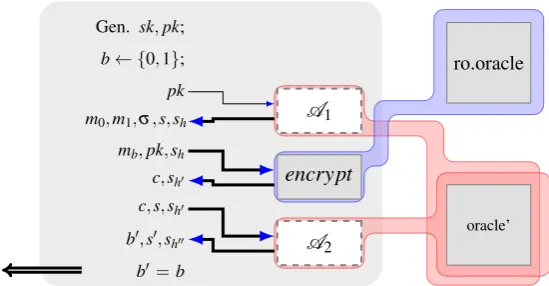
21
Digital Asset (Switzerland) GmbH, Zurich, Switzerland,
[email protected]
2
Institute of Information Security, Department of Computer Science,
ETH Zurich, Zurich, Switzerland,
[email protected]
Abstract
This tutorial demonstrates how cryptographic security notions, constructions, and game-based security proofs can be formalized using the CryptHOL frame-work. As a running example, we formalize a variant of the hash-based ElGamal encryption scheme and its IND-CPA security in the random oracle model. This tutorial assumes familiarity with Isabelle/HOL basics and standard cryptographic terminology.
1
Introduction
CryptHOL [2,9] is a framework for constructing rigorous game-based proofs using the proof assistant Isabelle/HOL [13]. Games are expressed as probabilistic functional programs that are shallowly embedded in higher-order logic (HOL) using CryptHOL’s combinators. The security statements, both concrete and asymptotic, are expressed as Isabelle/HOL theorem statements, and their proofs are written declaratively in Is-abelle’s proof language Isar [18]. This way, Isabelle mechanically checks that all defi-nitions and statements are type-correct and each proof step is a valid logical inference in HOL. This ensures that the resulting theorems are valid in higher-order logic. This tutorial explains the CryptHOL essentials using a simple security proof. Our running example is a variant of the hashed ElGamal encryption scheme [5]. We for-malize the scheme, the indistinguishability under chosen plaintext (IND-CPA) security property, the computational Diffie-Hellman (CDH) hardness assumption [3], and the security proof in the random oracle model. This illustrates how the following aspects of a cryptographic security proof are formalized using CryptHOL:
• Game-based security definitions (CDH in§2.1and IND-CPA in§2.4)
• Oracles (a random oracle in§2.2)
• Cryptographic schemes, both generic (the concept of an encryption scheme) and a particular instance (the hashed Elgamal scheme in§2.5)
• Security statements (concrete and asymptotic,§3.2and§4.2)
• Different kinds of proof steps (§§3.3–3.8):
– Using intermediate games
– Defining failure events and applying indistinguishability-up-to lemmas
– Equivalence transformations on games
This tutorial assumes that the reader knows the basics of Isabelle/HOL and game-based cryptography and wants to get hands-on with CryptHOL. The semantics behind CryptHOL’s embedding in higher-order logic and its soundness are not discussed; we refer the reader to the scientific articles for that [2,9]. Shoup’s tutorial [16] provides a good introduction to game-based proofs. The following Isabelle features are frequently used in CryptHOL formalizations; the tutorials are available from the Documentation panel in Isabelle/jEdit.
• Function definitions (tutorialsprog-proveandfunctions, [8])
• Locales (tutoriallocales, [1])
• The Transfer package [7]
This document is generated from a corresponding Isabelle theory file available on-line [11].1 It contains this text and all examples, including the security definitions and proofs. We encourage all readers to download the latest version of the tutorial and fol-low the proofs and examples interactively in Isabelle/HOL. In particular, a Ctrl-click on a formal entity (function, constant, theorem name, ...) jumps to the definition of the entity.
We split the tutorial into a series of recipes for common formalization tasks. In each section, we cover a familiar cryptography concept and show how it is formalized in CryptHOL. Simultaneously, we explain the Isabelle/HOL and functional programming topics that are essential for formalizing game-based proofs.
1.1
Getting started
CryptHOL is available as part of the Archive of Formal Proofs [10]. Cryptography formalizations based on CryptHOL are arranged in Isabelle theory files that import the relevant libraries.
theoryCryptHOL-Tutorialimports
CryptHOL.CryptHOL
begin
The file CryptHOL.CryptHOL is the canonical entry point into CryptHOL. For the hashed Elgamal example in this tutorial, the CryptHOL library contains everything that is needed. Additional Isabelle libraries can be imported if necessary.
2
Modelling cryptography using CryptHOL
This section demonstrates how the following cryptographic concepts are modelled in CryptHOL.
• A security property without oracles (§2.1)
• An oracle (§2.2)
• A cryptographic concept (§2.3)
• A security property with an oracle (§2.4)
• A concrete cryptographic scheme (§2.5)
2.1
Security notions without oracles: the CDH assumption
In game-based cryptography, a security property is specified using a game between a challenger and an adversary. The probability of an adversary to win the game against the challenger is called its advantage. A cryptographic construction satisfies a security property if the advantage for any “feasible” adversary is ”negligible”. A typical secu-rity proof reduces the secusecu-rity of a construction to the assumed secusecu-rity of its building blocks. In a concrete security proof, it is therefore not necessary to formally define “feasibility” and ”negligibility”, as the security statement establishes a concrete rela-tion between the advantages of specific adversaries.2 We return to asymptotic security statements in§4.
A formalization of a security property must therefore specify all of the following:
• The operations of the scheme (e.g., an algebraic group, an encryption scheme)
• The type of adversary
• The game with the challenger
• The advantage of the adversary as a function of the winning probability
For hashed Elgamal, the cyclic group must satisfy the computational Diffie-Hellman assumption. To keep the proof simple, we formalize the equivalent list version of CDH.
Definition(The list computational Diffie-Hellman game). LetG be a group of order
qwith generatorg. The List Computational Diffie-Hellman (LCDH) assumption holds forG if any “feasible” adversary has “negligible” probability in winning the following
LCDH gameagainst a challenger:
1. The challenger picksxandyrandomly (and independently) from{0, . . . ,q−1}.
2. It passesgxandgyto the adversary. The adversary generates a setLof guesses about the value ofgxy.
3. The adversary wins the game ifgxy∈L.
The scheme for LCDH uses only a cyclic group. To make the LCDH formalisation reusable, we formalize the LCDH game for an arbitrary cyclic groupG using Isabelle’s module system based on locales. The localelist-cdhfixesG as a finite cyclic group that has elements of type 0grp. Basic facts about finite groups are formalized in the CryptHOL theoryCryptHOL.Cyclic-Group.3
localelist-cdh=cyclic-groupG
forG ::0grp cyclic-group(structure)
begin
The LCDH game does not need oracles. The adversary is therefore just a probabilis-tic function from two group elements to a set of guesses, which are group elements again. In CryptHOL, the probabilistic nature is expressed by the adversary returning a discrete subprobability distribution over sets of guesses, as expressed by the type constructorspmf. We define the following abbreviation as a shorthand for the type of LCDH adversaries.4
type-synonym0grp0adversary=0grp0⇒0grp0⇒0grp0set spmf
The LCDH game itself is expressed as a function from the adversaryA to the subprob-ability distribution of the adversary winning. CryptHOL provides operators to express these distributions as probabilistic programs and reason about them using program log-ics:
• Thedonotation desugars to monadic sequencing in the monad of subprobabili-ties [17]. Intuitively, every linex←p; samples an elementxfrom the distribution
p. The sampling is independent unless the distributionpdepends on previously sampled variables. At the end of the block, thereturn-spmf returns whether the adversary has won the game.
• sample-uniform ndenotes the uniform distribution over the set{0, ...,n−1}.
• orderG denotes the order ofG and([ˆ]):: 0grp ⇒nat ⇒ 0grpis the group exponentiation operator.
The LCDH game formalizes the challenger’s behavior against an adversaryA. In the following definition, the challenger randomly (and independently) picks two natural numbersxandythat are between 0 andG’s order and passes them to the adversary. The adversary then returns a setzsof guesses forgx∗y, wheregis the generator of
G. The game finally returns aboolean that indicates whether the adversary produced a right guess. Formally,gameA is aboolean random variable.
definitiongame::0grp adversary⇒bool spmfwhere
gameA =do{
3The syntax directivestructuretells Isabelle that all group operations in the context of the locale refer to the groupGunless stated otherwise.
Isabelle automatically adds the locale parameters and the assumptions on them to all definitions and lem-mas inside that locale. Of course, we could have made the groupG an explicit argument of all functions ourselves, but then we would not benefit from Isabelle’s module system, in particular locale instantiation.
x←sample-uniform(orderG); y←sample-uniform(orderG); zs←A (g[ˆ]x) (g[ˆ]y); return-spmf(g[ˆ] (x∗y)∈zs)
}
The advantage of the adversary is equivalent to its probability of winning the LCDH game, which is measured using thespmf function.
definitionadvantage:: 0grp adversary⇒real
whereadvantageA =spmf (gameA)True
end
This completes the formalisation of the LCDH game and we close the localelist-cdh
withend. The above definitions are now accessible under the namesgameand advan-tage. Furthermore, when we later instantiate the localelist-cdh, they will be specialized to the given pararameters. We will return to this topic in§2.5.
2.2
A Random Oracle
A cryptographic oracle grants an adversary black-box access to a certain information or functionality. In this section, we formalize a random oracle, i.e., an oracle that models a random function with a finite codomain. In the Elgamal security proof, the random oracle represents the hash function: the adversary can query the oracle for a value and the oracle responds with the corresponding “hash”.
Like for the LCDH formalization, we wrap the random oracle in the localerandom-oracle
for modularity. The random oracle will return abitstring, i.e. a list of booleans, of lengthlen.
type-synonymbitstring=bool list
localerandom-oracle=
fixeslen::nat
begin
In CryptHOL, oracles are modeled as probabilistic transition systems that given an initial state and an input, return a subprobability distribution over the output and the successor state. The type synonym(0s, 0a, 0b)oracle0abbreviates0s⇒ 0a⇒(0b×0s) spmf.
A random oracle accepts queries of type 0aand generates a random bitstring of length
len. The state of the random oracle remembers its previous responses in a mapping of type 0a*bitstring. Upon a queryx, the oracle first checks whether this query was received before. If so, the oracle returns the same answer again. Otherwise, the oracle randomly samples a bitstring of lengthlen, stores it in its state, and returns it alongside with the new state.
type-synonym0a state=0a*bitstring
definitionoracle::0a state⇒0a⇒(bitstring× 0a state)spmf
where
bs←spmf-of-set(nlists UNIV len); return-spmf (bs,σ(x7→bs))} |Some bs⇒return-spmf(bs,σ))
Initially, the state of a random oracle is the empty mapempty, as no queries have been asked. For readability, we introduce an abbreviation:
abbreviation(input)initial:: 0a statewhereinitial≡Map.empty
This actually completes the formalization of the random oracle. Before we close the locale, we prove two technical lemmas:
1. The lemmalossless-oraclestates that the distribution over answers and succes-sor states islossless, i.e., a full probability distribution. Many reasoning steps in game-based proofs are only valid for lossless distributions, so it is generally recommended to prove losslessness of all definitions if possible.
2. The lemmafreshdescribes random oracle’s behavior when the query is fresh. This lemma makes it possible to automatically unfold the random oracle only when it is known that the query is fresh.
lemmalossless-oracle[simp]:lossless-spmf (oracleσx) by(simp add:oracle-def split:option.split)
lemmafresh: oracleσx=
(do{bs←spmf-of-set(nlists UNIV len); return-spmf (bs,σ(x7→bs))})
ifσx=None
usingthatby(simp add:oracle-def)
end
Remark: Independence is the default. Note that- spmf represents a discrete prob-ability distribution rather than a random variable. The difference is that every spmf is independent of all other spmfs. There is no implicit space of elementary events via which information may be passed from one random variable to the other. If such in-formation passing is necessary, this must be made explicit in the program. That is why the random oracle explicitly takes a state of previous responses and returns the updated states. Later, whenever the random oracle is used, the user must pass the state around as needed. This also applies to adversaries that may want to store some information.
2.3
Cryptographic concepts: public-key encryption
A cryptographic concept consists of a set of operations and their functional behaviour. We have already seen two very simple examples: the cyclic group in§2.1and the ran-dom oracle in§2.2. We have formalized both of them as locales; we have not modelled their functional behavior as this is not needed for the proof. In this section, we now present a more realistic example: public-key encryption with oracle access.
access an oracle jointly with the adversary. As before, the operations are modelled as parameters of a locale,ind-cpa-pk.
• The key generation algorithmkey-genoutputs a public-private key pair.
• The encryption operationencrypttakes a public key and a plaintext of type0plain
and outputs a ciphertext of type0cipher.
• The decryption operationdecrypttakes a private key and a ciphertext and outputs a plaintext.
• Additionally, the predicatevalid-plains tests whether the adversary has chosen a valid pair of plaintexts. This operation is needed only in the IND-CPA game definition in the next section, but we include it already here for convenience.
localeind-cpa-pk=
fixeskey-gen::(0pubkey×0privkey,0query,0response)gpv
andencrypt::0pubkey⇒0plain⇒(0cipher,0query,0response)gpv anddecrypt::0privkey⇒0cipher⇒(0plain,0query,0response)gpv
andvalid-plains:: 0plain⇒0plain⇒bool
begin
The three actual operations are generative probabilistic values (GPV) of type(-,0query,
0response)gpv. A GPV is a probabilistic algorithm that has not yet been connected to
its oracles. The interface to the oracle is abstracted in the two type parameters 0query
for queries and 0responsefor responses. As before, we omit the specification of the functional behavior, namely that decrypting an encryption with a key pair returns the plaintext.
2.4
Security notions with oracles: IND-CPA security
In general, there are several security notions for the same cryptographic concept. For encryption schemes, an indistinguishability notion of security [6] is often used. We now formalize the notion indistinguishability under chosen plaintext attacks (IND-CPA) for public-key encryption schemes. Goldwasser et al. [15] showed that IND-CPA is equiv-alent to semantic security.
Definition(IND-CPA). Letkey-gen,encryptanddecryptdenote a public-key encryp-tion scheme. The IND-CPA game is a two-stage game between theadversaryand a
challenger:
Stage 1 (find):
1. The challenger generates a public keypkusingkey-genand gives the public key to the adversary.
2. The adversary returns two messagesm0andm1.
3. The challenger checks that the two messages are a valid pair of plaintexts. (For example, both messages must have the same length.)
Stage 2 (guess):
1. The challenger flips a coinb(either 0 or 1) and givesencrypt pk mbto the
2. The adversary returns a bitb0.
The adversary wins the game if his guess b0is the value of b. Let Pwin denote the
winning probability. His advantage is|Pwin−1/2|
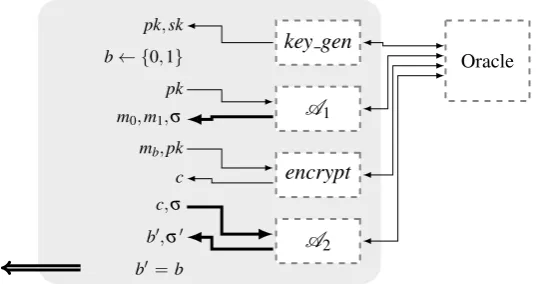
Like for the encryption scheme, we will define the game such that the challenger and the adversary have access to a shared oracle, but the oracle is still unspecified. Conse-quently, the corresponding CryptHOL game is a GPV, like the operations of the abstract encryption scheme. When we specialize the definitions in the next section to the hashed Elgamal scheme, the GPV will be connected to the random oracle.
The type of adversary is now more complicated: It is a pair of probabilistic functions with oracle access, one for each stage of the game. The first computes the pair of plaintext messages and the second guesses the challenge bit. The additional 0state
parameter allows the adversary to maintain state between the two stages.
type-synonym(0pubkey0,0plain0,0cipher0,0query0,0response0,0state)adversary= (0pubkey0⇒((0plain0×0plain0)×0state,0query0,0response0)gpv)
×(0cipher0⇒0state⇒(bool,0query0,0response0)gpv)
The IND-CPA game formalization below follows the above informal definition. There are three points that need some explanation. First, this game differs from the simpler LCDH game in that it works with GPVs instead of SPMFs. Therefore, probability distributions like coin flipscoin-spmf must be lifted from SPMFs to GPVs using the coercionlift-spmf. Second, the assertionassert-gpv(valid-plains m0m1)ensures that
the pair of messages is valid. Third, the constructTRY ELSE catches a violated assertion. In that case, the adversary’s advantage drops to 0 because the result of the game is a coin flip.
fungame::(0pubkey,0plain,0cipher,0query,0response,0state)adversary
⇒(bool,0query,0response)gpv
where
game(A1,A2) =TRY do{ (pk,sk)←key-gen;
((m0,m1),σ)←A1pk;
assert-gpv(valid-plains m0m1);
b←lift-spmf coin-spmf;
cipher←encrypt pk(if b then m0else m1);
b0←A2cipherσ;
Done(b0=b)
}ELSE lift-spmf coin-spmf
Figure1visualizes this game as a grey box. The dashed boxes represent parameters of the game or the locale, i.e., parts that have not yet been instantiated. The actual proba-bilistic program is shown on the left half, which uses the dashed boxes as sub-programs. Arrows in the grey box from the left to the right pass the contents of the variables to the sub-program. Those in the other direction bind the result of the sub-program to new variables. The arrows leaving box indicate the query-response interaction with an ora-cle. The thick arrows emphasize that the adversary’s state is passed around explicitly. The double arrow represents the return value of the game. We will use this to define the adversary’s advantage.
key gen
A1
encrypt
A2
Oracle
pk,sk b← {0,1}
pk m0,m1,σ
mb,pk c c,σ
b0,σ0
b0=b
Figure 1: Graphic representation of the generic IND-CPA game.
initial stateσ :: 0sits initial state. The operatorrun-gpv connects the game with the oracle, whereby the GPV becomes an SPMF.
funadvantage::(0σ,0query,0response)oracle0× 0σ
⇒(0pubkey,0plain,0cipher,0query,0response,0state)adversary⇒real
where
advantage(oracle,σ)A =|spmf (run-gpv oracle(gameA)σ)True−1/2| end
2.5
Concrete cryptographic constructions: the hashed ElGamal
en-cryption scheme
With all the above modelling definitions in place, we are now ready to explain how concrete cryptographic constructions are expressed in CryptHOL. In general, a cryp-tographic construction builds a crypcryp-tographic concept from possibly several simpler cryptographic concepts. In the running example, the hashed ElGamal cipher [5] con-structs a public-key encryption scheme from a finite cyclic group and a hash function. Accordingly, the formalisation consists of three steps:
1. Import the cryptographic concepts on which the construction builds.
2. Define the concrete construction.
3. Instantiate the abstract concepts with the construction.
First, we declare a new locale that imports the two building blocks: the cyclic group from the LCDH game with namespacelcdhand the random oracle for the hash function with namespacero. This ensures that the construction can be used for arbitrary cyclic groups. For the message space, it suffices to fix the lengthlen-plainof the plaintexts.
localehashed-elgamal=
lcdh:list-cdhG +
ro:random-oracle len-plain
forG ::0grp cyclic-group(structure)
andlen-plain::nat
Second, we formalize the hashed ElGamal encryption scheme. Here is the well-known informal definition.
Definition(Hashed Elgamal encryption scheme). LetGbe a cyclic group of orderq
that has a generatorg. Furthermore, lethbe a hash function that maps the elements ofG
to bitstrings, and⊕be the xor operator on bitstrings. The Hashed-ElGamal encryption scheme is given by the following algorithms:
Key generation Pick an elementxrandomly from the set{0, . . . ,q−1}and output the pair(gx,x), wheregxis the public key andxis the private key.
Encryption Given the public keypkand the messagem, pickyrandomly from the set
{0, . . . ,q−1}and output the pair(gy,h(pky)⊕m). Here⊕denotes the bitwise exclusive-or of two bitstrings.
Decryption Given the private keyskand the ciphertext(α,β), outputh(αsk)⊕β.
As we can see, the public key is a group element, the private key a natural number, a plaintext a bitstring, and a ciphertext a pair of a group element and a bitstring.5 For readability, we introduce meaningful abbreviations for these concepts.
type-synonym0grp0pub-key=0grp0
type-synonym0grp0priv-key=nat
type-synonymplain=bitstring
type-synonym0grp0cipher=0grp0×bitstring
We next translate the three algorithms into CryptHOL definitions. The definitions are straightforward except for the hashing. Since we analyze the security in the random or-acle model, an application of the hash functionHis modelled as a query to the random oracle using the GPVhash. Furthermore, we define the plaintext validity predicate to check the length of the adversary’s messages produced by the adversary.
abbreviationhash::0grp⇒(bitstring,0grp,bitstring)gpv
where
hash x≡Pause x Done
definitionkey-gen::(0grp pub-key×0grp priv-key)spmf
where
key-gen=do{
x←sample-uniform(orderG); return-spmf(g[ˆ]x,x)
}
definitionencrypt::0grp pub-key⇒plain⇒(0grp cipher,0grp,bitstring)gpv
where
encryptαmsg=do{
y←lift-spmf(sample-uniform(orderG)); h←hash(α[ˆ]y);
Done(g[ˆ]y,h[⊕]msg)
}
definitiondecrypt::0grp priv-key⇒ 0grp cipher⇒(plain,0grp,bitstring)gpv
key gen
A1
encrypt
A2
ro.oracle
sk,pk b← {0,1}
pk m0,m1,σ
mb,pk c c,σ
b0,σ0
b0=b
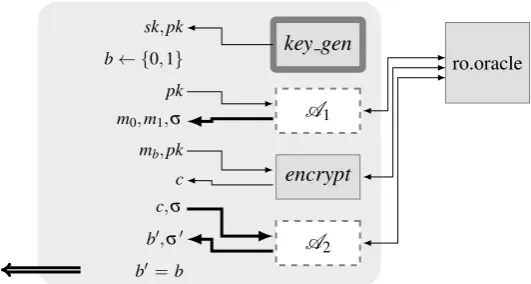
Figure 2: The IND-CPA game instantiated with the Hashed-ElGamal encryption scheme and accessing a random oracle.
where
decrypt x= (λ(β,ζ).do{
h←hash(β[ˆ]x); Done(ζ[⊕]h)
})
definitionvalid-plains::plain⇒plain⇒bool
where
valid-plains msg1 msg2←→length msg1=len-plain∧length msg2=len-plain
The third and last step instantiates the interface of the encryption scheme with the hashed Elgamal scheme. This specializes all definition and theorems in the locale
ind-cpa-pkto our scheme.
sublocaleind-cpa:ind-cpa-pk(lift-spmf key-gen)encrypt decrypt valid-plains.
Figure2 visualizes the instantiation. In comparison to Fig.1, the boxes for the key generation and the encryption algorithm have been instantiated with the hashed Elga-mal definitions from this section. We nevertheless draw the boxes to indicate that the definitions of these algorithms has not yet been inlined in the game definition. The thick grey border around the key generation algorithm denotes thelift-spmf operator, which embeds the probabilistickey-genwithout oracle access into the type of GPVs with oracle access. The oracle has also been instantiated with the random oracleoracle
imported fromhashed-elgamal’s parent localerandom-oraclewith prefixro.
3
Cryptographic proofs in CryptHOL
fea-sible adversaries–to that end, we would have to formally define feasibility, for which CryptHOL currently does not offer any support.
The actual proof of the bound consists of several game transformations. We will focus on those steps that illustrate common steps in cryptographic proofs (§3.3–§3.8) .
3.1
The reduction
The security proof involves a reduction argument: We will derive a bound on the ad-vantage of an arbitrary adversary in the IND-CPA gamegamefor hashed Elgamal that depends on another adversary’s advantage in the LCDH gamegameof the underlying group. The reduction transforms every IND-CPA adversaryA into a LCDH adversary
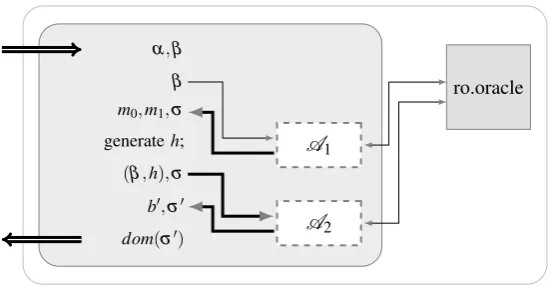
elgamal-reductionA, usingA as a black box. In more detail, it simulates an execu-tion of the IND-CPA game including the random oracle. At the end of the game, the reduction outputs the set of queries that the adversary has sent to the random oracle. In detail, the reduction works as follows given a two part IND-CPA adversaryA = (A1, A2)(Figure3visualizes the reduction as the dotted box):
1. It receives two group elementsαandβfrom the LCDH challenger.
2. The reduction passesα to the adversary as the public key and runsA1to get
messagesm1andm2. The adversary is given access to the random oracle with
the initial stateempty.
3. The assertion checks that the adversary returns two valid plaintexts, i.e.,m1and m2are strings of lengthlen-plain.
4. Instead of actually performing an encryption, the reduction generates a random bitstringh of lengthlen-plain(nlists UNIV len-plaindenotes the set of all bit-strings of lengthlen-plainandspmf-of-setconverts the set into a uniform distri-bution over the set.)
5. The reduction passes(β,h)as the challenge ciphertext to the adversary in the
second phase of the IND-CPA game.
6. The actual guessb0of the adversary is ignored; instead the reduction returns the setdom s0of all queries that the adversary made to the random oracle as its guess for the CDH game.
7. If any of the steps after the first phase fails, the reduction’s guess is the setdom sof oracle queries made during the first phase.
funelgamal-reduction
::(0grp pub-key,plain,0grp cipher,0grp,bitstring,0state)ind-cpa.adversary
⇒0grp lcdh.adversary
where
elgamal-reduction(A1,A2)α β=do{
(((m1,m2),σ),s)←exec-gpv ro.oracle(A1α)ro.initial;
TRY do{
-::unit←assert-spmf (valid-plains m1m2);
h←spmf-of-set(nlists UNIV len-plain);
(b0,s0)←exec-gpv ro.oracle(A2(β,h)σ)s; return-spmf (dom s0)
}ELSE return-spmf(dom s)
A1
A2
ro.oracle
α,β
β
m0,m1,σ
generateh;
(β,h),σ
b0,σ0
dom(σ0)
Figure 3: The reduction for the Elgamal security proof.
3.2
Concrete security statement
A concrete security statement in CryptHOL has the form: Subject to some side condi-tions for the adversaryA, the advantage in one game is bounded by a function of the transformed adversary’s advantage in a different game.6
theoremconcrete-security:
assumesside conditions forA
showsadvantage1A ≤f(advantage2(reductionA))
For the hashed Elgamal scheme, the theorem looks as follows, i.e., the functionf is the identity function.
theoremconcrete-security-elgamal:
assumeslossless:ind-cpa.losslessA
showsind-cpa.advantage(ro.oracle,ro.initial)A ≤lcdh.advantage(elgamal-reductionA)
Such a statement captures the essence of a concrete security proof. For if there was a feasible adversaryA with non-negligible advantage against thegame, thenelgamal-reduction A would be an adversary against thegamewith at least the same advantage. This im-plies the existence of an adversary with non-negligible advantage against the crypto-graphic primitive that was assumed to be secure. What we cannot state formally is that the transformed adversaryelgamal-reductionA is feasible as we have not formalized the notion of feasibility. The readers of the formalization must convince themselves that the reduction preserves feasibility.
In the case of elgamal-reduction, this should be obvious from the definition (given the theorem’s side condition) as the reduction does nothing more than sampling and redirecting data.
Our proof for the concrete security theorem needs the side condition that the adversary is lossless. Losslessness for adversaries is similar to losslessness for subprobability
distributions. It ensures that the adversary always terminates and returns an answer to the challenger. For the IND-CPA game, we define losslessness as follows:
definition(inind-cpa-pk)lossless
::(0pubkey,0plain,0cipher,0query,0response,0state)adversary⇒bool
where
lossless= (λ(A1,A2).(∀pk.lossless-gpvI-full(A1pk))
∧(∀cipherσ.lossless-gpvI-full(A2cipherσ)))
So now let’s start with the proof.
proof−
As a preparatory step, we split the adversaryA into its two phasesA1andA2. We
could have made the two phases explicit in the theorem statement, but our form is easier to read and use. We also immediately decompose the losslessness assumption onA.7
obtainA1A2whereA [simp]:A = (A1,A2)by(casesA)
fromlosslesshavelossless1[simp]:V
pk.lossless-gpvI-full(A1pk)
andlossless2[simp]:V
σcipher.lossless-gpvI-full(A2σcipher)
by(auto simp add:ind-cpa.lossless-def)
3.3
Recording adversary queries
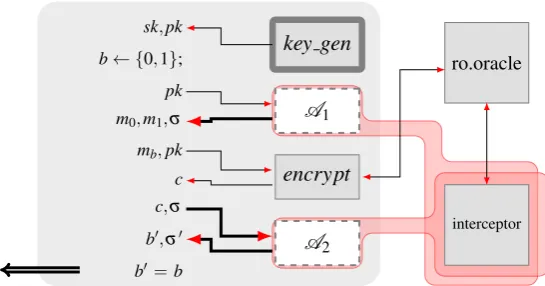
As can be seen in Fig.2, both the adversary and the encryption of the challenge cipher-text use the random oracle. The reduction, however, returns only the queries that the adversary makes to the oracle (in Fig.3,his generated independently of the random oracle). To bridge this gap, we introduce aninterceptorbetween the adversary and the oracle that records all adversary’s queries.
defineinterceptor::0grp set⇒0grp⇒(bitstring× 0grp set,-,-)gpv
where
interceptorσx= (do{
h←hash x; Done(h,insert xσ)
})forσx
We integrate this interceptor into thegameusing theinlinefunction as illustrated in Fig.4and name the resultgame0.
definegame0where
game0=TRY do{
(pk,-)←lift-spmf key-gen;
(((m1,m2),σ),s)←inline interceptor(A1pk){};
assert-gpv(valid-plains m1m2);
b←lift-spmf coin-spmf;
c←encrypt pk(if b then m1else m2); (b0,s0)←inline interceptor(A2cσ)s; Done(b0=b)
}ELSE lift-spmf coin-spmf
key gen
A1
encrypt
A2
ro.oracle
interceptor sk,pk
b← {0,1}; pk m0,m1,σ
mb,pk c c,σ
b0,σ0
b0= b
Figure 4: The IND-CPA game after expanding the key generation algorithm’s defini-tion and inlining the query-recording hash oracle. The red boxes represent the inline operator.
We claim that the above modifications do not affect the output of the IND-CPA game at all. This might seem obvious since we are only logging the adversary’s queries without modifying them. However, in a formal proof, this needs to be precisely justified. More precisely, we have been very careful that the two gamesgame A andgame0
have identical structure. They differ only in thatgame0uses the adversary(λpk.inline interceptor(A1pk) /0,λcipherσ.inline interceptor(A2cipher σ))instead ofA.
The formal justification for this replacement happens in two steps:
1. We replace the oracle transformerinterceptorwithid-oracle, which merely passes queries and results to the oracle.
2. Inlining the identity oracle transformerid-oracledoes not change an adversary and can therefore be dropped.
The first step is automated using Isabelle’s Transfer package [7], which is based on Mitchell’s representation independence [12]. The replacement is controlled by so-called transfer rules of the formR x ywhich indicates thatxshall replacey; the cor-respondence relationRcaptures the kind of replacement. Thetransferproof method then constructs a constraint system with one constraint for each atom in the proof goal where the correspondence relation and the replacement are unknown. It then tries to solve the constraint system using the rules that have been declared with the attribute
[transfer-rule]. Atoms that do not have a suitable transfer rule are not changed and their correspondence relation is instantiated with the identity relation(=).
The second step is automated using Isabelle’s simplifier.
oracle transformers structurally identical except for the state update function. Hav-ing proved that the state update functionλ-σ.σ is a correct replacement for insert
w.r.t. cr, thetransfer-proverthen lifts this replacement to the bisimulation rule. Here,
transfer-prover is similar totransfer except that it works only for transfer rules and builds the constraint system only for the term to be replaced.
The theory source of this tutorial contains a step-by-step proof to illustrate how transfer works.
{definecr::unit⇒ 0grp set⇒boolwherecrσ σ0=Trueforσ σ0 have[transfer-rule]:cr(){}by(simp add:cr-def)— initial states
have[transfer-rule]:((=) ===>cr===>cr) (λ-σ.σ)insert— state update
by(simp add:rel-fun-def cr-def)
have[transfer-rule]: —cris a bisimulation for the oracle transformers
(cr===>(=) ===>rel-gpv(rel-prod(=)cr) (=))id-oracle interceptor
unfoldinginterceptor-def[abs-def]id-oracle-def[abs-def]bind-gpv-Pause bind-rpv-Done
bytransfer-prover
haveind-cpa.gameA =game0unfoldinggame0-defA ind-cpa.game.simps
bytransfer(simp add:bind-map-gpv o-def ind-cpa.game.simps split-def)
}
3.4
Equational program transformations
Before we move on, we need to simplifygame0and inline a few of the definitions. All
these simplifications are equational program transformations, so the Isabelle simplifier can justify them. We combine theinterceptorwith the random oracleoracleinto a new oracleoracle0with which the adversary interacts.
defineoracle0::0grp set×(0grp*bitstring)⇒0grp⇒
-whereoracle0= (λ(s,σ)x.do{
(h,σ0)←caseσx of None⇒do{
bs←spmf-of-set(nlists UNIV len-plain); return-spmf(bs,σ(x7→bs))}
|Some bs⇒return-spmf (bs,σ);
return-spmf(h,insert x s,σ0)
})
have∗:exec-gpv ro.oracle(inline interceptorA s)σ=
map-spmf(λ(a,b,c).((a,b),c)) (exec-gpv oracle0A (s,σ))forA σs by(simp add:interceptor-def oracle0-def ro.oracle-def Let-def
exec-gpv-inline exec-gpv-bind o-def split-def cong del:option.case-cong-weak)
We also want to inline the key generation and encryption algorithms, push theTRY ELSE towards the assertion (which is possible because the adversary is lossless by assumption), and rearrange the samplings a bit. The latter is automated using
monad-normalisation[14].
havegame0:run-gpv ro.oracle game0ro.initial=do{
x←sample-uniform(orderG); y←sample-uniform(orderG); b←coin-spmf;
(((msg1,msg2),σ),(s,s-h))←
exec-gpv oracle0(A1(g[ˆ]x)) ({},ro.initial);
TRY do{
(h,s-h0)←ro.oracle s-h(g[ˆ] (x∗y));
let cipher= (g[ˆ]y,h[⊕] (if b then msg1 else msg2));
(b0,(s0,s-h00))←exec-gpv oracle0(A2cipherσ) (s,s-h0); return-spmf(b0=b)
}ELSE do{
b←coin-spmf; return-spmf b
} }
includingmonad-normalisation
by(simp add:game0-def key-gen-def encrypt-def∗exec-gpv-bind bind-map-spmf assert-spmf-def
try-bind-assert-gpv try-gpv-bind-lossless split-def o-def if-distribs lcdh.nat-pow-pow) This call to Isabelle’s simplifier may look complicated at first, but it can be constructed incrementally by adding a few theorems and looking at the resulting goal state and searching for suitable theorems using find-theorems. As always in Isabelle, some intuition and knowledge about the library of lemmas is crucial.
• We knew that the definitionsgame0-def,key-gen-def, andencrypt-def should be unfolded, so they are added first to the simplifier’s set of rewrite rules.
• The equationsexec-gpv-bind,try-bind-assert-gpv, andtry-gpv-bind-lossless en-sure that the operatorexec-gpv, which connects thegame0with the random ora-cle, is distributed over the sequencing. Together with∗, this gives the adversary access tooracle0instead of the interceptor and the random oracle, and makes the call to the random oracle in the encryption of the chosen message explicit.
• The theoremlcdh.nat-pow-powrewrites the iterated exponentiation(g[ˆ]x) [ˆ] ytog[ˆ] (x∗y).
• The other theoremsbind-map-spmf,assert-spmf-def,split-def,o-def, andif-distribs
take care of all the boilerplate code that makes all these transformations type-correct.
Note that the state of the oracleoracle0is changed betweenA1andA2. Namely, the
random oracle’s parts-hmay change when the chosen message is encrypted, but the state that records the adversary’s queriessis passed on unchanged.
3.5
Capturing a failure event
A1
encrypt
A2
ro.oracle
oracle’ Gen. sk,pk;
b← {0,1}; pk m0,m1,σ,s,sh mb,pk,sh c,sh0 c,s,sh0 b0,s0,sh00 b0= b
Figure 5: The IND-CPA game after flattening. The blue box around the encryption algorithm and the random oracle represents the expanded definition of them.
Introducing a failure event into a game is straightforward. So far, the gamesgame
andgame0 simply denoted the probability distribution of whether the adversary has
guessed right. For hashed Elgamal, the simulation breaks if the adversary queries the random oracle with the same queryg[ˆ] (x∗y)that is used for encrypting the chosen messagemb. So we simply change the return type of the game to return whether the
adversary guessed rightandwhether the failure event has occurred. The next definition
game1does so. (Recall thatoracle0stores in its first state componentsthe queries by the adversary.) In preparation of the next reasoning step, we also split off the first two samplings, namely ofxandy, and make them parameters ofgame1.
definegame1::nat⇒nat⇒(bool×bool)spmf
wheregame1x y=do{
b←coin-spmf;
(((m1,m2),σ),(s,s-h))←exec-gpv oracle0(A1(g[ˆ]x)) ({},ro.initial);
TRY do{
-::unit←assert-spmf(valid-plains m1m2); (h,s-h0)←ro.oracle s-h(g[ˆ] (x∗y)); let c= (g[ˆ]y,h[⊕] (if b then m1else m2));
(b0,(s0,s-h00))←exec-gpv oracle0(A2cσ) (s,s-h0);
return-spmf(b0=b,g[ˆ] (x∗y)∈s0)
}ELSE do{
b←coin-spmf;
return-spmf(b,g[ˆ] (x∗y)∈s)
} }forx y
It is easy to prove thatgame0combined with the random oracle is a projection ofgame1
with the sampling added:
let?sample=λf::nat⇒nat⇒- spmf.do{
x←sample-uniform(orderG); y←sample-uniform(orderG); f x y}
havegame0-game1:
run-gpv ro.oracle game0ro.initial=map-spmf fst(?sample game1)
3.6
Game hop based on a failure event
A game hop based on a failure event changes one game into another such that they behave identical unless the failure event occurs. Thefundamental-lemmabounds the absolute difference between the two games by the probability of the failure event. In the running example, we would like to avoid querying the random oracle when en-crypting the chosen message. The next gamegame2is identical except that the call to the random oracleoracleis replaced with sampling a random bitstring.
definegame2::nat⇒nat⇒(bool×bool)spmf
wheregame2x y=do{
b←coin-spmf;
(((m1,m2),σ),(s,s-h))←exec-gpv oracle0(A1(g[ˆ]x)) ({},ro.initial);
TRY do{
-::unit←assert-spmf(valid-plains m1m2);
h←spmf-of-set(nlists UNIV len-plain);
— We do not query the random oracle forg[ˆ] (x∗y), but instead sample a random bitstring hdirectly. So the rest differs fromgame1only if the adversary queriesg[ˆ] (x∗y).
let cipher= (g[ˆ]y,h[⊕] (if b then m1else m2)); (b0,(s0,s-h0))←exec-gpv oracle0(A2cipherσ) (s,s-h);
return-spmf(b0=b,g[ˆ] (x∗y)∈s0)
}ELSE do{
b←coin-spmf;
return-spmf(b,g[ˆ] (x∗y)∈s)
} }forx y
To apply thefundamental-lemma, we first have to prove that the two games are indeed the same except when the failure event occurs.
haverel-spmf (λ(win,bad) (win0,bad0).bad=bad0∧(¬bad0−→win=win0)) (game2x y) (game1x y)forx y
proof−
This proof requires two invariants on the state oforacle0. First,s=dom s-h. Second,s
only becomes larger. The next two statements capture the two invariants:
interpretinv-oracle0:callee-invariant-on oracle0(λ(s,s-h).s=dom s-h)I-full
byunfold-locales(auto simp add:oracle0-def split:option.split-asm if-split)
interpretbad:callee-invariant-on oracle0(λ(s,-).z∈s)I-fullforz
byunfold-locales(auto simp add:oracle0-def)
First, we identify a bisimulation relation?Xbetween the different states oforacle0for the second phase of the game. Namely, the invariants =dom s-hholds, the set of queries are the same, and the random oracle’s state (a map from queries to responses) differs only at the pointg[ˆ] (x∗y).
let?X=λ(s,s-h) (s0,s-h0).s=dom s-h∧s0=s∧s-h=s-h0(g[ˆ] (x∗y):=None)
Then, we can prove that?Xreally is a bisimulation fororacle0except when the failure event occurs. The next statement expresses this.
let?bad=λ(s,s-h).g[ˆ] (x∗y)∈s
let?R= (λ(a,s10) (b,s20).?bad s10=?bad s20∧(¬?bad s20−→a=b∧?X s10s20))
havebisim:rel-spmf ?R(oracle0s1 plain) (oracle0s2 plain)
by(auto split:prod.splits intro!:rel-spmf-bind-reflI simp add:oracle0-def rel-spmf-return-spmf2 fun-upd-twist split:option.split dest!:fun-upd-eqD)
haveinv:callee-invariant oracle0?bad
— Once the failure event has happened, it will not be forgotten any more.
by(unfold-locales)(auto simp add:oracle0-def split:option.split-asm)
Now we are ready to prove that the two gamesgame1andgame2are sufficiently similar. The Isar proof now switches into anapplyscript that manipulates the goal state directly. This is sometimes convenient when it would be too cumbersome to spell out every intermediate goal state.
show?thesis
unfoldinggame1-def game2-def
— Peel off the first phase of the game using the structural decomposition rulesrel-spmf-bind-reflI andrel-spmf-try-spmf.
apply(clarsimp intro!:rel-spmf-bind-reflI simp del:bind-spmf-const)
apply(rule rel-spmf-try-spmf)
subgoalTRYforb m1m2σs s-h apply(rule rel-spmf-bind-reflI)
— Exploit that in the first phase of the game, the setsof queried strings and the map of the random oracles-hare updated in lock step, i.e.,s=dom s-h.
apply(drule inv-oracle0.exec-gpv-invariant;clarsimp)
— Has the adversary queried the random oracle withg[ˆ] (x∗y)during the first phase?
apply(casesg[ˆ] (x∗y)∈s)
subgoalTrue— Then the failure event has already happened and there is nothing more to do. We just have to prove that the two games on both sides terminate with the same probability.
by(auto intro!:rel-spmf-bindI1 rel-spmf-bindI2 lossless-exec-gpv[whereI=I-full]dest!: bad.exec-gpv-invariant)
subgoalFalse— Then let’s see whether the adversary queriesg[ˆ] (x∗y)in the second phase. Thanks toro.fresh, the call to the random oracle simplifies to sampling a random bitstring.
apply(clarsimp iff del:domIff simp add:domIff ro.fresh intro!:rel-spmf-bind-reflI)
apply(rule rel-spmf-bindI[whereR=?R])
— The lemmaexec-gpv-oracle-bisim-bad-fulllifts the bisimulation fororacle0to the adversaryA2interacting withoracle0.
apply(rule exec-gpv-oracle-bisim-bad-full[OF - - bisim inv inv])
apply(auto simp add:fun-upd-idem)
done done
subgoalELSEby(rule rel-spmf-reflI)clarsimp
done qed
Now we can add the sampling of x andy in front ofgame1 andgame2, apply the fundamental-lemma.
hencerel-spmf (λ(win,bad) (win0,bad0).(bad←→bad0) ∧(¬bad0−→win ←→win0)) (?sample game2) (?sample game1)
by(intro rel-spmf-bind-reflI)
hence|measure(measure-spmf (?sample game2)){(win,-).win} −measure(measure-spmf (?sample game1)){(win,-).win}|
≤measure(measure-spmf(?sample game2)){(-,bad).bad}
unfoldingsplit-def by(rule fundamental-lemma)
moreover
failure) are elementary events. We therefore transform the above statement to measure the probability of elementary events usingspmf.
havemeasure(measure-spmf(?sample game2)){(win,-).win}=spmf(map-spmf fst(?sample
game2))True
andmeasure(measure-spmf(?sample game1)){(win,-).win}=spmf(map-spmf fst(?sample
game1))True
andmeasure(measure-spmf(?sample game2)){(-,bad).bad}=spmf(map-spmf snd(?sample
game2))True
unfoldingspmf-conv-measure-spmf measure-map-spmfby(auto simp add:vimage-def split-def)
ultimately havehop12:
|spmf(map-spmf fst(?sample game2))True−spmf (map-spmf fst(?sample game1))True|
≤spmf(map-spmf snd(?sample game2))True
bysimp
3.7
Optimistic sampling: the one-time-pad
This step is based on the one-time-pad, which is an instance of optimistic sampling. If two runs of the two games in an optimistic sampling step would use the same random bits, then their results would be different. However, if the adversary’s choices are independent of the random bits, we may relate runs that use different random bits, as in the end, only the probabilities have to match. The previous game hop fromgame1to
game2made the oracle’s responses in the second phase independent from the encrypted ciphertext. So we can now change the bits used for encrypting the chosen message and thereby make the ciphertext independent of the message.
To that end, we parametrizegame2by the part that does the optimistic sampling and call this parametrized versiongame3.
definegame3::(bool⇒bitstring⇒bitstring⇒bitstring spmf)⇒nat⇒nat⇒(bool×bool)
spmf
wheregame3f x y=do{
b←coin-spmf;
(((m1,m2),σ),(s,s-h))←exec-gpv oracle0(A1(g[ˆ]x)) ({},ro.initial);
TRY do{
-::unit←assert-spmf(valid-plains m1m2);
h0←f b m1m2;
let cipher= (g[ˆ]y,h0);
(b0,(s0,s-h0))←exec-gpv oracle0(A2cipherσ) (s,s-h); return-spmf(b0=b,g[ˆ] (x∗y)∈s0)
}ELSE do{
b←coin-spmf;
return-spmf(b,g[ˆ] (x∗y)∈s)
} }forf x y
Clearly, if we plug in the appropriate function?f, then we getgame2:
let?f =λb m1 m2.map-spmf (λh.(if b then m1 else m2) [⊕]h) (spmf-of-set(nlists UNIV
len-plain))
havegame2-game3:game2x y=game3?f x yforx y
by(simp add:game2-def game3-def Let-def bind-map-spmf xor-list-commute o-def)
length. The congruence rulestry-spmf-cong bind-spmf-cong[OF refl ]if-cong[OF refl]extract this information from the program of the game.
let?f0=λb m1m2.spmf-of-set(nlists UNIV len-plain)
havegame3:game3?f x y=game3?f0x yforx y
by(auto intro!:try-spmf-cong bind-spmf-cong[OF refl]if-cong[OF refl]
simp add:game3-def split-def one-time-pad valid-plains-def
simp del:map-spmf-of-set-inj-on bind-spmf-const split:if-split)
The rest of the proof consists of simplifyinggame3?f0. The steps are similar to what we
have shown before, so we do not explain them in detail. The interested reader can look at them in the theory file from which this document was generated. At a high level, we see that there is no need to track the adversary’s queries ingame2orgame3any more
because this information is already stored in the random oracle’s state. So we change theoracle0back intooracleusing the Transfer package. With a bit of rewriting, the result is then thegamefor the adversaryelgamal-reductionA. Moreover, the guessb0
of the adversary is independent ofbingame3?f, so the first boolean returned bygame3 ?f0is just a coin flip.
havegame3-bad:map-spmf snd(?sample(game3?f0)) =lcdh.game(elgamal-reductionA)
havegame3-guess:map-spmf fst(game3?f0x y) =coin-spmfforx y
3.8
Combining several game hops
Finally, we combine all the (in)equalities of the previous steps to obtain the desired bound using the lemmas for reasoning about reals from Isabelle’s library.
haveind-cpa.advantage(ro.oracle,ro.initial)A =|spmf(map-spmf fst(?sample game1))True
−1/2|
usingind-cpa-game-eq-game0by(simp add:game0-game1o-def)
also have. . .=|1/2−spmf (map-spmf fst(?sample game1))True|
by(simp add:abs-minus-commute)
also have1/2=spmf (map-spmf fst(?sample game2))True
by(simp add:game2-game3game3o-def game3-guess spmf-of-set)
also have|. . .−spmf (map-spmf fst(?sample game1))True| ≤spmf (map-spmf snd(?sample
game2))True
by(rule hop12)
also have. . .=lcdh.advantage(elgamal-reductionA)
by(simp add:game2-game3game3game3-bad lcdh.advantage-def o-def del:map-bind-spmf)
finally show?thesis.
This completes the concrete proof and we can end the localehashed-elgamal.
qed
end
4
Asymptotic security
An asymptotic security statement can be easily derived from a concrete security theo-rem. This is done in two steps: First, we have to introduce a security parameterη to
4.1
Introducing a security parameter
Since all our definitions were done in locales, it is easy to introduce a security parameter after the fact. To that end, we define copies of all locales where their parameters now take the security parameter as an additional argument. We illustrate it for the locale
ind-cpa-pk.
Thesublocalecommand brings all the definitions and theorems of the originalind-cpa-pk
into the copy and adds the security parameter where necessary.
localeind-cpa-pk0=
fixeskey-gen::security⇒(0pubkey×0privkey,0query,0response)gpv
andencrypt::security⇒ 0pubkey⇒0plain⇒(0cipher,0query,0response)gpv
anddecrypt::security⇒ 0privkey⇒ 0cipher⇒(0plain,0query,0response)gpv andvalid-plains::security⇒0plain⇒0plain⇒bool
begin
sublocaleind-cpa-pk key-genηencryptηdecryptηvalid-plainsηforη. end
We do so similarly forlist-cdh,random-oracle, andhashed-elgamal.
localehashed-elgamal0=
lcdh:list-cdh0G+
ro:random-oracle0len-plain
forG ::security⇒0grp cyclic-group andlen-plain::security⇒nat
begin
sublocalehashed-elgamalG ηlen-plainηforη..
4.2
Asymptotic security statements
For asymptotic security statements, CryptHOL defines the predicatenegligible. It states that the given real-valued function approaches 0 faster than the inverse of any polyno-mial. A concrete security statement translates into an asymptotic one as follows:
• All advantages in the bound become negligibility assumptions.
• All side conditions of the concrete security theorems remain assumptions, but wrapped into an eventually statement. This expresses that the side condition holds eventually, i.e., there is a security parameter from which on it holds.
• The conclusion is that the bounded advantage isnegligible.
theoremasymptotic-security-elgamal:
assumesnegligible(λ η.lcdh.advantageη(elgamal-reductionη(A η))) andeventually(λ η.ind-cpa.lossless(A η))at-top
showsnegligible(λ η.ind-cpa.advantageη(ro.oracleη,ro.initial) (A η))
The proof is canonical, too: Using the lemmas aboutnegligibleand Eberl’s library for asymptotic reasoning [4], we transform the asymptotic statement into a concrete one and then simply use the concrete security statement.
apply(rule negligible-mono[OF assms(1)])
apply(rule landau-o.big-mono)
apply(intro eventuallyI impI)
apply(simp del:ind-cpa.advantage.simps add:ind-cpa.advantage-nonneg lcdh.advantage-nonneg)
by(rule concrete-security-elgamal)
end
References
[1] C. Ballarin. Locales: A module system for mathematical theories. Journal of Automated Reasoning, 52(2):123–153, Feb 2014.
[2] D. A. Basin, A. Lochbihler, and S. R. Sefidgar. Crypthol: Game-based proofs in higher-order logic.IACR Cryptology ePrint Archive, 2017:753, 2017.
[3] W. Diffie and M. Hellman. New directions in cryptography. IEEE Transactions on Information Theory, 22(6):644–654, 1976.
[4] M. Eberl. Landau symbols. Archive of Formal Proofs, Jul 2015. http://isa-afp. org/entries/Landau Symbols.html, Formal proof development.
[5] T. ElGamal. A public key cryptosystem and a signature scheme based on discrete logarithms.IEEE Transactions on Information Theory, 31(4):469–472, 1985.
[6] S. Goldwasser and S. Micali. Probabilistic encryption & how to play mental poker keeping secret all partial information. InACM Symposium on Theory of Computing (STOC 1982), Proceedings, pages 365–377, 1982.
[7] B. Huffman and O. Kunˇcar. Lifting and Transfer: A modular design for quotients in Isabelle/HOL. InCertified Programs and Proofs (CPP 2013), Proceedings, pages 131–146, 2013.
[8] A. Krauss.Automating Recursive Definitions and Termination Proofs in Higher-Order Logic. Dissertation, Technische Universit¨at M¨unchen, 2009.
[9] A. Lochbihler. Probabilistic functions and cryptographic oracles in higher or-der logic. InEuropean Symposium on Programming (ESOP 2016), Proceedings, pages 503–531, 2016.
[10] A. Lochbihler. Crypthol.Archive of Formal Proofs, May 2017.http://isa-afp.org/ entries/CryptHOL.html, Formal proof development.
[11] A. Lochbihler, S. R. Sefidgar, and B. Bhatt. Game-based cryptography in hol.
Archive of Formal Proofs, 2017. http://isa-afp.org/entries/Game Based Crypto. shtml, Formal proof development.
[12] J. C. Mitchell. Representation independence and data abstraction. In ACM SIGACT-SIGPLAN Symposium on Principles of Programming Languages (POPL 1986), Proceedings, pages 263–276, 1986.
[14] J. Schneider, M. Eberl, and A. Lochbihler. Monad normalisation. Archive of Formal Proofs, May 2017. http://isa-afp.org/entries/Monad Normalisation.html, Formal proof development.
[15] G. Shafi and S. Micali. Probabilistic encryption.Journal of Computer and System Sciences, 28(2):270–299, 1984.
[16] V. Shoup. Sequences of games: A tool for taming complexity in security proofs.
IACR Cryptology ePrint Archive, 2004:332, 2004.
[17] P. Wadler and S. Blott. How to make ad-hoc polymorphism less ad hoc. InACM SIGPLAN-SIGACT Symposium on Principles of Programming Languages (POPL 1989), Proceedings, pages 60–76, 1989.