Quasi-Model-Independent Search for New High
p
TPhysics at D0
B. Abbott,56A. Abdesselam,11M. Abolins,49V. Abramov,24B. S. Acharya,16D. L. Adams,58M. Adams,36G. A. Alves,2 N. Amos,48 E. W. Anderson,41M. M. Baarmand,53V. V. Babintsev,24 L. Babukhadia,53 T. C. Bacon,26A. Baden,45
B. Baldin,35 P. W. Balm,19 S. Banerjee,16E. Barberis,28 P. Baringer,42J. F. Bartlett,35 U. Bassler,12 D. Bauer,26 A. Bean,42 M. Begel,52A. Belyaev,23 S. B. Beri,14G. Bernardi,12 I. Bertram,25 A. Besson,9R. Beuselinck,26 V. A. Bezzubov,24 P. C. Bhat,35V. Bhatnagar,11 M. Bhattacharjee,53 G. Blazey,37 S. Blessing,33A. Boehnlein,35 N. I. Bojko,24 F. Borcherding,35A. Brandt,58R. Breedon,29G. Briskin,57 R. Brock,49G. Brooijmans,35 A. Bross,35 D. Buchholz,38 M. Buehler,36 V. Buescher,52 V. S. Burtovoi,24 J. M. Butler,46 F. Canelli,52 W. Carvalho,3D. Casey,49
Z. Casilum,53 H. Castilla-Valdez,18D. Chakraborty,53K. M. Chan,52S. V. Chekulaev,24 D. K. Cho,52 S. Choi,32 S. Chopra,54 J. H. Christenson,35 M. Chung,36D. Claes,50 A. R. Clark,28 J. Cochran,32L. Coney,40 B. Connolly,33 W. E. Cooper,35D. Coppage,42 M. A. C. Cummings,3,7D. Cutts,57G. A. Davis,52 K. Davis,27K. De,58K. Del Signore,48
M. Demarteau,35R. Demina,43P. Demine,9D. Denisov,35 S. P. Denisov,24S. Desai,53H. T. Diehl,35 M. Diesburg,35 G. Di Loreto,49 S. Doulas,47 P. Draper,58 Y. Ducros,13 L. V. Dudko,23 S. Duensing,20 L. Duflot,11 S. R. Dugad,16 A. Dyshkant,24D. Edmunds,49 J. Ellison,32 V. D. Elvira,35R. Engelmann,53S. Eno,45G. Eppley,60 P. Ermolov,23 O. V. Eroshin,24J. Estrada,52 H. Evans,51 V. N. Evdokimov,24T. Fahland,31S. Feher,35 D. Fein,27T. Ferbel,52 F. Filthaut,20 H. E. Fisk,35 Y. Fisyak,54 E. Flattum,35F. Fleuret,28M. Fortner,37 K. C. Frame,49S. Fuess,35 E. Gallas,35 A. N. Galyaev,24 M. Gao,51 V. Gavrilov,22R. J. Genik II,25 K. Genser,35C. E. Gerber,36 Y. Gershtein,57R. Gilmartin,33
G. Ginther,52B. Gómez,5G. Gómez,45P. I. Goncharov,24 J. L. González Solís,18 H. Gordon,54 L. T. Goss,59 K. Gounder,32 A. Goussiou,53 N. Graf,54 G. Graham,45 P. D. Grannis,53 J. A. Green,41H. Greenlee,35S. Grinstein,1 L. Groer,51S. Grünendahl,35A. Gupta,16S. N. Gurzhiev,24G. Gutierrez,35P. Gutierrez,56 N. J. Hadley,45H. Haggerty,35
S. Hagopian,33V. Hagopian,33 K. S. Hahn,52R. E. Hall,30 P. Hanlet,47 S. Hansen,35J. M. Hauptman,41C. Hays,51 C. Hebert,42D. Hedin,37A. P. Heinson,32U. Heintz,46 T. Heuring,33R. Hirosky,61J. D. Hobbs,53B. Hoeneisen,8 J. S. Hoftun,57 S. Hou,48Y. Huang,48 R. Illingworth,26 A. S. Ito,35M. Jaffré,11 S. A. Jerger,49 R. Jesik,39K. Johns,27
M. Johnson,35 A. Jonckheere,35 M. Jones,34H. Jöstlein,35 A. Juste,35 S. Kahn,54E. Kajfasz,10 D. Karmanov,23 D. Karmgard,40 S. K. Kim,17 B. Klima,35 C. Klopfenstein,29 B. Knuteson,28W. Ko,29J. M. Kohli,14A. V. Kostritskiy,24 J. Kotcher,54A. V. Kotwal,51 A. V. Kozelov,24E. A. Kozlovsky,24J. Krane,41M. R. Krishnaswamy,16S. Krzywdzinski,35 M. Kubantsev,43S. Kuleshov,22 Y. Kulik,53S. Kunori,45V. E. Kuznetsov,32G. Landsberg,57 A. Leflat,23C. Leggett,28
F. Lehner,35 J. Li,58 Q. Z. Li,35J. G. R. Lima,3D. Lincoln,35 S. L. Linn,33J. Linnemann,49 R. Lipton,35A. Lucotte,9 L. Lueking,35C. Lundstedt,50 C. Luo,39A. K. A. Maciel,3,7 R. J. Madaras,28 V. Manankov,23 H. S. Mao,4T. Marshall,39
M. I. Martin,35R. D. Martin,36 K. M. Mauritz,41 B. May,38 A. A. Mayorov,39R. McCarthy,53 J. McDonald,33 T. McMahon,55H. L. Melanson,35 X. C. Meng,4M. Merkin,23 K. W. Merritt,35 C. Miao,57H. Miettinen,60 D. Mihalcea,56 C. S. Mishra,35N. Mokhov,35N. K. Mondal,16H. E. Montgomery,35R. W. Moore,49M. Mostafa,1
H. da Motta,2E. Nagy,10F. Nang,27 M. Narain,46V. S. Narasimham,16H. A. Neal,48 J. P. Negret,5S. Negroni,10 D. Norman,59 T. Nunnemann,35 L. Oesch,48 V. Oguri,3B. Olivier,12N. Oshima,35 P. Padley,60 L. J. Pan,38 K. Papageorgiou,26 A. Para,35 N. Parashar,47R. Partridge,57N. Parua,53M. Paterno,52 A. Patwa,53B. Pawlik,21 J. Perkins,58M. Peters,34 O. Peters,19 P. Pétroff,11 R. Piegaia,1H. Piekarz,33 B. G. Pope,49E. Popkov,46H. B. Prosper,33 S. Protopopescu,54 J. Qian,48P. Z. Quintas,35R. Raja,35 S. Rajagopalan,54 E. Ramberg,35 P. A. Rapidis,35N. W. Reay,43
S. Reucroft,47J. Rha,32 M. Ridel,11 M. Rijssenbeek,53 T. Rockwell,49 M. Roco,35 P. Rubinov,35 R. Ruchti,40 J. Rutherfoord,27A. Santoro,2L. Sawyer,44 R. D. Schamberger,53 H. Schellman,38 A. Schwartzman,1N. Sen,60 E. Shabalina,23R. K. Shivpuri,15D. Shpakov,47M. Shupe,27R. A. Sidwell,43 V. Simak,7H. Singh,32J. B. Singh,14 V. Sirotenko,35P. Slattery,52E. Smith,56 R. P. Smith,35R. Snihur,38 G. R. Snow,50 J. Snow,55S. Snyder,54J. Solomon,36
V. Sorín,1M. Sosebee,58 N. Sotnikova,23K. Soustruznik,6M. Souza,2N. R. Stanton,43G. Steinbrück,51 R. W. Stephens,58F. Stichelbaut,54D. Stoker,31V. Stolin,22 D. A. Stoyanova,24 M. Strauss,56M. Strovink,28 L. Stutte,35A. Sznajder,3W. Taylor,53 S. Tentindo-Repond,33J. Thompson,45 D. Toback,45 S. M. Tripathi,29 T. G. Trippe,28 A. S. Turcot,54P. M. Tuts,51P. van Gemmeren,35 V. Vaniev,24 R. Van Kooten,39 N. Varelas,36 A. A. Volkov,24A. P. Vorobiev,24 H. D. Wahl,33 H. Wang,38Z.-M. Wang,53J. Warchol,40G. Watts,62 M. Wayne,40
H. Weerts,49A. White,58 J. T. White,59 D. Whiteson,28J. A. Wightman,41 D. A. Wijngaarden,20 S. Willis,37 S. J. Wimpenny,32 J. V. D. Wirjawan,5,9J. Womersley,35 D. R. Wood,47 R. Yamada,35 P. Yamin,54T. Yasuda,35 K. Yip,54
S. Youssef,33 J. Yu,35 Z. Yu,38 M. Zanabria,5H. Zheng,40 Z. Zhou,41M. Zielinski,52 D. Zieminska,39A. Zieminski,39 V. Zutshi,52 E. G. Zverev,23 and A. Zylberstejn13
(D0 Collaboration)
1Universidad de Buenos Aires, Buenos Aires, Argentina
2LAFEX, Centro Brasileiro de Pesquisas Fìsicas, Rio de Janeiro, Brazil
3Universidade do Estado do Rio de Janeiro, Rio de Janeiro, Brazil
4Institute of High Energy Physics, Beijing, Peoples Republic of China
5Universidad de los Andes, Bogotá, Colombia
6Charles University, Prague, Czech Republic
7Institute of Physics, Academy of Sciences, Prague, Czech Republic
8Universidad San Francisco de Quito, Quito, Ecuador
9Institut des Sciences Nucléaires, IN2P3-CNRS, Universite de Grenoble 1, Grenoble, France
10CPPM, IN2P3-CNRS, Université de la Méditerranée, Marseille, France
11Laboratoire de l’Accélérateur Linéaire, IN2P3-CNRS, Orsay, France
12LPNHE, Universités Paris VI and VII, IN2P3-CNRS, Paris, France
13DAPNIA/Service de Physique des Particules, CEA, Saclay, France
14Panjab University, Chandigarh, India
15Delhi University, Delhi, India
16Tata Institute of Fundamental Research, Mumbai, India
17Seoul National University, Seoul, Korea
18CINVESTAV, Mexico City, Mexico
19FOM-Institute NIKHEF and University of Amsterdam/NIKHEF, Amsterdam, The Netherlands
20University of Nijmegen/NIKHEF, Nijmegen, The Netherlands
21Institute of Nuclear Physics, Kraków, Poland
22Institute for Theoretical and Experimental Physics, Moscow, Russia
23Moscow State University, Moscow, Russia
24Institute for High Energy Physics, Protvino, Russia
25Lancaster University, Lancaster, United Kingdom
26Imperial College, London, United Kingdom
27University of Arizona, Tucson, Arizona 85721
28Lawrence Berkeley National Laboratory and University of California, Berkeley, California 94720
29University of California, Davis, California 95616
30California State University, Fresno, California 93740
31University of California, Irvine, California 92697
32University of California, Riverside, California 92521
33Florida State University, Tallahassee, Florida 32306
34University of Hawaii, Honolulu, Hawaii 96822
35Fermi National Accelerator Laboratory, Batavia, Illinois 60510
36University of Illinois at Chicago, Chicago, Illinois 60607
37Northern Illinois University, DeKalb, Illinois 60115
38Northwestern University, Evanston, Illinois 60208
39Indiana University, Bloomington, Indiana 47405
40University of Notre Dame, Notre Dame, Indiana 46556
41Iowa State University, Ames, Iowa 50011
42University of Kansas, Lawrence, Kansas 66045
43Kansas State University, Manhattan, Kansas 66506
44Louisiana Tech University, Ruston, Louisiana 71272
45University of Maryland, College Park, Maryland 20742
46Boston University, Boston, Massachusetts 02215
47Northeastern University, Boston, Massachusetts 02115
48University of Michigan, Ann Arbor, Michigan 48109
49Michigan State University, East Lansing, Michigan 48824
50University of Nebraska, Lincoln, Nebraska 68588
51Columbia University, New York, New York 10027
52University of Rochester, Rochester, New York 14627
53State University of New York, Stony Brook, New York 11794
54Brookhaven National Laboratory, Upton, New York 11973
55Langston University, Langston, Oklahoma 73050
56University of Oklahoma, Norman, Oklahoma 73019
57Brown University, Providence, Rhode Island 02912
58University of Texas, Arlington, Texas 76019
59Texas A&M University, College Station, Texas 77843
61University of Virginia, Charlottesville, Virginia 22901
62University of Washington, Seattle, Washington 98195
(Received 22 November 2000)
We apply a quasi-model-independent strategy (“Sleuth”) to search for new high pT physics in 艐100pb21ofpp¯ collisions atps苷1.8TeV collected by the D0 experiment during 1992–1996 at the
Fermilab Tevatron. We systematically analyze many exclusive final states and demonstrate sensitivity to a variety of models predicting new phenomena at the electroweak scale. No evidence of new highpT physics is observed.
DOI: 10.1103/PhysRevLett.86.3712 PACS numbers: 13.85.Rm, 12.60. – i
It is generally recognized that the standard model, an extremely successful description of the fundamental par-ticles and their interactions, must be incomplete. Unfor-tunately, the possibilities beyond the current paradigm are sufficiently broad that the first hint could appear in any of many different guises. This suggests the importance of performing searches that are as model independent as pos-sible. In this Letter we describe a search for new physics beyond the standard model, assuming nothing about the expected characteristics of the new processes other than that they will produce an excess of events at high trans-verse momentum共pT兲. An explicit prescription (“Sleuth”)
[1,2] is applied to many exclusive final states [1 – 3] in a data sample corresponding to approximately 100pb21 of pp¯ collisions collected by the D0 detector [4] during 1992–1996 (Run I) at the Fermilab Tevatron.
The data are partitioned into exclusive final states using standard criteria that identify isolated and energetic elec-trons (e), muons (m), and photons (g), as well as jets共j兲, missing transverse energy (E兾T), and the presence ofWand
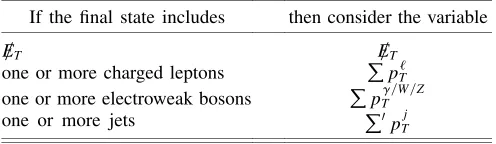
Zbosons [1]. For each exclusive final state, we consider a small set of variables given in Table I. The notationP0pTj
is shorthand forpTj1if the final state contains only one jet,
andPni苷2pji
T if the final state containsn$ 2jets, unless
the final state contains only n$ 3jets and no other ob-jects, in which casePni苷3pji
T is used. Leptons andE兾Tfrom
reconstructedW orZbosons are not considered separately in the left-hand column. Because the muon momentum resolution in Run I was modest, we definePpTᐉ 苷
P
pTe
for events with one or more electrons and one or more muons, and we determine E兾T from the transverse energy
summed in the calorimeter, which includes thepTof
elec-trons, but only a negligible fraction of thepT of muons.
When there are exactly two objects in an event (e.g., one Z boson and one jet), their pT values are expected to be
nearly equal, and we therefore use the average pT of the
two objects. When there is only one object in an event (e.g., a singleW boson), we use no variables, and simply count the number of such events.
The Sleuth algorithm requires as input a data sample, a set of events modeling each background processi, and the number of background events bˆi 6 dbˆi from each
back-ground process expected in the data sample. From these we determine the regionRof greatest excess and quantify the degreeP to which that excess is interesting. The
algo-rithm itself, applied to each individual final state, consists of seven steps:
(1) We construct a mapping from the d-dimensional variable space defined by Table I into the d-dimensional unit box (i.e., 关0, 1兴d) that flattens the total background distribution. We use this to map the data into the unit box. (2) We define a “region”Rabout a set ofN data points to be the volume within the unit box closer to one of the data points in the set than to any of the other data points in the sample. The arrangement of data points themselves thus determines the regions. A region containingN data points is called anN-region.
(3) Each region contains an expected number of back-ground events bˆR, numerically equal to the volume of
the region3 the total number of background events ex-pected, and an associated systematic error dbˆR, which
varies within the unit box according to the systematic er-rors assigned to each contribution to the background esti-mate. We can therefore compute the probability pNR that
the background in the region fluctuates up to or beyond the observed number of events. This probability is the first measure of the degree of interest of a particular region.
(4) The rigorous definition of regions reduces the num-ber of candidate regions from infinity to艐2Ndata.
Impos-ing explicit criteria on the regions that the algorithm is allowed to consider further reduces the number of candi-date regions. We apply geometric criteria that favor high values in at least one dimension of the unit box, and we limit the number of events in a region to 50. The number of remaining candidate regions is still sufficiently large that an exhaustive search is impractical, and a heuristic is em-ployed to search for regions of excess. In the course of this search, the N-region RN for which pNR is minimum
TABLE I. A quasi-model-independently motivated list of in-teresting variables for any final state. The set of variables to consider for any exclusive channel is the union of the variables in the second column for each row that pertains to that final state.
If the final state includes then consider the variable
E兾T E兾T
one or more charged leptons PpᐉT one or more electroweak bosons PpTg兾W兾Z one or more jets P0
is determined for each N, andpN 苷minR共pNR兲is noted.
EachRNalways contains the corner1of the unit box,
cor-responding to the point1` in the original variable space; these regions are therefore, in all cases, much larger than the intrinsic resolution of the detector.
(5) In any reasonably sized data set, there will always be regions in which the probability forbRto fluctuate up to or
above the observed number of events is small. We deter-mine the fractionPN ofhypothetical similar experiments
(hse’s) in whichpN found for the hse is smaller thanpN
observed in the data by generating random events drawn from the background distribution and computing pN by
following steps (1) – (4).
(6) We defineP andNminbyP 苷PNmin 苷minN共PN兲,
and identifyR苷 RNmin as the most interesting region in
this final state.
(7) We use a second ensemble of hse’s to determine the fraction P of hse’s in which P found in the hse is smaller than P observed in the data. The most important output of the algorithm is this single number P, which may loosely be said to be the “fraction of hypothetical similar experiments in which you would see an excess as interesting as what you actually saw in the data.”P takes on values between zero and unity, with values close to zero indicating a possible hint of new physics. The computation of P rigorously takes into account the many regions that have been considered within this final state.
The smallestP found in the many different final states considered (Pmin) determines P˜, the “fraction of
hypo-thetical similar experimental runs(hser’s) that would have produced an excess as interesting as actually observed in the data,” where an hser consists of one hse for each final state considered. P˜ is calculated by simulating an ensem-ble of hypothetical similar experimental runs, and noting the fraction of these hser’s in which the smallestP found is smaller than the smallestP observed in the data. Because
˜
P depends only on the single final state that definesPmin, correlations among final states may be neglected in this calculation. LikeP,P˜ takes on values between zero and unity, and the potential presence of new highpT physics
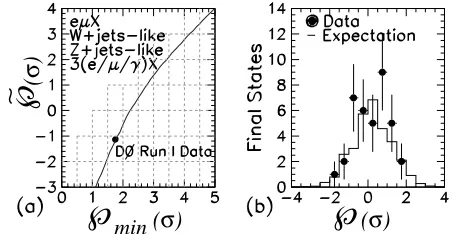
would be indicated by findingP˜ to be small. The differ-ence betweenP˜ andP is that in computingP˜ we account for the many final states that have been considered. The correspondence between Pmin and P˜ for the final states considered here is shown in Fig. 1(a).
D0 has previously analyzed several final states (2j,ee, eE兾T,Wg,W, Z, Zj, andWj) [5] in a manner similar to
the strategy used here, but without the benefit of Sleuth. No evidence of physics beyond the standard model was observed. The final states we describe in this Letter di-vide naturally into four sets: those containing one electron and one muon (emX); those containing a single lepton, missing transverse energy, and two or more jets (W 1 jets-like); those containing two same-flavor leptons and two or more jets (Z 1jets-like); and those in which the sum of the number of electrons, muons, and photons is$3
[3共e兾m兾g兲X].
℘∼
(
σ
)
℘
min(
σ
)
℘
(
σ
)
FIG. 1. (a) The correspondence betweenP˜ andPmin, each
ex-pressed in units of standard deviations. The curve reflects the number of final states, both populated and unpopulated, con-sidered in this Letter. (b) Histogram of the P values com-puted for the populated final states considered in this article, in units of standard deviations. The distribution agrees well with expectation.
The emX data correspond to 1086 6pb21 of inte-grated luminosity. The data and basic selection criteria are identical to those used in the publishedt¯tcross section analysis for the dilepton channels [6], which include the selection of events containing one or more isolated elec-trons withpeT . 15GeV, and one or more isolated muons
withpTm .15GeV. In this Letter all electrons (and
pho-tons) havejhdetj,1.1or1.5,jhdetj, 2.5, and muons have jhdetj, 1.7, unless otherwise indicated [7]. The dominant backgrounds to the emX final states are from Z兾gⴱ !tt !emnnnn, and processes that generate a true muon and a jet that is misidentified as an electron. Smaller backgrounds includeWW andtt¯production.
TheW 1jets-like final states include events in both the electron and muon channels. The eE兾T2j共nj兲 events [8],
corresponding to1156 6pb21of collider data, have one electron with pTe .20GeV, E兾T .30GeV, and two or
more jets withpTj .20GeV andjhdetj,2.5. The elec-tron and missing transverse energy are combined into a W boson if30,mTen , 110GeV. ThemE兾T2j共nj兲data
[9] correspond to 9465pb21 of integrated luminosity. Events in the final sample must contain one muon with pmT .25GeV and jhdetj, 0.95, two or more jets with
pjT . 15GeV and jhdetj,2.0 and with the most ener-getic jet withinjhdetj,1.5, andE兾T .30GeV. Because
an energetic muon’s momentum is not well measured in the detector, we are unable to separate “W-like” events from “non-W-like” events using the transverse mass, as done above in the electron channel. The muon and missing transverse energy are therefore always combined into aW boson. The W共!mE兾T兲2j共nj兲 final states are combined
with theW共!eE兾T兲2j共nj兲final states described above to
form theW2j共nj兲final states. The dominant background to both theeE兾T2j共nj兲andmE兾T2j共nj兲final states is from
W 1jets production. A few events fromtt¯production and semileptonic decay are expected in the final states W3j andW4j.
correspond to an integrated luminosity of12367 pb21. Offline event selection requires two electrons with trans-verse momentapTe .20GeV and two or more jets with
pTj .20GeV and jhdetj,2.5. We use a likelihood
method to help identify events with significant missing transverse energy [3]. An electron pair is combined into a Z boson if 82,mee ,100GeV, unless the
event contains significant E兾T or a third charged lepton.
The mm2j共nj兲 data [11] correspond to 9465pb21 of integrated luminosity. Events in the final sample contain two or more muons with pTm.20GeV and
at least one muon with jhdetj,1.0, and two or more jets with pTj .20GeV and jhdetj,2.5. A mm pair is
combined into a Z boson if the muon momenta can be varied within their resolutions such that mmm 艐MZ and
E兾T 艐0. The dominant background to both theee2j共nj兲
and mm2j共nj兲 data is from Drell-Yan production, with Z兾gⴱ !共ee兾mm兲.
Events in the3共e兾m兾g兲Xfinal states are analyzed using
12367pb21of integrated luminosity. All objects (elec-trons, photons, muons, and jets) are required to be isolated, to havepT $15GeV, and to be within the fiducial
vol-ume of the detector. Jets are required to havejhj,2.5. E兾Tis identified if its magnitude is larger than 15 GeV. The
dominant backgrounds to many of these final states include Zg andWZ production.
References [1,3] provide examples of Sleuth’s per-formance on representative signatures. When ignorance of both WW and t¯t is feigned in the emX final states, we find PemE兾T 苷2.4s and PemE兾T2j 苷 2.3s in D0 data, correctly indicating the presence of WW and t¯t. When ignorance oft¯t only is feigned, we findPemE兾T2j 苷1.9s. Excesses are observed with only 3.9WW events ex-pected in emE兾T (with a background of 45.6 events),
and only 1.8t¯t events in emE兾T2j (with a background
of 3.4 events), even though Sleuth “knows” nothing about either WW or t¯t. We are able to consistently find indications of the presence ofWW andt¯t in an ensemble of mock experiments at a similar level of sensitivity.
In the W 1jets-like final states we again feign igno-rance of t¯t in the background estimate, and findPmin .
3s in 30% of an ensemble of mock experimental runs on the final states W3j, W4j, W5j, and W6j. In the
℘ ℘
FIG. 2. Examples of Sleuth’s analysis of the final states (a)W2j and (b)Z2j.
Z 1jets-like final states we consider a hypothetical signal: a first generation scalar leptoquark with a mass of 170 GeV and a branching ratio into charged leptons ofb 苷 1. In the ee2j final state 5.960.8 such leptoquark events would be expected with a background of3264events. Sleuth findsPee2j .3.5s in 80% of the mock experiments
per-formed. Finally, in the final states 3共e兾m兾g兲X we find that a careful and systematic definition of final states can result in discovery sensitivity with only a few events, in-dependent of their kinematics. We conclude from these studies that Sleuth is sensitive to a variety of new physics signatures.
Figure 2 shows the results of the Sleuth analysis of two typical final states (W2j and Z2j). The variable space TABLE II. Summary of results. The most interesting final state is found to beee4j, with P 苷0.04. Upon taking into account the many final states we have considered in this analy-sis, we find P˜ 苷0.89. The calculation of these quantities is described in the text.
Final State Bkg Data P
emX
emE兾T 48.567.6 39 0.14共11.08s兲 emE兾Tj 13.261.5 13 0.45共10.13s兲 emE兾T2j 5.260.8 5 0.31共10.50s兲 emE兾T3j 1.360.3 1 0.71共20.55s兲
W 1jets-like
W2j 400653 441 0.29共10.55s兲
W3j 77610 67 0.23共10.74s兲
W4j 14.362.3 15 0.53共20.08s兲
W5j 1.860.4 1 0.81共20.88s兲
W6j 0.2560.07 1 0.22共10.77s兲 eE兾T2j 11.661.7 7 0.76共20.71s兲 eE兾T3j 2.560.6 5 0.17共10.95s兲 eE兾T4j 0.8060.24 2 0.13共11.13s兲
Z 1jets-like
Z2j 98619 85 0.52共20.05s兲
Z3j 13.262.7 12 0.71共20.55s兲
Z4j 1.960.5 1 0.83共20.95s兲
ee2j 3264 32 0.72共20.58s兲
ee3j 4.560.6 4 0.61共20.28s兲 ee4j 0.6460.20 3 0.04共11.75s兲 eeE兾T2j 3.760.8 2 0.68共20.47s兲 eeE兾T3j 0.4560.13 1 0.36共10.36s兲 eeE兾T4j 0.06160.028 1 0.06共11.55s兲
mm2j 0.5060.15 2 0.08共11.41s兲
3共e兾m兾g兲X
eee 2.661.0 1 0.89共21.23s兲
Zg 4.360.7 3 0.84共20.99s兲
Zgj 1.0360.31 1 0.63共20.33s兲
eeg 2.260.4 1 0.88共21.17s兲
eegE兾T 0.2660.10 1 0.23共10.74s兲
egg 10.762.1 6 0.66共20.41s兲
eggj 2.360.7 4 0.21共10.81s兲
egg2j 0.3760.15 1 0.30共10.52s兲
Wgg 0.2160.08 1 0.18共10.92s兲
ggg 2.560.5 2 0.41共10.23s兲
˜
defined by Table I is two dimensional; parentheses are used in the axis labels to indicate the transformed variables of the unit box. The circles are individual data events, and filled circles define the region selected by Sleuth. The re-gions chosen are seen to correspond to highpT in at least
one dimension, as required by the imposed criteria. Vi-sually, these regions do not appear to contain an unusual excess, and large Ps are found. Similar results are ob-tained for other final states.
Table II summarizes the values of P obtained for all populated final states analyzed in this article. Taking into account the many final states (both populated and unpopu-lated) that are considered, we find P˜ 苷0.89, implying that 89% of an ensemble of hypothetical similar experi-mental runs would have produced a final state with a can-didate signal more interesting than the most interesting observed in these data. Figure 1(b) shows a histogram of the P values, in units of standard deviations, computed for the populated final states analyzed in this article, to-gether with the distribution expected from a simulation of many mock experimental runs. Good agreement is ob-served. We find no evidence of new high pT physics in
these data.
We thank the staffs at Fermilab and collaborating in-stitutions, and acknowledge support from the Department of Energy and National Science Foundation (U.S.A.), Commissariat à L’Energie Atomique and CNRS/Institut National de Physique Nucléaire et de Physique des Partic-ules (France), Ministry for Science and Technology and Ministry for Atomic Energy (Russia), CAPES and CNPq (Brazil), Departments of Atomic Energy and Science and Education (India), Colciencias (Colombia), CONACyT (Mexico), Ministry of Education and KOSEF (Korea),
CONICET and UBACyT (Argentina), The Foundation for Fundamental Research on Matter (The Netherlands), PPARC (United Kingdom), A. P. Sloan Foundation, and the A. von Humboldt Foundation.
[1] D0 Collaboration, B. Abbott et al., Phys. Rev. D 62, 092004 (2000).
[2] B. Knuteson, Ph.D. thesis, University of California at Berkeley, 2000 (unpublished).
[3] D0 Collaboration, B. Abbottet al., Phys. Rev. D (to be published), hep-ex/0011067.
[4] D0 Collaboration, S. Abachiet al.,Nucl. Instrum. Methods Phys. Res., Sect. A338,185 (1994).
[5] D0 Collaboration, B. Abbott et al., Phys. Rev. Lett. 82, 2457 (1999); ibid.80,666 (1998);ibid.82,4769 (1999); D0 Collaboration, S. Abachiet al.,Phys. Lett. B385,471 (1996); D0 Collaboration, S. Abachiet al.,Phys. Rev. Lett.
76,3271 (1996);ibid.78,3634 (1997); D0 Collaboration, B. Abbott et al., Phys. Rev. D 61, 072001 (2000); ibid.
032004 (2000); D0 Collaboration, B. Abbottet al.,Phys. Rev. Lett.84,2792 (2000);ibid.,hep-ex/0010026. [6] D0 Collaboration, S. Abachi et al., Phys. Rev. Lett. 79,
1203 (1997).
[7] The detector pseudorapidity hdet is defined with respect
to the center of the detector, and the pseudorapidity h is defined with respect to the primary interaction point. [8] D0 Collaboration, B. Abbott et al., Phys. Rev. Lett. 80,
2051 (1998).
[9] D0 Collaboration, B. Abbott et al., Phys. Rev. Lett. 83, 2896 (1999).
[10] D0 Collaboration, B. Abbott et al., Phys. Rev. Lett. 79, 4321 (1997).