A Performance Analysis of Multi-Hop Wireless
Ad-Hoc Network Routing Protocols in MANET
S.Tamilarasan
Department of Information Technology, Loyola Institute of Technology & Management (LITAM), Sattenpalli, Andhra Pradesh, India.
Abstract— Mobile Ad-Hoc Network (MANET) is a collection of wireless mobile hosts forming a temporary network without the aid of any stand-alone infrastructure or centralized administration. Most of the proposed MANET protocols do not address security issues. In MANETs routing algorithm is necessary to find specific routes between source and destination. The primary goal of any ad-hoc network routing protocol is to meet the challenges of the dynamically changing topology and establish an efficient route between any two nodes with minimum routing overhead and bandwidth consumption. The existing routing security is not enough for routing protocols. An ad-hoc network environment introduces new challenges that are not present in fixed networks. A several protocols are introduced for improving the routing mechanism to find route between any source and destination host across the network. In this paper present a logical survey on routing protocols and compare the performance of AODV, DSR and DSDV.
Keywords— DSR, AODV, DSDV, MANET.
I. INTRODUCTION
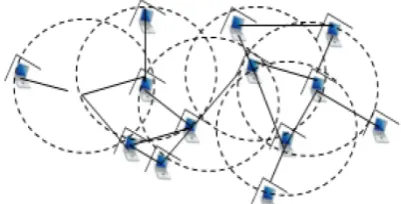
Wireless networking is an emerging technology that allows users to access information and services electronically, regardless of their geographic position. Wireless networks have become increasingly popular in the computing industry. The applications of the ad hoc networks are vast [9]. Mobile Ad hoc network (MANET) is a self-organized network because it is an infrastructure less feature of networks. MANET is a collection of nodes. Each node can connect by wireless communication links, without any fixed station such as base station. In MANET each node can act as a router and connectivity is achieved in the form of multihop graph between the nodes [8]
Fig. 1: Wireless Network Structures (Infrastructure less Networks)
A routing is a core problem in network for sending data from one node to another. Several protocols have been developed under the authority of Mobile Ad hoc networking group. MANET is a charter of Internet Engineering Task Force (IETF). Lots of research has also been done about the performance of ad hoc networks under varying scenarios. Different kind of metrics or characteristics may be used to analyse the performance of an ad hoc network [7, 9].
1.1 Characteristics of MANET (1) Dynamic Topology:
Nodes can move arbitrarily with respect to other nodes in the network.
(2) Bandwidth-Constrained:
Manet’s nodes are mobile, so they are using radio links that have far lower capacity than hardwired link could use. In practice the realized throughput of a wireless network is less than a radio’s theoretical maximum rate. (3) Energy Constrained Operation:
Mobile nodes are likely to relay on batteries, that is why the primary design criteria may sometimes be energy conservation.
(4) Limited Physical Security:
Normally, radio networks are vulnerable to physical security threats compared to fixed networks. The possibility of eavesdropping, spoofing and Denial of Service attacks is higher. Existing link security techniques can be applied. However, a single point failure in an ad hoc network is not as crucial as in more centralised networks.
(5) Unpredictable Link Properties:
Wireless media is very unpredictable. Packet collision is intrinsic to wireless network. Signal propagation faces difficulties such as signal fading, interference and multi-path cancellation. All these properties make the measures, such as bandwidth and delay of a wireless link, unpredictable.
(6) Hidden and Exposed Terminal Problems:
In the MAC layer with the traditional carrier sense multiple access (CSMA) protocol, multi-hop packet relaying introduces the “hidden terminal” and “exposed terminal” problems. The hidden terminal problem happens when signals of two, say B and C, which are out of the transmission range of each other, collide at a common receiver, say node A. An exposed terminal is created when a node A, is within range of and between two other nodes B and C, which are out of range of each other. When A wants to transmit to one of them, node B for example, the other node, C in this case, is still able to transmit to a fourth node, D which is in C’s range (but out of the range of node A). Here A is an exposed terminal to C but can still transmit to B.
Fig.2: Hidden Fig.3: Exposed Terminal Problem [1] Terminal Problem [1]
(7) Route Maintenance:
The dynamic nature of the network topology and the changing behaviour of the communication medium make the precise maintenance of network state information very difficult. Thus the routing algorithms in ad hoc networks have to operate with inherently imprecise information. Furthermore, in ad hoc networking environments, nodes can join or leave anytime. The established routing paths may be broken even during the process of data transfer. So, need for maintenance and reconstruction of routing paths with minimal overhead and delay.
QoS-aware routing would require reservation of resources at the routers (intermediate nodes). However, with the changes in topology the intermediate nodes also change and new paths are created. Thus the reservation maintenance with the updates in the routing path becomes cumbersome.
1.2. Issues in MANETs: (1) Multicasting:
This is the ability to send packets to multiple nodes at once. This is similar to broadcasting except the fact that the broadcasting is done to all the nodes in the network. This is important as it takes less time to transfer data to multiple nodes.
(2) Loop Free:
A path taken by a packet never transits the same intermediate node twice before it arrives at the destination. To improve the overall, we want the routing protocol to guarantee that the routes supplied are loop-free. This avoids any waste of bandwidth or CPU consumption.
(3) Multiple routes:
If one route gets broken due to some disaster, then the data could be sent through some other route. Thus the protocol should allow creating multiple routes.
(4) Distributed Operation:
The protocol should of course be distributed. It should not be dependent on a centralized node.
(5) Reactive:
It means that the routes are discovered between a source and destination only when the need arises to send data. Some protocols are reactive while others are proactive which means that the route is discovered to various nodes without waiting for the need.
(6) Unidirectional Link Support:
The radio environment can cause the formation of unidirectional links. Utilization of these links and not only the bi-directional links improves the routing protocol performance.
(7) Power Conservation:
The nodes in an ad-hoc network can be laptops and thin clients, such as PDAs that are very limited in battery power and therefore use some sort of stand-by mode to save power. It is therefore important that the routing protocol has support for these sleep-modes.
(8) Proactive Operation:
This is opposite to demand based operation. If additional delays that occur in demand based operation are unacceptable, proactive approach can be used especially when energy and bandwidth capacities support the use of proactive operation.
(9) Security:
Ad hoc routing protocols are exposed too much kind of attacks. Maintaining link layer security is in practice harder with ad hoc networks than with fixed networks. Sufficient routing protocols security is desirable. Sufficient within this context covers prohibiting disruption or modification of protocol operation. (10)“Sleep” Period Operation:
Since nodes in ad hoc networks may have energy constraints or because of some other need, nodes may want to stop sending and/or receiving data from arbitrary time periods. A routing protocol should be able handle such “sleep” periods without overly unfavourable consequences.
1.3 Applications of MANET:
(1) Sensor Networks for environmental monitoring. (2) Rescue operations in remote areas.
(3) Remote construction sites and Personal Area Networking.
(4) Emergency operations. (5) Military battlefield. (6) Civilian environments. (7) Law enforcement activities. (8) Commercial projects. (9) Educational Class rooms.
II. MANETROUTING PROTOCOL
MANET protocols are used to create routes between multiple nodes in mobile ad-hoc networks. IETF (Internet Engineering Task Force) MANET working group is responsible to analyse the problems in the ad-hoc networks and to observe their performance [7, 9]. There are different criteria for designing and classifying routing protocols for wireless ad-hoc networks. The MANET protocols are classified into three huge groups, namely Proactive (Table-Driven), Reactive (On-Demand) routing protocol and hybrid routing protocols [1, 2]. The following figure shows the classification of protocols.
Fig.4: Different type of routing protocols in wireless Ad-hoc network
Proactive (Table-Driven) routing protocol: - In proactive routing protocol perform consistent and up-to-date routing information to all the nodes is maintained at each node. Reactive (On-Demand) routing protocol: - This type of protocols find route on demand by flooding the network with Route Request packets
2.1. Proactive vs. Reactive Routing
larger in such schemes as one has to discover all routes. Examples of such schemes are the conventional routing schemes, Destination Sequenced Distance Vector (DSDV). Reactive Schemes determine the route when needed. Therefore they have smaller Route Discovery overheads. Examples for such schemes are Ad Hoc On-Demand Distance Vector (AODV) routing protocol.
2.2. Single-Path vs. Multi-Path
There are several criteria for comparing single-path routing and multi-path routing in ad-hoc networks. First, the overhead of route discovery in multi-path routing is much more than that of single-path routing. On the other hand, the frequency of route discovery is much less in a network which uses multi-path routing, since the system can still operate even if one or a few of the multiple paths between a source and a destination fail. Second, it is commonly believed that using multi-path routing results in a higher throughput. Third, multi-path networks are fault tolerant when dynamic routing is used, and some routing protocols, such as OSPF (Open Shortest Path First), can balance the load of network traffic across multiple paths with the same metric value [2, 6, 10].
2.3. Proactive vs. Source Initiated
A proactive (Table-Driven) routing protocols are maintaining up-to-date information of both source and destination nodes. It is not only maintained a single node’s information, it can maintain information of each and every nodes across the network. The changes in network topology are then propagated in the entire network by means of updates. Some protocols are used to discover routes when they have demands for data transmission between any source nodes to any destination nodes in network, such protocol as DSDV(.Destination Sequenced Distance Vector ) routing protocol. These processes are called initiated on-demand routing. Examples include DSR (Dynamic Source Routing) and AODV (Ad-hoc On Demand Distance Vector) routing protocols [2].
III.AD-HOCONDEMANDVECTORPROTOCOL (AODV)
AODV combines some properties of both DSR and DSDV. It uses route discovery process to cope with routes on-demand basis. It uses routing tables for maintaining route information. It is reactive protocol; it doesn’t need to maintain routes to nodes that are not communicating. AODV handles route discovery process with Route Request (RREQ) messages. RREQ message is broadcasted to neighbour nodes. The message floods through the network until the desired destination or a node knowing fresh route is reached. Sequence numbers are used to guarantee loop freedom. RREQ message cause bypassed node to allocate route table entries for reverse route. The destination node unicasts a Route Reply (RREP) back to the source node. Node transmitting a RREP message creates routing table entries for forward route [14].
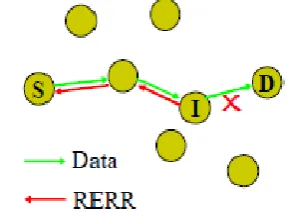
For route maintenance nodes periodically send HELLO messages to neighbour nodes. If a node fails to receive three consecutive HELLO messages from a neighbour, it concludes that link to that specific node is down. A node that detects a broken link sends a Route Error (RERR) message to any upstream node. When a node receives a
RERR message it will indicate a new source discovery process [5, 14].
Fig. 5: AODV routing protocol with RREQ. And RERR message
Fig 6: AODV routing protocol with RREP message.
IV.DYNAMIC SOURCE ROUTING (DSR)
The Dynamic Source Routing Protocol (DSR) is a reactive routing protocol .By the means of this protocol each node can discover dynamically a source route to any destination in the network over multiple hops. It is trivially loop free owing to the fact that a complete, ordered list of the nodes through which the packet must pass is included in each packet header. The two main mechanisms of DSR are Route Discovery and Route Maintenance, which work together to discover and maintain source routes to arbitrary destinations in the network [1, 5]. The following figure shows the route discovery method.
Salvaging: An intermediate node can use an alternate route from its own cache, when a data packet meets a failed link on its source route.
Gratuitous route repair: A source node receiving a RERR packet piggybacks the RERR in the following RREQ. This helps clean up the caches of other nodes in the network that may have the failed link in one of the cached source routes. Promiscuous listening: When a node overhears a packet not addressed to it, it checks if the packet could be routed via itself to gain a shorter route. If so the node sends a gratuitous RREP to the source of the route with this new, better route. Aside from this, promiscuous listening helps a node to learn different routes without directly participating in the routing process [5, 6].
Fig.7: Creation of the route record in DSR
Fig. 8: Building of the route record during route discovery
V. DESTINATION-SEQUENCED DISTANCE-VECTORS ROUTING (DSDV)
DSDV is a hop-by-hop distance vector routing protocol. It is proactive; each network node maintains a routing table that contains the next-hop for, and number of hops to, all reachable destinations. Periodical broadcasts of routing updates attempt to keep the routing table completely updated at all times [3]. To maintain the consistency of routing tables in a dynamically varying topology, each station periodically transmits updates, and transmits updates immediately when significant new information is available.
Routing information is distributed between nodes by sending full dumps infrequently and smaller incremental updates more frequently [10]. Routing information is advertised by broadcasting or multicasting the packets which are transmitted periodically and incrementally as topological changes are detected – for instance, when stations move within the network [4].
To guarantee loop-freedom DSDV uses a concept of sequence numbers to indicate the freshness of a route. A route R is considered more favorable than R' if R has a greater sequence number or, if the routes have the same sequence number, R has lower hop-count. The sequence number for a route is set by the destination node and increased by one for every new originating route advertisement. When a node along a path detects a broken route to a destination D, it advertises its route to D with an infinite hop-count and a sequence number increased by one. Route loops can occur when incorrect routing information is present in the network after a change in the network topology, e.g., a broken link. In this context the use of sequence numbers adapts DSDV to a dynamic network topology such as in an ad-hoc network [2, 3, and 10].
DSDV requires a regular update of its routing tables, which uses up battery power and a small amount of bandwidth even when the network is idle. Whenever the topology of the network changes, a new sequence number is necessary before the network re-converges; thus, DSDV is not suitable for highly dynamic networks. (As in all distance-vector protocols, this does not perturb traffic in regions of the network that are not concerned by the topology change.) [10].
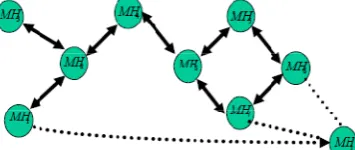
Fig.9: Movements in Ad Hoc Networks – MH4
Table.1: Advertised Route Table
VI. METRICS FOR PERFORMANCE ANALYSIS Throughput: Ratio of the packets delivered to the total number of packets sent.
Packet Delivery: Packet Delivery Ratio in this simulation is defined as the ratio between the number of packets sent by constant bit sources (CBR) and numbers of packets received by CBR sink at destination.
(1) Minimum Delay: Minimum Time taken for the packets to reach the next node.
(2) Maximum Delay: Maximum Time taken for the packets to reach the next node.
(3) Average End-to-End Delay: Time taken for the packets to reach the destination.
(4) Simulation Time: The time for which simulations will be run i.e. time between the starting of simulation and when the simulation ends.
(5) Network size: It determines the number of nodes and size of area that nodes are moving within. Network size basically determines the connectivity. Very lesser nodes in the same area mean fewer neighbours to send request to, but also smaller probability of collision. (6) Number of Nodes: This is constant during the
simulation. We used 50 nodes for simulations.
(7) Pause time: Node will stop a “pause time” amount before moving to another destination point.
(8) Jitter: Jitter describes standard deviation of packet delay between all nodes.
(9) Power Consumption: The total consumed energy divided by the number of delivered packet.
(10)Average Packet Delay: It is the sum of the times taken by the successful data packets to travel from their sources to destination divided by the total number of successful packet. The average packet delay is measured in seconds.
(11)Average Hop Count: It is sum of the times taken by the successful data packets to travel from their sources to destination divided by the total number of successful packets. The average hop count is measured in number of hops.
VII.COMPARISON
In order to evaluate the performance of ad-hoc network routing protocols, the following metrics were found. 7.1. Packet Delivery Fraction (PDR) Result
The PDF is the ratio between the numbers of packets originated by the application layer sources and the number of packets received by the sinks at the final destination. PDF will depict the loss rate that will be seen by the transport protocols, which in turn affects the maximum throughput that the network can support. According to packet delivery ratio, DSR performs well when the number of nodes is less and the loads of the network also less. However its performance declines with increased number of nodes due to more traffic in the network. The performance of DSDV is better with more numbers of nodes than in comparison with the other two protocols. The performance of AODV is consistently uniform.
Fig. 10: Packet Delivery Ratio for AODV, DSR, DSDV
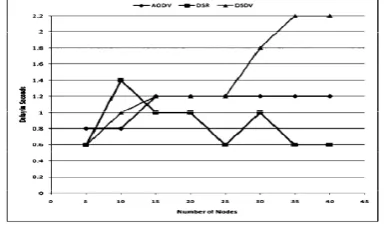
7.2. Average End to End Delay Result
The delay is affected by high rate of CBR packets as well. The buffers become full much quicker, so the packets have to stay in the buffers a much longer period of time before they are sent. This can be seen at the DSR routing protocol when it was reach around 2400 packets at the 0 mobility. For average end-to-end delay, the performance of DSR and AODV are almost uniform. However, the performance of DSDV is degrading due to increase in the number of nodes the load of exchange of routing tables becomes high and the frequency of exchange also increases due to the mobility of nodes.
Fig. 11: Average End-to-End Delay for AODV, DSR, DSDV
7.3. Number of Packets Dropped
The number of data packets that are not successfully sent to the destination. In terms of dropped packets, DSDV’s performance is the worst. The performance degrades with the increase in the number of nodes. AODV and DSR performs consistently well with increase in the number of nodes.
Fig. 12: Dropped Packets for AODV, DSR, DSDV
Table: 2 Comparison between DSDV, DSR, AODV
Protocol Propriety DSDV AODV DSR
Routing Type Flat Flat Flat
Routing Metric Shortest Path Fresh and shortest Path Shortest Path
Routing Maintenance
Routing
Table Routing Table
Routing Cache Multiple Route No No Yes
Loop Free Yes Yes Yes
Multicast No Yes No Periodic Broadcast Yes Yes No
QoS No No No
Distribution
Environment Yes Yes Yes
Unidirectional Link
Support No Yes No
Loop Optimization Yes Yes Yes
Reactive No Yes Yes
Proactive Yes No No
Scalability Yes Yes Yes
Route Reconfiguration
Sequence Number Adapts
Erase Route Notify Source.
Erase Route Notify Source.
VIII.CONCLUSION
In this article we provide description of three routing protocol proposed for MANET. We also provide a classification of these Schemes according to the Routing Methods (Reactive and Proactive), Packet Delivery Fraction, and Average End to End Delay and Number of Packets Dropped. The significant observation result is that reactive routing protocol AODV performance is the best considering its ability to maintain connection by periodic exchange if information, which is required for TCP, based traffic. Delivered virtually all packets at low node mobility, and failing to coverage as node mobility increases. Meanwhile DSR was very good at all mobility rates and movement speeds and DSDV performs almost as well as DSR, but still requires the transmission of many routing overhead packets. At higher rates of node mobility it’s actually more expensive than DSR. Compared the On-Demand (DSR and AODV) and Table-Driven (DSDV) routing protocols by varying the number of nodes and measured the metrics like end-end-delay, dropped packets, As far as packet delay and dropped packets ratio are concerned, DSR/AODV performs better than DSDV with large number of nodes. Hence for real time traffic AODV is preferred over DSR and DSDV. For less number of nodes and less mobility, DSDV’s performance is superior.
REFERENCES
[1] Sapna S. Kaushik; P.R.Deshmukh, (2009). Comparison of effectiveness of AODV, DSDV, and DSR routing protocols in MANETs. International Journal of Information Technology and Knowledge management,” July-December 2009, Volume 2, No. 2, pp. 499-502.
[2] [2] S. A. Ade; P.A.Tijare, (2010). “Performance Comparison of AODV, DSDV, OLSR and DSR Routing Protocols in Mobile Ad Hoc Networks.” July-December 2010, Volume 2, No. 2, pp. 545-548.
[3] [3] P.Johansson, T. Larsson, N. Hedman, B. Mielczarek, and M. Degermark. “Scenario based Performance Analysis of Routing Protocols for Mobile Ad-hoc Networks”, Mobicom’99, 1999, Pages 195-206.
[4] [4] C. E. Perkins and P. Bhagwat “Highly Dynamic Destination Sequenced Distance-vector Routing (DSDV) for Mobile Computers”, Proceedings of the ACM SIGCOMM ’94 Conference, August 1994, pages 234–244.
[5] [5] S.R. Das, C.E. Perkins, and E.E. Royer, “Performance Comparison of Two on Demand Routing Protocols for Ad Hoc Networks,” Proc. INFOCOM, 2000, pp. 3-12.
[6] Geetha Jayakumar and G. Gopinath; “Performance Comparison of Two On-demand Routing Protocols for Ad-hoc Networks based on Random Way Point Mobility Model” American Journal of Applied Sciences 5 (6): 2008, ISSN 1546-9239, pp. 659 – 664.
[7] R.M.Shrma; “Performance Comparison of AODV, DSR and AntHocNet Protocols”, International Journal of Computer Science and Technology. Volume No. 1, Issue 1, September 2010, pp. 29 – 32.
[8] K. TAMIZARASU; M. RAJARAM; “Analysis of AODV Routing Protocol for Minimized Routing Delay in Ad Hoc Networks”, International Journal on Computer Science and Engineering. Vol. 3, No. 3, March 2011, pp. 1075 – 1078.
[9] [9] Md. Anisur Rahman; Md. Shohidul Islam; Alex Talevski; “Performance Measurement of Various Routing Protocols in Ad-hoc Network”, Proceedings of International MultiConference of Engineers and Scientists, 2009, Vol. 1, pp. 18 – 20.
[10] [10] Nor Surayati Mohamad Usop; Azizol Abdullah; Ahmad Faisal Amri Abidin; “Performance Evaluation of AODV,
DSDV & DSR Routing Protocol in Grid Environment”, IJCSNS International Journal of Computer Science and Network Security, VOL.9 No.7, July 2009, pp. 261 – 268.
[11] [11] Boukerche A, “Performance Comparison and Analysis of Ad Hoc Routing Algorithms”, IEEE International Conference on Performance, Computing and Communications, 2001, Apr 2001, pp 171-178.
[12] [12] G. Karthiga; J.Benitha Christinal; Jeban Chandir Moses; “Performance Analysis of Various Ad-Hoc Routing Protocols in Multicast Environment”, International Journal of Computer Science and Technology. VO l. 2, Issue 1, March 2011, pp. 161 – 165.
[13] [13] Samir R. Das; Charles E. Perkins; Elizabeth M. Royer; “Performance Comparison of Two On-Demand Routing Protocols for Ad Hoc Networks”, IEEE Personal Communications Magazine special issue on Ad hoc Networking, February 2001, pp. 16-28.
[14] [14] C.E.Perkin; Charles E. Perkins; Elizabeth M. Royer; “ Ad hoc on-demand distance vector (AODV) routing”, Proceedings of the 2nd IEEE Workshop on Mobile Computing Systems and Applications, New Orleans, LA, February 1999, pp. 90-100.
[15] [15] R.Asokan; A.M.Natarajan; C.Venkatesh; “Optimized Quality of Service (QoS) Routing in mobile ad hoc networks using SELF – HEALING Technique “, International Journal on Wireless & Optical Communications (IJWOC),2007. Vol. 4, Issue 3. pp. 291-304.
[16] [16] Dharmaraju, D; Roy-Chowdhury, A; Hovareshti, P; Baras, J.S; “INORA – a unified signaling and routing mechanism for QoS support in mobile ad hoc networks”, parallel Processing workshop, 2002, proceedings. International Conference on 2002, pp. 86-93
[17] Rakesh Kumar Jha; Suresh V. Limkar; Dr. Upena D. Dalal; “A Performance Comparison of Routing Protocols (DSR and TORA) for Security Issue In MANET(Mobile Ad Hoc Networks)”, IJCA Special Issue on “Mobile Ad-hoc Networks” MANETs, 2010, pp. 79-83.
Author
S. Tamilarasan, M.E.- Associate professor cum Head of Department, Loyola institute of Technology and management, Dullipala (village), Sattenapalli (Mandal), Guntur, Andhra Pradesh, India.
Specialization: