Home -Based Challenges to Effective Implementation of
Curriculum under Free Primary Education System in Nomadic
Kenya
John Aluko Orodho 1* Peter Ndirangu Waweru 2 Miriam Ndichu 3 Ruth Nthinguri 4 1.John Aluko orodho, Associate Professor of Research, School of Education, Kenyatta University, Kenya
2.Peter Ndirangu Waweru , PhD Student, School of Education, Mount Kenya University, Kenya 3.Miriam Ndichu. PhD Student, School of Education, Mount Kenya University, Kenya
4.Ruth Nthinguri, Lecturer, School of Education, Mount Kenya University, Kenya [email protected] or [email protected]
Abstract
This study explored the school-based challenges to effective curriculum implementation under the free primary education (FPE) system in Kenya. The study was framed by the constructivist theory. Convenience sampling was used to select a sample of 205 primary school teachers and employed mixed methods to collect and analyze data. It was found that despite the gains made in quality education since the launch of FPE in Kenya at the national level, there still remain pockets within Kenyan geographical regions which have remained behind in attaining effective implementation of curriculum, resulting into low academic achievement. The study established that the effect of school –based factors, especially human and infrastructural, when compounded with active and effective instructional techniques used by teachers , student motivation and school safety concerns significantly contributes to effective implementation of curriculum and enhance students academic achievement .It is recommended that strategies should be put in place to urgently address teacher shortages, reduce over-crowding in classrooms by improving school infrastructure, and enhance teacher professional development and upgrading mechanisms as well as teacher motivation via attractive terms of service and remuneration packages .[ 182 words]
Keywords: Free Primary education Classroom practices, Teacher classroom practices, Curriculum implementation, Teacher professional development, Academic performance.
1. Introduction
1.1.1 Background to the study
Several reasons have been advanced by researchers to explain the causes of students academic performance(Republic of Kenya/UNESCO,2012).These include school based factors , home-based factors , Government policy , and a combination of the tthree. Yet, the achievement of universal participation in education will be fundamentally dependent upon the quality of education available (Amadio, Truong, Ressler, & Gross, 2004; UNESCO, 2005, 2012). Researchers and policy makers tend to concur that teacher effectiveness is a pivotal policy issue in education reforms aimed at improving quality (Anderson, 2004; Carnoy, 2004, Republic of Kenya, 2010). Research evidence shows that teachers are the most important of the school-related factors affecting student achievement through their effectiveness (Darling-Hammond, 2000; King Rice, 2003; Mckenzie & Sarnagn. 2004; MOEST, 2005a). Other, research evidence from teacher-effectiveness studies indicates that student engagement in learning is to be valued above curriculum plans and materials (Talber & McLanghin, 1993; Wenglinsky, 2000; Wright, Horn & Sanders, 1997). Research on teacher effectiveness has yielded a wealth of understanding about the impact that teacher ability has on student growth. Nonetheless, an overview of recent literature on school- based factors, particularly teacher effectiveness reveals no commonly agreed upon definition of the qualities that an effective teacher should possess (Republic of Kenya/UNESCO, 2012). Most studies from developed countries, however, tend to emphasize qualities such as knowledge and organization of the subject matter, skills in instruction and attitudes that are useful when working with students (Braskamp, Brandenburg & Ory, 1984; Cashin, 1995; Sammons, Hillman & Mortimore, 1995).
Republic of Kenya, 2010). In Kenya the Commission on alignment of education to the new constitutional dispensation in 2010 noted that current policy stipulates that a primary school teacher should be able to teach all the 7 subjects in the primary school curriculum (Republic of Kenya, 2010), and this could be another challenge to effective implementation of curriculum.
The team of experts counseled that two years of teacher training is not adequate for the teacher trainee to acquire mastery in subject content and skills of pedagogy in all the 7 subjects (Republic of Kenya, 2010). These compromises the quality of teaching offered after the training. The curriculum at this level should also place more emphasis on child approaches in teaching so as to enhance both quality learning and motivation. Teaching in primary schools is currently dominated by transmission forms of teaching in which pupils are passive and expected to recall facts (Republic of Kenya, 2010). Thus teacher effectiveness should also entail skills upgrading for teachers. However, this has not been the case as lack of adequate opportunities for in-service training has denied most practicing teachers the chance to enhance their skills beyond those acquired during their pre-service basic training ((Republic of Kenya, 2010 ).
Research shows that effective teachers have more students in their class’s assigned tasks and in learning throughout the day ( Abagi, 2010 ; Taylor, Pearson, & Walpole, 1999). Classrooms in which engaged learning occurs have higher levels of student cooperation, student success, and task involvement (Kemp & Hall, 1992). Moreover, students achieve more when teachers employ systematic teaching procedures (Kernp & Hall, 1992). Teachers who have higher rates of communication with parents are viewed as more effective. Effective teachers are also shown to provide a variety of opportunities for students to apply and use knowledge and skills in different learning situations (Kemp & Hall, 1992). For the teachers to apply all these skills and strategies of effective teaching, they must be well motivated. However, the instruments to reward and motivate teachers are limited as there are limited opportunities for their career growth (Mckenzie & Santiago, 2004). The introduction of FPE brings new challenges that are likely to affect teachers' effectiveness negatively.
Availability of adequate and relevant teaching and learning resources is very crucial in enhancing teacher effectiveness. However, Kenya spends only 4.2% of the recurrent primary education budget on non-teacher salary inputs (World Bank, 2003). Yet the amount of resources available for non-teacher salary items is a crucial factor for teachers to be effective. Studies suggest that books and other learning materials are highly cost-effective complementary inputs in the learning process. Other factors that influence education quality include teacher motivation, development and supervision, system management and school maintenance (Galabawa, 2003). The supply of adequate and well trained teachers is a major determinant of quality of education. World Bank Development Report (2004) indicated the Pupil - Teacher Ratio (PTR) in Kenya to be around 30:1. However there are wide disparities in teacher allocation and distribution across provinces, districts and schools. According to the MOEST and UNESCO (2005) study, Kajiado district had the highest PTR of 58:1 followed by Kisumu and Kwale with 44:1 and 42:1 respectively and Embu with the lowest PTR of 29:1 (Galabawa, 2003). These disparities have to be controlled and addressed for teachers' effectiveness to be realized.
The introduction of FPE in 2003 resulted in an exponential growth in enrolment in primary schools (Galabawa, 2003). Enrolment in primary schools escalated from 5.8 million in 2002 to 7 million in 2003 and 7.2 million in 2004 (MOEST, 2004). This may have compromised the quality of education in the country's public primary schools.
1.1.2The study context
Since attainment of political independence in 1963, the Government of the Republic of Kenya has committed itself to improving standards of education at all levels. This commitment has been driven by several reasons, including the need to provide education as a fundamental human right, education as social vaccine to the fight against poverty, and education as an integral and indispensable vehicle for achieving the goals of national development, integration and peace ( Njeru & Orodho, 2003, Republic of Kenya, 2008 ,2012).
It is for this reason that the Government of Kenya has from time to time appointed various education commissions, Committees, and Task Forces to address various challenges facing the education sector. Examples include the Kenya Education Commissions , commonly referred to as the Ominde Commission( 1964), National Committee on Educational Objectives and Policies,( 1976), the Presidential Working Party on the second university in Kenya (1981), the Presidential Working Party on Education and Manpower Training for the Next Decade and Beyond ( 1988), the Commission of Inquiry in the Education system in Kenya (2000) and the Commission on the alignment of Education to the constitutional dispensation in Kenya ( 2010).
The Government is also a signatory to international conventions and protocols that have emphasized the right of every human being to quality education. Examples include the United Nations convention on the Elimination of All Forms Discrimination against women (CEDAW), and the World Conference on Education for All (EFA). The Governments commitments and seriousness in implementing the recommendations of the international conventions and protocols to meet the challenges of education and training and reach the 21st century is evidenced by the various strategies so far developed. Two of the key policy documents this century are the Sessional Paper No.1 of 2005 on Education, Training and Research and its implementation program, through the Education Sector Support Program (KESSP) and the Basic Education Act No.14 of 2013 ( Republic of Kenya, 2005,2013).
With regard to basic education, the Government focuses on ( as outlined in Sessional Paper No.1 of 2005) promotion of access ,equity, relevance, and quality education. Specifically, the framework aims at achieving Education for All (EFA) by 2015, ensuring the right of children Act (2001), increasing access, equity and relevance of basic education, and delivering quality services efficiently and effectively at all times and at all levels of the education system.
The Constitution of Kenya (2010) has the Bill of Rights at its core while the Kenya Vision 2030, acknowledges the need to reform the education and training to create a sector fit for purpose( Republic of Kenya, 2012). This has led to the policy provisions embodied in this document which address the constitutional requirements and national aspirations as well as offer direction in modernizing and re-branding the country’s education and training system (Republic of Kenya, 2013).According to the Bill of Rights in the constitution of Kenya, basic education is a fundamental human right. This implies that citizens can hold the state accountable for ensuring that every child aged 4 to 17 years is in school and receiving quality education. This is consistent with the international education commitments and other international conventions to which Kenya is a signatory. For example, the African Charter on the Human and Peoples’ Rights, Article 17, provides that every individual shall have a right to education; the African Charter on the Rights and Welfare of the Child, Article 11, articulates detailed provisions on the right to free and compulsory basic education for the child and, state’s obligation towards that right; while the United Nations International Convention on Social and Economic Rights, Article 13, declares the recognition of the right of all to education and the objectives thereof. The Convention on the Rights of the Child, Articles 28, 29 and 30, secure the rights of a child to free and compulsory basic education. Kenya is also a signatory to the Jomtien Protocols (1990) and the Accra Accord (2002), which established the Millennium Development Goals (MDG) and modalities for assessing progress thereof.
Towards the realization of the set goals outlined in the preceding section, the Government has developed various intervention strategies to ensure safe and secure environments. One strategy was the development of the safety standards manual for schools ( Republic of Kenya, 2008).The development of the school safety manual arose from the strong conviction that, fist, safe and secure school environment facilitates and fosters quality teaching and learning in educational institutions . Safety, especially in schools, is even more critical given the fact that young children are vulnerable to insecurity (Republic of Kenya, 2008).
1.1.3 The Problem Statement
Ratios (PTRs) in densely populated areas; high cost of special equipment for children with special needs; diminished community support following their misconstrued role vis-a-vis that of the Government in the implementation of the FPE initiative; gender and regional disparities; increased number of orphans in and out of school as a result of HIV/AIDS; and other reasons such as internal inefficiencies (MOEST, 2005b). According to the 2005 Education for All (EFA) Global Monitoring Report, the quality of education remains very poor in most sub-Saharan African countries, including Kenya. Performance of Kenyan primary pupils in absolute terms is low and internal efficiency of education at this level requires policy intervention ((Republic of Kenya, 2010).
Recent credible documents of the Republic of Kenya similarly underscore the fact that despite the gains in access and quality since the launch of FPE in the country, there still remains pockets within Kenyan schools in which performance has not improved and constantly remained below the national average for a host of reasons including those that are school-based (Republic of Kenya/UNESCO, 2012). The first ever Education for All ( EFA) assessment in 2010 revealed that although Kenya had made significant progress towards the attainment of the goals during the first decade of the millennium, challenges related to the quality of education were still critical and needed concerted efforts between all education stakeholders to resolve ( Republic of Kenya/UNESCO , 2012).
1.1.4 Purpose and Objectives of the Study
The purpose of this investigation was to investigate school-based challenges to effective implementation of curriculum under the PFE education system in Kenya.
1. To assess the influence of the challenges of the introduction of FPE on teaching methodology as perceived by the teachers,
2. To examine the influence of the challenges that the introduction of FPE posed to the availability and effective use of teaching/learning resources as perceived by the teachers.
3. To determine the influence of the challenges of the introduction of FPE on management of examination as perceived by the teachers.
4. To analyze possible differences in teacher-perceived effects of selected school variables (type, location, teaching class, pupil age variation and teacher characteristics) on teacher effectiveness in implementing FPE.
1.1.5. The Theoretical framework
The study was guided by the Constructivist Learning Theory as cited by Frosnot (1996) ,Richardson (2003) and Yilmaz (2008) .While constructivism is still evolving and has to be fully accepted by other scholars and the public alike, constructivists theory has a rich history , most famously initiated by John Dewey ( Dewey, 1916, 1933, 1938) in his progressive mode for teaching and learning. Dewey saw the need for public schools to be communities and to teach the skills for community in an increasingly industrial, urban, disaffected society. He also had insights on how children learn best derived from his own experience as an educator and from his interactions with outstanding teachers of the day. Best teaching for Dewey, included physical activity as a necessary but not sufficient part of learning. The three scholars, Frosnot (1996) ,Richardson (2003) and Yilmaz (2008) contend that the theory can best be explained in terms of its relation to teachers interacting with the learners in a more active and reinforcing fashion. According to Books and Brooks (1993), the theory states that people construct their own understanding and knowledge of the world through experiencing things and reflecting on those experiences. The theory is based on the claim that learners too, learn from their experiences as they interact with the phenomenon (Brunner, 1961). Bassey, Umoren and Udida (2003) similarly contend that the learning process requires adequate attention from the learners I order to assimilate and absorb what is being taught .People exhibit significant individual differences in the cognitive processing styles that they adopt in problem solving and other decision making activities. As far back as 1966, Brunner, one of the proponents of constructivist learning theory stated that a theory of instruction should address four major aspects: (i) predisposition towards learning (ii), the way in which a body of knowledge can be structured so that it can be most readily grasped by the learner (iii), the most effective sequences in which to present material to be learned, and (iv) the nature and pacing of rewards and punishments (Brunner, 1966).
lost in the material or lose interest in the presentation. In this type of learning environment, students have limited opportunity to ask questions or may be uncomfortable asking questions in front of the class. Brooks and Brooks (1993) have provided the following as retention rates when using different learning media: lecture = 5 %; reading =10 %; audio-visual =20%; demonstration = 30%; discussion group = 50%; practice by doing = 75% and teaching = 90%. According to Brooks and Brooks (1993), teachers are very important especially as they use raw data and primary sources in addition to manipulative, interactive, and physical material during curriculum implementation.
From the foregoing and in the context of this paper the main school-based factors considered is the teacher who is at the centre of curriculum implementation by choosing the best instructional methods that foster effective learning. Thus, constructivism requires that we reflect on all aspects of the teaching in which we engage, as educators. We should examine our planning, our use of external standards, the materials we use, the environment in our classroom, our own attitudes and expectations ,and especially, the needs of the students , whether they are children or teachers.
Methods and Materials
A cross-sectional survey of the perception of Kenya's primary school teachers on the levels of challenges introduced by the FPE initiative as well as the resultant effects on teacher effectiveness was conducted using a semi-structured questionnaire. The target population for this study included all public primary school teachers in Kenya. A convenient sample of 205 undergraduate and postgraduate teachers undertaking the school-based bachelor of education and masters of education degrees at Kenyatta University was selected for the study. This sample is representative of Kenya's primary school teachers, as the programme draws students from all over the country. The sample comprised 55 from urban schools, 120 from rural/agricultural and 30 from ASALs or pastoralist schools, yielding a total sample size of 205. Only teachers from public primary schools were included after isolating those from secondary schools and private schools. The teachers were of different characteristics as shown in Table 1.
Table1: The Distribution of study sample (n=205)
Location/Sex Male Female Total
Urban 24 31 55
Rural/Agricultural 51 69 120
ASAL/Pastoralist 17 13 30
Total 92 113 205
The semi-structured questionnaire included items for measuring the various variables. Part one of the instrument had statements to establish the characteristics of school and the teachers that were in-built into the study as moderator variables. Parts two and three of the questionnaire presented respondents with 20 items each eliciting data on the levels of FPE challenges and perceived teacher effectiveness. The items had a 5-point Likert scale response framework. A few open-ended items were included to tap detailed qualitative information to supplement the quantitative survey. This instrument was pilot tested among 10 primary school teachers drawn in two schools in Githurai in Kiambu County who were not part of the study. This was to ascertain it’s the validity and reliability of the questionnaires. Based on the split-half technique, a reliability coefficient of .85 was obtained, and accordingly declared reliable for the task at hand Borg & Gall, 1989).
Results and Discussion
Figure 1 carries data which reveals that teachers perceive the introduction of FPE to have brought with it challenges that are currently affecting their effectiveness. The figure illustrates the various categories of challenges as perceived by the respondents. Figure1 indicates teachers who participated in the study perceived FPE to have introduced challenges that have jeopardized their teaching effectiveness. The challenges which were mentioned by a majority of teachers were ineffective teaching methods mentioned by 25.37 percent followed by high teaching load cited by 23.41 percent and inadequate instructional materials mentioned by 22.44 percent. The two reasons seem to be pointing in the direction of shortage of teachers to handle the large number of students as result of the upsurge in pupil enrolment due to the introduction of FPE.
& Kioko, 2004).
Figure1: Perceived challenges faced by primary school teachers under FPE education system
Majority of the respondents, constituting 25.37 percent indicated that the effect of FPE on teacher's teaching/learning methodology is profound due to over-enrolment and the resultant overcrowding in classes that affect teacher/student interaction. Teachers are increasingly unable to give personal attention. The task force that was set up in 2010 to align education to the new constitutional dispensation noted with concern that learning in primary schools is currently dominated by transmission forms of teaching and learning in which pupils are expected to recall facts for the purpose of passing examinations( Republic of Kenya, 2010). This examination oriented mode of teaching hampered the spirit of active involvement of learners in the learning process. According to Abagi (2010) and Taylor et tal.(1999), classroom in which engaged learning occurs have higher levels of student cooperation, student academic performance and lifelong learning and task involvement. Moreover, pupils achieve more when teachers employ systematic teaching procedures that involve provision of a variety of opportunities for students to apply and use knowledge and skills in different learning situations. It is, thus, imperative that for teachers to apply all these skills and strategies of effective teaching, they must be exposed to continuous professional development through in-service training in addition to commensurate remuneration. However, instruments to reward and motivate teachers in Kenya is limited as there are very scanty opportunities for teacher career growth and unattractive terms of service , especially the low employment packages compared to their counterparts in the civil service.
There was an equal proportion of teacher who cited lack of individual focus on the learner due to large class-size and general lack of motivation amongst teachers and learners.
The other challenges like availability of teaching resource school facilities, difficulties with pupil discipline control, teacher, morale and management (examinations have a similar perceived severity, as they are all indirectly influenced by the worsening pupil-teacher ratios (PTR).
The respondents indicated that it is now not uncommon for teachers to take advantage of the high enrolment as an excuse for not performing and engage in other income generating activities outside the school in order to compensate for their low pay. Teacher motivation and commitment to duty is believed to be at an all-time low by the respondents due to the current economic constraints. The added workload causes strain and stress among teachers, while lacks of incentives and poor remuneration have combined to affect the teachers' commitment to duty. Trends in pupil discipline with the introduction of FPE are also worrying. The respondents indicated that new forms of indiscipline have emerged with the introduction of FPE due to the varied ages of pupils admitted in the various classes. Some join without any pre-primary, especially in the lower primary classes. Cases of big pupils especially boys bullying the young ones are on the increase.
The capacity of the existing teaching force and other school personnel has also been affected by the introduction of FPE. There are gross staffing inadequacies resulting in staff experiencing strain due to the increased workload, over enrolment and the government's inability to increase the teaching workforce. The teaching and learning materials provided by FPE are also grossly inadequate. About 87% of the respondents indicated that the teaching and learning materials provided by FPE have been adversely affected in primary schools, with evident deterioration in their quality, quantity and effective use. The delay in FPE funds disbursement and the low level of the preparedness of school administrators to manage the funds are largely to blame for this. The facilities for school activities such as sanitary, classroom and sports facilities have been over-stretched in many schools.
The factor which was cited by the least number of teachers was the effect of student absenteeism due to the introduction of user fees. It is quite clear that the factors that were mentioned by teachers are those that work against effective teacher-pupil engagement in the learning process and which are instrumental in enhancing
teacher effectiveness.
The morale of the teachers is crucial in this relationship as it is paramount that for the teachers to apply the skills that instigate effective learning and use strategies of effective teaching, they must be well motivated. Within the FPE set-up this has not been conducive thereby diminishing the instruments to reward and motivate teachers, which have been found to enhance effectiveness and morale through opening opportunities for career growth (Mckenzie & Santiago, 2004).
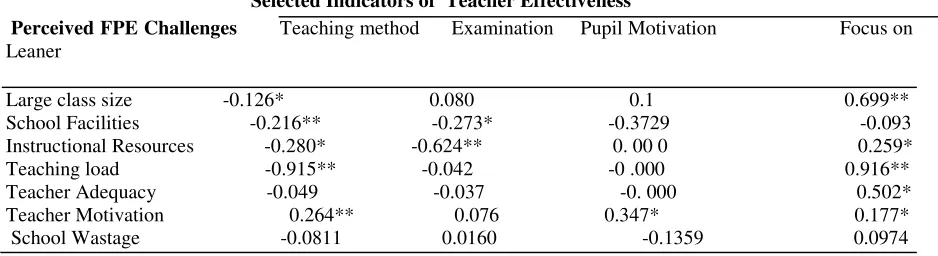
Table 1: Bi-variate Pearson's Product Moment Correlation Coefficient between the specific challenges to FPE implementation and specific aspects of teacher effectiveness
Selected Indicators of Teacher Effectiveness
Perceived FPE Challenges Teaching method Examination Pupil Motivation Focus on Leaner
Large class size -0.126* 0.080 0.1 0.699** School Facilities -0.216** -0.273* -0.3729 -0.093
Instructional Resources -0.280* -0.624** 0. 00 0 0.259* Teaching load -0.915** -0.042 -0 .000 0.916** Teacher Adequacy -0.049 -0.037 -0. 000 0.502* Teacher Motivation 0.264** 0.076 0.347* 0.177* School Wastage -0.0811 0.0160 -0.1359 0.0974
The study revealed a moderately positive and significant correlation between the motivation of the teacher and pupil motivation (r=.347) and teaching method (r=.264). There was a very weak positive significant correlation between large class size handled by individual teachers and administration of examinations (r=.08).
In contrast, there was a strong inverse relationship between large teaching load and the selection of effective teaching method (-.915), and focus on individual learner while teaching (-.699). Similarly, there was a strong inverse relationship between adequacy of teachers and level of focus on individual learner (r= -.502). However, there were weak inverse correlations between large class size and effective teaching methods (r= -.126) and school physical facilities and teaching methods(r= -.0811). There was no significant relationship between instructional resources and pupil motivation (r=.00) and relationship between adequacy of teachers’ and pupil motivation (r= 0.00).
The results indicate that the extent of the challenge posed by inadequacy of learning resources was found to be inversely related to teacher effectiveness. Adequacy of teachers, in terms of teaching load was found to be related to effectiveness in examination management and individual focus on the learner, hence enhancing pupil discipline and control. There was no evidence from the study to show that adequacy of teachers is related significantly to the other aspects of teacher effectiveness such as pupil motivation during teaching and effective administration of examinations.
The challenge of availability and adequacy of teaching and learning resources was found to inversely affect perceived teacher effectiveness in use of teaching methods, use of teaching and learning resources as well as focus on individual learner, hence fostering pupil discipline and control. The study showed no evidence that the challenge posed by FPE through school wastage in terms of pupil absenteeism significantly influences teacher effectiveness.
The study further attempted to establish the association between the location of the school as the independent variable and its effect on teacher effectiveness as the dependent variable. The chi-square statistical technique was used to test the degree of association between the variables location of school and effect on effective curriculum implementation at∝ =.05.
Table 1: Location of school and Effects of FPE on teacher effectiveness
Location/Effect Very Much Much A little Not at all/Never
Urban schools 4 22 18 11
Rural/Agricultural 16 26 47 31
ASAL/Pastoralist 10 8 7 5
The χ2 =14.188,df=6 at ∝ =.05 significant since X2 critical =12.592
result of the introduction of the FPE programme. The characteristics of the teacher upon which significant differences in the FPE challenges and perceived teacher effectiveness when investigated include gender, teaching position, teaching class (lower or upper primary), experience and qualification.
Conclusions and recommendations
The introduction of FPE in 2003 by the Government of Kenya led to notable strains in the ability of primary schools to offer quality education. Based on a prime indicator of school-based factors, the study has demonstrated that the key challenges to effective curriculum implementation of FPE include: teacher inadequacy, teacher morale, school wastage, and inadequacy of teaching learning resources and school facilities. These have negatively impacted on effective implementation of the curriculum using modern learner friendly instructional techniques that actively engage the learner in the entire teaching /learning process. The country's commitment to achieving UPE and EFA has thus been threatened as confirmed by the first ever Education for All(EFA) assessment in 2010 that revealed that Kenya still had challenges to quality education that included teacher shortages due to budgetary constraints with many schools reporting a PTR of more than 1:50; overcrowded classes due to inadequate infrastructure; inadequate textbook storage facilities and poor maintenance of textbooks ; and ineffective curriculum implementation resulting in low mastery of literacy and numeracy in pupil performance due to teacher absenteeism and inappropriate pedagogical skills, among others ( Republic of Kenya/UNESCO, 2012) . The challenge of implementing FPE in the country has made the achievement of some specific MDG targets in education difficult. The Republic of Kenya/UNESCO (2012) findings tend to confirm the finding of this study that the substantial influx of student population after the introduction of FPE in 2003 has exacerbated the challenges of large class sizes, pupil age variation, pupil discipline management, low teacher morale, teacher inadequacy as well as facilities and teaching/learning resources. Teachers of different characteristics perceive these challenges to have affected their effectiveness and thus the quality of primary education in the country.
The introduction of FPE has also affected the capacity of existing teaching force. The specific facets of teacher effectiveness that the initiative apparently jeopardized include teaching methodology, pupil discipline control, and management of examinations and effective use of teaching and learning resources. The teachers have seemingly lost the capacity for effective pupil engagement, which is instrumental in improving teacher effectiveness. Within the FPE set-up efficient teaching workforce satisfaction has not been conducive; thereby diminishing the instruments to reward motivate the teachers. Specific challenges that significantly affect teacher effectiveness include large class size, teacher inadequacies and pupil age variation. The locations of the schools in which teachers operate do not significantly influence their perceptions towards effective curriculum implementation. This indicates that challenges have affected both male and female teachers as well as urban, ASAL and rural schools alike. Any inter, interventions to address the challenges highlighted in this paper should, therefore, not be teacher gender and school location-specific. The key elements of the FPE implementation that need urgent redress are those that catalyze the effects of these challenges on teacher effectiveness. It would be prudent to enhance the ability of teachers to effectively absorb the effects of these challenges on their effectiveness. Teacher rationalization and appropriate FPE policy reforms are necessary.
Acknowledgements
The primary school teachers undertaking school-based undergraduate teacher education studies during the 2011/2012 academic year at Kenyatta University, School of Education, provided the data used in this study. The authors would also like to acknowledge the input of two postgraduate students from Kenyatta University and Mount Kenya University who participated in the data analysis stage of the project that resulted into this report.
References
ADEA. (2003). The Challenge of Learning: Improving the Quality of Basic Education in Sub-Saharan Africa. Discussion paper for the ADEA Biennial Meeting, Grand Baize, Mauritius, 3-6 December. Paris, Association for the Development of Education in Africa.
Amadio, M., Truong, N., Ressler, D. & Gross, S. (2004). Quality Education for All? World trends in educational aims and goals between the 1980s and the 2000s. Background paper for EFA Global
Bassey,S.W .,Umoren,G & Udida,L.A.(2003). Cognitive styles, secondary schools students attitudes and
academic performance in Chemisry in Akwa Ibom State –Nigeria.
Bennell P., Hyde, K. & Swainson, N. (2005). The impact of the HIV/AIDS epidemic on the education sector in sub-Saharan Africa: A synthesis of the findings and recommendations of three country studies. Brighton, Centre for International Education, University of Sussex.
Bennell, P. (2004). Primary School Teachers Taking the Strain in Sierra Leone. Background paper for EFA
Borg, W. R and Gall, M.D (1989). Education Research: An Introduction. New York/London: Longman Publishers
Brock,S.E (2013).Selecting a sample. Educational Research, 250
Brook, G,J.& Brooks, G.M. (1993).In search of understanding: The case for constructivist classrooms, Alexandria VA: Association for supervision and Curriculum Development(ASCD).
Brunner, J.S.(1961).The Act of Discovery. Havard Educational Review, Vol . No. 31 1961. Brunner, J.S. (1966). Towards a theory of instruction. Camridge, MA, Havard University Press.
Carnoy, M. (2004). Education for all and the quality of education: a reanalysis. Background paper for EFA
Global Monitoring Report 2005.
Cashin, W. E. (1995). Student ratings of teaching : The research revisited. IDEA Paper No. 32, Center for Faculty Evaluation and Development, Kansas State University.
Cox, C. (2004). Innovation and reform to improve the quality of primary education: Chile. Background paper for
EFA Global Monitoring Report 2005.
Fosnot,C.T. (1996).Constructivsm. Apsychological Theory for Learning . In Fosnot,C.T. (Ed.).Constructivism :
Theory. Perspectives and Practices 8-33. NEW York: Teachers College Press.
Galabawa.C.J. (2003). Enhancing Efficiency, Improving Quality and Relevance: A paper Presented in the Kenya National Conference on Education, at Kenyatta International Conference Centre (KICC) Nairobi, 27 to 29 November, 2003.
Griffin (2010). Test model of the organizational antecedents of parental involvement and satisfaction with public
education. Retrieved September 3, 2010 from http://Hum.sage pub.com.content/49/12/1549abstract.
Lewin, K. M. & Stuart, J. S. (2003). Researching Teacher Education: New Perspectives on Practice, Performance and Policy. Multi-Site Teacher Education Research Project (MUSTER) Synthesis.
Kemp, L., Hall, A. H. (1992). Impact of effective teaching research on student achievement and
teacher performance: Equity and access implications for quality education. Jackson, MS: Jackson State
University. (ERIC Document Reproduction Service No. ED 348 360).
Kigotho, W. (2004). Teachers battling heavy odds. School & Career, 6 May 2004.
King Rice J. (2003). Teacher quality: Understanding the effectiveness of Teachers. Economic Policy Institute. Kremer, M., Moulin, S., Namunyu, R.& Myatt, D. (1997). The Quantity-Quality Trade-off in
Education: Evidence from a Prospective Evaluation in Kenya. Working Paper. Cambridge, MA, Harvard University.
Lewin, K. M. & Stuart, J. S. (2003). Researching Teacher Education: New Perspectives on Practice,Performance and Policy. Multi-Site Teacher Education Research Project (MUSTER) Synthesis Report. London, Department for International Development. (DFID Educational Paper 49a.)
Mckenzie P. & Santiago P. (2004). Improving Teacher Supply and Effectiveness: Raising the Quality of Learning for All. Meeting of OECD Education Ministers Held in Dublin 15-19 March 2004. Ministry of Education, Science and Technology (MOEST) (2005a). Sessional Paper No. 1 on Policy Reforms for Education, Training and Research: Meeting the Challenges of Education Training And Research in the 21st Century. Nairobi: MOEST.
Republic of Kenya.(2004). S. Development of Education in Kenya. MOEST: Nairobi - Kenya.
Republic of Kenya .(2005a).) Sessional Paper No. 1 on PolicyReforms for Education, Training and Research:
Meeting the Challenges of Education Training and Research in the 21st Century. Ministry of Education, Science
and Technology (MOEST Nairobi: MOEST.
Republic of Kenya.(2005b). Kenya Education Sector Support Programme 2005 - 2010: Delivering Quality
Education and Training to All Kenyans. Nairobi: MOEST.
MOEST & UNESCO (2005). Challenges of Implementing Free Primary Education in Kenya: An Assessment Report. Nairobi: MOEST & UNESCO.
Moulton, J. (2003). Improving the Quality of Primary Education in Africa: What has the World Bank Learned?
Draft background paper for ADEA Biennial Meeting, Grand Baie, Mauritius, 3-6 December.
Njeru H. N & Orodho A.J (2003). Access and participation in secondary School Education in Kenya: Emerging Issues and Policy Implications, IPAR Discussion paper NO. 037/2003 ISBN 9966-948-27-9
Njeru, E. & Kioko U. (2004). The Impact of HIV/AIDS on Primary Education in Kenya. Nairobi: Institute
Policy Analysis and Research (IPAR).
Nzomo J., Kariuki M., & Guantai L. (2001) The Quality of Primary Education in Kenya: Some policy suggestions based on a survey of schools, Paris: UNESCO
Oliver,R (1977). Effects of expectation and disconfirmation 0n post exposure product evaluation: An alternative interpretation .Journal of Applied Psychology. 62(4) p480.
Republic of Kenya (1994). Perception and opinion of selected staff of MoES&T Regarding Factors Associated with wastage in Primary Educatio0n in Kenya. SPRED Project, Kenyatta University, Nairobi
_______ (2001):Children's Act, Government Printer, Nairobi
_______ (2005a). National Development Plan. Government Printers Nairobi
_______ (2005b) Economic Survey. Government Printers Nairobi
_______ (2005c) Kenya Education Sector Support Programme (KESSP). Government Printers
________ (2006) Economic Survey. Government Printers Nairobi
Richardson,V. (2003).Constructist Pedagogy. Teachers College Record 105 (9) : 1623-1640’
Sammons, P., Hillman, J. & Mortimore, P. (1995). Key characteristics of effective schools: A review of school effectiveness research. London, Office for Standards in Education.
Talber, J.E. & McLaughlin, M.W. (1993). Understanding Teaching in Context. I. D. K. Cohen, M.W. Mclanghin & J.E. Talber (Eds.) Teaching for understanding challenges for policy and practice. Pp 167 - 206. San Francisco: Jersey - Bass.
UNESCO (2004).Monitoring Report 2005 through the UNESCO International Bureau of Education, Geneva. Andersen, L. W. (2004). Increasing Teacher Effectiveness. 2nd ed. Paris, UNESCO International Institute for Educational Planning.
UNESCO (2004):Challenges of Implementing Free Primary Education in Kenya: Assessment Report
UNESCO (2005): EFA Global Monitoring Report 2005: Education for All , The Quality Imperative, UNESCO, Paris
UN. (2005a): MDG Status Report for Kenya for 2005, UN
UN. (2005b):UN Millennium Project, Task Force on Education and Gender Equality 2005. World Education Forum (2000). Dakar Framework for Action
UNESCO. (2005). Education For All (EFA) Global Monitoring Report. UNESCO, Paris. United Nations (UN). (2004). Millennium development goals: Progress report 2004. Available at www.un.org/millenniumgoals/mdg2004chart.pdf. Retrieved January 25th 2006.
UNESCO (2012). Systematic monitoring of education for All. Paris: United Nations Educational, Scientific and Cultural Organization,( UNESCO)
Wang,M & Yang, ,F .(2010).How does customer relations management create better customer outcomes for small educational institutions? African Journal of Business Management. Vol.4 (16) pp3541-3549, 18 November, 2010.
Wenglinsky, H. (2000). How teaching matters: Bringing the classroom back into discussion of teacher quality.
Princeton NJ: Education Testing Service.
World Bank. (1980) .Education Sector Policy Paper. A Paper Presented to the Executive Directors of the World Bank, April, 1980.
Wright, S. P., Horn, S. P., Sanders, W. L. (1997). Teacher and Classroom Context. Personnel Evaluation in
Education, Vol. 11: 57-7.
Wright,(2009).Parents and teachers perception of effective parental involvement .Ed.D Dissertation, Liberty University, Whitfield.