IN THIS
ISSUE
A Method for the Characferisafion of Range-Type Vegetation
I. A. Nicholson and Roy Hughes 293 Converting from Brush to Grass Increases Wafer Yield in Southern
California____________________________ __ __ _...Lawrence W. Hill and Raymond M. Rice 300 Fertilization of Seeded Grasses on Mounfainous Rangelands in Northeastern
Utah and Southeastern Idaho..._________.._______~A. C. Hull, Jr. 306 Seed Yield of Russian Wild Ryegrass Grown on an Irrigated Clay Soil in
Southwestern Saskatchewan... . . . . ___ .____ ______________.____________.____ _____. ..T. Lawrence 311 Halogefon-Concern to Cafflemen..._AZZen D. Bruner and Jos. H. Robertson 312 The Effect of Intensify and Season of Use on fhe Vigor of Desert Range
Planfs..._.._..._~___________~~__~_~~_____C. Wayne Cook and L. A. Stoddart 315 Comments on Range Management Technical Assistance in the Middle East
with Special Refelrence fo Saudi Arabia...._...HaroZd F. Heady 317 Grazing in Relation to Runoff and Erosion on Some Chaparral Watersheds
of Central Arixona... Lowell R. Rich and Hudson G. Reynolds 322 The Grasslands of the Wesf... ________________________ Theodore A. Neubauer 327 Earthen Windbreaks, a New Management Device for Salt Marsh Rangelands
Thomas N. Shiflet 332 Spray Penetration in Scruboak with Helicopter Application
R. F. WagZe and CZive M. Countryman 333
Current Li~erafure..._____________._____..__._____.___.____.__.._._...__________________._.__~__._._. 335 News and Nofes... ____ _ _._________ _______________________ ________________________________________ __.__ ._____ _____ _.__________ 339
Wiih the Seciions... ________.__ _ ._____ _____________________________________________________________.______~ __________________ 342 Society Business... ____ ________________________________________.____~___.__________~________.___.__~._~__~ __________________.__ 346
Cover Photo - At Home for the Winter
Photo by Don Neal, U.S. Forest Service, Susanville, California,Journal of
Volume 16, Number 6 November, 1963RANGE
MANAGEMENT
A Method for the Characterisation
of Range-Type Vegetation
I. A. NICI-IQLSON AND ROY HUGHES
Head of Agronomy Department, Hill Farming Research Organization, Edinburgh, Scotland and Agronomist, Welsh Plant Breeding Station, Aberystwyth, Wales, respectively. Mr. Hughes was formerly also with the H.F.R.O., Edinburgh.
In the last 30 years spectacular advances have been made in the production and use of pasture.
In particular, these develop-
ments have taken place on the better soils and in temperate cli- matic regions. In many parts of
the world today, however, in-
creasing attention is now being focussed on the more extensively used permanent grazings which are inherently unsuited to in-
tensive husbandry techniques.
Davies (1960) has recently dis-
cussed these grasslands and
classified them on a global basis into five categories according to their productivity. The two low- est categories, accounting for 68 percent of the total permanent grassland area of the world, he
describes as “extensive” and
“very extensive” carrying ten
“cattle units” and one to five such units per 100 acres, respec-’ tively. The cattle ranches of the western hemisphere, Africa and Australia, together with the up- land grazings of Western Europe,
come into the “extensive” pas-
toral group, while the “very ex- tensive” group includes those of
Patagonia, Northern Australia
and many types in Africa. Fun-
damentally, the problems of
these grazings are ecological and generally the management tech-
niques evolved in regions of
more intensive production can-
not be applied to them. Simi- larly, many of the well estab- lished techniques in pasture re- search are not appropriate for studies under extensive manage- ment regimes and special meth- ods are often needed.
In Great Britian, there are ap- proximately 14 million acres of upland “rough grazings” of low productivity used for livestock
production and this area com-
prises 29 percent of the available agricultural land. The vegetation
of this range land, within a
fenced or unfenced grazing unit of 300-1,000 or more acres, may exhibit a high degree of botani-
cal uniformity being composed
essentially of a single vegetation
type, e.g. a community domi-
nated by purple moor-grass (Mo-
Zinia caerulea (L.) Moench) ,
mat-grass (Nardus stricta
L.) ,
Bent/fescue species (Agrostis
L./Festuca L.) or heather (Cal-
Zuna vulgaris (L.) Hull). Much
more commonly, however, the
vegetation is distributed as a
mosaic of several different types or shows well defined altitudinal zonation. As the stocking rate is generally low, e.g. three to eight acres per sheep or 20 or more acres per cattle beast, large plots
293
are usually required in grazing studies. Where the vegetation
within the plot enclosure is
mixed, with pronounced spatial heterogeneity, it becomes diffi- cult to characterise the area and follow vegetation changes with- out adopting laborious and time-
consuming methods. The tech-
nique described in this paper was
developed for use under such
conditions.
Requirements of the Technique and ifs Use
The need for a suitable survey method arose with the establish- ment of a grazing experiment in
1950. This involved a simple
comparison of two contiguous
plots, each of approximately 40 acres, on deeply dissected ter- rain bearing a distinct vegeta- tional mosaic. Callunetum2 was the largest single community, but though heather was strongly dominant throughout its range, there were important changes in associated species with altitude.
An aerial photograph of the
--
1The authors wish to acknowledge the advice given on the statistical analysis by Dr. M. R. Sampjord of the Agricultural Research Council Unit of Statistics, Aberdeen and also for the assistance of Miss P. F. Ritches of the Hill Farming Re- search Organization. The authors are also indebted to the British Air Ministry for permission to publish the aerial photograph in Figure 1. 2The suffix -etum added to the gen-
294 NICHOLSON AND HUGHES
Yas .
SCALE
32
31
30
29
28
27
26
25
24
23
22
21
20
19
18
17
16
15
14
13
12
11
10
9
8
CHARACTERISATION OF RANGE-TYPE VEGETATION 295
area (Figure 1) gave useful in-
formation, but further data were
needed for its detailed interpre-
tation. The following require-
ments were considered necessary
in the design of a suitable tech-
nique.
1. Speed of operation in mak-
ing periodic measurements on
each plot or part of it.
2. Representation
of the
spatial distribution and extent of
the main communities and their
variants.
3. A sufficient measure of the
specific composition
of com-
munities to enable variation to
be detected where this was not
expressed in the character of the
dominant.
The requirements therefore
combined the essential features
of mapping with those of more
detailed vegetational analysis.
Methods of surveying
and
measuring vegetation have been
reviewed
by Brown. (1954).
Briefly, it can be said that con-
ventional techniques were not
readily applicable to the experi-
mental area or suitable for the
experimental
requirements
either because of their laborious
nature or, as in the case of recon-
naissance methods, b e c au s e of
their limitation in terms of ac-
curacy and detail.
Outline of the Method
The method finally developed
was based on point sampling us-
ing a two pronged fork3.
Since the boundaries of com-
munities were required, there
was little alternative
to sysi
tematic sampling if stations were
to be restricted to a manageable
number. The sampling stations
were therefore sited at regular
intervals along a series of equi-
distant transects. The plot taken
3The authors are indebted to Mr. P. J. Faulks, Senior Lecturer in Bot- any, University of Aberdeen, who advocated the use of a two-pronged fork for vegetational analysis and who made many valuable com- ments in the early stages of the work.
as an example
in this paper
measured 300 by 750 yards and
transects were laid out at right
angles to the long axis at 22-
yard intervals, measured hori-
zontally irrespective of s lop
e .There were 34 transects, most of
which were 300 yards long, the
sampling interval
along each
transect being three yards. The
area was thus divided
into
squares three by 33 yards with
samples taken at the grid inter-
sections. Sampling
with two
points at each station and re-
cording only the first species hit
by the descending needles (with
a distance of three inches be-
tween prongs) gave the mini-
mum number of points necessary
to provide some information on
species relationships
over the
mosaic. This procedure enabled
the data to be used for mathe-
matical characterisation of the
vegetation and also for the con-
struction of a “point” map to
show its distribution (Figure 1).
In the field, transects laid out
with a theodolite were perma-
nently marked at various points
according to the terrain.
The
three-yard sampling interval
was estimated by pacing after
previous practice under various
slope and other conditions. Al-
though the transects were ac-
curately positioned, the vertical
axes of the grid were thus only
estimated. As the errors in pac-
ing were different for each tran-
sect, the vertical axes therefore
departed from straight lines ac-
cording to the magnitude of the
errors on each transverse.
In
practice, as shown later, this did
not constitute a serious limita-
tion of the method.
Consfrucfbn of the Map
The outline of the map (Fig-
ure 1) is drawn to scale and the
transects shown as belts, stations
being represented by 99 pairs of
squares straddling
the center
line. Intervals between stations
are eliminated and the stations
are represented by a sequence
of contiguous squares in which
the appropriate species symbols
are drawn.
Statistical Treatment
In this paper, statistical work
is restricted to an examination
of the associations between each
of three selected species and all
other species. The main purpose
of this is to indicate, by applica-
tion of a chi-square test, how the
data can be used to give con-
siderably more information
about the vegetation than by the
use of frequency alone. (For an
account of a similar approach
using a more critical technique,
see Williams and Lambert {1959
and 1960) .)
In preparing the data for anal-
ysis contingency
tables were
constructed showing the class
frequencies
(number
of sta-
tions) of all relevant paired oc-
currences. Only class frequen-
cies with expected values of >5
were examined and the signifi-
cance level was fixed at P< .05.
Examination of the Method
Field Work
The most laborious part of the
work lay in marking out the par-
allel transects,
a procedure
which required one theodolite
operator and two assistants. The
time taken per transect varied
with topography and thus the
distance which could be ranged
from the theodolite
without
changing its position. On mod-
erately sloping ground, however,
any incompleted section of line
was easily continued by unaided
visual ranging with surveyor’s
poles. On the easiest terrain the
transects were marked out al-
most as rapidly as the position
of the theodolite
could be
changed. The sampling time for
a 300-yard-long transect varied
from about ten minutes
in
shrubby communities to about
thirty-five minutes where short
close-grazed turf predominated.
Accuracy in Delineating Plant Communifies
296
tograph (Figure 1) shows a
close similarity in the vegeta-
tional pattern as expressed by
the two methods. The main
zones of heather dominance for
example are clearly shown, to-
gether with the peripheral
Pteri- dietum.It should also be noted
that in the aerial photograph the
top section of the plot is shown
in fairly uniform dark shades
(apart from the patchwork
caused by the burning pattern)
giving no indication of the spe-
cies associated with the domi-
nant. The map shows that a
variety of species are present in
this area and that the main
heather areas lack uniformity
both in the associated species
and in their frequency.
A series of measurements on
the photograph and on the map
have been used to estimate the
error in delineating community
boundaries along each transect.
Differences as low
.as 0.3 per-
cent have been found where the
ground was fairly level, though
in one or two cases on very bro-
ken ground discrepancies as high
as 13 percent have been found4.
To mitigate the tendency for high
errors on undulating terrain it
is an advantage if several ver-
tical lines are laid down at right
angles to the transects to reduce
the cumulative pacing error.
Florisfic Composition and Species Relationships
The species recorded on the
map and the appropriate sym-
bols or index letters used are
shown in the list below.
’As the first species hit by each
needle of the sampling fork is
the only one recorded there is a
tendency for the shorter or pros-
trate species to be underesti-
4It
should be noted that the aerial photograph was not specially taken for the purpose and as the projec- tion is not vertical, some discrep- ancy is inevitable. As it was in- tended to use the same photograph forsuccessive
ground surveys, how- ever, this objection is not unduly serious.NICHOLSON AND HUGHES
mated. The most detailed infor-
mation on the composition of
the community
is therefore
given in short single-layered
types, but even in tall dense veg-
etation such as vigorous Callune-
turn or bracken stands, differ-
ences in community structure
are revealed except where the
upper canopy
is completely
closed. In many types of exten-
sive characterisation, however,
any lack of detail in this respect
may not be regarded as a serious
disadvantage, particularly
as
any further information con-
sidered necessary can
be ac-
quired by more detailed local
studies as and when required.
n
cv
T
E
0
L/I
G
P
R
W
IQ
&I
Z
cx
Ea
Ev
Je
I
XHeather
(Calluna vulgaris(L.) Hull)
Mouse-eared
chickweed
(Cerastium vulgatum L.)
Marsh thistle (Cirsium
pal- ustre(L.) Stop.)
Crowberry
(Empetrum ni- grumL.)
Bell-heather
(Erica cinerea L*)Crossleaved heather
(E.
tetralix L.)
Heath bedstraw
(Gal&m hercynicumWeigel)
Common tormentil
(Poten- tilla erecta(L.) Rausch)
Sheep’s sorrel
(Rumex ace- tosellaL.)
White clover
(Trifolium re- pensL.)
Blaeberry
(Vaccinium myr- tillusL.)
Cowberry
(V. vitis-ideae LJSpeedwells
(VeronicaL.
sPP*)
Sedges (Carex L. spp.)
Common cotton-grass
(Eri- ophorum angustifoliumHonck.)
Draw-moss
(E. vaginatum LJSoft rush (Juncus effusus
L.)
Heath rush (J.
squarrosus L-1L
N
m
un
Ao
AP
l?5%!
E!l
!%I
Hl
H
Lo
Pa
Pt
cl a
cl 8
q
Woodrush
(LuxulaDC.
SPP.)
Bog asphodel
(Narthecium ossifragum(L.) Huds.)
Brown bent-grass
(Agrostiscanina L.)
Common bent-grass
(A. tenuisSibth.)
Sweet vernal-grass
(An- thoxanthum odoratumL.)
Early hair-grass
(Aira prae- coxL.)
Wavy hair-grass
(Des-champsia flexuosa
(L.)
Trin.)
Sheep’s
fescue
(Festuca ovinaL.)
Red fescue
(F. rubraL.)
Yorkshire fog (Holcus
Zan- atusL.)
HOZCUS
L. spp.
Perennial rye-grass
(Lo- Zium perenneL.)
Annual meadow-grass
(Poa annuaL.)
Rough-stalked
meadow-
grass
(P. trivialisL.)
Bracken fern
(Pteridium aquilinum(L.) Kuhn)
Misc. mosses
Bare ground
Although the use of a two-
pronged fork imposes some sta-
tistical restrictions, it is of inter-
est to ascertain whether the as-
sociations of species pairs re-
corded in this way can give use-
ful guidance on the classification
of communities with the area
as a whole.
CHARACTERISATION OF RANGE-TYPE VEGETATION 297
Table 1. Chi-square matrix for fransecfs 1-34 (whole plot area)
Heather 3 2 17 4* 2 0 1 9** 6* 35** 1 lO* 81** Bent grasses 13** 13** 0 lo** 24** 5* 7** 2 33** _ 120** _ _ 227**
Bracken 0 0 -8**1 --100 2 0- 12
Total 16** 15”” 1 25** 29”” 7 7” 4 42*” 6” 157”” 1 10”” 320*” (Values of chi-square not calculated for expected values < 5)
For column totals, chi-square= 6.0 (5%) = 9.2 (1%) For row totals, chi-square X15.5 (5%) =20.1 (1%) Degree of association of:
Heather with blaeberry’$
Bent grasses with misc. mosses,** fescue*!‘* and heath bedstraw * *
Bracken
Degree of association of:
Heather with fescues* *, HoZcus*, heath bedstraw** and misc. dicot species. * Bent grasses with bell heather**, wavy
hair-grass**, crowberrvzk” ” and blaeberry” *
Bracken with crowberry * *
ties” occur with a frequency less than the expectation. The bent- grasses are positively associated
with the fescues, mosses and
heath bedstraw and negatively
with bell heather, wavy hair- grass, crowberry and blaeberry. Bracken fern shows a positive association with no other species and is negatively associated with crowberry (one percent level). The main species groupings dem- onstrated by this analysis are thus:
a) heather/blaeberry b) bent/fescue grassland
The exclusion of the large
number of self: self occurrences from the analysis obscures the existence of large areas of rela- tively pure heather though in the case of bracken areas the ab- sence of significant associations with other plants indicates its
presence in relatively pure
stands.
More than Expected
Less The chi-square matrix for
than zone (1) is shown in Table 2. Expected Heather is positively associated
The area was further ex-
amined by division into three zones, namely:
(1) Transects 1 - 9, character- ised by a predominance of gram-
inaceous communities, bracken
communities and zones of
heather dominance.
(2) Transects 10 - 20, consist- ing mainly of heather but also
containing small graminaceous
and bracken areas.
(3) Transects 21- 34, contain- ing mainly heather.
These zones can be picked out on the “point” map and specific
frequencies for each zone are
shown in Figure 2. Contingency tables were prepared for each
zone, but owing to the large
number of expected frequencies of < five in zones (2) and (3) and the high self: self occur- rences, especially of heather, a valid analysis of these zones was not possible.
only with wavy hair-grass,
which in this area has received
Table 2. Chi-square matrix for fransecfs 1-9
Heather 1 21”” - - 1 - 0 - 3 - 16** 0 3 45** Bent grasses 5” 19** - - 3 _ 0 - 4* - 15** - - 46** Bracken - 1 - - - 0 - 0 - - 1 Total 6* 41** _ _ 4 _ - - 7* - 31** - 3 92** (Values of chi-square not calculated for expected values < 5)
Degree of association of:
Heather with wavy hair-grass**
!
More Bent grasses with fescues* and heath bedstraw** than
Bracken Expected
Degree of association of:
Heather with heath bedstraw” * Bent grasses with bell heather* and
wavy hair-grass* * Bracken
FIGURE 2. Percentage frequency of species and groups of species in zones 1, 2 and 3.
a competitive advantage as a re- sult of burning and heavy graz- ing pressure. On suitable soils the succession from heather to bent/fescue grassland appears to have been completed as a result of these two factors, and the sep- aration of soils on this basis re- ceived added emphasis by the
highly significant negative as-
sociation (one percent level) of
heather with heath bedstraw,
one of the principal constituents
of bent/fescue grassland. The
bent-grasses are positively as- sociated with fescues and heath
bedstraw and negatively with
bell heather and wavy hair-
grass. Bracken shows no signifi- cant associations.
Floristic Change
The comparisons discussed
above are concerned with spatial
differences in vegetation at a
given time. Two areas of
strongly dominant heather, at
the north end of the area (be- tween transects 21 and 34)) were
burnt however after the first
analysis in 1956. The effect of
burning on the vegetation and
the subsequent nature of regen- eration is illustrated diagram- matically by construction of the “point” maps in Figure 3. Map
A shows the condition before
burning, Map B two years later and Map C eight years after burning.
Table 3 shows the percentage frequency of species for tran- sects 22 - 34 in the burnt and un- burnt areas for the three years 1954, 1958 and 1961. The general rise in frequency of heather in
the unburnt area reflects the
increasing dominance of the
plant. In 1958, two years after burning area B (the area was practically devoid of vegetation after the burn in 1956) consider-
able recolonisation had taken
place. Heather had greatly in- creased and bare ground was only 18 percent. Other species including wavy hair-grass were
Table 3. Florisfic changes in burnf and unburnt areas, 1954-61 (percent
frequency)
Unburnt Burnt
_
1954 1958 1961 1954 1958 1961
Heather 82.8 89.9 94.3
Blaeberry 5.1 0.9 0.7
Cowberry 1.6 0.6 0.3
Heath rush 1.1 0.9 0.4
Wavy hair-grass 1.0 0.6 0.2
Other species 7.1 6.0 4.0
Bare ground 1.3 1.1 0.1
- P -
100.0 100.0 100.0
83.7 55.3 74.4 5.6 9.1 7.1 2.0 3.7 2.4 2.2 4.5 3.5 0.4 4.1 3.3 5.4 5.3 6.0 0.7 18.0 3.3
- - -
CHARACTERISATION OF RANGE-TYPE VEGETATION 299
/ 24
23 22
FIGURE 3. “Point” maps of area covered by transects 22-34. Map A shows vegetation in 1954, Map R in 1958 two years after burning and Map C in 1961. Areas marked B on all maps indicate location of 1956 burn.
contributing noticeably to the
vegetation. By 1961 the succes- sion was considerably more ad- vanced with heather approach- ing its former prominent posi- tion. Other species were corres-
pondingly reduced though still
more prominent than before
burning.
Unfortunately the sampling
intensity was such that the data
available from the two small
burnt areas were considered to
be insufficient to allow a valid chi-square analysis to be carried out at the various successional
phases. The use of frequency
and preparation of a series of “point” maps for comparisons in
time, however, do demonstrate
the manner in which segments of the survey area can be iso- lated easily for more specific study without repetition of the entire survey.
Conclusions
The technique has been found to satisfy the requirements for
certain agronomic studies in
terms of speed and accuracy in the general characterisation of spatial pattern over an area, or on a given area at different times. It is simple and objective to operate and a map of con- siderable value can be produced readily. It is thought that the
method might be applicable to
a wide range of vegetation types, but from present evidence it is most suitable for use when the vegetation is disposed as a mo- saic of different communities, rather than where extensive uni- form areas occur. For many pur- poses, at least in preliminary work, it may be unnecessary to record individual species and in this case the use of a life form
characterisation may be ade-
quate, thus considerably reduc- ing the work.
The dimensions of the sam-
plinz fork i.e., the length of the prongs and their distances apart will depend on the nature of the vegetation, particularly regard-
ing its height and whether
closed or open communities are being studied. Although two in-
dependent points recorded at
each station would be statis-
tically more acceptable, experi- ence has shown that even this
departure from the technique
adds considerably to the sam-
pling time.
LITERATURE CITED
DAVIES, WILLIAM. 1960. Pastoral sys- tems in relation to world food supplies. The Advancement of Sci- ence, 17, 67, 272-280.
BROWN, DOROTHY. 1954. Methods of Surveying and Measuring Vegeta- tion. Commonwealth Bureau of Pastures and Field Crops Bulletin 42.
WILLIAMS, W. T. AND LAMBERT, J. M.
1959 and 1960. Multivariate Meth- ods in Plant Ecology.
I Association analysis in plant com- munities. Jour. of Ecol. 47: 83-101. II The use of an electronic digital computer for association analysis. Jour. of Ecol. 48: 689-710.
SpeciaMs
in
Qualify
N AT
1 V E G R A S S
E S
I
Wheatgrasses l Bluestems l Gramas l Switchgrasses l Lovegrasses l Buffalo l and Many OthersWe grow, harvest, process these seeds Native Grasses Harvested in ten States I Your Inquiries
Converting from Brush to Grass Increases
Water Yield in Southern California
LAWRENCE W. HILL AND RAYMOND M. RICE Research Foresters, Pacific Southwest Forest and Range Experiment Station, Forest Service, U. S. Department of AgricuZture, Glendora, California.
Southern California has no
monopoly on water supply prob- lems. But its problems are acute because of an unprecedented population increase accompanied by an overdraft of groundwater supplies. Most of California’s water comes from its wildland areas. In southern California,
brush-covered wildlands com-
prise about five and one half million acres. How these wild- lands are managed is one key to supplying some of the large and increasing demands for inexpen- sive and high quality water.
To help meet this challenge,
the San Dimas Experimental
Forest was established in 1933.2
A major objective was to de-
velop watershed management
methods that would produce
more usable water. This paper reports some answers we have found.
The Experimental Area
The 17,000-acre San Dimas Ex- perimental Forest stands on the southern slope of the San Gab- riel Mountains, about 35 miles east of Los Angeles. It is repre- sentative of the brush-covered mountains of southern Califor- nia. The land is highly dissected into numerous drainages which range from less than one square mile to more than 15 square miles. These are generally fan-
‘Presented at sixteenth annual meeting, American Society of Range Management, Rapid City, South Dakota, February 14, 1963. 2The San Dimas Experimental For-
est is maintained by the Forest Ser- vice in cooperation with the Cali- fornia Division of Forestry.
3CZimatic data are based on 27 years of record, 1933-l 960.
shaped and have short, steep stream channels and precipitous side slopes.
Rocks have been subjected to most of the recognized types of alteration, including folding and
faulting, extensive weathering
and erosion, extreme heat, and pressure. This geologic activity has resulted in the present com-
plex body of metamorphic and
igneous rocks. Because of fault- ing, the rock mass is extensively
and deeply fractured (Storey,
1947).
The soils on the Experimental Forest are generally residual and immature, moderate- to coarse-
textured, normally intermixed
with large amounts of fractured
rock, and very unstable. They
usually have no profile develop- ment, low water-retention capa-
city, and shallow depth. Only
seven percent of the area has soils greater than three feet deep
(Crawford, 1962).
A Mediterranean-type climate
prevails-dry, hot summers, and
rainy mild winters. Summer
temperatures often exceed
lOOoF., and winter temperatures seldom drop below 25”F.4 The
average annual temperature is
57.9”, and average annual evap-
oration (from free water sur-
face) is 64 inches. Annual pre- cipitation has ranged from 48.2
to 11.5 inches, averaging 26.7
inches. Nearly three-quarters of this falls from December through
March. Almost no rain occurs
during the summer.
Rainfall Disposition and Wafer Use By Plants
A rainfall disposition study on
an 875-acre watershed showed
that a considerable amount of
water was lost that might be
saved by alternative manage-
ment practice (Anonymous,
1955). Over a 15-year period the average loss from the watershed was more than 50 percent of the rainfall. The largest single loss was from evaporation (Table 1). If we could alter the kind,
structure, and density of the
watershed vegetation, we might r e d u c e evapotranspiration an d
increase streamflow. However,
many questions needed answer- ing before we finally selected
vegetation management as a
means for increasing w-ater
yield: What happens to precipi- tation once it reaches the soil? Do native plants differ in their
water requirements? What
changes in vegetation do we
make, where, and how? If we
do get more water, what hap- pens to it? How much goes into
underground storage and how
much is realized as streamflow?
Lysimeter and plot studies
helped to answer some of these questions.
Lysimefer Study
Twenty-six lysimeters were
built in 1937 in order to compare water losses and yields under several kinds of plants native to the mountains of southern Cal- ifornia. Each lysimeter, a con- crete tank 10.5 feet wide, 21 feet long, six feet deep, was filled with uniformly-mixed soil. After a suitable calibration period pe- rennial grasses and native shrubs were planted in 20 tanks. Rain- fall, runoff, seepage, and soil moisture data were collected and analyzed for rainfall disposition differences between the several cover types (Patric, 1961; Sin- clair and Patric, 1959)
Compared to bare soil, vege-
tation markedly decreased run-
off (Table 2). Infiltration under grass and shrubs was more than twice that of the bare lysimeter during the low-rainfall period
and more than three times
greater during the high-rainfall period. Only under grass did ap-
CONVERSION INCREASES WATER YIELD 301
Table 1. Disposition of annual rainfall in Monroe Canyon, 1938-1939 fo 1952- 1953.
_____
15-year Driest year Wettest year average
Disposition 1950-1951 1940-1941 1938-1953
--- (Inches) - - - -
Rainfall 12 52 27
Interception 2 5 3
Evapotranspiration 10 14 12
_____-.-
Total Loss 12 19 15
Streamflow yield (l) 11 3
Groundwater yield (‘) 22 9
Total Yield (‘) 33 12
i Trace
preciable amounts of water perc- olate through the soil and be-
come available as net yield.
Since the grasses became dor- mant early in summer, they did not reduce soil moisture to the same extent and depth as did the deeper-rooted brush, which used water all summer. Conse- quently, less winter rainfall was needed to recharge the. grass- covered soil. The excess rainfall percolated below the root zone as water yield.
We can conclude from this
study that (a) plant cover in- creased infiltration, (b) perco- lation yields were always greater under the grass cover, (c) evap- orative losses under the grass did not differ markedly between low and high rainfall periods, and
(d) the study did not reveal how much water native plants might use in their natural environment.
Plot Study
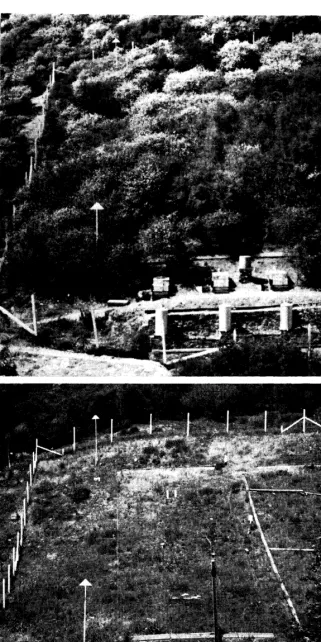
Before testing the lysimeter results on a watershed, a plot study was begun to find out if percolation yields could be in- creased by replacing deep-rooted brush with a shallow-rooted an- nual grass cover. This study was carried out under natural condi- tions (Figure 1).
For several years we measured rainfall, runoff, erosion, and soil moisture on nine hillside plots
heavily covered with native
brush, mostly scrub oak (Quer- cus dumosa). These plots had an average gradient of 35 per-
cent. The soil was a permeable, stony, sandy loam averaging 12 feet deep.
In 1951, we converted two sets (six plots) of plots to annual
ryegrass (Lolium multiflorum) ,
and left the third set undis-
turbed. During the next two
years we maintained a grass
cover on the converted plots by
killing all brush sprouts and
seedlings, and forbs with 2, 4, 5-T. The third year (1954-1955) we permitted a heavy stand of
summer-growing forbs to de-
velop.”
Once the grass cover was com- pletely established, no appreci- able amount of runoff or erosion
from the plots occurred. But the
change in vegetation greatly
altered water losses and soil
moisture relations (Rowe and
Reimann, 1961).
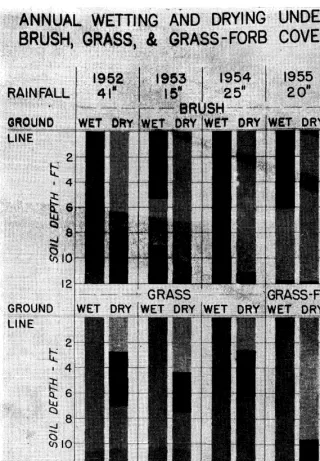
The soil of the undisturbed brush plots was wet to field ca- pacity through the la-foot depth the first winter. Rainfall that season totaled 41 inches. During the next three winters, however, rainfall was only 15, 25, and 20 inches, and the soil was wet to field capacity to depths of only four, nine and one half, and four feet. Each summer, evapotrans- piration dried the entire soil of these plots to near or below wilt-
ing point. Rainfall was not
enough after the first year to fully re-wet the soil (Figure 2). In contrast, the soil of plots
converted from brush to grass
was wet to field capacity the en- tire depth each rainy season. During the first three summers the grass-covered soils dried be- low field capacity to about seven feet and below wilting point to about three feet. Consequently, there was a greater carry-over of water in the three to la-foot depth of soil under grass than un- der brush at the end of summer.
A substantial soil moisture
Table 2. Annual rainfall disposition on the San Dimas lysimefers. average of five consecutive dry years and in one wef year.
.__
LOW RAINFALL PERIOD, 1952-1957
Evapora-
Surface Infiltration tive
Vegetation Rainfall runoff 1 Percolation loss2 --- (Inches) __-_---
Bare 20.6s 27.7 7.9 0 7.4
Brush4 20.6 3.0 17.6 0 17.6
Grass 20.6 3.4 17.2 1.8 15.7
HIGH RAINFALL PERIOD, 1957-1958
Bare 48.4 39.1 9.3 (5) 8.7
Brush4 48.4 19.4 29.0 3.8 24.6
Grass 48.4 20.3 28.1 11.5 16.5
-~
1 Not adjusted for interception. But, other studies have shown that brush intercepts about 11 percent of annual rainfall whereas grass intercepts about 6.5 percent.
2 Evaporative loss = rainfall - (runoff + percolation - increase or i- de- crease in soil moisture).
302 HILL AND RICE
FIGURE 1. Cover converted from brush to grass; before conversion, above; after con- version but before forbs were permitted to develop, below.
saving and potential ground-
water yield, 6.4 inches, was ob- tained under grass (Table 3) .
But when we permitted deep-
rooted, summer-growing forbs to invade the grass, soil moisture and percolation gains were lost
(Table 4). The soil throughout the 12-foot depth was nearly as dry by summer’s end as under the brush.
The study pointed out three important considerations. Vege-
tation conversion to increase
water yield (a) must be done on soils more than three feet deep, (b) the grass must be main- tained free of weeds, and (c) more than enough rainfall to re- place the soil water used by grass during the previous year must be received.
Managing For Increased Wafer Yield
Drawing on the results of the two earlier studies, we placed an
entire watershed under inten-
sive management to increase the
yield of usable water (Rowe,
1957).
Plants in the canyon bottom
have the most opportunity to
waste water. Consequently, for
our first water yield improve- ment trial, we removed 38 acres
of thirsty canyon-bottom trees
and brush from 875-acre Monroe
Canyon (Figure 3) during the
spring of 1958 and 1959. Volfe
Canyon, an adjacent 740-acre
watershed, was chosen as an un- treated control to evaluate treat-
ment effects in Monroe. These
drainages, similar in their hydro- logic and vegetal characteristics,
are comparable to many moun-
tain watersheds in southern Cali- f ornia.
4Forb.s included: common yellow mustard (Brassica campestris) , prickly lettuce (Lactuca serriola) , Douglas nightshade (Solanum douglasi), soap plant (Chlorogalum pomeridianum) , and Sierra thistle
(Cirsium californicum).
CONVERSION INCREASES WATER YIELD 303
FIGURE 2. Water-use differences under brush, grass, and grass-forb cover.
Chamise-chaparral and scrub
oak-chaparral formations, un-
burned since 1919, clothed the slopes.‘) Riparian woodland oc- cupied the canyon bottom and
covered about ten percent of
the watershed (87 acres). The
true riparian vegetation occu-
pied about ten percent of the area treated (3.8 acres). It con-
sisted of white alder (Alnus
rhombifolia), bigleaf maple (Acer macrophyllum), California laurel (Umbrellaria californica), willow (Salix spp.) , mulefat (Baccharis viminea), California
sycamore (Platanus racemosa),
and several associated herba-
ceous plants-about 25 acres of
the treated area were occupied by oak-woodland. The main spe- cies included California live oak (Quercus agrifolia), California
Table 3. Wafer regimen under brush and grass during a year of moderate rainfall, 1953-1954.
Water storage Evapo-
Vegetation Beg. of yr. End of yr. Rainfall Percolation transpira-
(10/19/53) (H/8/54) tion
--- (Inches) - - L - - - - -
Brush 9.9 11.4 24.9 0.0 23.4
Grass 21.6 24.9 24.9 6.4 15.5
laurel, interior live oak (Quercus wislizenii), bigleaf maple, can- yon live oak (Quercus chryso- Zepis), and bigcone Douglas-fir (Pseudotanga macrocarpa). Scat-
tered trees, native shrubs,
grasses, forbs, and rock outcrop occupied the remaining part of the cleared area.
Fifteen acres were cleared the first spring and 23 acres the next spring. The 1.3-mile long clear- ing varied from 100 feet to over 400 feet wide. It extended up the side slopes an average of 50 feet above the stream.
After clearing, the area was hand sprayed to kill sprouting
vegetation, brush seedings and
weeds. Native grasses, mostly
ripgut (Bromzbs rigidus), quickly invaded the area and provided good soil protection.
Treatment Effect on Waier Quantify
Water yield gains first ap-
peared during the summer and fall of 1958. With only 15 acres cleared, streamflow was 17.4 acre feet more than predicted with-
out treatment (Table 5). This
increase resulted from lower
day-to-day evapotranspiration
losses. Rainfall was light (1.8
inches) and contributed to
streamflow only the small
amount intercepted by the
stream.
304 HILL AND RICE
Table 4. Water regimen under brush and grass-forb cover during a year of moderate rainfall, 1955-1956.
Water storage Evapo-
Vegetation Beg. of yr. End of yr. Rainfall Percolation trans-
(1 l/9/55) (1 l/30/56) piration
Brugh Grass-forb
----w--e (Inches) - - - -
10.7 13.0 20.5 0.0 18.2
13.2 16.7 20.5 0.0 17.0
low the root zone of the previ- ously-cleared 15 acres. Here soil
moisture deficits were low so
that 8.4 acre feet of the season’s increased streamflow came from this area. The rest, 4.4 acre feet, resulted from lower day-to-day
evapotranspiration from all 38
acres cleared. This gain came
during inter-storm periods.
Streamflow gain the second
dry season, summer and fall,
1959, was 14 acre feet. Rainfall during the period was only 1.3 inches and contributed little to streamflow. As before, this sea-
son’s gain in streamflow was
principally due to lqwer day-to- day evapotranspiration.
During the second rainy season (winter and spring, 1959-1960) streamflow gain was eight acre- feet. Rainfall, 22.9 inches, was enough to satisfy soil moisture deficits. As in the 1958-1959 rainy season, the largest proportion of the gain came during and im- mediately after storms.
The largest gains in stream- flow came during the dry season when water is most needed. Be-
fore treatment, streamflow in
Monroe Canyon usually dried up in early July. Since the treat- men began, however, streamflow has been continuous.
Effects On Wafer Quality
Streamflow yields during the
rainy seasons were among the
highest on record (1934-1960)
yet no increase in storm dis charge or erosion rates was de- tected. In fact stream channel banks, and side slopes -some
of which eroded before treat-
ment-appeared to be complete-
ly stabilized. There were no
flood-producing storms during
cannot predict what effect clear- ing and subsequent grass cover establishment might have had on erosion and flood peaks.
Chemical analyses showed no trace of herbicides in the stream- flow. But small traces of oil (two
to 30 p.p.m.) used in the spray
mixture were found in some
samples.
Water temperature in Monroe Canyon appeared to be higher
than untreated Volfe Canyon.
During the summer, tempera-
tures were generally above 65°F. A relatively high concentration of green algae (Cladophora spp.) was associated with these tem- peratures.
The study was short-lived be- cause of a July 1960 fire. Never- theless, several conclusions can be drawn:
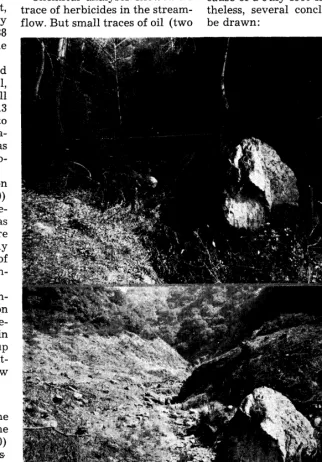
FIGURE 3. Part of the treated canyon bottom in Monroe Canyon; before clearing, above;
the same area after clearing, below.
CONVERSION INCREASES WATER YIELD
305
Table 5. Gains in sfreamflow from removing 38 acres of woodland-riparian vegeiafion in Monroe Canyon.
Rainfall Total gain Gain in Preceding During in streamflow per Season season season streamflow acre cleared
- - (Inches) - - --- (Acre feet) - - - First Year
Dry Seasoni 47.0 1.8 17.4 1.1
First Year
Rainy Season2 1.8 13.2 12.8 0.3
Second Year
Dry Season 13.2 1.3 14.0 0.4
Second Year
Rainy Season 1.3 22.9 8.0 0.2
First year total ____ 15.0 30.2 0.8 Second year total ____ 24.2 22.0 0.6 1 15 acres cleared
2 38 acres cleared
1. The study was conducted
during two years of below-aver-
age rainfall which were pre-
ceded by an above-average rain-
fall year. Gains in streamflow
during the post-treatment period
are probably associated with this
high rainfall as well as with the
treatment.
2. Seasonal gains in stream-
flow were less the second year
than in the first year. This de-
cline probably reflects the below
average rainfall conditions dur-
ing the second year’s rainy sea-
son. We would expect larger
gains with average rainfall.
3. Gains in streamflow were
highest during the dry season
when water is most needed and
lowest during the rainy season.
Streamflow has been continuous
since treatment began.
4. Dry season streamflow was
highest because the grass died
early in summer and, conse-
quently, used little soil water.
On the other hand, tree and
shrub growth in the control
watershed was in full foliage and
at the peak of annual growth. It
withdrew soil water all season,
and from a much greater depth.
5. If soils are not saturated
during the rainy season, treat-
ment may have little effect on
this season’s streamflow.
6. Streamflow gains were prob-
ably least from the area where
free water and wet soil surfaces
were exposed to wind and sun.
Gains were probably greatest
from the area where grass roots
did not penetrate continuously
saturated soil.
Multiple Benef ifs From Brush Conversion
We have demonstrated at San
Dimas that water yields can be
improved by converting canyon-
bottom vegetation from wood-
land-brush to a grass cover. At
present we are converting 140
acres of brush-covered
side
slopes with deep soil in Monroe
Canyon to grass cover. We ex-
pect additional yields in stream-
flow to result from this treat-
ment.
But water yield improve-
ments are not the only benefits
of a brush conversion program.
Extensive brush fields are bro-
ken into smaller, more manage-
able units for more effective fire
control. Grassed areas provide
for wildlife a new habitat that is
not found in dense brush. In
areas suitable for grazing, new
range for livestock is developed.
Research is underway at San
Dimas to determine the inte-
grated effect of some of these
multiple benefits.
LITERATURE CITED ANONYMOUS. 1955. Annual report.
U. S. Forest Serv., Calif. Forest 8~ Range Experiment Sta., 92 pp., illus.
CRAWFORD, JAMES M., JR. 1962. Soils of the San Dimas Experimental Forest. U. S. Forest Serv., Pacific Southwest For. & Range Exp. Sta., Misc. Paper 76, 20 pp, illus. PATRIC, J. H. 1961. The San Dimas
lysimeters. Jour. Soil 8~ Water Conserv. 16 (1) : 13-17.
ROWE, P. B. 1957. Plan for applied watershed management to in- crease water yield, Big Dalton Canyon, San Dimas Experimental Forest. U. S. Forest Serv. Pacific Southwest For. & Range Exp. Sta. 11 PP.
ROWE, P. B. AND REIMAN, L. F. 1961. Water use by brush, grass and grass forb vegetation. Jour. For- estry 59 (3) : 173-181.
SINCLAIR, J. D., AND PATRIC, J. H. 1959. The San Dimas disturbed soil lysimeters. Inter. Union Geodesy & Geophysics, Proc. 1959: 116-125.
STOREY, H. C. 1947. Geology of the San Gabriel Mountains, Califor- nia, and its relation to water dis- tribution. Calif. Dept. Nat. Re- sources, Div. Forestry, 19 pp.
Fertilization of Seeded Grasses on Mountainous
Rangelands in Northeastern Utah and
Southeastern Idaho1
A. C. HULL, JR.
Range Conservationist, Crops Research Division, Agri- cultural Research Service, U. S. Department of Agri-
culture, Logan, Utah
Fertilization has been widely
tested as a way to increase herb-
age production of western range-
lands. Eckert et
al.(1961) found
a response to nitrogen in the
eight to la-inch precipitation
zone in Nevada, but concluded
that fertilization would not be
practical. In North Dakota, with
17 inches of precipitation, Rogler
and Lorenz (1957) obtained an
average of 2,271 pounds of air-
dry herbage per acre per year
from a heavily grazed native
pasture when they applied 90
pounds of nitrogen per acre for
six successive years. Unfertilized
range yielded 748 pounds per
acre. Two years of fertilization
did more to improve the range
than six years of complete iso-
lation from grazing.
On Colorado’s Front Range
McGinnies (1962) worked on
five sites with precipitation of
12 to 16 inches. He found that
nitrogen increased
herbage
yields on older seeded grass
stands on average or better sites
and in years of average or above-
average precipitation.
Eckert
and Bleak (1960) determined
that four mountain soils with 15
to 40 inches annual precipitation
in western Nevada and northern
1 Cooperative investigations of Crops Research Division, Agricultural Re- search Service and the U. S. Forest Service, U. S. Department of Agri- culture; and Utah Agricultural Ex- periment Station, Logan, Utah. Thanks to Wesley Bitters and Steven Smith, former students who assisted with the study and to Dr. R. L. Smith for help on analysis of soil-nitrogen losses. Utah Agric. Expt. Sta. Journal Paper 316.
California were deficient in ni-
trogen, phosphorus, and lime.
Retzer (1954) obtained no im-
portant increase in native herb-
age by top dressing with 14 fer-
tilizers and minor elements on
seven range soils on sites with 15
to 30 inches of precipitation in
the Rocky Mountains.
Gomm (1962) worked in a
high-altitude park in Montana,
where the annual precipitation
was 25 inches. He found that fer-
tilizers probably decreased the
number of established seedlings.
Hull et
al.(1962) applied several
fertilizers spring and fall for
three years on new range seed-
ings on six mountainous areas in
the West where precipitation
ranged from 12 to 40 inches an-
nually. They found that nitro-
gen increased seedling numbers
at one location and increased
vigor of seeded and native plants
at most locations.
On many dry ranges where
moisture limits plant growth
and on some mountainous areas
where precipitation is high, fer-
tilization has given erratic re-
sults. The present studies were
initiated to test the response of
seeded grasses on mountainous
rangelands to commercial ferti-
lizers.
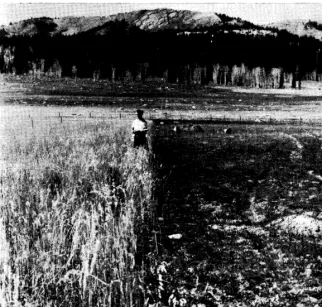
FIGURE 1. General view of the Logan Canyon area where fertilizers were applied in 1957 and 1958.
Experimental Procedures and Resulfs
This paper
reports
three
studies separately: (1) Fertiliza-
tion of pubescent wheatgrass
(Agropyron trichophorum
(Link) Richt.) in northeastern
Utah, (2) Fertilization of new
seedings in southeastern Idaho,
and (3) Fertilization of a mix-
ture in southeastern Idaho.
Nitrogen (N) was appplied as
ammonium nitrate and phos-
phorus (available P,O,) as treble
superphosphate on the soil sur-
face. Results were measured by
numbers of plants per square
foot or by pounds of air-dry
herbage per acre. Chemical con-
tent of the herbage was deter-
mined in the third study. Soil
and herbage samples were ana-
lyzed by standard procedures.
Significance of results at the
five-percent
level was deter-
mined by Duncan’s (1955) mul-
tiple range test.
Ferfilizafion of Pubescent Wheafgrass in Northeastern Ufah
The experimental area was a
big sagebrush
(Artemisia triden- tutuNutt.) covered opening in
the spruce (Picea spp.) and fir
(Abies
spp.) zone at an elevation
of 7,700 feet in Logan Canyon
(Figure 1). Aspect was south-
west with a 15-percent slope.
Nearby snow survey and summer
precipitation records showed an
annual precipitation of approxi-
mately 32 inches; 4.5 inches of
rain June to September and 27.5
inches of late fall rain and win-
ter snow. Snow usually covered’
the area from mid-November to
mid-May. The soil was a loam
Soil characteristics at the zero to
six and six to 12-inch depths be-
fore treatment were as follows
(data for the shallow depth are
listed first): pH (saturated
paste) 6.3, 6.5; percent soluble
salts 0.02, 0.02; organic matter
percent 6.9, 4.1, nitrogen percent
0.3,0.2; and pounds P,05 per acre
390, 241.
Pubescent wheatgrass
was
seeded in the fall of 1953. A good
FERTILIZATION OF GRASSES
stand of grass resulted. Three
replicates of six fertilizer treat-
ments listed below were applied
to one series of plots in October
1957 and to another series in
June 1958.
Results:
Rates of fertilizer
(pounds per acre) applied both
spring and fall and average air-
dry grass production (pounds
per acre) in 1958 were: No fertil-
izer, 760; N 20, 685; N 40, 718;
N 60, 842; N 40 and
P205, 200791; and P,O, 200, 811. Although
fertilizers were associated with
increased grass yields, the differ-
ences were not significant. There
was no significant difference
between spring and fall applica-
tion. Favorable moisture in 1959
caused yields which were almost
double those in 1958, but again
there was no significant differ-
ence in grass growth or yield.
There were no visible differ-
ences either year in season of
growth, color, or vigor of the
grass as the result of fertilizer
treatments.
Feriilization of New Seedings in Soufheasfern Idaho
The study area was a weedy
opening at 8400 feet elevation in
the spruce-fir type in Franklin
Basin, southeastern Idaho. The
aspect was west with a three-
percent slope. Snow normally
covered the area from late Octo-
ber to June 1. Five-year snow
survey and summer precipitation
records averaged 42.3 inches an-
nually. Winter snow and late-
fall rain amounted to 36.2 inches;
rain from June to September 6.1
307
inches. The first 12 inches of soil
were a silt loam with clay loam
below. Calcium carbonate at all
depths was 0.2 percent (Table 1).
Ten seeding methods were
used in the fall and three in the
spring with four replications for
three years (1957-1960). The fol-
lowing species were seeded sep-
arately in each seeding method;
intermediate wheatgrass
(Agro-pyron intermedium
(Host)
Beauv.) ,
slender wheatgrass
(A. trachyculum(Link)
Malte) ,pu-
bescent wheatgrass,
smooth
brome
(Bromus inermisLeyss.) ,
and hard fescue
(Festucu ovinuvar. duriusculu (L.) Koch).
Five fertilizer treatments were
applied at right angles to all
seeded rows at the following
pounds per acre at the time of
seeding: (1) No fertilizer; (2)
N 100; (3) P,05 200; (4) N 100
and P,O, 200; and (5) N 100, P,O,
200, potash (K,O) 100, sulfur (S)
100, copper sulfate 50, ferrous
sulfate 50, magnesium sulfate 50,
manganous sulfate 50, zinc sul-
fate 50, sodium borate 20, and
ammonium molybdate one pound
per acre.
Seedlings were counted spring
and fall for three years after
seeding. Notes were made on
height and vigor of seeded and
native species.
Results:
Averaging all five spe-
cies on all seeding treatments
gave the following plants per
square foot for the five fertilizer
treatments listed above: 0.8, 0.7,
0.7, 0.6,0.6. Fertilizer application
did not significantly affect plant
Table 1. Soil characferisfics at Franklin Basin before fertilizers were ap- plied.
Moisture percent
Soil Potas- Organic Satura-
depth PH Salts sium P205 N matter 15 Y3 tion
(Satu-
rated (EC x (me/100
(Inches) paste) 103) g.) (WA) (Percent) (Atmospheres)
o-3 5.9 .26 1.04 66 .20 3.9 11 29 45
3-6 5.9 -22 .72 49 .20 3.8 11 28 48
6-12 5.7 .18 .62 - .15 3.0 12 27 47
12-24 5.6 .21 .58 - .ll 2.0 12 26 44