Hybrid Publicly Verifiable Computation
?James Alderman, Christian Janson, Carlos Cid, and Jason Crampton
Information Security Group, Royal Holloway, University of London Egham, Surrey, TW20 0EX, United Kingdom
{James.Alderman, Carlos.Cid, Jason.Crampton}@rhul.ac.uk [email protected]
Abstract. Publicly Verifiable Outsourced Computation (PVC) allows weak devices to delegate computations to more powerful servers, and to verify the correctness of results. Delegation and verification rely only on public parameters, and thus PVC lends itself to large multi-user systems where entities need not be registered. In such settings, individual user requirements may be di-verse and cannot be realised with current PVC solutions. In this paper, we introduceHybrid PVC (HPVC) which, with a single setup stage, provides a flexible solution to outsourced computation supporting multiple modes: (i) standard PVC, (ii) PVC with cryptographically enforced access control policies restricting the servers that may perform a given computation, and (iii) a reversed model of PVC which we callVerifiable Delegable Computation(VDC) where data is held remotely by servers. Entities may dynamically play the role of delegators or servers as required.
Keywords Publicly Verifiable Computation, Outsourced Computation, Dual-Policy Attribute-based Encryption, Revocation, Access Control
1
Introduction
The trend towards cloud computing means that there is a growing trust dependency on remote servers and the functionality they provide.Publicly Verifiable Computation (PVC) [23] allowsany entity to use public information to delegate or verify computations, and lends itself to large multi-user systems that are likely to arise in practice (as delegators need not be individually registered).
However, in such a system, the individual user requirements may be diverse and require different forms of outsourced computation, whereas current PVC schemes support only a single form. Clients may wish to request computations from a particular server or to issue a request to a large pool of servers; in the latter case, they may wish to restrict the servers that can perform the computation to only those possessing certain characteristics. Moreover, the data may be provided by the client as part of the computation, or it may be stored by the server; and the role of servers and clients may be interchangeable depending on the context.
Consider the following scenarios: (i) employees with limited resources (e.g. using mobile devices when out of the office) need to delegate computations to more powerful servers. The workload of the employee may also involve responding to computation requests to perform tasks for other employees or to respond to inter-departmental queries over restricted databases; (ii) Entities that invest heavily in outsourced computations could find themselves with a valuable, processed dataset that is of interest to other parties, and hence want to selectively share this information by allowing others to query the dataset in a verifiable fashion; (iii) database servers that allow public queries may become overwhelmed with requests, and need to enlist additional servers to help (essentially the server acts as a delegator to outsource queries with relevant data). Finally, (iv) consider a form of peer-to-peer network for sharing computational resources – as individual resource availability varies, entities can sell spare resources to perform computations for other users or make their own data available to others, whilst making computation requests to other entities when resources run low.
Current PVC solutions do not handle these flexible requirements particularly well; although there are several different proposals in the literature that realise some of the requirements described above, each requires an independent (potentially expensive) setup stage. We introduceHybrid PVC (HPVC) which
?A preliminary version of this paper appears in the proceedings of Topics in Cryptology - CT-RSA 2016,
is a single mechanism (with the associated costs of a single setup operation and a single set of system parameters to publish and maintain) which simultaneously satisfies all of the above requirements. Entities may play the role of both delegators and servers, in the following modes of operation, dynamically as required:
– Revocable PVC (RPVC) where clients with limited resources outsource computations on data of their choosing to more powerful, untrusted servers using only public information. Multiple servers can compute multiple functions. Servers may try to cheat to persuade verifiers of incorrect information or to avoid using their own resources. Misbehaving servers can be detected and revoked so that further results will be rejected and they will not be rewarded for their effort;
– RPVC with access control (RPVC-AC) which restricts the servers that may perform a given computation. Outsourced computations may be distributed amongst a pool of available servers that are not individually authenticated and known by the delegator. Prior work [1] used symmetric primitives and required all entities to be registered in the system (including delegators) but we achieve a fully public system where only servers need be registered (as usual in PVC);
– Verifiable Delegable Computation(VDC) where servers are the data owners and make a static dataset available for verifiable querying. Clients request computations on subsets of the dataset using public, descriptive labels.
We begin, in Section 2, with a summary of related work and the KP-ABE-based PVC schemes [23, 2] on which we base our HPVC construction. In Section 3, we define the generic functionality and security properties of HPVC. We then, in Section 4.1, discuss each supported mode of computation, and how it fits our generic definition. To support user revocation [2], we introduce a new cryptographic primitive called Revocable-Key Dual-policy Attribute-based Encryption (rkDPABE) in Section 4.2 and provide a detailed construction and proof in Appendix B. In Section 4.3, we instantiate HPVC usingrkDPABEand in Section 5 we present the security proofs for our scheme. Finally, in Section 6 we conclude the paper.
2
Background and Related Work
Verifiable computation [17, 13, 27, 16, 12, 10, 23] may be seen as a protocol between a (weak) clientCand a server S, resulting in the provably correct computation of F(x) by the server for the client’s choice ofF andx. The setup stage may be computationally expensive (amortised over multiple computations) but other operations should be efficient for the client. Some prior work used garbled circuits with fully homomorphic encryption [17, 13] or targeted specific functions [10, 16, 12]. Chung et al. [14] introduced memory delegationwhich is similar to VDC; a client uploads his memory to a server who can update and compute a functionF over the entire memory. Backes et al. [8] consider a client that outsources data and requests computations on a data portion. The client can efficiently verify the correctness of the result without holding the input data. Most work requires the client to know the data in order to verify [18, 9, 11, 22].Verifiable oblivious storage [3] ensures data confidentiality, access pattern privacy, integrity and freshness of data accesses. Work on authenticated data lends itself to verifiable outsourced computations, albeit for specific functions only. Backes et al. [7] use privacy-preserving proofs over authenticated data outsourced by a trusted client. Similar results are presented in [25] using public logs. It is notable that [7] and [11] achieve public verifiability. In independent and concurrent work, Shi et al. [24] use DP-ABE to combine keyword search on encrypted data with the enforcement of an access control policy.
Parno et al. [23] introduce Publicly Verifiable Computation (PVC) where multiple clients outsource computations of a single function to a single server, and verify the results. Alderman et al. [2] introduce a trusted Key Distribution Centre (KDC) to handle the expensive setup for all entities, to allow multiple servers to compute multiple functions, and to revoke misbehaving servers. Informally, the KDC acts as the root of trust to generate public parameters and delegation information, and to issue secret keys and evaluation keys to servers. To outsource the evaluation ofF(x), a delegator sends an encoded inputσF(x)
to a serverS, and publishes verification tokens.S uses an evaluation key forF to produce an encoded output θF(x).Any entity can verify correctness ofθF(x) using a verification key and learn the value of F(x). IfS cheated they may be reported to the KDC for revocation.
evaluation key is a pair of decryption keys linked to F andF (the complement function ofF). Exactly one message can be recovered, implying whether F or F was satisfied, and hence if F(X) = 1 or 0. Ciphertext indistinguishability ensuresS cannot return the other message to imply an incorrect result.
3
Hybrid Publicly Verifiable Computation
3.1 Formal Definition
To accommodate different modes of computation, we define HPVC generically in terms of parameters
ω,O,ψ andS. Depending on the mode (and which party provides the input data),OorS will encode
functions, whileω orψ encode input data, as detailed in Section 4.1. We retain the single, trusted Key Distribution Centre (KDC) from RPVC [2] who initialises the system for a function familyF resulting in a set of public parametersppand a master secret keymk. For each functionF ∈ F, the KDC publishes a delegation keypkF. It also registers each entitySi that wants to act as a server by issuing a signing keyskSi. It may also updatepp during any algorithm to reflect changes in the user population.
Depending on the mode, servers either compute functions Oon behalf of clients, or make a dataset ψavailable for public querying. The Certifyalgorithm is run by the KDC to produce an evaluation key
ek(O,ψ),Si enablingSi to perform these operations.Sichooses a set of labelsLi – in RPVC or RPVC-AC modes,Liuniquely represents the functionFthatSishould be certified to compute; in VDC mode,Liis aset of labels, each uniquely representing a data point contained in the datasetDi owned bySi.1In the VDC setting, the server is the data owner and soSi also provides a listFiadvertising the functions that he is willing to evaluate on his data in accordance with his own data usage policies; in RPVC settings, Fi advertises the functionsSi is certified to compute.
To request a computation ofF(X) (encoded inωorS) fromSi, a delegator uses public information to runProbGen. He provides labelsLF,X ⊆Li describing the computation: in RPVC or RPVC-AC modes, the delegator provides the input dataX and LF,X labels the function F to be applied; in VDC mode, the client uses the descriptive labels to choose a subset of data pointsX ⊆Di, X⊆Dom(F) held bySi that should be computed on.ProbGen generates an encoded input σ(ω,S) and a public verification key vk(ω,S).
A server combines σ(ω,S) with its evaluation key to compute θF(X) encoding the resultF(X). Any
entity can verify the correctness ofθF(X)using vk(ω,S). Verification outputs the result y=F(X) of the
computation (if correct) and generates a tokenτθF(X) which is sent to the KDC; if the token signifies that the result was incorrectly formed then the server is revoked from performing further evaluations. This prevents delegators wasting their (limited) resources outsourcing to a server known to be untrustworthy, and also acts as a deterrent, especially when servers are rewarded per computation.
We now present a formal definition of all necessary algorithms for an HPVC scheme.
Definition 1. An hybrid publicly verifiable outsourced computation (HPVC) scheme for a family of functionsF comprises the following algorithms:
1. (pp, mk)←$ Setup(1λ,F): this randomised algorithm is run by the KDC to establish public parameters
ppand a master secret keymkfor the system. The inputs are the security parameterλ, and the family of functions F that may be computed;
2. pkF $
←FnInit(F, mk, pp): this randomised algorithm is run by the KDC to generate a public delegation key,pkF, allowing entities to outsource, or request, computations ofF;
3. skSi $
←Register(Si, mk, pp): this randomised algorithm is run by the KDC to enrol an entitySiwithin the system to act as a server. It generates a personalised signing key skSi;
4. ek(O,ψ),Si $
← Certify(mode, Si,(O, ψ), Li,Fi, mk, pp): this randomised algorithm is run by the KDC to generate an evaluation key ek(O,ψ),Si enabling the entity Si to compute on the pair (O, ψ). The algorithm also takes as input the mode in which it should operate, a set of labelsLi, a set of functions Fi, the master secret key as well as the public parameters;
5. (σ(ω,S), vk(ω,S))
$
←ProbGen(mode,(ω,S), LF,X, pkF, pp): this randomised algorithm is run by an entity to request a computation of F(X)fromSi. The inputs are the mode, the pair(ω,S)representing the
computation request, a set of labels LF,X ⊆Li, the delegation key forF and the public parameters. The algorithm outputs an encoded input σ(ω,S) and a verification keyvk(ω,S);
6. θF(X)
$
←Compute(mode, σ(ω,S), ek(O,ψ),Si, skSi, pp): this randomised algorithm is run by an entitySi to computeF(X). The inputs are the mode, an encoded inputσ(ω,S), an evaluation keyek(O,ψ),Si and a signing key for Si. The algorithm outputs an encoded outputθF(X)representingF(X);
7. (y, τθF(X))←Verify(θF(X), vk(ω,S), pp): this algorithm is run by any entity that wants to verify whether the result was computed correctly or not. The inputs are the encoded outputθF(X), the verification key vk(ω,S)and the public parameters. The algorithm outputs the actual resulty. If the resultycorresponds
to F(x) it additionally creates a tokenτθF(x) = (accept, Si) indicating that the result was correctly computed. Otherwise, the result y corresponds to ⊥ and it creates a token τθF(x) = (reject, Si) indicating that the result is malformed and Si misbehaved;
8. um←$ Revoke(τθF(X), mk, pp): this randomised algorithm is run by the KDC inputting the token from the verification process, the master secret key and public parameters. If τθF(X) = (reject, Si), the algorithm revokes all evaluation keys ek(·,·),Si of the server Si by rendering them non-functional and thereby preventingSi from performing any further evaluations within the current system. The update material umconsists of a set of updated evaluation keys{ek(O,ψ),S0} which are issued to all servers.
Otherwise, in case τθF(X)= (accept, Si)then the algorithm outputs⊥indicating that no update was necessary.
Although not explicitly stated, the KDC may update the public parametersppduring any algorithm in order to address any changes in the entity population.
We say that an HPVC scheme iscorrectif, when all algorithms are run honestly in any order and the result is computed by a non-revoked server, the result is correct and the verification algorithm accepts the result. We can model this as a cryptographic game between a challenger and a PPT adversary; the adversary aims to find an encoded output (generated honestly by a non-revoked server) which either does not encode the correct result, or which does encode the correct result yet which will not be accepted by the verification algorithm.
The adversary is given access to a set of oracles; for each algorithm in Definition 1, we define a cor-responding oracle which executes the corcor-responding algorithm on arguments provided by the adversary, and returns the output of the algorithm to the adversary. The adversary may query theSetuporacle only once (before making any other oracle queries), but can thereon call the remaining oracles any number of times and in any order.
The challenger maintains two lists,LRegandLF.LReg is a list of tuples comprising server identities, Si, and the resulting signing keys, skSi, that have been queried to theRegister oracle. LF comprises tuples of the form (Si, ψ, Li,Fi, ek(O,ψ),Si) denoting that the server Si has been queried to the Certify oracle for the set of functionsFiand thatek(O,ψ),Si was generated. When the adversary makes aRevoke query with a revocation token that identifies a serverSi to be revoked (that is, if τθF(X) = (reject, Si) is given as input to theRevoke oracle), the challenger removes all entries of the form (Si,·,·,·,·,·) (i.e. all entries forSi for any function) fromLF.
The challenger also creates and maintains a tableT which records the parameters and values relating to each computation performed through the oracle queries.T is updated in the following oracles:
– ProbGen: the challenger creates a new row inT comprising 7 components, all of which are initialised to be empty; it then assigns X (which is either given explicitly inω or can be found by searching
LF for the labels LF,X),F, the resultF(X) (computed by the challenger itself),σ(ω,S) andvk(ω,S)
to the first 5 components;
– Compute: the challenger first searches T for all rows that contain the queried σ(ω,S) in the 4th
component and where the 6th component is empty (i.e. those rows relating to computations on this encoded input that have not yet been performed). For each such row, r, the challenger takes the second component (the function identifier, ˜F), and checks that there exists a server identity ˜Si such that the tuple ( ˜Si, skS˜i)∈LReg (whereskS˜i is that given as input to theComputeoracle)and such that the tuple ( ˜Si,·,·,Fi, ek(O,ψ),Si) ∈LF (where ek(O,ψ),Si is also that given as input to the
being used to perform the computation and which is certified for a function ˜F for which the encoded inputσF,X was generated.
The challenger then performs the Compute algorithm on the queried σ(ω,S), ek(O,ψ),Si andSKSi to produce an outputθF(X). For each of the rows rofT found above, the challenger writesθF(X) and
˜
Si to the 6th and 7th components ofr respectively. Thus, a row of T will only have a (non-empty) value in the 6thcomponent if there exists a non-revoked, certified server to perform the computation for whichσ(ω,S)was generated.
Thus, when complete, the entries ofT will be of the form
(X, F, F(X), σ(ω,S), vk(ω,S), θF(X), S).
After a polynomial number of queries, the adversary will return a valueθF?(X)which it believes either encodes an incorrect computational result or which encodes a correct computational result yet which theVerifyalgorithm will reject (that is, an output for which the protocol execution will not be correct). The challenger first performs a look up in T for all entries containing θ?F(X) in the 6th position of the tuple, and stores any such entries as another table ˜T. Note that this means thatθ?
F(X) must have been
honestly generated by theComputeoracle (else it would not be in T).
For each such row, the challenger uses the 5thcomponent (the verification key) to runVerifyonθ? F(X)
to generate the outputy.
The challenger first checks whetherymatches the 3rd component of the row (that is, whetheryis the correct computational resultF(X)). If so, it then checks whetherτθF(X) = (reject, Si), and if so it ends the game by returning 1 to indicate that the adversary has won the game (the adversary has found a valid encoding of a correct result, computed by a certified, non-revoked server, that theVerifyalgorithm is incorrectly rejecting).
On the other hand, if y didnot match the correct value ofF(X), the challenger also ends the game by returning 1 to indicate that the adversary has won the game (the adversary in this case has found an incorrect result that was computed honestly by the algorithms).
If no row in ˜Tallows the adversary to win, then the challenger outputs 0 to indicate that the adversary has lost.
An HPVC scheme is correct if, for all PPT adversaries, the probability that the adversary wins the game described above is 0.
3.2 Security Models
In this section we discuss the security notions we wish to achieve in our HPVC framework. In more detail, we can achieve security in the sense of public verifiability, revocation and authorised computation.2 We
require to include some additional restrictions on the games that are placed from our current rkDPABE primitive (which we introduce in Section B) which acts as our main building block for our HPVC construction.
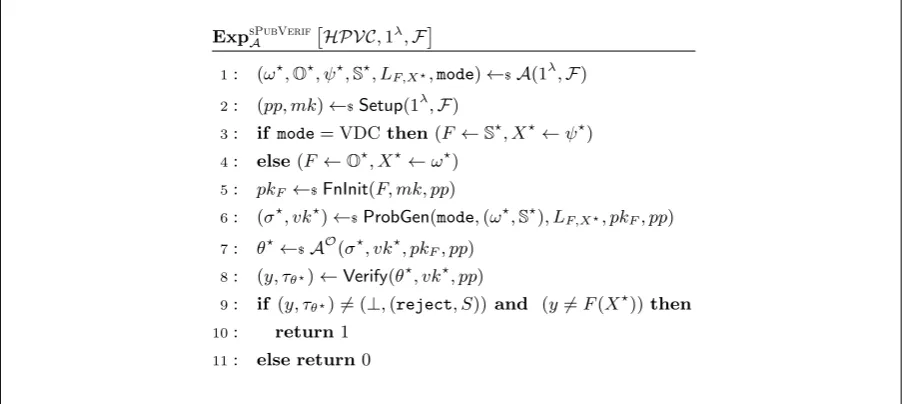
Selective Public Verifiability. In Figure 1, we define a selective notion of public verifiability. This notion captures that no server is able to return a malformed result for a computation without being detected.
The game begins with the adversary first selecting its challenge parameters. Note that the adversary chooses the mode it wishes the challenge to be generated in and the respective labels necessary for this mode. Furthermore, the adversary outputs choices for ω?, O?, ψ? and S?, despite only ω? and S? are
used to form the challenge input. This notation was used mainly for notational convenience to allow us to define the challenge computation in terms ofF andX? in line 3 or 4 depending on the mode. However, we want to stress that this information can also be learnt from the set of labelsLF,X? and the chosen mode of computation. Thus, this notational convenience does not weaken the game since the information
2
ExpsPubVerif A
HPVC,1λ,F
1: (ω?,O?, ψ?,S?, LF,X?,mode)←$A(1λ,F)
2: (pp, mk)←$Setup(1λ,F)
3: if mode= VDCthen(F ←S?, X?←ψ?) 4: else(F ←O?, X?←ω?)
5: pkF←$FnInit(F, mk, pp)
6: (σ?, vk?)←$ProbGen(mode,(ω?,S?), LF,X?, pkF, pp)
7: θ?←$AO(σ?, vk?, pkF, pp)
8: (y, τθ?)←Verify(θ?, vk?, pp)
9: if (y, τθ?)6= (⊥,(reject, S))and (y6=F(X?))then 10: return1
11: else return0
Fig. 1.The selective public verifiability experimentExpsPubVerif A
HPVC,1λ,F
has been already determined by the adversary’s choices.
After the adversary has chosen the parameters, the game proceeds with the challenger runningSetup
to initialise the system and FnInit to return the public delegation key pkF for the chosen challenge function. The challenger continues with runningProbGen on the challenge inputs to output a challenge for the adversary. The adversary receives the challenge and public information and is given oracle access toFnInit(·, mk, pp),Register(·, mk, pp),Certify(·,·,(·,·),·,·, mk, pp) andRevoke(·, mk, pp) which we denote byO. All oracles simply run the relevant algorithm. Finally, the adversary wins the game if it is able to create an encoded output that verifies correctly but does not encode the correct valueF(X).
Definition 2. The advantageof a PPT adversary in the sPubVerifgame for an hybrid publicly veri-fiable outsourced computation schemeHPVC, for a family of functionsF is defined as:
AdvsPubVerif
A,HPVC (1λ,F) = Pr h
ExpsPubVerif A
HPVC,1λ,F
→1i.
We say that the hybrid publicly verifiable outsourced computation scheme HPVC is secure with respect to selective public verifiabilityif for all PPT adversaries A, it holds that
AdvsPubVerif A,HPVC (1
λ,F)≤negl(λ).
3.3 Selective, Semi-static Revocation.
The notion ofrevocation requires that, if a server is detected as misbehaving, meaning that a serverSi returns a result such that the verification algorithmVerifyoutputs (⊥,(reject, Si)), then any subsequent computations bySi should be rejected, even if the result may be correct.
In Figure 2, we define a selective, semi-static notion of revocation. This notion starts with the ad-versary choosing its challenge parameters which the challenger can parse to determineF andX?. The challenger maintains a (initially empty) listQRev of currently revoked entities as well as the current time
ExpsssRevoc A
HPVC,1λ,F, qt
1: (ω?,O?, ψ?,S?, LF,X?,mode)←$A(1λ,F, qt)
2: if mode= VDCthen(F ←S?, X?←ψ?) 3: else(F ←O?, X?←ω?)
4: QRev←
5: t←1
6: (pp, mk)←$Setup(1λ,F)
7: pkF ←$FnInit(F, mk, pp)
8: R← A(pkF, pp)
9: AO(pkF, pp)
10: if (R6⊆QRev)then return0
11: (σ?, vk?)←$ProbGen(mode,(ω?,S?), LF,X?, pkF, pp)
12: θ?←$AO(σ?, vk?, pkF, pp)
13: if ((y,(accept, S))←Verify(θ?, vkF,x?, pp) and (S∈R))then
14: return1
15: else return0
OCertify(mode, Si,(
O, ψ), Li,Fi, mk, pp)
1: if (LF,X?⊆Li and Si∈/R) or(t=qt and R6⊆QRev\Si)then return ⊥
2: QRev←QRev\Si
3: returnCertify(mode, Si,(O, ψ), Li,Fi, mk, pp)
ORevoke(τθ
F0(X), mk, pp)
1: t←t+ 1
2: if (τθF0(x)= (accept,·))then return ⊥
3: if (t=qt and R6⊆QRev∪Si)then return ⊥
4: QRev←QRev∪Si
5: returnRevoke(τθF0(X), mk, pp)
Fig. 2.The selective, semi-static revocation experimentExpsssRevoc A
HPVC,1λ,F, qt
Register(·, mk, pp),Certify(·,·,(·,·),·,·, mk, pp) andRevoke(·, mk, pp) which we denote by O. Certifyand
Revokeoracle queries are handled as specified in Figure 2. The adversary finishes its oracles query phase (line 9) after making a polynomial number of queries q, including qt many Revoke queries, and does not return a value other than signalling to the challenger that it may proceed with the remainder of the game. The challenger checks that all queries made by the adversary have indeed generated a list of currently revoked servers that is a superset of the challenge revocation list R. If this is not true, the challenger aborts the game and the adversary loses as it was not able to choose its queries or the listR
appropriately. Otherwise, the challenger continues with the game and generates the challenge by running
Definition 3. The advantageof a PPT adversary in the sssRevocgame for an hybrid publicly verifi-able outsourced computation scheme HPVC, for a family of functions F is defined as:
AdvsssRevoc
A,HPVC(1λ,F, qt) = Pr
h
ExpsssRevoc A
HPVC,1λ,F, qt→1
i .
We say that the hybrid publicly verifiable outsourced computation scheme HPVC is secure with respect to selective, semi-static revocationif for all PPT adversaries A, it holds that
AdvsssRevoc
A,HPVC(1λ,F, qt)≤negl(λ).
3.4 Selective Authorised Computation.
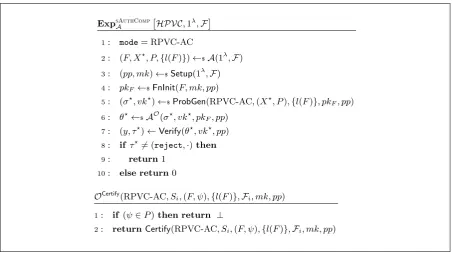
In Figure 3, we define a selective notion of authorised computation. This notion ensures that only a server that satisfies an additional authorisation policy in the encoded input should be able to perform a given computation on this encoded input. Thus, in contrast, a result generated by an unauthorised server should always be rejected even if the result is correct.
ExpsAuthComp A
HPVC,1λ,F
1: mode= RPVC-AC
2: (F, X?, P,{l(F)})←$A(1λ,F)
3: (pp, mk)←$Setup(1λ,F)
4: pkF←$FnInit(F, mk, pp)
5: (σ?, vk?)←$ProbGen(RPVC-AC,(X?, P),{l(F)}, pkF, pp)
6: θ?←$AO(σ?, vk?, pkF, pp)
7: (y, τ?)←Verify(θ?, vk?, pp)
8: if τ?6= (reject,·)then 9: return1
10: else return0
OCertify(RPVC-AC, Si,(F, ψ),{l(F)},Fi, mk, pp)
1: if (ψ∈P)then return ⊥
2: returnCertify(RPVC-AC, Si,(F, ψ),{l(F)},Fi, mk, pp)
Fig. 3.The selective authorised computation experimentExpsAuthComp A
HPVC,1λ,F
The game begins with explicitly setting the mode of computation to RPVC-AC and the adversary chooses the parameters for the game accordingly as otherwise the parameters would not be meaningful. Those parameters consist of a challenge function F, challenge input X?, the authorisation policy P and the respective function labels for this mode. The game proceeds with the challenger runningSetup
to initialise the system and FnInit to return the public delegation key pkF for the chosen challenge function. It continues with the challenger runningProbGento create the challenge for the adversary. The adversary receives the challenge and public information and is given oracle access to FnInit(·, mk, pp),
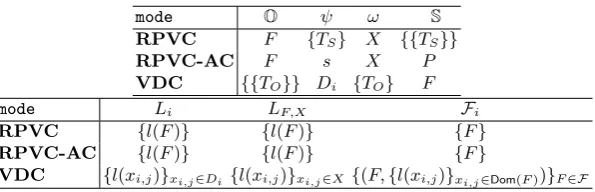
Table 1.Parameter definitions for different modes of computation
mode O ψ ω S
RPVC F {TS} X {{TS}}
RPVC-AC F s X P
VDC {{TO}} Di {TO} F
mode Li LF,X Fi
RPVC {l(F)} {l(F)} {F}
RPVC-AC {l(F)} {l(F)} {F}
VDC {l(xi,j)}xi,j∈Di {l(xi,j)}xi,j∈X{(F,{l(xi,j)}xi,j∈Dom(F))}F∈F
Definition 4. The advantage of a PPT adversary in the sAuthComp game for an hybrid publicly verifiable outsourced computation scheme HPVC, for a family of functions F is defined as:
AdvsAuthComp
A,HPVC (1λ,F) = Pr h
ExpsAuthComp A
HPVC,1λ,F
→1i.
We say that the hybrid publicly verifiable outsourced computation scheme HPVC is secure with respect to selective authorised computationif for all PPT adversariesA, it holds that
AdvsAuthComp
A,HPVC (1λ,F)≤negl(λ).
4
Instantiating HPVC
In this section, we provide a construction of an HPVC scheme for the classN C1, which includes common arithmetic and matrix operations. Let F be the family of Boolean formulas closed under complement using a revocable key dual-policy ABE in a black-box manner. We construct our scheme from a novel use of Dual-policy Attribute-based Encryption (DP-ABE) which combines Key-policy ABE (KP-ABE) and Ciphertext-policy ABE (CP-ABE). Decryption keys are linked to an “objective” policy O and “subjective” attribute setψ, and ciphertexts linked to an “objective” attribute setω and “subjective” policyS; decryption requires both policies to be satisfied – ω∈Oandψ∈S.
Following [23], we encrypt two random messages to form the encoded input, while decryption keys form evaluation keys; by linking these toF,F andX according to the mode, we ensure that exactlyone message can be recovered, implying whetherF orF was satisfied, and hence ifF(X) = 1 or 0. DP-ABE security ensures a server cannot learn a message implying an invalid result.
The values ofω,O,ψandSdepend upon the mode, as detailed in Table 1. Two additional parameters TO and TS “disable” modes when not required. Note that, trivially, ψ ∈ S when ψ = {TS} and S =
{{TS}}, and similarly forTO.
In this section, we first provide more details about the different modes of computation that are supported by our HPVC scheme. Next we introduce a new cryptographic primitive which acts as our main building block of our construction and finally we provide the concrete instantiation details.
4.1 Supporting Different Modes of Computation
RPVC. In this mode, a delegator owns some input data X and wants to learn F(X) but lacks the computational resources to do so itself; thus, the computation is outsourced. In this setting, only the parametersOandωare required, and are set to beF andX respectively. The setX comprises a single
datapoint: the input data to this particular computation. The remaining parametersSandψare defined
in terms of the dummy parameterTS. The set of functionsFithat a server is certified for during a single
Certify operation is simply F, and the sets of labels Li and LF,X both comprise a single element l(F) uniquely labellingF.
The construction of [1] used a symmetric key assignment scheme allowing only authorised entities to derive the required keys. However, the KDC had to register all delegators and verifiers. This was due both to the policies being enforced (e.g. to restrict the computations delegators may outsource), and to the use of symmetric primitives – to encrypt inputs that only authorised servers can decrypt, delegators must know the secret symmetric key. Thus, the scheme is not strictly publicly delegable as delegation does not dependonly on public information, and similarly for verification.
We retain public delegability and verifiability whilst restricting the servers that may perform a given computation. In some sense, servers are already authorised for functions by being issued evaluation keys. However, we believe that access control policies in this setting must consider additional factors than just functions. The semantic meaning and sensitivity of input data may affect the policy, or servers may need to possess specific resources or characteristics, or be geographically nearby to minimise latency. E.g. a government contractor may, due to the nature of its work, require servers to be within the same country. One solution could be for the KDC to issue signed attributes to each server who attaches the required signatures to computation results for verification. In this case, a verifier must decide if the received attributes are sufficient. We consider the delegator that runsProbGento “own” the computation and, as such, it should specify the authorisation policy that a server must meet. As this is a publicly verifiable setting, any entity can verify and we believe (i) verifiers should not accept a result that the delegator itself would not accept, and (ii) it may be unreasonable to expect verifiers to have sufficient knowledge to determine the authorisation policy. Of course, the delegator could attach a signed authorisation policy to the verification key, but verifiers are not obliged to adhere to this policy and doing so creates additional work for the verifier – one of the key efficiency requirements for PVC is that verification is very cheap. Using DP-ABE to instantiate HPVC allows the delegator to specify the authorisation policy during
ProbGen and requires no additional work on the part of the verifier compared to standard RPVC. Furthermore, an unauthorised server cannot actually perform the computation and hence verification will always fail.
We use the objective parametersωandOto compute (as for RPVC) whilst the subjective parameters
ψandS enforce access control on the server. Servers are assigned both an evaluation key for a function
F anda set of descriptive attributes describing their authorisation rights,s⊆ US, whereUS is a universe of attributes used solely to define authorisation. ProbGen operates on both the input data X and an authorisation policyP ⊆2US\ {∅}which defines the permissible sets of authorisation attributes to per-form this computation. Servers may produce valid, acceptable outputs only ifs∈P, i.e. they satisfy the authorisation policy. E.g.P = (Country=UK)∨((clearance=Secret)∧(Country=USA)) is satisfied bys={Country=UK,Capacity=3TB}.
VDC. Verifiable Delegable Computation reverses the role of the data owner – a server owns a static database and enables delegators to request computations/queries over the data. Hence, the user rela-tionship is more akin to the traditional client-server model compared to PVC. Delegators learn nothing more than the result of the computation, and do not need the input data in order to verify. The effi-ciency requirement for VDC is also very different from PVC: outsourcing a computation is not merely an attempt to gain efficiency as the delegator never possesses the input data and so cannot execute the computation himself (even with the necessary resources). Thus, VDC does not have the stringent effi-ciency requirement present in PVC (that outsourcing and verifying computations be more efficient than performing the computation itself, for outsourcing to be worthwhile). Our solution behaves reasonably well, achieving constant time verification; the size of the query depends on the function F, while the size of the server’s response depends only on the size of the result itself andnot on the input size which may be large, particularly when querying remote databases. Future work in this area should focus on reducing the cost of outsourcing computations.
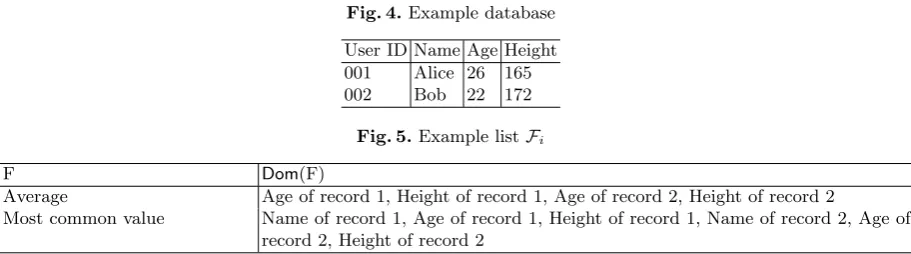
In VDC, each entity Si that wants to act as a server owns a dataset Di = {xi,j}mj=1i comprising mi data points. The KDC issues a single evaluation key EKDi,Si enabling Si to compute on subsets of Di. Si publishes a list Li comprising a unique label l(xi,j)∈ Li for each data point xi,j ∈Di, and a list of functions Fi ⊆ F that are (i) meaningful on their dataset, and (ii) permissible according to their own access control policies. Furthermore, not all data points xi,j ∈ Di may be appropriate for each function e.g. only numeric data should be input to an averaging function. Fi comprises elements (F,S
Fig. 4.Example database User ID Name Age Height 001 Alice 26 165 002 Bob 22 172
Fig. 5.Example listFi
F Dom(F)
Average Age of record 1, Height of record 1, Age of record 2, Height of record 2
Most common value Name of record 1, Age of record 1, Height of record 1, Name of record 2, Age of record 2, Height of record 2
Delegators may select servers and data usingonly these labels e.g. they may askSi to computeF(X) for any function F ∈ Fi on a set of data points X ⊆ Dom(F)3 by specifying labels {l(xi,j)}xi,j∈X. Although it may be tempting to suggest that Si simply caches the results of computing eachF ∈ Fi, the number of input setsX ⊆Dom(F) could be large, making this an unattractive solution.
As an example, consider a serverSithat owns the database in Table 4. The datasetDirepresents this as a set of field values for each record in turn:Di={001,Alice,26,165, 002, Bob,22,172}.Si publishes data labelsLi={User ID of record 1, Name of record 1, Age of record 1, Height of record 1, User ID of record 2, Name of record 2, Age of record 2, Height of record 2}. In Table 5, Fi lists the functions and domains thatSi is willing to compute. To find the average age, a delegator queries “Average” on input
X ={Age of record 1, Age of record 2}.
Possible applications for which this mode may be useful are the following:
– MapReduce [15] (or Hadoop) is a programming model for the parallel processing of large com-putations using a cluster or grid of computers (nodes) which can take advantage of the locality of data to decrease transmission costs. Each worker node computes a subproblem on a portion of the data and report to a manager who combines the results. VDC enables verifiable MapReduce such that onlyvalid results are combined. The manager acts as the KDC to distribute evaluation keys for partitions of the data to workers, and then requests multiple sub-problems to be solved over this partitioning.
– Verifiable queries on remote databases.Servers may also act as remote database providers and register with a KDC to provide a verifiable querying service. Any delegator may use public information to queryany function allowed by the server (within the family allowed by the VDC scheme) on these databases. Data is remotely stored and delegators see nothing more than the results of queries which they are assured are correct. Alternatively, in this setting, the data owner could act as the KDC to outsource its data to an untrusted server. Due to the public delegation and verification properties, other data users can query the outsourced data and verify the correctness of the results. The data owner need not retain any knowledge of the data after it has been outsourced.
– Three-party computation. Backes et al. [7] consider computations over outsourced data based on privacy-preserving proofs over authenticated data outsourced by a trusted client. In this setting, a trusted source produces and authenticates some data which is given to a server. Other parties can then request computations on this data and efficiently verify the results, but learn nothing more than the computation results and their validity. The solution of Backes et al. [7] makes use of homomorphic MACs and succinct non-interactive arguments (SNARGs) [20]. Similar results are found in [25, 11]. In the context of VDC, the CP-ABE decryption mechanism achieves the same goal as SNARGs. The source can be thought of as the KDC, the service provider as the computational server and the third parties as delegators.
Backes et al. [7] considered several applications of this model. For example, trusted sensors could be placed in client premises (e.g. a smart energy meter or a sensor placed in a car to monitor driving habits). These sensors collect data which is authenticated (due to the trusted nature of the collection devices) and given to the client who acts as the service provider. Because this data could be sensitive (e.g. revealing the habits and lifestyle of the client), the service provider may be reluctant to release the data to third parties. Nevertheless, there exist legitimate business cases that require access to compute on the data (e.g. for billing purposes or to produce an insurance quote). Therefore, these third parties
3
may request appropriate computations on the data from the service provider, and can verify that the computation is performed correctly on the correct data.
The efficiency requirement in this setting [7] is simply that verification is more efficient than computation, which our construction in Section 4.3 certainly meets, having constant time verification.
4.2 Revocable Dual-policy Attribute-based Encryption
Before instantiating HPVC, we first introduce a new cryptographic primitive which forms the basic building-block of our construction. If revocation is not required then a standard DP-ABE scheme can be used.
In the following we provide a formal definition of arevocable key dual-policy attribute-based encryption scheme. Note that we refer to the access structure associated to a decryption key as anobjective access structure, denoted asO, and the attribute set associated with a ciphertext is referred to as anobjective
attribute set, denoted as ω. Both the objective access structure and attribute set are associated with the KP-ABE functionality. Similarly, we refer to the access structure associated with a ciphertext as a subjectiveaccess structure, denoted asS, whereas we refer to the attribute set associated to a decryption key as asubjective attribute set, denoted asψ. Thus, both the subjective access structure and attribute set are associated with the CP-ABE functionality.
An indirectly revocable key DP-ABE scheme defines the universe of attributes to beU =Uattr∪ Ul∪ UID∪ Utime∪TO∪TS. In more detail, Uattr is the “normal” attribute universe for describing ciphertexts
and forming access policies,Ulcontains a set of attributes (disjoint fromUattr) that uniquely label each
function and each data item, Utime comprises attributes for time periods, and UID contains attributes
encoding entity identities.TOandTSare additional (“dummy”) attributes that efficiently enable the
DP-ABE scheme to either function as a KP-DP-ABE scheme or CP-DP-ABE scheme. In Section 4.3, we discuss in more detail how those dummy attributes influence the execution of the different modes of computations within our unified HPVC construction.
More formally, an indirectly revocable key DP-ABE scheme is presented in the following definition.
Definition 5. A revocable key dual-policy attribute-based encryption (rkDP-ABE) schemeconsists of the following algorithms:
– (pp, mk)←$ Setup(1λ,U) : this randomised algorithm takes as input the security parameter and the universe of attributes U and outputs public parameterspp and master secret keymk;
– ct(ω,S),t $
←Encrypt(m,(ω,S), t, pp) : this randomised encryption algorithm inputs a message m, an objective attribute set ω, a subjective policy S, the current time period t ∈ Utime and the public
parameters pp. It outputs a ciphertext ct(ω,S),t that is valid for timet;
– skid,(O,ψ)
$
←KeyGen(id,(O, ψ), mk, pp) : this randomised key generation algorithm takes as input an
identity id∈ UID, an objective access structure O, a subjective attribute setψ, as well as the master
secret key mkand public parameters pp. It outputs a secret decryption keyskid,(O,ψ);
– ukR,t $
←KeyUpdate(R, t, mk, pp) : this randomised algorithm takes a revocation list R ⊆ UID
con-taining the identities of revoked entities, the current time period t, as well as the master secret key
mk and public parameterspp. It outputs updated key material ukR,twhich makes the decryption keys
skid,(O,ψ), for all non-revoked identities id ∈/ R, functional to decrypt ciphertexts encrypted for the
time period t;
– pt←Decrypt(ct(ω,S),t,(ω,S), skid,(O,ψ),(O, ψ), ukR,t, pp) : this decryption algorithm takes as input a ciphertextct(ω,S),t formed for the time periodtand the associated pair(ω,S), a secret decryption key
skid,(O,ψ) for an entity id and the associated pair (O, ψ), an update key ukR,t for the current time period t and the public parameters pp. The algorithm outputs a plaintext pt which corresponds to the correct message m, if and only if the objective attributes ω satisfy the objective access structure
O and the subjective attributes ψ satisfy the subjective access structure S and the value of t in the
update key matches the one specified during encryption. If not, ptoutputs ⊥.
Definition 6. A revocable key DP-ABE scheme is correct if for allm∈ M, allid∈ UID, allR⊆ UID,
all access structures O,S ⊆2Uattr \ {∅}, all attribute sets ω, ψ ⊆ U
attr and all t ∈ Utime, if ω ∈ Oand ψ∈Sandid∈/ R, it holds that
Pr[(pp, mk)←$ Setup(1λ,U), ct(ω,S),t
$
←Encrypt(m,(ω,S), t, pp), skid,(O,ψ)
$
←KeyGen(id,(O, ψ), mk, pp), ukR,t
$
←KeyUpdate(R, t, mk, pp),
m←Decrypt(ct(ω,S),t,(ω,S), skid,(O,ψ),(O, ψ), ukR,t, pp)] = 1−negl(λ).
Definition 5 suffices to comprehend the remainder of this paper as we shall use anrkDPABE scheme in a black-box manner. For completeness, we give correctness and security definitions, a construction and a security proof in the Appendix B.
4.3 Construction
In this section we provide a construction of an HPVC scheme for a familyF of monotone Boolean func-tions closed under complement using a revocable key dual-policy ABE schemeRKDPABE in a black box manner comprising the algorithms DPABE.Setup, DPABE.Encrypt, DPABE.KeyGen, DPABE.KeyUpdate
andDPABE.Decrypt. We also use a signature scheme with algorithmsSig.KeyGen,Sig.SignandSig.Verify, and a one-way functiong. LetU =Uattr∪Ul∪UID∪Utime∪TO∪TSbe the universe of attributes acceptable
by the revocable key dual-policy ABE scheme, formed as the union of the following sub-universes, where Uattr consists of the attributes that form characteristic tuples for input data, Ul be a set of attributes (disjoint from Uattr) that uniquely label each function and each data item, UID comprises attributes
representing entity identifiers, Utime comprises attributes representing time periods issued by the time
sourceTand finallyTOandTSrepresent the objective dummy attribute and subjective dummy attribute
respectively.
We encode Boolean functions in terms of access structures overUattr. Computations withn-bit outputs
can be built from n Boolean functions returning each bit in turn. We can handle negations by either building rkDPABE from non-monotonic ABE [21] or by adding negated attributes to the universe [26]. We choose to use the latter approach and add negated attributes to Uattr. Thus, for the ith bit of a
binary input string X = x1. . . xn, we define attributes AX,i0 and A1X,i ∈ Uattr and X is encoded as AX ={AjX,i∈ Uattr:xi=j}.
In more detail, the dummy attributesTOandTSplay generally a crucial role in a DP-ABE scheme as
they efficiently enable a DP-ABE scheme to function as either KP-ABE or CP-ABE [6]. For KP-ABE, the subjective policy corresponds toS={{TS}}and is satisfied by the subjective attributeψcontaining
the special attribute TS. Thus, S is trivially satisfied and decryption (in KP-ABE) only depends on
the objective policy and attributes. Similarly, the same holds for CP-ABE where the objective policy corresponds toO={{TO}}that is trivially satisfied by the objective attributeω containing the special
attributeTO. As noted in [23, 2], we require to establish two distinct ABE schemes to overcome a possible
one-sided error in the verification stage. Thus, we initialise two distinct rkDP-ABE systems overU and hence we define a total of four additional dummy attributes whereT0
O, TS0 relate to the first rkDP-ABE
system, and T1
O, TS1 relate to the second rkDP-ABE system. As summarised in Table 1, the function
corresponds in the modes RPVC and RPVC-AC to O = F and S = {{TS0}}. Thus, the complement
function for those modes can be defined as O=F and S ={{TS1}}. Similarly, it follows for the mode
VDC thatO={{TO0}}andS=F, and the the complement can be defined asO={{TO1}}andS=F.
Each mode operates by encrypting a pair of randomly chosen messages and issuing keys such that the recovery of one message implies whether the encryption of a message was linked to F or F, and thus whether F(X) = 1 or 0. Ciphertext indistinguishability ensures that an adversary cannot cheat by returning the other message. Our HPVC scheme operates in the following way.
1. Setup, presented in Algorithm 1, first forms the attribute universe U and initialises two rkDPABE
entities, a (empty) list of revoked entitiesLRev as well as a time sourceT(e.g. a networked clock or
counter) to index update keys. The algorithm finally outputs the public parameters ppand master secret keymk comprising of public and secret rkDPABE parameters respectively. Furthermore, the public parameters also contain LReg and the dummy attributes enabling a client to flexibly switch
between the modes of computations by disabling certain parts of the rkDPABE scheme while the master secret key additionally contains the list of revoked entities LRev. Note that the public
pa-rameters may be implicitly updated throughout the execution of all algorithms of an HPVC scheme accommodating any changes in the system population.
Algorithm 1 (pp, mk)←$ Setup(1λ,F)
1: U ← Uattr∪ Ul∪ UID∪ Utime∪TO∪TS
2: (mpk0ABE, msk 0 ABE, T
0 O, T
0
S)←$DPABE.Setup(1λ,U)
3: (mpk1ABE, msk 1 ABE, T
1 O, T
1
S)←$DPABE.Setup(1λ,U)
4: forSi∈ UIDdo
5: LReg[Si][0]← 6: LReg[Si][1]← {} 7: endfor
8: LRev←
9: InitialiseT
10: pp←(mpk0ABE, mpk 1 ABE, T
0 O, T
0 S, T
1 O, T
1 SLReg,T) 11: mk←(mskABE0 , msk1ABE, LRev)
2. FnInit, presented in Algorithm 2, sets the public delegation key pkF (for all functions F) to be the public parameters for the system (since we use public key primitives). This step is not required in our particular construction, but we retain the algorithm for consistency with prior definitions as well as for generality as other instantiations may require this step.
Algorithm 2 pkF $
←FnInit(F, mk, pp)
1: pkF ←pp
3. Register, presented in Algorithm 3, creates a public-private key pair by calling theKeyGenalgorithm of the digital signature scheme. The algorithm provides the server with its own secret signature key and updatesLReg[Si][0] to store the verification key forSi. These prevent servers being impersonated and wrongly revoked.
Algorithm 3 skSi $
←Register(Si, mk, pp)
1: (skSig, vkSig)←$Sig.KeyGen(1λ)
2: skSi ←skSig
3: LReg[Si][0]←LReg[Si][0]∪vkSig
4. Certify, presented in Algorithm 4, aims to generate an evaluation keyek(O,ψ),Si for a serverSi. The algorithm first adds an element (F,S
means that an evaluation key must be issued for a dataset Di that includes (at least) the specified input dataX. It is sufficient to include labels only on the subjective attribute set without also adding them to the objective policy. As these labels are a security measure against a misbehaving server, we amend the servers key but need not take similar measures against the delegator. Delegators are then able to specify the required labels in their created subjective policy. Those labels need to be present in the server’s key for a successful evaluation (decryption). The KDC should check that the label corresponds to the input to ensure that a server does not advertise data he does not own. It also generates an update key for the current time period to prove that Si is not currently revoked. In RPVC and RPVC-AC modes, another pair of keys is generated using the second DP-ABE system for the complement inputs.
Algorithm 4 ek(O,ψ),Si $
←Certify(mode, Si,(O, ψ), Li,Fi, mk, pp)
1: forF∈ Fi do
2: LReg[Si][1]←LReg[Si][1]∪(F, [ l∈Li
l)
3: endfor
4: LRev←LRev\Si
5: t←T
6: skABE0 ←$DPABE.KeyGen(Si,(O, Aψ∪ [
l∈Li
l), msk0ABE, mpk 0 ABE)
7: uk0LRev,t←$DPABE.KeyUpdate(LRev, t, msk0ABE, mpkABE)0
8: if (mode= RPVC)or(mode= RPVC-AC)then 9: skABE1 ←$DPABE.KeyGen(Si,(O, Aψ∪
[
l∈Li
l), mskABE1 , mpk1ABE)
10: uk1LRev,t←$DPABE.KeyUpdate(LRev, t, msk 1
ABE, mpk 1 ABE)
11: else
12: skABE1 ←⊥
13: uk1LRev,t←⊥
14: endif
15: ekF,S ←(sk0ABE, sk 1 ABE, uk
0
LRev,t, uk 1
LRev,t)
5. ProbGen, presented in Algorithm 5, aims to create a problem instanceσ(ω,S) that the server can use
to evaluate the computation as well as preparing a verification key that enables anyone to verify the server’s computational result. The algorithm starts with choosing messages m0 and m1 randomly
from the message space. The messagem0is encrypted with (Aω,S∧Vl∈LF,Xl) in the first rkDPABE system, whilstm1 is encrypted with the complement policy under either the first rkDPABE system
for VDC or the second one for RPVC and RPVC-AC depending on the chosen mode of computation. Note that the attributes remain the same as it is the same attributeT0
Oor input dataX respectively.
The algorithm also prepares a public verification keyvk(ω,S). The key is simply generated by applying
a one-way function g to each randomly chosen message and also includes a copy ofLReg from the
Algorithm 5 (σ(ω,S), vk(ω,S))
$
←ProbGen(mode,(ω,S), LF,X, pkF, pp)
1: (m0, m1)←$M × M
2: t←T
3: c0←$DPABE.Encrypt(m0,(Aω,S∧
^
l∈LF,X
l), t, mpkABE0 )
4: if (mode= VDC)then
5: c1←$DPABE.Encrypt(m1,(Aω,S∧
^
l∈LF,X
l), t, mpk0ABE)
6: else
7: c1←$DPABE.Encrypt(m1,(Aω,S∧
^
l∈LF,X
l), t, mpk1ABE)
8: endif
9: σ(ω,S)←(c0, c1)
10: vk(ω,S)←(g(m0), g(m1), LReg)
6. Compute, presented in Algorithm 6, is performed by a serverSi and aims to return the result of the evaluation of a function on some input data. The algorithm attempts to decrypt both ciphertexts of the problem instanceσ(ω,S), ensuring that different modes of computation use the correct parameters.
Decryption succeeds only if the function evaluates to 1 on the input dataX, i.e. the policy is satisfied. SinceF andFoutput opposite results onX, exactly one plaintext will correspond to a failure symbol ⊥. The server signs the results using its personal signing key. Finally, the algorithm outputs the computational result θF(X) comprising the two plaintexts, the server id and the server’s signature
on the output.
Algorithm 6 θF(X)
$
←Compute(mode, σ(ω,S), ek(O,ψ),Si, skSi, pp)
1: Parseσ(ω,S) as (c0, c1) andek(O,ψ),Si as (sk 0
ABE, sk1ABE, uk0LRev,t, uk 1
LRev,t)
2: d0←DPABE.Decrypt c0, skABE0 , uk 0
LRev,t, mpk 0 ABE
3: if (mode= VDC)then
4: d1←DPABE.Decrypt c1, sk0ABE, uk 0
LRev,t, mpk 0 ABE
5: else
6: d1←DPABE.Decrypt c1, sk1ABE, uk 1
LRev,t, mpk 1 ABE
7: endif
8: γ←$Sig.Sign(d0, d1, Si, skSi)
9: θF(X)←(d0, d1, Si, γ)
7. Verify, presented in Algorithm 7, determines whether the returned computational result is valid or not. The algorithm first checks whether the function F is listed in LReg[S][1] to ensure that
the server that generated the computational result is authorised to compute F. If this check fails, the result is immediately rejected. Next, the algorithm verifies the signature using the verification key for Si stored in LReg. If correct, it applies the one-way function g to each plaintext in θF(X)
and compares the results to the components of the verification key. If either comparison results in a match (i.e. the server successfully recovered a message), the algorithm creates an acceptance tokenτθF(X) = (accept, Si) indicating that the server indeed performed the computation correctly. Otherwise the result is rejected, and the algorithm creates a rejection token τθF(X) = (reject, Si) and Si is reported for revocation. Ifm0 was returned thenF(X) = 1 asm0 was encrypted for the
non-complemented inputs. Otherwisem1was returned and thusF(X) = 0. Note that this algorithm
Algorithm 7 (y, τθF(X))←Verify(θF(X), vk(ω,S), pp)
1: ParseθF(x) as (d0, d1, Si, γ) andvk(ω,S) as (g(m0), g(m1), LReg)
2: if F ∈LReg[Si][1]then
3: if accept←Sig.Verify((d0, d1, Si), γ, LReg[Si][0])
4: if g(m0) =g(d0)return(y←1, τθF(X)←(accept, Si))
5: elseif g(m1) =g(d1)return(y←0, τθF(X)←(accept, Si))
6: else return(y←⊥, τθF(x)←(reject, Si))
7: endif 8: endif 9: endif
10: return(y←⊥, τθF(x)←(reject, Si))
8. Revoke, presented in Algorithm 8, aims to revoke misbehaving servers by redistributing fresh update keys to all non-revoked servers. The algorithm first checks whether a server Si should in fact be revoked, i.e. whether it received as input a rejection token τθF(X)= (reject, Si). If so, it deletes the listLReg[Si][1] of computations thatSi may perform such that the server is no longer authorised to perform any computations within the system. Additionally, it also addsSito the revocation listLRev,
and refreshes the time sourceTand samples the new time period. The algorithm then generates new
update keys for all non-revoked entities such that non-revoked keys are still functional in the new time period and distributes them accordingly. If the algorithm receives as input an acceptance token indicating that there is no need to revoke any server since computations were performed correctly, it outputs⊥.
Algorithm 8 um←$ Revoke(τθF(X), mk, pp)
1: if τθF(X) = (reject, Si)then 2: LReg[Si][1]← {}
3: LRev←LRev∪Si
4: RefreshT 5: t←T
6: uk0LRev,t←$DPABE.KeyUpdate(LRev, t, msk 0
ABE, mpk 0 ABE)
7: if (mode= RPVC)or(mode= RPVC-AC)then 8: uk1LRev,t←$ABE.KeyUpdate(LRev, t, msk
1
ABE, mpk 1 ABE)
9: endif
10: forS0∈ UID do
11: ParseekF,S0 as (skABE0 , sk1ABE, uk0L
Rev,t−1, uk 1
LRev,t−1)
12: ekF,S0 ←(sk0ABE, skABE1 , ukL0
Rev,t, uk 1
LRev,t)
13: endfor
14: returnum← {ekF,S0}S0∈U
ID
15: else
16: return ⊥
5
Proofs of Security
In this section we present the full proof of Theorem 1 by providing proofs of security for the notions of selective public verifiability, selective semi-static revocation and selective authorised computations.
5.1 Selective Public Verifiability
Lemma 1. The HPVC scheme defined by Algorithms 1–8 is secure in the sense of selective public verifiability (Figure 1) under the same assumptions as in Theorem 1.
Proof. SupposeAHPVC is an adversary with non-negligible advantage against the selective public
verifi-ability game (Figure 1) when instantiated by Algorithms 1–8. We begin by defining the following three games:
– Game 0. This is the selective public verifiability game as defined in Figure 1.
– Game 1. This is the same asGame 0with the modification that inProbGen, we no longer return an encryption of m0 and m1. Instead, we choose another random message m0 6= m0, m1 and, if F(X?) = 1, we replace c
1 by the encryption of m0, and otherwise we replace c0. In other words,
we replace the ciphertext associated with the unsatisfied function with the encryption of a separate random message unrelated to the other system parameters, and in particular to the verification keys. – Game 2.This is the same asGame 1with the exception that instead of choosing a random message
m0, we implicitly setm0 to be the challenge inputwin the one-way function game.
We show that from the adversary’s point of viewGame 2is indistinguishable fromGame 0except with negligible probability. This means that an adversary against the selective public verifiability game can be run againstGame 2. We then finally show that if an adversary has a non-negligible advantage againstGame 2then the adversary can invert a one-way function.
Game 0toGame 1. We begin by showing that there is a negligible distinguishing advantage between Game 0 and Game 1, both with parameters (HPVC,1λ,F). Suppose otherwise, that A
HPVC can
distinguish the two games with non-negligible advantageδ. We then show that it is possible to construct an adversaryAABEthat usesAHPVCas a subroutine to break theIND-sHRSSsecurity of the (indirectly)
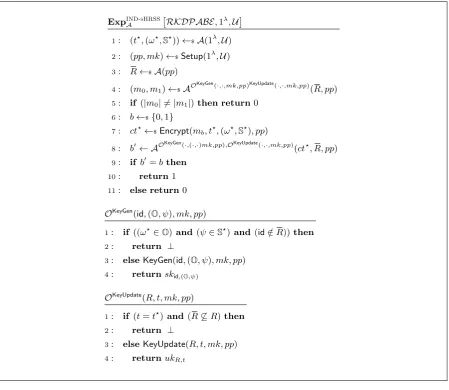
revocable key DP-ABE scheme formalised in Figure 6. Note that we only focus on the modes RPVC and VDC, and the mode RPVC-AC can be seen as a special case of the mode RPVC as we can assume the adversary being authorised to evaluate a challenge computation. We consider a challengerCplaying the
IND-sHRSSgame (Figure 6) withAABE, andAABE in turn acts as a challenger forAHPVC. Given the
above parameters the entities interact in the following way.
1. AHPVC declares its choice of challenge parameters (ω?,O?, ψ?,S?, LF,X?,mode) including a set of labels LF,X? and the mode of computationmode detailing in which mode the challenge needs to be generated.
2. AABE must send a challenge attribute set and policy (ω,e eS), and a challenge time period et to the
challenger as AABE’s challenge input for theIND-sHRSS game of the rkDP-ABE scheme. Recall
from Table 1 that in casemode= VDC the challenge subjective policyS?corresponds to the function F and the subjective attribute setψcorresponds to the challenge input dataX?⊆Di. Also following Table 1, in casemode= RPVC the challenge objective policyO? corresponds to the functionF and the objective attribute set ω corresponds to the challenge input dataX?. In either mode, the other challenge input parameters correspond to either dummy attributes or dummy policies, and these dummy policies are trivially satisfied by the dummy attributes (cf. Section 4.3). As usual, AABE
computesr=F(X?).
– Ifmode= VDC, we need to set the challenge input pair to theIND-sHRSS game of the rkDP-ABE scheme such that the pair is not satisfied by the challenge inputX? and thus need to set
e
Sto be unsatisfied.
• Ifr= 1: we set
e
ω=Aω?={TO}, and
e S=S?∧
^
lj∈LF,X?
• Ifr= 0: we set
e
ω=Aω?={TO},
and
e S=S?∧
^
lj∈LF,X?
lj=F∧ {l(xi,j)}xi,j∈X?.
– Ifmode= RPVC, then we set
e
ω=Aω? =AX?,
and
e S=S?∧
^
lj∈LF,X?
lj ={{TS}} ∧ {l(F)}.
Finally,AABE also sets its challenge (ω,e eS) for the time periodet= 1 for theIND-sHRSS game and
sends all challenge parameters to the challengerC.
3. C runs the DPABE.Setup algorithm to generate mpkABE, mskABE and sends
mpkABE toAABE.
4. AABE initialises its target revocation listRwhich is initially empty and sends it toC, and simulates
runningHPVC.Setupsuch that the outcome is consistent with the previously generatedmpkABE. If
mode= VDC, it setsmpkABE0 ←mpkABEas provided by the challenger and implicitly setsmsk0ABE←
mskABE. Note that any use of mskABE0 will be simulated using oracle calls to the challenger. If
mode = RPVC, it setsmpkABEr ←mpkABE as issued byC, and implicitly setsmskABEr ←mskABE
to be the key held by the challenger. In either case, AABE executes DPABE.Setupitself to generate
a second DP-ABE system.
5. AABE runs HPVC.FnInitas detailed in Algorithm 2.
6. AABE must generate a challenge problem instance for AHPVC as the output of HPVC.ProbGen. To
do so, AABE samples three distinct, equal length messages m0, m1 and m0 uniformly at random
from the message space. AABE provides m0 and m1 as its choice of challenge to C, and receives
back the encryption, ct?, of one of these messages (mb? for b? $
← {0,1}, where b? is chosen by the challenger), under the challenge attribute set and policy (eω,eS) and challenge time period et.
More formally, ct? $
←DPABE.Encrypt(mb?,(
e
ω,eS),et, mpkABE). It needs to assignct? to be one of the
ciphertextscorc0 that form the challenge problem instance (encoded input)σF,X? using the correct ABE system parameters.AABE chooses a random bits
$
← {0,1}which intuitively corresponds to its guess for the challenger’s choice of b?.
– Ifmode= VDC, we need to distinguish the following cases. • Ifr= 1, AABE generates
c←$ DPABE.Encrypt(m0,eω,S?∧ ^
lj∈LF,X?
lj,et, mpk 0 ABE)
and setsc0=ct?. It also setsvk=g(m0) andvk0 =g(ms). • Ifr= 0, AABE setsc=ct? and generates
c0←$ DPABE.Encrypt(m0,eω,S?∧ ^
lj∈LF,X?
lj,et, mpk 0 ABE).
It also sets vk=g(ms) andvk0=g(m0). – Ifmode= RPVC,AABE setsc=ct? and generates
c0←$ DPABE.Encrypt(m0,eω,S?∧ ^
l∈LF,X?
l,et, mpk 1 ABE).
Finally,AABE setsσF,X?= (c, c0) andvkF,X?= (vk, vk0, LReg).
7. AHPVC receives all outputs from the above HPVC.ProbGen algorithm, and then is provided with
oracle access to which AABE responds in the following way:
– HPVC.FnInit(·, mk, pp) and HPVC.Register(·, mk, pp) are executed as specified in Algorithms 2 and 3.
– HPVC.Certify(mode, Si,(O, ψ), Li,Fi, mk, pp) : in order to generate an evaluation key for the queried parameters, AABE needs to request queries to the KeyGen oracle in the rkDP-ABE
game formalised in Figure 6.AABE updates first the usual list entries and then setsO0 =Oand ψ0=Aψ∪Slj∈Liljand requests an oracle query to the challenger forO
KeyGen(S
i,(O0, ψ0), mk, pp)
as specified in Figure 6. The challenger shall generate a rkDP-ABE decryption key if and only if ω /e ∈ O0 or ψ0 ∈/
e
S or Si ∈ R. Note that Si ∈/ R is fulfilled since we chose R to be empty. By construction, the conditionψ0 ∈eS is satisfied only if the labels {lj}lj∈Li ⊇ {lk}lk∈LF,X?. As specified above, if the labels do not satisfy this relation then ψ0 ∈/ eS and the challenger may
generate the key, whichAABE will receive asskABE0 .
If, on the other hand, the labels do satisfy this relation then we have the following cases depending on the chosen mode.
• If mode = VDC, then from the above relation {lk}lk∈LF,X? ⊆ {lj}lj∈Li it follows that {l(xi,k)}xi,k∈X? ⊆ {l(xi,j)}xi,j∈Di and thus it follows thatX
? ⊆D
i. Thus, this means that by the uniqueness of the labels within the system, AHPVC has requested an evaluation key
for a superset of the challenge input setX?, i.e. the setD
i that contains the challenge input set X? and possibly some more additional data points. If X? ⊆D
i, then the data set Di must satisfy eitherF orF in order to satisfyeS. However,eSwas chosen in such a way that it
is not satisfied by X? and thus also not by D
i. Hence, the challenger may generate a valid key whichAABE stores assk0ABE.
• If mode = RPVC, then (as specified in Table 1) both setsLi and LF,X? are singleton sets. Thus, from{lj}lj∈Li⊇ {lk}lk∈LF,X? it follows thatLi =LF,X?={l(F)}. By the uniqueness of the labels within the system, it then follows that O=O? which means thatAHPVC has
requested an evaluation key for the challenge function F. However, in step 4, the challenger got assigned the ABE system with master secret key mskr
ABE such that O? is not satisfied
by the challenge input eω. Therefore, also O0 is not satisfied either by the challenge inputωe
and hence the challenger may generate a valid key whichAABE stores asskrABE.
AABE needs further to make queries to aKeyUpdateoracleOKeyUpdate to the challenger in order
to obtain an update key. The challenger returns a valid key if and only if t 6=et or R ⊆QRev.
Observe that the second condition is satisfied sinceR=and hence is a subset ofQRev. Hence
a challenger may generate a valid update key.
Also ifmode= RPVC, thenAABE additionally generates a secret keysk1ABE−r by itself using the
parameters of the second DP-ABE system which it owns for the pair (O, ψ).
– HPVC.Revoke(τθF(X), mk, pp) : whenever aRevokequery is requested,AABEexecutes Algorithm 8 as specified except it requires to make aKeyUpdateoracle query to the challenger for the update key that relates to the ABE system owned byC. Ifmode= RPVC, this is the keyukr
LRev,t, and if
mode= VDC, this is the keyuk0
LRev,t. The challenger may create a valid update key if and only ift6=qtorR⊆QRev. SinceRwas defined to be an empty list and hence is a subset ofQRev the
challenger may always return a valid update key.
Eventually AHPVC finishes its query phase and outputs a guess θ? which it believes to be a valid
forgery.
8. AABE parses the guessθ? as (d, d0, Si, γ). One of the valuesdandd0 will be⊥(by construction) and we denote the other value (non-⊥) byY. Observe that, since AHPVC is assumed to be a successful
adversary against selective public verifiability, the non-⊥ value, Y, that it will return will be the plaintext ms since the challenge access structure was always set to be unsatisfied on the challenge input. Thus, ifg(Y) =g(ms),AABE outputs a guessb0=sand otherwise guessesb0= (1−s).
Notice that ifs=b? (the challenge bit chosen byCin the
IND-sHRSSgame in Figure 1), then the
the verification key comprises the one-way functiong applied to a legitimate messagem0 and a random messagem1−b? that is unrelated to both ciphertexts.
Now, we consider the advantage of this constructed AABE playing the IND-sHRSS game for the
revocable key DP-ABE scheme. Recall that by assumption, AHPVC has a non-negligible advantageδin
distinguishing betweenGame 0 andGame 1, that is
Pr
h
ExpGame 0A
HPVC
HPVC,1λ,F
→1i−PrhExpGame 1A HPVC
HPVC,1λ,F
→1i >δ
whereExpGame iA HPVC
HPVC,1λ,F
denotes the output of running AHPVC inGame i.
Now we derive the probability of AABE guessingb? correctly. It follows:
Pr[b0 =b?] = Pr[s=b?] Pr[b0 =b?|s=b?] + Pr[s6=b?] Pr[b0 =b?|s6=b?]
= 1
2Pr[g(Y) =g(ms)|s=b ?] +1
2Pr[g(Y)6=g(ms)|s6=b ?]
= 1 2Pr
h
ExpGame 0AHPVC HPVC,1λ,F
→1i
+1
2(1−Pr[g(Y) =g(ms)|s6=b ?])
= 1 2Pr
h
ExpGame 0AHPVC HPVC,1λ,F
→1i
+1 2
1−PrhExpGame 1AHPVC HPVC,1λ,F
→1i
= 1 2
PrhExpGame 0A HPVC
HPVC,1λ,F
→1i
−PrhExpGame 1AHPVC
HPVC,1λ,F
→1i+ 1
> 1
2(δ+ 1) Hence,
AdvAABE >
Pr[b0 =b?]−1 2
>
1
2(δ+ 1)− 1 2
= δ 2
Sinceδ is assumed non-negligible, δ
2 is also non-negligible. If AHPVC has advantageδ at distinguishing
these games thenAABE can win theIND-sHRSS game with non-negligible probability. Thus since we
assumed the ABE scheme to beIND-sHRSSsecure, we conclude thatAHPVCcannot distinguishGame
0fromGame 1with non-negligible probability.
Game 1toGame 2. The transition fromGame 1to Game 2is to simply set the value ofm0 to no longer be random but instead to correspond to the challengewin the one-way function inversion game. We argue that the adversary has no distinguishing advantage between these games since the new value is independent of anything else in the system except the verification keyg(w) and hence looks random to an adversary with no additional information (in particular,AHPVC does not see the challenge for the
one-way function as this is played betweenC andAABE).
Final Proof. We now show that usingAHPVCinGame 2,AABEcan invert the one-way functiong– that
is, given a challenge z =g(w) AABE can recover w. Specifically, during HPVC.ProbGen, AABE chooses