Survey on Clustering Techniques in Wireless
Sensor Network
Priya Vyas
#, Manoj Chouhan*
#
Department of Information Technoloy, Rajiv Gandhi Proudyogiki Vishwavidyalaya
Indore,India
*
Department of Information Technology, Shri Vaishnav Institute of Technology & Science
Indore, India
Abstract— Wireless sensor nodes are made up of small electronic devices which are capable of sensing, computing and communicating data in harsh physical environments like surveillance field. Sensor nodes majorly depends on power source for energy, which get depleted at a faster rate because of the unmonitored operations and communication they need to perform with different device nodes. Today, the major downside of wireless sensor network is its energy source constraints. Communication protocols can be designed to make efficient utilization of energy resources of a sensor node and to obtain real time functionality. We are able to solve this downside to some extent by using clustering architecture. In this paper we study about wireless sensor network and it’s clustering techniques used for network formation.
Keywords— Wireless sensor network; Sensor Node; Cluster Architecture; Routing; QoS.
I. INTRODUCTION
Wireless sensor network is an infrastructure consists of sensing, processing, and communication (transmitter/receiver) elements. It provides ability to instrument, observe, and react to events in a specified environment. The environment can be physical, biological system, or an information technology (IT) framework, wireless sensor networks have ability to dynamically become accustomed it to changing environments. Typical applications include, data collection, monitoring, surveillance, health monitoring, etc.
Sensors are used to sense events occurring around it and gather relevant data from those events. Sensor nodes are fitted with an on-board processor. Instead of sending the raw data to the base station, sensor nodes uses their processing capability and transmits only the required and partially processed data in envelop to the base station. From the base station all the data delivered to the deliberate user for further processing.
The use of wireless sensor networks is enormously increased in last decades and at the same time it faces the problem of energy constraints in terms of limited battery lifetime. As each node depends on energy for its operations, this has become a major issue in wireless sensor networks because once sensor nodes deployed, it is not possible to replace or recharge the batteries. The failure of one node can interrupt the entire system or application.
Following are the steps can be taken to save energy caused by communication:-
· To schedule the state of the nodes (i.e. transmitting, receiving, idle or sleep).
· By using suitable clustering algorithm for network formation · By using optimal routing methods.
Sensor nodes try to minimize the energy consumption by minimal activation of the sleeping nodes. Every sensing node can be in
modes [4]. In active mode nodes consume energy when receiving or transmitting data. In idle mode, the nodes consume almost the same amount of energy as active mode, while in sleep mode, the nodes shut down its radio to save the energy. The small amount of energy in a sensor node limits the abilities of nodes in terms of processing, memory, storage, and communication; it also results into limited network lifetime.
Another way to minimize the energy consumption is by using appropriate clustering algorithm, because clustering algorithms are more energy efficient than direct routing algorithm. In this, sensor nodes are grouped together to form small clusters and a cluster head (CH) for each cluster is elected. In this architecture, sensor node transmits data to their respective CH and CH aggregates data and forward them to a base station. Sensor nodes in clusters transmit messages over a short distance within their respective clusters therefore minimum amount of energy exhausted from sensor nodes in clusters but in case of CHs more energy is drained due to message transmission over long distance i.e. CHs to the base Station .
The remainder of the paper is organized as follows: In section [2], we described how it communicates with other clusters in cluster based WSN. Section [3] presents some of its design challenges & consideration regarding designing WSN. In Section [4], we present some of the cluster based scheme for arrangement of nodes in WSN. In section [5], some sensor network applications which show the usefulness of Wireless sensor networks. We conclude our paper in Section [6].
A. Hardware Constraints
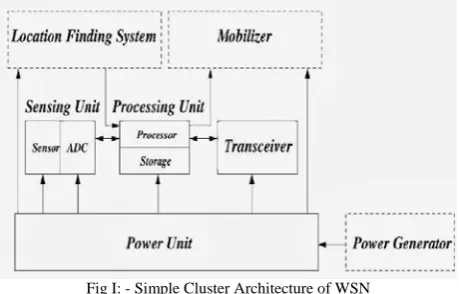
A sensor node, which can also be referred as a sensor mote, is a component of a larger network of sensors. Each node in the wireless sensor network is responsible for collecting data about the environment around it and sending that data to processors in the network [1] [2] [3]. A Block Diagram of sensor and its component is shown in fig I.
I). Sensors
Sensors are the small devices used for to sense the physical phenomenon from the geographical area they are deployed. Sensing units are usually composed of two subunits: sensors and analogue to digital converters (ADCs) [1]. The analogue signals produced by the sensors based on the events observed from surrounding are converted to digital signals by the ADC, and then fed into the processing unit. Sensors are available in so many different forms like seismic, low sampling rate magnetic, thermal, etc, which are able to monitor temperature, humidity, vehicular movement, noise levels, etc.
II). Power Source
power, vibrations, acoustic noise, and piezoelectric effects [3]. The vast majority of the existing commercial and research platforms relies on batteries, which direct the node size.
III). Communication Element
The communication element consists of a radio transmitter and a radio receiver. Both of these parts must exist for any node, so that it can communicate with the other nodes in network. The transceiver unit of sensor nodes may be a passive or active optical device as in smart dust nodes or a radio frequency (RF) device. RF communication is preferred in most of the ongoing sensor network research projects [2], because the packets conveyed in sensor networks are small, and the frequency re-use is high due to short communication distances.
IV). Processor
The nodes consist of a microprocessor and some flash memory [2]. The basic functions of the processing unit are to make decisions and deal with collected data. The electronic brain stores collected data in its memory until enough information has been collected, after a point the processing unit puts the data in envelopes or packages. These envelopes are then sent to the radio for broadcasting. The brain also communicates with other nodes to maintain the most effective network.
Fig I: - Simple Cluster Architecture of WSN
II. COMMUNICATION IN BETWEEN SENSOR NODES
Sensor Nodes communicate with each other using radio transmitters and receivers. They form networks with other motes that change with the positions of the motes. They create links with each other in different configurations to maximize the performance for each mote. These links all lead to the cluster head, which transmits the information from each of the nodes present in cluster to whatever computer or PDA type device is used to collect and process the data [3].
When the sensor nodes are linked as one, they form parts of a machine with superior computational power than any of the individual parts. These “machines” of sensor nodes change with position and with conditions like high moisture and other situations can affect broadcast abilities of many nodes. Changes in conditions can make some connections stronger than they used to be, and others nearly unworkable. The thinking capability within the network allows the pieces to reorganize in such a way that all nodes will continue to be functional [7].
III. DESIGN CHALLENGES IN CLUSTERING ALGORITHS
Wireless Sensor Networks present vast challenges in terms of implementation. Design goals targeted in traditional networking provide little more than a basis for the design in wireless sensor networks [3]. WSN decomposed into smaller clusters for energy utilization is considered to be an efficient approach to prolong network lifetime. Some important design considerations in designing clustering algorithms are discussed below:
A. Storage
Storage space in sensors is very limited and communication is costly, a storage model is required to satisfy storage constraints and query requirements. Conventional approaches in WSNs require that data be transferred from sensor nodes to a centralized base station because storage is limited in sensor nodes. Techniques such as aggregation and compression reduce the amount of data transferred, thereby reducing communication and energy costs. These techniques are important for real-time or event-based applications, but they may not suffice. Applications that operate on a query-and-collect approach will selectively decide which data are important to collect. Optimizing sensor storage becomes important in this case when massive data is stored over time.
B. Security
A WSN is vulnerable to threats and risks. An adversary can compromise a sensor node, alter the integrity of the data, eavesdrop on messages, inject fake messages, and waste network resource. Unlike wired networks, wireless nodes broadcast their messages to the medium. Hence, the issue of security must be addressed in WSNs. Designing security protocols requires understanding of these limitations and achieving acceptable performance with security measures to meet the needs of an application.
C. Communication
Coverage in a WSN needs to guarantee that the monitored region is completely covered with a high degree of reliability. Coverage is important because it affects the number of sensors to be deployed, the placement of these sensors, connectivity, and energy. Sensor provisioning, management, and control services are developed to coordinate and manage sensor nodes. They enhance the overall performance of the network in terms of power, task distribution, and resource usage.
D. Limited Energy
Wireless sensor nodes have limited energy sources and once they are deployed in the field, it is very difficult to recharge or replace their batteries. With the capability of reducing the amount of data transmission, the clustering algorithms are more energy efficient compared to the direct routing algorithms. This can be achieved by balancing the energy consumption in sensor nodes by optimizing the cluster formation, periodically reelecting CHs based on their residual energy, and efficient intra-cluster and inter-cluster communication. But clustering algorithms should prevent high energy cluster reconstruction process.
E. Network Lifetime
The energy limitation on nodes results in a limited network lifetime for nodes in a network. Clustering can help to prolong the network lifetime of WSNs by reducing the number of nodes contending for channel access, data aggregation at CHs via intra-cluster communication and direct or multi-hop communication by CHs with a base station. Proper network should design for to increase network lifetime.
F. Quality of Service (QoS)
IV.
C
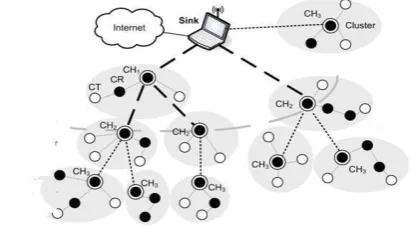
LUSTERINGIn wireless sensor network power consumption is the most important factor, all sensor nodes suffer from low energy constraints. In WSN, each node is provided with a limited amount of energy source & after exhaustion of batteries, it is difficult to replace them. Since nodes in WSN provided with limited power, it is necessary to minimize the power consumption in wireless sensor networks for to maximize their lifetime. Today most of the research in wireless sensor field is about power utilization in wireless sensor networks. Clustering provides a way to reduce quick energy reduction from sensor network. Fig II shows Architecture of Clustered Sensor Network. Distributed clustering algorithms are more practical compared to centralized clustering algorithms since central control of large number of sensor nodes are not convenient. [3]
In wireless sensor networks large number of nodes is deployed for sensing & data collecting purpose, but if all the nodes communicate & transmit data in network then it will result in congestion, data collision & in rapid energy reduction of sensor networks. Hierarchical clustering solves this problem and can helps in efficient resource utilization [6]. It also helps in increasing cluster efficiency by reducing the number of data transmission in between clusters node to base station. In the hierarchical network structure each cluster has a leader, which is also called the cluster head (CH) and usually performs the special tasks referred above (fusion and aggregation), and have several common sensor nodes (SN) as members. [7]
The cluster network is a two-level hierarchy where the CH nodes form the higher level and the cluster-member nodes form the lower level. In these sensor nodes periodically transmit their data to the corresponding CH nodes. The CH nodes aggregate the data and transmit them to the base station (BS) either in single hop or through multi-hop topology. Data transmission on longer distance causes energy depletion in CH at higher rate. A common solution in order to balance the energy consumption is to rotate the CH role among all
Fig III: Simple Architecture of clustered Senor Network
the nodes over time in each cluster in order achieve better load balancing and for more uniform energy consumption. Base Station is generally considered fixed and at a far distance from the sensor nodes. It is the data processing point, all the data from CH transmitted to BS for further processing, and then data is accessed by the end user. The CH nodes actually act as gateways between the sensor nodes and the BS. [9]
A. Classification of Clustering Algorithm
The most significant and widely used routing algorithms are cluster structure. Selecting optimum cluster size, cluster head election and re-election, and cluster maintenance are the main issues to be addressed in designing of clustering algorithms [6]. There have been several different ways to classify the algorithms used for WSNs clustering, one of the most early and common classifications are -:
I).Centralized Clustering Algorithms. II).Distributed Clustering Algorithms.
We are considering Distributed clustering scheme in our analysis because centralized scheme are not convenient [9]
Most of the known clustering algorithms for WSNs can be further distinguished into two main categories, depending on cluster formation criteria and parameters used for CH election [3]:
I).Probabilistic (random or hybrid) Clustering Algorithms II).Non Probabilistic Clustering Algorithms
V. PROBABILISTIC ALGORITHMS
In the probabilistic clustering algorithms, each sensor node is assigned with a node ID or some probability value used to determine the initial CH. The probabilities at first assigned to each node often serve as the primary criterion, for nodes present in network, in order to decide individually their election as CHs; however other secondary criteria may also be considered either during Selection process i.e., the residual energy or during the cluster formation process i.e., the communication cost in order to achieve better energy consumption and network lifetime. Clustering algorithms in this category shows faster convergence in addition to energy efficient network utilization, efficient load balancing and low message overheads and reduced volume of exchanged messages.[6][9]
A. LEACH
LEACH is a Probabilistic Clustering Algorithm, which uses distributed scheme for one-hop cluster formation without any centralized control. The main objectives of LEACH is to extend network lifetime, reduced energy consumption by sensor node, use of data aggregation to reduce the number of communication messages so that congestion on data link can be controlled [9]. By using LEACH we can maximize network’s lifetime by trying to evenly distribute the energy consumption among all the nodes in the network and to reduce the energy consumption in the network nodes. LEACH provides better scalability for cluster formation by using localized coordination scheme.
All nodes get a chance to become CHs to balance the energy spent per round by each sensor node. After cluster formation, the CH node creates schedules in time division form, assigning each node a slot to transmit. In LEACH, the Cluster Heads compress data arriving from member nodes and send an aggregated packet to the Base Station (BS) in order to reduce the amount of information that must be transmitted to the BS. [3][9][12]
B. Hybrid Energy-Efficient Distributed Clustering Algorithm (HEED)
HEED is a Probabilistic Clustering Algorithm. Unlike LEACH, in HEED CH nodes are not selected randomly. In HEED distributed scheme is used for cluster formation, it periodically selects cluster heads according to a node’s residual energy as a primary parameter and a secondary parameter like node proximity to its neighbours or node degree. Residual energy of each node is used to probabilistically choose the initial set of CHs. On contrary, intra-cluster communication (i.e. in between nodes of same cluster) cost reflects the node degree or node’s proximity to the neighbour and is used by the nodes in deciding to join a cluster or not. [8] In HEED every CH having knowledge of residual energy of sensor nodes in cluster for primary parameter, but knowledge of the entire network is needed to determine intra-cluster communication cost and configuration of those parameters might be difficult in the practical world.
pattern is retained within each cluster for sensor nodes communication, whereas multi-hop communication is allowed among CHs and the BS [3].
C. Two Level Low Energy Adaptive Clustering Hierarchy (T-LEACH)
This algorithm is an extension to LEACH and utilizes two levels of CHs (primary and secondary). The two-level structure of T-LEACH reduces the number of nodes that require transmitting data to the base station by effectively reducing the full energy usage. T-LEACH uses random rotation of local cluster with base stations by this we can build a two-level hierarchy, it is possible in form of primary cluster-heads and secondary cluster-heads. This helps in better distribution of the energy load among the sensors in the network. T-LEACH uses localized coordination to enable scalability and robustness. [3]
In T-LEACH primary CH in each cluster communicates with the secondaries and the corresponding secondaries communicate with the nodes in their sub cluster. Data-fusion can also be performed as in LEACH. In addition, communication with a cluster is still scheduled using TDMA time-slots. The organization of a round will consist of first selecting the primary and secondary CHs using the same mechanism as LEACH, with a priori probability of being elevated to a primary CH less than that of a secondary node. The use of two-levels of clusters for transmitting data to the base stations leverages the advantages of small transmit distances for more nodes more than in the original LEACH. In this way fewer nodes are required to transmit far distances to the base station and it is particularly true in networks where the density of nodes is high.
The TL-LEACH uses the following techniques to achieve energy and latency efficiency [12]:
I). Randomized, adaptive, self-configuring cluster formation II). Localized control for data transfers
D. Energy Efficient Clustering Algorithm (EECS)
EECS is a Distributed clustering scheme, in this cluster head and BS communicates in single-hop pattern. The network is partitioned into a set of clusters with one cluster head in each cluster. It is mainly used for periodical data gathering applications in WSNs.
EECS is similar to LEACH with some enhancement in cluster formation and cluster head selection process. In the cluster head election phase, a relentless range of candidate nodes are elected and compete for cluster heads, in a localized competition without iteration, according to the node residual energy. Thus it has much lower message overhead. The method also produces a near uniform distribution of cluster heads. Further in second phase i.e. cluster formation phase clusters are formed by dynamic resizing of clusters based on cluster distance from the base station. [3][13]
VI. NON-PROBABILISTIC ALGORITHMS
In Non Probabilistic Clustering Algorithms, more specific criteria for CH election and cluster formation which are primarily considered are mainly based on the nodes’ proximity i.e. connectivity, degree, distance etc. and on the information received from other closely located nodes. In addition to node proximity, some algorithms conjointly use a combination of metrics like the residual energy, transmission power, mobility, etc. to achieve more generalized goals than single-criterion protocols [9].
The cluster formation procedure here is mainly based on the communication of nodes with their neighbours’ i.e. in one or multi-hop neighbours and generally requires more intensive exchange of messages and probably graphs traversing in some extent.
On the contrary these algorithms are usually more reliable toward the direction of extracting robust and well-balanced clusters. In the same category we also address a relatively new and quite challenging class of clustering algorithms for WSNs, the biologically inspired protocols based on swarm intelligence which are probably the most promising alternative approaches for clustering in WSNs nowadays. [12].
A. Highest-Connectivity Cluster Algorithm (HCC)
HCC is a Non-Probabilistic Clustering Algorithm. It is a distributed multi-hop hierarchical clustering algorithm which also efficiently extends to form a multi-level cluster hierarchy. HCC proceeds in two phases, one is “Tree Discovery” and other one is “Cluster Formation.” [9]
Any node in the WSN can initiate the cluster formation process. Each node broadcasts the number of neighbours’ it have, connectivity of node is considered, the node with highest connectivity is elected as CH, but in the case of a tie, the node with the lowest connectivity persuaded. Node which has already selected a CH withdraws its intention to be a CH. The connectivity based heuristic used in this scheme elect’s the sensor with maximum number of 1-hop neighbours as the CH. The creation of one-hop cluster and clock synchronization requirement limit the practical usage of the algorithm. [3]
B. Biologically Inspired Clustering Algorithm
In the last few years some new algorithms have also been proposed based on swarm intelligence techniques which model the collective behaviour of social insects such as ants.
Swarm intelligence clustering algorithm based on the ANTCLUST method which is a model of an ant colonial closure to solve problems in cluster formation. [9]
In colonial closure model, once two objects meet along they acknowledge whether or not they belong to identical cluster or not. Within the case of a WSN, in the start the device nodes with a lot of residual energy become CHs severally. Then, every which way chosen nodes meet one another, exchange info, and clusters are created, merged, and discarded through these native conferences and comparison of their info. Every node with less residual energy chooses a clustersupported specific criteria, just like the residual energy of the CH, its distance to the CH, and estimation of the cluster size. Eventually, energy economical clusters are fashioned that end in Associate in Nursing extension of the lifespan of the WSN. Generally, biologically inspired clustering algorithms show that they can dynamically control the CH selection while achieving quite uniform distribution of CHs and energy consumption.
C. Weight-Based Clustering Algorithm
WCS is a Non-Probabilistic Clustering Algorithm, which uses distributed scheme for cluster formation in this single-hop communication pattern. In this CH is elected non-periodically. For purpose of power saving, it invoked a new election every time a sensor loses the connection with any CH. It is invoked on demand, every time a reconfiguration of the network’s topology is inescapable. [9]
WCA is based on a combination of metrics that take into account several system parameters such as: the ideal node degree; transmission power; mobility; and the remaining energy of the nodes. Depending on the specific application, any or all of these parameters can be used as a metric to elect CHs. The election procedure is based upon a global parameter that is called combined. This algorithm attempted to provide better load balancing through reduced number of sensors in a cluster but the requirement of clock synchronization limits its applications. [9][14]
TABLEI: Comparison among Different Clustering Algorithms
VII. APPLICATIONS
A. Military Application
The characteristics of sensor network like rapid deployment, self organizing capability, & fault tolerance makes them perfect for military & surveillance purpose. Military applications include Monitoring inimical forces, Monitoring friendly forces and equipment, Military-theatre or Battlefield surveillance, Targeting, Battle damage assessment, Nuclear; biological, and Chemical Attack detection, Target Tracking & many more. Sensor networks can be deployed in critical territory, and with it’s help some valuable, detailed, and timely information about the opposing forces and territory can be gathered within minutes before the opposing forces can intercept them. [1]
B. Environmental Application
Some environmental applications of sensor networks include tracking the movements of birds, small animals, and insects; monitoring environmental conditions that affect crops and livestock; irrigation; micro instruments for large-scale earth monitoring and planetary exploration; chemical/ biological detection; precision agriculture; Biological, Earth, and Environmental Monitoring in marine, Soil, and atmospheric contexts; forest fire detection; meteorological or geophysical research; flood detection; bio-complexity mapping of the environment; and pollution study. [1]
C. Health Application
Health monitoring applications using WSN can improve the existing health care and patient monitoring. In this a network is formed around human body by placing sensors close to body for measuring signals like heart beat rate or breathe rate. Some other similar applications include Glucose level monitors, Organ monitors, Cancer
Detectors and General health monitors. The idea of embedding wireless biomedical sensors inside human body is promising, although many additional challenges exist: the system must be ultra safe and reliable; require minimal maintenance; energy-harnessing from body heat. [15]
D. Home Applications
Home automation is a very large application area for wireless sensor network. Wireless sensor integrated within buildings could allow distributed monitoring and control, improving living conditions and reducing the energy consumption, for instance by controlling temperature and airflow in each room, we can save large amount of energy. Wireless sensor network application to Home Application is the idea of Smart Home. [7]
E. Other Commercial Application
Today, sensor network reaches into daily life of every household. Some of the commercial applications are monitoring material fatigue; managing inventory; monitoring product quality; constructing smart office spaces; environmental control in office buildings; robot control and guidance in automatic manufacturing environments. [7]
VII. CONCLUSION
The attributes of WSNs and the characteristics of the environment within which sensor nodes are typically deployed make it very challenging to sustain longer. In this chapter we focused on energy utilization in WSNs and described different clustering strategies which are used to prolong network lifetime even in harsh environment.
In the first Section of this chapter we discussed wireless sensor networks & hardware constraints. In third section we discussed some important design consideration of WSN. In the Fourth part of the paper we provided a brief categorization of the basic clustering scheme in WSN used to maintain scalability & maximize networks lifetime. In Seventh part of the paper we presented a review of number of WSN application in today’s scenario. As the application of WSNs to different fields become more apparent, advances in network hardware and battery technology will pave the way to practical energy efficient implementations of this clustering scheme required.
ACKNOWLEDGEMENT
I especially thank to Mr. Manoj Chouhan for helpful discussion on WSN which helps me to clarify my ideas and for his valuable advices and encouragement.
REFERENCES
1. I.F. Akyildiz, W. Su*, Y. Sankarasubramaniam, E. Cayirci, "Wireless sensor networks: a survey", 2002 Published by Elsevier Science B.V.
2. Ethan Culler-Mayeno,”Working of Motes ”A Technical Report: Wireless Sensor Networks and How They Work”,
3. P. Kumarawadu*, D. J. Dechene, M. Luccini, and A. Sauer,”Algorithms for Node Clustering in Wireless Sensor Networks: A Survey”,©2008 IEEE
4. Hamid Karimi, Mehdi Kargahi, Nasser Yazdani, ”Energy-Efficient Cluster-Based Scheme for Handling Node Failure in Real-Time Sensor Networks”,2009 Eighth IEEE International Conference on Dependable, Autonomic and Secure Computing
5. Venkataraman S. Emmanuel S. Thambipillai,”Energy-efficient cluster-based scheme for failure management in sensor networks”,Published in IET Communications.
6. Po-Jen Chuang*, Sheng-Hsiung Yang, and Chih-Shin Lin, "An Energy Efficient Clustering Approach For Wireless Sensor Networks"
7. A Book By Kazem Soharbay, Daniel Minoli, Taieb Znati, "Wireless sensor networks-Technology, Protocols, and Applications"
8. Ossama Younis and Sonia Fahmy, "HEED: A Hybrid, Energy-Efficient, Distributed Clustering Approach for Ad-hoc Sensor Networks"
9. Basilis Mamalis, Damianos Gavalas, Charalampos Konstantopoulos, and Grammati Pantziou, "Clustering in Wireless Sensor Networks" 10. Junpei Kamimura, Naoki Wakamiya, Masayuki Murata."
Energy-Efficient Clustering Method for Data Gathering in Sensor Networks",
11. Th. Arampatzis, J. Lygeros, "A Survey of Applications of Wireless Sensor and Wireless Sensor Networks", Proceedings of the 13th
Mediterranean Conference on Control and Automation Limassol, Cyprus, June 27-29, 2005©2005 IEEE
12. V. Loscri, G. Morabito and S. Marano, “A Two-Level Hierarchy for Low-Energy Adaptive Clustering Hierarchy”, Proceedings of
Clustering
Approach Time Complexity QoS Cluster Topology CH Selection CH Rotation Multilevel
LEACH Constant No Single Hop Probabilistic Yes No
HEED Constant No Single Hop Probabilistic Yes No
EEHC Variable No Multi-Hop Probabilistic Yes Yes
TLEACH Constant No Single Hop Probabilistic Yes Yes
EECS Constant No Single Hop Probabilistic Yes No
WCA Variable No Single Hop Non-Probabilistic No No
Vehicular Technology Conference 2005, vol 3, 1809-1813
13. M. Ye, C. Li, G. Chen and J. Wu, “EECS: An Energy Efficient Clustering Scheme in Wireless Sensor Networks”, National Laboratory of Novel Software Technology, Nanjing University,China.
14. M. Chatterjee, S. K. Das and D. Turgut, “WCA: A Weighted Clustering Algorithm for Mobile Ad Hoc Networks,” Clustering Computing, 2002, vol. 5, pp. 193–204
15. Nishi Sharma*, Vandna Verma**,”Energy Efficient LEACH Protocol for Wireless Sensor Network”,International Journal of
Information & Network Security (IJINS) Vol.2, No.4, August 2013, pp. 333~338 ISSN: 2089-3299
16. Jorge Tavares, Fernando J. Velez, João M. Ferro,” Application of Wireless Sensor Networks to Automobiles”, Measurement Science Review, Volume 8, Section 3, No. 3, 2008