A Contention Avoidance Scheme for
Optical Packet Switched Networks
ArchitaBhartiya Todani
1, Subhrabrata Choudhury
2, Abhijit Bhowmik
3M. Tech. Student, Dept. of CSE, Dr. B. C. Roy Engineering College, Durgapur, W.B., India 1
Associate Professor, Dept. of IT , National Institute of Technology, Durgapur, W. B., India2
Assistant Professor Dept. of CSE, Dr. B. C. Roy Engineering College, Durgapur, W.B., India3
Abstract:Optical Packet Switched(OPS) networks combine the potentials of the high capacity optical technology with the flexibility of packet switching. OPS networks provides the finest granularity and highest multiplexing gain in its segment and can be considered as one of those technologies which has the potential to utilize the high bandwidth available through DWDW. However, optical RAMs are still not successful, wavelength converters are expensive and deflection routing is topology dependent. Hence, high losses due to contention occlude the benefits offered by these networks. My work basically aims at utilizing the capabilities of electronics to queue and schedule the traffic using the prior knowledge of the link loads in such a way that the packets experience less contention while travelling through the intermediate core nodes.
Keywords:Optical Packet Switched Network, OPS, contention avoidance, contention resolution, offset time
I. INTRODUCTION
Wavelength-division multiplexing is currently being deployed in telecommunications networks in order to satisfy the increased demand for capacity brought about by the explosion in Internet use [1]. While current applications of WDM focus on relatively static usage of individual wavelength channels, optical switching technologies enable fast dynamic allocation of WDM channels. The challenge involves in combining the advantages of these relatively coarse grained WDM techniques with emerging optical switching capabilities to yield a high-throughput optical platform directly underpinning next-generation networks. All-optical networks can be considered as a switching technology to employ this huge available bandwidth. In an all-optical OPS network, the data payload remains in the optical domain while the control header may be processed electronically in the intermediate switches. OPS network offers the finest granularity( in terms of packets) which leads to high statistical multiplexing gain [2].
In OPS network, the packets are sent without the co-ordination among the transmitters. Thus, the packets going to the same output link at the same time may contend with each other leading to packet losses. This loss due to contention is one of the major drawbacks of these networks. The problem amplifies due to the lack of the presence of optical buffers. Optical buffering technology can still be considered to be in its nascent stage as optical RAMs have still not been successfully deployed. It mainly relies on bulky FDLs(Fiber Delay Lines). Fiber delay lines though useful, are very expensive and lead to complexity, as the OPS switches need complex scheduling algorithms and hardware to realize it. In addition, an optical signal is usually degraded in these lines and therefore optical amplifiers have to be placed at regular intervals for signal regeneration.
In OBS(Optical Burst Switching) network architecture [3], the BHP(Burst Header Packet) is separated from the data payload by an offset time. The client packets are aggregated and assembled into large burst units at the edge nodes of OBS network. Meanwhile, the control information is transmitted out-of-band and delivered with some offset-time (OT) prior to the data burst in such a way that the intermediate nodes have enough time both to process this information and to reconfigure dynamically the switching matrix. This implies that the BHP travels before the data through the intermediate nodes reserving the network resources (such as bandwidth) along its way such that the data packets can travel undisturbed without any O/E/O conversions. This definitely reduces the contention probability in packets, which leads to less loss in the network. The architectural differences between the OPS and OBS can be one of the major reasons, the contention loss in both these technologies differ. In this context, OBS can be said to have a better control over loss due to contention than OPS.
In our work, we desire to inculcate the architectural benefits offered by OBS into OPS by provisioning of offset time in the edge nodes of the OPS network. The offset time will give the edge node enough time to collect information about the status of their adjacent links to dynamically configure the routes for incoming packets.
II. RELATED WORK
Contention losses seem to be a major drawback of these optical networks. Thus, many works have been found in the recent past that suggests various hardware and software solutions to overcome contention losses. In [4] a contention avoidance scheme suggests to use additional wavelengths to carry the same traffic, which will help distribute the load among the wavelengths thereby reducing the packet dropping probability. This hardware based contention avoidance scheme requires more transceivers at the switches increasing the network cost.
Some of the software based contention avoidance schemes have also been studied which are useful and do not impose additional hardware costs. One of the schemes proposed in [5] employs a feedback mechanism in which the OPS network measures the packet loss rate and then reports it to the ingress switch. Based on current levels, the traffic flow is regulated varying the data flows at ingress switches to match with the latest status of the available resources. In other techniques [6], traffic is smoothed at each ingress switch using a re-negotiated heuristic model to allow regulated traffic to arrive in the OPS network to control the packet loss rate.
Other controlled traffic transmission schemes include load-balanced traffic transmission e.g. [2]. In this technique, the output controller in an ingress switch (both edge switch and core switch) connected to a given core switch balances its traffic load by distributing packets uniformly among the wavelengths/fibers on the output link that connects the ingress switch to the given core switch. Since the traffic is balanced on all wavelengths, it is expected to have the same PLR on all wavelengths. On of the most efficient hardware based contention resolution schemes is wavelength conversion [7] in which OPS core switch is provided with WCs(Wavelength converters) to resolve the blocking of optical packets by transmitting a contending optical packet on another wavelength. Wavelength conversions can be restricted to full as well as limited or shared wavelength conversions. But, not all packets arriving at the destination would need a WC at the same time another input/output may require more WCs thus leaving the expensive hardware resources underutilized.
Deflection Routing [8] is the most popular software based contention resolution scheme in which the contending packets may be deflected along the other links which are idle or two other core switches which have free outputs. Deflection routing is cheap and simple but it may result in optical packets looping in the network for a long time. In addition ,the deflected packets can cause network congestion in high traffic loads.
We observed that the current proposals suggest unique software and hardware based contention avoidance and resolution schemes. In contrast to the existing research, which mainly aims at investigating the network routing efficiency gains, complex scheduling and buffering technologies, my work mainly aims at provisioning of offset-time in the OPS networks. The offset- time provided to the edge nodes will give them enough time to judge the link nodes and dynamically modulate their traffic leading to less loss due to contention.
III. PROPOSED SOLUTION
In the following two subsections, we would propose a mechanism for contention avoidance by the introduction of waiting time.
A. General Discussion
Conventional Optical circuit switched WDM based networks has long been proved to be an inefficient switching technique, which although provides high reliability but is unable to achieve high bandwidth utilization, as it does not support statistical multiplexing. Furthermore, it can only provide granularity in terms of wavelength. Optical burst switching networks on the other hand, can achieve better utilization of the resources as it can derive some amount of statistical multiplexing gain. But, as the burst sizes are generally bigger (in tens of kb) than packet size, the multiplexing gain (Link utilization) [9] is not as efficient as in OPS. OPS achieves the best possible multiplexing gain as compared to all other switching techniques currently available. High multiplexing gain directly affects the throughput of the system, therefore OPS has gathered prime importance in the recent past.
Contention is a fundamental problem for optical packet switching, since there is no such thing as optical RAM, in analogy to electronic RAM. Three dimensions of contention resolution are commonly proposed, namely 1) Fiber Delay Line (FDL) buffering in the time domain; 2) deflection routing in the space domain; 3) wavelength conversion in the wavelength domain. FDLs are adopted as buffers in the optical domain. They are limited and can only delay data for a small, fixed length of time. Wavelength conversion requires Tunable Wavelength Converters (TWC) [1]. Deflection routing is topology dependent and may cause crank back routing, and disordering upon arrival at the destination.
In OPS the header and the payload are sent simultaneously, hence such advance resource reservation schemes cannot be applied here. This difference in architectures ensures that the packet loss in OBS is significantly lower than in OPS [10]. This loss due to contention is so significant that the benefits offered by OPS [2] have been totally neglected by the researchers.
It can be seen here, that the combination of the traditional three optical contention resolution methods are not very appropriate. Therefore, in our work, we desire to derive similar architectural advantages(as OBS) in the OPS network by delaying the userstraffic in the ingress nodes by a fixed amount(comparable with the offset-time in OBS) . We propose to introduce a mandatory delay(waiting time), such that the edge nodes have enough time to estimate the traffic loads that will be applied in the different links in the near future and use this information to dynamically route the packets in the best possible paths(with less contention) and increase the throughput of the network. Therefore, we can summarize our objectives as:
1. To achieve better higher statistical multiplexing gain.
2. Design a contention avoidance scheme such that the performance of OPS in core networks improves providing higher throughput.
B. Proposed Scheme
Many contention avoidance and resolution schemes have been discussed in recent past [2]. Many of the works have suggested different routing mechanism and traffic modulation techniques for controlling contention losses. However, to the best of my knowledge no recent work proposes the provisioning of an offset time in OPS network for better assessment of „future‟ traffic to make better routing decisions.
We propose to devise a scheme, which will not only avoid contention, but simplifies the operation of the core optical nodes by minimizing the amount complex processing there. For avoiding contention, we introduce a mandatory waiting time in each ingress node between scheduling the incoming packets. This waiting time, will offer an offset time/desirable delay between contending incoming packets. Each edge node would get enough time for assessing their
future traffic loads that will be applied on their adjacent links in the near future and regulate their packet flow into the network accordingly. This extra time will help the edge nodes in choosing better routes(with lesser contention), such that the optical packets travel undisturbed through the various intermediate nodes to reach their destination.
For obtaining the desired situation for performing simulation studies, we can conclude that:
1. If there is no provisioning of waiting time, the edge nodes would decide the routing paths on the most recent information in their routing table and send their packets. But, due to delays (propagation delays etc) on different links, the packets travelling through the different intermediate core nodes face a situation different from what was predicted by the edge nodes. Therefore, they have a higher probability of suffering loss due to contention.
2. On the contrary, if we introduce a mandatory waiting time in the network, we assume that during that waiting phase, the edge nodes will send and receive updates from their adjacent nodes. These updates will contain information about the traffic to be injected into the network by the other nodes in the near future. Utilizing this information,the edge nodes will be able to find the routes and send their packets. Now, the packets have been routed through a path considering the future traffic, therefore there is a better chance that they will escape high losses due to contention. We can conclude here that the nodes have a better estimation of the traffic in the network to make routing decisions.
It can be assumed here, that routing based on information attained by introducing a mandatory waiting time and routing based on information obtained from higher information exchange between the nodes are equivalent.
C. Trade-Offs
If the information exchange rate is increased
1. We can make better routing decisions and dynamically alter the routes of the packets to their destinations.
2. On the contrary, it will increase the overhead in the network as the traffic may increase due to increasing the overall routing packets.
Therefore, it is very important that the information exchange rate be optimized. If the mandatory waiting time in the edge nodes is increased
1. Every incoming packet will experience a mandatory delay, which might have been not necessary. This would increase the overall delay in the network leading to an increase in overhead traffic. In this context, it is very essential to mention that although the overall delay increases, but the delay applied remains constant and doesnot lead to jitter. Therefore, there will not be a significant change in the overall average throughput of the system.
IV.SIMULATION AND RESULTS
The proposed scheme has been implemented using ns2(Network Simulator2). Simulations have been carried out using two different network topologies.
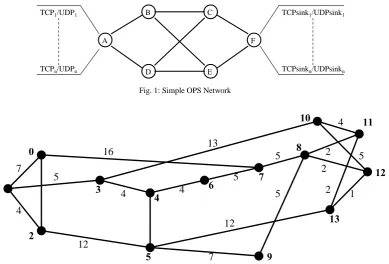
1. Fig: 1 represents a SIMPLE mesh network topology
2. Fig: 2 represents NSFNET network topology, which represents an American backbone network.
The SIMPLE network topology is small and has 6 nodes. On the other hand NSFNET is comparably a bigger topology with 15 nodes. The small OPS network contains small link lengths with small propagation delays ranging from (2- 8) ms whereas the NSFNET contains both short and long hauls with propagation delays ranging from 5-20 ms.
Fig. 1: Simple OPS Network
Fig. 2: 14-node NSFNET network with propagation delays
Route calculation and selection are done according to Link State dynamic routing protocol, where the paths are chosen dynamically by judging the traffic load along the route. Each network node is both an edge node and a core node capable of generating packets destined to other nodes. In the analysis, we assume that there is presence of buffers in the source node for providing a waiting time between the incoming packets. Also, the nodes are not enhanced with FDL buffers. The transmission capacity of the channels is 1-10 Gbps.
A mandatory waiting time is applied during the scheduling of packets in the ingress nodes of the network as has been proposed earlier. Furthermore, the information exchange intervals (in which the nodes exchange routing tables) has been decreased, which enables them to exchange more and more information about the loads that will be applied to the links in the future during that waiting time. When much information is being exchanged between the nodes, the ingress nodes can be assumed to hold more accurate information about the traffic statistics for the future. Therefore the possible contending packets can be time shifted before they flow into the network and get lost due to contention.
A
B
D
C
E
F TCP1/UDP1
TCPn/UDPn
TCPsink1/UDPsink1
TCPsinkn/UDPsinkn
0
1
2
3
4
5
6 7
8
9
10 11
12
13 7
4
12 5
16 13
4 4
5
5 2
2 4
2
5
1 5
12
Fig. 3: Waiting time Vs. Loss rate for simple network
Fig. 4: Waiting time Vs. Loss rate for NSFNET network
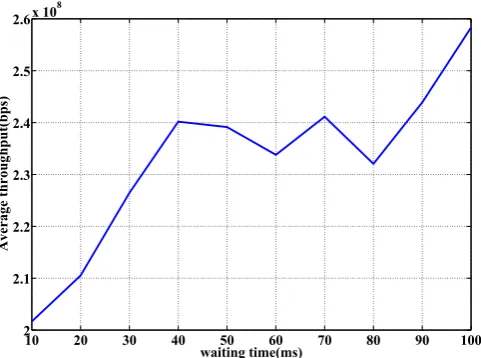
Fig. 5: Throughput Vs. waiting time at packet size = 60,000 Bytes
10 20 30 40 50 60 70 80 90 100
0 0.5 1 1.5 2 2.5 3 3.5 4 4.5 5
waiting time(ms)
lo
ss
r
at
e(
%
)
packet size=60000 bytes packet size=50000 bytes packet size=40000 bytes
40000
50000
60000
10 20 30 40 50 60 70 80 90 100
1 2 3 4 5 6 7 8
waiting time(ms)
lo
se
r
at
e(
%
)
packet size=100000 bytes packet size=80000 bytes packet size=40000 bytes
100000 40000
80000
10 20 30 40 50 60 70 80 90 100
2 2.1 2.2 2.3 2.4 2.5 2.6x 10
8
waiting time(ms)
A
ve
ra
ge
t
h
ro
u
gh
p
u
t(
b
p
Fig. 6: Throughput Vs. waiting time at packet size = 80,000 Bytes
Fig. 7: Throughput Vs. waiting time at packet size = 1,00,000 Bytes
UDP agents have been deployed with CBR(constant bit rate) traffic to measure the loss in the network with an increase in waiting time corresponding to a decrease in exchange intervals. Fig. 3 shows the loss curve with increasing waiting time, which was simulated in the simple OPS network, while Fig. 4 depicts the loss curve being simulated in the larger NSFNET network. We observe here that the loss rate decreases by a considerable amount with an increase in waiting time. The loss curves have been shown for various packet sizes and it can also be observed that the loss rate decreases with an increase in packet size. We find similar characteristics of the loss curve in the case of NSFNET network.
Reno TCP agents have been applied at the network layer with FTP traffic at the application layer, to measure the throughput of the system with the change in waiting time. Fig. 5, 6 and 7 shows the average throughput versus waiting time for packet sizes 60 kb, 80kb and 100 kb respectively. The average throughput increases with an increase in waiting time and similar results can be observed for various packet sizes.
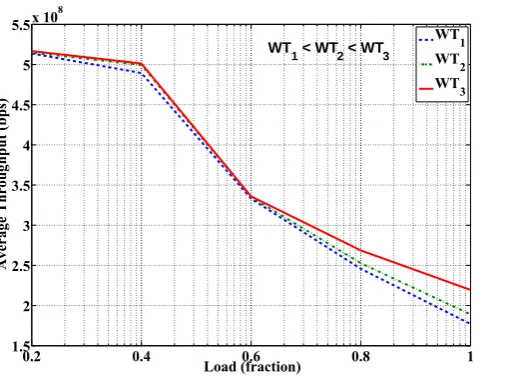
Furthermore, Fig: 9 shows load vs. average throughput graph for packet size =80,000 Bytes. The load is changed by varying the load capacity on the links between the nodes. It can be seen that, when here the traffic load becomes almost equal to the link transmission capacity, the throughput increases incredibly with an increase in waiting time. Similar characteristics have been observed for packet size=1,00,000 Bytes.
10 20 30 40 50 60 70 80 90 100
2.25 2.3 2.35 2.4 2.45 2.5 2.55
2.6x 10
8
waiting time(ms)
A
ve
ra
ge
t
h
ro
u
gh
p
u
t(
b
p
s)
10 20 30 40 50 60 70 80 90 100
2.2 2.25 2.3 2.35 2.4 2.45 2.5 2.55 2.6 2.65x 10
8
waiting time(ms)
A
ve
ra
ge
T
h
ro
u
gh
p
u
t(
b
p
Fig. 8: Throughput Vs. Load at packet size = 1,00,000 Bytes
Fig. 9: Throughput Vs. Load at packet size = 80,000 Bytes
V. CONCLUSION
In this paper, a new technique has been proposed to address some key problems involved in current optical packet switched networks. A kind of offset time has been applied to the edge nodes to modulate the traffic flow in the network which can be decided by analyzing the advance knowledge (about link loads) obtained by more exchange of information. This helps the edge nodes to time-shift the possible contending packets before they flow in the network. Furthermore, it shifts the burdenfor contention resolution from the core nodes to the edge nodes, where it is easier to employ complex electronic processing. Hence our concept permits the simplification of optical core nodes, minimizing the need for optical buffering, still retaining an all-optical data path in the network.
ACKNOWLEDGMENT
The authors would like to thank their colleagues and friends for their constant support and encouragement. The authors specially thank their parents for their love and blessings.
REFERENCES
[1] P. Chandra, A. Turuk, and B. Sahoo, “Survey on optical burst switching in WDM networks,” in Industrial and Information Systems (ICIIS), 2009
International Conference on, pp. 83 –88,Dec. 2009.
[2] A. G. P. Rahbar and O. W. W.Yang, “Contention avoidance and resolution schemes in bufferless all-optical packet-switched networks: A
survey,” IEEE Communications Surveys And Tutorials, vol. 10, no. 4, 2008.
[3] L. Xu, H. Perros, and G. Rouskas, “Techniques for optical packet switching and optical burst switching,” Communications Magazine, IEEE, vol.
0.2 0.4 0.6 0.8 1
2 2.5 3 3.5 4 4.5 5 5.5 6 6.5x 10 8 Load (fraction) A ve ra ge T h ro u gh p u t (b p s) WT 1 WT2 WT 3 WT
1 < WT2 < WT3
0.2 0.4 0.6 0.8 1
1.5 2 2.5 3 3.5 4 4.5 5 5.5x 10 8 Load (fraction) A ve ra ge T h ro u gh p u t (b p s) WT 1 WT2 WT 3 WT
[4] G. X. Y. Li and H. Ghafouri-Shiraz, “On the benefits of multifiber optical packet switch,” Microwave and Optical Technology Letter, vol. 43, no. 5, pp. 376–378, Dec 2004.
[5] A. G. P. Rahbar and O. Yang, “Reducing loss rate in slotted optical networks: A lower bound analysis,” in Proc. IEEE ICC Istanbul, June 2006.
[6] D. K. H. Z. Lu and I. D. Henning, “Contention resolution scheme for slotted optical packet switched networks,” in Proc. 9th Conf. Optical
NetworkDesign and Modelling (ONDM), Milan, Italy, Feb 2005.
[7] M. L. V. Eramo and P. Pacifici, “A comparison study on the number of wavelength converters needed in synchronous and asynchronous
all-opticalswitching architectures,” J. Lightwave Tech., vol. 21, no. 2, 2005.
[8] S. Yao, B. Mukherjee, S. Yoo, and S. Dixit, “A unified study of contention-resolution schemes in optical packet-switched networks,” Journal of
LightwaveTechnology, vol. 21, pp. 672–683, 2003.
[9] A. Drakos, T. Orphanoudakis, C. (T) Politi, and A. Stavdas, “Statistical traffic multiplexing with service guarantees over optical core networks,” in DataCommunication Networking (DCNET), Proceedings of the 2010 International Conference on, pp. 1 –5, July 2010.