GRECS: Graph Encryption for Approximate
Shortest Distance Queries
Xianrui Meng∗ [email protected]
Seny Kamara† [email protected]
Kobbi Nissim‡ [email protected]
George Kollios§ [email protected]
Abstract
We propose graph encryption schemes that efficiently support approximate shortest distance queries on large-scale encrypted graphs. Shortest distance queries are one of the most funda-mental graph operations and have a wide range of applications. Using such graph encryption schemes, a client can outsource large-scale privacy-sensitive graphs to an untrusted server with-out losing the ability to query it. Other applications include encrypted graph databases and controlled disclosure systems. We propose GRECS (stands for GRaph EnCryption for ap-proximate Shortest distance queries) which includes three schemes that are provably secure against any semi-honest server. Our first construction makes use of only symmetric-key op-erations, resulting in a computationally-efficient construction. Our second scheme, makes use of somewhat-homomorphic encryption and is less computationally-efficient but achieves opti-mal communication complexity (i.e., uses a miniopti-mal amount of bandwidth). Finally, our third scheme is both computationally-efficient and achieves optimal communication complexity at the cost of a small amount of additional leakage. We implemented and evaluated the efficiency of our constructions experimentally. The experiments demonstrate that our schemes are efficient and can be applied to graphs that scale up to 1.6 million nodes and 11 million edges.
1
Introduction
Graph databases that store, manage, and query large graphs have received increased interest recently due to many large-scale database applications that can be modeled as graph problems. Example applications include storing and querying large Web graphs, online social networks, biological net-works, RDF datasets, and communication networks. As a result, a number of systems have been proposed to manage, query, and analyze massive graphs both in academia (e.g., Pregel [MAB+10], GraphLab [LGK+10], Horton [SEHK12], Trinity [SWL13], TurboGraph [HLP+13], and GraphChi-DB [KG14]) and industry (e.g., Neo4j, Titan, DEX, and GraphBase). Furthermore, with the advent of cloud computing, there is a natural desire for enterprises and startups to outsource the storage and management of their databases to a cloud provider. Increasing concerns about data security
∗
Department of Computer Science, Boston University. Supported by by NSF grants IIS-1320542 and CNS-1414119. †
Microsoft Research. ‡
Department of Computer Science, Ben-Gurion University and CRCS, Harvard University. Work partly done when the author was visiting the Rafik B. Hariri Institute for Computing and Computational Science & Engineering at Boston University. Supported by NSF grant CNS-1237235, a Simons Investigator grant, and ISF grant 276/12.
§
and privacy in the cloud, however, have curbed many data owners’ enthusiasm about storing their databases in the cloud.
To address this, Chase and Kamara [CK10] introduced the notion of graph encryption. Roughly speaking, a graph encryption scheme encrypts a graph in such a way that it can be privately queried. Using such a scheme, an organization can safely outsource its encrypted graph to an untrusted cloud provider without losing the ability to query it. Several constructions were described in [CK10] including schemes that support adjacency queries (i.e., given two nodes, do they have an edge in common?), neighbor queries (i.e., given a node, return all its neighbors) and focused subgraph queries on web graphs (a complex query used to do ranked web searches). Graph encryption is a special case of structured encryption, which are schemes that encrypt data structures in such a way that they can be privately queried. The most well-studied class of structured encryption schemes are searchable symmetric encryption (SSE) schemes [SWP00, CM05, Goh03, CGKO06, KPR12, KP13, CJJ+13, CJJ+14, NPG14, SPS14] which, roughly speaking, encrypt search structures (e.g., indexes or search trees) for the purpose of efficiently searching on encrypted data.
In this work, we focus on the problem of designing graph encryption schemes that support one of the most fundamental and important graph operations: finding the shortest distance between two nodes. Shortest distance queries are a basic operation in many graph algorithms but also have applications of their own. For instance, on a social network, shortest distance queries return the shortest number of introductions necessary for one person to meet another. In protein-protein interaction networks they can be used to find the functional correlations among proteins [PWJ04] and on a phone call graph (i.e., a graph that consists of phone numbers as vertices and calls as edges) they return the shortest number of calls connecting two nodes.
Our techniques and contributions. Computing shortest distance queries on massive graphs (e.g., the Web graph, online social networks or a country’s call graph) can be very expensive, so in practice one typically pre-computes a data structure from the graph called a distance oracle that answers shortest distance queries approximately [TZ05, DSGNP10, CDF+13]; that is, given two vertices v1 and v2, the structure returns a distance d that is at most α·dist(v1, v2) +β, where α, β >1 anddist(v1, v2) is the exact distance betweenv1 and v2.
In this work, we focus on designing structured encryption schemes for a certain class of distance oracles referred to as sketch-based oracles. Below we summarize our contributions:
• We propose three distance oracle encryption schemes. Our first scheme only makes use of symmetric-key operations and, as such, is very computationally-efficient. Our second scheme makes use of somewhat-homomorphic encryption and achieves optimal communication plexity. Our third scheme is computationally-efficient, achieves optimal communication com-plexity and produces compact encrypted oracles at the cost of some leakage.
• We show that all our constructions are adaptively semantically-secure with reasonable leakage functions.
• We implement and evaluate our solutions on real large-scale graphs and show that our con-structions are practical.
1.1 Related Work
[GYJ+11, LT08, CFL10], use differential privacy [DMNS06] to query graph statistics privately
[KNRS13, SY13], or use private information retrieval (PIR) [MY12] to privately recover shortest paths. We note that none of these approaches are appropriate in our context where the graph itself stores sensitive information (and therefore must be hidden unlike in the PIR scenario) and is stored remotely (unlike the differential privacy and anonymization scenarios). Structured and graph en-cryption was introduced by Chase and Kamara in [CK10]. Structured enen-cryption is a generalization of searchable symmetric encryption (SSE) which was first proposed by Song, Wagner and Perrig [SWP00]. The notion of adaptive semantic security was introduced by Curtmola, Garay, Kamara and Ostrovsky in [CGKO06] and generalized to the setting of structured encryption in [CK10]. One could also encrypt and outsource the graph using fully homomorphic encryption [Gen09], which supports arbitrary computations on encrypted data, but this would be prohibitively slow in prac-tice. Another approach is to execute graph algorithms over encrypted and outsourced graphs is to use Oblivious RAM [GO96] over the adjacency matrix of the graph. This approach, however, is inefficient and not practical even for small graphs since it requires storage that is quadratic in the number of nodes in the graph and a large number of costly oblivious operations. Recent work by [WNL+14] presents an oblivious data structure for computing shortest paths on planar graphs using ORAM. For a sparse planar graph with O(n) edges, their approach requires O(n1.5) space complexity at the cost of O(√nlogn) online query time. Recent works based on ORAM, such as [?,?], also propose oblivious secure computation frameworks that can be used to compute single source shortest paths. However, these are general purpose frameworks and are not optimized to answer shortest distance queries. Other techniques, such as those developed by Blanton, Steele and Aliasgari [BSA13] and by Aly et al. [ACM+13] do not seem to scale to sparse graphs with millions of nodes due to the quadratic complexity of the underlying operations which are instantiated with secure multi-party computation protocols.
Distance oracles. Computing shortest distances on large graphs using Dijkstra’s algorithm or breadth first search is very expensive. Alternatively, it is not practical to store all-pairs-shortest-distances since it requires quadratic space. To address this, in practice, one pre-computes a data structure called a distance oracle that supports approximate shortest distance queries between two nodes with logarithmic query time. Solutions such as [DSGNP10, PBCG09, QXSW13, CDF+13, Che14, Coh14, CHKZ03] carefully select seed nodes (also known as landmarks) and store the shortest distances from all the nodes to the seeds. The advantage of using such a data structure is that they are compact and the query time is very fast. For example, the distance oracle construction of Das Sarma, Gollapudi, Najork and Panigrahy [DSGNP10] requires ˜O(n1/c) work to return a (2c− 1)-approximation of the shortest distance for some constant c.
2
Preliminaries and Notations
Given an undirected graph G = (V, E), we denote its total number of nodes as n = |V| and its number of edges asm=|E|. A shortest distance queryq= (u, v) asks for the length of the shortest path between u and v which we denote dist(u, v). The notation [n] represents the set of integers
{1, . . . , n}. We write x ← χ to represent an element x being sampled from a distribution χ. We write x ←−$ X to represent an element x being uniformly sampled at random from a set X. The output xof a probabilistic algorithmAis denoted by x← Aand that of a deterministic algorithm
B by x := B. Given a sequence of elements v, we define its ith element either as vi or v[i] and
its total number of elements as |v|. If A is a set then |A| refers to its cardinality. Throughout,
A functionν :N→Nis negligible inkif for every positive polynomialp(·) and all sufficiently large
k, ν(k) < 1/p(k). We write f(k) = poly(k) to mean that there exists a polynomial p(·) such that
f(k)≤p(k) for all sufficiently largek∈N; and we similarly writef(k) =negl(k) to mean that there exists a negligible function ν(·) such that f(k)≤ν(k) for all sufficiently largek. A dictionary DX is a data structure that stores label/value pairs (`i, vi)ni=1. Dictionaries support insert and lookup operations defined as follows: an insert operation takes as input a dictionary DXand a label/value pair (`, v) and adds the pair to DX. We denote this as DX[`] := v. A lookup operation takes as input a dictionary DXa label`i and returns the associated valuevi. We denote this as vi :=DX[`i]. Dictionaries can be instantiated using hash tables and various kinds of search trees.
2.1 Cryptographic Tools
Encryption. In this work, we make use of several kinds of encryption schemes including stan-dard symmetric-key encryption and homomorphic encryption. A symmetric-key encryption scheme SKE = (Gen,Enc,Dec) is a set of three polynomial-time algorithms that work as follows. Gen is a probabilistic algorithm that takes a security parameter k as input and returns a secret key
K; Enc is a probabilistic algorithm that takes as input a key K and a message m and returns a ciphertext c; Dec is a deterministic algorithm that takes as input a key K and a ciphertext
c and returns m ifK was the key under which c was produced. A public-key encryption scheme PKE= (Gen,Enc,Dec) is similarly defined except thatGenoutputs a public/private key pair (pk,sk) and Encencrypts messages with the public keypk. Informally, an encryption scheme is CPA-secure (Chosen-Plaintext-Attack-secure) if the ciphertexts it outputs do not reveal any partial information about the messages even to an adversary that can adaptively query an encryption oracle. We refer the reader to [KL08] for formal definitions of symmetric-key encryption and CPA-security.
A public-key encryption scheme is homomorphic if, in addition to (Gen,Enc,Dec), it also in-cludes an evaluation algorithm Eval that takes as input a function f and a set of ciphertexts
c1 ← Encpk(m1) through cn ← Encpk(mn) and returns a ciphertext c such that Decsk(c) =
f(m1, . . . , mn). If a homomorphic encryption scheme supports the evaluation of any
polynomial-time function, then it is a fully-homomorphic encryption (FHE) scheme [RAD78, Gen09] oth-erwise it is a somewhat homomorphic encryption (SWHE) scheme. In this work, we make use of only “low degree” homomorphic encryption; namely, we only require the evaluation of quadratic polynomials. In particular, we need the evaluation algorithm to support any num-ber of additions: Encpk(m1 +m2) = Eval +,Encpk(m1),Encpk(m2)
; and a single multiplication: Encpk(m1m2) =Eval(×,Encpk(m1),Encpk(m2)), that is, a ciphertext that results from a
homomor-phic multiplication cannot be used in another homomorhomomor-phic multiplication. Concrete instantiations of such schemes include the scheme of Boneh, Goh and Nissim (BGN) [BGN05] based on bilinear maps and the scheme of Gentry, Halevi and Vaikuntanathan [GHV10] based on lattices.
Pseudo-random functions. A pseudo-random function (PRF) from domain D to co-domain R
3
Distance Oracles
At a high-level, our approach to designing graph encryption schemes for shortest distance queries consists of encrypting a distance oracle in such a way that it can be queried privately. A distance oracle is a data structure that supports approximate shortest distance queries. A trivial construction consists of pre-computing and storing all the pairwise shortest distances between nodes in the graph. The query complexity of such a solution is O(1) but the storage complexity is O(n2) which is not practical for large graphs.
We consider two practical distance oracle constructions. Both solutions are sketch-based which means that they assign a sketchSkv to each nodev∈V in such a way that the approximate distance
between two nodes u and v can be efficiently (sublinear) computed from the sketchesSku and Skv.
The first construction is by Das Sarma et al. [DSGNP10] which is itself based on a construction of Thorup and Zwick [TZ05] and the second is by Cohen et al. [CDF+13]. The two solutions produce sketches of the same form and distance queries are answered using the same operation.
Sketch-based oracles. More formally, a sketch-based distance oracle DO= (Setup,Query) is a pair of efficient algorithms that work as follows. Setuptakes as input a graph G, an approximation factor α and an error bound ε and outputs an oracle ΩG = {Skv}v∈V. Query takes as input an
oracle ΩGand a shortest distance queryq = (u, v). We say thatDOis (α, ε)-correct if for all graphs G and all queries q= (u, v), Pr [dist(u, v)≤d≤α·dist(u, v) ]≥1−ε, whered:=Query(ΩG, u, v).
The probability is over the randomness of algorithm Setup.
The Das Sarma et al. oracle. The Setup algorithm makes σ =Θ(e n2/(α+1)) calls to a Sketch sub-routine with the graph G. Throughout, we refer to σ as the oracle’s sampling parameter and we note that it affects the size of the sketches. During theith call, theSketchroutine generates and returns a collection of sketches (Skiv1, . . . ,Skivn), one for every node vj ∈V. Each sketch Skivj is a set constructed as follows. During theith call to Sketch, it samples uniformly at random λ= logn
sets of nodes S0, . . . , Sλ−1 of progressively larger sizes. In particular, for all 0 ≤ z ≤ λ−1, set Sz is of size 2z. Skivj then consists of λ pairs {(wz, δz)}0≤z≤λ−1 such that wz is the closest node
to vj among the nodes in Sz and δz = dist(vj, wz). Having computed σ collections of sketches (Skiv1, . . . ,Skivn)i∈[σ], Setup then generates, for each node vj ∈ V, a final sketch Skvj = Sσi=1Skivj.
Finally, it outputs a distance oracle ΩG = (Skv1, . . . ,Skvn). Throughout, we refer to the nodes
stored in the node/distance pairs of the sketches as seeds.
The Cohen et al. oracle. The Setup algorithm assigns to each node v ∈V a sketch Skv that
includes pairs (w, δ) chosen as follows. It first chooses a random rank functionrk:V →[0,1]; that is, a function that assigns to each v ∈V a value distributed uniformly at random from [0,1]. Let
Nd(v) be the set of nodes within distanced−1 ofv and letρ= Θ(n2/(α+1)). Throughout, we refer
toρ as the oracle’s rank parameter and note that it affects the size of the sketches. For each node
v∈V, the sketchSkv includes pairs (w, δ) such thatrk(w) is less than theρthvalue in the sorted set
{rk(y) : y ∈ Ndist(u,v)(v)}. Finally it outputs a distance oracle ΩG = (Skv1, . . . ,Skvn). Like above,
we refer to the nodes stored in the node/distance pairs of the sketches as seeds.
Shortest distance queries. The two oracle constructions share the sameQueryalgorithm which works as follows. Given a query q= (u, v), it finds the set of nodes Iin common between Sku and
Skv and returns the minimum over s∈Iof dist(u, s) +dist(s, v). If there are no nodes in common,
Sk(u): {(a,3), (b,3), (e,6), (g,3), (h,4)}
Sk(v): {(b,2), (d,1), (e,3), (h,3), (f,7)}
Figure 1: Two sketches for nodesu and v. The approximate shortest distanced= 5.
4
Distance Oracle Encryption
In this section we present the syntax and security definition for our oracle encryption schemes. There are many variants of structured encryption, including interactive and non-interactive, response-revealing and response-hiding. We consider interactive and response-hiding schemes which denote the fact that the scheme’s query operation requires at least two messages (one from client and a response from server) and that queries output no information to the server.
Definition 4.1 (Oracle Encryption) A distance oracle encryption scheme Graph = (Setup,distQuery) consists of a polynomial-time algorithm and a polynomial-time two-party protocol that work as follows:
• (K,EO)←Setup(1k,Ω, α, ε): is a probabilistic algorithm that takes as input a security
param-eter k, a distance oracle Ω, an approximation factor α, and an error parameter ε. It outputs a secret key K and an encrypted graph EO.
• (d,⊥)←distQueryC,S (K, q),EO: is a two-party protocol between a clientC that holds a key
K and a shortest distance queryq= (u, v)∈V2 and a serverS that holds an encrypted graph EO. After executing the protocol, the client receives a distance d≥0 and the server receives
⊥. We sometimes omit the subscripts C andS when the parties are clear from the context.
For α ≥ 1 and ε < 1, we say that Graph is (α, ε)-correct if for all k ∈ N, for all Ω and for all
q = (u, v)∈V2,
Pr [d≤α·dist(u, v) ]≥1−ε,
where the probability is over the randomness in computing (K,EO) ← Setup(1k,Ω, α, ε) and then (d,⊥)←distQuery (K, q),EO.
4.1 Security
At a high level, the security guarantee we require from an oracle encryption scheme is that: (1) given an encrypted oracle, no adversary can learn any information about the underlying oracle; and (2) given the view of a polynomial number of distQuery executions for an adaptively generated sequence of queries q = (q1, . . . , qn), no adversary can learn any partial information about either
ΩG orq.
Such a security notion can be difficult to achieve efficiently, so often one allows for some form of leakage. Following [CGKO06, CK10], this is usually formalized by parameterizing the security definition with leakage functions for each operation of the scheme which in this case include the Setup algorithm anddistQuery protocol.
We adapt the notion of adaptive semantic security from [CGKO06, CK10] to our setting to the case of distance oracle encryption.
simulator and LSetup and LQuery are (stateful) leakage functions:
IdealA,S(1k):
• A outputs an oracle Ω, its approximation factor α and its error parameter ε.
• Given LSetup(Ω), 1k, α and ε, S generates and sends an encrypted graph EO toA.
• A generates a polynomial number of adaptively chosen queries(q1, . . . , qm). For each qi, S is
given LQuery(Ω, qi) and A and S execute a simulation of distQuery with A playing the role of
the server and S playing the role of the client.
• A computes a bit b that is output by the experiment.
RealA(1k):
• A outputs an oracle Ω, its approximation factor α and its error parameter ε.
• C computes (K,EO)←Setup(1k,Ω, α, ε) and sends the encrypted graphEO to A.
• A generates a polynomial number of adaptively chosen queries (q1, . . . , qm). For each query qi,A and C execute distQueryC,A (K, q),EO
.
• A computes a bit b that is output by the experiment.
We say thatGraph is adaptively (LSetup,LQuery)-semantically secure if for all ppt adversaries A,
there exists a ppt simulator S such that
Pr
h
RealA(1k) = 1 i
−Pr h
IdealA,S(1k)
i = 1
=negl(k).
The definition above captures the fact that, given the encrypted oracle and its view of the query protocol, an adversarial server cannot learn any information about the oracle beyond the leakage.
4.2 Leakage
All the distance oracle encryption schemes we discuss in this work leak information. We describe and formalize these leakages below.
Setup leakage. The setup leakage of our first and second constructions,GraphEnc1andGraphEnc2 in Sections 5.1 and 5.2, includes the total number of nodes in the underlying graphn, the maximum sketch sizeS= maxv∈V |Skv|and the maximum distance over all seedsD= maxv∈V max(w,δ)∈Skvδ.
The setup leakage of our third construction, GraphEnc3 in Section 5.3, includes n, S, D and the total number of seeds Z =P
v∈V |Skv|.
Query pattern leakage. The query leakage of our first two constructions, GraphEnc1 and GraphEnc2, reveals whether the nodes in the query have appeared before. We refer to this as thequery pattern leakage and formalize it below.
Definition 4.3 (Query pattern) For two queriesq, q0 defineSim(q, q0) =(u=u0,u=v0,v=u0,
v = v0), i.e., whether each of the nodes q = (u, v) matches each of the nodes of q0 = (u0, v0). Let
We do not claim that it is always reasonable for a graph encryption scheme to leak the query pattern - it may convey sensitive information in some settings. Furthermore, Definition 4.2 does not attempt to capture all possible leakages. As with many similar definitions, it does not capture side channels, and, furthermore, it does not capture leakage resulting from the client’s behavior given the query answers, which, in turn may be affected by the choice of an approximation algorithm (see also [FIM+06, HKKN01] for a discussion of privacy of approximation algorithms).
Sketch pattern leakage. Our third construction, GraphEnc3, leaks the query pattern and an additional pattern we refer to as the sketch pattern. The sketch pattern reveals which seeds are shared between the different sketches of the oracle and the size of the sketches. We formalize this below by revealing randomized “pseudo-ids” of the seeds in each sketch.
Definition 4.4 (Sketch pattern leakage) The sketch pattern leakage functionLSP(ΩG, q) for a
graph Gand a query q = (u, v) is a pair (X, Y), where X={f(w) : (w, δ)∈Sku} and Y ={f(w) :
(w, δ)∈Skv} are multi-setsand f :{0,1}logn→ {0,1}logn is a random function.
It is not clear what this leakage implies in practice but we note that the leakage is not (directly) over the graph but over thesketches which contain a random subset of nodes. Therefore, it may be possible to add some form of noise in the sketches (e.g., using fake sketch elements) to guarantee some level of privacy to the original graph. We note that leakage is revealed in all SSE constructions such as [SWP00, CM05, Goh03, CGKO06, CK10, KPR12, KO12, KP13, CJJ+13, NPG14, CJJ+14]. However, in all these constructions the leakage is over a data structure (e.g., an inverted index) that holdsall of the original data (i.e., all the keywords and documents). In our case, the leakage is over a structure that holds only a random subset of the data. This could provide additional help with respect to privacy but this is a topic for future work and is not the main focus of this paper.
4.3 Efficiency
We evaluate the efficiency and practicality of our constructions according to the following criteria:
• Setup time: the time for the client to pre-process and encrypt the graph;
• Space complexity: the size of the encrypted graph;
• Query time: The time to execute a shortest distance query on the encrypted graph;
• Communication complexity: the number of bits exchanged during a query operation.
5
Our Constructions
5.1 A Computationally-Efficient Scheme
We now describe our first scheme which is quite practical. The scheme GraphEnc1 = (Setup,distQuery) makes use of a symmetric-key encryption scheme SKE = (Gen,Enc,Dec) and a PRP P. The Setup algorithm works as follows. Given a 1k,ΩG,α and ε:
• It pads each sketch to the maximum sketch size S by filling them with dummy values.
• It then generates keys K1, K2 for the encryption scheme and PRP respectively and setsK =
(K1, K2). For all v∈V, it computes a labelPK2(v) and creates an encrypted sketch ESkv =
(c1, ..., cλ), where ci ←EncK1(wikδi) is a symmetric-key encryption of theith pair (wi, δi) in
Skv.
• It then sets up a dictionary DX in which it stores, for all v ∈ V, the pairs (PK2(v),ESkv),
ordered by the labels. The encrypted graph is then simply EO=DX.
The distQuery protocol works as follows. To query EO on q = (u, v), the client sends a token tk= (tk1,tk2) = (PK2(u), PK2(v)) to the server which returns the pairESku :=DX[tk1] andESkv:=
DX[tk2]. The client then decrypts each encrypted sketch and computes mins∈Idist(u, s) +dist(s, v)
(note that the algorithm only needs the sketches of the nodes in the query).
Security and efficiency. It is straightforward to see that the scheme is adaptively (L,LQP
)-semantically secure, where L is the function that returnsn, S and D. We defer a formal proof to the full version of this work. The communication complexity of the distQuery protocol is linear in
S, where S is the maximum sketch size. Note that even though S is sub-linear in n, it could still be large in practice. For example, in the Das Sarma et al. construction S=O(n2/α·logn). Also, in the case of multiple concurrent queries, this could be a significant bottleneck for the scheme.
In the following Section, we show how to achieve a solution withO(1) communication complexity and in Section 6 we experimentally show that it scales to graphs with millions of nodes.
5.2 A Communication-Efficient Scheme
We now describe our second scheme GraphEnc2 = (Setup,distQuery) which is less computationally efficient than our first but is optimal with respect to communication complexity.
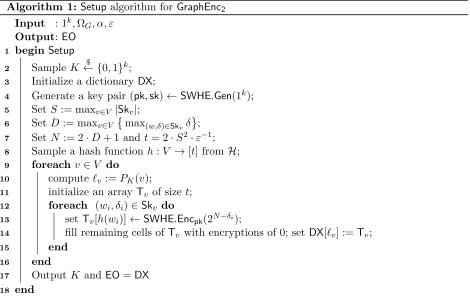
The details of the construction are given in Algorithms 1 and 2. It makes use of a SWHE scheme SWHE = (Gen,Enc,Dec,Eval), a pseudo-random permutation P and a family of universal hash functions H.
The Setup algorithm works as follows. Given 1k, ΩG, α, and ε as inputs, it generates a
public/secret-key pair (pk,sk) forSWHE. LetDbe the maximum distance over all the sketches and
S be the maximum sketch size. Setup setsN := 2·D+ 1 and samples a hash functionh← H$ with domainV and co-domain [t], where t= 2·S2·ε−1.
It then creates a hash table for each node v ∈V. More precisely, for each node v, it processes each pair (wi, δi) ∈ Skv and stores Encpk(2N−δi) at location h(wi) of a t-size array Tv. In other
words, for allv∈V, it creates an arrayTv such that for all (wi, δi)∈Skv,Tv[h(wi)]←Encpk(2N−δi). It then fills the empty cells of Tv with homomorphic encryptions of 0 and stores each hash table
Tv1 through Tvn in a dictionary DX by setting, for allv∈V,DX[PK(v)] :=Tv. Finally, it outputs
DX as the encrypted oracle EO.
Fig. 2 below provides an example of one of the hash tables Tv generated from a sketch
Algorithm 1:Setup algorithm forGraphEnc2
Input : 1k,ΩG, α, ε Output:EO
1 beginSetup
2 SampleK ← {$ 0,1}k; 3 Initialize a dictionaryDX;
4 Generate a key pair (pk,sk)←SWHE.Gen(1k); 5 SetS := maxv∈V |Skv|;
6 SetD:= maxv∈V
max(w,δ)∈Skvδ ;
7 SetN := 2·D+ 1 and t= 2·S2·ε−1; 8 Sample a hash functionh:V →[t] from H;
9 foreachv∈V do
10 compute`v :=PK(v);
11 initialize an array Tv of sizet;
12 foreach (wi, δi)∈Skv do
13 set Tv[h(wi)]←SWHE.Encpk(2N−δi);
14 fill remaining cells ofTv with encryptions of 0; set DX[`v] :=Tv;
15 end
16 end
17 OutputK andEO=DX
18 end
Encpk(2N−δi) is stored at location h(wi) of the table Tv. For example, we place Encpk(22−δj) to Tv[h(wj)] since h(wj) = 1. Finally, all remaining locations of Tv are filled with SWHEencryptions
of 0. Notice that, since we are using probabilistic encryption, the encryptions of 0 are different, and are indistinguishable from the encryptions of the other values.
!! …!…!
Tv Encpk(2
N−δi) Enc
pk(2
N−δk) Encpk(2
N−δj)
Encpk(0) Encpk(0)
Encpk(0)
0 h(wi) 2 h(wj) h(wk) t-1
Figure 2: One node’s encrypted hash table.
The distQuery protocol works as follows. Given a query q = (u, v), the client sends tokens (tk1,tk2) = (PK(u), PK(v)) to the server which uses them to retrieve the hash tables of nodes u
and v by computing Tu:=DX[tk1] and Tv :=DX[tk2]. The server then homomorphically evaluates
an inner product over the hash tables. More precisely, it computes c := Pt
i=1Tu[i]·Tv[i], where
P
and·refer to the homomorphic addition and multiplication operations of of the SWHE scheme. Finally, the server returns onlyc to the client who decrypts it and outputs 2N −log2(Decsk(c)).
Note that the storage complexity at the server isO(n·t) and the communication complexity of distQuery is O(1) since the server only returns a single ciphertext. In Section 5.2.1, we analyze the correctness and security of the scheme.
Algorithm 2:DistQuery algorithm forGraphEnc2
Input : Client’s input is (K, q) and server’s input isEO.
Output: Client’s output is distq and server’s output is ⊥. 1 begindistQuery
2 C: client parsesq as (u, v);
3 C⇒S: client sends tk= (tk1,tk2) = (PK(u), PK(v)); 4 S: server retrieves T1 :=DX[tk1] and T2 :=DX[tk2];
5 foreach i∈[t]do
6 Server computes ci ←SWHE.Eval(×,T1[i],T2[i]);
7 end
8 S⇒C: server sendsc←SWHE.Eval(+, c1, . . . , ct); 9 C: client computesm←SWHE.Decsk(c);
10 C: client outputsdist= 2N −logm.
11 end
Instantiating & optimizing the SWHE scheme. For our experiments (see Section 6) we instantiate the SWHEscheme with the BGN construction of [BGN05]. We choose BGN due to the efficiency of its encryption algorithm and the compactness of its ciphertexts and keys (as compared to the lattice-based construction of [GHV10]). Unfortunately, the BGN decryption algorithm is expensive as it requires computations of discrete logarithms. To improve this, we make use of various optimizations. In particular, we compute discrete logs during decryption using the Baby step Giant step algorithm [Sha71] and use a pre-computed table to speed up the computation. We defer the details of our optimizations to the full version of this work.
5.2.1 Correctness
Here, we analyze the correctness of GraphEnc2. We first bound the collision probability of our construction and then proceed to prove correctness in Theorem 5.2 below.
Lemma 5.1 Let q = (u, v) be a shortest distance query and let Eq be the event that a collision
occurred in theSetupalgorithm while constructing the hash tablesTu andTv. Then,Pr [Eq]≤2·S
2
t .
Proof: LetCollv be the event that at least one collision occurs while creatingv’s hash tableTv
(i.e., in Algorithm 1 Setup Line 13). Also, let XCollu,v be the event that there exists at least one
pair of distinct nodes wu ∈Sku andwv ∈Skv such that h(wu) =h(wv). For any q= (u, v), we have
Pr [Eq]≤Pr [Collu] + Pr [Collv] + Pr [XCollu,v]. (1)
Let su be the size of Sku an sv be the size of Skv. Since there are su2
and sv 2
node pairs in Sku
and Skv, respectively, and each pair collides under h with probability at most 1/t, Pr [Collu]≤ s
2
u 2·t
and Pr [Collv] ≤ s
2
v
2·t. On the other hand, if I is the set of common nodes in Sku and Skv, then
Pr [XCollu,v] ≤ (su−|I|)(tsv−|I|). Recall that su = sv ≤ S, so by combining with Eq. 1, we have
Pr [Eq]≤2·S2
t .
Note that in practice “intra-sketch” collision eventsCollu and Collv may or may not affect the
encryptions will not affect the inner product operation since they will be canceled out. Inter-sketch collision events XCollu,v, however, may affect the results since they will cause different nodes to
appear in the intersection of the two sketches and lead to an incorrect sum.
Theorem 5.2 Let G= (V, E), α≥1 and ε <1. For allq= (u, v)∈V2 withu6=v,
Pr [α·dist(u, v)−log|I| ≤d≤α·dist(u, v) ]≥1−ε,
where (d,⊥) := GraphEnc2.distQuery (K, q),EO
, (K,EO) ← GraphEnc2.Setup(1k,ΩG, α, ε), and I
is the number of common nodes between Sku and Skv.
Proof: LetIbe the set of nodes in common betweenSkuandSkv and letmindist= minwi∈I{δiu+ δvi}, where for all 0≤i≤ |I|,δiu ∈Sku and δiv ∈Skv. Note that at line 8 in Algorithm 2distQuery,
the server returns to the client c=Pt
i=1Tu[i]·Tv[i].
LetEq be the event a collision occurred during Setup in the construction of the hash tablesTu
and Tv of u andv respectively. Conditioned on Eq, we therefore have that
c = |I| X
i=1
Encpk(2N−δ
u
i)·Encpk(2N−δ v i)
= Encpk 22N ·Σ |I|
i=12
−(δu i+δvi),
where the first equality holds since for any nodewi 6∈I, one of the homomorphic encryptions Tu[i]
orTv[i] is an encryption of 0. It follows then that (conditioned onEq) at Step 10 the client outputs
d = 2N−log 22N ·Σi|I=1| 2−(δiu+δiv)
≤ 2N−log 22N−mindist
≤ mindist,
where the first inequality holds since mindist≤ (δiu+δiv) for all i∈ |I|. Towards showing a lower bound ondnote that
d = 2N−log 22N ·Σi|I=1| 2−(δiu+δiv)
≥ 2N−log 22N−mindist+|I|
≥ mindist−log|I|,
where the first inequality also holds from mindist ≤ (δui +δiv) for all i ∈ |I|. Now, by the (α, ε )-correctness of DO, we have that mindist ≤ α·dist(u, v) with probability at least (1−ε) over the coins of DO.Setup. So, conditioned onEq,
mindist−log|I| ≤d≤α·dist(u, v).
The Theorem follows by combining this with Lemma 5.1 which bounds the probability of Eq and
noting that Setupsetst= 2·S2·ε−1.
Remark on the approximation. Note that Theorem 5.2 also provides a lower bound of α·
dist(u, v)−log|I| for the approximate distance. In particular, the bound depends on the set of common nodes |I|which varies for different queries but is small in practice. Furthermore, if log|I|
is larger than mindist, the approximate distance returned could be negative (we indeed observe a few occurrences of this in our experiments).
To improve the accuracy of the approximation, one could increase the base in the homomorphic encryptions. More precisely, instead of using encryptions of the form Encpk(2N−δ) we could use Encpk(BN−δ) forB= 3 orB = 4. This would result in an improved lower bound ofmindist−logB|I|
but would also increase the homomorphic decryption time since this increases the message space which in turn adds overhead to the decryption algorithm. We leave it as an open problem to further improve this lower bound without increasing the message space.
Remark on error rate. Given the above analysis, a client that makes γ queries will have an error ratio of ε·γ. In our experiments we found that, in practice, when using the Das Sarma et al. oracle, setting σ ≈3 results in a good approximation. So if we fix σ = 3 and set t =O(√n), then the error rate is O γ·log2(n)/√n which decreases significantly asngrows. In the case of the Cohen et al. all-distance sketch, if we fixρ= 4 and sett=O(√n), then we achieve about the same error rateO γ·ln2(n)/√n
. We provide in Section 6 detailed experimental result on the error rate.
5.2.2 Security
In the following Theorem, we analyze the security ofGraphEnc2.
Theorem 5.3 IfP is pseudo-random andSWHEis CPA-secure thenGraphEnc2, as described above,
is adaptively(LSetup,LQuery)-semantically secure, whereLSetup(ΩG) = (n, S, D)andLQuery(ΩG, q) =
LQP(ΩG, q).
Proof Sketch: Consider the simulator S that works as follows. Given leakage LSetup(ΩG) =
(S, D), it starts by generating (pk,sk) ← SWHE.Gen(1k). For all 1 ≤ i ≤ n, it then samples
`i ← {$ 0,1}lognwithout repetition and setsDX[`i] :=T
i, whereTiis an array that holdst= 2·Sm2 ·ε−1
homomorphic encryptions of 0∈2N, whereN = 2·D+ 1. It outputsEO=DX.
Given leakageLQuery(ΩG, q) =LQP(ΩG, q) it checks if either of the query nodesuorv appeared
in any previous query. If u appeared previously, S sets tk1 to the value that was previously used.
If not, it sets tk1 := `i for some previously unused `i. It does the same for the query node v; that
is, it sets tk2 to be the previously used value ifvwas previously queried or to an unused`i if it was
not.
The theorem follows from the pseudo-randomness ofP and the CPA-security ofSWHE.
5.3 A Space-Efficient Construction
To address this, we propose a third construction GraphEnc3 = (Setup,distQuery) which is both space-efficient and achieves O(1) communication complexity. The only trade-off is that it leaks more than the two previous constructions.
Algorithm 3:Setup algorithm forGraphEnc3
Input : 1k,ΩG, α, ε Output:EO
1 beginSetup
2 SampleK1, K2 ← {$ 0,1}k; 3 Initialize a counterctr= 1;
4 LetZ =Pv∈V |Skv|;
5 Sample a random permutationπ over [Z];
6 Initialize an arrayArrof size Z;
7 Initialize a dictionaryDX of sizen;
8 Generate (pk,sk)←SWHE.Gen(1k); 9 SetS := maxv∈V |Skv|;
10 SetD:= maxv∈V
max(w,δ)∈Skvδ ;
11 SetN := 2·D+ 1 and t= 2·S2·ε−1;
12 Initialize collision-resistant hash functionh:V →[t]; 13 foreachv∈V do
14 sample Kv← {0,1}k; 15 foreach(wi, δi)∈Skv do
16 computeci←SWHE.Encpk(2N−δi);
17 if i6=|Skv|then
18 SetNi =hh(wi)kcikπ(ctr+ 1)i;
19 else
20 SetNi =hh(wi)kcikNULLi;
21 end
22 Sampleri← {$ 0,1}k;
23 SetArr[π(ctr)] :=hNi⊕H(Kvkri), rii; 24 Setctr=ctr+ 1 ;
25 end
26 end
27 foreachv∈V (in random order) do
28 SetDX[PK1(v)] :=haddrArr(hv)kKvi ⊕FK2(v)
29 end
30 OutputK = (K1, K2,pk,sk) andEO= (DX,Arr);
31 end
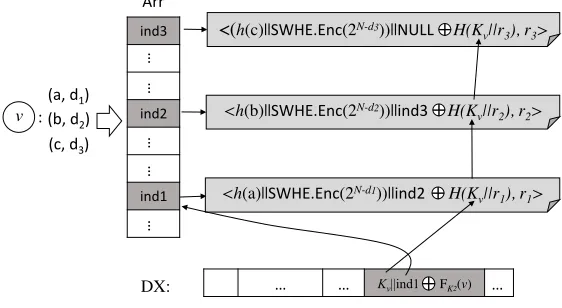
the seed/distance pairs in each sketch Skv as a linked-list where each node stores a seed/distance
pair. We then randomly shuffle all the nodes and place them in an array; that is, we place each node of each list at a random location in the array while updating the pointers so that the “logical” integrity of the lists are preserved (i.e., given a pointer to the head of a list we can still find all its nodes). We then encrypt all the nodes with a per-list secret key.
The scheme makes use of a SWHE scheme SWHE = (Gen,Enc,Eval,Dec), a pseudo-random permutation P, a pseudo-random function F, a random oracle H and a collision-resistant hash functionh modeled as a random function
The Setup algorithm takes as input a security parameter k, an oracle ΩG , an approximation
factor α, and an error parameter ε < 1. As shown in Algorithm 3, it first initializes a counter ctr= 1 and samples a random permutationπ over the domain [Z], where Z=P
v∈V |Skv|. It then
initializes an Z-size arrayArr. It proceeds to create an encrypted sketchESkv from each sketchSkv
as follows. It first samples a symmetric key Kv for this sketch. Then for each seed/distance pair
(wi, δi) in Skv, it creates a linked-list node Ni = hh(wi)kcikπ(ctr+ 1)i, where ci ← Encpk(2N−δi), and stores an H-based encryption hNi⊕H(Kvkrv), rvi of the node at location π(ctr) in Arr. For the last seed/distance pair, it uses instead a linked-list node of the form Ni =hh(wi)kcikNULLi, it
then increments ctr.
Setup then creates a dictionary DX where it stores for each node v ∈ V, the pair (PK1(v),haddrArr(hv)kKvi ⊕FK2(v)), where addrArr(hv) is the location in Arr of the head of v’s
linked-list. Figure 3 provides a detailed example for how we encrypt the sketch. Suppose node u’s sketchSku has the element (a, d1),(b, d2),(c, d3). The locationsind1,ind2,ind3inArrare computed
according the random permutation π.
ind3%
ind2%
ind1%
…%
…%
…%
…%
…%
Arr%
…% …% Kv||ind1 FK2(v) …% DX:
(a,%d1)
(b,%d2)
(c,%d3)
v : <h(b)||SWHE.Enc(2N-d2))||ind3%%%%%H(K
v||r2), r2>
<(h(c)||SWHE.Enc(2N-d3))||NULL%%%%%H(K
v||r3), r3>
<h(a)||SWHE.Enc(2N-d1))||ind2%%%%%%H(K
v||r1), r1>
Figure 3: Example of encrypting Sku ={(a, d1),(b, d2),(c, d3)}.
The distQuery protocol, which is shown in Algorithm 4, works as follows. Given a query q = (u, v), the client sends tokens (tk1,tk2,tk3,tk4) = (PK1(u), PK1(v), FK2(u), FK2(v)) to the server
which uses them to retrieve the values γ1 := DX[tk1] and γ2 := DX[tk2]. The server computes
ha1||Kui := γ1 ⊕tk3 and hb1||Kvi := γ2⊕tk4. Next, it recovers the lists pointed to by a1 and b1. More precisely, starting with i= 1, it parses Arr[a1] ashσu, rui and decryptsσu by computing
hhikcikai+1i:= σu⊕H(Kukru) whileai+1 6=NULL. And starting with j = 1, it does the same to
recoverhh0jkc0jkbj+1iwhile bj+16=NULL.
The server then homomorphically computes an inner product over the ciphertexts with the same hashes. More precisely, it computes ans := P
(i,j):hi=h0jci ·c
0
j, where
P
Algorithm 4:The protocol distQueryC,S.
Input : Client’s input is K, q= (u, v) and server’s input isEO
Output: Client’s output is dand server’s output is⊥
1 begindistQuery
2 C: computes (tk1,tk2,tk3,tk4) = (PK1(u), PK1(v), FK2(u), FK2(v));
3 C⇒S: sends tk= (tk1,tk2,tk3,tk4);
4 S: computesγ1 ←DX[tk1] and γ2←DX[tk2];
5 if γ1=⊥ or γ2=⊥then
6 exit and return⊥to the client
7 end
8 S: computeha1||Kui:=γ1⊕tk3; 9 S: parse Arr[a1] ashσu, rui; 10 S: computeN1:=σu⊕H(Kukru);
11 repeat
12 parse Ni ashhikcikai+1i; 13 parse Arr[ai+1] ashσi+1, ri+1i; 14 computeNi+1 :=σi+1⊕H(Kukri+1);
15 set i=i+ 1;
16 untilai+1 =NULL;
17 S: computehb1||Kvi:=γ2⊕tk4; 18 S: parse Arr[b1] ashσv, rvi; 19 S: computeN01:=σv⊕H(Kvkrv);
20 repeat
21 parse N0j as hh0jkc0jkbj+1i; 22 parse Arr[bj+1] ashσj+1, rj+1i; 23 computeN0j+1:=σj+1⊕H(Kvkrj+1);
24 set j=j+ 1;
25 untilbj+1 =NULL;
26 S: sets:=SWHE.Encpk(0); 27 foreach(Ni,N0j) do
28 if hi=h0j then
29 computep:=SWHE.Eval(×, ci, c0j); 30 computes:=SWHE.Eval(+, s, p);
31 end
32 end
33 S⇒C: sends;
34 C: computed:=SWHE.Decsk(s)
35 end
Note that the storage complexity at the server isO(m+|V|) and the communication complexity of distQuery is stillO(1) since the server only returns a single ciphertext.
5.3.1 Correctness and Security
as those in the encrypted graph produced byGraphEnc2 with the exception of the encryptions of 0; and (2) the output d of the client results from executing the same homomorphic operations as in GraphEnc2, with the exception of the homomorphic sums with 0-encryptions.
We note that GraphEnc3 leaks only a little more than the previous constructions. With respect to setup leakage it reveals, in addition to (n, S, D), the total number of seeds Z. Intuitively, for a query q = (u, v), the query leakage consists the query pattern leakage in addition to: (1) which seed/distance pairs in the sketchesSku andSkv are the same; and (2) the size of these sketches. This
is formalized in Definition 4.4 as the sketch pattern leakageLSP(ΩG, q). In the following Theorem,
we summarize the security of GraphEnc3.
Theorem 5.4 If P and F are pseudo-random, if SWHE is CPA-secure then GraphEnc3, as
de-scribed above, is adaptively (LSetup,LQuery)-semantically secure in the random oracle model, where
LSetup(ΩG) = (n, S, D, Z) and LQuery(ΩG, q) = (LQP(ΩG, q),LSP(ΩG, q)).
Proof Sketch: Consider the simulatorS that works as follows. Given leakage LSetup = (n, S, D, Z), for all 1≤i≤Z it samples Γi
$
← {0,1}logt+g(N)+logZ+k, where g(·) is the ciphertext expansion of
SWHE,t= 2·S2·ε−1 and N = 2·D+ 1. It then stores all the Γi’s in aZ-element array Arr. For
all 1≤i≤n, it samples`i $
← {0,1}logn without repetition and setsDX[` i]
$
← {0,1}logZ+k. Finally,
it outputs EO= (DX,Arr).
Given leakage LQuery(G, q) = (LQP(G, q),LSP(G, q)) such that LSP(G, q) = (X, Y), S first checks if either of the query nodes uorvappeared in any previous query. Ifu appeared previously,
S setstk1 andtk3 to the values that were previously used. If not, it setstk1:=`ifor some previously
unused`i andtk3 as follows. It chooses a previously unusedα∈[Z] at random, a keyKu $
← {0,1}k
and sets tk3 :=DX[tk1]⊕ hαkKui. It then remembers the association between Ku and X and the
sketch size|Sku|. It does the same for the query nodev, setstk2 andtk4 analogously and associates
|Skv|and Y with the keyKv it chooses.
It simulates the random oracleHas follows. Given (K, r) as input, it checks to see if: (1)K has been queried before (in the random oracle); and (2) if any entry in Arr has the form hs, ri where
s is a (logt+g(N) + logZ)-bit string. If K has not been queried before, it initializes a counter ctrK := 0. If an appropriate entry exists inArr, it returnss⊕ hγ, c, pi, whereγ is thectrth element
of the multi-setX orY associated withK,cis a SWHE encryption of 0 andpis an unused address in Arr chosen at random or ∅ ifctr =|Sk|, where|Sk| is the sketch size associated with K. If no appropriate entry exists in Arr, S returns a random value. The Theorem then follows from the pseudo-randomness of P and F and the CPA-security ofSWHE.
6
Experimental Evaluation
In this section, we present experimental evaluations of our schemes on a number of large-scale graphs. We implement the Das Sarma et al. distance oracle (DO1) and Cohen et al. distance
oracle (DO2) and all three of our graph encryption schemes. We use AES-128 in CBC mode for
symmetric encryption and instantiate SWHE with the Boneh-Goh-Nissim (BGN) scheme, imple-mented in C++ with the Stanford Pairing-Based Library PBC1. We use OpenSSL2 for all basic cryptographic primitives and use 128-bit security for all the encryptions. We use HMAC for PRFs and instantiate the hash function in GraphEnc3 with HMAC-SHA-256. All experiments were run on a 24-core 2.9GHz Intel Xeon, with 512 GBs of RAM running Linux.
1
http://crypto.stanford.edu/pbc/ 2
6.1 Datasets
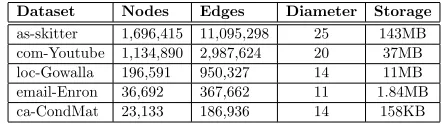
We use real-world graph datasets publicly available from the Stanford SNAP website3. In particular, we useas-skitter, a large Internet topology graph;com-Youtube, a large social network based on the Youtube web site; loc-Gowalla, a location-based social network;email-Enron, an email communica-tion network; andca-CondMat, a collaboration network for scientific collaborations between authors of papers related to Condensed Matter research. Table 1 summarizes the main characteristics of these datasets.
Dataset Nodes Edges Diameter Storage
as-skitter 1,696,415 11,095,298 25 143MB
com-Youtube 1,134,890 2,987,624 20 37MB
loc-Gowalla 196,591 950,327 14 11MB
email-Enron 36,692 367,662 11 1.84MB
ca-CondMat 23,133 186,936 14 158KB
Table 1: The graph datasets used in our experiments
Notice that some of these datasets contain millions of nodes and edges and that the diameters of these graphs are small. This is something that has been observed in many real-life graphs [LKF05] and is true for expander and small-world graphs, which are known to model many real-life graphs. The implication of this, is that the maximum distanceDin the sketches generated by the distance oracles is, in practice, small and therefore the value N that we use in GraphEnc2 and GraphEnc3 (see Algorithm 1 and 3) is typically small.
6.2 Overview
For a graph G= (V, E) withnnodes, we summarize in Table 2 our constructions’ space, setup, and communication complexities as well as the complexities for both the server and client during the query phase. Note that the complexities for each scheme also depend on α, however, in practice, since settingσforDO1(ρforDO2) to some small numbers resulted good approximations, therefore,
it makes α = O(logn). In our experiments, we test differentσ and ρ’s and the sketch size, |Skv|,
for each node is sublinear in the size of the graph, i.e. O(logn).
Scheme GraphEnc1 GraphEnc2 GraphEnc3
Space O(nlogn) O(nlog2n/ε) O(nlogn) Setup Time O(nlogn) O(nlog2n/ε) O(nlogn)
Communication O(logn) O(1) O(1)
Server Query Comp. O(1) O(log2n/ε) O(logn) Client Query Comp. O(logn) O(diameter) O(diameter)
Table 2: The space, setup, communication, and query complexities of our constructions (α is set to be in O(logn)).
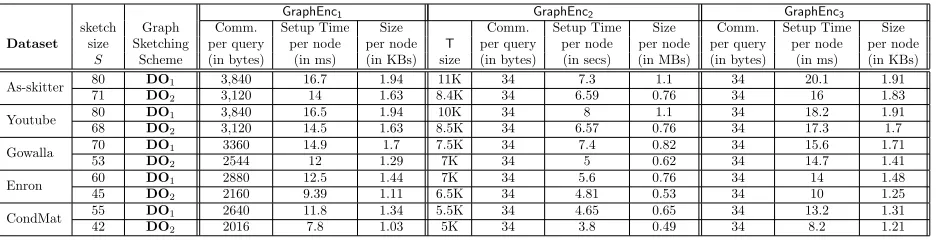
Table 3 summarizes our experimental results. Compared to existing schemes, such as [ACM+13], our experiments shows that the constructions are very efficient and scalable for large real dataset. For example, in [ACM+13], it takes several minutes to securely compute the shortest path distance for graph with only tens to hundreds of nodes, whereas it takes only seconds for our scheme to query the encrypted graph up to 1.6 million nodes.
3
GraphEnc1 GraphEnc2 GraphEnc3
Dataset
sketch Graph Comm. Setup Time Size Comm. Setup Time Size Comm. Setup Time Size
size Sketching per query per node per node T per query per node per node per query per node per node
S Scheme (in bytes) (in ms) (in KBs) size (in bytes) (in secs) (in MBs) (in bytes) (in ms) (in KBs)
As-skitter 80 DO1 3,840 16.7 1.94 11K 34 7.3 1.1 34 20.1 1.91
71 DO2 3,120 14 1.63 8.4K 34 6.59 0.76 34 16 1.83
Youtube 80 DO1 3,840 16.5 1.94 10K 34 8 1.1 34 18.2 1.91
68 DO2 3,120 14.5 1.63 8.5K 34 6.57 0.76 34 17.3 1.7
Gowalla 70 DO1 3360 14.9 1.7 7.5K 34 7.4 0.82 34 15.6 1.71
53 DO2 2544 12 1.29 7K 34 5 0.62 34 14.7 1.41
Enron 60 DO1 2880 12.5 1.44 7K 34 5.6 0.76 34 14 1.48
45 DO2 2160 9.39 1.11 6.5K 34 4.81 0.53 34 10 1.25
CondMat 55 DO1 2640 11.8 1.34 5.5K 34 4.65 0.65 34 13.2 1.31
42 DO2 2016 7.8 1.03 5K 34 3.8 0.49 34 8.2 1.21
Table 3: A full performance summary for GraphEnc1,GraphEnc2, and GraphEnc3
6.3 Performance of GraphEnc1
We evaluate the performance of GraphEnc1 using both the Das Sarma et al. and Cohen et al. distance oracles. For the Das Sarmaet al. oracle (DO1), we set the sampling parameterσ = 3 and
for the Cohen et al. oracle (DO2) we set the rank parameter ρ = 4. We choose these parameters
because they resulted in good approximation ratios and the maximum sketch sizes (i.e., S) of roughly the same amount. Note that, the approximation factor α in those then is in O(logn) for GraphEnc1, therefore, the communication complexity (see Table 2) in GraphEnc1 is O(logn). We can see from Table 3 that the time to setup an encrypted graph with GraphEnc1 is practical—even for large graphs. For example, it takes only 8 hours to setup an encryption of the as-skitter graph which includes 1.6 million nodes. Since theGraphEnc1.Setupis highly-parallelizable, we could speed setup time considerably by using a cluster. A cluster of 10 machines would be enough to bring the setup time down to less than an hour. Furthermore, the size of the encrypted sketches range from 1KB for CondMat to 1.94KB for as-skitter per node. The main limitation of this construction is that the communication is proportional to the size of the sketches. We tested for various sketch sizes, and the communication per query went up to 3.8KB for as-skitter when we setS= 80. This can become quite significant if the server is interacting with multiple clients.
6.4 Performance of GraphEnc2
The first column in Table 3 of theGraphEnc2 experiments gives the size the encrypted hash tables Tv constructed during GraphEnc2.Setup. Table sizes range from 5K for ca-CondMat to 11K for
as-skitter.
The Time column gives the time to create an encrypted hash-table/sketch per node. This in-cludes generating the BGN encryptions of the distances and the 0-encryptions. Note that this makes GraphEnc2.Setup quite costly, about 3 orders of magnitude more expensive than GraphEnc1.Setup. This is mostly due to generating the 0-encryptions. Note, however, that similarly to GraphEnc1, we can use extensive parallelization to speed up the setup. For example, using a cluster of 100 ma-chines, we can setup the encrypted graph on the order of hours, even foras-skitter which includes 1.6 million nodes. The space overhead per node is also large, but the encrypted graph itself can be distributed in a cluster since every encrypted sketch is independent of the other. Finally, as shown in Table 3, GraphEnc2 achieves a constant communication cost of 34B.
In Fig. 4, we report on the intra- and inter-collisions that we observed when executing over 10K different queries over our datasets. The collision probability ranges between 1% and 3.5%. As we can see from the results, the oracle DO2 has less collisions than DO1.
different nodes collide, the product of these values will be a random value, whereas if the same node is mapped to the same entry the product will give 1. More discussion about this technique will appear in the full version of this work.
Figure 4: Collision probabilities for different datasets
6.5 Performance of GraphEnc3
TheGraphEnc3 columns in Table 3 show thatGraphEnc3is as efficient asGraphEnc1in terms of setup time and encrypted sketch size. Moreover, it achieves O(1) communication of 34B likeGraphEnc2. Using a single machine, GraphEnc3.Setup took less than 10 hours to encrypt as-skitter, but like the other schemes, it is highly parallelizable, and this could be brought down to an hour using 10 machines. We instantiated the hash functionh using a cryptographic keyed hash function HMAC-SHA-256.
6.5.1 Construction time & encrypted sketch size
Since the performance of GraphEnc3 depends only on the size of the underlying sketches we in-vestigate the relationship between the performance ofGraphEnc3.Setup and the sampling and rank parameters of the Das Sarma et al. and Cohen et al. oracles, respectively. We use values ofσ and
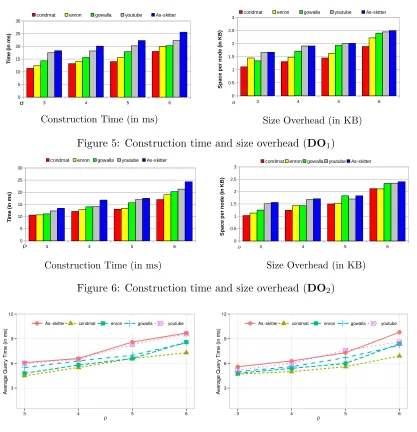
ρ ranging from 3 to 6 in each case which resulted in maximum sketch sizesS ranging from 43 to 80. Figure 5 and Figure 6 give the construction time and size overhead of an encrypted sketch when using the Das Sarma et al. oracle and Cohen et al. oracle respectively.
In each case, the construction time scales linearly when σ and ρ increase. Also, unlike the previous schemes, GraphEnc3 produces encrypted sketches that are compact since it does not use 0-encryptions for padding purposes.
6.5.2 Query Time
Construction Time (in ms) Size Overhead (in KB)
Figure 5: Construction time and size overhead (DO1)
Construction Time (in ms) Size Overhead (in KB)
Figure 6: Construction time and size overhead (DO2)
3 6 9 12
3 4 5 6
ρ
A
ver
age Quer
y Time (in ms)
As−skitter condmat enron gowalla youtube
(a) Query Time (in ms) usingDO1
3 6 9 12
3 4 5 6
ρ
A
ver
age Quer
y Time (in ms)
As−skitter condmat enron gowalla youtube
(b) Query Time (in ms)DO2
Figure 7: Average Query time
and, furthermore, these operations are independent so they can be parallelized. We note that we use mostly un-optimized implementations of all the underlying primitives and we believe that a more careful implementation (e.g., faster pairing library) would reduce the query time even further. We also measure the decryption time at the client. As pointed out previously, decryption time depends on N which itself is a function of the diameter of the graph. Since all our graphs have small diameter, client decryption time—which itself consists of a BGN decryption— was performed very efficiently. In particular, the average decryption time was less than 4 seconds and in most cases the decryption ranged between 1 and 3 seconds.
the client may reveal the diameter of the graph, since it is related to the N and the max distance in the sketches.
6.6 Approximation errors
0.0 0.2 0.4 0.6
3 4 5 6
σ
mean of relativ
e error with sd
as−skitter condmat enron gowalla youtube
DO1
0.0 0.1 0.2 0.3 0.4 0.5
3 4 5 6
ρ
mean of relativ
e error with sd
as−skitter condmat enron gowalla youtube
DO2
Figure 8: Mean of Estimated Error with Standard Deviation
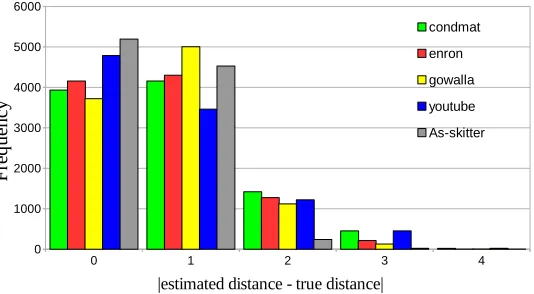
We investigate the approximation errors produced by our schemes. We generate 10K random queries and run theQueryC,S protocol. For client decryption, we recover 2N−logmand round it to its floor value. We used breadth-first search (BFS) to compute the exact distances between each pair of nodes and we compare the approximate distance returned by our construction to exact distances obtained with BFS. We report the mean and the standard deviation of the relative error for each dataset. We used both oracles to compute the sketches. We present our results in Figure 8, which shows that our approximations are quite good. Indeed, our experiments show that our constructions could report better approximations than the underlying oracles. This is due to the fact that both oracles overestimate the distance so subtracting log|I| can improve the approximation. For the Gowalla dataset, the mean of the relative error ranges from 0.36 to 0.13 when using the Das Sarma et al. oracle DO1. For as-skitter, it ranges from 0.45 to 0.22. The mean error and the variance
decreases as we increase the size of each sketch. In addition, we note that DO2 performs better in
all datasets. Also, half of the distances returned are exact and most of the distances returned are at most 2 away from the real distance. Figure 9 shows the histogram for the absolute error when using DO2 with ρ = 3. All the other datasets are very similar to them, so we omit them due to
space limitations.
We note that a very small number of distances were negative and we removed them from the experiments. Negative distances result from the intersection size|I|being very large. Indeed, when the client decrypts theSWHE ciphertext returned by the server, it recoversd≥mindist−log|I|. If
|I|is large andmindistis small (say, 1 or 2) then it is very likely that dis negative. However, in the experiments, the number of removed negative values were very small (i.e., 80 out of 10000 queries).
7
Conclusion
In this work, we described three graph encryption schemes that support approximate shortest dis-tance queries. Our first solution, GraphEnc1, is based only on symmetric-key primitives and is computationally very efficient while our second solution, GraphEnc2, is based on somewhat homo-morphic encryption and is optimal in terms of communication complexity. Furthermore, our third solution, GraphEnc3, achieves the “best of both worlds” and is computationally very efficient with optimal communication complexity. Our schemes work with any sketched-based distance oracle. We implemented our constructions and evaluated their efficiency experimentally, showing that our constructions are practical for large-scale graphs.
References
[ACM+13] Abdelrahaman Aly, Edouard Cuvelier, Sophie Mawet, Olivier Pereira, and Math-ieu Van Vyve. Securely solving simple combinatorial graph problems. In Financial Cryptography, pages 239–257, 2013.
[BGN05] D. Boneh, E.-J. Goh, and K. Nissim. Evaluating 2-dnf formulas on ciphertexts. In TCC 2005, pages 325–342, 2005.
[BSA13] Marina Blanton, Aaron Steele, and Mehrdad Aliasgari. Data-oblivious graph algo-rithms for secure computation and outsourcing. InASIACCS, pages 207–218, 2013.
[CDF+13] Edith Cohen, Daniel Delling, Fabian Fuchs, Andrew V. Goldberg, Mois´es Goldszmidt, and Renato F. Werneck. Scalable similarity estimation in social networks: closeness, node labels, and random edge lengths. InCOSN, pages 131–142, 2013.
[CFL10] James Cheng, Ada Wai-Chee Fu, and Jia Liu. K-isomorphism: privacy preserving network publication against structural attacks. In SIGMOD Conference, pages 459– 470, 2010.
[CGKO06] R. Curtmola, J. Garay, S. Kamara, and R. Ostrovsky. Searchable symmetric encryp-tion: Improved definitions and efficient constructions. In CCS 2006, pages 79–88. ACM, 2006.
[Che14] Shiri Chechik. Approximate distance oracles with constant query time. In STOC, pages 654–663, 2014.
[CHKZ03] Edith Cohen, Eran Halperin, Haim Kaplan, and Uri Zwick. Reachability and distance queries via 2-hop labels. SIAM J. Comput., 32(5):1338–1355, 2003.
[CJJ+14] D. Cash, J. Jaeger, S. Jarecki, C. Jutla, H. Krawczyk, M. Rosu, and M. Steiner.
Dynamic searchable encryption in very-large databases: Data structures and imple-mentation. InNetwork and Distributed System Security Symposium (NDSS ’14), 2014.
[CK10] M. Chase and S. Kamara. Structured encryption and controlled disclosure. In ASI-ACRYPT ’10, volume 6477, pages 577–594, 2010.
[CM05] Y. Chang and M. Mitzenmacher. Privacy preserving keyword searches on remote encrypted data. InACNS ’05, pages 442–455. Springer, 2005.
[Coh14] Edith Cohen. All-distances sketches, revisited: Hip estimators for massive graphs analysis. InPODS, pages 88–99, 2014.
[DMNS06] Cynthia Dwork, Frank McSherry, Kobbi Nissim, and Adam Smith. Calibrating noise to sensitivity in private data analysis. InTCC, pages 265–284, 2006.
[DSGNP10] A. Das Sarma, S. Gollapudi, M. Najork, and R. Panigrahy. A sketch-based distance oracle for web-scale graphs. InWSDM, pages 401–410, 2010.
[FIM+06] Joan Feigenbaum, Yuval Ishai, Tal Malkin, Kobbi Nissim, Martin J. Strauss, and Rebecca N. Wright. Secure multiparty computation of approximations. ACM Trans-actions on Algorithms, 2(3):435–472, 2006.
[Gen09] C. Gentry. Fully homomorphic encryption using ideal lattices. In STOC ’09, pages 169–178. ACM Press, 2009.
[GHV10] C. Gentry, S. Halevi, and V. Vaikuntanathan. A simple bgn-type cryptosystem from lwe. InAdvances in Cryptology - EUROCRYPT ’10, pages 506–522. Springer, 2010.
[GO96] O. Goldreich and R. Ostrovsky. Software protection and simulation on oblivious RAMs. Journal of the ACM, 43(3):431–473, 1996.
[Goh03] Eu-Jin Goh. Secure indexes. Cryptology ePrint Archive, Report 2003/216, 2003.
http://eprint.iacr.org/2003/216/.
[GYJ+11] Jun Gao, Jeffrey Xu Yu, Ruoming Jin, Jiashuai Zhou, Tengjiao Wang, and Dongqing
Yang. Neighborhood-privacy protected shortest distance computing in cloud. In SIG-MOD, pages 409–420, 2011.
[HKKN01] Shai Halevi, Robert Krauthgamer, Eyal Kushilevitz, and Kobbi Nissim. Private ap-proximation of np-hard functions. InSTOC, pages 550–559. ACM, 2001.
[HLP+13] Wook-Shin Han, Sangyeon Lee, Kyungyeol Park, Jeong-Hoon Lee, Min-Soo Kim, Jinha Kim, and Hwanjo Yu. Turbograph: a fast parallel graph engine handling billion-scale graphs in a single PC. InKDD, pages 77–85, 2013.
[KG14] Aapo Kyrola and Carlos Guestrin. Graphchi-db: Simple design for a scalable graph database system - on just a PC. CoRR, abs/1403.0701, 2014.
[KL08] J. Katz and Y. Lindell. Introduction to Modern Cryptography. Chapman & Hall/CRC, 2008.
[KO12] K. Kurosawa and Y. Ohtaki. Uc-secure searchable symmetric encryption. InFinancial Cryptography and Data Security (FC ’12), Lecture Notes in Computer Science, pages 285–298. Springer, 2012.
[KP13] S. Kamara and C. Papamanthou. Parallel and dynamic searchable symmetric encryp-tion. InFinancial Cryptography and Data Security (FC ’13), 2013.
[KPR12] S. Kamara, C. Papamanthou, and T. Roeder. Dynamic searchable symmetric encryp-tion. In ACM Conference on Computer and Communications Security (CCS ’12). ACM Press, 2012.
[LGK+10] Yucheng Low, Joseph Gonzalez, Aapo Kyrola, Danny Bickson, Carlos Guestrin, and Joseph M. Hellerstein. Graphlab: A new framework for parallel machine learning. In UAI, pages 340–349, 2010.
[LKF05] Jure Leskovec, Jon M. Kleinberg, and Christos Faloutsos. Graphs over time: densifi-cation laws, shrinking diameters and possible explanations. In KDD, pages 177–187, 2005.
[LT08] Kun Liu and Evimaria Terzi. Towards identity anonymization on graphs. InSIGMOD Conference, pages 93–106, 2008.
[MAB+10] Grzegorz Malewicz, Matthew H. Austern, Aart J. C. Bik, James C. Dehnert, Ilan Horn, Naty Leiser, and Grzegorz Czajkowski. Pregel: a system for large-scale graph processing. InSIGMOD, pages 135–146, 2010.
[MY12] Kyriakos Mouratidis and Man Lung Yiu. Shortest path computation with no informa-tion leakage. PVLDB, pages 692–703, 2012.
[NPG14] M. Naveed, M. Prabhakaran, and C. Gunter. Dynamic searchable encryption via blind storage. InOakland S& P 2014, 2014.
[PBCG09] Michalis Potamias, Francesco Bonchi, Carlos Castillo, and Aristides Gionis. Fast short-est path distance short-estimation in large networks. InCIKM, pages 867–876, 2009.
[PWJ04] Natasa Przulj, Dennis A. Wigle, and Igor Jurisica. Functional topology in a network of protein interactions. Bioinformatics, 20(3):340–348, 2004.
[QXSW13] Zichao Qi, Yanghua Xiao, Bin Shao, and Haixun Wang. Toward a distance oracle for billion-node graphs. InVLDB, pages 61–72, 2013.
[RAD78] R. Rivest, L. Adleman, and M. Dertouzos. On data banks and privacy homomorphisms. InFoundations of Secure Computation, pages 169–180, 1978.
[SEHK12] Mohamed Sarwat, Sameh Elnikety, Yuxiong He, and Gabriel Kliot. Horton: Online query execution engine for large distributed graphs. InICDE, pages 1289–1292, 2012.
[Sha71] Daniel Shanks. Class number, a theory of factorization, and genera. In 1969 Number Theory Institute, pages 415–440. Providence, R.I., 1971.
[SWL13] Bin Shao, Haixun Wang, and Yatao Li. Trinity: a distributed graph engine on a memory cloud. InSIGMOD, pages 505–516, 2013.
[SWP00] D. Song, D. Wagner, and A. Perrig. Practical techniques for searching on encrypted data. InOakland S & P, pages 44–55, 2000.
[SY13] Entong Shen and Ting Yu. Mining frequent graph patterns with differential privacy. InKDD 2013, pages 545–553, 2013.
[TZ05] M. Thorup and U. Zwick. Approximate distance oracles. Journal of the ACM, 52(1):1– 24, January 2005.