Enterprise
Architecture Management
Viewpoint Survey 2007
TU München, sebis
Software Engineering for Business Information Systems (sebis)
Ernst Denert-Stiftungslehrstuhl
Chair for Informatics 19
Release 1.0
February 2008
Enterprise Architecture Management
Pattern Catalog
Version 1.0
February 2008
Technical Report TB 0801
Sabine Buckl, Alexander M. Ernst, Josef Lankes, Prof. Dr. Florian Matthes
Software Engineering for Business Information Systems (sebis)
Ernst Denert-Stiftungslehrstuhl
Chair for Informatics 19
Technische Universit¨
at M¨
unchen
Boltzmannstraße 3, 85748 Garching b. M¨
unchen, Germany
Informatics of the Technische Universit¨at M¨unchen. sebis has been established in 2002 with funding of the Ernst Denert-Stiftung and is headed by Professor Dr. Florian Matthes. The main research areas ofsebis are:
• Software Cartography: Development of multi-faceted and formal models that help to manage (plan, build, operate, optimize) complex software application landscapes consisting of hundreds or thousands of information systems.
• Innovative technologies and software architectures for enterprise information and knowledge management (enterprise solutions, groupware and social software).
• Domain-specific and reflective languages and models for families of business applications.
sebis is using software engineering methods (model construction & abstraction, analysis & design,
construction & evaluation) and is working in close relationship with industrial partners and with organizations from the public sector.
Professor Matthes puts particular emphasis on the knowledge transfer from academia to industry. For example, he is co-founder of CoreMedia AG, of infoAsset AG, and of 20six Web log services AG, which at present employ a total of approx. 150 employees.
Copyright
Copyright c2008 Technische Universit¨at M¨unchen, sebis, Germany. All rights reserved. The information contained and opinions expressed herein may be changed without prior notice.
Trademarks
All trademarks or registered trademarks are the property of their respective owners.
Disclaimer
The information contained herein has been obtained from sources believed to be reliable at the time of publication but cannot be guaranteed. Please note that the findings, conclusions and recommendations that TU M¨unchen, sebis delivers will be based on information gathered in good faith from both primary and secondary sources, whose accuracy cannot always be guaranteed by TU M¨unchen, sebis.
TU M¨unchen, sebis disclaims all warranties as to the accuracy, completeness, or adequacy of such information. TU M¨unchen, sebis shall have no liability for errors, omissions, or inadequacies in the information contained herein or for interpretations thereof. In no event shall TU M¨unchen, sebis be liable for any damage of any kind (e.g. direct, indirect, special, incidental, consequential, or punitive damages) whatsoever, including without limitation lost revenues, or lost profits, which may result from the use of these materials. The reader assumes sole responsibility for the selection of these materials to achieve its intended results.
There will be no warranty that the results of this publication will be economically and technically exploitable and unencumbered by third-party proprietary rights.
Sponsoring
TheEnterprise Architecture Management Viewpoint Survey has been sponsored bySiemens IT
1 Introduction and Overview 17
1.1 Objectives of the EAM Pattern Catalog . . . 17
1.2 Compilation of the EAM Pattern Catalog . . . 18
1.3 EAM Pattern Approach . . . 20
1.4 Miscellaneous Information . . . 24
2 Using theEAM Pattern Catalog 25 2.1 Establishing an organization-specific EA Management through EAM Pattern Integration . . . 25
2.2 Inspiring and Assessing an already implemented EA Management approach . . . 26
2.3 EAM Pattern Catalog as a basis for academic research . . . 26
2.4 Integrating EAM Patterns . . . 27
2.4.1 Integrating M-Patterns . . . 27
2.4.2 Integrating V-Patterns . . . 28
2.4.3 Integrating I-Patterns . . . 28
2.5 How to Read the EAM Pattern Graph . . . 29
3 Concerns 31 3.1 Concern C-2 . . . 32
3.2 Concern C-4 . . . 32
3.3 Concern C-5 . . . 32
3.5 Concern C-9 . . . 32 3.6 Concern C-19 . . . 32 3.7 Concern C-29 . . . 33 3.8 Concern C-33 . . . 33 3.9 Concern C-34 . . . 33 3.10 Concern C-35 . . . 33 3.11 Concern C-36 . . . 33 3.12 Concern C-41 . . . 33 3.13 Concern C-44 . . . 33 3.14 Concern C-46 . . . 34 3.15 Concern C-50 . . . 34 3.16 Concern C-51 . . . 34 3.17 Concern C-52 . . . 34 3.18 Concern C-54 . . . 34 3.19 Concern C-55 . . . 34 3.20 Concern C-56 . . . 34 3.21 Concern C-61 . . . 35 3.22 Concern C-62 . . . 35 3.23 Concern C-64 . . . 35 3.24 Concern C-65 . . . 35 3.25 Concern C-66 . . . 35 3.26 Concern C-67 . . . 35 3.27 Concern C-68 . . . 35 3.28 Concern C-70 . . . 36 3.29 Concern C-71 . . . 36 3.30 Concern C-78 . . . 36 3.31 Concern C-80 . . . 36 3.32 Concern C-86 . . . 36 3.33 Concern C-87 . . . 36 3.34 Concern C-88 . . . 36 3.35 Concern C-89 . . . 37 3.36 Concern C-90 . . . 37 3.37 Concern C-91 . . . 37 3.38 Concern C-92 . . . 37
3.39 Concern C-95 . . . 37
3.40 Concern C-98 . . . 37
3.41 Concern C-99 . . . 37
3.42 Concern C-100 . . . 38
3.43 Concern C-101 . . . 38
4 Methodology Patterns (M-Patterns) 39 4.1 Technology Homogeneity . . . 40
4.1.1 Analysis of Standard Conformity of the Application Landscape (M-2) . . . 40
4.1.2 Management of Blueprint Conformity of the Application Landscape (M-4) . . . 44
4.1.3 Management of Homogeneity (M-3) . . . 48
4.1.4 Analysis of standard vs. individual Software (M-10) . . . 52
4.1.5 Analysis of the Enterprise Knowledge (M-5) . . . 54
4.2 Business Processes . . . 56
4.2.1 Process Analysis (M-6) . . . 57
4.3 Application Landscape Planning . . . 61
4.3.1 Analysis of the Application Landscape (M-13) . . . 61
4.3.2 Development of Plan and Target Landscapes (M-14) . . . 64
4.3.3 Management of the Application Lifecycle (M-15) . . . 66
4.3.4 Horizontal and vertical integration (M-18) . . . 69
4.4 Support of Business Processes . . . 71
4.4.1 High Level Process Support (M-29) . . . 71
4.4.2 Business Process Data Flow Analysis (M-30) . . . 74
4.5 Project Portfolio Management . . . 76
4.5.1 Strategic Conformance Analysis of the Project Portfolio (M-24) . . . 76
4.5.2 Monitoring of the Project Portfolio (M-25) . . . 78
4.5.3 Decision for Project Approval (M-26) . . . 82
4.6 Infrastructure Management . . . 87
4.6.1 Infrastructure Failure Impact Analysis (M-34) . . . 87
4.7 Interface, Business Object, and Service Management . . . 89
4.7.1 Management of Business Objects (M-19) . . . 89
4.7.2 Management of Business Services and Domains (M-20) . . . 91
4.7.3 Management of Interfaces (M-21) . . . 93
5 Viewpoint Patterns (V-Patterns) 98 5.1 Viewpoint V-5 . . . 99 5.1.1 Solution Section . . . 99 5.2 Viewpoint V-6 . . . 101 5.2.1 Solution Section . . . 101 5.3 Viewpoint V-8 . . . 103 5.3.1 Solution Section . . . 103 5.4 Viewpoint V-12 . . . 104 5.4.1 Solution Section . . . 104 5.5 Viewpoint V-17 . . . 105 5.5.1 Solution Section . . . 105 5.5.2 Consequence Section . . . 106 5.6 Viewpoint V-18 . . . 107 5.6.1 Solution Section . . . 107 5.7 Viewpoint V-23 . . . 109 5.7.1 Solution Section . . . 109 5.8 Viewpoint V-24 . . . 110 5.8.1 Solution Section . . . 110 5.9 Viewpoint V-25 . . . 111 5.9.1 Solution Section . . . 111 5.10 Viewpoint V-26 . . . 112 5.10.1 Solution Section . . . 112 5.10.2 Consequence Section . . . 113 5.11 Viewpoint V-27 . . . 114 5.11.1 Solution Section . . . 114 5.12 Viewpoint V-28 . . . 115 5.12.1 Solution Section . . . 115 5.12.2 Consequence Section . . . 116 5.13 Viewpoint V-29 . . . 117 5.13.1 Solution Section . . . 117 5.13.2 Consequence Section . . . 118 5.14 Viewpoint V-30 . . . 119 5.14.1 Solution Section . . . 119 5.14.2 Consequence Section . . . 120
5.15 Viewpoint V-32 . . . 121 5.15.1 Solution Section . . . 121 5.15.2 Consequence Section . . . 122 5.16 Viewpoint V-33 . . . 123 5.16.1 Solution Section . . . 123 5.17 Viewpoint V-35 . . . 125 5.17.1 Solution Section . . . 125 5.18 Viewpoint V-36 . . . 126 5.18.1 Solution Section . . . 126 5.19 Viewpoint V-37 . . . 128 5.19.1 Solution Section . . . 128 5.19.2 Consequence Section . . . 129 5.20 Viewpoint V-38 . . . 130 5.20.1 Solution Section . . . 130 5.21 Viewpoint V-39 . . . 132 5.21.1 Solution Section . . . 132 5.21.2 Consequence Section . . . 133 5.22 Viewpoint V-40 . . . 134 5.22.1 Solution Section . . . 134 5.23 Viewpoint V-41 . . . 136 5.23.1 Solution Section . . . 136 5.23.2 Consequence Section . . . 137 5.24 Viewpoint V-44 . . . 138 5.24.1 Solution Section . . . 138 5.25 Viewpoint V-45 . . . 140 5.25.1 Solution Section . . . 140 5.25.2 Consequence Section . . . 141 5.26 Viewpoint V-46 . . . 142 5.26.1 Solution Section . . . 142 5.27 Viewpoint V-47 . . . 144 5.27.1 Solution Section . . . 144 5.28 Viewpoint V-48 . . . 145 5.28.1 Solution Section . . . 145 5.28.2 Consequence Section . . . 146
5.29 Viewpoint V-49 . . . 147 5.29.1 Solution Section . . . 147 5.29.2 Consequence Section . . . 148 5.30 Viewpoint V-51 . . . 149 5.30.1 Solution Section . . . 149 5.31 Viewpoint V-52 . . . 151 5.31.1 Solution Section . . . 151 5.32 Viewpoint V-55 . . . 153 5.32.1 Solution Section . . . 153 5.33 Viewpoint V-56 . . . 155 5.33.1 Solution Section . . . 155 5.34 Viewpoint V-57 . . . 157 5.34.1 Solution Section . . . 157 5.34.2 Consequence Section . . . 158 5.35 Viewpoint V-59 . . . 159 5.35.1 Solution Section . . . 159 5.35.2 Consequence Section . . . 160 5.36 Viewpoint V-60 . . . 161 5.36.1 Solution Section . . . 161 5.36.2 Consequence Section . . . 162 5.37 Viewpoint V-61 . . . 163 5.37.1 Solution Section . . . 163 5.37.2 Consequence Section . . . 164 5.38 Viewpoint V-63 . . . 165 5.38.1 Solution Section . . . 165 5.38.2 Consequence Section . . . 166 5.39 Viewpoint V-64 . . . 167 5.39.1 Solution Section . . . 167 5.40 Viewpoint V-66 . . . 168 5.40.1 Solution Section . . . 168 5.41 Viewpoint V-67 . . . 169 5.41.1 Solution Section . . . 169 5.41.2 Consequence Section . . . 170 5.42 Viewpoint V-68 . . . 171
5.42.1 Solution Section . . . 171 5.43 Viewpoint V-69 . . . 172 5.43.1 Solution Section . . . 172 5.43.2 Consequence Section . . . 173 5.44 Viewpoint V-70 . . . 174 5.44.1 Solution Section . . . 174 5.45 Viewpoint V-75 . . . 176 5.45.1 Solution Section . . . 176 5.46 Viewpoint V-76 . . . 178 5.46.1 Solution Section . . . 178 5.46.2 Consequence Section . . . 179 5.47 Viewpoint V-79 . . . 180 5.47.1 Solution Section . . . 180 5.48 Viewpoint V-80 . . . 182 5.48.1 Solution Section . . . 182 5.49 Viewpoint V-81 . . . 184 5.49.1 Solution Section . . . 184 5.49.2 Consequence Section . . . 185 5.50 Viewpoint V-82 . . . 186 5.50.1 Solution Section . . . 186 5.50.2 Consequence Section . . . 187
6 Information Model Patterns (I-Patterns) 188 6.1 I-Pattern I-6 . . . 189 6.1.1 Solution Section . . . 189 6.2 I-Pattern I-8 . . . 190 6.2.1 Solution Section . . . 190 6.3 I-Pattern I-12 . . . 191 6.3.1 Solution Section . . . 191 6.3.2 Consequence Section . . . 192 6.4 I-Pattern I-18 . . . 193 6.4.1 Solution Section . . . 193 6.4.2 Consequence Section . . . 194 6.5 I-Pattern I-23 . . . 195
6.5.1 Solution Section . . . 195 6.6 I-Pattern I-24 . . . 196 6.6.1 Solution Section . . . 196 6.6.2 Consequence Section . . . 196 6.7 I-Pattern I-25 . . . 197 6.7.1 Solution Section . . . 197 6.8 I-Pattern I-26 . . . 198 6.8.1 Solution Section . . . 198 6.9 I-Pattern I-30 . . . 199 6.9.1 Solution Section . . . 199 6.10 I-Pattern I-32 . . . 201 6.10.1 Solution Section . . . 201 6.11 I-Pattern I-33 . . . 202 6.11.1 Solution Section . . . 202 6.12 I-Pattern I-35 . . . 203 6.12.1 Solution Section . . . 203 6.13 I-Pattern I-36 . . . 204 6.13.1 Solution Section . . . 204 6.14 I-Pattern I-38 . . . 205 6.14.1 Solution Section . . . 205 6.14.2 Consequence Section . . . 205 6.15 I-Pattern I-39 . . . 206 6.15.1 Solution Section . . . 206 6.16 I-Pattern I-40 . . . 207 6.16.1 Solution Section . . . 207 6.17 I-Pattern I-41 . . . 208 6.17.1 Solution Section . . . 208 6.18 I-Pattern I-44 . . . 209 6.18.1 Solution Section . . . 209 6.19 I-Pattern I-46 . . . 210 6.19.1 Solution Section . . . 210 6.20 I-Pattern I-47 . . . 211 6.20.1 Solution Section . . . 211 6.21 I-Pattern I-48 . . . 212
6.21.1 Solution Section . . . 212 6.22 I-Pattern I-51 . . . 213 6.22.1 Solution Section . . . 213 6.23 I-Pattern I-52 . . . 215 6.23.1 Solution Section . . . 215 6.24 I-Pattern I-55 . . . 216 6.24.1 Solution Section . . . 216 6.25 I-Pattern I-56 . . . 217 6.25.1 Solution Section . . . 217 6.26 I-Pattern I-57 . . . 218 6.26.1 Solution Section . . . 218 6.27 I-Pattern I-59 . . . 219 6.27.1 Solution Section . . . 219 6.27.2 Consequence Section . . . 220 6.28 I-Pattern I-63 . . . 221 6.28.1 Solution Section . . . 221 6.29 I-Pattern I-64 . . . 222 6.29.1 Solution Section . . . 222 6.30 I-Pattern I-66 . . . 223 6.30.1 Solution Section . . . 223 6.31 I-Pattern I-67 . . . 225 6.31.1 Solution Section . . . 225 6.32 I-Pattern I-68 . . . 226 6.32.1 Solution Section . . . 226 6.33 I-Pattern I-69 . . . 227 6.33.1 Solution Section . . . 227 6.34 I-Pattern I-70 . . . 228 6.34.1 Solution Section . . . 228 6.35 I-Pattern I-75 . . . 229 6.35.1 Solution Section . . . 229 6.36 I-Pattern I-76 . . . 230 6.36.1 Solution Section . . . 230 6.37 I-Pattern I-79 . . . 231 6.37.1 Solution Section . . . 231
6.38 I-Pattern I-80 . . . 233 6.38.1 Solution Section . . . 233 6.39 I-Pattern I-81 . . . 234 6.39.1 Solution Section . . . 234 6.40 I-Pattern I-82 . . . 235 6.40.1 Solution Section . . . 235 6.41 I-Pattern I-83 . . . 236 6.41.1 Solution Section . . . 236 6.41.2 Consequence Section . . . 237
A Evaluation of the Questionnaire 239 A.1 Approach of the Evaluation . . . 239
A.1.1 Selecting Methodologies . . . 239
A.1.2 Viewpoints and Related Aspects . . . 241
A.2 Results of the Evaluation . . . 243
A.2.1 Analysis of Homogeneity of the Application Landscape (M-1) . . . 243
A.2.2 Analysis of Standard Conformity of the Application Landscape (M-2) . . . 243
A.2.3 Management of Homogeneity (M-3) . . . 245
A.2.4 Management of Blueprint Conformity of the Application Landscape (M-4) . . . 247
A.2.5 Analysis of standard vs. individual software (M-10) . . . 248
A.2.6 Analysis of the enterprise knowledge (M-5) . . . 249
A.2.7 Process Analysis (M-6) . . . 251
A.2.8 Analysis of the business processes in respect to customer needs (M-7) . . . 253
A.2.9 Alignment to Product Strategies (M-8) . . . 253
A.2.10 Process KPIs (M-9) . . . 253
A.2.11 Process Landscape Planning (M-12) . . . 254
A.2.12 Analysis of the Application Landscape (M-13) . . . 254
A.2.13 Development of Plan and Target Landscapes (M-14) . . . 256
A.2.14 Management of the Application Lifecycle (M-15) . . . 259
A.2.15 Horizontal and vertical integration (M-18) . . . 262
A.2.16 High Level Process Support (M-29) . . . 264
A.2.18 Process Data Flow Analysis (M-32) . . . 266
A.2.19 Strategic Conformance Analysis of the Project Portfolio (M-24) . . . 267
A.2.20 Decision for Project Approval (M-26) . . . 268
A.2.21 Monitoring of the Project Portfolio (M-25) . . . 269
A.2.22 Alignment of Project Portfolio to Organizational Skills (M-28) . . . 270
A.2.23 Infrastructure Lifecycle Analysis (M-33) . . . 270
A.2.24 Infrastructure Failure Impact Analysis (M-34) . . . 271
A.2.25 Management of Business Objects (M-19) . . . 272
A.2.26 Management of Business Services and Domains (M-20) . . . 275
A.2.27 Management of Interfaces (M-21) . . . 277
A.2.28 Service Lifecycle Management (M-22) . . . 280
A.2.29 Management of Service Levels Agreements (SLA) (M-23) . . . 282
A.2.30 Service Dependency Analysis (M-31) . . . 282
B Excluded EAM Patterns 283 B.1 Excluded M-Patterns . . . 283
B.1.1 Analysis of the business processes in respect to customer needs (M-7) . . . 283
B.1.2 Alignment of the business processes to product policy (M-8) . . . 283
B.1.3 Process KPIs (M-9) . . . 284
B.1.4 Planning the Process Landscape (M-12) . . . 284
B.1.5 Management of Service Levels Agreements (SLA) (M-23) . . . 284
B.1.6 Alignment of the Project Portfolio to Organizational Skills (M-28) . . . 284
B.1.7 Service Dependency Analysis (M-31) . . . 285
B.1.8 Detailled Analysis of Process Support (M-32) . . . 285
B.1.9 Infrastructure Lifecycle Analysis (M-33) . . . 285
B.2 Excluded V-Patterns . . . 286 B.2.1 Viewpoint V-1 . . . 286 B.2.2 Viewpoint V-2 . . . 288 B.2.3 Viewpoint V-7 . . . 290 B.2.4 Viewpoint V-11 . . . 291 B.2.5 Viewpoint V-13 . . . 292 B.2.6 Viewpoint V-14 . . . 293 B.2.7 Viewpoint V-15 . . . 294 B.2.8 Viewpoint V-16 . . . 295
B.2.9 Viewpoint V-19 . . . 296 B.2.10 Viewpoint V-20 . . . 298 B.2.11 Viewpoint V-21 . . . 300 B.2.12 Viewpoint V-22 . . . 301 B.2.13 Viewpoint V-42 . . . 302 B.2.14 Viewpoint V-43 . . . 303 B.2.15 Viewpoint V-50 . . . 304 B.2.16 Viewpoint V-53 . . . 305 B.2.17 Viewpoint V-54 . . . 306 B.2.18 Viewpoint V-62 . . . 307 B.2.19 Viewpoint V-65 . . . 308 B.2.20 Viewpoint V-71 . . . 309 B.2.21 Viewpoint V-72 . . . 311 B.2.22 Viewpoint V-73 . . . 312 B.2.23 Viewpoint V-77 . . . 314 B.2.24 Viewpoint V-78 . . . 315 B.3 Excluded I-Patterns . . . 317 B.3.1 I-Pattern I-71 . . . 317 B.3.2 I-Pattern I-72 . . . 318 B.3.3 I-Pattern I-73 . . . 319 B.3.4 I-Pattern I-77 . . . 320
Introduction and Overview
1.1
Objectives of the
EAM Pattern Catalog
The objective of this document is to complement existing Enterprise Architecture (EA) management frameworks (see [Lei07], [Sch06] for an overview of EA management frameworks), which provide a holis-tic and generic view on the problem of EA management by providing additional detail and guidance needed to systematically establish EA management in a step-wise fashion within a given enterprise.
TheEAM Pattern Catalog identifies thedependenciesbetween
• individual managementconcerns(Which goal is to be achieved for which stakeholders?),
• managementmethodologies(Which activities are required to address a given concern?),
• supporting viewpoints(Which diagrams, figures, documents, etc. help stakeholders to collab-oratively perform these activities?), and
• information models (Which information is required to generate a particular viewpoint?).
Methodologies, viewpoints and information models are thus presented aspatterns, so called EAM
patterns: They describe possible solutions for recurring problems that can and may have to be adapted
to a specific enterprise context.
TheEAM Pattern Catalog identifiesbest practicesby focusing on concerns, methodology patterns,
viewpoint patterns and information model patterns, which are considered relevant and useful by ex-perienced practitioners and are also supported by literature.
TheEAM Pattern Catalog utilizes aconsistent terminology and information organization to
simplify the selection, adaption and integration of patterns.
The EAM Pattern Catalog is organized in a way that it serves as a starting point for a pattern
community, similar to the design pattern community in software engineering. Over time, the pattern catalog is meant to be expanded and revised based on the growing knowledge and practical experience gained in managing the EA.
To summarize, theEAM Pattern Catalog should helppractitionersintroducing EA management in a given enterprise and should provide academia with a solid and extensive reference documenting current approaches in EA management and their rationale.
1.2
Compilation of the
EAM Pattern Catalog
TheEAM Pattern Catalog has been compiled as part of the research on Software Cartography1 (see
e.g. [LMW05], [BEL+07b], [Wit07], [BEL+07a]) at the chair for Software Engineering for Business In-formation Systems (sebis) of Prof. Dr. Florian Matthes at the Technische Universit¨at M¨unchen. This research emphasizes the role of graphical maps to foster the communication between the different stake-holders (sponsors, users, developers, architects, administrators, etc.) of application landscapes, which often have different concerns and educational backgrounds. The catalog nicely demonstrates that view-points provide an eye-catching and easy to understand starting point for discussions about the goals and the scope of EA management initiatives. TheEAM Pattern Catalog links these viewpoints with management methodologies, management objectives (concerns), and underlying information models and provides the basis for an incremental development of EA management processes and information models.
In a first phase (October 2006 until July 2007), the EAM Pattern Catalog was initialized by our group based on input from the following sources:
• Research project Software Cartography, Technische Universit¨at M¨unchen,
Chair for Informatics 19 (sebis) (e.g. [LMW05], [BEL+07b], [Wit07], [BEL+07a])
• Partners of the research project Software Cartography
• EAM Tool Survey 2005 [seb05]
• Enterprise Architecture at Work (ArchiMate), 2005, Marc Lankhorst et al. (Telematica Institut) [JGBvB05]
• Management von IT-Architekturen (Edition CIO), 2006, Gernot Dern [Der06]
• IT-Unternehmensarchitektur, 2007, Wolfgang Keller [Kel07]
In a second phase(July 2007 until February 2008), the initialEAM Pattern Catalog was evaluated using an online questionnaire to identify methodologies and viewpoints that are considered relevant and useful by practitioners. Appendix A provides details of this selection process as well as relevance and usage statistics for each element.
The EAM Pattern Catalog tries to find a balance between a green field approach and a completely
predefined approach as provided by some EA management frameworks and EA management tools. It avoids a giant integrated information model but utilizes a consistent terminology and a common organization to permit an understanding and comparison of multiple approaches from different sources. Sample viewpoints help readers to grasp essential concepts.
1For more information about the research project Software Cartography see www.softwarekartographie.de (in German).
Representatives of the following companies participated in the online questionnaire:
• Allianz Group IT
• AXA
• BSH Bosch und Siemens Hausger¨ate
• BMW Group
• BTC AG
• cirquent Softlab Group
• Credit Suisse
• Deutsche Bahn
• Deutsche B¨orse Systems
• Deutsche Post • Deutsche Telekom • EWE AG • FJH AG • FIDUCIA IT • HVB Information Services • Krones • Kuehne + Nagel • M¨unchener R¨uck
• Nokia Siemens Networks
• O2 Germany
• RWE AG
• Siemens CIO
• Siemens PG
• Siemens IT Solutions and Services
• Wacker Chemie AG
• Zollner Elektronik
Based on the evaluation of the questionnaire results, theEAM Pattern Catalog in its present form covers
• 43 concerns (48 have been excluded due to the questionnaire evaluation),
• 20 methodologies (10 have been excluded due to the questionnaire evaluation),
• 53 viewpoints (21 have been excluded due to the questionnaire evaluation), and
• 47 information model fragments (19 have been excluded due to the questionnaire evaluation). To support navigation and search, we clustered the best-practice concerns and methodologies according to the following EA managementtopics(see Figure 1.1).
Technology Homogeneity (Complex 1) describes methodologies analyzing and managing whether the application landscape relies on a homogeneous set of technologies and architectures.
Business Processes (Complex 2) is concerned with analyzing the interaction of business applica-tions, business processes, and related entities relevant to business at a high level of abstraction.
Application Landscape Planning (Complex 3) is concerned with planning and analyzing the struc-ture and evolution of the application landscape, focusing on current, planned, andtarget land-scapes.
Support of Business Processes (Complex 4) introduces methodologies for analyzing, how a spe-cific business process is supported by IT.
Project Portfolio Management (Complex 5) is concerned with managing the portfolio of projects changing the application landscape. For example, technical, financial, and strategic aspects are addressed in selecting projects to be included in the portfolio and in the subsequent monitoring of the portfolio.
Infrastructure Management (Complex 6) analyzes the technical infrastructure, on which the ap-plication landscape relies, and what impacts this infrastructure can have on the support the business applications provide to the business.
Interface, Business Object, and Service Management (Complex 7) summarizes methodologies concerned with analyzing and finding services in the context of service oriented architectures (SOA). Thereby, the data flows created by communication via services, and the business objects exchanged through service interfaces are important aspects of the analyzes.
Interface, Business Object, and Service Management Infrastructure Management
Project Portfolio Management Support of Business Processes Application Landscape Planning Business Processes Technology Homogeneity M-2
Complex Methodology
M-3 M-4 M-5 M-10 M-6 M-13 M-14 M-15 M-18 M-29 M-30 M-24 M-25 M-26 M-34 M-19 M-20 M-21 M-22Figure 1.1: EA management topics addressed by the methodology patterns of the catalog
1.3
EAM Pattern Approach
This section details the EAM pattern approach, which has first been introduced by [BEL+07b] con-trasting the variety of approaches from academia and practice, which exhibit at least one of the following problems:
• EA management is usually introduced from scratch, not considering related initiatives already present in or outside the organization.
• EA management frameworks, like Zachman [Zac92], TOGAF [Gro03], etc., are usually either too abstract and therefore not ”implementable”, or too extensive to be used in real world.
• Lacking an actual starting point for the EA management initiatives, companies tend to call for proposal to a wide number of potential EA stakeholders. Consolidating their demands and integrating their information needs an all-embracing EA management approach is likely to develop, which would demand a vast amount of data to be gathered, although only a part of it would be needed to address the pain points of the company.
• If an approach has been implemented, it is mostly not documented, why certain decision have been taken, e.g. why a special entity has been introduced to the information model. This leads to information models, which cannot be adapted or extended due to the fact that no one knows what aspects rely on which parts of the model.
• Approaches proposed e.g. by organizations or standardization groups are usually a ”complete or nothing” approach, meaning that it is supposed to be introduced as one single piece instead of an incremental introduction. This results in an EA management approach that cannot evolve according to the maturity level of the company.
The EAM pattern approach tries to address the problems stated above, as it is based on best practices, with precise instructions, e.g. an information model fragment, which exactly specifies which data has to be maintained to address a concern. Additionally, it is a concern driven approach, which is extendible as it is based on patterns and includes rationales for design decisions made.
In addition to concerns clustered by topic (see Section 1.2), theEAM Pattern Catalog includes three types of EAM patterns:
AMethodology Pattern(M-Pattern)defines stepsto be taken in order to address given concerns. Furthermore, as a guidance for applying the method, statements about the intended usage context are provided, which include the concerns to which the M-Pattern can be applied. These concerns are addressed by procedures defined by the M-Pattern, which can be very different, ranging from e.g. visualizations and group discussions to more formal techniques as e.g. metrics calculations. Missing methodologies constitute a common issue in EA management information models. On the other hand, frameworks as e.g. TOGAF [Gro03] provide a process model (e.g. the TOGAF ADM), but leave the details of the methodologies supporting the specific activities in the EA management process relatively open. We explicate the methodology as part of our approach to EA management support, in order to complement activities carried out in an ad-hoc manner or relying on implicit knowledge with activities carried out more systematically.
AViewpoint Pattern(V-Pattern) provideslanguages used by M-Patterns. A V-Pattern proposes a way to present data stored according to one or more I-Patterns. In our research project Software Cartography, we found that industrial users often specify viewpoints by example. This means that an exemplary view is provided for the viewpoint, possibly together with some textual explanations. While we do not contend that this may be sufficient in certain use cases, e.g. sketching concepts in presentations, we see problems arising, when the goal is providing official information to a wider audience for an extended period. In order to ensure the understandability of a view, we regard a legend to be mandatory.
An Information Model Pattern (I-Pattern) supplies underlying models (the abstract syntax) for the data visualized in one or more V-Patterns. An I-Pattern contains an information model fragment including the definitions and descriptions of the used information objects. As described in [BEL+07b], different languages are possible for describing an I-Pattern, varying in their degree of formality, including among others textual descriptions in natural language, Meta Object Facility
(MOF), Unified Modeling Language (UML) class diagrams, ontology languages, and mathematical
formalizations, or combinations of these approaches. Choosing a specific approach basically has to
consider the needs of the use cases to be supported. While an object-oriented description might be sufficient for creating asoftware map or a tabular report, process simulation may only be reasonably possible on a more formal basis. Therefore, we propose using a language adequate to the problem to be addressed, thereby strongly considering UML as the default language, as it is widely understood and has been found by us to be problem-adequate in many situations in the context of EA management information models [BEL+07b]. In case a language different from UML is chosen, complementing its specification with an UML-based description can yield advantages, especially as integrating information model patterns is simplified by them being available in a common language.
Patterns of all three EAM pattern types are described uniformly using the notation described in Table 1.1.
Overview section
Id
An unique alphanumerical identifier
Name
A short and expressive name for the EAM pattern
Alias
Names this EAM pattern is also known as (optional)
Summary
A short summary of the EAM pattern
Version
Version number of the EAM pattern
Solution Section
Detailed description of the EAM pattern
Consequence Section
Consequences resulting from the usage of the EAM pattern
(optional)
Table 1.1: Structure of the EAM patterns
M-Pattern also include a Problem Section, which lists the concerns addressed by the respective M-Pattern. Due to reasons of brevity, empty consequence sections are omitted.
Figure 1.2 provides a graphical overview of the elements of the EAM Pattern Catalog and their relationships, the so called EAM pattern graph2: Concerns (orange) are addressed by M-Patterns (blue), which utilize V-Patterns (green) for communication. V-Patterns visualize information specified by I-Patterns (red). Concerns and M-Patterns are clustered into topics (nested boxes).
2A downloadable and navigable version of the EAM pattern graph can be found at the EAM Pattern Cataloghomepage athttp://www.systemcartography.info/eampc
Figure
1.2:
Graphical
o
v
erview
of
EAM
Pattern
Catalo
g
elemen
ts
and
their
re
lat
ionships:
Concerns
(or
ange),
M-P
atterns
(blue),
V-P
atterns
(gr
e
en)
and
I-P
atterns
(red)
This diagram is also the basis for a content management solution to maintain theEAM Pattern Catalog
in digital form.
The conceptual UML class diagram in Figure 1.3 shows the classes, associations and their cardinalities3.
Concern M-Pattern V-Pattern I-Pattern
adressed by 1..* 1..* uses concepts of * * visualizes information of 1..* 1..*
utilizes for communication
1..* 1..* uses results of * * is layer for * *
Figure 1.3: UML class diagram describing the structure of the
EAM Pattern Catalog
1.4
Miscellaneous Information
The homepage of theEAM Pattern Catalog can be found at
http://www.systemcartography.info/eampc
This website includes additional information about the EAM Pattern Catalog and documents that have been created together with the catalog.
TheEnterprise Architecture Management Viewpoint Survey, which represents the basis of theEAM
Pattern Catalog, also encompassed a survey of the current understanding and approaches taken to EA
management in practice. This resulted in theEnterprise Architecture Management Report 2008 – Best
Practices and Trends. Further information about theEnterprise Architecture Management Viewpoint
Survey can be found at
http://wwwmatthes.in.tum.de/file/Projekte/EAMVS2007/index.htm
For questions and suggestions concerning theEAM Pattern Catalog and theEnterprise Architecture
Management Viewpoint Survey, or if you want to join the EAM pattern community please do not
hesitate to contact us [email protected]
3Figure 1.3 includes an association called uses concepts of, which is not used in this version of theEAM Pattern Catalog, as relationships between different I-Patterns have not yet been included. See Section 2.4.3 for possible usage scenarios of this extension, which will be introduced in a future release of theEAM Pattern Catalog.
Using the
EAM Pattern Catalog
TheEAM Pattern Catalog, as a collection of best practices in EA management, may support different
activities with three of them detailed below.
2.1
Establishing an organization-specific EA Management
through EAM Pattern Integration
TheEAM Pattern Catalog supports introducing a light-weight, organization-specific approach to EA
management based on best practices. In this use case it is assumed that EA management is introduced in a green field approach. In this case, first of all thepain pointsof the company, the so called concerns have to be identified. This is supported by the list of concerns included in theEAM Pattern Catalog, which can be found in Section 3.
The selected concerns include references to M-Pattern that can be used to address these concerns. According to the approach sketched in Section 1.3, the methodology described in the M-Pattern uses certain V-Pattern for visualizing aspects of the EA, which are referenced by the M-Pattern. Based on the selected V-Pattern the associated I-Patterns have to be selected. The last step is to integrate the EAM patterns to a organization-specific approach for EA management. Section 2.4 gives some hints on how to integrate the EAM pattern.
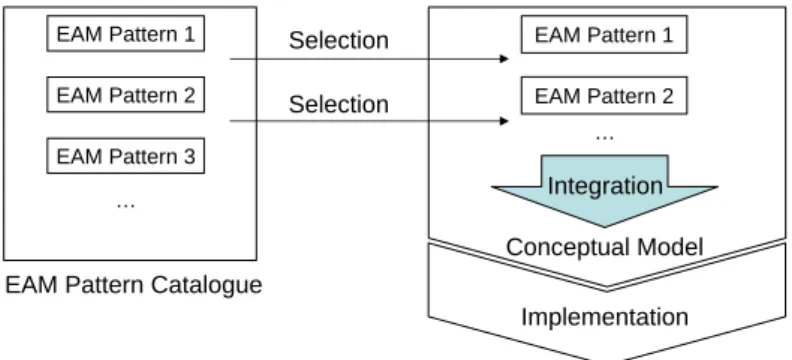
This approach is the same as the generalized process on how to implement an EA management approach based on EAM patterns shown in Figure 2.1.
One or more catalogs of EAM patterns, supplied bypattern designers, serve as a basis. From these catalogs, the developers for EA management support choose EAM patterns, that are perceived as adequate for addressing specific concerns of the respective organization, preferably under participation of the prospective users.
After integrating EAM patterns, thereby creating a coherent organization-specific conceptual model, the respective concepts can be implemented, e.g. in an EA management tool or a suite of tools. This procedure offers the possibility to incrementally implement an EA management approach, starting
EAM Pattern Catalogue EAM Pattern 1 EAM Pattern 2 EAM Pattern 3 EAM Pattern 1 EAM Pattern 2 Selection Selection Integration Conceptual Model Implementation … …
Figure 2.1: Implementing an EA management approach based on EAM pattern
with an initial set of M-Patterns, V-Patterns, and I-Patterns, which on the one hand includes rationale for the decisions made, e.g. why certain elements of the information model have been selected and on the other hand can later be extended, when a higher maturity level has been reached. In this case the EAM pattern graph (see Figure 1.2) can be used to e.g. identify EAM patterns, which easily fit into the already selected EAM patterns due to being closely related.
For example, it can be possible to create additional visualizations using the information already col-lected. In this case the I-Patterns, which are already in use have to be determined and then further V-Patterns have to be found, which use the same information model fragments.
The same is true for M-Patterns, as they use V-Patterns. Therefore, it may be possible that V-Patterns, which are already in use, can be utilized to address additional concerns with M-Patterns.
2.2
Inspiring and Assessing an already implemented
EA Management approach
The second usage scenario for theEAM Pattern Catalogis to take it as a reference book for suggestions concerning the approach currently selected in a company. This offers the possibility to compare the own EA management approach with best practices in use elsewhere. The EAM Pattern Catalog can e.g. be used to look for typical concerns, which occur in other companies. This case may best be addressed by simply flipping through the EAM Pattern Catalog.
Additionally theEAM Pattern Catalog can suggest visualizations that can be found in academia and practice, which may be helpful in the currently selected EA management approach.
In this cases the EAM pattern graph (see Figure 1.2) can be used to find on the one hand M-Patterns to address the concerns and on the other hand to find I-Pattern, showing the information needed to be able to create the required visualizations.
2.3
EAM Pattern Catalog
as a basis for academic research
In addition to the application of theEAM Pattern Catalog in practice, it may also be seen as a basis for future academic research. Currently, there is no common ground for research on EA management, meaning that there is no approach for EA management, which may be iteratively enhanced and extended. There are punctiform approaches for specific EA management topics, but these lack the integration into a holistic EA management approach, and the acceptance in wider communities.
The pattern based approach addresses this deficiency as it offers the possibility to improve single EAM patterns without having to create a completely new approach. Furthermore, the existingEAM Pattern
Catalogcan easily be extended due to the openness of the pattern approach.
Therefore, we are establishing a community, which will govern the future development, by e.g. per-forming reviews, improvement, extension, etc., of theEAM Pattern Catalog.
2.4
Integrating EAM Patterns
Integrating the selected EAM patterns is an important aspect of using the EAM Pattern Catalog. Special attention has to be paid to potential conflicts, inconsistencies, or discrepancies, due to contra-dictory assumptions made by different EAM patterns, especially when using EAM patterns of different origins1.
Such diverging assumptions may be completely valid for the EAM patterns themselves, e.g. due to them being based on different theories, being designed for different environments, or addressing different concerns. However, when simultaneously contained in a specific approach to EA management, diverging assumptions may easily turn out to be damaging or depriving results coming from the approach of their validity. This motivates the need to carefully manage such discrepancies in integrating EAM patterns, preferably avoiding them altogether. Thus, the below elaborations on integrating EAM patterns pay special attention to this issue.
2.4.1
Integrating M-Patterns
Selecting and integrating M-Pattern defines, how a specific set of methodologies interact in order to address a given set of concerns.
This can be achieved via aprocess model, which provides the steps to be taken in EA management. Therein, it exhibits, according to [Kro93], a basic characteristic of a method itself. Integrating M-Pattern can rely both on general research in the field of process models, from systems [Kro93] or software engineering [Som04], and also specific process models for EA management, which are part of some EA management frameworks, e.g. TOGAF ADM [Gro03].
Basically, different reasons can lead to a methodology relying on specific assumptions:
• An M-Pattern may have been tested under specific conditions, other conditions can be known to be detrimental to the M-Pattern. An example may be factors known to benefit or impede effective knowledge management [DDLB98].
• An M-Pattern may be directly built on a specific (scientific) theory, which is valid under certain assumptions [SBK07]. These assumptions then also have to hold for the M-Pattern to be applicable.
In order to be able to effectively integrate EAM patterns, these assumptions have to be documented with the respective pattern. This is necessary to enable a pattern integrator managing inconsistencies when integrating M-Patterns. If e.g. one M-Pattern relies on information passing a formal review and publication process, while another M-Pattern wants to subject this information to wiki-style evolution, it has to be thoroughly checked whether and how these M-Pattern can be used together.
1Integrating the EAM patterns shipped with this catalog should be a minor problem, as the EAM patterns are developed relying on a common terminology in order to fit to each other.
2.4.2
Integrating V-Patterns
Integrating V-Pattern may appear as the easiest integration task, as viewpoints are, according to the IEEE 1471 [IEE00], supposed to be relatively self-contained. They are demanded to be able to address one or more concerns on their own, without demanding information from other viewpoints.
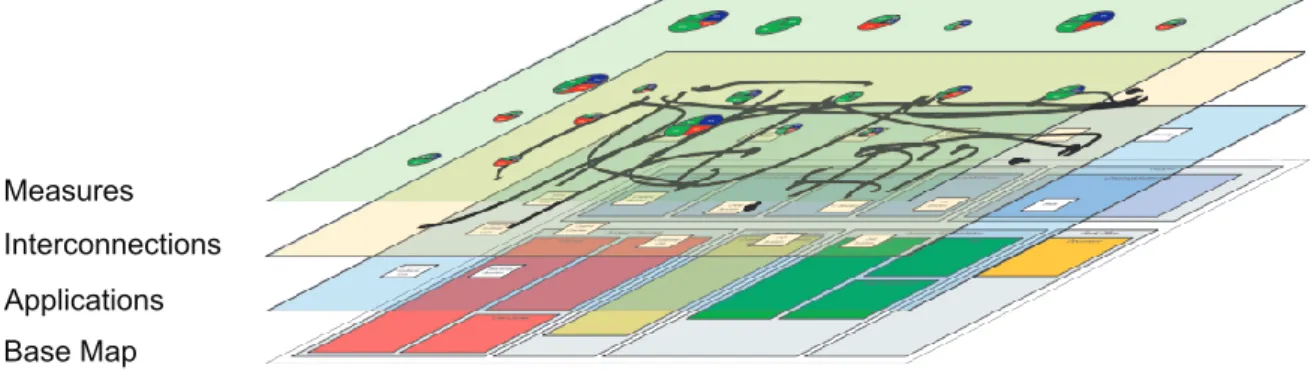
Adopting the idea of patterns to viewpoints offers the advantage to easily add layers to viewpoints. It is then possible to e.g. visualize applications on one layer and different key performance indicators on additional layers. This is the basis for the so calledlayering principle2, which is borrowed from cartography (see Figure 2.2 for an example).
Base Map Applications Interconnections Measures
Figure 2.2: Layering principle
2.4.3
Integrating I-Patterns
As described in [BEL+07b], integrating I-Patterns strongly relies on the integrator’s skills in con-ceptual modeling. It may e.g. be possible to identify identical classes within two I-Patterns to be integrated. However, identifying identical classes may not be as easy as it possibly seems at first sight, e.g. by identifying similar class names. Although EAM pattern designers should simplify pattern integration by naming different concepts clearly differently, also across different EAM patterns, this cannot basically be expected, especially, if patterns from various catalogs with distinct authors are to be integrated3.
Issues in this respect may originate from the simplifications inherent in the creation of models [Sta73], which may of course vary in different abstractions underlying different I-Patterns. A prominent ex-ample in this respect can be found in common abstractions of abusiness application. In some cases, a business application signifies a system installed in a specific environment, offering specific function-alities. In other cases, the term might specify the software itself, making no statements about specific installations. Usage of the term might also vary in respect to the versioning information used. While, as stated above, sensible naming schemes, e.g. BusinessApplication,
DeployedBusinessApplica-tion,BusinessApplicationVersion, are able to contribute to the prevention of such problems, one must
not rely on this alone. Exact definitions of the used concepts have to be provided by the pattern de-signers, in order to enable the user to find possibly contradictory definitions of concepts. Furthermore,
2See [ELSW06] for more details on the layering principle. 3
During the creation of thisEAM Pattern Catalog version, the distinction between different concepts with different names has been taken into account. Nevertheless, there are some concepts, like e.g. Service and Business Service where this distinction may be improved in one of the next releases of the EAM Pattern Catalog. Another improvement may be the introduction of abstract concepts, like a service, which may than be further detailed in a kind of inheritance relationship.
these definitions have to be used by the pattern integrators, checking them carefully to avoid possible inconsistencies in the resulting information model.
2.5
How to Read the EAM Pattern Graph
Two different kinds of EAM pattern graphs are included in thisEAM Pattern Catalog. An overview of all included EAM patterns, together with the addressed concerns (see Figure 1.2), and a subgraph for each M-Pattern and V-Pattern, showing the relationships of one EAM pattern to related EAM patterns4.
The complete EAM pattern graph has been simplified to improve readability, it e.g. does not include differentiations between different types of edges, but solely the relationships between the different EAM patterns. Additionally, concerns and M-Patterns have been clustered according to the structure introduced in Section 1.2.
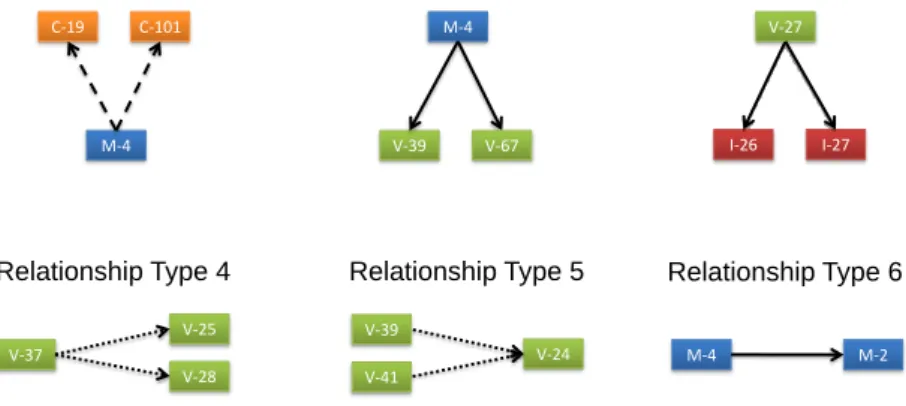
Contrastingly, the subgraphs are more detailed, as the semantics of the different edges are emphasized. Figure 2.3 shows the different kinds of relationships used in the subgraphs. The following description explains the different relationship types:
Relationship Type 1 The concerns C-19 and C-101 are addresses by M-Pattern M-4.
Relationship Type 2 M-Pattern M-4 uses V-Patterns V-39 and V-67.
Relationship Type 3 V-Pattern V-27visualizes information of I-Patterns I-26 and I-27.
Relationship Type 4 V-Pattern V-37 is a layer and can alternatively be used on V-Patterns V-25 and V-28.
Relationship Type 5 V-Pattern V-24constitutes a base map for V-Patterns V-39 and V-41.
Relationship Type 6 M-Pattern M-4 uses results of M-Pattern M-2.
Relationship Type 1 M-4 C-19 C-101 M-4 V-67 V-39 Relationship Type 2 I-26 V-27 I-27 Relationship Type 3 V-37 V-25 V-28 V-24 V-41 V-39 M-2 M-4
Relationship Type 4 Relationship Type 5 Relationship Type 6
Figure 2.3: Types of relationships between EAM patterns
4Future versions of this EAM Pattern Catalog may also include subgraphs for each Pattern, as the I-Pattern may obtain more references to other I-I-Patterns.
Concerns
This chapter contains a listing of all concerns, which are considered in theEAM Pattern Catalog. The concerns are ordered according to their identifier. For each concern a list of M-Pattern addressing the concern is given.
For allowing easier access to the concerns listed below, Figure 3.1 shows the concerns grouped according to the EA management topics introduced in Figure 1.1.
Interface, Business Object, and Service Management Infrastructure Management
Project Portfolio Management Support of Business Processes Application Landscape Planning Business Processes Technology Homogeneity
Complex Concern
C-2 C-50 C-101 C-19 C-46 C-100 C-54 C-55 C-56 C-33 C-86 C-87 C-34 C-35 C-88 C-36 C-89 C-90 C-44 C-78 C-80 C-95 C-91 C-92 C-29 C-98 C-41 C-52 C-61 C-51 C-62 C-64 C-65 C-66 C-67 C-68 C-70 C-71 C-99 C-4 C-5 C-8 C-93.1
Concern C-2
C-2: Where are architectural blueprints or architectural standards used, and are there areas where those standards are breached?
Addressed by: M-2 (see page 40), M-4 (see page 44)
3.2
Concern C-4
C-4: Which technologies, e.g. programming languages, middleware, operating systems, database management systems, used in the application landscape should be replaced, which ones should be kept?
Addressed by: M-3 (see page 48)
3.3
Concern C-5
C-5: Which activities or projects have to be started, in order to increase conformance to standards? What has to be done in order to modify the current business applications to increase their conformance to standards and reduce heterogeneity?
Addressed by: M-3 (see page 48), M-4 (see page 44)
3.4
Concern C-8
C-8: The goal is to reduce the usage of individual software, by replacing such systems with standard software. The concern is aimed at outlining project proposals for replacing individual software, which can then be evaluated in respect to their feasibility and benefit.
Addressed by: M-3 (see page 48)
3.5
Concern C-9
C-9: Possibilities to reorganize the application landscape in respect to the used technologies should be outlined. Thereby, possible goals are: Reducing licensing costs, reducing maintenance costs, taking into account the support periods of the technology products, etc.
Addressed by: M-3 (see page 48)
3.6
Concern C-19
C-19: Do the business applications currently used correspond to the architectural blueprints and architectural solutions (architectural standards)? If not, are there documented reasons for this, as e.g. strategic decisions?
3.7
Concern C-29
C-29: At the beginning of a planning period the available IT budget has to be assigned to project proposals. Project proposals that will be approved have to be selected, others have to be rejected or delayed.
Addressed by: M-26 (see page 82)
3.8
Concern C-33
C-33: Which applications are used by which organizational units?
Addressed by: M-13 (see page 61)
3.9
Concern C-34
C-34: How does the long-term vision, the target of the application landscape, look like?
Addressed by: M-14 (see page 64)
3.10
Concern C-35
C-35: How does the application landscape look like at a specific date?
Addressed by: M-14 (see page 64)
3.11
Concern C-36
C-36: Which dependencies exist between business applications and are affected by current or planned projects? Which projects change the same business application? Are there changes on a business application that must be finalized before changes made by another project can be performed?
Addressed by: M-15 (see page 66)
3.12
Concern C-41
C-41: Which infrastructure software is used by the business applications?
Addressed by: M-34 (see page 87), M-1 (see page 64)
3.13
Concern C-44
C-44: How can the operating expenses and maintenance costs be reduced, e.g. by identification of business applications providing the same functionality (redundancy)?
Addressed by: M-18 (see page 69)
3.14
Concern C-46
C-46: Which knowledge about specific subjects, e.g. technologies, or programming languages, is currently available in the organization?
Addressed by: M-5 (see page 54)
3.15
Concern C-50
C-50: How is an architectural blueprint / architectural solution made up?
Addressed by: M-2 (see page 40)
3.16
Concern C-51
C-51: Which business objects are used or exchanged by which business applications or services?
Addressed by: M-19 (see page 89)
3.17
Concern C-52
C-52: What are the dependencies between the used business objects?
Addressed by: M-19 (see page 89)
3.18
Concern C-54
C-54: Do the business processes adequately consider the environment of the organization, like incom-ing events, as e.g. customer requests?
Addressed by: M-6 (see page 57)
3.19
Concern C-55
C-55: Which business processes, if any, are suitable candidates for being outsourced?
Addressed by: M-6 (see page 57)
3.20
Concern C-56
Addressed by: M-6 (see page 57)
3.21
Concern C-61
C-61: Which business objects are exchanged over which interfaces?
Addressed by: M-19 (see page 89)
3.22
Concern C-62
C-62: What are the domains of the application landscape?
Addressed by: M-20 (see page 91)
3.23
Concern C-64
C-64: How to find services within the development process of the application landscape?
Addressed by: M-20 (see page 91)
3.24
Concern C-65
C-65: Which services are offered by which business application?
Addressed by: M-20 (see page 91)
3.25
Concern C-66
C-66: Which business processes are supported by which services?
Addressed by: M-20 (see page 91)
3.26
Concern C-67
C-67: Which interfaces are offered/used by which business application?
Addressed by: M-21 (see page 93)
3.27
Concern C-68
C-68: What is the type, e.g. online, offline, batch, etc. of a specific interface? How is the interface implemented? What are its capabilities?
3.28
Concern C-70
C-70: Which business applications are affected by the shut-down of an interface?
Addressed by: M-21 (see page 93)
3.29
Concern C-71
C-71: How does the lifecycle of a service look like?
Addressed by: M-22 (see page 96)
3.30
Concern C-78
C-78: To which extent are the business processes supported by business applications? Which business processes are supported manually? Can the automated support be extended?
Addressed by: M-29 (see page 71), M-30 (see page 74)
3.31
Concern C-80
C-80: To which extend does the IT support the flexibility of the business processes? Where is the flexibility put at risk?
Addressed by: M-18 (see page 69), M-29 (see page 71), M-30 (see page 74)
3.32
Concern C-86
C-86: Which business applications are hosted by which organizational unit?
Addressed by: M-13 (see page 61)
3.33
Concern C-87
C-87: Which business processes are supported by which business application?
Addressed by: M-13 (see page 61)
3.34
Concern C-88
C-88: How will the application landscape evolve over time in order to support the strategies defined? What are the differences to the current landscape?
3.35
Concern C-89
C-89: Which business applications will be affected by projects in the near future?
Addressed by: M-15 (see page 66)
3.36
Concern C-90
C-90: In which phase of its lifecycle is a business application at a certain point in time?
Addressed by: M-15 (see page 66)
3.37
Concern C-91
C-91: The activities modifying the application landscape should be aligned to the needs, which have been specified by the defined strategies. Thereby, financial aspects and necessities dictated by the environment of the organization, e.g. via laws, regulations, etc. should be considered.
Addressed by: M-24 (see page 76)
3.38
Concern C-92
C-92: Increase the probability of success of challenging projects by selecting them for special project monitoring/consulting by the enterprise architecture management. Identify the projects, which can be expected to profit from such a monitoring.
Addressed by: M-25 (see page 78)
3.39
Concern C-95
C-95: How can a more continuous IT support concerning business processes be realized?
Addressed by: M-29 (see page 71), M-30 (see page 74)
3.40
Concern C-98
C-98: What is the impact of the shut-down of an infrastructure element? What other elements of the application landscape are affected?
Addressed by: M-34 (see page 87)
3.41
Concern C-99
Addressed by: M-21 (see page 93)
3.42
Concern C-100
C-100:Analyze, to what extent individual and standard software is used in the application landscape.
Addressed by: M-10 (see page 52)
3.43
Concern C-101
C-101:Which activities or projects have to be started in order to improve conformance to architectural standards? Which modifications to the currently used business applications are necessary to achieve conformity?
Methodology Patterns (M-Patterns)
This chapter includes all M-Patterns that have been evaluated in theEnterprise Architecture
4.1
Technology Homogeneity
4.1.1
Analysis of Standard Conformity of the Application Landscape (M-2)
M-Pattern Overview
Id M-2
Name Analysis of Standard Conformity of the Application Landscape Alias Analysis of Architectural Standards
Summary This M-Pattern gives an overview, which business applications conform to ar-chitectural standards
Version 1.0
Problem Section
The methodology addresses the following concerns:
• C-2: Where are architectural blueprints or architectural standards used, and are there areas where those standards are breached?
• C-50: How is an architectural blueprint / architectural solution made up?
One of the fundamental problems to be addressed in this context is the growing complexity of the application landscape induced by the uncontrolled increase in used technologies, architectures, plat-forms, etc. Controlling this growth is thereby supposed to increase efficiency in IT operation and development, e.g. due the possibility to focus necessary knowledge on selected technologies, platforms, etc.
Solution Section
M-2
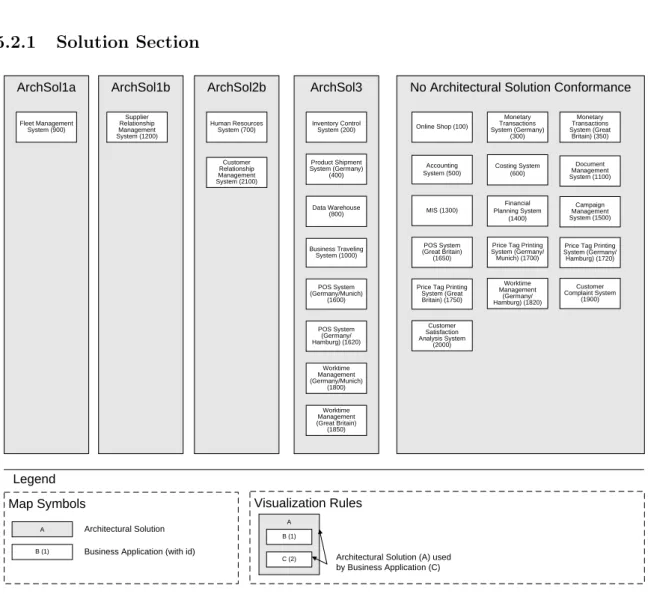
M-2 C-2 C-50 V-6 V-5 V-23 V-66 M-4Architectural solutions and architectural blueprints consider homogeneity not only on the level of a specific kind of technology e.g. programming lan-guages or middleware, but include architectural solutions and consider technologies at the level of standardized technologybundles.
The methodology uses the following viewpoints:
• V-5: Standard Conformity Layerfor C-2
• V-6: Clustering by Standard, for C-2
• V-23: Technologies by Architectural Standardspecifically for C-50
• V-66: Architectural Solution in detail (UML); This viewpoint also addresses
viewpoint nevertheless, as it illustrates the basic concepts behind architectural solutions and architectural blueprints as a way to create architectural standards.
This methodology describes basic steps for creating an overview of which (deployed) business applica-tion uses which architectural soluapplica-tion, and gives hints for analyzing this overview.
• For collecting information, it has to be noted that the employees operating a (deployed) business application might not always be totally aware of the respective application’s architecture. Thus, the respective developers might have to be included into the data collection process. Of course, up-to-date blueprint and solution definitions are a prerequisite for this task (see methodology M-4). Additionally, an understanding about the blueprints should exist with the developers. This could possible require a more detailed overview than provided by V-23.
• The collected information should be verified. Also here different possibilities apply, ranging from automated plausibility checks to manual reviews, which could be tied into visualization creation. If necessary, missing or possibly erroneous information has to be delivered in addition or corrected.
• Creation of the visualizations (e.g. according to V-5 and V-6)
A V-23 - diagram can provide first background information about the existing architectural blueprints and solutions. It can give a first overview of the technologies included in a standard. This allows a first stage of the analysis: The set of standards might be to small (too restrictive) or too big (too permissive).
In analyzing diagrams according to viewpoints V-5 and V-6, the focus is likely to be on the business applications not conforming to the respective architectural standard. On the one hand, such business applications might be looked at specifically, considering e.g.:
• Does it require not to conform with the standard?
• How much are costs thus induced? Who bears these costs?
• Has the wrong standard been prescribed for the application?
On the other hand, analysis can also focus on the totality of the non-conforming business applications, e.g. looking at:
• What do they have in common?
• Are the standards inadequate for important parts of the application landscape?
• Are there organizational units for which there are no means of enforcing the standards? Especially a V-6 - diagram might be helpful in getting an impression of the importance of the different architectural solutions. A standard only existing to serve a small proportion of the business applications might need a special justification.
Consequence Section
The architectural blueprints and solutions need to live asboundary objects1 in the communities of the software architects and the enterprise architects. Only if these two communities interpret the blueprints and solutions in a coherent way, they can be supposed to be an instrument towards a less uncontrolled growth of the technology zoo behind an application landscape.
1
A boundary object is an object which allows members of different communities to build a shared under-standing in respect to certain things. Boundary objects are interpreted differently by the different communities, and realizing and discussing these differences can lead to a shared understanding. [SG89, Str99]
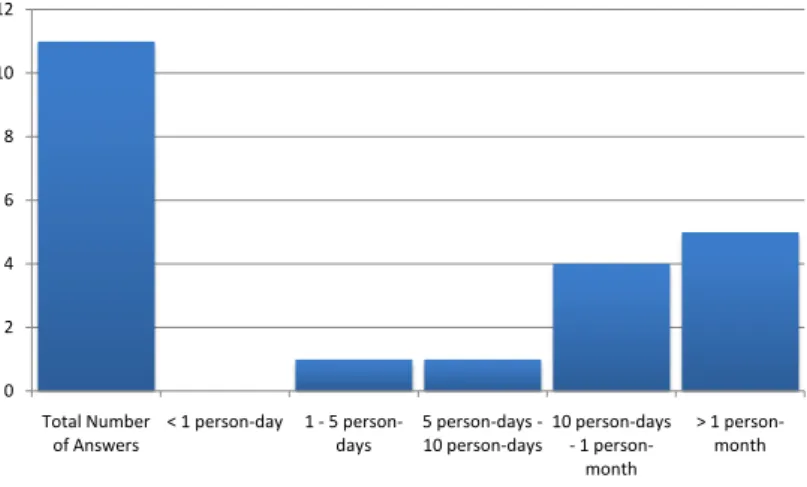
The data collection effort per year for information aboutbusiness applications, architectural solutions,
and assignment of architectural solutions to business applications has been stated by practitioners
using such methodologies as:
0 5 10 15 20 25 Total Number of Answers < 1 person-day 1 - 5 person-days 5 persondays -10 person-days 10 person-days - 1 person-month > 1 person-month
The data collection effort per year for information aboutthe structure of architectural solutions and
its components or technologies has been stated by practitioners using such methodologies as:
0 5 10 15 20 25 30 Total Number of Answers < 1 person-day 1 - 5 person-days 5 persondays -10 person-days 10 person-days - 1 person-month > 1 person-month
4.1.2
Management of Blueprint Conformity of the Application Landscape
(M-4)
M-Pattern Overview
Id M-4
Name Management of Blueprint Conformity of the Application Landscape Alias Management of Architectural Standards
Summary The methodology helps to decide on problems regarding the use of architectural solutions or architectural blueprints. Thereby, the appliance of the methodol-ogy may lead to new guidelines, or roadmaps. It can be based on analyses from M-2.
Version 1.0
Problem Section
The methodology addresses the following concerns:
• C-19: Do the business applications currently used correspond to the architectural blueprints and architectural solutions (architectural standards)? If not, are there documented reasons for this, as e.g. strategic decisions?
• C-101: Which activities or projects have to be started in order to improve conformance to architectural standards? Which modifications to the currently used business applications are necessary to achieve conformity?
Solution Section
M-4
M-4 V-67 V-39 C-19 C-101 M-2This methodology is based on methodology M-2. It is supposed to address a high inhomogeneity regarding used software architectures and tech-nologies in an application landscape (e.g. found via M-2), which can arise due to uncontrolled de-velopment or evolution of business applications. The methodology addresses such an uncontrolled evolution by setting architectural standards, i.e. developing a set of architectural blueprints and architectural solutions, and assigning them to the business applications. Architectural blueprints and solutions are thereby defined as introduced in M-2. After architectural standards have been
set, activities and projects for improving conformance to the standards can be derived, which can then enter project portfolio management as proposals.
Subsequently, three aspects of the methodology are described: Firstly, creating architectural standards, then, setting standards for specific business applications or subsets of the application landscape, and finally, enforcing them.
The methodology uses the following viewpoints:
• V-39: Effects of a Project Proposal on the Application Landscape (detail)
• V-67: Standard Conformity Exceptions
Setting Standards: Creating Architectural Blueprints and Architectural Solutions:Before setting specific standards, it is necessary to decide, what these standards should encompass. Possibil-ities here are e.g.:
1. Which components (deployed and running sub-systems) a business application may consists of, and how these may communicate (connectors)
2. The infrastructure software, on which the components rely on 3. The hardware running the components
4. Development environments used for developing the respective software
The EAMVS online survey found that the first two items are most important to practitioners.2 Thereby, the first and the second item can be addressed by architectural blueprints and solutions, as used in M-2. Understood this way, an architectural blueprint is an exemplary description of a software architecture in the component-and-connector viewtype according to [CBB+02]. This leads to different possible notations fordefining an architectural blueprint:
• We propose V-Pattern V-66, which is based on the respective UML-notation in [CBB+02]. While this V-Pattern has not been selected by the online survey (see A.2), we present it nonetheless, as it constitutes an important component of this M-Pattern, and no equivalent viewpoint has been selected.
• V-Pattern V-78 is an possible alternative to V-66, and was also not been selected by the online survey.
• The architectural description language ACME [GMW97] is another possibility.
However, the description of the exemplary architecture in an architectural blueprint is technology-neutral. The specific technologies are set when an architectural solution is created based on a specific architectural blueprint, which assigns a specific technology to each so calledabstract technology in the architectural solution.
Several aspects may influence, which and how many architectural standards are offered.
• In favour of an additional architectural standard: Projects may choose an architecture and technologies they see most fit for the respective tasks.
• Against an additional architectural standard
– Knowledge about an additional architecture has to be kept available (at least) as long as the respective business applications are operated.
– Available knowledge (from other business applications) might not be reused.
2Ranked by practitioners regarding importance on a 1-5 scale (5 is most important), they received an average rating of 4 or more.
The set of offered standards has to strike a balance between these effects.
Setting standards: Selecting standards for business applications
In term of the concerns addressed by the methodology, setting standards is focused on C-19. We propose addressing this concern using diagrams according to V-67. Such a diagram can indicate, where architectural standards are met, where this is not the case, and where breaching the standard is specifically allowed.
Breaching standards can e.g. be allowed if significant business success is tied to the possibility to have projects outside the respective standards. However, this introduces the issue of who receives the benefits derived from breaching the standard, and who bears the costs induced thereby. This is further discussed in the Consequence Section.
Enforcing Standards: Deriving Measures for increasing Homogeneity
Once standards are set, measures for improving conformance have to be developed and discussed, as described in C-101. Certainly, such measures are described in a detailled, textual way. However, diagrams according to V-39 can give an overview of the changes in the application landscape due to a (specific) proposed measure. A variant of this would display the changes of a set of proposals on one software map.
Deriving measures involves finding the non-conforming business applications (e.g. via analyses as described in M-2). Based on this, the reasons for the business applications non-conforming to the standards can be determined. This sets the ground for deciding, whether a specific business application currently not conforming to its standards has to be changed. Subsequent points might be important in such a discussion:
• Has the wrong standard been set for a business application? In this case, the standard should be changed.
• If there are excessive costs for getting conformant to the standard, an exception could be sensible.
• If the benefit of conforming to the standard cannot be realized in a specific situtaion, this might also be a reason for an exception.
If it is decided that one or more business applications have to be changed, the respecitve proposal has to be created, and can then be entered into project portfolio management.
Consequence Section
It is helpful, if not necessary for the methodology, that architectural solutions are boundary objects
between Enterprise Architects and Software Architects. These two domains need an aligned under-standing of the architectural standards, enabling them to efficiently communicate in using them. If architectural standards are to be beneficial, there has to be an entity having both power and committment to enforce the standards. This entity is then likely to be also in charge of allowing exceptions from the standards. Thereby, it has to address the problem that the benefit and the costs of conforming to blueprints and solutions occur in different places:
• It is likely that the costs for conforming to an architectural standard occur directly with the development team or operators responsible for the respective application (in the short term). Costs can also occur at users, if an conforming business application is less suitable, e.g. due to decreased performance, which is not improvable without a highly specialized architecture.