A
Ad
dvvaan
ncce
ess iin
n tth
he
e iid
de
en
nttiiffiiccaattiio
on
n aan
nd
d aan
naallyyssiiss o
off aalllle
elle
e--ssp
pe
ecciiffiicc e
ex
xp
prre
essssiio
on
n
Christopher G Bell and Stephan Beck
Address: Medical Genomics, University College London Cancer Institute, Huntley Street, London WC1E 6BT, UK. Correspondence: Stephan Beck. Email: [email protected]
A
Ab
bssttrraacctt
Allele-specific expression (ASE) is essential for normal development and many cellular processes but, if impaired, can result in disease. ASE is a feature of organisms with genomes consisting of more than one set of homologous chromosomes. The higher the number of chromosome sets (ploidy) per cell, the higher the potential complexity of ASE. Humans, for instance, are diploid (except germ cells, which are haploid), resulting in multiple possible expression states in time and space for each set of alleles. ASE is invoked and modulated by both genetic and epigenetic changes, affecting the underlying DNA sequence or chromatin of each allele, respectively. Although numerous methods have been developed to assay ASE, they usually require RNA to be available and are dependent upon genetic polymorphisms (such as single nucleotide poly-morphisms (SNPs)) to differentiate between allelic transcripts. The rapid convergence to second-generation sequencing as the method of choice to examine genomic, epigenomic and transcriptomic data enables an integrated and more general approach to define and predict ASE, independent of SNPs. This ‘Omni-Seq’ approach has the potential to advance our understanding of the biology and pathophysiology of ASE-mediated processes by elucidating subtle combina-torial effects, leading to the accurate delineation of sub-phenotypes with consequential benefit for improved insight into disease etiology.
Published: 29 May 2009
Genome Medicine 2009, 11::56 (doi:10.1186/gm56)
The electronic version of this article is the complete one and can be found online at http://genomemedicine.com/content/1/5/56 © 2009 BioMed Central Ltd
A
Alllle
elle
e--ssp
pe
ecciiffiicc e
ex
xp
prre
essssiio
on
n
The interrelationship between the haploid fractions of diploid (or polyploid) genomes and how they control a co-ordinated regulation of gene expression is still poorly understood. This is despite the fact that the contribution of expression variation to phenotypic diversity, adaptive evolution and disease susceptibility is well recognized [1]. It has been challenging, however, to identify the underlying mechanisms. For instance, only a small minority of single nucleotide polymorphisms (SNPs) identified from the recent plethora of genome-wide disease association studies involved protein-coding sequence changes. Most of the disease-associated SNPs were found within non-coding intronic or
intergenic regions from where they are thought to operate on gene expression through cis-acting mechanisms [2].
Here, we will only consider diploidy, which is the situation found in all nucleated, somatic cells in humans, giving rise to five possible expression states for each set of alleles (Table 1). Expression states 1 and 2 refer to the situations where expression is either ‘on’ or ‘off’ for both alleles and, therefore, do not result in allele-specific expression (ASE).
imprinting: this is a parent-of-origin specific action, where either the paternal or maternal allele has complete expression output, either within the entire body, specific tissue/cell types, specific developmental stages or only for a particular isoform [3]. Computational prediction suggests that our current knowledge of imprinted genes is an under-estimate [4]. A second mechanism is X-inactivation, the random assignment and maintenance of a clonal lineage, whereby functional hemizygosity of the homogametic female genome is invoked for dosage critical genes on one X chromosome [5]. The third is an as yet unknown mecha-nism, resulting in wide-spread monoallelic expression of autosomal genes [6]. This involves the apparently stochastic choice of either allele to be expressed and was first recog-nized in a subset of immune and neurological genes, including those encoding odorant, T cell, and natural killer cell receptors, as well as immunoglobulin and interleukin genes. In a subsequent study, almost 10% of the 3,939 genes assessed were found to have one allele switched off [6]. In these cases, and contrary to X–inactivation, ASE was not stable within a clone lineage, as the allele that was expressed could alternate, and the choice of expression was made independently for each gene, not for a chromosome in its entirety. Although genes of diverse functions were involved, those encoding cell-surface proteins were over-represented, as well as those undergoing lineage-specific accelerated evolution. Due to the small sample size, however, some of these genes may in fact display differential rather than monoallelic expression [7].
Finally, expression state 5 refers to differential expression between the two alleles (ASE∆), which, arguably, is the most common ASE state and is discussed in more detail in the next section.
M
Me
etth
ho
od
dss ffo
orr tth
he
e iid
de
en
nttiiffiiccaattiio
on
n o
off aalllle
elle
e--ssp
pe
ecciiffiicc
e
ex
xp
prre
essssiio
on
n
Although the monoallelic mechanism of imprinting was first identified in 1984 [8], quantitative variance in expression of
the two different alleles was only first acknowledged in 2002, in a small study where 6 of only 13 genes investigated showed allelic differences [9]. Since these early studies drew attention to possible cis-regulatory effects causing ASE, additional individual loci were queried by PCR-based methods, such as real-time quantitative PCR or discrimi-nation of PCR products by differing primer extension [10]. However, in order to identify and characterize this variation on a more genome-wide level, PCR techniques were coupled with microarray technology. Initially performed by Lo et al. [11] using an early Affymetrix HuSNP array with approxi-mately 1,000 exonic SNPs in 602 genes, a surprisingly high estimate of >50% of genes showed some ASE pattern and the majority of these were not known to be imprinted.
Thereafter, many further studies have used this approach dependent upon heterozygous SNPs residing within the gene’s coding region and, subsequently, compared ratios of copy DNA (cDNA) from RNA to quantify differences [12,13]. The direct measurement of both alleles within the same system removes the possible confounding influence of trans -acting environmental factors. This can identify plausible imprinted genes, which familial studies can verify. However, they may also be developmental-, time- or tissue-specific [13] or display ASE that will show co-segregation through a pedigree.
Two widely used commercially developed techniques for ASE analysis include the BeadArray platform and the Oligo Pool All (OPA) method (Illumina Inc.). In the BeadArray method, genomic and converted RNA are assessed for the ratio of each allele by primer extension assays with fluores-cence-labeled allele-specific primers. The resolution allows a 1.5-fold ASE change to be detected robustly from experi-mental noise. This method was used by Serre et al. to estimate that approximately 20% of human genes display ASE [14]. The OPA method is based on the Golden Gate assay [15]. By excluding any SNP within within 45 base pairs (bp) of the start or end of exons, in order to ensure that there was an equivalent chance of working between genomic DNA and converted DNA, this method was used to investigate the unrelated 210 individuals within the HapMap population [16]. By exploring the interaction between non-synonymous SNPs and cis-regulatory features, this study estimated ASE to be approximately 18%.
The major issues with these aforementioned techniques are threefold, and various adaptations have been developed to overcome them. Firstly, the influence of bias in PCR amplification in these ASE examinations has been acknow-ledged and a custom ASE array has been developed that removes this possible confounding factor [17]. Secondly, issues of cross-hybridization were also reduced in the custom ASE array study by the use of longer probes (39 to 49 bp) and a new probe design. The use of shorter probes may have also contributed to a possible overestimation of T
Taabbllee 11 P
Poossssiibbllee eexxpprreessssiioonn ssttaatteess ooff aalllleellee sseettss iinn ddiippllooiidd ggeennoommee Expression states
Non-ASE ASEi/xi ASE∆
Allele 1 2 3 4 5
A On Off On Off ∆
a On Off Off On ∆
ASE in earlier studies. Probes were designed for the mismatch base to have a balanced Tmon either side, thus placing it at the most thermodynamically disruptive location. Thirdly, the necessity of a SNP to reside within the transcript limits the number of genes for which there are informative haplotypes. However, when multiple SNPs occur, robust results can be elucidated with consistent ratio differences, which is considerably aided if these SNPs are in strong linkage disequilibrium (LD) with each other. Verlaan
et al. [18] have modified their method to investigate un-spliced primary transcripts, thereby including the intronic regions and thus greatly increasing the number of polymorphisms that can be used to delineate allele calls. These results estimated that >10% of genes expressed in a lymphoblastoid cell line exhibited ASE. An alternative approach, independent of the transcription of coding region SNPs, is to use a marker of transcriptional activity (such as phosphorylated RNA polymerase II (Pol II)), as developed in the haploChIP method [19]. By immunoprecipitation of phosphorylated Pol II cross-linked to chromatin, the relative DNA fragment amounts of these protein-DNA interactions are differentiated by the use of any SNP within the location of interest.
E
Ep
piigge
en
ne
ettiiccaallllyy d
drriivve
en
n aalllle
elle
e--ssp
pe
ecciiffiicc e
ex
xp
prre
essssiio
on
n
The significant role of DNA methylation as a common driving factor in ASE has been substantiated by a number of studies, including a recent investigation of a cohort of pediatric patients with acute lymphoblastic leukaemia. In this study, DNA and RNA from both blood and bone marrow were analyzed and 16% were found to display ASE [7]. A direct quantitative correlation between ASE and CpG site methylation was observed within individual samples. The unequal epigenetic state of each haploid genome is clearly a major factor in the asymmetrical expression of the two alleles. Genome-wide methods to investigate the epigenome, including DNA methylation with methylated DNA immuno-precipitation (MeDIP) [20] and chromatin structure with chromatin-dependent immunoprecipitation (ChIP) [21] have enabled a primary view of these features.
The concept of specific epigenetic haplotypes or ‘hepitypes’ that may add additional power to phenotype-related studies was proposed by Murrell et al. [22] and initial support for this concept has come from the work of Kerkel et al. [23]. Although allele-specific methylation of CpG dinucleotides is a characteristic feature of imprinted loci, a genomic exami-nation by methylation-sensitive restriction enzymes and subsequent analysis on microarray revealed regions where adjacent SNPs were influential [23]. The sequence, as opposed to parental origin (as would be expected in im-printed loci), was associated with methylation state in a dozen regions. Thus, a comparison of common haplotypes within linkage disequilibrium blocks of disease-association SNPs for their methylation status may well reveal whether
the epigenetic state of these hepitypes links SNPs with expression and possible phenotype and/or disease suscep-tibility. However, the necessity for functional examination of
cis-regulation in the appropriate tissue has also been highlighted by the observation that in approximately 50% of differing tissues the same haplotype has differing effects [18]. Furthermore, Zhang et al. [24] found that while DNA methylation levels were usually very comparable in different cells, ASE was not, reinforcing the possibility of environ-ment-specific hepitype interactions.
IIn
ntte
eggrraatte
ed
d aap
pp
prro
oaacch
h ffo
orr tth
he
e iid
de
en
nttiiffiiccaattiio
on
n o
off aalllle
elle
e--ssp
pe
ecciiffiicc e
ex
xp
prre
essssiio
on
n
The recent combination and integration of more than one method of investigation has opened a novel route into ASE-related research [25]. Exploring the discriminatory power of different epigenetic states, Wen et al. [25] investigated if ASE (and imprinting) could be analyzed independently of SNPs. For that, they assayed the two parentally derived genomes for DNA methylation using MeDIP and the histone methylation mark H3 lysine-4 dimethylation (H3K4Me2) using ChIP. While DNA methylation (particularly at promo-ters) is associated with heterochromatic and transcrip-tionally inactive regions, the presence of H3K4Me2 is associated with euchromatic and actively transcribed regions of the genome. The authors hypothesized that the regions where DNA methylation and H3K4Me2 co-localized (‘double hits’) should be enriched for ASE due to imprinting (ASEi) if the two marks were to map to separate parental chromo-somes. Using custom tiling arrays enriched for imprinted and non-imprinted genes, respectively, they found that imprinted genes were enriched (more than fivefold) for ‘double hits’, which were frequently located at transcrip-tional start sites near antisense or alternative transcripts. If a third mark, CTCF binding sites (an insulator protein often associated with imprinted genes [26]), was assayed as well, known imprinted genes were enriched (>75-fold) by ‘triple hits’. As expected, the ‘double hits’ (DNA methylation and H3K4Me2) were mapped to opposite alleles.
or large intervening non-coding RNAs, can be analyzed at single base pair resolution and a wide dynamic range of expression.
All these different but complementary techniques (MeDIP-Seq, ChIP-Seq and RNA-Seq) can now be conducted on one sequencing platform, facilitating a coordinated and integrated ‘Omni-Seq’ approach for genomic, epigenomic and expression analyses to be run in parallel. Such combinatorial analyses have the potential and power to delineate subtle modifications that may not be detectable by one technique alone. The challenges for bioinformatics are obviously daunting, with mammoth amounts of data currently being generated using just one method. However, this concern is being tackled and experience tells us that it is not insurmountable [30]. Looking back, solutions were eventually found for the exponential growth of data in the past decade. We predict that such a harmonized approach will be able to tease out the most informative combinatorial causes of ASE and will become the integrated method of biological examination, with as yet unforeseen benefits for human health prediction, prognostication and diagnosis.
C
Co
on
nccllu
ud
diin
ngg rre
em
maarrk
kss aan
nd
d o
ou
uttllo
oo
ok
k
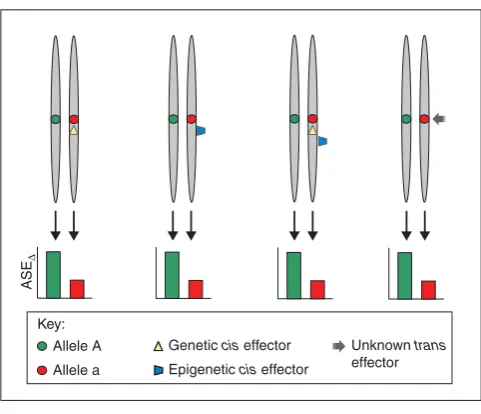
ASE is clearly a common and highly complex phenomenon. Simplistically, ASE and ASE∆in particular, can be invoked by three cis-acting mechanisms (Figure 1): genetically driven, for example, via sequence variation; epigenetically driven, for example, via DNA methylation and/or chromatin modification; or (epi)genetically driven, for example, via
hepitypes. In addition, there is evidence for as yet unknown
trans-acting mechanisms effecting ASE∆. Emerging techno-logies such as ‘4C’ [31], which use chromosome confirmation capture in conjunction with microarrays or second-generation sequencing platforms, increasingly allow the ability to assay the three-dimensional nuclear organization for unbiased interaction of genomic sequences in cisas well as trans.
There can be little doubt that the advances in ASE discussed here will translate into clinical benefits in the not too distant future. In the area of diagnostics, for instance, the exploitation of ASE is already well underway for tumor type classification, evaluation of differential gene expressivity or penetrance in monogenic hereditary conditions and the discovery of currently unknown imprinted genes with res-pect to their roles in developmental syndromes. In addition, ASE can be expected to shed more light on the critical pathophysiology and epistatic factors in complex diseases. The exploitation of ASE for therapeutics may take a little longer, but certainly has tremendous potential, particularly when coupled with targeted RNA-based therapy [32]. In this context, ASE may enable the identification of critical disease-causing haplotypes, epitypes and hepitypes for down-regulation with targeted RNA interference-based therapies.
Thus, accurate delineation of an allele’s genetic and epigenetic state, linked with knowledge of its transcriptional output, will undoubtedly improve our understanding of ASE and its wide-ranging implications for genome biology and medicine.
A
Ab
bb
brre
evviiaattiio
on
nss
ASE, allele specific expression; bp, base pair; ChIP, chromatin dependent immunoprecipitation; H3K4Me2, H3 lysine-4 dimethylation; LD, linkage disequilibrium; MeDIP, methylated DNA immunoprecipitation; OPA, oligo pool all method; Pol II, RNA polymerase II; SNP, single nucleotide polymorphism.
C
Co
om
mp
pe
ettiin
ngg iin
ntte
erre
essttss
The authors declare that they have no competing interests.
A
Au
utth
ho
orrss’’ cco
on
nttrriib
bu
uttiio
on
nss
CB and SB wrote the review jointly.
A
Au
utth
ho
orrss’’ iin
nffo
orrm
maattiio
on
n
CB is a Postdoctoral Researcher and Genetic Pathologist in Professor Beck’s Medical Genomics group at the University College London Cancer Institute, and his research is focused on the Epigenomics of Common Diseases. SB is Professor of F
Fiigguurree 11
Mechanisms capable of invoking differential allele-specific expression (ASE∆):genetically driven by cis-acting polymorphisms; epigenetically driven by cis-acting epigenetic effectors; hepitype driven by a combination of genetic and epigenetic effectors; and driven by as yet unknowntrans effectors.
ASE
∆
Allele A Allele a
Genetic cis effector Epigenetic cis effector
Medical Genomics at University College London and is interested in the genomics and epigenomics of phenotypic plasticity in health and disease [33].
A
Acck
kn
no
ow
wlle
ed
dgge
em
me
en
nttss
CB and SB were supported by the Wellcome Trust.
R
Re
effe
erre
en
ncce
ess
1. Knight JC: AAlllleellee--ssppeecciiffiicc ggeennee eexxpprreessssiioonn uunnccoovveerreedd.. Trends Genet 2004, 2200::113-116.
2. The Wellcome Trust Case Control Consortium: GGeennoommee--wwiiddee aassssoocciiaattiioonn ssttuuddyy ooff 1144,,000000 ccaasseess ooff sseevveenn ccoommmmoonn ddiisseeaasseess aanndd 3
3,,000000 sshhaarreedd ccoonnttrroollss.. Nature 2007, 444477::661-678.
3. Morison IM, Ramsay JP, Spencer HG: AA cceennssuuss ooff mmaammmmaalliiaann iimmpprriinnttiinngg.. Trends Genet 2005, 2211::457-465.
4. Luedi PP, Dietrich FS, Weidman JR, Bosko JM, Jirtle RL, Hartemink AJ: CCoommppuuttaattiioonnaall aanndd eexxppeerriimmeennttaall iiddeennttiiffiiccaattiioonn ooff nnoovveell hhuummaann iimmpprriinntteedd ggeenneess.. Genome Res 2007, 1177::1723-1730.
5. Chow JC, Yen Z, Ziesche SM, Brown CJ: SSiilleenncciinngg ooff tthhee mmaammmmaalliiaann X
X cchhrroommoossoommee.. Annu Rev Genomics Hum Genet 2005, 66::69-92. 6. Gimelbrant A, Hutchinson JN, Thompson BR, Chess A: WWiiddeesspprreeaadd
m
moonnooaalllleelliicc eexxpprreessssiioonn oonn hhuummaann aauuttoossoommeess.. Science 2007, 3
31188::1136-1140.
7. Milani L, Lundmark A, Nordlund J, Kiialainen A, Flaegstad T, Jon-mundsson G, Kanerva J, Schmiegelow K, Gunderson KL, Lonnerholm G, Syvanen AC: AAlllleellee--ssppeecciiffiicc ggeennee eexxpprreessssiioonn ppaatttteerrnnss iinn pprriimmaarryy lleeuukkeemmiicc cceellllss rreevveeaall rreegguullaattiioonn ooff ggeennee eexxpprreessssiioonn bbyy CCppGG ssiittee m
meetthhyyllaattiioonn.. Genome Res 2009, 1199::1-11.
8. McGrath J, Solter D: CCoommpplleettiioonn ooff mmoouussee eemmbbrryyooggeenneessiiss rreeqquuiirreess b
bootthh tthhee mmaatteerrnnaall aanndd ppaatteerrnnaall ggeennoommeess.. Cell 1984, 3377::179-183. 9. Yan H, Yuan W, Velculescu VE, Vogelstein B, Kinzler KW: AAlllleelliicc
vvaarriiaattiioonn iinn hhuummaann ggeennee eexxpprreessssiioonn.. Science 2002, 229977::1143. 10. Bray NJ, Buckland PR, Owen MJ, O’Donovan MC: CCiiss--aaccttiinngg
vvaarriiaa--ttiioonn iinn tthhee eexxpprreessssiioonn ooff aa hhiigghh pprrooppoorrttiioonn ooff ggeenneess iinn hhuummaann bbrraaiinn.. Hum Genet 2003, 111133::149-153.
11. Lo HS, Wang Z, Hu Y, Yang HH, Gere S, Buetow KH, Lee MP: A
Alllleelliicc vvaarriiaattiioonn iinn ggeennee eexxpprreessssiioonn iiss ccoommmmoonn iinn tthhee hhuummaann ggeennoommee.. Genome Res 2003, 1133::1855-1862.
12. Pant PV, Tao H, Beilharz EJ, Ballinger DG, Cox DR, Frazer KA: A
Annaallyyssiiss ooff aalllleelliicc ddiiffffeerreennttiiaall eexxpprreessssiioonn iinn hhuummaann wwhhiittee bblloooodd cceellllss.. Genome Res 2006, 1166::331-339.
13. Pollard KS, Serre D, Wang X, Tao H, Grundberg E, Hudson TJ, Clark AG, Frazer K: AA ggeennoommee--wwiiddee aapppprrooaacchh ttoo iiddeennttiiffyyiinngg nnoovve ell--iimmpprriinntteedd ggeenneess.. Hum Genet 2008, 112222::625-634.
14. Serre D, Gurd S, Ge B, Sladek R, Sinnett D, Harmsen E, Bibikova M, Chudin E, Barker DL, Dickinson T, Fan JB, Hudson TJ: DDiiffffeerreennttiiaall aalllleelliicc eexxpprreessssiioonn iinn tthhee hhuummaann ggeennoommee:: aa rroobbuusstt aapppprrooaacchh ttoo iiddeen n--ttiiffyy ggeenneettiicc aanndd eeppiiggeenneettiicc cciiss--aaccttiinngg mmeecchhaanniissmmss rreegguullaattiinngg ggeennee e
exxpprreessssiioonn.. PLoS Genet 2008, 44::e1000006.
15. Fan JB, Chee MS, Gunderson KL: HHiigghhllyy ppaarraalllleell ggeennoommiicc aassssaayyss.. Nat Rev Genet 2006, 77::632-644.
16. Dimas AS, Stranger BE, Beazley C, Finn RD, Ingle CE, Forrest MS, Ritchie ME, Deloukas P, Tavare S, Dermitzakis ET: MMooddiiffiieerr eeffffeeccttss b
beettwweeeenn rreegguullaattoorryy aanndd pprrootteeiinn--ccooddiinngg vvaarriiaattiioonn.. PLoS Genet 2008, 4
4::e1000244.
17. Bjornsson HT, Albert TJ, Ladd-Acosta CM, Green RD, Rongione MA, Middle CM, Irizarry RA, Broman KW, Feinberg AP: SSNNPP--ssppeecciiffiicc aarrrraayy--bbaasseedd aalllleellee--ssppeecciiffiicc eexxpprreessssiioonn aannaallyyssiiss.. Genome Res 2008, 1
188::771-779.
18. Verlaan DJ, Ge B, Grundberg E, Hoberman R, Lam KC, Koka V, Dias J, Gurd S, Martin NW, Mallmin H, Nilsson O, Harmsen E, Dewar K, Kwan T, Pastinen T: TTaarrggeetteedd ssccrreeeenniinngg ooff cciiss--rreegguullaattoorryy vvaarriiaattiioonn iinn h
huummaann hhaapplloottyyppeess.. Genome Res 2009, 1199::118-127.
19. Knight JC, Keating BJ, Rockett KA, Kwiatkowski DP: IInn vviivvoo cch haarraacc--tteerriizzaattiioonn ooff rreegguullaattoorryy ppoollyymmoorrpphhiissmmss bbyy aalllleellee--ssppeecciiffiicc qquuaan nttiiffiiccaa--ttiioonn ooff RRNNAA ppoollyymmeerraassee llooaaddiinngg.. Nat Genet 2003, 3333::469-475. 20. Weber M, Davies JJ, Wittig D, Oakeley EJ, Haase M, Lam WL,
Schubeler D: CChhrroommoossoommee--wwiiddee aanndd pprroommootteerr--ssppeecciiffiicc aannaallyysseess iiddeennttiiffyy ssiitteess ooff ddiiffffeerreennttiiaall DDNNAA mmeetthhyyllaattiioonn iinn nnoorrmmaall aanndd ttrraan nss--ffoorrmmeedd hhuummaann cceellllss.. Nat Genet 2005, 3377::853-862.
21. Ren B, Robert F, Wyrick JJ, Aparicio O, Jennings EG, Simon I, Zeitlinger J, Schreiber J, Hannett N, Kanin E, Volkert TL, Wilson CJ,
Bell SP, Young RA: GGeennoommee--wwiiddee llooccaattiioonn aanndd ffuunnccttiioonn ooff DDNNAA b
biinnddiinngg pprrootteeiinnss.. Science 2000, 229900::2306-2309.
22. Murrell A, Rakyan VK, Beck S: FFrroomm ggeennoommee ttoo eeppiiggeennoommee.. Hum Mol Genet 2005, 1144::R3-R10.
23. Kerkel K, Spadola A, Yuan E, Kosek J, Jiang L, Hod E, Li K, Murty VV, Schupf N, Vilain E, Morris M, Haghighi F, Tycko B: GGeennoommiicc ssuurrvveeyyss b
byy mmeetthhyyllaattiioonn--sseennssiittiivvee SSNNPP aannaallyyssiiss iiddeennttiiffyy sseeqquueennccee--ddeeppeennddeenntt aalllleellee--ssppeecciiffiicc DDNNAA mmeetthhyyllaattiioonn.. Nat Genet 2008, 4400::904-908. 24. Zhang Y, Rohde C, Tierling S, Jurkowski TP, Bock C, Santacruz D,
Ragozin S, Reinhardt R, Groth M, Walter J, Jeltsch A: DDNNAA mmeetth hyyllaa--ttiioonn aannaallyyssiiss ooff cchhrroommoossoommee 2211 ggeennee pprroommootteerrss aatt ssiinnggllee bbaassee ppaaiirr aanndd ssiinnggllee aalllleellee rreessoolluuttiioonn.. PLoS Genet 2009, 55::e1000438.
25. Wen B, Wu H, Bjornsson H, Green RD, Irizarry R, Feinberg AP: O
Ovveerrllaappppiinngg eeuucchhrroommaattiinn//hheetteerroocchhrroommaattiinn-- aassssoocciiaatteedd mmaarrkkss aarree e
ennrriicchheedd iinn iimmpprriinntteedd ggeennee rreeggiioonnss aanndd pprreeddiicctt aalllleellee--ssppeecciiffiicc mmood diiffii--ccaattiioonn.. Genome Res 2008, 1188::1806-1813.
26. Kim TH, Abdullaev ZK, Smith AD, Ching KA, Loukinov DI, Green RD, Zhang MQ, Lobanenkov VV, Ren B: AAnnaallyyssiiss ooff tthhee vveerrtteebbrraattee iinnssuullaattoorr pprrootteeiinn CCTTCCFF--bbiinnddiinngg ssiitteess iinn tthhee hhuummaann ggeennoommee.. Cell 2007, 112288::1231-1245.
27. Down TA, Rakyan VK, Turner DJ, Flicek P, Li H, Kulesha E, Graf S, Johnson N, Herrero J, Tomazou EM, Thorne NP, Backdahl L, Her-berth M, Howe KL, Jackson DK, Miretti MM, Marioni JC, Birney E, Hubbard TJ, Durbin R, Tavare S, Beck S: AA BBaayyeessiiaann ddeeccoonnvvoolluuttiioonn ssttrraatteeggyy ffoorr iimmmmuunnoopprreecciippiittaattiioonn--bbaasseedd DDNNAA mmeetthhyylloommee aannaallyyssiiss.. Nat Biotechnol 2008, 2266::779-785.
28. Mikkelsen TS, Ku M, Jaffe DB, Issac B, Lieberman E, Giannoukos G, Alvarez P, Brockman W, Kim TK, Koche RP, Lee W, Mendenhall E, O’Donovan A, Presser A, Russ C, Xie X, Meissner A, Wernig M, Jaenisch R, Nusbaum C, Lander ES, Bernstein BE: GGeennoommee--wwiiddee m
maappss ooff cchhrroommaattiinn ssttaattee iinn pplluurriippootteenntt aanndd lliinneeaaggee--ccoommmmiitttteedd cceellllss.. Nature 2007, 444488::553-560.
29. Wang Z, Gerstein M, Snyder M: RRNNAA--SSeeqq:: aa rreevvoolluuttiioonnaarryy ttooooll ffoorr ttrraannssccrriippttoommiiccss.. Nat Rev Genet 2009, 1100::57-63.
30. Doctorow C: BBiigg ddaattaa:: wweellccoommee ttoo tthhee ppeettaacceennttrree.. Nature 2008, 4
45555::16-21.
31. Ohlsson R, Gondor A: TThhee 44CC tteecchhnniiqquuee:: tthhee ‘‘RRoosseettttaa ssttoonnee’’ ffoorr ggeennoommee bbiioollooggyy iinn 33DD??Curr Opin Cell Biol 2007, 1199::321-325. 32. Wood M, Yin H, McClorey G: MMoodduullaattiinngg tthhee eexxpprreessssiioonn ooff ddiisseeaassee
ggeenneess wwiitthh RRNNAA--bbaasseedd tthheerraappyy..PLoS Genet 2007, 33::e109. 33. MMeeddiiccaall GGeennoommiiccss aatt UUnniivveerrssiittyy CCoolllleeggee LLoonnddoonn