R E S E A R C H
Open Access
Alterations in fecal microbiota composition
by probiotic supplementation in healthy
adults: a systematic review of randomized
controlled trials
Nadja B. Kristensen
*, Thomas Bryrup, Kristine H. Allin, Trine Nielsen, Tue H. Hansen and Oluf Pedersen
Abstract
Background:The effects of probiotic supplementation on fecal microbiota composition in healthy adults have not
been well established. We aimed to provide a systematic review of the potential evidence for an effect of probiotic supplementation on the composition of human fecal microbiota as assessed by high-throughput molecular approaches in randomized controlled trials (RCTs) of healthy adults.
Methods:The survey of peer-reviewed papers was performed on 17 August 2015 by a literature search through
PubMed, SCOPUS, and ISI Web of Science. Additional papers were identified by checking references of relevant papers. Search terms included healthy adult, probiotic, bifidobacterium, lactobacillus, gut microbiota, fecal microbiota, intestinal microbiota, intervention, and (clinical) trial. RCTs of solely probiotic supplementation and placebo in healthy adults that examined alteration in composition of overall fecal microbiota structure assessed by shotgun metagenomic sequencing, 16S ribosomal RNA sequencing, or phylogenetic microarray methods were included. Independent collection and quality assessment of studies were performed by two authors using predefined criteria including methodological quality assessment of reports of the clinical trials based on revised tools from PRISMA/Cochrane and by the Jadad score.
Results:Seven RCTs investigating the effect of probiotic supplementation on fecal microbiota in healthy adults were identified and included in the present systematic review. The quality of the studies was assessed as medium to high. Still, no effects were observed on the fecal microbiota composition in terms ofα-diversity, richness, or evenness in any of the included studies when compared to placebo. Only one study found that probiotic supplementation significantly modified the overall structure of the fecal bacterial community in terms ofβ-diversity when compared to placebo.
Conclusions:This systematic review of the pertinent literature demonstrates a lack of evidence for an impact of probiotics on fecal microbiota composition in healthy adults. Future studies would benefit from pre-specifying the primary outcome and transparently reporting the results including effect sizes, confidence intervals, andPvalues as well as providing a clear distinction of between-group and within-group comparisons.
Background
The human gut microbiota refers to the microbes that reside inside the gut and partake in several functions beneficial to the host including fermentation of other-wise indigestible dietary fibers and other food items [1], synthesis of vitamins and amino acids [2], prevention of pathogen colonization [3], maturation and regulation of
the immune system [4], modulation of gastrointestinal hormone release, and regulation of brain behavior through bidirectional neuronal signaling as part of the gut-brain axis [5]. The development of culture-indpendent, high-throughput molecular techniques has enabled the identification of previously unknown bacterial species, thereby providing novel insights into the compositional diversity and functional capacity of fecal microbiota. As a result, studies have suggested that disorders such as colorectal cancer, rheumatoid arthritis, type 2 diabetes, and obesity are associated with disease-specific dysbiotic * Correspondence:[email protected]
The Novo Nordisk Foundation Center for Basic Metabolic Research, Section of Metabolic Genetics, Faculty of Health and Medical Sciences, University of Copenhagen, Universitetsparken 1, 2nd floor, Copenhagen Ø 2100, Denmark
© 2016 Kristensen et al.Open AccessThis article is distributed under the terms of the Creative Commons Attribution 4.0 International License (http://creativecommons.org/licenses/by/4.0/), which permits unrestricted use, distribution, and reproduction in any medium, provided you give appropriate credit to the original author(s) and the source, provide a link to the Creative Commons license, and indicate if changes were made. The Creative Commons Public Domain Dedication waiver (http://creativecommons.org/publicdomain/zero/1.0/) applies to the data made available in this article, unless otherwise stated.
Kristensenet al. Genome Medicine (2016) 8:52
shifts in fecal microbiota [6–11]. Consequently, in recent years the gut microbiota as a potential modifiable risk fac-tor for disease development has received massive atten-tion. One common approach applied to convey health benefits by way of modifying the gut microbiota has been the use of probiotic supplementation. Probiotics are de-fined as live microorganisms that, when administered in adequate amounts, confer a health benefit on the host in a safe and efficacious manner [12]. Suggested mechanisms by which probiotics may benefit the gut environment and the health of the host include improvement of the intes-tinal barrier function through effects on the epithelium and mucus lining, production of anti-microbial substances, competition with pathogenic bacteria, and regulation of luminal acidity (reviewed in [13, 14]).
The therapeutic effect of probiotic supplementation has been studied in a broad range of diseases, particu-larly in regard to gastrointestinal and metabolic disor-ders where results have supported the potential use of probiotics as therapeutic agents (reviewed in [15, 16]). Common to both sets of disorders is a multitude of readily available, clinically relevant outcome measures (e.g. body mass index, fat mass, insulin resistance, severity of gastro-intestinal symptoms) by which to measure treatment ef-fect. The effect of probiotics in disease-free individuals is, however, not as easily assessed. Interpretation of an effect on the composition of fecal microbiota in healthy indi-viduals may be particularly complicated due to the lack of an internationally accepted consensus definition of a normal or a healthy fecal microbial community [17, 18].
Terms such as ecological stability, idealized compos-ition, or favorable functional profile have been suggested as hallmarks of a healthy gut microbiota [17]. These are all very unspecific concepts and the compositional and functional characteristics of a healthy gut microbial community remain to be defined. Furthermore, an ef-fect of probiotics on the composition of the gut micro-biota is an intermediate outcome only and should be interpreted with caution in regard to implications for the health of the host. Despite these limitations, several probiotic interventions aiming to observe alterations in fecal microbiota composition have been performed in healthy adults [19–28]. Results from these studies have the potential to provide insights into the underlying mechanisms of probiotics and fecal microbiota. Cur-rently, no systematic review has addressed the effects of probiotics on fecal microbiota composition using high-throughput metagenomic methods (i.e. phylogenetic microarrays, 16S ribosomal RNA (rRNA) sequencing, or shotgun metagenomic sequencing) in healthy adults. In the context of a billion dollar market for probiotic supplements [29] with products being marketed, in part, toward healthy individuals by stating effects on gastrointestinal health, alluding to the fecal microbial
community, an overview of the current evidence is warranted.
The objective of the present systematic review was to explore in healthy adults the current evidence for an effect of probiotic supplementation compared to pla-cebo on the composition of human fecal microbiota as assessed by high-throughput molecular approaches in randomized controlled trials (RCTs).
Methods
We undertook a systematic review of the possible effects of probiotic intervention on the composition of fecal microbiota in healthy adults. The available literature was identified and examined as a systematic review and not a meta-analysis due to the heterogeneity of the study designs and methods. The results are reported in accordance with the PRISMA statement guidelines (Preferred Reporting Items for Systematic Reviews and Meta-Analyses) [30]. The study followed ana prioriestablished protocol.
Eligibility criteria
The criteria for eligibility were healthy adults as study population, probiotics and placebo as intervention, alter-ation in composition of fecal microbiota assessed by shotgun metagenomic sequencing, 16S rRNA sequen-cing or phylogenetic microarray methods as the primary outcome, and RCT as the study design with no criteria on study duration. No limits were applied for language or time. Studies not exploiting the randomized con-trolled design and providing only within-group results (i.e. results before and after the intervention in the pro-biotic group only) were not included. Moreover, only studies assessing the overall bacterial ecology were in-cluded. Accordingly, studies investigating survival of the probiotic strains only were considered ineligible. Studies with interventions combining probiotics with other sup-plements (e.g. prebiotics, antibiotics, medications) were excluded. If studies had more than two arms, only the com-parison of probiotics to placebo was considered. Studies examining both healthy and unhealthy participants were excluded.
Information sources, search strategy, and study selection
The identification of papers involved four sequential processes performed by two independent reviewers (NBK and TB). On 17 August 2015, a literature search was conducted through multiple electronic databases (PubMed, SCOPUS, and ISI Web of Science) to capture as many relevant citations as possible. The search phrase used was:
Healthy adult AND (probiotic OR bifidobac* OR lactobac*) AND (gut microbio* OR f*cal microbio* OR intestinal microbio*) AND (clinical trial OR interven-tion OR trial).
In PubMed, “Species” was limited to include only humans and“Article types”was limited to cover“Clinical trial,” “Comparative study,” “Controlled clinical trial,” “Journal article,”and“Randomized controlled trial.”
In ISI Web of Science,“Document types”was limited to contain“Article,” “Clinical trial,” “Other,”and“Abstract.”
In Scopus,“Source type and document type”was limited to comprise “Journals and article,” “Short survey,” and “Erratum.”For“Subject area,” “Agricultural and biological sciences,” “Nursing,” “Pharmacology,” “Toxicology and pharmaceutics,” “Environmental science,” “Veterinary,” “Chemistry,”and“Neuroscience”were excluded.
Full reports were obtained and screened for all titles appearing to meet the inclusion criteria or in case of any uncertainty. References in 31 full-text articles were also assessed for inclusion in the present review. Screening and eligibility assessment by title and ab-stract resulted in 1373 citations (Fig. 1). The assessment
was performed independently in an unblinded standard-ized manner by NBK and TB resulting in seven included studies. Any disagreements between reviewers were re-solved by consensus.
Data collection process
Independent data collection was performed by two authors (NBK and TB). Corresponding authors of the following studies were contacted in order to acquire missing infor-mation on allocation concealment or other measures of risk of bias: Lahti et al., Rampelli et al., Ferrario et al., Bjerg et al., Hanifi et al., and Simon et al. [19, 21–24, 27]. Unpub-lished information about blinding was obtained from Lahti et al., Bjerg et al., and Hanifi et al. [19, 21, 22] and the rea-son for excluding data from three participants from the intervention group (missing fecal samples) was obtained from Hanifi et al. [21].
Fig. 1Flow chartof literature selection process [30]
Data items
Information extracted from each included RCT was: (1) participant characteristics (including age and gender); (2) intervention (including probiotic strain and dosage as well as mode of administration); (3) design (including study design and duration); and (4) outcome measure (including the microbiomics and intervention effect on overall fecal microbiota structure).
Quality assessment
The methodological quality assessment of reports of the clinical trials was performed independently by NBK and TB using a three-item instrument (the Jadad score) that evaluates likelihood of bias in research reports [31]. The three items evaluated by a five-point scale are quality of randomization, quality of blinding, and rea-sons for withdrawal/drop-out (0 = worst, 5 = best). Risk of bias was further assessed regarding concealment of randomization, early termination of trial, blinding of patients, healthcare providers, data collectors and out-come assessors, reporting of drop-out or withdrawal, selective outcome reporting, and other potential biases [32, 33].
Summary measures
Intervention effects on the overall fecal microbiota struc-ture, that is, richness, abundance, evenness,α-diversity or compositional dissimilarity (β-diversity), were the primary measures of treatment effects.
Results Study selection
A total of 1368 citations were identified through the search in PubMed, SCOPUS, and ISI Web of Science and an additional five were identified through checking the references of relevant papers. After the removal of duplicates, 1287 citations were left. NBK and TB screened the initial search results using abstracts and 1256 citations were excluded as irrelevant for one or more of the following reasons: animal study, meta-analysis/review, non-healthy or non-adult participants, no probiotic intervention, or no assessment of fecal micro-biota composition. The full papers of the remaining 31 citations and references therein were assessed to select studies for inclusion using the abovementioned criteria, resulting in the exclusion of 24 studies due to one or a combination of the following reasons: no assessment of fecal microbiota composition, assessment of single-strain survival only, inclusion of healthy participants, non-randomized controlled design, provision of only within-group results, and combined intervention of probiotic with prebiotics or other foods. Following the selection process (Fig. 1), seven studies [19–24, 27] remained (five of which were identified by checking the references
of relevant papers) and were included in the present sys-tematic review.
Study characteristics
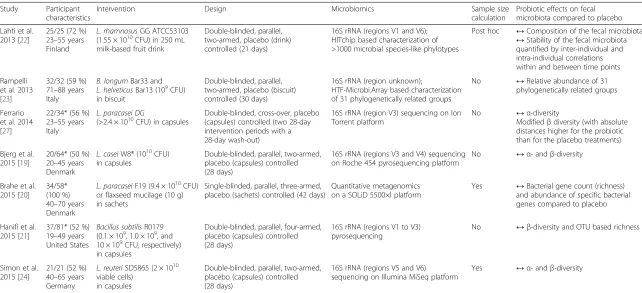
All seven studies were published in English language journals between February 2013 and October 2015 (EPub June 2015). One study was performed in Finland [22], two in Italy [23, 27], two in Denmark [19, 20], one in the United States [21], and one in Germany [24]. An overview of the study characteristics and main results are presented in Table 1. The studies were designed as RCTs, one of which used a cross-over design [27]. Six studies were double-blinded, whereas one was single-blinded [20]. Participants were all healthy adults (range, 19–88 years) with a proportion of female participants in the range of 50–100 %. The total number of included in-dividuals was in the range of 21–81. The intervention received was probiotics belonging to the genus Lactoba-cillus (n = 5) [19, 20, 22, 24, 27], Bifidobacterium and
Lactobacillus combined (n = 1) [23], or Bacillus (n = 1) [21] which was provided in biscuits (n = 1) [23], milk-based drinks (n = 1) [22], sachets (n = 1) [20], or capsules (n = 4) [19, 21, 24, 27] administered at a dose of ~109to 1011 colony-forming units (CFU) for 21–42 days. Three of the studies collected additional samples 1–3 weeks after the intervention had ended [19, 21, 22]. Compli-ance was assessed by pill count or screening for the pro-biotic in fecal microbiota and evaluated as sufficient in most of the studies. However, Rampelli et al. found only a trend towards enrichment of the probiotic strain [23]. Habitual diet was assessed in two studies [20, 27]. In the present review, the primary outcome of interest is alter-ations in fecal microbiota composition, which was assessed by either microarray hybridization (HITchip (n = 1) [22], HTF-Microbi.Array (n = 1) [23]), or next-generation se-quencing methods (16S rRNA sese-quencing on Ion Torrent PGM (n = 1) [27], Illumina MiSeq platforms (n = 1) [24], or 454 pyrosequencing (n = 2) [19, 21]), or metagenomics on a SOLiD 5500×l platform (n = 1) [20]. Of the studies using a 16S rRNA-based approach, one did not report which hypervariable region of the 16S rRNA gene was targeted and no studies targeted the same set of regions. The data-bases used for mapping the sequences were GreenGenes version 13.5 (n = 1) [27], RDP (MultiClassifier 1.1 or not specified) (n = 2) [19, 24], or both (versions not specified) (n = 1) [21], while two did not report the database used. The study by Brahe et al. [20] used metagenomics and mapped reads to a reference catalogue of 3.3 million bac-terial genes [34].
Risk of bias
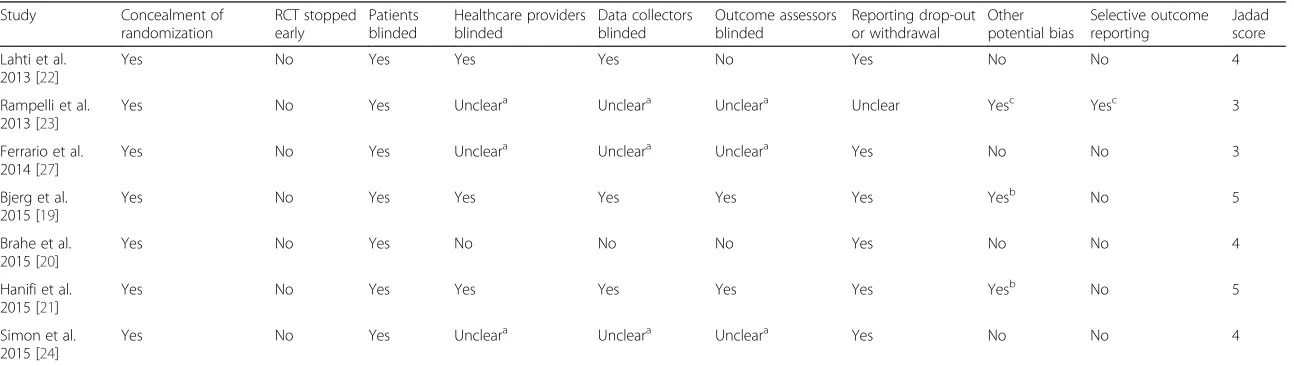
Seven studies were identified and evaluated as medium to high quality by the Jadad score (3–5) as presented in Table 2. The quality of the included studies is generally
Table 1Characteristics of the studies reviewed
Study Participant characteristics
Intervention Design Microbiomics Sample size
calculation
Probiotic effects on fecal microbiota compared to placebo Lahti et al.
2013 [22]
25/25 (72 %) 23–55 years Finland
L. rhamnosusGG ATCC53103 (1.55 × 10¹⁰CFU) in 250 mL
milk-based fruit drink
Double-blinded, parallel, two-armed, placebo (drink) controlled (21 days)
16S rRNA (regions V1 and V6); HITchip based characterization of >1000 microbial species-like phylotypes
Post hoc ↔Composition of the fecal microbiota
↔Stability of the fecal microbiota quantified by inter-individual and intra-individual correlations within and between time points Rampelli
et al. 2013 [23]
32/32 (59 %) 71–88 years Italy
B. longumBar33 and
L. helveticusBar13 (109CFU)
in biscuit
Double-blinded, parallel, two-armed, placebo (biscuit) controlled (30 days)
16S rRNA (region unknown);
HTF-Microbi.Array based characterization of 31 phylogenetically related groups
No ↔Relative abundance of 31 phylogenetically related groups
Ferrario et al. 2014 [27]
22/34* (56 %) 23–55 years Italy
L. paracasei DG
(>2.4 × 10¹⁰CFU) in capsules Double-blinded, cross-over, placebo(capsules) controlled (two 28-day
intervention periods with a 28-day wash-out)
16S rRNA (region V3) sequencing on Ion Torrent platform
No ↔α-diversity
Modifiedβdiversity (with absolute distances higher for the probiotic than for the placebo treatments) Bjerg et al.
2015 [19]
20/64* (50 %) 20–45 years Denmark
L. caseiW8® (1010CFU)
in capsules
Double-blinded, parallel, two-armed, placebo (capsules) controlled (28 days)
16S rRNA (regions V3 and V4) sequencing on Roche 454 pyrosequencing platform
No ↔α- andβ-diversity
Brahe et al. 2015 [20]
34/58* (100 %) 40–70 years Denmark
L. paracaseiF19 (9.4 × 10¹⁰CFU)
or flaxseed mucilage (10 g) in sachets
Single-blinded, parallel, three-armed, placebo (sachets) controlled (42 days)
Quantitative metagenomics on a SOLiD 5500×l platform
Yes ↔Bacterial gene count (richness) and abundance of specific bacterial genes compared to placebo
Hanifi et al. 2015 [21]
37/81* (52 %) 19–49 years United States
Bacillus subtilisR0179 (0.1 × 10⁹, 1.0 × 10⁹, and
10 × 109CFU, respectively) in capsules
Double-blinded, parallel, four-armed, placebo (capsules) controlled (28 days)
16S rRNA (regions V1 to V3) pyrosequencing
No ↔β-diversity and OTU based richness
Simon et al. 2015 [24]
21/21 (52 %) 40–65 years Germany
L. reuteriSD5865 (2 × 10¹⁰
viable cells) in capsules
Double-blinded, parallel, two-armed, placebo (capsules) controlled (28 days)
16S rRNA (regions V5 and V6) sequencing on Illumina MiSeq platform
Yes ↔α- andβ-diversity
Participant characteristics are number of participants with microbiome data/number of participants included in the study. Participant characteristics (% women and age range of participants in years) are based upon number of participants included in the study. CFU, colony-forming units. OTU, operational taxonomic unit.↔indicates no difference between the probiotic group and placebo.↑indicates an increase in the probiotic group compared to placebo.↓indicates a decrease in the probiotic group compared to placebo.Pvalues are unadjusted for multiple testing. *Performed next-generation sequencing on fecal samples from a subgroup of the included individuals. In the study by Ferrario et al., 22 participants (of 34) completed the study. Bjerg et al. selected 10 (of 32) placebo-treated and 10 (of 32) probiotic-treated participants with the highest triacylglycerol concentration in the blood at week 0. The study by Brahe et al. had a third intervention arm not relevant for the present study where the number of participants were approximately two-thirds of the total number of participants included in the study. Hanifi et al. selected 20 (all) placebo-treated and 17 (of 20) probiotic-treated participants from the group with the highest dose (10 × 109
CFU) of the probiotic treatment
Kristensen
et
al.
Genome
Medici
ne
(2016) 8:52
Page
5
of
Table 2Assessment of risk of bias in the studies reviewed
Study Concealment of randomization
RCT stopped early
Patients blinded
Healthcare providers blinded
Data collectors blinded
Outcome assessors blinded
Reporting drop-out or withdrawal
Other potential bias
Selective outcome reporting
Jadad score Lahti et al.
2013 [22]
Yes No Yes Yes Yes No Yes No No 4
Rampelli et al. 2013 [23]
Yes No Yes Uncleara Uncleara Uncleara Unclear Yesc Yesc 3
Ferrario et al. 2014 [27]
Yes No Yes Uncleara Uncleara Uncleara Yes No No 3
Bjerg et al. 2015 [19]
Yes No Yes Yes Yes Yes Yes Yesb No 5
Brahe et al. 2015 [20]
Yes No Yes No No No Yes No No 4
Hanifi et al. 2015 [21]
Yes No Yes Yes Yes Yes Yes Yesb No 5
Simon et al. 2015 [24]
Yes No Yes Uncleara Uncleara Uncleara Yes No No 4
Based on PRISMA (and Cochrane)’s tools for assessing risk of bias. The Jadad score is a three-item instrument that evaluates likelihood of bias in terms of quality of randomization, quality of blinding, and reasons for withdrawal/drop-out. It is compiled of the following quality items from the table: Concealment of randomization, Patients blinded, Healthcare providers blinded, Data collectors blinded, Outcome assessors blinded, and Reporting drop-out or withdrawal
a
Double-blinded study but unclear whether healthcare providers, data collectors, and outcome assessors were all blinded b
Performed next-generation sequencing on fecal samples from a subgroup of the included individuals. Bjerg et al. selected 10 (of 32) placebo-treated and 10 (of 32) probiotic-treated participants with the highest triacylglycerol concentration in the blood at week 0. Hanifi et al. selected 20 (all) placebo-treated and 17 (of 20) probiotic-treated participants from the group with the highest dose (10 × 109colony-forming units) of the probiotic treatment
c
No direct comparison between treatment groups was made for the age-related dysbiosis
Kristensen
et
al.
Genome
Medici
ne
(2016) 8:52
Page
6
of
high in regard to risk of bias and the methods of asses-sing fecal microbiota configuration. However, blinding of healthcare providers, data collectors, and outcome asses-sors were either not performed or unclearly reported in three of the seven included studies, which may have caused performance and detection bias. Two studies only investigated the effect of the probiotic treatment on a subgroup of participants, which is also a potential source of bias.
Results of individual studies
In terms of richness, evenness, or α-diversity measures, no effects were observed on the fecal microbiota com-position in any of the included studies when compared to placebo and only in the study by Ferrario et al. [27] was it found that probiotic treatment significantly modi-fied the compositional dissimilarity (β-diversity).
In the study by Lahti et al. [22], the temporal stability of fecal microbiota, quantified by the correlation of the fecal microbiota profiles among three time points, did not differ between the probiotic (L. rhamnosus GG ATCC53103) and the placebo group.
In the study by Rampelli et al. [23], there was no effect of probiotic supplementation (B. longum Bar33 and L. helveticusBar13) on the relative abundance of 31 phylo-genetically related groups when compared to placebo. In the same study, the effect of probiotic supplementation on age-related dysbiosis was also evaluated. The probiotic intervention reverted an age-related increase ofClostridium clusterXi,C. difficile,C. perfringens,Enterococcus Faecium, andCampylobacterwhen comparing the probiotic and the placebo group to a common reference of eight young, healthy adults; but no direct comparison was made be-tween treatment groups.
In the study by Ferrario et al. [27], the α-diversity re-ported as Chao1 and Shannon coefficients and number of detected genera did not change as a result of the pro-biotic intervention (L. paracaseiDG) when compared to placebo. Yet, the β-diversity between the probiotic and the placebo group was modified with absolute distances significantly higher for the probiotic than for the placebo treatments when assessed by principal coordinate ana-lysis (PCoA) of weighted UniFrac distances. Accordingly, the relative abundance of Proteobacteria (P= 0.006) and Clostridiales genus Coprococcus (P= 0.009) were inc-reased and the Clostridiales genus Blautia (P= 0.036) was decreased in the probiotic group when compared to placebo. Additionally, analyses of predicted functional profiles revealed changes in eight Kyoto Encyclopedia of Genes and Genomes modules related to bacterial path-ways in membrane transport, amino acid metabolism, energy metabolism, and metabolism of cofactors and vita-mins (P< 0.05).
In the study by Bjerg et al. [19], the β-diversity was not affected by the probiotic intervention (L. casei W8®) compared to placebo when assessed by PCoA of species and genus level Operational Taxonomic Unit (OTU) based UniFrac distances. Furthermore, no difference in α-diversity (Chao1 and Shannon index) or species rich-ness was observed between the probiotic and the pla-cebo group.
In the study by Brahe et al. [20], fecal microbiota was assessed by shotgun-sequencing-based metagenomics. The bacterial gene count (richness) did not change within the probiotic group (L. paracaseiF19) compared to placebo. Alterations in the abundance of individual bacterial genes (2493 genes assigned to two metage-nomic species) were observed after the intervention in the probiotic group. However, fewer alterations were ob-served in the intervention group compared to the pla-cebo group (7436 genes assigned to six metagenomic species). Yet, no direct comparison between the groups is explicitly stated.
In the study by Hanifi et al. [21], no difference in com-positional dissimilarity (β-diversity) between the treat-ment groups (Bacillus subtilisR0179 in different doses) and placebo was shown when analyzed using PCoA based on the UniFrac metric. Sequence reads binned to multiple OTUs assigned to the genus Ruminococcus in-creased in the probiotic group (with the highest dose (10 × 109CFU, Table 2) compared to placebo (P< 0.01).
In the study by Simon et al. [24], the overall compos-ition of fecal microbiota was unaffected by probiotic supplementation (L. reuteri SD5865) both in terms of α-(Chao1, Shannon, and Simpson indices) and β- (Bray-Curtis, Morisita-Horn, and weighted UniFrac) diversity.
Discussion
Overall, this systematic review demonstrates that there is no convincing evidence for consistent effects of probiotics on fecal microbiota composition in healthy adults.
No effects were observed on the fecal microbiota com-position in terms ofα-diversity, richness, or evenness in any of the included studies when compared to placebo. Only in the paper by Ferrario et al. [27] was it reported that probiotic supplementation significantly modified the overall structure of the fecal bacterial community in terms of compositional dissimilarity (β-diversity) when compared to placebo.
Study design and reporting of results
Overall, the reporting of the analyses and results was non-transparent and difficult to assess with very few effect sizes, confidence intervals, andP values reported. This is possibly due to the fact that fecal microbiomics is a rela-tively new research area that currently relies heavily on non-parametric statistics and lacks an internationally
accepted standard approach of reporting results. Unfortu-nately, this impedes the comparison of results in the present review. As the only study, Ferrario et al. [27] used a cross-over design, which may not be the ideal design to assess the effects of a probiotic intervention due to the risk of carry-over effects [35]. In the study the probiotic cell count was decreased after the 4-week wash-out period compared with baseline count, suggesting that wash-out was effective. However, a carry-over effect at the outcome level cannot be excluded. Only two studies provided a priorisample size calculations [20, 24], of which two calcu-lated statistical power based on alterations in fecal micro-biota composition [20, 22]. Thus, several of the studies may well have been underpowered, with an inherent risk of unequal distribution of confounding factors. A potential confounder in the studies reviewed is habitual diet. Human studies have revealed that short-term and long-term changes in diet (such as plant-based vs. animal-based, amount of dietary fibers and fat) influence the fecal microbiota composition and function [36–38]. Hence, the enormous inter-individual variation in the dietary intake and its effect on the fecal microbiota may mask the true picture of the impact of a probiotic treatment. Only one of the included studies monitored habitual diet with the aim of accounting for differences in dietary habits, specif-ically considering prebiotic fibers, during the intervention period [27]. A major limitation of most included studies is an unclear, inexplicit statement of the pre-specified pri-mary outcome and delimitation of secondary outcomes. Only one study [24] is explicitly labeled as a pilot trial, reporting a multitude of outcomes, only in part addressing multiple testing. Two studies do not address the issue of multiple testing [23, 27], while others report multiple mary outcomes or make no distinction between pri-mary and secondary outcomes [19–22]. Reporting of the results is generally unclear, with between-group comparisons on primary outcomes intermixed with re-sults on secondary outcomes and within-group
compar-isons of differences between baseline and
post-intervention measures.
Heterogeneity
Although study participants in the included trials were all healthy adults, the demographic makeup varied widely among studies. Rampelli et al. [23] included only elderly individuals, who may respond differently to pro-biotics than young individuals and Brahe et al. [20] in-cluded postmenopausal women only.
Considering that the impact on the fecal microbiota may differ among strains of the same bacterial species [39], despite close phylogenetic relationships, a potential source of heterogeneity is the use of various probiotic agents. Six studies used single-strain interventions with probiotic products belonging to the generaLactobacillus
[19, 20, 22, 24, 27] or Bacillus [21]. One study used a double-strain probiotic mixture of bacteria belonging to the genera Lactobacillus and Bifidobacterium [23]. Whereas the use of different probiotic agents makes it difficult to draw any meta-analytical conclusions, the choice between single-strain and multi-strain interven-tion is probably of less importance. In most cases, inert bacteria are administered and within a few hours are entering a diverse ecosystem where they are numerically a minority. So while additive or synergistic effects might be observed in vitro, the opportunity for metabolically active strains delivered in combination to result in similar effects in vivo may not present itself.
None of the studies included in the present review comment on the rationale behind their choice of dosage. The International Scientific Association for Probiotics and Prebiotics provides a list of dosages ranging from 1 × 10⁸to 1.8 × 10¹²CFU twice daily depending on strain and disease, based on at least one well designed clinical trial showing a beneficial effect for a health promoting or therapeutic outcome [40]. However, the list covers gastrointestinal disorders only and does not address fecal microbiota in healthy participants. In general, different dosages should be assessed to facilitate an interpretation of the dose-response relationship of probiotic consump-tion on relevant outcomes, rather than on safety and via-bility alone. The information provided by such studies would enable the identification of the dosage needed to observe an impact on the relevant outcome and add to the likelihood that an observed association is causal [41]. Hanifi et al. [21] examined and detected oral dose-response relationships, but for tolerance and gastrointes-tinal viability only. As of now, it is impossible to draw any conclusions on the ideal dosage regarding effects on the fecal microbiota composition. Likewise, the optimal duration of intervention remains elusive.
Mode of administration may also contribute to the observed lack of impact on fecal microbiota. Ingested probiotics must survive hostile environments including acidic, protease and bile-salt rich conditions during their passage through the gastrointestinal tract [42, 43]. Cur-rently, screening feces is the only way to assess whether the probiotics have survived through the gastrointestinal tract. Yet, the site of action may be proximal to the colon and it is not necessarily possible to conclude on the degree of colonization or even the amount of bacteria that produce the effect [44]. In contrast to the findings in five of the in-cluded studies, the study by Rampelli et al. [23] showed only a trend towards enrichment of the probiotic strain, perhaps due to the use of biscuits as the mode of adminis-tration, yet, another reason may be low compliance. This may add to the explanation why little effect of probiotics was found in Rampelli et al. [23]. Compliance was evalu-ated as sufficient in the remaining studies [19–22, 24, 27].
Further adding to the heterogeneity between studies is the application of different methods for assessing fecal microbiota. Even though all studies applied high-throughput metagenomics approaches, the resolution and specificity levels varied tremendously and no studies used the same methodological approach. Only one study examined the fecal microbiota by an untargeted metage-nomic approach using shotgun sequencing and thereby providing information on microbial gene and derived functional levels, free of bias introduced by amplification of a specific genomic region as is the case in targeted 16S rRNA sequencing and array-based analyses [45]. Com-positional information can be achieved by mapping the reads to a microbial gene reference catalogue [34], as was done by Brahe et al. [20]. Still, only a fraction of se-quencing reads can be mapped to the existing reference catalogues. The targeted 16S rRNA approach provides information at the taxonomic level in the form of abun-dance and phylogenetic relationship, but the method has pitfalls in PCR amplification steps [46] and cross-platform comparison is not straightforward. Of the included stud-ies, two use 454 pyrosequencing [19, 21], one uses Illu-mina MiSeq [24], another uses Ion Torrent sequencing [27], and two use phylogenetic microarrays [22, 23]. The sequencing platforms differ in costs, coverage, and length of reads with the Illumina platform becoming more widely used [45]. Community profiles from HITChip correlate well with pyrosequencing-based compositions (Pearson correlations at phylum (average r = 0.94), class (0.93), order (0.94) and family levels (0.77)) and the HTF microbe.array has demonstrated good reproducibility by cluster analysis of the phylogenetic fingerprint in samples from the same participant [47, 48]. In general, using phylogenic microarray approaches have the advantages of being cost-efficient for compositional characterization; however cross-hybridization may occur and only taxa that are covered by the reference sequences can be detected [47]. Another well-known source of bias in 16S rRNA-based studies is the targeted hypervariable region of the 16S rRNA gene. The region used for analysis in the in-cluded studies applying 16S rRNA-based methods varies with one study using V1 and V6 [22], one study using V3 [27], one study using V3 and V4 [19], one study using V5 and V6 [24], and one study does not specify [23]. Several studies have examined the effects of region choice when evaluating fecal microbiota composition with no current international consensus [47, 49–51].
Probiotics in health and disease
In a recent systematic review including 29 trials studying
healthy adults with undisturbed microbiota (using
non-high-throughput molecular techniques) only ~20 % showed an effect of probiotic treatment on fecal micro-biota. It is concluded that there is little, if any, evidence of
an effect of probiotic treatment in circumstances where the microbiota is unperturbed by pathophysiological pro-cesses or pharmaceutical treatment (antibiotics or chemo-therapy), either concurrent with or prior to intervention. However, where dysbiosis is present or where the micro-biota is perturbed, there is some evidence for a restorative or protective effect of certain strains of probiotics, both on the fecal microbial community itself, but more import-antly, also on host physiology, e.g. alleviation of gastro-intestinal symptoms [18].
In the case of dysbiotic or perturbed microbial commu-nities, any restorative or protective effect on the micro-biota alone, without any measurable beneficial effect for the host, would predominantly be of academic interest by improving our understanding of the intestinal ecosystem. In the case of undisturbed microbiota, any inference of health benefit from changes to the microbiota alone would be highly speculative without a direct linkage to relevant host phenotypes. Ideally, hard endpoint data would deter-mine the effects of probiotics in healthy individuals, but considering the time perspective of generating such data this may be long in coming. Until such studies are avail-able, any statement on health benefits of probiotic supple-mentation in healthy participants would rely on observed effects on biomarkers or other intermediate outcomes.
Limitations
Limitations of this review include the search terms used to identify relevant papers. In addition to probio*, we specifically searched on bifido* and lacto*, but other search terms such as Bacillusand Saccharomyces could have been relevant. Publication bias is a well-known challenge within the field of systematic reviews and meta-analyses; however, the majority of the studies in-cluded in the present review provide null findings, indi-cating that this concern may be settled to some extent. Language bias cannot be ruled out since our search was exclusively based on English language dominated sources.
Conclusions
Based on our review of the available RCTs, we find there is a lack of evidence to conclude whether or not there is an effect of probiotics on fecal microbiota composition in healthy adults, as assessed by high-throughput mo-lecular techniques. A number of issues blur the conclu-sions that can be drawn from the studies, including small sample sizes with lack of statistical power, low resolution-methods of assessing fecal microbiota com-position, inter-individual variation in susceptibility to-ward the probiotic, use of different probiotic strains either in isolation or in combination, variations in dos-age and administration mode of probiotics, duration of intervention, or variation in the habitual diet of partici-pants. Future research on the impact of probiotics on
fecal microbiota configuration and function should in-volve statistically well-powered RCTs in well-phenotyped individuals. Importantly, future studies would also benefit from pre-specifying the primary outcome and transpar-ently reporting the results including effect sizes, confi-dence intervals, and Pvalues as well as providing a clear distinction of within-group and between-group com-parisons. For the purpose of demonstrating health ben-efits of probiotic supplementation, effects should be demonstrated on relevant host phenotypes, which is non-trivial in healthy participants. Studies with micro-biome features as the primary outcome should be reserved for improving our understanding of biology in general and our insight into microbial interactions in vivo in particular.
Abbreviations
CFU:Colony forming units; OTU: Operational taxonomic unit; PCoA: Principal coordinate analysis; RCT: Randomized controlled trial; rRNA: Ribosomal RNA.
Competing interests
The authors declare that they have no competing interests.
Authors’contributions
NBK performed the literature search, quality assessment of the included studies, and wrote the manuscript. TB performed the literature search and quality assessment of the included studies. KA, TN, THH, and OP supervised the literature search and quality assessment of the included studies and revised the manuscript critically. All authors approved the final manuscript.
Funding
The Novo Nordisk Foundation Center for Basic Metabolic Research is an independent research center at the Faculty of Health and Medical Sciences, University of Copenhagen and is partially funded by an unrestricted grant from the Novo Nordisk Foundation (http://www.metabol.ku.dk). The funders played no role in study design, collection, analysis, interpretation of data, writing of the report, or in the decision to submit the paper for publication.
Received: 15 January 2016 Accepted: 8 April 2016
References
1. Bäckhed F, Ding H, Wang T, Hooper LV, Koh GY, Nagy A, et al. The gut microbiota as an environmental factor that regulates fat storage. P Natl Acad Sci USA. 2004;101(44):15718–23.
2. LeBlanc JG, Milani C, de Giori GS, Sesma F, van Sinderen D, Ventura M. Bacteria as vitamin suppliers to their host: a gut microbiota perspective. Curr Opin Biotechnol. 2013;24(2):160–8.
3. Endt K, Stecher B, Chaffron S, Slack E, Tchitchek N, Benecke A, et al. The microbiota mediates pathogen clearance from the gut lumen after non-typhoidal Salmonella diarrhea. PLoS Pathog. 2010;6(9):e1001097. 4. Round JL, Mazmanian SK. The gut microbiota shapes intestinal immune
responses during health and disease. Nat Rev Immunol. 2009;9(5):313–23. 5. Collins SM, Surette M, Bercik P. The interplay between the intestinal
microbiota and the brain. Nat Rev Microbiol. 2012;10(11):735–42. 6. Feng Q, Liang S, Jia H, Stadlmayr A, Tang L, Lan Z, et al. Gut microbiome
development along the colorectal adenoma-carcinoma sequence. Nat Commun. 2015;6:6528.
7. Yu J, Feng Q, Wong SH, Zhang D, Liang QY, Qin Y, et al. Metagenomic analysis of faecal microbiome as a tool towards targeted non-invasive biomarkers for colorectal cancer. Gut. 2015. doi:10.1136/gutjnl-2015-309800. 8. Zhang X, Zhang D, Jia H, Feng Q, Wang D, Liang D, et al. The oral and gut
microbiomes are perturbed in rheumatoid arthritis and partly normalized after treatment. Nat Med. 2015;21(8):895–905.
9. Le Chatelier E, Nielsen T, Qin J, Prifti E, Hildebrand F, Falony G, et al. Richness of human gut microbiome correlates with metabolic markers. Nature. 2013;500(7464):541–6.
10. Qin J, Li Y, Cai Z, Li S, Zhu J, Zhang F, et al. A metagenome-wide association study of gut microbiota in type 2 diabetes. Nature. 2012; 490(7418):55–60.
11. Forslund K, Hildebrand F, Nielsen T, Falony G, Le Chatelier E, Sunagawa S, et al. Disentangling type 2 diabetes and metformin treatment signatures in the human gut microbiota. Nature. 2015;528(7581):262–6.
12. Hill C, Guarner F, Reid G, Gibson GR, Merenstein DJ, Pot B, et al. Expert consensus document: The International Scientific Association for Probiotics and Prebiotics consensus statement on the scope and appropriate use of the term probiotic. Nat Rev Gastroenterol Hepatol. 2014;11(8):506–14. 13. Gerritsen J, Smidt H, Rijkers GT, de Vos WM. Intestinal microbiota in human
health and disease: the impact of probiotics. Genes Nutr. 2011;6(3):209–40. 14. Rijkers GT, Bengmark S, Enck P, Haller D, Herz U, Kalliomaki M, et al. Guidance
for substantiating the evidence for beneficial effects of probiotics: current status and recommendations for future research. J Nutr. 2010;140(3):671S–6S. 15. Ford AC, Quigley EM, Lacy BE, Lembo AJ, Saito YA, Schiller LR, et al. Efficacy
of prebiotics, probiotics, and synbiotics in irritable bowel syndrome and chronic idiopathic constipation: Systematic review and meta-analysis. Am J Gastroenterol. 2014;109(10):1547–61.
16. Le Barz M, Anhê FF, Varin TV, Desjardins Y, Levy E, Roy D, et al. Probiotics as complementary treatment for metabolic disorders. Diabetes Metab J. 2015; 39(4):291–303.
17. Bäckhed F, Fraser CM, Ringel Y, Sanders ME, Sartor RB, Sherman PM, et al. Defining a healthy human gut microbiome: current concepts, future directions, and clinical applications. Cell Host Microbe. 2012;12(5):611–22. 18. McFarland LV. Use of probiotics to correct dysbiosis of normal microbiota
following disease or disruptive events: a systematic review. BMJ Open. 2014; 4(8):e005047.
19. Bjerg AT, Sørensen MB, Krych L, Hansen LH, Astrup A, Kristensen M, et al. The effect of Lactobacillus paracasei subsp. paracasei L. casei W8® on blood levels of triacylglycerol is independent of colonisation. Benef Microbes. 2015;6(3):263–9.
20. Brahe LK, Le Chatelier E, Prifti E, Pons N, Kennedy S, Blædel T, et al. Dietary modulation of the gut microbiota–a randomised controlled trial in obese postmenopausal women. Br J Nutr. 2015;114(03):406–17.
21. Hanifi A, Culpepper T, Mai V, Anand A, Ford A, Ukhanova M, et al. Evaluation of Bacillus subtilis R0179 on gastrointestinal viability and general wellness: a randomised, double-blind, placebo-controlled trial in healthy adults. Benef microbes. 2014;6(1):19–27.
22. Lahti L, Salonen A, Kekkonen RA, Salojärvi J, Jalanka-Tuovinen J, Palva A, et al. Associations between the human intestinal microbiota, Lactobacillus rhamnosus GG and serum lipids indicated by integrated analysis of high-throughput profiling data. PeerJ. 2013;1:e32.
23. Rampelli S, Candela M, Severgnini M, Biagi E, Turroni S, Roselli M, et al. A probiotics-containing biscuit modulates the intestinal microbiota in the elderly. J Nutr Health Aging. 2013;17(2):166–72.
24. Simon MC, Strassburger K, Nowotny B, Kolb H, Nowotny P, Burkart V, et al. Intake of Lactobacillus reuteri improves incretin and insulin secretion in glucose-tolerant humans: a proof of concept. Diabetes Care. 2015;38(10): 1827–34.
25. McNulty NP, Yatsunenko T, Hsiao A, Faith JJ, Muegge BD, Goodman AL, et al. The impact of a consortium of fermented milk strains on the gut microbiome of gnotobiotic mice and monozygotic twins. Sci Transl Med. 2011;3(106):106ra–106.
26. Zhang J, Wang L, Guo Z, Sun Z, Gesudu Q, Kwok L, et al. 454 pyrosequencing reveals changes in the faecal microbiota of adults consuming Lactobacillus casei Zhang. FEMS Microbiol Ecol. 2014;88(3):612–22.
27. Ferrario C, Taverniti V, Milani C, Fiore W, Laureati M, De Noni I, et al. Modulation of fecal Clostridiales bacteria and butyrate by probiotic intervention with Lactobacillus paracasei DG varies among healthy adults. J Nutr. 2014;144(11): 1787–96.
28. Plaza-Diaz J, Fernandez-Caballero JA, Chueca N, Garcia F, Gomez-Llorente C, Saez-Lara MJ, et al. Pyrosequencing analysis reveals changes in intestinal microbiota of healthy adults who received a daily dose of
immunomodulatory probiotic strains. Nutrients. 2015;7(6):3999–4015. 29. marketsandmarkets.com. Probiotic Ingredients Market by Function (Regular,
Preventative, Therapy), Application (Food & Beverage, Dietary Supplements & Animal Probiotics), Ingredient (Bacteria & Yeast), and by Region - Global Trends & Forecast to 2020. Available at: http://www.marketsandmarkets. com/Market-Reports/probiotic-market-advanced-technologies-and-global-market-69.html (accessed 14 Mar 2016).
30. Moher D, Liberati A, Tetzlaff J, Altman DG. Preferred reporting items for systematic reviews and meta-analyses: the PRISMA statement. Ann Intern Med. 2009;151(4):264–9.
31. Jadad AR, Moore RA, Carroll D, Jenkinson C, Reynolds DJM, Gavaghan DJ, et al. Assessing the quality of reports of randomized clinical trials: is blinding necessary? Control Clin Trials. 1996;17(1):1–12.
32. Liberati A, Altman DG, Tetzlaff J, Mulrow C, Gotzsche PC, Ioannidis JP, et al. The PRISMA statement for reporting systematic reviews and meta-analyses of studies that evaluate health care interventions: explanation and elaboration. PLoS Med. 2009;6(7):e1000100.
33. Higgins JPT, Green S. Cochrane Handbook for Systematic Reviews of Interventions Version 5.1.0 [updated March 2011]. The Cochrane Collaboration; 2011. Available at: http://handbook.cochrane.org/. 34. Qin J, Li R, Raes J, Arumugam M, Burgdorf KS, Manichanh C, et al. A human
gut microbial gene catalogue established by metagenomic sequencing. Nature. 2010;464(7285):59–65.
35. Haller D, Antoine JM, Bengmark S, Enck P, Rijkers GT, Lenoir-Wijnkoop I. Guidance for substantiating the evidence for beneficial effects of probiotics: probiotics in chronic inflammatory bowel disease and the functional disorder irritable bowel syndrome. J Nutr. 2010;140(3):690s–7s. 36. David LA, Maurice CF, Carmody RN, Gootenberg DB, Button JE, Wolfe BE,
et al. Diet rapidly and reproducibly alters the human gut microbiome. Nature. 2014;505(7484):559–63.
37. Shoaie S, Ghaffari P, Kovatcheva-Datchary P, Mardinoglu A, Sen P, Pujos-Guillot E, et al. Quantifying diet-induced metabolic changes of the human gut microbiome. Cell Metab. 2015;22(2):320–31.
38. Zeevi D, Korem T, Zmora N, Israeli D, Rothschild D, Weinberger A, et al. Personalized nutrition by prediction of glycemic responses. Cell. 2015;163(5): 1079–94.
39. Menard O, Butel MJ, Gaboriau-Routhiau V, Waligora-Dupriet AJ. Gnotobiotic mouse immune response induced by Bifidobacterium sp. strains isolated from infants. Appl Environ Microbiol. 2008;74(3):660–6.
40. Guarner F, Khan AG, Garisch J, Eliakim R, Gangl A, Thomson A, et al. World Gastroenterology Organisation Global Guidelines: probiotics and prebiotics October 2011. J Clin Gastroenterol. 2012;46(6):468–81.
41. Hill AB. The Environment and disease: association or causation? Proc R Soc Med. 1965;58:295–300.
42. Cook MT, Tzortzis G, Charalampopoulos D, Khutoryanskiy VV. Microencapsulation of probiotics for gastrointestinal delivery. J Control Release. 2012;162(1):56–67.
43. Charteris WP, Kelly PM, Morelli L, Collins JK. Development and application of an in vitro methodology to determine the transit tolerance of potentially probiotic Lactobacillus and Bifidobacterium species in the upper human gastrointestinal tract. J Appl Microbiol. 1998;84(5):759–68.
44. Farnworth ER. The evidence to support health claims for probiotics. J Nutr. 2008;138(6):1250S–4S.
45. Weinstock GM. Genomic approaches to studying the human microbiota. Nature. 2012;489(7415):250–6.
46. Rastogi G, Sani RK. Molecular techniques to assess microbial community structure, function, and dynamics in the environment. In: Ahmad I, Ahmad F, Pichtel J, Rastogi G, Sani R, editors. Microbes and Microbial Technology. New York: Springer; 2011. p. 29–57.
47. Claesson MJ, O’Sullivan O, Wang Q, Nikkila J, Marchesi JR, Smidt H, et al. Comparative analysis of pyrosequencing and a phylogenetic microarray for exploring microbial community structures in the human distal intestine. PLoS One. 2009;4(8):e6669.
48. Candela M, Consolandi C, Severgnini M, Biagi E, Castiglioni B, Vitali B, et al. High taxonomic level fingerprint of the human intestinal microbiota by ligase detection reaction–universal array approach. BMC Microbiol. 2010;10:116. 49. Mizrahi-Man O, Davenport ER, Gilad Y. Taxonomic classification of bacterial
16S rRNA genes using short sequencing reads: evaluation of effective study designs. PLoS One. 2013;8(1):e53608.
50. Sundquist A, Bigdeli S, Jalili R, Druzin ML, Waller S, Pullen KM, et al. Bacterial flora-typing with targeted, chip-based Pyrosequencing. BMC Microbiol. 2007;7:108.
51. Wang Q, Garrity GM, Tiedje JM, Cole JR. Naive Bayesian classifier for rapid assignment of rRNA sequences into the new bacterial taxonomy. Appl Environ Microbiol. 2007;73(16):5261–7.
• We accept pre-submission inquiries
• Our selector tool helps you to find the most relevant journal
• We provide round the clock customer support
• Convenient online submission
• Thorough peer review
• Inclusion in PubMed and all major indexing services • Maximum visibility for your research
Submit your manuscript at www.biomedcentral.com/submit
![Fig. 1 Flow chart of literature selection process [30]](https://thumb-us.123doks.com/thumbv2/123dok_us/237093.1516945/3.595.60.538.323.698/fig-flow-chart-literature-selection-process.webp)