Open Access
Research
Does codon bias have an evolutionary origin?
Jan C Biro
Address: Homulus Foundation, 612 S Flower St., #1220, Los Angeles, 90017 CA, USA
Email: Jan C Biro - [email protected]
Abstract
Background: There is a 3-fold redundancy in the Genetic Code; most amino acids are encoded by more than one codon. These synonymous codons are not used equally; there is a Codon Usage Bias (CUB). This article will provide novel information about the origin and evolution of this bias.
Results: Codon Usage Bias (CUB, defined here as deviation from equal usage of synonymous codons) was studied in 113 species. The average CUB was 29.3 ± 1.1% (S.E.M, n = 113) of the theoretical maximum and declined progressively with evolution and increasing genome complexity. A Pan-Genomic Codon Usage Frequency (CUF) Table was constructed to describe genome-wide relationships among codons. Significant correlations were found between the number of synonymous codons and (i) the frequency of the respective amino acids (ii) the size of CUB. Numerous, statistically highly significant, internal correlations were found among codons and the nucleic acids they comprise. These strong correlations made it possible to predict missing synonymous codons (wobble bases) reliably from the remaining codons or codon residues.
Conclusion: The results put the concept of "codon bias" into a novel perspective. The internal connectivity of codons indicates that all synonymous codons might be integrated parts of the Genetic Code with equal importance in maintaining its functional integrity.
Background
The genetic code is redundant: 20 amino acids plus start and stop signals are coded by 64 codons. This redundancy increases the resistance of genes to mutation: the third codon letters (wobble bases) can often be interchanged without affecting the primary sequence of the protein product. Nevertheless, wobble base usage is highly con-served in mRNA sequences (there is no or very little indi-vidual or intra-species variation) and, interestingly, some wobble mutations (though they are called silent muta-tions) are known to cause genetic disease with no change in the amino acid sequences [1].
However, the wobble bases are not randomly selected, as they might be if interchangeability were unrestricted.
There is codon bias, i.e. codon usage is not equally distrib-uted between the possible synonyms; some redundant codons are preferentially used. This bias is described in Codon Usage Frequency (CUF) Tables [2].
Many studies confirm the existence of codon bias and sig-nificant correlations have been found between codon bias and various biological parameters such as gene expression level [3-6] gene length [7-9], gene translation initiation signal [10], protein amino acid composition [11], protein structure [12,13], tRNA abundance [14-17], mutation fre-quency and pattern, [18,19] and GC composition [20-23].
These observations may not be universally valid because some statistically significant observations in one species Published: 30 July 2008
Theoretical Biology and Medical Modelling 2008, 5:16 doi:10.1186/1742-4682-5-16
Received: 7 July 2008 Accepted: 30 July 2008
This article is available from: http://www.tbiomed.com/content/5/1/16
© 2008 Biro; licensee BioMed Central Ltd.
are not reproduced in another. However, there is a strong expectation that codon bias, which is obviously well con-served in different species, reflects a general biological function because of the universal nature of the Genetic Code and the structure and function of nucleic acids and proteins.
The aim of this study is to investigate the possible origin of so-called "codon bias", measure it quantitatively and compare it among many species.
Materials and methods
Codon Usage Frequency (CUF) Tables were obtained for 113 different organisms from the Codon Usage Database (NCBI-GenBank, update: November 16, 2006 [24]). The organisms were selected from KEGG (Kyoto Encyclopedia of Genes and Genomes, [25]) and represented a wide vari-ety of species from different evolutionary lines [Addi-tional file 1].
To calculate Codon Usage Bias (CUB) numerically, I assumed that statistically equal usage of all available syn-onymous codons is the neutral "starting point" for the development of species-specific codon usages, and the CUB is the sum of the deviations from such random, equal usage.
The codons (i, 64) were divided into 21 subgroups (j, cor-responding to the 20 amino acids and 1 stop signal). The number of occurrences of a codon was normalized and the frequencies of the codons (CUFij) in each fraction were calculated. The sum of CUFif in a fraction was always treated as 100% so the sum of all fractions was 2100%. ni is the number of synonymous codons in the jth fraction and nj = 64
CUFij is the frequency (%) of the ith codon in the jth frac-tion encoded by ni synonymous codons.
These fractional frequencies were compared to the ran-dom fractional frequencies (rCUFij), defined as the frac-tional frequency that a codon would have if all alternative codons were used randomly and equally.
rCUF(1j) = rCUF(2j) = rCUF(n)j = rCUF(ij) = 100/ni (%)
The sum of rCUF in a fraction is also 100% and in each fraction altogether is 2100%.
CUB is defined as the absolute difference between CUF and
rCUF:-More simply, CUB is the absolute number of fractional frequencies minus the number expected if usage of synon-ymous codons was uniform.
CUB may be used in some cases with its +/- orientation indicated. In these cases, positive values indicate over-uti-lization of a codon (e.g. dominant codons) while negative values indicate under-utilization (suppression).
CUBmin = 0 if CUFij = rCUFij and the Calculated Maximal Possible CUBmax is 2416.7%. This is the value when only one of all the possible synonymous codons is used (100% frequency) for every amino acid and for the stop signal.
Further explanation of the CUB calculation is given in [Additional file 2], together with an example. CUFij (%) is not to be confused with a "regular" codon frequency (CUFi), which indicates the frequency of a codon in the entire genome (all 21 fractions) and is usually given in the CUF Tables in #/1000 units.
The definition of CUB in this article is not directly compa-rable to other widely used definitions such as CUI.
Results
Quantitative evaluation of codon bias
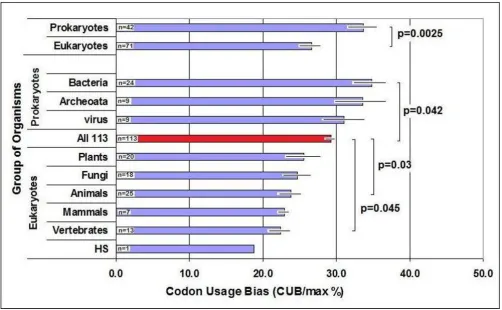
CUB = 0% when all available synonymous codons are equally used. The maximal calculated bias, CUBmax = 100%, indicates that only one codon is used for each amino acid (and for the stop signal), while the remaining 43 codons are not used at all. I calculated CUB in 113 spe-cies and found that the average value is 29.3 +/- 1.1% (S.E.M, n = 113). There seems to be a modest but signifi-cant decrease in the bias during evolution: bacteria and archeoata have the highest bias while vertebrates have the lowest. Eukaryotes have significantly lower CUB than prokaryotes. Humans have the lowest value (18.9%) (Fig-ure 1).
There is a slight negative correlation between the size of the codon- and gene-pool of an organism and its CUB (p < 0.01, n = 113, not shown). The size and complexity of both genome and proteome increase with evolution, while the CUB decreases. A larger codon pool seems to utilize more codon variation, which leads to lower differ-ences between the usage frequencies of synonymous codons.
CUFij CUF
i n ij j n i j = = = =
∑
100∑
21001 1
(%) (%)
CUBij CUF rCUF and
CUB CUF rCUF
Qualitative evaluation of CUB
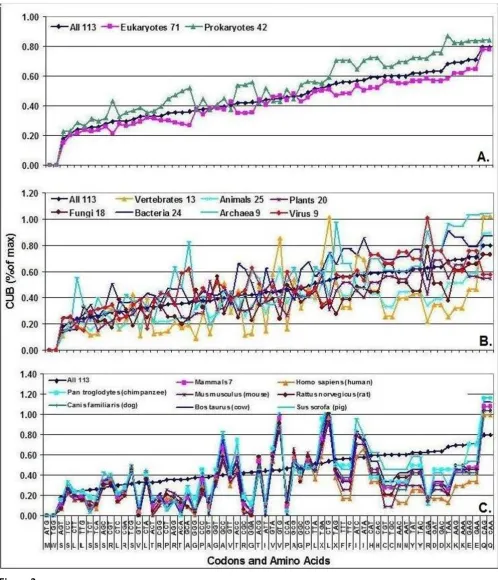
Detailed analysis of different species reveals wide varia-tions in CUB (Figure 2). There is a seemingly random var-iation in CUB between amino acids and different groups of organisms. However, a comparison of closely-related spe-cies with large codon pools shows very similar patterns. For example, all mammals have very similar CUB patterns.
Pan-genomic codon usage
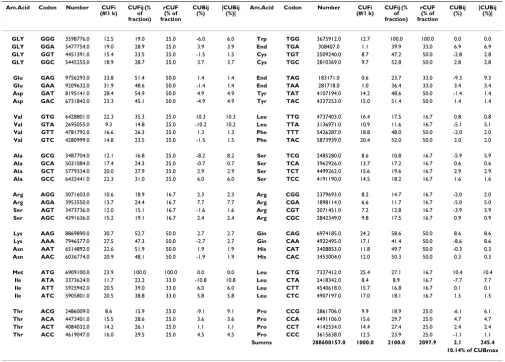
I accumulated the CUF data from the 113 species into a single CUF Table (Table 1). This Table is intended to give a virtual representation of all organisms (Pan-Genome) and a numerical representation of the "universal" transla-tion machinery. As many as 288 × E10 codons are repre-sented in this collection. The distribution of CUB values in the Pan-Genomic CUF Table is illustrated in Figure 3. The transition from maximum-positive to maximum-neg-ative values is smooth and there is no obvious or unam-biguous border between the so-called dominant and prohibited codons. All possible codons are used.
There is a significant positive correlation between the number of synonymous codons (ni, #/amino acid) and the propensity of amino acids in the proteome (#/1000 amino acid residues). A similar correlation exists between
synonymous codon frequency and CUB (Figure 4). These important correlations were discovered by analyzing the Pan-Genomic CUF Table (64 values) and were confirmed using individual data from all species (113 × 21 values).
Another possible way to evaluate the possible phyloge-netic relationships among CUBs in different species is to use the Pan-Genomic CUB Table as a common reference. I performed correlation analyses and compared the lists of species-specific CUB values to the list of mean CUB values in the Pan-Genomic CUB Table (64 × 113 comparisons), then used the significance of correlations as an indicator of CUB distances [Additional file 3].
I found that the CUB of vertebrates is most similar (least distant) to the average CUB, while bacteria and viruses are most distant from it. This correlation analysis involves all codons and gives no information about the development of individual CUBs. I therefore compared the codon-spe-cific CUB values in the 113 species to obtain a rough esti-mate of the stability of (commitment to) a CUB through evolution. The mean/SD of the 113 amino acid-specific CUB values gives a good estimate how this stability (Figure 5).
Codon Usage Bias (CUB) in Some Organisms
Figure 1
CUB Comparisons
Figure 2
Internal dynamics of codons
Correlations between individual CUB frequencies
When one of the synonymous codons is used more fre-quently than expected (positive CUB), another will be less frequently used (negative CUB). More generally, this
means that codon usage changes in a subgroup of the 64 codons will be accompanied by changes in the opposite direction in the remaining codons.
I sorted the CUB values (64 × 113 = 7,232 listed in total) in the Pan-Genomic CUB Table according to their sizes and +/- directions [Additional file 4]. This sorting divided the 64 codons (c) into two subgroups (Ac and Bc) and the 113 species (s) into two additional groups (As and Bs). The Ac-As and Bc-Bs subgroups contained predominantly over-represented (positive CUB) codons and are located in the opposite diagonal corners of the Table. The Ac-Bs and Bc-As fields contained predominantly under-repre-sented (negative CUB) codons and are located in the other opposite diagonal corners of the Table.
There is an internal inverse relationship between codons, which is valid and the same for all species. This inverse relationship is shown in a compressed and simplified form in Figure 6a, b.
Table 1: Pan-Genomic CUF & CUB Table
Am.Acid Codon Number CUFi (#/1 k)
CUFij (% of fraction)
rCUF (% of fraction
CUBij (%)
|CUBij (%)|
Am.Acid Codon Number CUFi (#/1 k)
CUFij (% of fraction)
rCUF (% of fraction
CUBij (%)
|CUBij (%)|
GLY GGG 3598776.0 12.5 19.0 25.0 -6.0 6.0 Trp TGG 3675912.0 12.7 100.0 100.0 0.0 0.0
GLY GGA 5477754.0 19.0 28.9 25.0 3.9 3.9 End TGA 308407.0 1.1 39.9 33.0 6.9 6.9
GLY GGT 4451391.0 15.4 23.5 25.0 -1.5 1.5 Cys TGT 2509240.0 8.7 47.2 50.0 -2.8 2.8
GLY GGC 5445255.0 18.9 28.7 25.0 3.7 3.7 Cys TGC 2810369.0 9.7 52.8 50.0 2.8 2.8
Glu GAG 9756293.0 33.8 51.4 50.0 1.4 1.4 End TAG 183171.0 0.6 23.7 33.0 -9.3 9.3
Glu GAA 9209632.0 31.9 48.6 50.0 -1.4 1.4 End TAA 281718.0 1.0 36.4 33.0 3.4 3.4
Asp GAT 8195141.0 28.4 54.9 50.0 4.9 4.9 Tyr TAT 4107194.0 14.2 48.6 50.0 -1.4 1.4
Asp GAC 6731842.0 23.3 45.1 50.0 -4.9 4.9 Tyr TAC 4337253.0 15.0 51.4 50.0 1.4 1.4
Val GTG 6428801.0 22.3 35.3 25.0 10.3 10.3 Leu TTG 4737403.0 16.4 17.5 16.7 0.8 0.8
Val GTA 2695055.0 9.3 14.8 25.0 -10.2 10.2 Leu TTA 3136971.0 10.9 11.6 16.7 -5.1 5.1
Val GTT 4781792.0 16.6 26.3 25.0 1.3 1.3 Phe TTT 5426287.0 18.8 48.0 50.0 -2.0 2.0
Val GTC 4280999.0 14.8 23.5 25.0 -1.5 1.5 Phe TAC 5873939.0 20.4 52.0 50.0 2.0 2.0
Ala GCG 3487704.0 12.1 16.8 25.0 -8.2 8.2 Ser TCG 2485280.0 8.6 10.8 16.7 -5.9 5.9
Ala GCA 5031084.0 17.4 24.3 25.0 -0.7 0.7 Ser TCA 3962926.0 13.7 17.2 16.7 0.6 0.6
Ala GCT 5779334.0 20.0 27.9 25.0 2.9 2.9 Ser TCT 4499262.0 15.6 19.6 16.7 2.9 2.9
Ala GCC 6432441.0 22.3 31.0 25.0 6.0 6.0 Ser TCC 4191190.0 14.5 18.2 16.7 1.6 1.6
Arg AGG 3071603.0 10.6 18.9 16.7 2.3 2.3 Arg CGG 2379693.0 8.2 14.7 16.7 -2.0 2.0
Arg AGA 3953550.0 13.7 24.4 16.7 7.7 7.7 Arg CGA 1898114.0 6.6 11.7 16.7 -5.0 5.0
Ser AGT 3473736.0 12.0 15.1 16.7 -1.6 1.6 Arg CGT 2071451.0 7.2 12.8 16.7 -3.9 3.9
Ser AGC 4391636.0 15.2 19.1 16.7 2.4 2.4 Arg CGC 2842349.0 9.8 17.5 16.7 0.9 0.9
Lys AAG 8869890.0 30.7 52.7 50.0 2.7 2.7 Gin CAG 6974185.0 24.2 58.6 50.0 8.6 8.6
Lys AAA 7946577.0 27.5 47.3 50.0 -2.7 2.7 Gin CAA 4922495.0 17.1 41.4 50.0 -8.6 8.6
Asn AAT 6514892.0 22.6 51.9 50.0 1.9 1.9 His CAT 3408853.0 11.8 49.7 50.0 -0.3 0.3
Asn AAC 6036774.0 20.9 48.1 50.0 -1.9 1.9 His CAC 3453004.0 12.0 50.3 50.0 0.3 0.3
Met ATG 6909100.0 23.9 100.0 100.0 0.0 0.0 Leu CTG 7327412.0 25.4 27.1 16.7 10.4 10.4
Ile ATA 3373624.0 11.7 22.2 33.0 -10.8 10.8 Leu CTA 2418342.0 8.4 8.9 16.7 -7.7 7.7
Ile ATT 5925942.0 20.5 39.0 33.0 6.0 6.0 Leu CTT 4540618.0 15.7 16.8 16.7 0.1 0.1
Ile ATC 5905801.0 20.5 38.8 33.0 5.8 5.8 Leu CTC 4907197.0 17.0 18.1 16.7 1.5 1.5
Thr ACG 2486009.0 8.6 15.9 25.0 -9.1 9.1 Pro CCG 2861706.0 9.9 18.9 25.0 -6.1 6.1
Thr ACA 4473401.0 15.5 28.6 25.0 3.6 3.6 Pro CCA 4491106.0 15.6 29.7 25.0 4.7 4.7
Thr ACT 4084032.0 14.2 26.1 25.0 1.1 1.1 Pro CCT 4142534.0 14.4 27.4 25.0 2.4 2.4
Thr ACC 4619047.0 16.0 29.5 25.0 4.5 4.5 Pro CCC 3615638.0 12.5 23.9 25.0 -1.1 1.1
Summs 288600157.0 1000.0 2100.0 2097.9 2.1 245.4
10.14% of CUBmax
Distribution of Pan-Genomic CUB
Figure 3
Correlations between Synonymous Codon Usage Frequency, Amino Acid Usage Frequency and Codon Usage Bias (CUB)
Figure 4
Negative correlations were expected between some sub-groups of CUBs and others in the same species. Surpris-ingly, however, all codons and all species belong to only 2 clusters with highly correlated, opposite dynamics.
The above figures indicate that there is a close internal and inverse correlation between the CUBs of different codons. The magnitude and orientation of a CUB shows wide var-iation between species. Our collection of 113 species is too limited for any conclusion about the phylogenetic rules of development of CUB to be drawn, but the first impression is an absence of phylogenetic rules:
- about half the species under-utilize about half the codons, while the other half show the opposite behavior in respect of the remaining codons.
- It is difficult to find a correlation between CUB and taxon boundaries. All mammals (in the table) show a homogenous CUB pattern, while other taxa are much more diverse.
- Most codons show a wide pangenomic variation in CUB, but some vary much less than others (Figure 5). Some codons (TAG, GGG, CGA, CTA) are under-utilized by more than 80% of the 113 species listed, i.e. these synon-ymous codons have become committed to a given CUB orientation while others have not. There is a significant negative correlation between the proportion of codons committed to a given CUB orientation and the extent to which CUB varies (also apparent in Figure 5).
Internal relationship among codon bases in codon usage tables
Codons are defined by 3 nucleotides. Therefore, CUF Tables can be further analyzed as Nucleotide Usage Fre-quency (NUF) Tables.
The 113 CUF Tables in our material are based on 288 mil-lion codons and 690 K CDS. The number of codons in this collection is enough to provide reliable information about the general rules, if any, that determine nucleotide ratios and correlations in genomes.
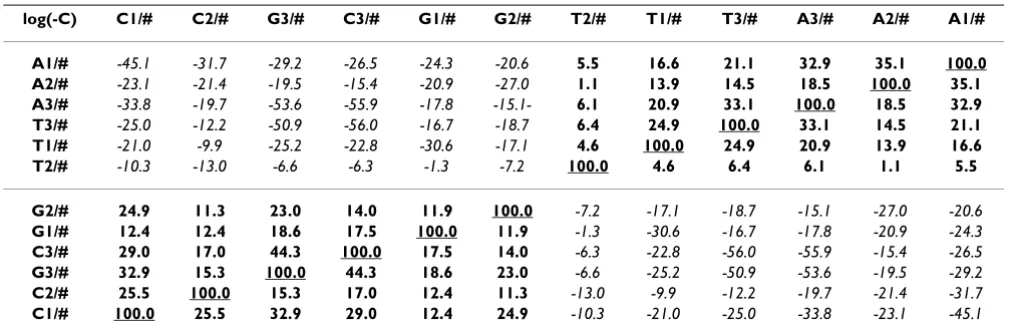
There are some highly significant correlations among codon bases. The fractional frequency of each nucleotide base in every codon position correlates positively with its complementary codon (Table 2).
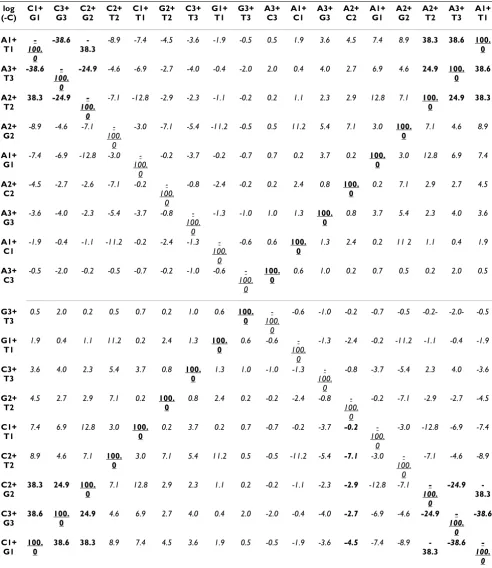
The sum of both complementary codon pairs (A+T and G+C) in every codon position is positively correlated to the sum of the same codon pair in the other two codon positions (Table 3). These correlations are valid for every species.
This strong positional correlation between codon bases suggests that it is possible to predict the frequency of usage of a nucleotide in the codon usage table from the frequencies of other nucleotides. Predictions regarding the third nucleotides in codons are especially interesting, because these are wobble bases for most amino acid codons.
Estimation of Codon Commitment
Figure 5
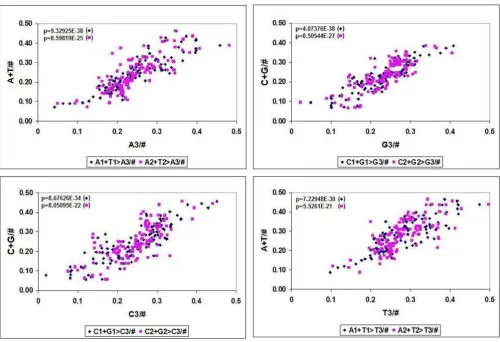
I used the correlation between the sum of complementary codon pairs in the 1st and 2nd codon positions to predict the wobble bases using the frequencies for 113 different species (Table 4, Figure 7). This is of course a prediction of the frequencies of the four wobble bases in all 64 possible codons and has no predictive value for individual wobble bases belonging to individual amino acids. All these cor-relation were of course carefully compared to correspond-ing random controls. Care was taken to ensure that the randomized control samples had the same size and distri-bution as the test samples. The sum of randomized frac-tions was kept equal to 1, as in the test samples. There were no correlations between the corresponding nucle-otides in the control samples.
This simple but highly significant and species-independ-ent positional relationship between NUFs provides
fur-ther strong support for the view that the genetic code is the result of development and not at all a "frozen accident".
Correlation between individual codons
The detection of a strong internal pangenomic relation-ship among codons in the CUF Tables and the positional correlation among the base residues of these codons led to an even deeper correlation analysis. The correlations between every single codon frequency and every other codon frequency (64 × 64/2 = 2,048) were calculated using linear regression analysis [Additional file 5].
Further detailed analysis of the internal positional correla-tions between codons and codon bases revealed signifi-cant correlations between different codons, which are generally valid for every species in our collection.
I noticed that there is a pattern of positive/negative corre-lations in these tables corresponding to the codon letters and their positions in the codon. The general rules of this pattern are summarized in Figure 8.
There is a simple rule regarding codon correlations in the pangenome: there are positive correlations between com-plementary nucleotides and negative correlations between non-complementary nucleotides. This pattern of correlations is statistically significant in most combina-tions of nucleotide posicombina-tions in codons. The correlacombina-tions are statistically most significant between nucleotides in the 3rd codon positions.
Prediction of individual wobble bases
I used these correlations to predict individual wobble bases (all 64) from the 1st and 2nd letters of the codons (all 64). The possible correlations between a codon and the 16 possible permutations of the 4 1st and 2nd codon letters (64 × 4 × 4 = 1024) are listed in [Additional file 6].
Accuracy of codon predictions
I used the strongest correlations [Supplementary File 6] to predict codon frequencies, and the mean of several predic-tions was used as the averaged predicted value (p). Four different approaches were used to evaluate the predictions quantitatively.
The correlation between real (r) and predicted (p) values belonging to the same codons was significant (p < 0.05) in 54 cases but not the other 10 (Figure 9a).
The correlation between real (r) and predicted (p) values belonging to the same species was significant (p < 0.05) in all 113 cases and The p value was below 10E-07 in all but 2 species (Figure 9b).
The average accuracy of individual CUF predictions in 113 species and 87 individual proteins was estimated by com-Species Dependent Internal Correlation between CUBs
Figure 6
paring the average real and predicted frequencies. The sig-nificance of the correlation between real and predicted CUF was 1.3E-64 when data from 113 species were aver-aged and compared (n = 64) and 1.9E-28 when data derived from 87 individual proteins (n = 64) were used (Figure 10).
Discussion
There are basically two approaches to measuring CUB. First, relative synonymous codon usage (RSCU) values can be calculated [5]. RSCU is the observed number of codon occurrences divided by the number expected if syn-onymous codons were used uniformly. Second, the rela-tive merits of different codons can be assessed from the viewpoint of translational efficiency. This second approach led to the development of the Codon Adapta-tion Index (CAI, [6]). The CAI model assigns a parameter, termed 'relative adaptiveness', to each of the 61 codons (stop codons excluded). The relative adaptiveness of a codon is defined as its frequency relative to the most often-used synonymous codons and is computed from a set of highly expressed genes. The CAI is widely used even though the subjectivity involved in selecting the reference codons is well recognized [26,27].
My way of calculating CUB is very close to the original suggestion [5] and regards uniform codon usage as the "null hypothesis"; any deviation from this is the bias. This approach made it possi-ble to avoid subjectivity and species limitations in choosing the reference set of codons, and I can build the concept of CUB on the massive foundation of statistical laws and the large collection of sequence data collected in Codon Usage Frequency Tables.
The origin and biological significance of CUB is not well understood, therefore I tried to find the rules (if any) of its evolutionary development and gain new insights about its possible function. I sort my findings into two main cate-gories: I found
a.) some (few) signs of the evolutionary origin and devel-opment of CUB;
b.) unexpectedly large number of highly significant intern correlations between different codon residues (bases) at different codon positions (first, central, wobble) as well as between individual codons.
Inter-species variation in CUB is about 10%, but it is obvi-ous that prokaryotes have significantly larger CUBs than eukaryotes. Bacteria may show the greatest bias because these primitive organisms are rich in highly-expressed genes and often use only one dominant codon. CUB decreases progressively with evolution and humans have the lowest bias (only about 20%). Evolutionary increase in codon number and genome complexity seems to reduce the CUB. It is noticeable that the average CUB (29.3 ± 1.1% (S.E.M.) n = 113) means that synonymous codon usage frequencies are 29.3% distant from the "all codons are equally good" hypothesis, and 70.7% distant from the "one codon is the best 'codon" alternative.
A more detailed qualitative analyzes of CUB is possible using a pan-genomic CUF Table. The original purpose of this virtual table was to create a reference for comparison of CUBs, but it turned out to reveal other codon-related connections too. The pan-genomic CUF Table is based on only 113 species, so it might be the first but not the last of its kind. It makes it possible to detect major, universal trends in codon usage behind small individual (or even species-wide) variations.
CUB is often correlated to the intensity of translation and has even been used to predict highly-expressed genes [6]. It is also known to be related to tRNA copy number, and co-evolution of tRNA gene composition and codon usage bias in genomes has been suggested [28]. I found a very strong correlation between the number of synonymous
Table 2: Positional nucleotide usage frequencies in 113 Species
log(-C) C1/# C2/# G3/# C3/# G1/# G2/# T2/# T1/# T3/# A3/# A2/# A1/#
A1/# -45.1 -31.7 -29.2 -26.5 -24.3 -20.6 5.5 16.6 21.1 32.9 35.1 100.0 A2/# -23.1 -21.4 -19.5 -15.4 -20.9 -27.0 1.1 13.9 14.5 18.5 100.0 35.1 A3/# -33.8 -19.7 -53.6 -55.9 -17.8 -15.1- 6.1 20.9 33.1 100.0 18.5 32.9 T3/# -25.0 -12.2 -50.9 -56.0 -16.7 -18.7 6.4 24.9 100.0 33.1 14.5 21.1 T1/# -21.0 -9.9 -25.2 -22.8 -30.6 -17.1 4.6 100.0 24.9 20.9 13.9 16.6 T2/# -10.3 -13.0 -6.6 -6.3 -1.3 -7.2 100.0 4.6 6.4 6.1 1.1 5.5
G2/# 24.9 11.3 23.0 14.0 11.9 100.0 -7.2 -17.1 -18.7 -15.1 -27.0 -20.6
G1/# 12.4 12.4 18.6 17.5 100.0 11.9 -1.3 -30.6 -16.7 -17.8 -20.9 -24.3
C3/# 29.0 17.0 44.3 100.0 17.5 14.0 -6.3 -22.8 -56.0 -55.9 -15.4 -26.5
G3/# 32.9 15.3 100.0 44.3 18.6 23.0 -6.6 -25.2 -50.9 -53.6 -19.5 -29.2
C2/# 25.5 100.0 15.3 17.0 12.4 11.3 -13.0 -9.9 -12.2 -19.7 -21.4 -31.7
C1/# 100.0 25.5 32.9 29.0 12.4 24.9 -10.3 -21.0 -25.0 -33.8 -23.1 -45.1
Table 3: Positional nucleotide usage frequencies in 113 Species log (-C) C1+ G1 C3+ G3 C2+ G2 C2+ T2 C1+ T1 G2+ T2 C3+ T3 G1+ T1 G3+ T3 A3+ C3 A1+ C1 A3+ G3 A2+ C2 A1+ G1 A2+ G2 A2+ T2 A3+ T3 A1+ T1 A1+ T1 -100. 0 -38.6 -38.3
-8.9 -7.4 -4.5 -3.6 -1.9 -0.5 0.5 1.9 3.6 4.5 7.4 8.9 38.3 38.6 100. 0 A3+ T3 -38.6 -100. 0
-24.9 -4.6 -6.9 -2.7 -4.0 -0.4 -2.0 2.0 0.4 4.0 2.7 6.9 4.6 24.9 100.
0 38.6
A2+ T2
38.3 -24.9
-100. 0
-7.1 -12.8 -2.9 -2.3 -1.1 -0.2 0.2 1.1 2.3 2.9 12.8 7.1 100. 0
24.9 38.3
A2+ G2
-8.9 -4.6 -7.1 -100.
0
-3.0 -7.1 -5.4 -11.2 -0.5 0.5 11.2 5.4 7.1 3.0 100. 0
7.1 4.6 8.9
A1+ G1
-7.4 -6.9 -12.8 -3.0 -100.
0
-0.2 -3.7 -0.2 -0.7 0.7 0.2 3.7 0.2 100. 0
3.0 12.8 6.9 7.4
A2+ C2
-4.5 -2.7 -2.6 -7.1 -0.2 -100.
0
-0.8 -2.4 -0.2 0.2 2.4 0.8 100. 0
0.2 7.1 2.9 2.7 4.5
A3+ G3
-3.6 -4.0 -2.3 -5.4 -3.7 -0.8 -100.
0
-1.3 -1.0 1.0 1.3 100. 0
0.8 3.7 5.4 2.3 4.0 3.6
A1+ C1
-1.9 -0.4 -1.1 -11.2 -0.2 -2.4 -1.3 -100.
0
-0.6 0.6 100. 0
1.3 2.4 0.2 11 2 1.1 0.4 1.9
A3+ C3
-0.5 -2.0 -0.2 -0.5 -0.7 -0.2 -1.0 -0.6 -100.
0
100. 0
0.6 1.0 0.2 0.7 0.5 0.2 2.0 0.5
G3+ T3
0.5 2.0 0.2 0.5 0.7 0.2 1.0 0.6 100. 0
-100.
0
-0.6 -1.0 -0.2 -0.7 -0.5 -0.2- -2.0- -0.5
G1+ T1
1.9 0.4 1.1 11.2 0.2 2.4 1.3 100. 0
0.6 -0.6 -100.
0
-1.3 -2.4 -0.2 -11.2 -1.1 -0.4 -1.9
C3+ T3
3.6 4.0 2.3 5.4 3.7 0.8 100. 0
1.3 1.0 -1.0 -1.3 -100.
0
-0.8 -3.7 -5.4 2.3 4.0 -3.6
G2+ T2
4.5 2.7 2.9 7.1 0.2 100. 0
0.8 2.4 0.2 -0.2 -2.4 -0.8 -100.
0
-0.2 -7.1 -2.9 -2.7 -4.5
C1+ T1
7.4 6.9 12.8 3.0 100. 0
0.2 3.7 0.2 0.7 -0.7 -0.2 -3.7 -0.2 -100.
0
-3.0 -12.8 -6.9 -7.4
C2+ T2
8.9 4.6 7.1 100. 0
3.0 7.1 5.4 11.2 0.5 -0.5 -11.2 -5.4 -7.1 -3.0 -100.
0
-7.1 -4.6 -8.9
C2+ G2
38.3 24.9 100.
0
7.1 12.8 2.9 2.3 1.1 0.2 -0.2 -1.1 -2.3 -2.9 -12.8 -7.1 -100. 0 -24.9 -38.3 C3+ G3 38.6 100. 0
24.9 4.6 6.9 2.7 4.0 0.4 2.0 -2.0 -0.4 -4.0 -2.7 -6.9 -4.6 -24.9
-100. 0 -38.6 C1+ G1 100. 0
38.6 38.3 8.9 7.4 4.5 3.6 1.9 0.5 -0.5 -1.9 -3.6 -4.5 -7.4 -8.9
-38.3
-38.6
-100. 0
codons and the frequency of the amino acids they encoded, as well as the CUB. More synonymous codons encode more amino acids of the same kind and cause greater bias. This (rather logical) connection is not
described in the literature, probably because the defini-tion of CUB is very different from mine.
I tried to define a kind of "phylogenetic tree" of CUBs using the pan-genomic CUF table as reference. The signif-icance of correlations between species-specific CUF and pan-genomic CUF gave a qualitative, theoretical measure of distances between codon usages. However this correla-tion-based approach did not successfully detect any recog-nizable, species-related evolutionary pattern.
Estimation of codon commitments through evolution showed that some codons are clearly over-utilized while other are avoided in most species. This finding is compat-ible with the concept of dominant and suppressed codons, but without stating that this difference is the result of evo-lution [29].
Table 4: Wobble base prediction
A3/# = A1+T1/# × 1.1004 + -0.2898 p = 9.3E-38
A3/# = A2+T2/# × 1.39228 + -0.6003 p = 8.6E-25
C3/# = C1+G1/# × 1.14274 + -0.3466 p = 8.7E-34
C3/# = C2+G2/# × 1.42309 + -0.3182 p = 8.1E-22
G3/# = C1+G1/# × 0.95213 + -0.2566 p = 4.1E-38
G3/# = C2+G2/# × 1.23154 + -0.251 p = 8.5E-27
T3/# = C1+G1/# × 0.99447 + -0.2019 p = 7.2E-30
T3/# = C2+G2/# × 1.26235 + -0.4851 p = 5.5E-21
Correlation between Codon Bases in Codons of 113 Species
Figure 7
Correlation between Codon Bases in Codons of 113 Species. The frequency of the four possible nucleotide bases (A, T, G, G) in the 3 possible codons positions (1st. 2nd, 3rd) were counted in 113 codon usage tables and plotted against each
other. A1+T1 > A3 means the correlation between the sum of the 1st A plus 1st T frequencies and the 3rd A frequency (n =
The non-randomness of synonymous codon usage is widely accepted today, and it has been suggested that independent forces (such as tRNA pool size [30]) have a role in the reading frame and there are contextual con-straints on synonymous codon choice [31-33].
Other lines of evidence suggest that the Genetic Code itself (the 64 codons in toto as a system) has an inherited, internal structure [34,35]. Statistical studies on the nucle-otide compositions of codons and of different codon positions support this concept [36-41].
I searched for the origin end development of codon bias and I found an extensive network of internal correlations between codons of a species and the nucleotides that define them. The correlations described in this article are:
- Correlation between the frequency of any single codon residue (base) at any codon position (first, central, wob-ble) and the frequency of any other single codon residue (base) at any other codon position (also first, central, wobble);
- Correlation between the sum of frequencies of any two codon residues (bases) at any two codon positions ((first, central, wobble) and the sum of any two other codon
res-idues (bases) at any two other codon positions (also first, central, wobble);
- Correlation between A+T, G+C frequencies at the 1st, 2nd codon positions and A+T, G+C frequencies at the 3rd codon position;
- Correlations between any two codons.
There seems to be a simple rule behind all these statisti-cally significant correlations: the correlation between any two nucleotides at any two codon positions is positive if the two nucleotides are complementary to each other and negative if they are not (illustrated in Figure 8).
The large number of statistically highly significant correla-tions made it possible to predict the frequencies of synon-ymous codons (in 113 species and 87 individual proteins) from the general overall frequencies of codons. The relia-bility of predictions was tested.
Conclusion
The cumulative Codon Usage Frequency of any codon is strongly dependent on the cumulative Codon Usage Fre-quency of other codons belonging to the same species. The rules of this codon dependency are the same for all species and reflect WC base pair complementarity. This internal connectivity of codons indicates that all synony-mous codons are integrated parts of the Genetic Code Accuracy of Codon Predictions – Amino Acid and Species Related Predictions
Figure 9
Accuracy of Codon Predictions – Amino Acid and Species Related Predictions. Codon frequencies (64) were predicted (p) in 113 species and compared to the real (r) values. The correlations between r and p were sorted for codons (A) and species (lB). The correlations were
expressed as f values (-log correlation coefficient). An f > 1.5 can be regarded as statistically significant correlation. CUF – Pan-Genomic Codon Correlations
Figure 8
with equal importance in maintaining its functional integrity. The so-called codon bias is a bias caused by the protein-centric view of the genome.
Competing interests
The author declares that they have no competing interests.
Authors' contributions
JB is the only author.
Additional material
Additional file 1
CUB Tables – Summary of 113 Species
Click here for file
[http://www.biomedcentral.com/content/supplementary/1742-4682-5-16-S1.xls]
Additional file 2
Calculation of Codon Usage Bias (CUB) – Explanation and Example. The 64 codons were sorted in to 21 subgroups (fractions) corresponding to the 20 coded amino acids and the stop signal. The sum of synonymous codon frequencies were always regarded as 100% i.e. the sum of all codon frequencies is 2100% (color coded columns). The fractional frequency (CUFij %) of a synonymous codon is the contribution of that codon to this 100%. The theoretical, natural frequencies of the synonymous codons is regarded as equal to each other (for example the natural fractional fre-quency of each synonymous codon of Arg is 100%/6 = 16.7%). The dif-ference between this theoretical (calculated) frequency and the real (counted) fractional frequency of a codon is the CUBij %. However it is necessary to use the |CUBij %| value instead to be able to calculate and compare the total CUB values of entire proteins (i.e. the sum of 64 CUB values). A theoretical extreme case of codon usage is when only one of all synonymous codons is used (CUB% 1 max column). The maximal possi-ble CUB of all codons will in this case be 2416.7%, which is regarded as the CUFmax. In the real case of Homo sapiens the sum of fractional fre-quencies is 456, which is 18.9% of the theoretical CUBmax.
Click here for file
[http://www.biomedcentral.com/content/supplementary/1742-4682-5-16-S2.xls]
Accuracy of Codon Predictions in species and proteins
Figure 10
Acknowledgements
The continuous support and editorial help of Dr P S Agutter is very much acknowledged.
References
1. Sauna ZE, Kimchi-Sarfaty C, Ambudkar SV, Gottesman MM: The sounds of silence: synonymous mutations affect function. Pharmacogenomics 2007, 8:527-532.
2. Codon Usage Database – NCBI-GenBank Flat File Release 156.0 [http://www.kazusa.or.jp/codon/]. [October 15 2006].
3. Gouy M, Gautier C: Codon usage in bacteria: correlation with gene expressivity. Nucleic Acids Res 1982, 10:7055-7074. 4. Sharp PM, Li WH: An evolutionary perspective on synonymous
codon usage in unicellular organisms. J Mol Evol 1986, 24:28-38. 5. Sharp PM, Tuohy TM, Mosurski KR: Codon usage in yeast: cluster analysis clearly differentiates highly and lowly expressed genes. Nucleic Acids Res 1986, 14:5125-5143.
6. Sharp PM, Li WH: The codon Adaptation Index – a measure of directional synonymous codon usage bias, and its potential applications. Nucleic Acids Res 1987, 15:1281-1295.
7. Bains W: Codon distribution in vertebrate genes may be used to predict gene length. J Mol Biol 1987, 197:379-388.
8. Eyre-Walker A: Synonymous codon bias is related to gene length in Escherichia coli: selection for translational accuracy? Mol Biol Evol 1996, 13:864-872.
9. Wan X, Xu D, Zhou J: A new informatics method for measur-ing synonymous codon usage bias. In Intelligent engineering sys-tems through artificial neural networksVolume 13. Edited by: Dagli C, Buczak A, Ghosh J, Embrechts M, Ersoy E. ASME Press, New York, NY; 2003:1101-1018.
10. Ma J, Campbell A, Karlin S: Correlations betweenShine-Dal-garno sequences and gene features such as predicted expres-sion levels and operon structures. J Bacteriol 2002,
184:5733-5745.
11. Lobry JR, Gautier C: Hydrophobicity, expressivity and aroma-ticity are the major trends of amino-acid usage in 999
Escherichia coli chromosome-encoded genes. Nucleic Acids Res 1994, 22:3174-3180.
12. Xie T, Ding D, Tao X, Dafu D: The relationship between synon-ymous codon usage and protein structure. FEBS Lett 1998,
434:93-96.
13. D'Onofrio G, Ghosh TC, Bernardi G: The base composition of the genes is correlated with the secondary structures of the encodedproteins. Gene 2002, 300:179-187.
14. Ikemura T: Correlation between the abundance of Escherichia coli transfer RNAs and the occurrence of the respective codons in its protein genes: a proposal for a synonymous codon choice that is optimal for the E. coli translational sys-tem. J Mol Biol 1981, 151:389-409.
15. Ikemura T: Correlation between the abundance of yeast transfer RNAs and the occurrence of the respective codons in protein genes. Differences in synonymous codon choice patterns of yeast and Escherichia coli with reference to the abundance of isoaccepting transfer RNAs. J Mol Biol 1982,
158:573-597.
16. Bulmer M: Coevolution of codon usage and transfer RNAabundance. Nature 1987, 325:728-730.
17. Kanaya S, Yamada Y, Kudo Y, Ikemura T: Studies of codon usage and tRNA genes of 18 unicellular organisms and quantifica-tion of Bacillus subtilis tRNAs: gene expression level and spe-cies- specific diversity of codon usage based on multivariate analysis. Gene 1999, 238:143-155.
18. Sueoka N: Directional mutation pressure, selective con-straints, and genetic equilibria. J Mol Evol 1999, 34(2):95-114. 19. Sueoka N: Two aspects of DNA base composition: G+C
con-tent and translation-coupled deviation from intra-strand rule of A = T and G = C. J Mol Evol 1999, 49:49-62.
20. Bernardi G: Compositional constraints and genome evolution. J Mol Evol 1986, 24:1-11.
21. Karlin S, Mrazek J: What drives codon choices in human genes? J Mol Biol 1996, 262:459-472.
22. Antezana MA, Kreitman M: The nonrandom location of synony-mous codons suggests that reading frame-independent forces have patterned codon preferences. J Mol Evol 1999,
49:36-43.
23. Sueoka N, Kawanishi Y: DNA G+C content of the third codon position and codon usage biases of human genes. Gene 2000,
261:53-62.
24. Sequence Manipulation Suite: Codon Usage. [http://bioinformat ics.org/sms2/codon_usage.html].
25. KEGG: Kyoto Encyclopedia of Genes and Genomes., KEGG Release 40.0. 2006 [http://www.genome.jp/kegg/].
26. Jansen R, Bussemaker HJ, Gerstein M: Revisiting the codon adap-tation index from a whole-genome perspective: analyzing the relationship between gene expression and codon
occur-Additional file 3
Correlation Analyses of Codon Usage Bias (CUB) in 113 Species. CUBs of 113 species (each containing 64 values) were compared to the virtual CUB values in the Pan-Genomic Codon Usage Table by linear regression analyses. The – log C values were used as a measure of similar-ity and are indicated by horizontal bars at the right edge of the table. C: significance of correlation. The subgroups, corresponding to larger phylo-genetic categories, are color coded and mean values for the groups are also indicated. The numbers of species in the subgroups are given in the "Mean" rows.
Click here for file
[http://www.biomedcentral.com/content/supplementary/1742-4682-5-16-S3.xls]
Additional file 4
CUB commitment and variation. The 64 codons in 113 species were sorted according to the size and +/- orientation of their CUB. Some man-ual adjustments were made to segregate the data into four approximately symmetrical subgroups (corresponding to the color codes).
Click here for file
[http://www.biomedcentral.com/content/supplementary/1742-4682-5-16-S4.xls]
Additional file 5
CUF- Pan-Genomic Codon Correlations. Codon frequencies were col-lected from 113 Codon Usage Frequency Tables and the significances of correlations (C, 64 × 64) were calculated. (n = 113). The table displays the -log C values. A – sign was added to the -log C value to indicate neg-ative correlations. Significant positive correlations (values > 2) are indi-cated by bold numbers and gray background, while significant negative correlations (values < -2) are indicated by italic numbers and pink back-ground. The collected data are sorted into 4 × 4 × 3 × 3 = 144 different subgroups corresponding to the 4 × 4 codon letter combinations and the 3 × 3 codon positions (red letters).
Click here for file
[http://www.biomedcentral.com/content/supplementary/1742-4682-5-16-S5.xls]
Additional file 6
Prediction of Wobble Bases. List of correlations between the frequency of a codon and the frequency of other codons, which contain the 4 × 4 per-mutations of codons at the 1st and 2nd codon positions. 64 times 16
equa-tions were calculated from these correlaequa-tions. Only the strongest correlations, those used in codon predictions, are listed and color coded. Positive correlations are indicated by bold letter in blue background and negative correlations are given by italic letters in pink background. F is as defined in fig. 9.
Click here for file
Publish with BioMed Central and every scientist can read your work free of charge "BioMed Central will be the most significant development for disseminating the results of biomedical researc h in our lifetime."
Sir Paul Nurse, Cancer Research UK
Your research papers will be:
available free of charge to the entire biomedical community
peer reviewed and published immediately upon acceptance
cited in PubMed and archived on PubMed Central
yours — you keep the copyright
Submit your manuscript here:
http://www.biomedcentral.com/info/publishing_adv.asp
BioMedcentral
rence in yeast using a variety of models. Nucleic Acids Research 2003, 31:2242-2251.
27. Karlin S, Campbell AM, Mrazek J: Comparative DNA analysis across diverse genomes. Annu Rev Genet 1998, 32:185-225. 28. Rocha EPC: Codon usage bias from tRNA's point of view:
redundancy, specialization, and efficient decoding for trans-lation optimization. Genome Res 2004, 14:2279-2286.
29. Britten RJ: Forbidden synonymous substitutions in coding regions. Mol Biol Evol 1993, 10:205-220.
30. Antezana MA, Kreitman M: The nonrandom location of synony-mous codons suggests that reading frame-independent forces have patterned codon preferences. J Mol Evol 1999,
49:36-43.
31. Lipman DJ, Wilbur WJ: Contextual constraints on synonymous codon choice. J Mol Biol 1983, 163(3):363-376.
32. Ticher A, Graur D: Nucleic acid composition, codon usage, and the rate of synonymous substitution in protein-coding genes. J Mol Evol 1989, 28:286-298.
33. Fedorov A, Saxonov S, Gilbert W: Regularities of context-dependent codon bias in eukaryotic genes. Nucleic Acids Res 2002, 30:1192-1197.
34. Biro JC, Benyo B, Sansom C, Szlavecz A, Fordos G, Micsik T, Benyo Z: A common periodic table of codons and amino acids. Bio-chem Biophys Res Commun 2003, 306:408-15.
35. Biro JC: Protein folding information in nucleic acids which is not present in the genetic code. Ann N Y Acad Sci 2006,
1091:399-411.
36. Frank GK, Makeev VJ: G and T nucleotide contents show spe-cie-invariant negative correlation for all three codon posi-tions. J Biomol Struct Dyn 1997, 14:629-639.
37. Wang J: The base contents of A, C, G or U for the three codon positions and the total coding sequences show positive cor-relation. J Biomol Struct Dyn 1998, 16:51-57.
38. Majumdar S, Gupta SK, Sundararajan VS, Ghosh TC: Compositional correlation studies among the three different codon posi-tions in 12 bacterial genomes. Biochem Biophys Res Commun 1999,
266:66-71.
39. D'Onofrio G, Bernardi G: A universal compositional correlation among codon positions. Gene 1992, 110:81-88.
40. Wada A: Compliance of genetic code with base-composition deflecting pressure. Adv Biophys 1992, 28:135-158.