R E S E A R C H A R T I C L E
Open Access
Student preparedness characteristics
important for clinical learning: perspectives
of supervisors from medicine, pharmacy
and nursing
Hasini Banneheke
1, Vishna Devi Nadarajah
2*, Srinivasan Ramamurthy
3, Afshan Sumera
2, Sneha Ravindranath
4,
Kamalan Jeevaratnam
5, Benny Efendie
6, Leela Chellamuthu
7, Purushotham Krishnappa
2and Ray Peterson
8Abstract
Background:Student perspectives of clinical preparedness have been studied in the literature, but the viewpoint
of supervisors is limited. Hence, the aim was to examine the perspective of supervisors on the characteristics of health professional students important for preparedness for clinical learning.
Methods:This was a descriptive, questionnaire-based, cross-sectional study conducted at three higher education
institutions in Malaysia. A previously published questionnaire with 62 characteristics was adopted with modifications after pre-testing. Descriptive analysis was completed for the demographic data. The sample was grouped based on health profession, clinical practice experience and teaching experience for further analysis. Non-parametric Kruskal-Wallis test was selected to evaluate differences in mean ranks to assess the null hypothesis that the medians are equal across the groups. Kruskal-Wallis post-hoc pair wise comparison was performed on samples with
significant differences across samples.
Results:The sample was comprised of 173 supervisors from medicine (55, 32%), pharmacy (84, 48%) and nursing
(34, 20%). The majority (63%) of the supervisors were currently in professional practice. A high percentage (40%) of supervisors had less than 4 years of teaching experience. The highest theme ratings were for willingness (6.00) and professionalism (5.90). There was a significant difference (p< 0.05) in the medians, among medicine, pharmacy and nursing professional speciality for willingness (5.70, 6.00 and 6.00), professionalism (5.70, 5.90 and 6.15),
communication and interaction (5.42, 5.67 and 6.00), personal attributes (5.42, 5.71 and 6.02) and the professional and interpersonal skills (5.50, 5.63 and 6.00) themes. Post-hoc analysis showed a significant difference (p< 0.05) between medicine and nursing groups in the willingness (5.70 and 6.00), professionalism (5.70 and 6.15) and personal attributes (5.42 and 6.02) themes. Supervisors who are currently in practice had given high ratings compared to other groups. There were no significant differences observed within groups with different level of teaching experiences.
Conclusions:All supervisors rated professionalism and willingness as the most important characteristics followed
by personal attributes. Further strengthening learning opportunities related to these characteristics in the curriculum may improve the students’preparedness in clinical learning.
Keywords:Clinical preparedness, Supervisor’s perspective, Clinical learning
* Correspondence:[email protected]
2School of Medicine, International Medical University, No 126 Jalan Jalil
Perkasa 19, Bukit Jalil, 57000 Kuala Lumpur, Malaysia
Full list of author information is available at the end of the article
Background
Medicine, pharmacy, and nursing students gain subject-specific knowledge during the initial part of their undergraduate study mainly through plenaries, small group learning, training in clinical skills or laboratories with occa-sional visits to hospitals and community centres. Practice re-lated contextual learning that takes place later in their training helps students understand the course content better, integrate and apply the knowledge for patient-centred care, inculcate correct attitudes and gain skills through practice [1]. Through this process, the novice undergraduate student transforms into a work-ready health care practitioner. Never-theless, the transition from the pre-clinical phase of study into the clinical learning environment remains stressful for the students [2–5] and they can suffer from initial clinical anxiety [6, 7] due to several reasons; (i) the differences in learning environments and teaching styles, (ii) the theory-practice gap, (iii) issues in working relationship with either health care practitioners, peers or patients, (iv) the fear of making mistakes, (v) apprehension over clinical educators’ evaluations, (vi) ambiguity of their role and responsibilities in a healthcare setting, and (vii) workload and performance expectations [2, 7–9]. Efforts are undertaken to increase student clinical preparedness [10] and reduce the stress for students during the transition by modifying the curriculum. Curricula modifications include incorporation of clinical skills and simulation sessions from year 1, the appointment of peer instructors and mentors [11], provision of short tran-sitional courses [12] and clinically-related resource materials [13, 14], access to clinical teachers [14], increasing hospital visits, general practice postings and community projects starting early and in the preclinical phase. However, even after incorporating these measures, evidence suggest that students are not at ease but continue to struggle during transition [15, 16]. Although preparedness of students is important, the difficulty in accessing clinical learning environments, priority for patient care and safety, availability of human resources and the high costs of training should also be considered [17, 18].
Student perspectives of clinical preparedness and tran-sition have been studied in the literature [4, 19–23]. However, the viewpoint of supervisors from various health professional courses who direct the students to gain professionally related skills in the clinical environ-ment is limited [10, 24]. Researchers have obtained stu-dent viewpoints in relation to learning environments, intellectual climate, and the relationship with fellow stu-dents and supervisors [25, 26]. Stustu-dents have reported that interest in the subject, a meaningful learning envir-onment and a positive student-supervisor relationship are the most important aspects for effective clinical learning. Supervision is an essential component in work based contextual learning for clinical students. Informa-tion from the existing literature has helped curriculum
planners to optimize their programmes. However, clin-ical settings and expectation are contextually different and will change over time and needs updating [27].
In this study, we considered the supervisors’ perspec-tives on the characteristics of health professional students that are important for preparedness for clinical learning. Given that students from various health professions such as medicine, nursing and pharmacy share similar clinical learning contexts, it is valuable to obtain the perspectives of the supervisors in these health professions. The data as-sists by exploring any differences in perceptions based on clinical practice experience, health profession specialty and teaching experience. A recent paper by Chipchase et al., describes the supervisors’ views on students’ clinical preparedness from disciplines such as occupational ther-apy, physiotherther-apy, and speech pathology [24] and identi-fies six themes that can be used as indicators for student preparedness for the clinical learning environment. The six themes are knowledge and understanding, willingness, professionalism, communication and interaction, personal attributes, and professional and interpersonal skills. We planned our study based on the questionnaire of Chipchase et al., so that we can explore these themes and characteristics in the context of other health professionals. In addition, there are no comparative studies in the litera-ture expressing the views of supervisors from medicine, pharmacy, and nursing on student clinical preparedness. The hypothesis is that there are differences between medicine, pharmacy and nursing supervisors on the characteristic that are important for students preparedness for clinical learning. Any differences or similarities in views would be useful for planning clinical teaching and learning in a resource efficient manner. Being multi-professional and healthcare-based, the findings of our study are applicable to any medical or health sciences school.
Methods
The aim was to examine medicine, pharmacy and nurs-ing supervisors’ perspectives on the characteristics of health professional students that are important for pre-paredness for clinical learning.
Study design, setting and participants
participate. Data collection was carried out over a period of 4 months.
Study instrument and data collection
The questionnaire with 62 characteristics developed by Chipchase et al., 2012 [24] was adopted. These 62 items are organized into six themes, namely knowledge and understanding, willingness, professionalism, communica-tion and interaccommunica-tion, personal attributes, and profes-sional and interpersonal skills. In addition to the 62 items, we added a section for demographic data and two open-ended questions for suggestions and comments. The copy of the modified Chipchase et al. questionnaire is attached in Additional file 1. The language of the sur-vey was in English. A pilot study was carried out to val-idate the modified questionnaire on a sub-sample (n = 20) of IMU supervisors. Those 20 participants in-volved in the pilot study were excluded from the main study. The six themes in the original questionnaire were removed at the time of data collection to reduce any po-tential bias in responding to each item. However, the 62 items were grouped under six themes at the time of data analysis. Item responses were based on a seven-point Likert scale with 1 = not important, 2 = slightly import-ant, 3 = somewhat importimport-ant, 4 = moderately importimport-ant, 5 = important, 6 = very important and 7 = extremely important.
Data analysis
Data entry and statistical analysis were completed using IBM SPSS Statistics for Windows, Version 20.0 (IBM Corp. Armonk, New York). Demographic data were analysed using descriptive analysis. Medians of the seven-point Likert scale for all 62 items were calculated. The open comments were categorized into the six themes in the original questionnaire independently by
two researchers. We grouped the supervisors based on their health profession (medicine, pharmacy and nurs-ing). In addition, we investigated how their clinical prac-tice experience and their years of teaching experience changes their perception on the characteristic important for clinical learning. The supervisor groups were further subdivided based on clinical practice experience for each health profession (currently in practice [group-1], prac-ticed in the past but not at present [group-2] and only practiced during study course/training [group-3]), and teaching experience for each health profession (less than 4 years [group-A], 5–9 years [group-B] and more than 10 years [group-C]). These subdivisions were selected to better understand the perceptions of supervisors on the characteristic important for clinical learning in the medi-cine, pharmacy and nursing professions.
All results were subjected to normality testing. Based on the Shapiro-Wilks normality test results, the non-parametric Kruskal-Wallis test was selected to evaluate differences in mean ranks and to assess the null hypothesis that the medians were equal across the groups. A Kruskal-Wallis post-hoc pairwise comparison was performed on samples, which showed significant difference across samples.
Results
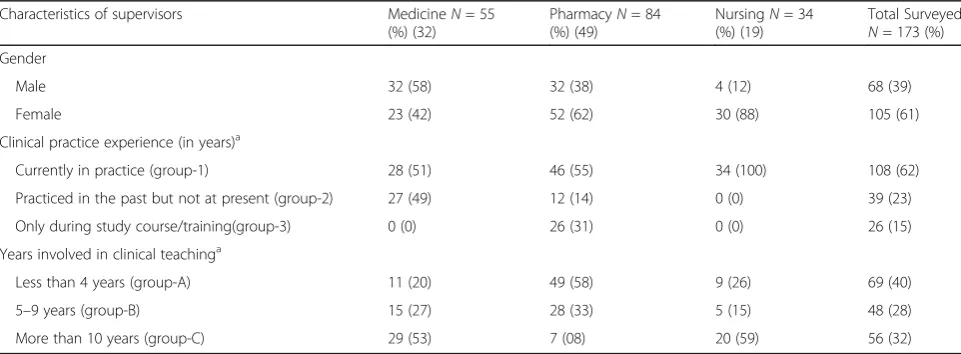
A total of 173 supervisors from medicine, pharmacy, and nursing participated in the study. The participation from each institution was as follows; International Medical University (119), Monash University (39) and Perdana University (15). The clinical supervisors from the three institutions consisted of nationalities from Malaysia, Myanmar, India, Pakistan, Sri Lanka, Australia, The United Kingdom, Ireland, Canada, The United States and the Middle Eastern region. The characteristics of supervisors is shown in Table 1. In total, there were more female participants (61%) than males. In terms of
Table 1Characteristics of supervisors for medicine, pharmacy and nursing
Characteristics of supervisors MedicineN= 55
(%) (32)
PharmacyN= 84 (%) (49)
NursingN= 34 (%) (19)
Total Surveyed N= 173 (%)
Gender
Male 32 (58) 32 (38) 4 (12) 68 (39)
Female 23 (42) 52 (62) 30 (88) 105 (61)
Clinical practice experience (in years)a
Currently in practice (group-1) 28 (51) 46 (55) 34 (100) 108 (62)
Practiced in the past but not at present (group-2) 27 (49) 12 (14) 0 (0) 39 (23)
Only during study course/training(group-3) 0 (0) 26 (31) 0 (0) 26 (15)
Years involved in clinical teachinga
Less than 4 years (group-A) 11 (20) 49 (58) 9 (26) 69 (40)
5–9 years (group-B) 15 (27) 28 (33) 5 (15) 48 (28)
More than 10 years (group-C) 29 (53) 7 (08) 20 (59) 56 (32)
a
clinical experience in their own health profession, the majority (62%) of the supervisors reported that they are currently in practice, while 23% had practiced in the past, and 15% have no clinical work experience. The ma-jority of those with no clinical work experience were pharmacists. A slightly higher percentage (40%) of su-pervisors had less than 4 years of teaching experience.
Supervisors’ratings related to characteristics of health professional students important for better preparedness for clinical learning
All supervisors’scores were above five (5) for all themes related to characteristics of health professional students which were important for better preparedness for clin-ical learning (Table 2). The median rating of the total sample was highest for the theme willingness (6.00) followed by professionalism (5.90), personal attributes (5.70), communication and interaction (5.66), profes-sional and interpersonal skills (5.50), and knowledge and comprehension (5.36).
Supervisors’ratings based on professional specialty There were three categories of health professions ana-lysed, namely medicine, pharmacy, and nursing. The me-dian values for the six themes for each speciality are reported in Table 2.
The Shapiro-Wilk test for normality showed signifi-cant differences (p < 0.05) for all themes. It also con-firmed that the distribution was not normal.
The non-parametric Kruskal-Wallis test showed that there was a significant difference ((p < 0.05) among medicine, pharmacy, and nursing professionals in the median gauging the level of importance of themes as follows: willingnessχ2 (2,n= 171) = 9.699,p = 0.008;χ2 (2,n= 171) = 8.956,p = 0.011for professionalism;χ2 (2, n = 171) = 7.788, p = 0.020for personal attributes and χ2 (2, n = 171) = 6.235, p = 0.044 for communication and interaction. With regard to knowledge and profes-sional and interpersonal skills, no significant differences in the medians among the three professional specialties were observed.
Kruskal-Wallis post-hoc pairwise comparisons demon-strated a significant difference (p < 0.05)between medicine and nursing groups in willingness, professionalism, and per-sonal attributes. The analysis between the medicine and pharmacy groups and the pharmacy and nursing groups showed no significant difference for all six themes.
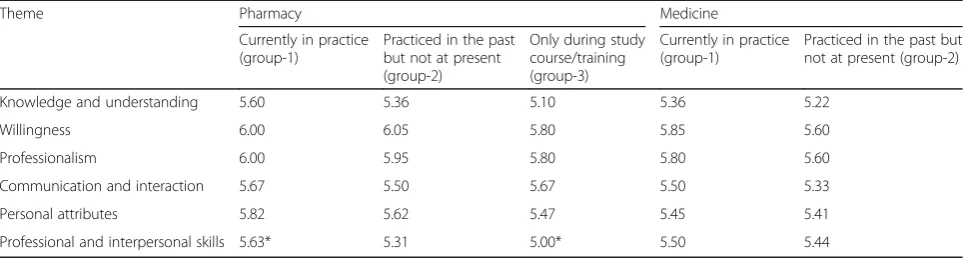
Supervisors’ratings based on clinical practice experience Each professional speciality was subcategorised into 3 groups based on clinical practice experience (ie Group-1: currently in practice; Group-2: practiced in the past but not at present; Group-3: practice experience only during study course/training). Only in the pharmacy profession were there participants in all three levels of clinical experi-ence (groups 1, 2 and 3). In medicine, only two levels of clinical experience (group 1 and 2) were present, and in nursing, all the participants belonged to group 1(i.e. currently in practice). The median values for the six themes for the pharmacy and medicine professions are shown in Table 3.
In medicine, no significant difference was observed be-tween groups 1 and 2 for all the six themes. For the pharmacy profession, there were significant differences (p < 0.05) in all the six themes as observed from the Shapiro-Wilk normality test. It also showed that the population was not normally distributed. Furthermore, the non-parametric Kruskal-Wallis test indicated that there was a significant difference χ2 (2,N= 83) = 6.342, p = 0.042 among three groups in the professional and interpersonal skills theme, while there was no significant difference observed for the other 5 themes. The post-hoc pairwise comparison indicated that there was a sig-nificant difference (p < 0.05) in the professional and interpersonal skills themes between group 1 and 3. There was no significant difference observed between group 1 and 2 and group 2 and 3.
Supervisors’ratings based on teaching experience Each professional speciality was subcategorised for ana-lysis based on the years of teaching experience into 3 groups categorized as Group-A: less than 4 years, Group-B: 5–9 years and Group-C: more than 10 years.
Table 2Professional Speciality: Medicine, pharmacy and nursing supervisors’ratings (median value) for each theme related to characteristics of health professional students important for better preparedness for clinical learning
Theme Medicine Pharmacy Nursing Overall rating
Knowledge and understanding 5.32 5.63 5.95 5.36
Willingness 5.70* 6.00 6.00* 6.00
Professionalism 5.70** 5.90 6.15** 5.90
Communication and interaction 5.42 5.67 6.00 5.66
Personal attributes 5.42* 5.71 6.02* 5.70
Professional and interpersonal skills 5.50 5.63 6.00 5.50
The median values for the six themes for pharmacy, medicine, and nursing professions are shown in Table 4.
For the three professions, the three groups were subjected to a normality test followed by the non-parametric Kruskal-Wallis test. There were no signifi-cant differences observed within three groups for the three professions indicating that the years of teaching experience has no impact on supervisors ratings.
Supervisors’responses to open-ended questions
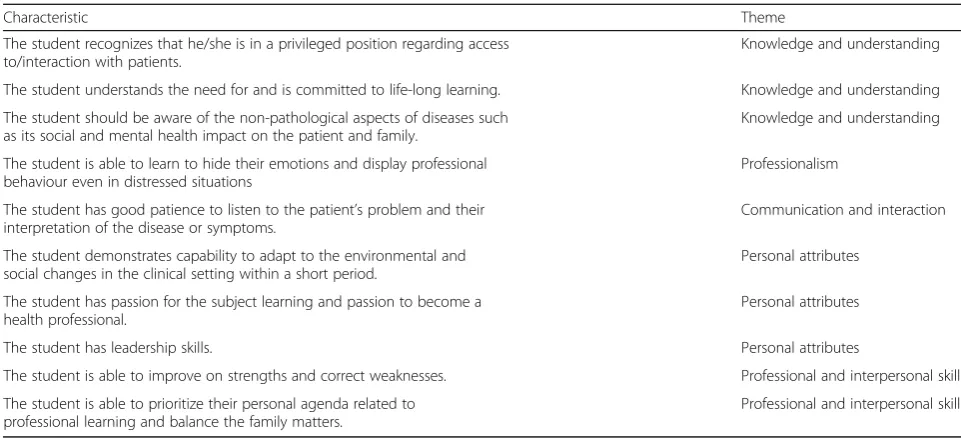
We invited the supervisors to state any other student at-tributes that are important for clinical learning that had not been mentioned or covered in the questionnaire. Twenty-one percent (n = 36) of the participants had responded. The summary of the salient suggestions that were matched with the themes are reported in Table 5.
There were 8% (n= 14) participants who had written comments under the open comments section. The par-ticipants suggested combining some characteristics as they felt there were repetition and overlap between char-acteristics for the same outcome. They also suggested that the Likert scale could have been a 3 points scale. They found it difficult to differentiate responses to the exact point in a 7-point scale.
Discussion
This study investigated the perception of health profes-sionals from medicine, pharmacy, and nursing on the characteristics important for the preparedness of under-graduate students for clinical training. Although entirely conducted in Malaysia, participants in this study had come from different countries with different training backgrounds. Additionally, there was a fair gender repre-sentation of clinical educators, and with experience levels ranging from junior, mid and senior levels for teaching and clinical practice.
The findings demonstrate that all of the themes and associated characteristics outlined in the questionnaire are important for student preparedness for clinical learn-ing. The characteristics outlined in the present study
were derived from previous work prepared on a consensus-based approach using the Delphi technique [24]. In that study, it was observed that despite situ-ational differences in the teaching and learning process and professional category, supervisors had similar expec-tations. Such an observation has been reported previ-ously in another study conducted in Saudi Arabia [28].
The participants in the present study rated professional-ism, willingness and personal attributes highly and a simi-lar observation was made in studies from other health sciences programs such as occupational therapy, physio-therapy, speech pathology [24] and nursing [28]. The pro-fessionalism theme is defined as professional skills and behaviours in this current study. Professionalism is built on fundamentals such as knowledge, clinical competen-cies, communication, ethics and legal understandings [29] and it directly influences the clinical learning process and students’preparedness for clinical learning [30]. Some au-thors assert that professionalism in a medical career is stage-specific and context related because professional be-havior is greatly influenced by personal value, organizational hierarchy and social desirability while others suggest it applies throughout the career [29]. Add-itionally, the increasing opportunities for commercial gains in clinical medicine and its possible negative impact on patient care have led to a greater expectation of profes-sional responsibility from students from the first day of clinical encounters [30]. Knowledge and understanding and professional and interpersonal skills had received the least rating of importance from supervisors. This may be justified as knowledge and even interpersonal skills could be taught or congregated as they go along in the training [21]. In another study describing ‘successful’and ‘ unsuc-cessful’clinical nursing learning, students characteristics such as critical thinking, communication skills, personal attributes such as positivity, eagerness to learn and traits demonstrating willingness such as acceptance of feedback have been highlighted as important and it concludes that unprepared students become unsuccessful professionals later [10].
Table 3Clinical Practice Experience: Medicine and pharmacy supervisors’ratings (median value)
Theme Pharmacy Medicine
Currently in practice (group-1)
Practiced in the past but not at present (group-2)
Only during study course/training (group-3)
Currently in practice (group-1)
Practiced in the past but not at present (group-2)
Knowledge and understanding 5.60 5.36 5.10 5.36 5.22
Willingness 6.00 6.05 5.80 5.85 5.60
Professionalism 6.00 5.95 5.80 5.80 5.60
Communication and interaction 5.67 5.50 5.67 5.50 5.33
Personal attributes 5.82 5.62 5.47 5.45 5.41
Professional and interpersonal skills 5.63* 5.31 5.00* 5.50 5.44
The nursing supervisors had notably different percep-tions for clinical preparedness compared to the medical and pharmacy professionals with higher scores on all six themes. For nursing supervisors, student characteristics related to the themes knowledge and understanding, per-sonal attributes and professional and interperper-sonal skills were highly significant. This difference in perception may arise from the role nurses’play within a healthcare setting compared to doctors or pharmacists. Nurses have high, continuous and recurrent patient contact especially in a ward setting collecting medical histories, distributing medications, monitoring patients’conditions [31], provid-ing health education and information. In addition, nurses often collaborate and communicate with other healthcare professionals. Barriers such as lack of interpersonal skills and mutual respect, poor attitudes toward team working, status differences and communication gaps were more commonly reported by nurses than by doctors as chal-lenges that affect nurses’ and doctors’ working relation-ships [32, 33]. On the other hand, the contextual and experiential learning for a nursing student starts from year 1. Thus, a nursing professional is developed on the job with much of the learning through feedback from clinical preceptors. This may explain why the nursing supervisors have rated personal attributes and professional and inter-personal skills as more important for clinical preparedness of their students. Meanwhile, the training and practice of medicine and pharmacy have many similarities. For ex-ample, the two programmes emphasise the knowledge of basic sciences in the early years of the undergraduate programme with gradual accentuation of clinical learning towards later years.
Clinical supervisors currently in practice assert higher importance on professional and interpersonal skills
compared to those with no clinical practice experience. Professional and interpersonal skills encompass skills such as time management, organizational, verbal and written communication, observational, research, social and problem-solving skills. Developing the interpersonal skills of health professionals is imperative in maintaining good clinical standards and will be rewarding for them in the long run. Practising supervisors or preceptors know from their daily experience that both patients and doctors are at risk with poor interpersonal skills [34]. For all three professions, active observation is necessary for the supervisors or preceptors to assess and give feed-back to students in training. If these supervisors or pre-ceptors are in practice they are considered more effective and are better role models for clinical learning [35]. However, they have to balance academic responsi-bilities and patient care within their duty hours [36] and thus they prefer a student with the right personal attri-butes such as enthusiasm, initiative and a desire to learn. A study that explored the importance of professional attributes for preparedness for nursing students reported that educators with more years of experience recognized communication and interaction as a vital characteristic for better clinical performance [28]. No difference in this perspective of the supervisors based on the years of teaching experience was identified in this present study.
Awareness of interprofessional learning is an import-ant graduate attribute. As stated in the literature, across the professions, the outcome/competency statements and relevant assessment tools tend to measure interpro-fessional engagement indirectly under prointerpro-fessional com-munication and professional behaviour descriptors [24]. In our current study, the questionnaire consists of ques-tions such as ‘the student is willing to work as a team
Table 5Summary of other characteristics suggested by the participants as important for clinical learning
Characteristic Theme
The student recognizes that he/she is in a privileged position regarding access to/interaction with patients.
Knowledge and understanding
The student understands the need for and is committed to life-long learning. Knowledge and understanding
The student should be aware of the non-pathological aspects of diseases such as its social and mental health impact on the patient and family.
Knowledge and understanding
The student is able to learn to hide their emotions and display professional behaviour even in distressed situations
Professionalism
The student has good patience to listen to the patient’s problem and their interpretation of the disease or symptoms.
Communication and interaction
The student demonstrates capability to adapt to the environmental and social changes in the clinical setting within a short period.
Personal attributes
The student has passion for the subject learning and passion to become a health professional.
Personal attributes
The student has leadership skills. Personal attributes
The student is able to improve on strengths and correct weaknesses. Professional and interpersonal skills
The student is able to prioritize their personal agenda related to professional learning and balance the family matters.
with peers, colleagues and other health professionals’ and ‘the student is able to communicate professionally with members of the multidisciplinary team’which were designed to measure interprofessional engagement. Clinical supervisors from all the three discipline rated these ques-tions highly clearly reflecting that they value the importance of the interprofessional learning (IPL) component. Hence, the further strengthening of IPL components will improve student preparedness for their clinical learning.
The supervisors open comments provided a valuable insight into the characteristics important for student clinical preparedness. Those descriptions were mapped to the clinical preparedness themes and explained why the themes were rated as important or highly important. Curriculum planners should be aware of the expecta-tions of different groups of clinical supervisors. They should provide evidence of appropriate student selection methods, teaching learning activities and assessment tools measuring professionalism, willingness, and af-firmative personal attributes. For example, the multiple mini interviews used for selection of students have been shown to be a useful tool to assess non-cognitive attri-butes of medical and other health professions students [37]. In this study, the scores obtained for each theme identify the priority areas from the supervisor’s perspec-tive. In outcomes/competencies based education, these prioritized attributes could be emphasized or built upon in the curriculum and be provided to students to aid their preparation for clinical learning. This approach will reduce the gap between students and clinical supervi-sor’s expectations in their clinical learning sites.Similarly, curriculum planners and reviewers should inform students of important characteristics as described in the six themes and ensure that they get the opportunity to learn and demonstrate these characteristics from the be-ginning of the course and at levels contextual to programme outcomes. It will also be helpful to include an orientation course immediately prior to the clinical transition of students focusing on these characteristics to reduce the levels of stress and anxiety among stu-dents. However, an essential action would be to continue giving assistance to students during their clinical learn-ing, whilst being vigilant and then supporting those stu-dents who may be struggling to meet the expectations.
The questionnaire used in this study had an exhaustive list of characteristics important for student preparedness for clinical learning. As such, it had resulted in the de-velopment of a lengthy questionnaire that became a limitation in the present study as it led to some clinical supervisors declining participation. Further development of the questionnaire with a shorter version would have been beneficial with increased response rates. Although the study involved multi-professional categories, it was not completely multi-centred as only in one institution
was there representation of all the professions. As such, this study will enhance the existing literature while pro-viding helpful tips to institutions that face similar issues. It will also model a process that other institutions may fol-low to identify their contextualized learner expectations.
Conclusions
All supervisors had rated professionalism and willing-ness as the two most important themes of characteristics to inculcate prior to clinical training followed by per-sonal attributes.There was a significant difference in the perspective of nursing supervisors regarding characteris-tics important for students’ clinical preparedness compared to medical and pharmacy professionals. In pharmacy, clinical supervisors currently in practice placed a higher importance on professional and interper-sonal skills and perinterper-sonal attributes compared to those with no clinical practice experience. There was no differ-ence in the perspective of the supervisors based on the years of teaching experience.
Considering the current interest in inter-professional education and teamwork, it will be interesting to carry out a qualitative study to determine the reasons for the ob-served differences in expectations among supervisors from different disciplines. Furthermore, we have completed a study among students to determine their perspective re-garding characteristics important for clinical learning and results of that study will be published in future.
Additional file
Additional file 1:Questionnaire on student preparedness for clinical learning-Supervisors’perspective. (DOCX 26 kb)
Acknowledgements
The authors gratefully acknowledge all the study participants.
Funding
This research work was funded by International Medical University, Kuala Lumpur, Malaysia under grant [IMU 280/2013 (staff)].
Availability of data and materials
The datasets during and/or analysed during the current study are available from the corresponding author on reasonable request.
Authors’contributions
HB, VDN, PK, KJ, AS, SRD, BE, SR, LC and RP were contributed to the concept, design, collection and interpretation of data. SR, AS and VDN carried out the statistical analysis of data. HB wrote the first draft of the manuscript. HB, SR, AS, SRD VDN and RP reviewed successive versions with intellectual contributions, took part in revising them and approved the final version.
Authors’information
Nsg.,Senior Lecturer; PK:MBBS, MD, Senior Lecturer /Head of Pathology Division; RPB.Sc(Hons), MAppSc(ScEd), PhD, DipEd, Grad DipScEd, Associate Professor/Medical Education
Ethics approval and consent to participate
The study protocol was approved by the International Medical University Joint Committee on Research and Ethics [IMU 280/2013 (staff)], the Perdana University Institutional Review Board, and Monash University Human Research Ethics Committee. The study objectives and details of the project were explained to participants using consent forms and their participation in the study was voluntary. Consent was obtained from participants before data collection.
Competing interests
The authors declare that they have no competing interests.
Publisher’s Note
Springer Nature remains neutral with regard to jurisdictional claims in published maps and institutional affiliations.
Author details
1
Faculty of Medical Sciences, University of Sri Jayewardenepura, Colombo, Sri Lanka.2School of Medicine, International Medical University, No 126 Jalan Jalil Perkasa 19, Bukit Jalil, 57000 Kuala Lumpur, Malaysia.3School of Pharmacy, International Medical University, Kuala Lumpur, Malaysia.4School of Dentistry, International Medical University, Kuala Lumpur, Malaysia.5School of Medicine, Perdana University, Selangor, Malaysia.6School of Pharmacy, Monash University, Selangor, Malaysia.7School of Health Sciences, International Medical University, Kuala Lumpur, Malaysia.8Faculty of Health Sciences, Adelaide Medical School, University of Adelaide, Adelaide, Australia.
Received: 26 May 2017 Accepted: 20 July 2017
References
1. Knecht-Sabres LJ, Kovic M, Wallingford M. St.Amand LE. Preparing Occupational Therapy Students for the Complexities of Clinical Practice. The Open J Occup Ther. 2013;1(3):4.
2. Kaneko S, Momino K. Stress factors and coping behaviors in nursing students during fundamental clinical training in japan. Int J Nurs Clin Pract. 2015;2:138.
3. Alexander DA, Haldane JD. Medical education: a student perspective. Med Educ. 1979;13(5):336–41.
4. Pitkala KH, Mantyranta T. Professional socialization revised: medical students' own conceptions related to adoption of the future physician's role–a qualitative study. Med Teach. 2003;25(2):155–60.
5. Elliott M. The clinical environment: a source of stress for undergraduate nurses. Aust J Adv Nurs. 2002;20(1):34–8.
6. Joolaee S, Jafarian Amiri SR, Farahani MA. Varaei S. Iranian nursing students' preparedness for clinical training: a qualitative study. Nurs Educ Today. 2015;35(10):e13–7.
7. Sharif F, Masoumi S. A qualitative study of nursing student experiences of clinical practice. BMC Nurs. 2005;4(1):6.
8. Mason SL. Radiography student perceptions of clinical stressors. Radiol Technol. 2006;77(6):437–50.
9. Radcliffe C, Lester H. Perceived stress during undergraduate medical training: a qualitative study. Med Educ. 2003;37(1):32–8.
10. Lewallen LP, De Brew JK. Successful and unsuccessful clinical nursing students. J Nurs Educ. 2012;51(7):389–95.
11. Moscaritolo LM. Interventional strategies to decrease nursing student anxiety in the clinical learning environment. J Nurs Educ. 2009;48(1):17–23. 12. Chumley H, Olney C, Usatine R, Dobbie A. A short transitional course can
help medical students prepare for clinical learning. Fam Med. 2005;37(7):496–501.
13. The University of Newcastle Australia, Resources for students; Student placement preparation. Newcastle The University of Newcastle Australia, 2015. 14. Grace S, O’neil R. Better prepared, better placement: an online resource for
health students. Asia-Pac J Coop Educ. 2014;15(4):291–304.
15. Van Gessel E, Nendaz MR, Vermeulen B, Junod A, Vu NV. Development of clinical reasoning from the basic sciences to the clerkships: a longitudinal
assessment of medical students' needs and self-perception after a transitional learning unit. Med Educ. 2003;37(11):966–74.
16. Prince KJAH, Boshuizen HPA, Van Der Vleuten CPM, Scherpbier AJJA. Students' opinions about their preparation for clinical practice. Med Educ. 2005;39(7):704–12.
17. Jones RF, Korn D. On the cost of educating a medical student. Acad Med. 1997;72(3):200–10.
18. The costs of training health professionals in the Republic of Moldova: World Health Organization 2014.
19. Shacklady J, Holmes E, Mason G, Davies I, Dornan T. Maturity and medical students’ease of transition into the clinical environment. Med Teach. 2009;31(7):621–6.
20. Moore A, Canaway R, O'Brien KA. Chinese medicine students' preparedness for clinical practice: an Australian survey. J Altern Complement Med. 2010;16(7):733–43.
21. Hasan SS, Wong PS, Ahmed SI, Chong DWK, Mai CW, Pook P, et al. Perceived impact of clinical placements on students' preparedness to provide patient-centered care in Malaysia. Curr Pharm Teach Learn. 2013;5(4):303–10.
22. Dornan T, Littlewood S, Margolis SA, Scherpbier A, Spencer J, Ypinazar V. How can experience in clinical and community settings contribute to early medical education? A BEME systematic review. Med Teach. 2006;28(1):3–18. 23. Widyandana D, Majoor G, Scherpbier A. Preclinical students' experiences in
early clerkships after skills training partly offered in primary health care centers: a qualitative study from Indonesia. BMC Med Educ. 2012;12:35. 24. Chipchase L, Buttrum P, Dunwoodie R, Hill A, Mandrusiak A, Moran M.
Characteristics of student preparedness for clinical learning: clinical educator perspectives using the Delphi approach. BMC Med Educ. 2012;12(1):112. 25. Dale B, Leland A, Dale JG. What factors facilitate good learning experiences
in clinical studies in nursing: bachelor students’perceptions. ISRN Nursing. 2013;7
26. Henzi D, Davis E, Jasinevicius R, Hendricson W, Cintron L, Isaacs M. Appraisal of the dental school learning environment: the students' view. J Dent Educ. 2005;69(10):1137–47.
27. Attrill S, Lincoln M, McAllister S. Supervising international students in clinical placements: perceptions of experiences and factors influencing competency development. BMC Med Educ. 2016;16:180.
28. Bayoumy HMM, Shaqiqi WA, Al BN. Exploring importance of professional attributes of nursing students as prior indicators of preparedness for successful clinical education. Int J Nurs Clin Pract. 2015;2:127.
29. Stern DT. Measuring medical professionalism. New York: Oxford University Press; 2006.
30. Cruess SR, Cruess RL. Professionalism: a contract between medicine and society. Can Med Assoc J. 2000;162(5):668–9.
31. Nursing Duties, Responsibilities and Career Options. 2016. http://study.com/ nursing_duties.html. Accessed 11 July 2016.
32. Nembhard IM, Edmondson AC. Making it safe: the effects of leader inclusiveness and professional status on psychological safety and improvement efforts in health care teams. J Organ Behav. 2006;27(7):941–66.
33. Ogbimi RI, Adebamowo CA. Questionnaire survey of working relationships between nurses and doctors in university teaching hospitals in southern Nigeria. BMC Nurs. 2006;5(1):1–6.
34. Barakat NG. Interpersonal skills. Libyan J Med. 2007;2(3):152–3. 35. Branch WT, Kroenke K, Levinson W. The clinician-educator—present and
future roles. J Gen Intern Med. 1997;12(Suppl 2):S1–4.
36. Christmas C, Durso SC, Kravet SJ, Wright SM. Advantages and challenges of working as a clinician in an academic Department of Medicine: academic Clinicians' perspectives. J Grad Med Educ. 2010;2(3):478–84.