R E S E A R C H A R T I C L E
Open Access
Safe prescribing training provision for
junior doctors: is this optimal?
Maria B. Kennedy
1, Muzaffar Malik
2, Inam Haq
3, Sian E. Williams
4and Michael Okorie
5*Abstract
Background:The aim of this study was to determine the training provisions in practical safe prescribing for foundation doctors in NHS hospitals located in the South Thames region.
Methods:A web-based questionnaire was distributed by e-mail to all 1762 foundation doctors in the South Thames Foundation School (STFS) region. In addition, a separate questionnaire was distributed to prescribing training Leads at 15 NHS Hospital Trusts. Quantitative data were analysed using descriptive statistics and thematic analysis was performed on qualitative data.
Results:Trainers: 10 Prescribing Leads (67 %) responded. Of the 9 NHS Trusts that offered safe prescribing training in their induction programme, 5 included a practical prescribing session. By the end of the foundation year, 6 NHS Trusts had provided at least one dedicated practical prescribing session for F1s compared with 2 NHS Trusts for F2s. Trainees: A total of 124 foundation trainees (7.2 %) responded (69 F1s and 55 F2s). 87 % of F1s received dedicated training in safe prescribing at their Trust induction (n= 60) in comparison to 49 % of F2s (n= 27). 80 % of F1s (n= 55) had a practical prescribing session during induction versus 27 % of F2s (n= 15). The difference was significant, X2 (1, N= 124) = 34.23,p <0.0001. Emerging themes from qualitative data included, recognition of medical education as a continuum, importance of working relationships with pharmacists and neglect of F2s.
Conclusions:There appears to be a lack of emphasis on the training of F2 doctors in practical safe prescribing compared with F1 doctors. There should be standardisation of safe prescribing training provisions, particularly in the induction period and for F2 doctors.
Keywords:Safe prescribing, Practical prescribing, Prescribing errors, Postgraduate medical education, Foundation programme training
Background
Prescribing medicines is one of the most common and important forms of therapeutic intervention made by doctors in both the primary and secondary care setting [1]. Despite its obvious importance and the frequency at which prescribing is performed, it remains an error-prone process, which can compromise patient safety. It has been recognised that the process of prescribing does not just entail putting pen to paper, but originates from the therapeutic decision to use a drug in clinical prac-tice. Prescribing errors can occur during either of these processes [2] and efforts to maintain a high standard of prescribing are essential.
The EQUIP study, highlighted the prevalence and na-ture of prescribing errors by foundation doctors in the UK [3]. Researchers found a mean error rate of 8.9 % across all grades of doctors. Foundation doctors were re-sponsible for the highest error rates, and unsurprisingly performed the majority of prescribing. Doctors in their second year of postgraduate training (F2s) were found to have the highest error rate at 10.3 %, followed by doctors in their first year of postgraduate training (F1s) at 8.4 % and the reasons for this are yet to be explored fully. Pre-scribing error is not a problem exclusive to the hospital setting, as 4.9 % of prescriptions written in general prac-tice, in the UK, contain an error [4].
Notably, new graduates do not feel adequately prepared to undertake the complex task of prescribing [5]. One pos-sibility is that attempts to optimise the undergraduate * Correspondence:[email protected]
5Medicine and Medical Education, Division of Medical Education, Brighton
and Sussex Medical School, Brighton, United Kingdom Full list of author information is available at the end of the article
medical curriculum in line with General Medical Council (GMC) guidance [6] have inadvertently created a void in terms of knowledge acquisition and prescribing skills in pharmacology and therapeutics. The UK Founda-tion Programme Curriculum 2012 [7] specifies a list of competencies that must be achieved but autonomy is afforded each NHS trust regarding how they ensure their trainees meet the learning outcomes and dem-onstrate themselves to be proficient practitioners.
Although there is a body of evidence to suggest that junior doctors’confidence increases with greater expos-ure, familiarity and knowledge [8, 9], this does not elim-inate error completely and conversely may result in an ill-placed sense of confidence amongst more experienced F2s. It is unknown to what extent, if any, this may con-tribute to the higher prescription errors rates observed amongst this group of doctors.
Dornan et al. concluded that the paucity of training in practical prescribing coupled with doctors’ unfamiliarity with drug charts are both contributing factors that can bring about prescribing errors. It was recommended that training in practical prescribing be offered to all F1 doc-tors, and furthermore, highlighted its importance during induction [3]. This might address the gap between the-ory and practice. One shortcoming of this however is that the recommendation was made for F1 training only, despite F2s having the highest prescribing error rate.
To date, reports investigating the training provisions in practical safe prescribing for junior doctors are lack-ing. This study sought to identify the level of provision of practical prescribing training for F1 and F2 doctors in NHS hospitals located in the South Thames Foundation School (STFS) region. The STFS oversees the training of over 1700 F1 and F2 doctors in a large geographical area in the South East of England in the UK [10].
Methods
Design
An e-questionnaire was utilised to elicit information re-garding safe and practical prescribing training provisions during the period of August 2013 and July 2014, with the induction period and the remainder of the foundation-training year scrutinised. This was in an attempt to ascer-tain the training provided and which aspects, if any, were mandatory. In addition, information was obtained on which sessions the respondents perceived to be useful. The questionnaire was available for completion between April and July 2014. A mix of open and closed questions was used in the study.
Respondents and setting
F1 and F2 doctors (trainee), as well as individuals re-sponsible for providing prescribing training (trainers) at the NHS Hospital Trusts in the region were invited to
participate in the study via e-mail. Participants were identified via the local Health Education England organ-isation, the STFS and the postgraduate centres at the various hospitals. A link to the trainee questionnaire was sent out in online bulletins both from the STFS and at some Trusts that utilise e-communications. In addition, each NHS Trust’s postgraduate medical centre was con-tacted directly by the research team and asked to for-ward a link to the survey via e-mail to their junior doctors. Prescribing leads were contacted directly via e-mail. The foundation school and the postgraduate med-ical centres sent out reminder e-mails on behalf of the research team.
Questionnaire design and administration
Questionnaires (Additional files 1 & 2) were designed using the Bristol Online Surveys software package. Questions were mainly in the single-best answer format, but some contained free text boxes for more detailed re-sponses. The qualitative data were obtained from the op-tional free text comment boxes embedded in the questionnaire.
The researchers and a random sample of division of medical education staff at Brighton and Sussex medical school, not directly involved in the research project, per-formed pretesting of the questionnaires.
Data management and analysis
Bristol Online Surveys stored completed responses to the questionnaires electronically. The results were transferred to Microsoft Excel and StatsDirect to perform descriptive statistics and the Chi squared test for association, respect-ively. The qualitative data were analysed manually using a thematic content analysis approach, and was completed independently by two members of the research team (MK and MO), who then discussed findings and agreed on the final themes.
Regarding analysis of the ranking of usefulness data, a score of 1–3 was assigned as being more effective; 4–6 was neutral and 7–9 representing less effective methods.
Results
Prescribing lead questionnaire
There were a total of 11 respondents representing 10 out of 15 NHS Hospital Trusts (67 %) contacted. One Trust submitted two responses, of which, one was excluded on the basis that their role with regard to prescribing training was unclear, and was therefore classified as an unreliable source.
considered part of their induction programme. The other 2 NHS Trusts offered this shadow week in a similar format but attendance at this additional component of the induc-tion was not mandatory. One NHS Trust offered inducinduc-tion within the first 4 weeks of the F1s’start date with their NHS Trust. Overall, 9 out of the 10 NHS Trusts reported that attendance was mandatory at the F1 induction.
Regarding F2 doctor induction, 7 NHS Trusts offered this within 1 week of trainees’start date. One NHS Trust offered induction within the first 4 weeks of the F2’s start date, and 1 NHS Trust did not know when exactly it was delivered. All 10 NHS Trusts reported that F2 at-tendance was compulsory at induction.
Nine NHS Trusts had a separate induction programme for F1 and F2 trainees and this included specific pre-scribing training. However, only 5 of the 10 NHS Trusts included a practical prescribing session where trainees got to practice using a drug chart/ e-prescribing system before doing so on the ward. By the end of the founda-tion training year (including inducfounda-tion), 8 NHS Trusts had provided dedicated session(s) on taking an accurate drug history to F1s, compared with 3 NHS Trusts for F2s. 6 NHS Trusts provided a dedicated practical pre-scribing session to F1s, while 2 NHS Trusts provided this to their F2s. 8 NHS Trusts provided a dedicated
session on pharmaceutical calculations to F1s, while 3 NHS Trusts provided this to F2s. F1s at 7 Trusts re-ceived dedicated training on other aspects of safety, but F2s at only 3 Trusts received the same [Fig. 1].
Foundation doctor questionnaire
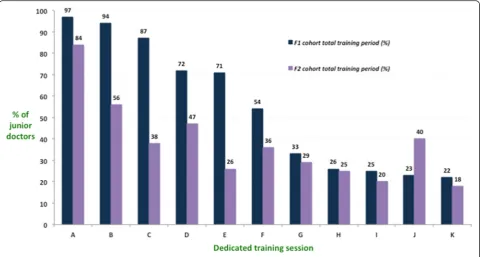
A total of 124 foundation trainees (7.2 %) completed the online questionnaire from 16 NHS Hospital Trusts and included 69 F1s (55.6 %) and 55 F2s (44.4 %). 87 % of F1s reported that they received dedicated training in safe prescribing at their NHS Trust induction (n= 60, 95 % confidence interval [CI] = 79–95 %) in comparison to 49 % of F2 doctors (n= 27, CI = 30–68 %). 80 % of F1s had a practical prescribing session during induction (n= 55, CI = 69–91 %), while the corresponding figure for the F2s was 27 % (n= 15, CI = 5–49 %). This difference was significant,
X2(1,N= 124) = 34.23,p <0.0001. By the end of the 1-year
training period, which included induction, a total of 94 % of F1s (n= 65, 95 % CI = 88–100 %) and 56 % of F2s (n= 31, 95 % CI = 39–73 %) had received a dedicated training session in practical prescription writing (including drug chart workshops). This dif-ference was also significant, X2 (1, N= 124) = 25.07,
p <0.0001 [Fig. 2].
Who provides the training?
Seventy eight percent of all foundation trainees (n= 97, 95 % CI = 70–86 %) reported dedicated training in safe pre-scribing by a clinical pharmacist. 55 % completed online training relating to safe prescribing (n= 68, 95 % CI = 43– 67 %). Clinical pharmacologists provided a dedicated ses-sion to just 11 % of foundation trainees (n= 14), but received the highest proportion of respondents who found their session(s) very effective 79 % (n= 11) [Fig. 3].
Impact of training on confidence
Ninety percent of F1 doctors reported confidence had improved to some degree by the end of the training period, compared to 65 % of F2 doctors. Only one re-spondent reported a negative change in prescribing con-fidence by the end of the training period; this was an F2 doctor.
Qualitative data
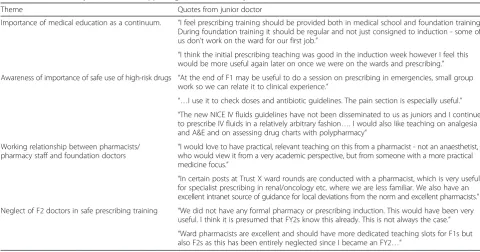
There were 32 doctors’responses to the optional qualita-tive question in the trainee questionnaire and a thematic analysis highlighted four emerging themes [Table 1]:
Importance of medical education as a continuum - 7 out of the 32 responses commented on the importance of the medical education continuum from undergraduate to postgraduate phases, but also on the importance of build-ing on the trainbuild-ing received durbuild-ing induction throughout
the foundation programme and the need for more training on the whole.
Awareness of importance of training in the safe use of high-risk drugs - 7 of the 32 respondents acknowledged the importance of teaching and learning around high risk drugs such as opioids, antibiotics, anticoagulants, or patient groups who may be more vulnerable to effects of drugs: renal, paediatric, oncology.
Working relationship between pharmacists/pharmacy staff and foundation doctors - this was mentioned by 6 of the 32 participants, and referred to the positive as-pects of pharmacists being knowledgeable, accessible and approachable, as well as how patient safety can be affected when these relationships break down.
Neglect of F2 doctors in safe prescribing training was mentioned by 4 of the trainees - all spoke about a lack of dedicated training session’s relating to safe prescrib-ing, and how there are often incorrect assumptions made about F2 knowledge and experience.
Discussion
Table 1Thematic analysis results and supporting statements from junior doctors
Theme Quotes from junior doctor
Importance of medical education as a continuum. “I feel prescribing training should be provided both in medical school and foundation training. During foundation training it should be regular and not just consigned to induction - some of us don’t work on the ward for our first job.”
“I think the initial prescribing teaching was good in the induction week however I feel this would be more useful again later on once we were on the wards and prescribing.”
Awareness of importance of safe use of high-risk drugs “At the end of F1 may be useful to do a session on prescribing in emergencies, small group work so we can relate it to clinical experience.”
“…I use it to check doses and antibiotic guidelines. The pain section is especially useful.” “The new NICE IV fluids guidelines have not been disseminated to us as juniors and I continue to prescribe IV fluids in a relatively arbitrary fashion…. I would also like teaching on analgesia and A&E and on assessing drug charts with polypharmacy”
Working relationship between pharmacists/
pharmacy staff and foundation doctors “
I would love to have practical, relevant teaching on this from a pharmacist - not an anaesthetist, who would view it from a very academic perspective, but from someone with a more practical medicine focus.”
“In certain posts at Trust X ward rounds are conducted with a pharmacist, which is very useful for specialist prescribing in renal/oncology etc. where we are less familiar. We also have an excellent intranet source of guidance for local deviations from the norm and excellent pharmacists.”
Neglect of F2 doctors in safe prescribing training “We did not have any formal pharmacy or prescribing induction. This would have been very useful. I think it is presumed that FY2s know this already. This is not always the case.” “Ward pharmacists are excellent and should have more dedicated teaching slots for F1s but also F2s as this has been entirely neglected since I became an FY2…”
Trusts attempt to address this unpreparedness and transi-tion by offering prescribing training to their F1 doctors. However, due to a lack of agreed national or regional stan-dards for the training of junior doctors in safe prescribing, there is little consistency in how various NHS Trusts en-sure competencies are achieved [13].
The absence of a standardised programme of the in-duction provided by NHS Trusts within the region to foundation doctors is concerning, and perhaps more so the fact that one Trust reported that attendance at such a programme was not mandatory. More needs to be done to minimise the stress and anxiety in junior doc-tors that has been reported during this transition phase [11, 12]. A well-structured induction programme with essential components such as safe practical prescribing training might address this obvious gap.
Results from this study also indicate that a minority of NHS hospital trusts appear to provide dedicated training in making a diagnosis, establishing therapeutic goals, com-munication, and discussing management options with pa-tients; all processes recognised as being important aspects of the prescribing process [14, 15]. However we noted that the junior doctors themselves indicate that they were well versed in such topics as a result of effective teaching and learning during their undergraduate course. These data corroborate the existing literature that indicates that such tasks were not associated with a feeling of unpreparedness [12]. Arguably, in the light of damaging reports about poor standards of care within the NHS, all tasks associated with the prescribing process should be included in a more formal and visible way in any safe prescribing training programmes irrespective of NHS Trust, i.e. a more stan-dardised content of training. The idea that competency frameworks such as the WHO or BPS guidelines could be used to identify educational interventions for each compe-tency domain has been highlighted [16], and appears to be a logical approach.
Literature documenting the post-graduate teaching and learning of safe prescribing is sparse but there is evi-dence that learning in the applied setting has been shown to boost prescribing confidence [9]. However, as the association between confidence and competence has not been well established [17], complacency in this area of research is not an option.
It is gratifying to note, from results of this study, that by the end of the training year almost all F1s have had some dedicated training in practical prescribing (94 %) and pharmaceutical calculations (87 %) which are both important aspects of the prescribing process especially at the extremities of age and with impaired physiological func-tion. In comparison, just over a third of F2s receive a dedi-cated session in these areas by the end of their training year. The timing of the training is also an issue for F2s, in par-ticular, with 36 and 27 % receiving the training at induction
for the practical prescription writing and pharmaceutical calculations respectively. The training provided is more pur-poseful if it occurs earlier during the training year, to sup-port the transition; a period that has been well documented as being an area of concern [11, 12].
Although the transition in medical education from undergraduate to postgraduate is better understood, there is a paucity of data relating to the transition from F1 to F2. There remains uncertainty as to why NHS Trusts do not routinely offer safe prescribing training for F2 doctors, or indeed why the error rate is greatest amongst this co-hort. What is clear from this study is that we might be fail-ing to support F2 doctors, who themselves feel that NHS Trusts often make incorrect assumptions about their cap-abilities:“I think it is presumed that F2s know this already. This is not always the case.”[Table 1]. Potential neglect of the F2 trainees is highlighted in this study.
It has been recommended that sources of drug informa-tion are clearly outlined and readily available in clinical workplaces [3]. In order for trainees to have an awareness of such sources of information, appropriate signposting sessions need to be optimised for all trainees. Considering it is not possible to determine how much education is enough, due to variability in how and when people learn, equipping junior doctors with knowledge of the sources of information early in their training is vital. Ideally, such training should be delivered during induction to raise awareness amongst F1 and F2s, before they are required to depend on these sources on the wards, and a more robust and mandatory induction could further support the trainees at the point of transition. The F2s in this study felt that unrealistic assumptions are often made about their knowledge or prescribing experience and therefore they do not receive enough dedicated training in this area of prac-tice. The optimal amount of training in practical prescrib-ing for the F2 cohort of doctors is currently unknown but considering that these doctors have highest prescribing error rate, perhaps more should be done [3].
Despite online learning resources being offered in many Trusts to a significant number of trainees, its perceived ef-fectiveness in this study was unclear. Further investigations as to the reasons for this are required. The benefits of using e-learning in the undergraduate domain have been discussed elsewhere [16, 18], but perhaps its use in the context of postgraduate education is not being optimised.
Limitations
This study sought to identify the training provisions for safe and effective practical prescribing within the STFS re-gion and not their efficacy. Whilst our data suggest gaps in the provision of safe and effective prescribing training, we have not considered why these gaps are present or how they might affect patient safety. Although there ap-pears to be a positive impact of the training on confidence in prescribing, it would be necessary to establish a link be-tween training provisions and prescribing errors to deter-mine their true value. However there are confounding factors that might make the evaluation of the effectiveness of this process very challenging.
The authors acknowledge that the response rate for the trainees’questionnaire was low and as a result the sample size of the study is a limitation in terms of its generalis-ability. A study sampling a greater number of trainees might produce data that highlight the situation nationally. It is worthy of note however, that the majority of NHS Trusts in the region were represented. Furthermore, the fact that the data from both groups (foundation doctors and prescribing leads) gives a consistent insight provides some reassurance that results might reflect the prevailing situation. However, further studies are indicated in order to ensure validity.
Conclusion
The variation in the teaching and learning of pharmacol-ogy and therapeutics in UK medical schools, and an asso-ciated lack of emphasis on practical prescribing within UK is well recognised [19]. The current study suggests that a similar trend can be seen in the postgraduate domain.
Despite on-going research in an attempt to reduce prescribing errors it remains a significant problem. One of the fundamentals of therapeutics is the ability to write a clear, legible and safe prescription and most NHS Hos-pital Trusts do provide some training in safe and effect-ive practical prescribing to their junior doctors, but perhaps a review of the training might optimise the ap-proach and content. NHS Trusts must assume responsi-bility to ensure that all Foundation doctors feel prepared to undertake this complex task. A more consistent ap-proach across regions in terms of safe prescribing train-ing provisions, with a greater emphasis on the induction period and on F2 doctors might be beneficial.
In spite of the limitations of this study, the results might prompt NHS Hospital Trusts to review their training in safe and effective practical prescribing in early postgradu-ate medical training. The development of minimum stan-dards for the teaching and learning of safe prescribing during the foundation years of training should be ex-plored. We propose that all NHS Trusts provide training, which includes a practical prescribing session, at induc-tion. In addition, as F1 and F2 needs are slightly different there should be a separate induction process placing em-phasis on the more important aspects for each group.
Additional files
Additional file 1:Trainee questionnaire. (DOCX 309 kb)
Additional file 2:Trainer questionnaire. (DOCX 307 kb)
Acknowledgements
This study was funded by Brighton & Sussex Medical School. Thanks to colleagues at Health Education Kent Surrey and Sussex, the South Thames Foundation School and individuals at each NHS Trust for their support and help in disseminating questionnaires to participants.
Availability of data and materials
These data form part of a thesis in progress. Therefore data are not yet publically available. However, data may be made available from authors upon reasonable request.
Authors’contributions
MO, SW, IH and MK contributed to the study conception and design. MK was primarily responsible for data collection. MO, SW, MM and MK contributed to analysis and interpretation of the data. MK, SW and MO prepared the initial draft with all authors contributing to subsequent critical review and redrafting of the manuscript. All authors approved the final manuscript.
Competing interests
The authors declare that they have no competing interests.
Consent for publication
Not applicable.
Ethics approval and consent to participate
This study had full ethical approval from the Brighton and Sussex Medical School Research Governance and Ethics Committee (RGEC) [reference 14/015/ OKO]. Consent was considered to have been obtained by the participant filling in the survey and sending their response. This was clearly stated in the covering letter for the survey and was approved by RGEC.
Author details
1Division of Medical Education, Brighton and Sussex Medical School,
Brighton, United Kingdom.2Medical Statistics, Division of Medical Education,
Brighton and Sussex Medical School, Brighton, United Kingdom.3Sydney Medical Program, Office of Medical Education, University of Sydney, Sydney, Australia.4Health Psychology, School of Pharmacy and Biomolecular
Sciences, University of Brighton, Brighton, United Kingdom.5Medicine and
Medical Education, Division of Medical Education, Brighton and Sussex Medical School, Brighton, United Kingdom.
Received: 9 February 2016 Accepted: 18 August 2016
References
1. Mucklow J, Bollington L, Maxwell S. Assessing prescribing competence. Br J Clin Pharmacol. 2012;74(4):632–9.
3. Dornan T, Ashcroft D, Heathfield H, Lewis P, Miles J, Taylor D, Tully M, Wass V. An in depth investigation into causes of prescribing errors by foundation trainees in relation to their medical education. EQUIP study. A report for the GMC 2009 (Online). Available from: http://www.gmc-uk.org/FINAL_Report_ prevalence_and_causes_of_prescribing_errors.pdf_28935150.pdf (Accessed July 2015).
4. Avery T, Barber N, Ghaleb M, Franklin B, Armstrong S, Crowe S, Dhillon S, Freyer A, Howard R, Pezzolesi C, Serumaga B, Swanwick G, Talabi O. Investigating the prevalence and causes of prescribing errors in general practice: The PRACtICe Study (PRevalence And Causes of prescrIbing errors in general practiCe). A report for the GMC 2012 (Online). Available from: http://www.gmc-uk.org/Investigating_the_prevalence_and_causes_of_prescribing_errors_in_ general_practice___The_PRACtICe_study_Reoprt_May_2012_48605085.pdf (Accessed April 2014).
5. Heaton A, Webb DJ, Maxwell SRJ. Undergraduate preparation for prescribing: The views of 2413 UK medical students and recent graduates. Br J Clin Pharmacol. 2008;66(1):128–34.
6. General Medical Council. Promoting excellence: standards for medical education and training (previously Tomorrow’s Doctors). 2016 (Online). Available at www.gmc-uk.org (Accessed 6 Jan 2016).
7. The Foundation Programme. The UK Foundation Programme Curriculum 2012 (Updated for 2014). 2012. Online at, http://www.foundationprogramme.nhs.uk/ pages/home (Accessed January 2015).
8. Tobaiqy M, McLay J, Ross S. Foundation year 1 doctors and clinical pharmacology and therapeutics teaching. A retrospective view in light of experience. Br J Clin Pharmacol. 2007;64(3):363–72.
9. Rothwell C, Burford B, Morrison J, Morrow G, Allen M, Davies C, Baldauf B, Spencer J, Johnson N, Peile E, Illing J. Junior doctors prescribing: enhancing their learning in practice. Br J Clin Pharmacol. 2012;73(2):194–202. 10. NHS Health Education England. South Thames Foundation School
Prospectus (programmes commencing August 2016). 2016.
11. Tallentire VR, Smith SE, Wylde K, Cameron HS. Are medical graduates ready to face the challenges of Foundation training? Postgrad Med J. 2011; 87(1031):590–5.
12. Illing J, Morrow G, Kergon C, Burford B, Spencer J, Peile E, Davies C, Baldauf B, Allen M, Johnson N, Morrison J, Donaldson M, Whitelaw M, Field M. How prepared are medical graduates to begin practice? A comparison of three diverse UK medical schools. 2008. Available from: http://www.gmc-uk.org/ FINAL_How_prepared_are_medical_graduates_to_begin_practice_ September_08.pdf_29697834.pdf (Accessed May 2015).
13. The National Prescribing Centre (NPC). A single competency framework for all prescribers. May 2012. Available from: https://www.
associationforprescribers.org.uk/images/Single_Competency_Framework.pdf (Accessed May 2015)
14. British Pharmacological Society. Ten Principles of Good Prescribing. Available from: www.bps.ac.uk: (Online); 2010 (Accessed October 2015). 15. de Vries TPMG, Henning RH, Hogerzeil HV, Fresle DA. Guide to good prescribing,
a practical manual. World Health Organisation. Available from: http://apps.who. int/iris/bitstream/10665/59001/1/WHO_DAP_94.11.pdf?ua=1
(Accessed June 2015).
16. Kamarudin G, Penm J, Chaar B, Moles R. Educational interventions to improve prescribing competency: a systemtic review. BMJ Open. 2013;3:e003291.
17. Ryan C, Ross S, Davey P, Duncan EM, Francis JJ, Fielding S, Johnston M, Ker J, Lee AJ, MacLeod MJ, Maxwell S, McKay GA, McKay JS, Webb DJ, Bond C. Prevalence and causes of prescribing errors: the prescribing outcomes for trainee doctors engaged in clinical training (PROTECT) study. PLoS One. 2014;9(1):e79802.
18. Maxwell S, Mucklow J. e-Learning initiatives to support prescribing. Br J Clin Pharmacol. 2012;74:621–31.
19. O’Shaughnessy L, Haq I, Maxwell S, Llewelyn M. Teaching of clinical pharmacology and therapeutics in UK medical schools: current status in 2009. Br J Clin Pharmacol. 2010;70(1):143–8.
• We accept pre-submission inquiries
• Our selector tool helps you to find the most relevant journal
• We provide round the clock customer support
• Convenient online submission
• Thorough peer review
• Inclusion in PubMed and all major indexing services
• Maximum visibility for your research
Submit your manuscript at www.biomedcentral.com/submit