H E L G O ~ D E R MEERESUNTERSUCHUNGEN Helgol~nder Meeresunters. 44,329-334 (1990)
A n e w d e v i c e for s a m p l i n g water from the benthic
b o u n d a r y layer
U-If Eversberg*
Institut fiir Meereskunde; D[isternbrooker Weg 20, D-W-2300 Kiel I, Germany
ABSTRACT: An instrument is described, which coUects water from the benthic boundary layer in shaUow waters with a maximum depth of 50 m. Four water samples of 7 1 each can be collected between 5 cm and 40 cm above the sediment. Handling is easy, and the sampling operation is short enough to allow repeated employment even on time-limited, routine investigations. First results show gradients in the organic matter and seston content of samples from the 5 to 35 cm above the sediment. The oxygen concentrations near the sea bottom decreased faster than those 3 m above, just below the summer pycnocline.
INTRODUCTION
While k n o w l e d g e of processes i n b e n t h i c a n d p e l a g i c e n v i r o n m e n t s has i n c r e a s e d quickly i n r e c e n t years, there is little i n f o r m a t i o n c o n c e r n i n g processes at the s e d i m e n t - w a t e r interface. This is partly b e c a u s e there are so few i n s t r u m e n t s able to s a m p l e w a t e r close to the sediment. Such samples are n e c e s s a r y to i n v e s t i g a t e c o n c e n t r a t i o n s a n d composition of particulate material a n d dissolved material such as n u t r i e n t s (e.g. Nixon, 1981) or pollutants. Such samples also help to u n d e r s t a n d the i m p o r t a n c e of s u s p e n s i o n f e e d i n g or lateral transport n e a r the s e d i m e n t (cf. Frithsen & Doering, 1986; Grant, 1984; Graf, 1987). Water samplers usually e m p l o y e d for this p u r p o s e i n p l a n k t o n r e s e a r c h are d o o m e d to failure d u e to their design. Most w a t e r samplers, for e x a m p l e the N i s k i n type, c a n n o t b e l o w e r e d close to the bottom, a n d furthermore they s a m p l e a r a n g e covering the full l e n g t h of the i n s t r u m e n t , i.e. up to 1.5 m.
To o b t a i n w a t e r s a m p l e s from the n e a r - b o t t o m b o u n d a r y layer, specially d e s i g n e d e q u i p m e n t is necessary. Such e q u i p m e n t m u s t satisfy several conditions:
(1) T h e w a t e r s a m p l e m u s t not c o n t a i n material r e s u s p e n d e d t h r o u g h a p p h c a t i o n of the sampler.
(2) T h e w a t e r s a m p l e m u s t originate from a d e f i n e d w a t e r layer a b o v e the s e d i m e n t . (3) T h e i n s t r u m e n t s h o u l d b e small a n d easy to h a n d l e to e n a b l e r e p e a t e d e m p l o y m e n t
d u r i n g short r o u t i n e cruises.
T h e existing n e a r - s e d i m e n t water samplers (e.g. T e s s e n o w et al., 1977) do n o t fully m e e t these r e q u i r e m e n t s . In this paper, a n e w l y c o n s t r u c t e d device is p r e s e n t e d w h i c h satisfies the above conditions.
' Present address: Meereszoologie, Universit~it Bremen, Fachbereich 2, AuBenstelle: Bfirger- meister-Smidt-StraBe 20, D-W-2850 Bremerhaven
330 Ulf E v e r s b e r g
D E S I G N
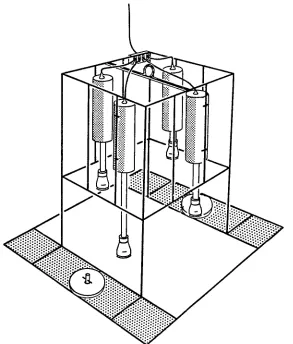
T h e w a t e r s a m p l e r (Fig. 1) consists of four cyhndrical PVC bottles m o u n t e d in a box- s h a p e d f r a m e of steel. T h e f r a m e is a s s e m b l e d on an iron grid w i t h l e a d w e i g h t s ; this e n s u r e s a firm footing on s a n d y as w e l l as on m u d d y s e d i m e n t s w i t h o u t a n y c o n s i d e r a b l e p e n e t r a t i o n into the substrate. T h e v o l u m e of t h e bottles is 7 1 each. B e l o w t h e bottles PVC t u b e s are m o u n t e d w h i c h e n l a r g e to a c o n e ( d i a m e t e r 8 cm) w i t h a 2 m m w i d e
::::.:...~
"M
Fig. 1. Steel frame with four PVC water bottles, water inlets at different heights above the ground plate. The hose (60 m) leads to a nitrogen tank and a safety valve above the surface
A b e n t h i c b o u n d a r y w a t e r s a m p l i n g d e v i c e 331
,C
Fig. 2. Schematic drawing of the water inlet and the ball valve. A = tubing; B = ball valve; C = cone; D = water inlet
O n board, t h e w a t e r bottles are filled with n i t r o g e n to a m a x i m u m p r e s s u r e of 6 bar. T h e ball v a l v e s p r e v e n t loss of pressure. T h e s a m p l e r is t h e n l o w e r e d by c a b l e to the s e d i m e n t . T h e h o s e has to r e m a i n slack e n o u g h to p r e v e n t d i s t u r b a n c e b y ship m o v e - ments. Before sampling, a w a i t i n g p e r i o d of s o m e m i n u t e s is n e c e s s a r y to a l l o w m a t e r i a l r e s u s p e n d e d d u r i n g d e p l o y m e n t to drift a w a y w i t h the current. T h e safety v a l v e is slowly o p e n e d on board, resulting in a r e d u c t i o n of gas p r e s s u r e in t h e instrument. W h e n the p r e s s u r e inside the bottles is l o w e r t h a n that outside, t h e ball v a l v e slowly o p e n s a n d w a t e r flows into t h e bottles. O n c e the w a t e r bottles are filled, the ball v a l v e s will close a g a i n b y g r a v i t a t i o n a n d the i n s t r u m e n t is h e a v e d on board. T h e w a t e r inlet is u n s c r e w e d a n d r e p l a c e d by a tap with a pin, w h i c h will lift t h e ball from the ball valve.
332 Ulf Eversberg
RESULTS AND DISCUSSION
T h e w a t e r s a m p l e r was tested u n d e r various w e a t h e r conditions at a d e p t h r a n g e of 10 m to 21 m o n sand, s a n d y - m u d a n d on mud. Usually, after 2.5 m i n (max. 4 min) no artificially r e s u s p e n d e d material was s e e n with the u n d e r w a t e r v i d e o system. D u r i n g s a m p l i n g (about 5 min), n o particles w e r e visibly s u c k e d off the s e d i m e n t surface into the w a t e r sampler. N e t c u r r e n t s p e e d w a s c o n t i n u o u s l y low (max. 2.5 cm/sec, m e a s u r e d b y a n A a n d e r a flowmeter), b u t some fast horizontal oscillations w e r e o b s e r v e d . T h e s e oscillations p r e v e n t e d the u s e of m o n o - d i r e c t i o n a l w a t e r inlets {Sternberg et al., 1986), b e c a u s e their o p e n i n g c a n n o t b e directed into the flow fast e n o u g h b y v a n e s . A s s u m i n g the s a m p l e (water v o l u m e 7 1} derives from a torus a r o u n d the w a t e r i n l e t ( d i a m e t e r 8 cm}, the vertical resolution is a b o u t +_ 10 cm in calm water. With i n c r e a s i n g c u r r e n t speed, resolution will b e better.
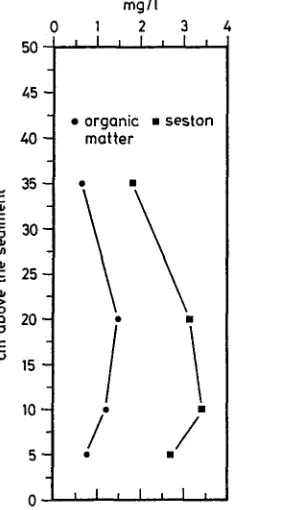
A typical seston a n d c o r r e s p o n d i n g organic w e i g h t profile is s h o w n i n Figure 3. W a t e r was collected i n M a y 1987 i n Kiel Bight, at 17 m w a t e r d e p t h a b o v e a s a n d y bottom
50
~5
40 35 84
t -
:6 3 0 -
2 s -
2 0 -
~ 1 5 - 10
5-
mg/I
0 1 2 3
I I i I r I f
9 organic 9 seston
matter
/
j"
~ I , I , I ,
Fig. 3. Seston dry weight and ash free dry weight (Afdw) of water samples at four heights above the sediment of Kiel Bight {water depth 17 m)
(Gabels Flach). As depicted, there is a n increase in seston a n d i n o r g a n i c w e i g h t from 35 cm a b o v e the s e d i m e n t to 20 cm a b o v e the s e d i m e n t a n d a further i n c r e a s e i n seston 10 cm a b o v e the s e d i m e n t . B e t w e e n 10 cm a n d 5 cm, seston c o n c e n t r a t i o n a n d organic w e i g h t d e c r e a s e rapidly.
r - E r
E
o
A b e n t h i c b o u n d a r y w a t e r s a m p h n g d e v i c e o x y g e n content of the w a t e r ( m g I -i )
2 4 6 8 10
, I,,, i I , I ,
15.00 -
3.00 - -
0.35 -
-0.20 _
0 . 1 0 -
0 . 0 5 -
--
.! / r
, ,
d
O
1
333
30.6. 15.8. 29.4. 18.4. 13.4. 17.3.
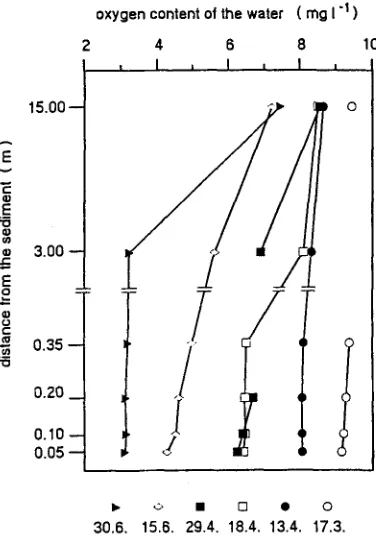
Fig. 4. Six oxygen concentration profiles from 1988. Water samples at four heights in close proximity to the s e d i m e n t surface, a n d two additional samples 3 m a n d 15 m above the s e d i m e n t
o x y g e n d a t a f r o m t h e w a t e r c o l u m n 3 m a n d 15 m a b o v e t h e s e d i m e n t a r e s h o w n . T h e d a t a s h o w n i n t h e f i g u r e a r e m e a n v a l u e s of t h r e e p a r a l l e l s w i t h t h r e e m e a s u r e m e n t s e a c h i n M a r c h a n d A p r i l . T h e s t a n d a r d e r r o r w a s a l w a y s l e s s t h a n 5 % . I n J u n e , o n l y 3 r e p l i c a t e s f r o m e a c h s a m p l e w e r e m e a s u r e d . W h i l e c h a n g e s of t h e o x y g e n c o n c e n t r a t i o n s a r e s m a l l n e a r t h e w a t e r s u r f a c e , t h e r e is a f a s t d e c r e a s e of t h e o x y g e n c o n t e n t n e a r t h e s e d i m e n t s t a r t i n g i n A p r i l . A t t h e e n d of J u n e , o n l y s m a l l a m o u n t s of o x y g e n w e r e f o u n d n e a r t h e s e a f l o o r a s w e l l a s 3 m a b o v e , j u s t b e l o w t h e s u m m e r p y c n o c h n e . T h e s e r e s u l t s s u g g e s t t h a t t h e n e w e q u i p m e n t p r o m i s e s a b e t t e r u n d e r s t a n d i n g of n e a r b o t t o m p r o c e s s e s .
Acknowledgements. I am i n d e b t e d to W. Queisser, M. Teucher, G. Graf, H. Beese, S. Podewski, K. Reiber a n d F. Kbster.
LITEI~.ATURE C I T E D
Frithsen, 3. B. & Doering, P. H., 1986. Active e n h a n c e m e n t of particle removal from the w a t e r column by tentaculate b e n t h i c Polychaetes. - Ophelia 25, 169-182.
Gral. G., 1987. Benthic responses to the a n n u a l s e d i m e n t a t i o n patterns. Interactions in coastal waters. Ed. b y E. Walger, B. Zeitschel & d. Rumohr. Springer, Berlin, 84-92.
3 3 4 Ulf E v e r s b e r g
Nixon, S. W., 1981. Remineralization a n d nutrient cycling in coastal m a r i n e ecosystems. In: Estuaries a n d nutrients. Ed. b y B. 3. Neilson & L. E. Cronin. H u m a n a Press, Chfton, 111-138.
Sternberg, R. W., Johnson, R. V., Cacchione, D. A. & Drake, D. E., 1986. A n i n s t r u m e n t system for monitoring a n d sampling s u s p e n d e d s e d i m e n t in the b e n t h i c b o u n d a r y layer. - Mar. Geol. 71,
187-199.