Psychology Research and Behavior Management 2018:11 37–45
Psychology Research and Behavior Management
Dovepress
submit your manuscript | www.dovepress.com 37
O R I G I N A L R E S E A R C H
open access to scientific and medical research
Open Access Full Text Article
How does cognitive dissonance influence the
sunk cost effect?
Shao-Hsi Chung1
Kuo-Chih Cheng2 1Department of Business
Administration, Meiho University, Pingtung, Taiwan; 2Department of
Accounting, National Changhua University of Education, Changhua City, Taiwan
Background: The sunk cost effect is the scenario when individuals are willing to continue to invest capital in a failing project. The purpose of this study was to explain such irrational behavior by exploring how sunk costs affect individuals’ willingness to continue investing in an unfavorable project and to understand the role of cognitive dissonance on the sunk cost effect. Methods: This study used an experimental questionnaire survey on managers of firms listed on the Taiwan Stock Exchange and Over-The-Counter.
Results: The empirical results show that cognitive dissonance does not mediate the relationship between sunk costs and willingness to continue an unfavorable investment project. However, cognitive dissonance has a moderating effect, and only when the level of cognitive dissonance is high does the sunk cost have significantly positive impacts on willingness to continue on with an unfavorable investment.
Conclusion: This study offers psychological mechanisms to explain the sunk cost effect based on the theory of cognitive dissonance, and it also provides some recommendations for corporate management.
Keywords:sunk costs, sunk cost effect, cognitive dissonance, behavior, unfavorable investment
Introduction
Sunk costs are the costs that have occurred in the past and should be irrelevant to future decisions.1 In fact, sunk costs still affect decision-makers’ continued investment
willing-ness in a failing project. They do not treat the sunk costs as sunk, thus producing the sunk cost effect.2 Over the past half century, research of the suck cost effect has focused
on exploration of probable factors that explain the cause of the sunk cost effect. Factors including self-justification, framing effects, risk perception, escalation of commitment, mental accounting, disposition effect, anticipated regret, tendency to keep doors open, personal responsibility, agency theory, and completion effect have been identified to uncover the inherent nature of the sunk cost effect.3–13 Because the sunk cost effect is
prevalent in the investment decision of modern enterprise and this effect is a possible cause of investment losses, the study of the sunk cost effect is worthy of attention.
Cognitive dissonance is a kind of cognitive bias associated with a psychologically uncomfortable state.14 Such dissonance may lead to memory errors, inaccurate
judg-ments, and faulty logic.15 Because certain types of cognitive bias have direct impacts
on the risk perceptions of entrepreneurs and influence the way they cope with risks lurking in their decisions,there is growing interest in whether and how individual
Correspondence: Kuo-Chih Cheng Department of Accounting, National Changhua University of Education, No.2, Shi-Da Road, Changhua City, 500, Taiwan Tel +886 4 723 2105 EXT 7501 Email [email protected]
Journal name: Psychology Research and Behavior Management Article Designation: ORIGINAL RESEARCH
Year: 2018 Volume: 11
Running head verso: Chung and Cheng
Running head recto: Cognitive dissonance influences sunk cost effect DOI: http://dx.doi.org/10.2147/PRBM.S150494
Psychology Research and Behavior Management downloaded from https://www.dovepress.com/ by 118.70.13.36 on 26-Aug-2020
For personal use only.
Dovepress
Chung and Cheng
cognitive bias affects the sunk cost effect.16,17 However, since
cognitive dissonance is a kind of mental state and an elusive concept, it is hard to observe, record, and track.18 So, there
is still no research on the influence of cognitive dissonance on the sunk cost effect.
By conceptualization and definition, cognitive dissonance includes two components, “arousal dissonance”, which is the cognitive aspect, and “discomfort dissonance”, which is the emotional aspect.19–21 The arousal dissonance is induced when a
decision is taken and the cognitions direct decision-makers into different beliefs, thus arousing cognitive confliction.19 From
the cognitive view of dissonance arousal, this study argues that the cognitive dissonance of decision-makers is caused by an initial investment decision on an unfavorable project, and postulates that cognitive dissonance plays an intermediary role in the relationship between sunk costs and willingness of continuing to invest. In the emotional aspect of cognitive dissonance, discomfort dissonance is a person’s psychological uncomfortable state, which comes from the changes in one’s emotions subsequent to the decision-making, often linked with anxiety and uncertainty.21 In this view, we suppose that
cognitive dissonance plays a role as a moderator on the causal relationship of the sunk cost effect, where the influence of different level of cognitive dissonance will differ. The aim of the study is to confirm that cognitive dissonance has a mediat-ing effect on the sunk cost effect, and/or a moderatmediat-ing effect. As a result, we hope to obtain a better understanding of the psychological mechanism of cognitive dissonance underlying the sunk cost effect.
Literature review and hypothesis
development
Sunk costs and sunk cost effect
Sunk costs, the past occurred costs, which can be regarded as stimuli, provide a strong impetus to continue an invest-ment project.2 In microeconomics, a rational individual
facing a resource allocation problem will consider his or her preferences and limited resources to make an ideal choice among multiple alternatives. However, in reality, decision-makers are often affected by the amount of input sunk costs, especially when their investment project gets into an unfavorable situation, which in turn causes the sunk cost effect.17,18 Under the sunk cost effect, considering the
substantial cash payout, decision-makers are unwilling to withdraw from an unfavorable project but only keep the project going for fear of instantly seeing the sunk costs turning into an immediate loss, which would finally cause serious losses.22
Cognitive dissonance and sunk cost effect
Cognitive dissonance refers to a situation involving con-flicting attitudes, beliefs, and behaviors.14 If a paradoxical
situation exists between belief and behavior, decision-makers would be in an uneasy and anxious mental condition, which would force them to try desperately to find an explanation for the discordance. When there is a feeling of inconsistency, decision-makers will naturally be prompted to seek resolu-tions to rule out the mental anguish, usually by struggling to find a way to change one or both cognitions to make them consonant.23 This process might be thought of as an
individual trapped in a conflict between behavior and belief often performing a self-justification process to rationalize his or her previous actions or to psychologically protect himself or herself against a perceived error in behavior.24 In this study,
we use the potential psychological mechanisms of cognitive dissonance to explore its mediation and moderation effects on the sunk cost effect and establish a relevant hypothesis.
Mediating effect of cognitive dissonance
In a review of literature addressing the sunk cost effect, the research stated that “through an effort-justification mecha-nism, people account for the amount of behavioral resources invested when selecting an alternative, in which case they may fall prey to purely behavioral sunk cost effects”.18 People fail
to ignore prior investments mainly due to a greater motiva-tion to minimize losses than to maximize gains.25 For this
kind of value-induced motivation, they would be motivated to compromise their self-interest in order to avoid a greater loss.26 However, when decision-makers are entrapped in the
sunk costs fallacy, although they are clearly aware that they should not continue to invest in a nonperforming or failing project, they constantly act otherwise and produce conflict-ing cognitions. In the cognitive view of arousal dissonance, cognitive dissonance is aroused by the amount of sunk costs taken in prior decision. Thus, sunk costs may bring cognitive dissonance, and the higher the fear for large loss results from immediate dropping-out, the larger the cognitive dissonance that would emerge.
Once a decision is made, for reducing cognitive dis-sonance, subsequent preferences will be revealed along with an increase in the attractiveness of the chosen alter-native and a decrease in the attractiveness of the rejected alternatives.18,27 Although individuals and organizations may
hold strong norms for rational and goal-directed behav-ior, their actions generally fall far short of these ideals.28
Hence, people with cognitive dissonance may continue investing in an attempt to achieve success and demonstrate
Psychology Research and Behavior Management downloaded from https://www.dovepress.com/ by 118.70.13.36 on 26-Aug-2020
Dovepress Cognitive dissonance influences sunk cost effect
that their previous decisions are not poor. Based on this rationale, since a lot of investment costs have been input into the project causing much arousal dissonance, decision-makers with a sense of increasing cognitive dissonance would frantically seek to justify their prior decisions, thus expressing stronger willingness to continue a nonperform-ing investment project. Briefly, decision-makers’ cognitive dissonance would be aroused by the sunk costs and they would then engage in rationalization to alleviate the con-flict state. Thus, cognitive dissonance plays a pivotal and intermediary role between sunk costs and willingness to continue investing in an unfavorable project. The mediating effect of cognitive dissonance is hypothesized as follows: Hypothesis 1: Cognitive dissonance has a mediating effect on the relationship between sunk costs and willingness to continue an unfavorable investment project.
Moderating effect of cognitive
dissonance
Decision-makers make irrational decisions as cognitive dis-sonance disturbs their rationality.29 The emotional view of
discomfort dissonance holds that cognitive dissonance of a decision maker emerges due to emotional changes following the free choice decision-making.20 The emotional
compo-nent of cognitive dissonance brings about an uncomfortable status that motivates dissonance reduction, as expected by dissonance theory.21 In this argument, we suggest that the
uncomfortable emotional part of cognitive dissonance will interfere with the formation of the sunk cost effect. In terms of the person’s discomfort dissonance, we predicted that when a decision maker has high cognitive dissonance, in order to reduce the risk of input capital waste and disgrace caused by interrupting an investment, they are willing to continue an unfavorable investment, to justify consciously unaccept-able and conflictive behaviors, thus causing the sunk cost effect. However, when the cognitive dissonance is low, they look back on the past input costs with a rational attitude and treat sunk costs as sunk, so the sunk costs have less effect on willingness to continue an investment; therefore, the sunk cost effect does not occur significantly. Accordingly, we suppose that cognitive dissonance has a moderating effect on the relationship between sunk costs and willingness to keep investing and we propose the following hypothesis: Hypothesis 2: Compared with low cognitive dissonance, when cognitive dissonance is high, the relationship between sunk costs and willingness to continue an unfavorable invest-ment project is more positive.
Methodology
Participants and experimental
questionnaire
This study adopted an experimental questionnaire sur-vey. The Academic Ethics Committee of the Accounting Department, the Graduate Institute of Accounting, and the EMBA at the National Changhua University of Education, authorized by the Ministry of Education, have reviewed this research. The Committee confirmed that the research conforms with the ethical norms to ensure that the rights and welfare of the research participants are adequately protected. We informed the participants in the preface of the questionnaire that the research was voluntary and anonymous. Written informed consent was provided by participants confirming their agreement to participate in the research. This study did not pay any compensation to participants and has no conflicts of interest. The partici-pants of this study are managers of companies listed on the Taiwan Stock Exchange and Over-The-Counter com-panies including electronic communication, transporta-tion, manufacturing, and service industries. A total of 170 questionnaires were sent to the managers, and 134 were received back. Afterward, six invalid questionnaires were removed because the responders did not clearly understand the scenario and questions in the questionnaire or did not fill it in completely. So, the total number of valid responses was 128, resulting in an effective recovery rate of 75%. Each questionnaire consisted of three sections (Figure S1), and a narrative case was given for decision-making.30 In
the experimental process, participants were randomly given one of four scenarios, each representing a different level of sunk costs. They were asked to read the scenario and then choose the level of willingness to continue an unfavorable investment project. Among 128 participants, 84 (65.6%) were male and 112 (87.5%) were educated to a bachelor’s degree level or higher. Ninety-five (74.2%) had more than 10 years work experience, and 103 (80.5%) were 31–50 years old.
Measure and analysis method
Sunk costs
Sunk costs were set as a manipulated variable. Participants were randomly assigned to one of the four levels (15%, 40%, 65%, or 90%). The numbers of valid participants in the four sunk cost levels were 33, 31, 34, and 30, respectively.
Psychology Research and Behavior Management downloaded from https://www.dovepress.com/ by 118.70.13.36 on 26-Aug-2020
Dovepress
Chung and Cheng
Cognitive dissonance
Cognitive dissonance is operationally defined in this study as psychologically uncomfortable states caused by cogni-tive conflicts given that the sunk costs have occurred. The questionnaire used to measure cognitive dissonance was developed by prior research.19 The magnitude of cognitive
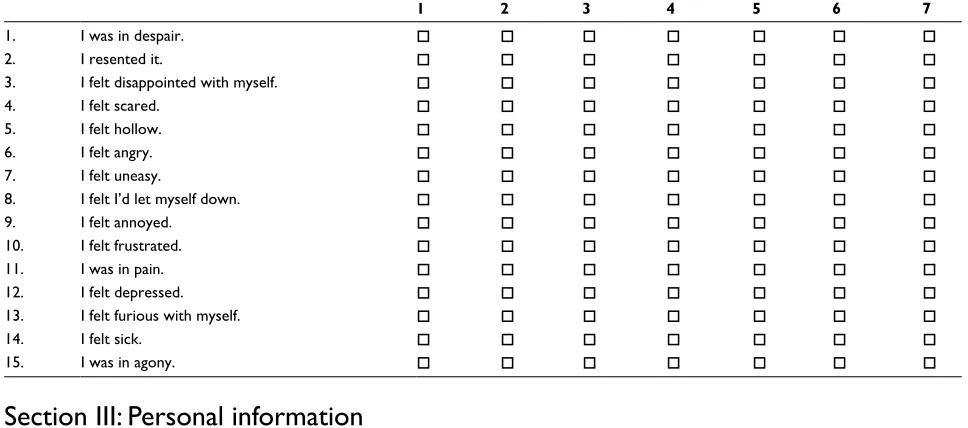
dis-sonance was gauged by the total score of the fifteen questions that were rated on a seven point Likert scale. A higher score indicated a higher level of cognitive dissonance. Cronbach’s
α was 0.87 in this study.
Willingness to continue the investment
project
Participants were requested to read a scenario related to four cases of sunk costs and decide their willingness to continue the investment project. The degree of willingness to continue was measured using a 0%–100% scale, with a 10% interval, where 0% indicates “definitely would not continue” and 100% denotes “definitely would continue”.
Analysis of mediation effect
To test whether sunk costs (SUNK) affect willingness to continue an unfavorable investment project (WILLING-NESS) indirectly under the mediation of cognitive dissonance (DISSONANCE), this study estimated the path coefficients using the following structural equations:
DISSONANCE =g11 SUNK +x1 (I)
WILLINGNESS =g21 SUNK +b21 DISSONANCE +x2 (II)
The variable DISSONANCE functions as a mediator when it meets the following requirements: 1) variations in SUNK significantly account for variations in the presumed mediator DISSONANCE, that is, g11 is significant in equa-tion (I), 2) variaequa-tions in DISSONANCE significantly account for variations in WILLINGNESS, that is, b21 is significant in equation (II), and 3) when conditions (1) and (2) are controlled, g21 in equation (II) is less than the correlation coefficient between SUNK and WILLINGNESS.31
Analysis of moderation effect
The moderation effect implies that the causal relation between the independent variable and dependent variable changes as a function of the moderating variable.31 Using DISSONANCE
as the moderator, this study examined whether SUNK has much more influence on WILLINGNESS when the level of DISSONANCE is high. To identify whether cognitive dissonance has a moderation effect, we employ the
hierar-chical regression analysis and set two regression equations as follows:
WILLINGNESS =b0+b1 SUNK +b2 DISSONANCE +e1
(III)
WILLINGNESS =b0+b1 SUNK +b2 DISSONANCE +
b3 SUNK×DISSONANCE+e2 (IV)
To confirm cognitive dissonance having a moderation effect, the coefficient of the product term (SUNK×DISSONANCE) in equation (IV) (ie, b3 ) must be significant, and the coefficient
of SUNK(ie, b1) must substantially decrease from equation
(III) to equation (IV).31 Moreover, to further test the nature of
the moderating effect, cognitive dissonance was dichotomized at the mean. The mean was selected as a split point to reveal a more natural division, in contrast to the median.32 A score
below the mean denoted low cognitive dissonance, while a score above the mean indicated high cognitive dissonance. The full samples were thus divided into two groups, and the two further regression analyses were implemented to assess the significance of the two groups’ slope.
Results
Manipulation check
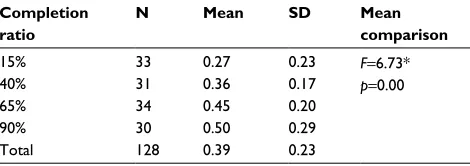
In this study, the effectiveness of manipulating the four levels of sunk costs was tested by comparing means of willingness to continue investments. The result, given in Table 1, shows that the four sunk cost levels have a significant difference (F=6.73, p<0.01). This indicates that the sunk cost scenarios have been effectively manipulated. In addition, the more the completion ratio, the higher the mean, revealing the existence of the sunk cost effect.
Descriptive statistics and correlation
Descriptive statistics and Pearson correlation coefficients (Pearson correlation analysis is applied for continuous
Table 1 Mean comparison of willingness to continue investments based on sunk cost levels
Completion ratio
N Mean SD Mean
comparison
15% 33 0.27 0.23 F=6.73*
p=0.00
40% 31 0.36 0.17
65% 34 0.45 0.20
90% 30 0.50 0.29
Total 128 0.39 0.23
Note: *p<0.01.
Abbreviation: SD, standard deviation.
Psychology Research and Behavior Management downloaded from https://www.dovepress.com/ by 118.70.13.36 on 26-Aug-2020
Dovepress Cognitive dissonance influences sunk cost effect
variables and interval variables.33 In this study, cognitive
dissonance is continuous, while sunk costs and willingness of continuing investments are interval. It is thus justified to compute Pearson correlation coefficients among these research variables.) of variables are presented in Tables 2 and 3, respectively. Except for a significant correlation between SUNK and WILLINGNESS (r=0.40, p<0.01), the correlations between SUNK and DISSONANCE and between DISSONANCE and WILLINGNESS were not significant.
Mediating effect of cognitive dissonance
The path coefficients of equation (I) and (II) are shown in Table 4. Since g11 and b21 are not significant, the results do not meet requirements for cognitive dissonance to be a mediator. Thus, Hypothesis 1 is not supported.
Moderating effect of cognitive dissonance
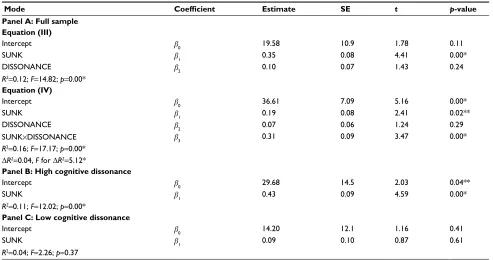
Table 5 shows the results of the regression analyses. Panel A presents the coefficients of equation (III) and (IV), where the coefficient of product term is significant (b3 =0.31, p<0.01). In addition, comparing the coefficient of SUNK in equation (III) and (IV), it reduces from b1= 0.35 (p<0.01) to b1= 0.19
(p<0.05). These results satisfy the requirements of cognitive dissonance to be the moderator. Panel B and Panel C present the results of high and low groups of cognitive dissonance, respectively. SUNK is significant in Panel B (b1 = 0.43,
p<0.01), but not in Panel C (b1= 0.09, p>0.1). It is clear that sunk costs only impact on willingness to continue investments in high cognitive dissonance, but not in low cognitive disso-nance. Thus, Hypothesis 2 is supported. The two regression lines of high and low cognitive dissonance are depicted in Figure 1. The intercept and slope are all greater in the regres-sion line of high cognitive dissonance, pointing out that the sunk cost effect is much more obvious when decision-makers act with high cognitive dissonance.
Conclusion and recommendations
The purpose of this study was to determine how cognitive dissonance affects the sunk cost effect. The findings tell us that there is only a moderating effect, but no mediating effect. The results could be explained by the psychological mechanism of the two components in cognitive dissonance, that is, arousal dissonance is not affected by sunk costs, but discomfort dissonance is attributed to sunk costs. An expla-nation for these results may be because the sunk cost decision was freely chosen by decision-makers, which explains why conflicting cognition was not aroused but psychological discomfort was felt internally.20 This study expounds the
potential psychological mechanism of cognitive dissonance on the sunk cost effect and has made a contribution to extending the theoretical framework in this research field. In practice, we provide some management recommendations. When an investment project is likely to fail and face the problem of continuity, this study found that decision-makers are often affected by sunk costs and tend to continue with the unfavorable investment. In order to avoid the individual cognitive dissonance to deepen the negative impact of the sunk cost effect, we suggest that enterprises should build an early warning and prevention system, such as an investment stop-loss mechanism, forcing decision-makers to terminate inefficient investment cases and avoid such serious losses. In
Table 2 Descriptive statistics
Variable Theoretical
score
Minimum Maximum Mean SD
SUNK 0.15–0.9 0.15 0.90 0.52 0.27
DISSONANCE 15–105 22 87 52.67 9.61
WILLINGNESS 0.00–1.00 0.00 1.00 0.39 0.23
Abbreviations: SD, standard deviation; SUNK, sunk costs; DISSONANCE, cognitive dissonance; WILLINGNESS, willingness to continue investments.
Table 3 Pearson correlation
Variable SUNK DISSONANCE
SUNK
DISSONANCE 0.11 (0.16)
WILLINGNESS 0.40 (0.00*) 0.09 (0.21)
Note:*p<0.01.
Abbreviations: SUNK, sunk costs; DISSONANCE, cognitive dissonance; WILLINGNESS, willingness to continue investments.
Table 4 Results of path analysis
Path Path coefficient Estimate z p-value
Independent variable Dependent variable
SUNK → DISSONANCE g11 0.11 1.00 0.16
SUNK → WILLINGNESS g21 0.41 2.96 0.00*
DISSONANCE → WILLINGNESS b21 0.04 0.45 0.33
Note: *p<0.01.
Abbreviations: SUNK, sunk costs; DISSONANCE, cognitive dissonance; WILLINGNESS, willingness to continue investments.
Psychology Research and Behavior Management downloaded from https://www.dovepress.com/ by 118.70.13.36 on 26-Aug-2020
Dovepress
Chung and Cheng
addition, a collective decision-making system can be set so as to avoid a single person from influencing major investment decisions. At the same time, the corporate management can strengthen the linkage between personal performance and investment project performance. The performance evalua-tion period of an investment project can also be designed to timely discover an erroneous decision. For future research, we suggest studying other psychological variables such as overconfidence and optimism to enrich the issue of explain-ing the sunk costs effect. In addition, researchers can extend
this study further to consider how to reduce the sunk cost effect. For example, managerial incentives may reduce managers’ attempts to invest in a failing project. Besides, the organization identity and emphasis on achievement of budgetary goals are all possible factors that can affect the decision of whether to continue on with an unfavorable investment. This study has some limitations. Because each manager was requested to answer all items in the question-naire, common method variances could exist and affect our results. However, since we efficiently manipulated the
Table 5 Results of regression analyses
Mode Coefficient Estimate SE t p-value
Panel A: Full sample Equation (III)
Intercept b0 19.58 10.9 1.78 0.11
SUNK b1 0.35 0.08 4.41 0.00*
DISSONANCE b2 0.10 0.07 1.43 0.24
R2=0.12; F=14.82; p=0.00*
Equation (IV)
Intercept b0 36.61 7.09 5.16 0.00*
SUNK b1 0.19 0.08 2.41 0.02**
DISSONANCE b2 0.07 0.06 1.24 0.29
SUNK×DISSONANCE b3 0.31 0.09 3.47 0.00*
R2=0.16; F=17.17; p=0.00*
∆R2=0.04, F for ∆R2=5.12*
Panel B:High cognitive dissonance
Intercept b0 29.68 14.5 2.03 0.04**
SUNK b1 0.43 0.09 4.59 0.00*
R2=0.11; F=12.02; p=0.00*
Panel C:Low cognitive dissonance
Intercept b0 14.20 12.1 1.16 0.41
SUNK b1 0.09 0.10 0.87 0.61
R2=0.04; F=2.26; p=0.37
Note: Dependent variable: WILLINGNESS; *p<0.01, **p<0.05.
Abbreviations: SE, standard error of the mean; SUNK, sunk costs; DISSONANCE, cognitive dissonance; WILLINGNESS, willingness to continue investments.
Figure 1 The sunk cost effect in high/low cognitive dissonance.
Willingness to continu
e
Sunk costs
High cognitive dissonance
Low cognitive dissonance
Psychology Research and Behavior Management downloaded from https://www.dovepress.com/ by 118.70.13.36 on 26-Aug-2020
Dovepress Cognitive dissonance influences sunk cost effect
experimental scenarios, the common method variances can be minimized. In addition, the experimental study was conducted in the participants’ workplaces rather than in a fixed experimental setting, and so the researchers could not effectively control the experiment.
Acknowledgment
Special thanks to Ms Shu-Li Peng for her assistance in the research and the reviewers’ valuable comments on the improvement of this study.
Disclosure
The authors report no conflicts of interest in this work.
References
1. Hongren C, Foster G, Datar SM. Cost Accounting: A Managerial Emphasis. Upper Saddle River, NJ: Prentice Hall; 2009.
2. Arkes HR, Blumer C. The psychology of sunk cost. Organ Behav Hum Dec.1985;35:124–140.
3. Brockner J. The escalation of commitment to a failing course of action: toward theoretical progress. Acad Manage Rev. 1992;17:39–61. 4. Sharp DJ, Salter SB. Project escalation and sunk costs: a test of the
international generalizability of agency and prospect theories. J Int Bus Stud. 1997;28(1):101–121.
5. Keil M, Tan BCY, Wei K, Saarinen T, Tuunainen V, Wassenaar A. A cross-cultural study on escalation of commitment behavior in software projects. MIS Quart.2000;24(2):299–324.
6. Yang ML, Cheng KC, Ni FY. The relationship between risk perception and sunk cost effects. J Manage Syst. 2009;16(4):487–504.
7. Gunia BC, Sivanathan N, Galinsky AD. Vicarious entrapment: your sunk costs, my escalation of commitment. J Exp Soc Psychol. 2009;45(6):1238–1244.
8. Soman D. The mental accounting of sunk time costs: why time is not like money. J Behav Decis Making.2001;7(14):169–185.
9. Kelly T. Sunk costs, rationality and acting for the sake of the past. Nous. 2004;38(1):60–85.
10. Kwak J, Park J. Effects of a regulatory match in sunk-cost effects: a mediating role of anticipated regret. Market Lett. 2012;23(1): 209–222.
11. Shin J, Ariely D. Keeping doors open: the effect of unavailabil-ity on incentives to keep options viable. Market Sci. 2008;27: 1083–1096.
12. Staw BM, Fox FV. Escalation: the determinants of commitment to a chosen course of action. Hum Relat.1977;30(5):431–450.
13. Mahaney R, Lederer A. Runaway information systems projects and escalating commitment. Presented at: Association For Computing Machinery Special Interest Group on Computer Personnel Research Conference; April 08–10; 1999:291–296; New Orleans, LA. 14. Festinger L. A Theory of Cognitive Dissonance. Palo Alto, CA: Stanford
University Press; 1957.
15. Evans JST, Barston JL, Pollard P. On the conflict between logic and belief in syllogistic reasoning. Mem Cognition. 1983;11(3):295–306. 16. Simon M, Houghton SM, Aquino K. Cognitive biases, risk perception
and venture formation: how individuals decide to start companies. J Bus Venturing. 2000;15(2):113–134.
17. Cunha JM, Caldieraro F. On the observability of purely behavioral sunk-cost effects: theoretical and empirical support for the BISC model.
Cognitive Sci. 2010;34(8):1384–1387.
18. Cunha JM, Caldieraro F. Sunk-cost effects on purely behavioral invest-ments. Cognitive Sci. 2009;33(1):105–113.
19. Sweeney JC, Hausknecht D, Soutar GN. Cognitive dissonance after purchase: a multidimensional scale. Psychol Market. 2000;17:369–385. 20. Cooper J, Fazio RH. A new look at dissonance theory. In: Berkowitz L, ed. Advances in Experimental Social Psychology. Vol 17. San Diego, CA: Academic Press; 1984:229–266.
21. Elliot AJ, Devine PG. On the motivational nature of cognitive dis-sonance: dissonance as psychological discomfort. J Pers Soc Psychol. 1994;67:382–394.
22. Coleman MD. Sunk cost, emotion, and commitment to education. Curr Psychol. 2010;29:346–356.
23. McElrath E. Cognitive dissonance identification in the institutional set-ting of the academic library. J Educ Media Libr Sci.2004;41(3):283–298. 24. Olsen RA. Cognitive dissonance: the problem facing behavioral finance.
J Behav Financ.2008;9(1):1–4.
25. Karlsson N, Juliusson Á, Grankvist G, Gärling T. Impact of decision goal on escalation. Acta Psychol. 2002;111:309–322.
26. Arkes HR. The psychology of waste. J Behav Decis Making. 1996; 9:213–224.
27. Chen T, Li Y, Wang H. A dissonance reduction method for intuitionistic fuzzy multi-criteria decision-making problems. Pan-Pac Manage Rev. 2011;14(1):1–27.
28. Staw BM, McKechnie PI, Puffer SM. The justification of organizational performance. Admin Sci Quart. 1983;28(4):582–600.
29. Oxoby RJ. Attitudes and allocations: status, cognitive dissonance, and the manipulation of attitudes. J Econ Behav Organ.2003;52(3):365–385. 30. Cheng KC. The impact of level of sunk cost and locus of control on the willingness to continue investment: mediating effect of risk perception.
J Manage. 2014;31(4):371–388.
31. Baron RM, Kenny DA. The moderator-mediator variable distinction in social psychological research: conceptual, strategic, and statistical considerations. J Pers Soc Psychol.1986;51(6):1173–1182.
32. Freedman D, Pisani R, Purves R, Adhikari A. Statistics. New York, NY: Norton; 1991.
33. Chen PY, Popovich PM. Correlation: Parametric and Nonparametric Measures. Thousand Oaks, CA: Sage Publications; 2002.
Psychology Research and Behavior Management downloaded from https://www.dovepress.com/ by 118.70.13.36 on 26-Aug-2020
Dovepress
Chung and Cheng
Supplementary materials
Figure S1 An example of the experimental scenarios
Please read the following sections carefully. Check an appropriate answer for each question based on your personal judg-ment and provide your personal information in the final section.
Section I: Decision-making scenario
You are the manager of an investment planning department of an international semiconductor manufacturing company. So far, since initiation of the investment project, you have already spent 40 million dollars of the budgeted 100 million dollars. The development of the investment project is 40% completed and will require an estimated 6–8 months for completion. Another firm, one of the competitors in the same industry, has just launched and commenced marketing a similar product, which is reported to feature much more functionality and greater ease of use than your design. Now, you are faced with the decision of whether to continue with the investment project.
Instruction:
In your role as the manager of the investment project, please choose one of the following percentages that best represents your willingness to continue the investment project.
0% 10% 20% 30% 40% 50% 60% 70% 80% 90% 100%
Section II:
Specify how you feel after making the decision in the above scenario. Rate each question using numbers from 1 to 7, whereby 1 indicates that you strongly disagree with the statement, while 7 signifies a strong agreement with the statement.
1 2 3 4 5 6 7
1. I was in despair.
2. I resented it.
3. I felt disappointed with myself.
4. I felt scared.
5. I felt hollow.
6. I felt angry.
7. I felt uneasy.
8. I felt I’d let myself down.
9. I felt annoyed.
10. I felt frustrated.
11. I was in pain.
12. I felt depressed.
13. I felt furious with myself.
14. I felt sick.
15. I was in agony.
Section III: Personal information
1.Your gender Male Female
2. The industry of your company Electronic communication Transportation Manufacturing
Service Other
3. The department you manage Accounting Finance Production Marketing
Purchasing Administrative Research and development Other 4. What is the total duration of your work experience? ______ years.
5. How old are you? ______ years old.
6.Your highest education Bachelor degree Master degree Ph.D. Other
7. The degree of understandability of scenario and questions 1 2 3 4 5 6 7
(1 = without understandability; 7 = full understandability)
Psychology Research and Behavior Management downloaded from https://www.dovepress.com/ by 118.70.13.36 on 26-Aug-2020
Dovepress
Psychology Research and Behavior Management
Publish your work in this journal
Submit your manuscript here: https://www.dovepress.com/psychology-research-and-behavior-management-journal Psychology Research and Behavior Management is an international,
peer-reviewed, open access journal focusing on the science of psychology and its application in behavior management to develop improved outcomes in the clinical, educational, sports and business arenas. Specific topics covered in the journal include: Neuroscience, memory and decision making; Behavior
modification and management; Clinical applications; Business and sports performance management; Social and developmental studies; Animal studies. The manuscript management system is completely online and includes a very quick and fair peer-review system, which is all easy to use. Visit http://www. dovepress.com/testimonials.php to read real quotes from published authors.
Dovepress
Cognitive dissonance influences sunk cost effectPsychology Research and Behavior Management downloaded from https://www.dovepress.com/ by 118.70.13.36 on 26-Aug-2020