197 | P a g e
TRAFFIC JAM DETECTION SYSTEM USING CLOUD
COMPUTING
Ashvini Patil
1, Dr.D.M.Yadav
21,2
Electronics & Telecommunication Engineering Department,
Savitribai Phule Pune University, (India)
ABSTRACT
We examinedthe benefitsof embedded systems on cloud computing. Specifically,we tend toleft solelyminimum
functions (controller and communication)within thefinishdevicewhereasimplementing remaining functions
(other controller /processing/ storage) into the server on cloud computing. Asassociateexperiment,we tend
todevelop a system capable of recognizingautomotivevarietyplate. Leveraging cloud computing
permitsU.S.A.to getsuchedgesassleekperformance, reduced development time, easierembedded system and
potential ofpracticalityand performance that were thoughtnot possible. Through developingthe amountplate
recognition system,we tend tosquare measureconvinced of realizing such potential.
Keywords: ARM, Camera, GPRS
I. INTRODUCTION
An “embedded system”may be awordcreatedby shortening "computer embedded system"that meansa system
product or adeviceintothatapchas been integrated [1]. Therefore, “embedded system”may be ageneral term
for any system product anddevicethat comes withapc. Game consoles, digital still cameras, and car navigation
systemsquare measurefashionablemerchandisefor embedded systems. Mostof thosemerchandise, so
far,arerunning alone and not closely connected tothe net.During thischapter,we are going tomake a case
forthe eventof systemmerchandise and electronic devices fromthe point of viewofprogrammer. Oncewithin
thepast, theprogrammedof electronic devices was nothingoveran easypower switch. Then, it first becamean
easyprogrammedlikea dial or a switch. Next, byemploying amicrocontroller, it developed into a
morecomplicatedprogrammedhaving ashowdevice and a keyboard. Now,it'smatureup to becomea
sophisticated User Interface running on the SoC (System on Chip) byexploitationnetsetting. In the
development of SoCthatisa vitala part ofelectronic devices, theresquare measurevariety of thingsthat
increasethe value, including,methodvalue, IP cost,codedevelopment and verificationvalue, and
Internet-security cost. Therefore,so asto pay offthe eventvalue,we'veto focus onworldwide marketin order that we
are able tosell the products insizable amount. Onthe oppositehand, however, in today’ssettingwherever
development time has become longer than everas a result ofclientdemand becomesa lot ofnumerousand
sophisticatedand keeping differentiation from the competition becomesharder,it'sclothedthatit'snow
notattainableto forma profit by following the conventional businessmeansofsimplychasingoncethe
198 | P a g e
II. ANALYSIS OF EMBEDDED DEVICE
To date, embedded devices have evolved intoa lot ofcomplicated systems,reckoning onthe
appliancebyexploitation electronic circuit, logic circuit, microcontroller and SoCduring thischapter,we are
going toanalyze the structure of internal function ofassociateembedded devicesimilarlyasaffiliationbetween
the deviceand also the outside. Currentlyassociateembedded deviceconsistsof the hardware structure of
thecomputer circuit board withthe employmentof semiconductorpartslikeASIC, microcontroller and SoCthe
applianceisenforcedincode. Thiscode wasenforcedinperiodOSthatpermitsexecution ofoverone task and
inperiod Linuxsetting wherever real timeoperateswas fine-tuned.Embedded devicesmay beroughly divided
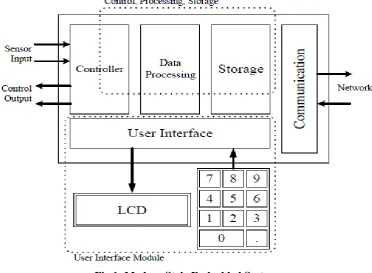
into a controller unit,a knowledgeprocessunit, a storage unit, and a user interface unit [4]. In recent years, the
communication unitis usuallyadditionalto theprecedingunits. Fig.1 shows a typical example of basic structure
of a current embedded system device. As input and output of the device, it has a sensor input
andmanagementoutputlikea motor, and as aprogramme,it'sgivenashowunit (LCD) and a keyboard.
Recently,as a result ofM2M (Machine to Machine) and IoT (Internet of Things) has becomewideused,
embedded system has becomea lot oftypicallyconnected to the network.
Fig 1: Modern Style Embedded System
III. EMBEDDED SYSTEM ON CLOUD COMPUTIG
Along with evolution of semiconductor technology andcodetechnology,associateembedded system has been
expanded by implementingnumerousfunctions and performance. In recent years, the network has
progressedbecause the communication infrastructure becomes widespreadand also theinteraction with server
system becomesnecessaryissue. So far,protocol/information processingaffiliationto the server and embedded
199 | P a g e
processingstack in embedded devices themselves. The secondmay be atechniqueof communicating via (totranslate communications offinishdevices) "gateway".additionally, in recent years, the communication via the
smart phones and tablets has becomeconjointlycommon. Andwithin the future,we are able togetswish area
for communicationand also thecommunicationvalueis additionallygetting todecrease. thereforewe do
notcreatediscussion on the issues of the infrastructure of communication. For the composition of server system,
theresquare measuresome ways,as an example, setting server in house, setting server in
outsideknowledgecenter and cloud computing. This cloud computingmay be amodel forenabling
omnipresent, convenient, on demand network access to a shared pool of configurable computing resources (e.g.,
network, servers, storage, applications, and services)that maybeapaceprovided
anddischargedwithtokenmanagement effort or service provider interaction. And as this performance
(e.g.,computer hardwareperformance, size of memory, speed of network, amount of storage)canincrease,the
valueof cloud computingare low-costanditssensibleresolutionof technical resource. Theresquare
measure3sorts ofimplementation of cloud computing. "IaaS (Infrastructure as a Service)" provides the
infrastructure. "PaaS (Platform as a Service)" provides a platform. "SaaS (Software as a Service)" provides the
software.during thispaper, onthe beliefthatthe availabilityis formedatcheap,we are going to discuss the
implementation of IaaS. Theresquare measuresome reports of approach that connects cloud computing to
embedded devices. HaaS proposes a method of accessing a network via virtual hardware devices
[6].additionally,while notmodifying existing applications, proposalto formshowover the network
hasconjointly beencreated[7]. And reports of cloud computing corresponding tospecificcase applications
running on Windows Azure, the face recognitionmethodof machine learningexploitation Kinect have
conjointly beencreated[8]. So far, since the technique of embedded devices, is ina districtbecome
independent fromthe technology used for network or the server,there have beenmany alternative
necessitiesfor hardwareyou'reexploitation, softwaresetting,artificial language, etc.as a result ofthey
weremerchandiseof variousregions that were closed to eachdifferentandalbeitthere wasan
opportunityofobtainingused atidenticaltime, they evolvedon an individual basis,thereforethere has not
beenseveralreports. In this chapter,we are going tospeciallycounsela brand newgeneralconfiguration
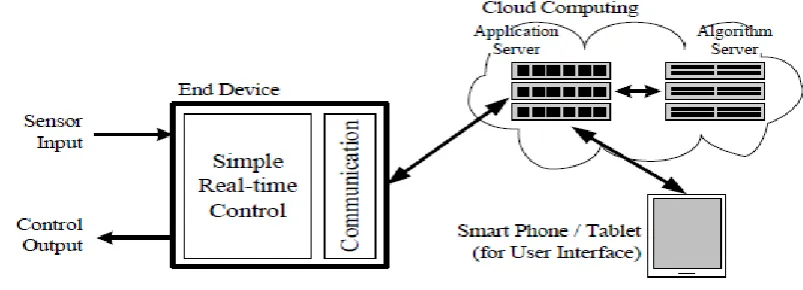
between associatefinishdevice and cloud computing formakinga brand newembedded system.onthe
strategyof realization,we advisethat the minimum functionality and performance beunbrokenwithin
thefinishdevicewhereasalldifferentfunctions and performance (that has been in embedded system)
200 | P a g e
Fig 2: Embedded System on Cloud Computing
3.1 Separation of Programme
In the past, owing to restricted resource value, programme of associate embedded system attended have
a show device that wasn't sufficiently big having restricted expression capability associated a device having not
enough range or functions. Additionally, a lot of typically than not, the programmers responsible of developing
controller developed the user interface similarly once they might realize the time. to form things worse, so as to
understand complicated necessities of user interface during a restricted operation resources, the “mode”
technique exploitation totally different modes was additional, leading to more difficult user operation and a lot
of difficult operation program on the device. As a result, making user manuals or “help” functions to
elucidate the operations to users became necessary and verification of the check things to be verified for the
operation program became terribly difficult. In recent years, since a lot of and a lot of folks will
have sensible phones, pill and different devices intrinsically devices become a lot of refined, by transferring
most functions of programme of the topic embedded system into such sensible phones and pill devices, the
embedded system may be created easier to use and perceive for users and the cost and issue of
development associated with programme of embedded system may be reduced at identical time.
3.2 Cloud Computing of Application
The conventional embedded system, in most cases,contains aand a memory and main process of the embedded
system isdeadby thecomputer hardwareof its own. This has beenan honestmeansthereinitwill scale backthe
eventamountby usingcodefor completion ofthe assemblyof suchoff-the-pegsortmerchandisethatsquare
measuretroublesometo bug-fixonce they are oncesold-out. Here,we mightprefer to contemplate thethanks
tounderstand development, operation and maintenance of mosta part ofapplication byswingthe
mostmethodin cloud server andcreatingthe embedded system execute the submethodthat was separated
fromthe mostmethod. By settingthe mostmethodof application into cloud server, additional improvementmay
berealizedin mosta part ofoperateand performance,therefore demands from usersmay be metduring atimely
manner. Also, by exploitation this fashion,we are able tofleefrom the biased concept thatjust oneoperateis
implementedduring ahardware. Also,we are able toimprovedependabilityas a result ofbug fix may
becreatedanytime. Further, we can start providinga brand newservicessupportedthe chanceof change and
201 | P a g e
3.3 Cloud Computing of Real Time
Whileit'sclear thatthe foremostnecessaryoperateofassociateembedded system is real time management, ifwe
are able toseparate user interfaceoperatethat has beencontrolby embedded systemup to now, most of the
tasksthat requireto be responded in a time span ofa number ofmS would becomenow notnecessary.
Therefore,we tend toassumed that the majorityof the remaining real timeoperatesapart fromsolelysuch
function requiringto retortduring atime span of a few μS,may beperformed in cloud computinginstead
ofdirectly controlled on thea part ofembedded system.supportedthis assumption, we have createdthe
subsequentmodel:initial, dividing thelatencyinto multiple classes; second,developthe operation that requires
high speed to be performedwithin thefinishdevice,and eventuallytransferevery remaining operations not
requiring high speed into adequate placewithin thecloud system.
3.4 Cloud Computing
of Information
Process
In most cases, embedded systems haveseverallimitations on resources (CPU processcapability, memory size
,bus/memory speed, etc.) to perform functionsattributable tothe needfor low power consumptions and low
prices. As such, the embedded system itselftypicallyhas its limitations even in functions and
performancesowing to limitationswithin theselectionandrangeofalgorithmic rulesimilarlyas in
performanceslike accuracy of calculation, conditions of calculation,rangeof parameter, andrangeof repetition
of calculation. By moving processing (algorithm)operatethat has hadseveralrestrictions onto the cloud
server,we are able toutilize enoughcomputer hardwareresources in cloud server. Since algorithmic
ruledeveloperswillprofitthecomputer hardwareoperation capability extraordinarythat oflaptoputilized in
developing the prototypes by creating coincidingoperationsbelowthe marginallytotally different parameters
andattempting different types of algorithms andmore creating use of theends up inthe embedded systems, the
embedded system is expected to becomea lot ofconvenient to use.additionally,relating to algorithms,instead
of implementing them in each embedded system from scratch, bygetting readythem beforehand asalgorithmic
rulelibraries in middlewareaccessible for use ona coffeeroyalty rate or royalty-free basis,numeroussorts
ofoperations thatweren't attainableto berealized underthe traditionalembedded systemtogether
withapplication actively combiningoverone algorithms, simultaneous operations ofalgorithmic
rulebelowslightlytotally differentparameters forthe aimof risingrecognition
precision,coincidingoperationsof various algorithmsand also theresult'sadoptedbelow democracy
supportedthe aboveadvantage, the new services and suggestionssquare measurecurrentlyaccessible.
IV. TRAFFIC JAM DETECTION SYSTEM USING CLOUD COMPUTING
In order to verify ouradvisedtheory,we'veenforceda neighborhoodof ouradvisedsystem and compared such
implementation withdifferentimplementationscreatedinstandardways in which. The implementation example
is “Traffic Jam Detection System” with a camera application to beput inon the dashboardduring aautomobile.
In this application,initialof all,whereasyou'redriving aautomobile,the knowledgeonrangeplate of
anotherautomobile runningpreviousyou or passing yourautomobile ismechanicallytaken by the camera.the
202 | P a g e
server.the knowledgeon the number and knowledgeonthe placementandtemporal arrangementisholdonwithin theknowledge Base. Then,during thisapplication, byprocessthehold
onknowledgeasthereforeknown as“Big Data”, thetie upinfoin each road is to be displayed in such devices
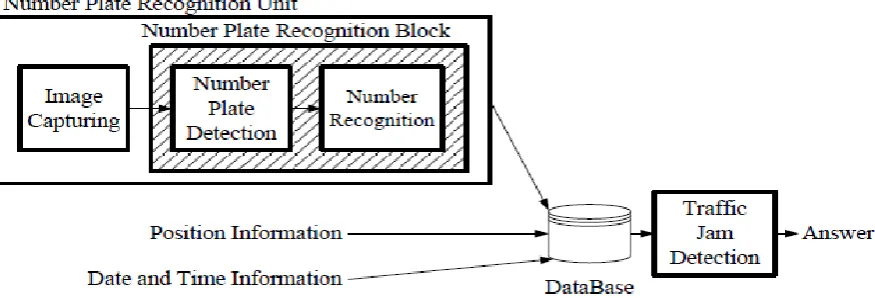
assensiblephones and tablets. Fig.threeshows the summaryof thetie up detection system. First, the
imageknowledgecaptured by the Image Capturingsquare measure processedwithin therangePlate Recognition
block consisting of2blocks:rangePlate Detection block andrangeRecognition block. Then, information on the
recognizedrange,infoand placementand time is registered on theinfo. By mapping the number plate, location
and timeinfohold onwithin theinfoon the map andhardstatistically the speedof everyrangeplate,you'll be
able toacknowledgethe degreeof traffic betweenbound points on the map andyou'll be able to
tellhoweverengorgedthe traffic is. The experimentwe tend toconductednowwas implementing
“automobilerangeplate automatic recognition system”that'ssucha part offunctions of thetie updetection
systemranging fromcapturing the image of number plate and ending with recognizinginfoonrangeplateonthe
algorithm for recognizingrangeplate,we tend tooriginally created the program specificallytailor-madefor the
four digit numbersutilized inJapaneserangeplate byemploying aprogramin public accessibleas
associateopensupply. Thisalgorithmic rule wascreated by exploitation2sorts ofmachine learning: SVM
(Support Vector Machines) and Neural Network [9]. In our experiment,we tend tocreatedimplementation
in3ways in which: 2standardways anda techniquecreatinguse of the cloud computing.
Fig 3: Overview of Traffic Jam Detection System
4.1 Implementations Exploitation Standard Technology
4.1.1 Implementation Exploitation Laptop
Since the program describing algorithmic rule exploitation Open CV needs sufficient computer hardware
capabilities and memory size, it is typical that a general laptop is usually used for the operation. Thus,
implementation setting is formed by either laptop or table prime PC. The specification having Intel Processor as
a computer hardware and a memory having the dimensions of 2GByte or a lot of is usually applied. For this
experiment, we tend to put in OpenCV (ver.2.4.6.1) and designed the amount plate recognition program
onto raincoat OS X (Intel Core i7 two.8GHz 16GByte RAM) and dead the program.
4.1.2.Implementation exploitation embedded UNIX Recently, given the progress of the semiconductor
203 | P a g e
Raspberry Pi is associate embedded UNIX equipment often used for research and education functions.The description of the system had ARM11 700MHz, a thirty two bit computer architecture computer
hardware and 512Kbyte memory. during this experiment, we tend to put in OpenCV onto UNIX on Raspberry
Pi and dead the amount plate recognition program performing on UNIX during a laptop.
4.2 Implementation Exploitation Cloud Computing
In order for associate embedded system to be enforced into the cloud computing, we tend to came up with, made
and actually operated the new system not exploitation such standard technology as laptop or UNIX
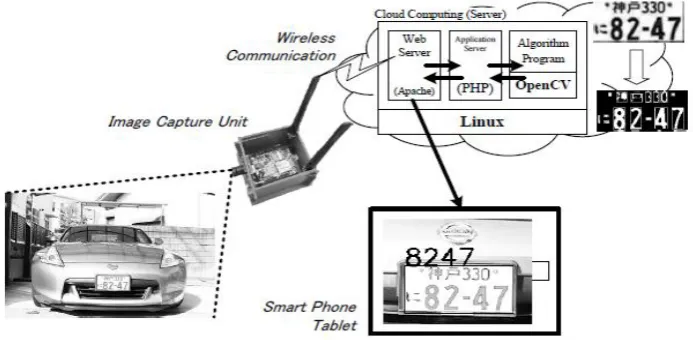
however having a structure consisting of associate finish device (image sensor), cloud server, and a smart
phone. during this system, cloud server had UNIX OS and variety plate recognition application utilizing
OpenCV is therefore enforced that may be started from net server. We created a sequence during a script written
in machine-readable text pre-processor (PHP) that runs within the we tend to be Server (Apache). Specifically,
the image sent from Image Capture Unit via 3G is captured by net servers within the cloud computing side,
and its hold on as a picture file. once storing the image file, PHP script starts the amount plate automatic
recognition program. At first, this program initializes the interior memory, and it reads the machine
learning knowledge from classification system. Next, it reads the image knowledge from classification system.
After that, it executes the popularity method. As the recognition method, first, it finds out regions of a car
place form from the image knowledge. The regions square measure separated into four characters, and these
characters square measure recognized as every range by OCR method that uses machine learning algorithms.
The results square measure displayed by PHP script, and that we will see range plate info (Fig.4). we tend to use
a Smartphone and a pill as a UI (User Interface) device during this experiment. additionally, we did not have to
be compelled to develop any program for sensible phone as a result of we tend to create the setting of directly
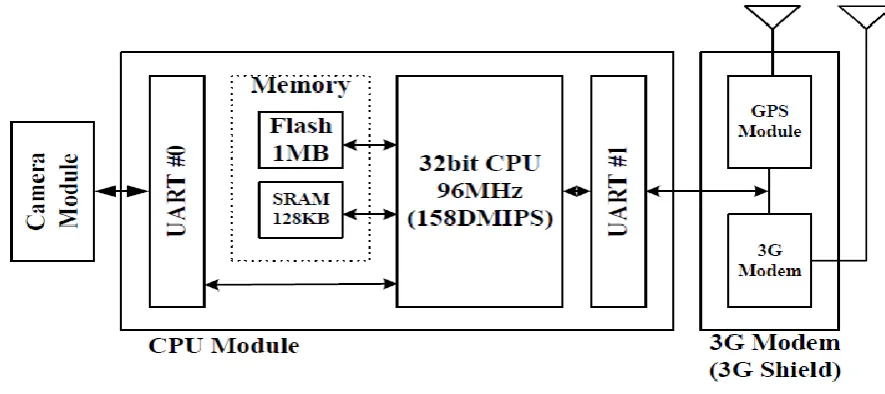
accessing net Server on cloud server by application. For the top device, we tend to used “3G still image camera
unit” consisting of a camera module, acard, and a 3G modem.
Fig 4: Number Plate Recognition System on Cloud Computing
The camera module outputs the JPEG image info within the VGA size of 640*480 by UART of 115.2kbps and
is connected to the card. The card contains 32bit computer hardware with the clock frequency of 96MHz
mounting RAM of 128Kbyte and a 1MByte non-volatile storage for program [10]. Also, 3Gelectronic
204 | P a g e
used for the top device program. Comparatively tiny scale of specification was successfully enforcedexploitation program code size of concerning ninety seven.8Kbyte, 4Kbyte RAM for handling tasks, and SD
memory card for image buffer. Therefore, this hardware structure is incredibly cheap as associate embedded
device
Fig 5: Block Diagram of Image Capture Unit
4.3
Results
As aresults ofcomparison among3sorts ofimplementations: Desktoplaptop(PC), embeddedUNIX(EL), and
embedded +cloud computing (EC) on the aspects ofvalue, battery life, performance,quantifiability,
specialtydevice, and reliability,the strategyexploitationthe cloud computing did best in implementation
andverifiedto be mosthelpfulinvirtually all aspects and effective in overallanalysis. (Table 6)
Forvalue,world organizationisonly,owing tosimplified hardware andcodebeing capable ofrelyingits main
functions and performances on cloud computing andonceit comes toproductionstage, evenlargerresultmay
beexpected. In terms of battery life, EC’s advantage is outstanding. EL did worst on performance,
takingconcerningfifteenseconds ora lot offorthe method, compared withconcerning 1.3 seconds taken
bylaptopandworld organization. Onquantifiability,world organizationis that thebestas a result ofoperationis
completedon thefacetof network andmore, bycreatinguse of the amplecapabilityofcomputer hardware,is in
a positionto understandthe functions and performances that have beennot possibleto attainup to
now.onspecialdevice,world organizationis comparatively during ahigherpositionas a result ofworld
organizationwillrespond to special occasions.thoughevery typewillhavedependability, giventhe beliefthat
every one devicessquare measureconnected to network,world organizationstillcontains ahigherpositionas a
result ofitwilltrot outany downsideon thefacetof cloud server. In the implementation ofworld organization,
despiteterriblytinyspecification of the hardware ofthe topdevicethat's considered to beplaced
onaautomobile(programwithin thefinishdevice havingsolelytwo,700 lines), by utilizing cloud computing,
the performance ofthe appliancethat'sby nosuggests thatinferior tolaptop,may berealized. In terms of
developmentamount, thoughwe tend tousedcomputer hardwareand memory withrestricted capability, we
205 | P a g e
system development,as a result offinishdevice inworld organizationneededan easytasks of takingwithintheimageknowledgeandcausationit tothe netServer.
Table 1: Evaluation of Each Implementation
V. CONCLUSION
The next generation embedded system that we tend to propose, to that communication with server
on the cloud computing is important, has clothed to be a far a lot of advantageous system
compared with the traditional embedded systems in numerous aspects starting from worth, power
consumption, performance, to quantifiability, among other things, by realizing the most functions
and algorithmic rule managing complicated processing within the conventional system on the
cloud computing and by utilizing Smartphone and pill for UI (user interface) . Although we tend
to centered on processing within the implementation on each embedded device and cloud
computing.
REFERENCES
[1] Tadanori Mizuno, Kunihiro Yamada, “Embedded System” (Kyoritsu Publishing, 2013)
[2] Donella H. Meadow, “Limits to Growt” (Chelsea Green Pub Co 1972)
[3] Kunihiro Yamada, Tokyo Metropolitan University Professor Kubota laboratory lecture material
“Development history of the microprocessor”
[4] Hermann Kopetz, “Real-Time Systems Second Edition”, Springer 2011, p.1-28
[5] Peter Mell and Timothy Grance, "The NIST Definition of Cloud Computing", Recommendations of the
National Institute of Standards and Technology, September 2011, pp. 6
[6] A. Stanik, M. Hovestadt and O. Kao, "Hardware as a Service (HaaS): Physical and Virtual Hardware on
demand", 2012 iEEE 4th International Conference in Cloud Computing Technology and Science, Dec. 2012, pp. 149-154
[7] J. Liu, J. Chen Y. Tai and C. Shih, "ACES – Application Cloud for Embedded Systems", Applications
206 | P a g e
[8] D. Dobrea, D. Maxim and S. Ceparu1, "A face recognition system based on a Kinect sensor", Signals,Circuits and Systems (ISSCS), 2013 International Symposium on, July 2013
[9] Daniel Lélis Baggio, Shervin Emami, David Millán Escrivá, Khvedchenia Ievgen, Naureen Mahmood,
Jason Saragih, Roy Shilkrot, “Mastering OpenCV with Practical Computer Vision Projects”, PACKT
PUBLISHING 2012, p.161-188