A NOVEL APPROACH FOR AUTOMATIC
TIMETABLE GENERATION
Mayuri Bagul
1, Sunil Chaudhari
2, Sunita Nagare
3,
Pushkar Patil
4, Guide: Prof. K.S.Kumavat
51,2,3,
,
4(Computer, BVCOERI, Nashik),
5(HOD Computer Dept, BVCOERI, Nashik,(India)
ABSTRACT
The manual system of preparing time table in colleges is very time consuming and tedious task which usually
ends up with various classes clashing either at identical room or with same teachers having more than one class
at a time. Due to manual approach, proper use of resources is neither effective nor efficient. To overcome all
these problems we propose to make an automated system with computer assisted timetable generator. The
system will take various inputs like number of subjects, teachers, maximal lectures a teacher can conduct,
priority of subject and topics to be covered in a week or a lecture, depending upon these inputs it will generate
possible time tables for working days of the week, making optimal use of all resources in a way that will best
suit the constraints. An appropriate timetable is then chosen from the optimal solutions generated.Timetable
creation is a very arduous and time consuming task. To create timetable it takes lots of patience and man hours.
Time table is created for various purposes like to organize lectures in school and colleges, to create timing
charts for train and bus schedule and many more. To create timetable it requires lots of time and man power .In
our paper we have tried to reduce these difficulties of generating timetable by Heuristic Algorithm.
Keywords: Component, Constraints, Resource Scheduling Algorithm, Heuristic Algorithm Time
Table generation.
I. INTRODUCTION
The class timetabling difficulty could be a planning formula with nice interest and implications within the fields
of operational analysis and AI. Most institutes subsume this drawback manually, i.e. an effort and error
methodology is employed to line a timetable. whereas setting a timetable, importance is given to effective
utilization of re that becomes a really exhausting task that has to be self-addressed a minimum of once a year by
each educational institute.
1.1
Required
The schedule should meet the necessity of latest course addition and recently listed students to recent batches.
This might end in schedule the whole plan yet again for its entire batches and to be regular in shortest doable
time before the batches courses begin. Another drawback that happens whereas planning plan for exams, once
multiple batches have examination on same day, they have to be schedules effectively taking under
time. The teaching staffs sometimes pay lots of your time in timetable generation and timetable management.
the target of the Timetable Generator project was to develop a tool that permits institutes to dynamically
generate timetables for colleges‟ internet access directly from "raw" schedule. These timetable generation codes
conjointly regard the supply of lecturers and different re whereas making timetable. Moreover, changes are often
merely created within the timetable as and once necessary counting on the supply of lecturers, replacement,
students, and technicians, school rooms and lessons. Timetabling issues area unit a particular kind of planning
drawback and area unit in the main involved with the assignment of events to slots subject to constraints with
the resultant answer constituting a timetable. Wren (1996) demarcated timetabling as: “Timetabling is that the
allocation, subject to constraints, of given to things being placed in house time, in such the way on appease as
nearly as doable a collection of covetable objectives.” The constraints in timetabling are often divided into 2
categories: exhausting and soft. Exhausting constraints cannot be profaned. Soft constraints don't seem to be
imperative however their satisfaction is additional covetable so as to supply a decent quality timetable. A
general timetabling drawback made from distribution variety of events like course, examinations, lectures, work
meeting etc. into a restricted range of slots and rooms whereas minimising the violations of a collection of
constraints. Heuristic optimisation ways area unit expressly aimed toward good possible answers which will not
be optimum wherever complication of restricted time on the market doesn't enable actual solution. The
empirical analysis of heuristic methodology is predicated on analytic drawback concerned within the tough
worst case result. In its simplest kind the planning task made from mapping category, teacher and area combos
onto time slots. Time Table creation is exhausting and time consuming process for the faculty in charge. At
present this is done manually as there are no efficient time table generators. While framing time table the basic
problems are slot clashes. Allotting periods itself is so tedious that allotting the whole time table is not at all
efficient when done manually. So, even the software which has already been created does not comply with the
constraints. The present system is therefore time consuming, tedious process requiring manual labor and
simultaneously, having less flexibility. Therefore we are proposing a system for Automatic timetable generation.
The algorithm based application allots periods in such a way that no period clashing or faculty period clash is
met. The subjects are paired in such a way that teachers remain associated and no period clash appears. Subjects
are allotted as per priority based on the number of lectures per week of that subject. High priority subjects are
given preference for number of periods per week and are allotted accordingly. Also the corresponding labs
are allotted for the suitable day. This helps satisfy the constraint of number of subjects per day both theory and
lab for a faculty. We assign subjects to teacher as per their seniority and as per their preference. This is done
starting from the high priority subject first and then the decreasing priority subjects and then the unassigned
subjects. This keeps utmost care of the designation of faculties and their p. This procedure creates not only a
feasible Time-Table for the department but also an optimal one. Output of the application is not only the class
time table but also faculty timetable, both the optimum ones. The proposed system is based on heuristic
algorithm that takes values and manages the constraints and source scheduling one by one. The system generates
a timetable for the lecture courses as well as the staff timetable. It distributes workload of lectures equally
among all the specified time slots. It prioritizes the lectures according to customized antecedence. If lecture
cannot be adjusted then it can be moved up in higher priority slot until adjusted accordingly. In our system we
interaction, where students can put their queries and teachers can respond. Also teachers can upload eBook‟s
and presentations for the students. This will prove quite helpful for the students as they can have access to these
study materials any time, any place and get their queries solved and refer to those anytime again. Also students
will be able to provide reviews for all the lectures and teachers. This will be helpful in getting an idea whether
the timetable is being followed and how do the students rate the lectures based on their understanding of the
subjects and topics taught during those lectures. These reviews will also be helpful for the staff to understand to
what extend do the students comprehend and what topics they find difficult to understand during the lectures.
Then the teachers will be able to accordingly schedule and reschedule the lectures for the students.
II. PROBLEM STATEMENT
The time tabling problem can be modeled as a constraint satisfaction problem with many parameters and loose
constraints. These constraints have to be modeled in a format that can be handled efficiently by the scheduling
algorithm. The scheduling involves allowing for a number of pair wise restrictions on which tasks can be done
simultaneously. For instance, in attempting to schedule classes at an institute, two courses taught by the same
faculty member cannot be scheduled for the same time slot. Similarly, two courses that are required by the same
group of students also should not conflict.
III. LITERATURE SURVEY
In some years two main approaches have been successful for implementing the timetabling problem. The first
approach is based on local search procedures method such as simulated annealing, tabu search and genetic
algorithms. These methods express constraints as some value of functions, which are minimized by a heuristic
search of better solutions in reference of some initial feasible solution. The second approach is based on
constraint programming (CP). Its main advantage is declaratively a direct statement of the constraints serves as
part of the program. This makes the program easy to modify, which is critical in timetabling problems. The
constraints are handled through a system of constraint propagation, which decrease domains of variables,
coupled with backtracking search. The main disadvantages of these approaches are
1. Difficulties with expressing hard and soft constraints,
2. The need to determine their parameters through experimentation and
3. Possible problems with improving the initial feasible solution,
Which – as a rule – may be determined without problem? An attempt to overcome the drawbacks along soft
constraints was discussed, successfully combined local search with constraint satisfaction to decrease their
drawbacks. A custom-tailored distribution strategy is able to introduce soft constraints during a search, leading
immediately to a “good” timetable; giving the ability to effectively optimize the timetable.
A. Bhaduri A [1], evolutionary techniques have been used to solve the time table scheduling problem.
Methodologies like Genetic Algorithms, Evolutionary Algorithms etc. have been used with mixed success.
have further solved the problem with a mimetic hybrid algorithm, genetic artificial immune network and
compare the result with that obtained from genetic algorithm. Results show that GAIN is able to reach the
ideal feasible solution faster than that of GA.
B. DiptiShrinivasan [2], Find a feasible tutorial timetable in a large university department is a challenging
problem faced repeatedly in educational establishments. This paper represents an evolutionary algorithm
(EA) based approach to solving a strong constrained university timetabling problem. The move toward a
problem-specific chromosome representation. Heuristics and also context-based reasoning have been used
for received feasible timetables in a reasonable computing time. An intelligent flexible mutation scheme has
been employed for fast-moving up the convergence. The comprehensive course timetabling system presented
in this paper has been approved, tested and discussed using real world data from a large university.
C. AnujaChowdhary [3] introduces a practical timetabling algorithm capable of taking care of both strong and
weak constraints effectively, used in an automatic timetabling system. So that each teacher and student can
view their timetable once they are final for a given semester but they do not edit them. Timetable Generation
System generates timetable for every class and teacher, in keeping with the convenience calendar of
teachers, availability and capacity of physical sources and some rules applicable at distinct classes,
semesters, teachers and subject‟s level.
D.Anirudha Nanda [4], proposes a general solution for the timetabling problem. Most heuristic proposed
previous approaches the difficulties from the students‟ point of view. This solution, however, works from the lecture‟s point of view i.e. lecturer availability for a given time slot. While all the strong constraints (e.g. the
availability of teachers, etc.) are resolved rigorously, the scheduling solution presented in this paper is a
flexible one, with a primary aim to solve the issues of clashes of lectures and subjects, pertaining to teachers.
E. A.Elkhyari [5], the proposed algorithm aids solving the timetabling problem while giving import to teacher
availability. This algorithm uses a heuristic approach to give a overall solution to school timetabling
difficulties. It initially uses randomly generated subject sequence to make a temporary time table. If the
teacher has been apportion more than the allowed maximum lectures the subjects is moved toward into a
Clash data structure. To avoid cycling to improve the search, this variable selection criterion can be
randomized.
F. [6], Harmony search algorithm (HSA) is a meta-heuristic Population-based method that is developed by
Geem et al.
G.[7], the meta-heuristics were classified based on the number of solutions that are used at the same time into
local searchbased (or trajectory) methods (i.e., hill climbing, tabu search, simulated annealing) and
population-based methods (i.e., genetic algorithm, harmony search algorithm, ant colony optimization).
H.[8] The MA has come to light as population-based metaheuristic algorithm by means of hybridizing the
natural(population-based) and cultural (local search-based) selection Principles drawing from the principles
I. [9] In a recent comprehensive survey to examine timetabling, Qu et al. suggested “There are many research
directions generated by considering the hybridization of meta-heuristic methods particularly between
population-based methods and other approaches.”
IV. EXISTING SYSTEM
Time Table creation is exhausting and time consuming process for the faculty in charge. At present this is done
manually as there are no efficient time table generators. While framing time table the basic problems are slot
clashes. Allotting periods itself is so tedious that allotting the whole time table is not at all efficient when done
manually. So, even the software which has already been created does not comply with the constraints. The
present system is therefore time consuming, tedious process requiring manual labor and simultaneously, having
less flexibility. Therefore we are proposing a system for Automatic timetable generation. The algorithm based
application allots periods (theory as well as labs) in such a way that no period clashing or faculty period clash is
met. The subjects are paired in such a way that teachers remain associated and no period clash appears. Subjects
are allotted as per priority based on the number of lectures per week of that subject. High priority subjects are
given preference for number of periods per week and are allotted accordingly. Also the corresponding labs are
allotted for the suitable day. This helps satisfy the constraint of number of subjects per day both theory and lab
for a faculty. We assign subjects to teacher as per their seniority and as per their preference. This is done starting
from the high priority subject first and then the decreasing priority subjects and then the unassigned subjects.
This keeps utmost care of the designation of faculties and their p. This procedure creates not only a feasible
Time-Table for the department but also an optimal one. Output of the application is not only the class time table
but also faculty timetable, both the optimum ones. The proposed system is based on heuristic algorithm that
takes values and manages the constraints and resource scheduling one by one. The system generates a timetable
for the lecture courses as well as the staff timetable. It distributes workload of lectures equally among all the
specified time slots. It prioritizes the lectures according to customized antecedence. If lecture cannot be adjusted
then it can be moved up in higher priority slot until adjusted accordingly. In our system we have also
implemented features other than the Timetable generation, such as a forum for student-teacher interaction,
where students can put their queries and teachers can respond. Also teachers can upload e-books and
presentations for the students. This will prove quite helpful for the students as they can have access to these
study materials any time, any place and get their queries solved and refer to those anytime again. Also students
will be able to provide reviews for all the lectures and teachers. This will be helpful in getting an idea whether
the timetable is being followed and how do the students rate the lectures based on their understanding of the
subjects and topics taught during those lectures. These reviews will also be helpful for the staff to understand
and analyze to what extend do the students comprehend and what topics they find difficult to understand during
the lectures. Then the teachers will be able to accordingly schedule and reschedule the lectures for the students.
V. ALGORITHM
Algorithmic strategy contains heuristic algorithm, variable used for that and different assumption for satisfying
HEURISTIC ALGORITHM:-
The term heuristic is used for algorithms which find solutions among all possible ones, but they do not
guarantee that the best will be found, therefore they may be considered as approximately and not accurate
algorithms. Thesealgorithms, usually find a solution close to the best one and they find it fast and easily.
Sometimes these algorithms can be accurate, that is they actually find the best solution, but the algorithm is still
called heuristic until this best solution is proven to be the best. The method used from a heuristic algorithm is
one of the known methods, such as greediness, but in order to be easy and fast the algorithm ignores or even
suppresses some of the problem's demands.
Consider the example of automatic timetable generator.
VARIABLE USED:-
--Time slots of the time tables:- ts1, ts2, ts3....,tsn
--List of Subjects:- s1,s2,s3, ...., sn
--Teachers:- t1,t2,t3, ...., tn
--Batches of students:- c1,c2,c3, ..., cn
--Flags indicating finalized timeslots :- tsf1, tsf2, tsf3, ..., tsfn
--Data structure to hold Final Timetable:-final_tt
--Count for day of week: Daycount
--Number of days of the week:- n
--Data structure to hold Subject-clash within the day:- clash
--Each element of Clash data structure:-clash_element
--Data structure for Subject-clash across days:-Dayclash
--Each element of Dayclash data structure:-day_clash_element
--Subject contained in dayclash:-sdc
--Teacher associated with subject in dayclash:-tdc
--Max number of lectures of subject si in the week:-k
--Counter for the number of subjects:-counter_sub
--Random number indicating random slot allotment for subject:-rand_sub_allot
--Data structure to hold all subjects:-init_sub
ASSUMPTION:-
This algorithm is designed to solve and generate school time tables. The following is a list of assumptions made
while developing this algorithm:
The algorithm produces optimum outputs in a five-day week.
The number of subjects (s1, s2, ...,sn) need to be finalized before the algorithm begins execution.
Number of teachers (t1, t2, ...,tn) entered before execution of the algorithm are assumed to be constant and
cannot be changed during or after the algorithm has been executed.
Any change in the above two assumptions will require a new generation of Timetable for the changed
data.
In each time table, all time-slot is filled with, a unique combination of subjects without any repetition of
subjects.
Any teacher is allowed at most „k‟ number of lectures in a week. The value of k is accepted before
execution of the algorithm.
It is assumed that a teacher cannot take more than one lecture for the same class in a day.
Timeslots ts1, ts2, ... ,tsn once entered at the beginning cannot be changed throughout the execution.
Every day in the week is assumed to have equal number of time slots.
Classrooms for any batch id fixed throughout the day.
USER-INPUT:-
--Time slots of the time tables:- ts1, ts2, ts3.... Tsn
--List of Subjects:- s1,s2,s3, ...., sn
--Teachers:- t1,t2,t3, ...., tn
--Max number of lectures of subject sI in the week:- k
--Batches of students:- c1,c2,c3, ..., cn
--Count for day of week: Daycount
SOME IMPORTANT EXPECTED RESULTS:
Expected result for the system is shown in figure 3 as follows-
Mon Tue Wed Thurs Fri
TS1 T1,S1 T1,S2 T2,S3 T3,S4 T4,S5
TS2 T4,S5 T1,S1 T1,S2 T2,S3 T3,S4
TS3 T3,S4 T4,S5 T1,S1 T1,S2 T2,S3
TS4 T2,S3 T3,S4 T4,S5 T1,S1 T1,S2
TS5 T1,S2 T2,S3 T3,S4 T4,S5 T1,S1
VI. IMPLEMENTED MODULE
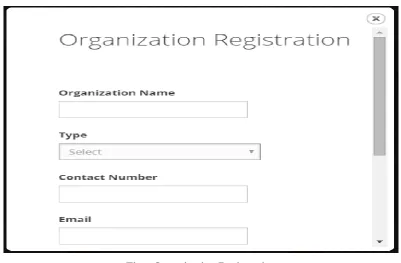
6.1 User Module of Organization Registartion
Following picture shows the Organization Registration page.
Fig. : Organization Registration
In Organization Registration ,we can fill up the information of Organization such as Name of
6.2 User Module of Student Registartion
Fig. : Student Registration
Above picture shows the Student Registration page. In student registration, we can fill up the information of
student such as full name of student, organization name, contact number, address etc.
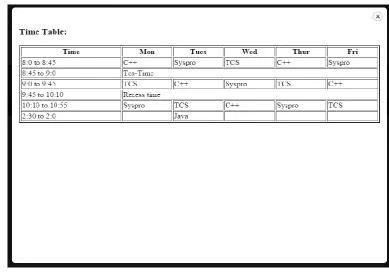
6.3 Graph & Generated time table
Following picture shows the Automatic Timetable Generated page.
Fig. : Timetable
In organization level, admin fill up the information staff i.e subject specialty, qualification, contact number etc.
After that staff canfill up the information of shows studentsdetails, shows attendance details, uploadnotes, fill
up all the information of classroom,lab,library details,timeshift information. Using all this information generate
VII. CONCLUSION
This application will simplify the process of time table generation smoothly which may otherwise needed to
done using spread sheet manually possibly leading to constraints problem that are difficult to determine when
time table is generated manually. The intention of the algorithm to generate a time-table schedule automatically
is satisfied. The algorithm incorporates a number of techniques, aimed to improve the efficiency of the search
operation. It also, addresses the important hard constraint of clashes between the availability of teachers. The
non-rigid soft constraints i.e. optimization objectives for the search operation are also effectively handled. Given
the generality of the algorithm operation, it can further be adapted to more specific scenarios, e.g. University,
examination scheduling and further be enhanced to create railway time tables. Thus, through the process of
automation of the time-table problem, many an-hours of creating an effective timetable have been reduced
eventually. The most interesting future direction in the development of the algorithm lies in its extension to
constraint propagation. When there is a value assigned to a variable, such assignment can be propagated to
unassigned variables to prohibit all values which come into conflict with the current assignments. The
information about such prohibited values can be propagated as well.
VIII. ACKNOWLEDGMENT
It gives us great pleasure in presenting the preliminary project report on „A Novel Approach for Automatic
Timetable Generation‟.
I would like to take this opportunity to thank my internal guide Prof. K.S.Kumavatfor giving me all the help and
guidance I needed. I am really grateful to them fortheir kind support. Their valuable suggestions were very
helpful.
I am also grateful to Prof. H.D.Sonawane, Head of Computer Engineering Department,CollegeName for his
In the end our special thanks to all staff members for providing various resourcessuch as laboratory with all
needed software platforms, continuous Internet connection,for Our Project.
Miss. Mayuri R. Bagul
Mr. Sunil C. Chaudhari
Miss. Sunita N. Nagare
Mr. Pushkar R. Patil
REFERENCES
[1] Mayuri Bagul1, Sunil Chaudhari2, Sunita Nagare3, Pushkar Patil4, K.S.Kumavt5,”A Novel Approach For
Automatic Timetable Generation”, at IJCA (International Journal of Computer Applications) (0975 –
8887) Volume 127 – No.10, October 2015.
[2] Bhaduri a “university timetable scheduling using genetic algorithm”. Advances in Recent Technologies
in Communication and Computing, 2009. ARTCom '09. International Conference
[3] DiptiShrinivasan “automated time table generation using multiple context reasoning for university
modules” Published in: evolutionary computation, 2002. cec '02. proceedings of the 2002 congress on
(volume:2 )
[4] AnujaChowdhary “TIME TABLE GENERATION SYSTEM” .Vol.3 Issue.2, February- 2014, pg.
410-414
[5] Anirudha Nanda “An Algorithm to Automatically Generate Schedule for School Lectures Using a
Heuristic Approach”.International Journal of Machine Learning and Computing, Vol. 2, No. 4, August
2012.
[6] A. Elkhyari, C. Gu´eret, and N. Jussien, “Solving dynamic timetabling problems as dynamic resource
constrained project scheduling problems using new constraint programming tools. In Edmund Burke and
Patrick De Causmaecker, editors, Practice And Theory of Automated Timetabling, Selected Revised