INTRODUCTION
Flavones (flavus = yellow), are a class of flavonoids based on the backbone of 2-phenylchromen-4-one Apart from flavones other flavonoids are isoflavonoids, derived from 3-phenylchromen-4-one structure neoflavonoids,
www.orientjchem.org Pg. 1475-1487
Synthesis of Flavone Skeleton by Different Methods
R.B. KSHATRIYA, Y.I. SHAIKH and G.M. NAzERUDDIN*
Department of Chemistry (P.G. & Research Centre), Poona College ofArts, Science & Commerce, Pune, India.
Corresponding author E-mail: [email protected]
http://dx.doi.org/10.13005/ojc/290425
(Received: October 01, 2013; Accepted: November 13, 2013)
ABSTRACT
Flavones (flavus = yellow), are a class of flavonoids based on the backbone of 2-phenylchromen-4-one. Flavones are mainly found in cereals and herbs. Flavones are biologically active compounds. Therefore number of synthetic methods were developed. In this mini revive we have tried to cover various synthetic strategies for the synthesis of flavones. Some of the well known methods used for synthesis of flavones are Baker & Venkatraman synthesis and Claisen-Schmidt condensation.
Key words: Flavones, Biologically Active Compounds, Synthetic Methods
derived from 4-phenylcoumarine structure.The three flavonoid classes are all ketone-containing compounds, and as such, are anthoxanthins (flavones and flavonols)
Flavones are well known for their various biological activities such as anticancer1 Anti
O
O 1
2
3 4
5 6 7
8
1' 2' 3' 4' 5'
Flavone
O
O 1
4
5 6 7
8
Isoflavone
O 1
5 6 7
8
Neoflavone
2O
1' 2''
3' 4' 5'
5'
4' 3'
2' 1'
inflammatory2, anti-osteoporotic3, anti-diabetic4, etc. some of the examples as shown as under.
Synthetic strategies of flaovones
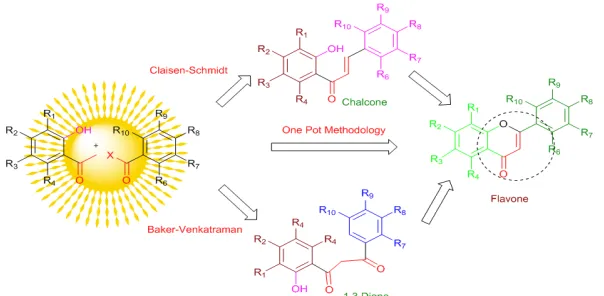
Traditionally, flavones have been prepared by BakerVenkatramanrearrangement and Claisen-Schmidt condensation.which involves the conversion of 2hydroxyacetophenones into
benzoyl esters, followed by rearrangement in base to1,3diphenylpropane1,3diones which upon cyclization under acidic conditions furnishes flavones. On the other hand hydroxychalcone synthesized from 2hydroxyacetophenone anbenzaldehyde under ClaisenSchmidt conditions can undergo oxidative cyclization to furnish flavones ring.
Fig. 1: Basic reactions for the synthesis of flavones Basic schemes related to synthesis of flavones is
mentioned below (Scheme 1-43),
Scheme 1: Palladium catalysed synthesis is carried out in sence of basic environment by Hua & Yang9
O
O R2
OAc I R1
R2
Pd(0),CO
Scheme 2: Solvent free synthesiso f flavone is carrie out by Julia & co-workers10
Scheme 3: Flavones via a Micro-Assisted, One-Pot Sonogashira”Carbonylation” Annulation Reactionis used by E.Awuah & A.Capretta11
Scheme 4: Photo cyclization of 2-Chloro-Substituted 1,3-Diarylpropan-1,3-diones to Flavones is invented by B.Kosmrrji & co-workers12
Scheme 5: Coversion of intermediate 1,3 dione is carried by G.Romanelli & co-workers13
Scheme 6: Alkene hydrogen is replaced by L.Klier & T.Bresser14
HO OH
OH R3
R2 R1
R4
O O
OEt O
O
R1 R2 R3 R4
micro wave HO
OH
X
R1 H
TMS Pd2dba3PA-Ph
microw wave,30 min.
I R2
OH
Pd2dba3PA-Ph 1 atm.,CO
TBAF,DbU,DMF mw,30 min.
O
O R1
R2
X Cl
O O
R1
R4 R3
R2 O
O
R1 R2
R3
R4 X
CH3CN
Light
O O
OH O
O Si supported
heteropoly acid 10 minutes
R R
O
O
1. TMP2Zn.2MgCl2.2LiCl
THF, -30
0C
2. E
+O
E
O
Scheme 7: A Novel Synthesis of 4H-Chromen-4-ones via Intramolecular Wittig Reaction is used for the synthesis of flavones15
Scheme 8: This invention converts 1,3 dione into flavones.Only base is used for this purpose16
Scheme 9: Koneni & his group first time invented flavones in which oxygen of flavone come from watr molecule17
Scheme10: A two step synthesis of flavones via Wacker oxidation is carried out in this process18
OCOR1 O
OTBDMS
Ph3P
SiMe3 O
R
O R1 R
OA
O
O O
R1
O R1
A = Et,Me,Ph
20 mole % K2CO3
DMF,N2
O OH
O OH
H O
R1 R2 R1 R2
O R1
O
R2 KOH
EtOH Heat
I2
DMSO
O OH
R1 R2
O R1
O
R2 Na2PdCl4.3H2O,NaOAc
HOAc , tBuOH.3H2O
tBuOOH , 700C
O
R2 O
OH O
O R2 CuCl2
MW
R1 R1
Scheme 12: Photo-Wittig reaction is apllied for the synthesis of flavones20
Scheme13.Oxidative cyclisation of chalcone to flavone is carried out for the synthesis of flavones.Here n-tetrabutylammonium tribromide is used as a catalyst21
Scheme 14: 2’allyoxy chalcone undergoes oxidative coupling when treated with iodine & DMSO22
O
R2
O
OH O
O R2 CuCl2
MW
R1 R1
O R1
R2
O
PPh3Br
O
O R1
R2
O
R3 H2O/Et3N/hv
O
OH O
O R1
R2
R3
R4
R5
R6 R6
R5 R
4
R3 R2
R1
1. TBATB,CH2Cl2 2. Et3N,K2CO3
3. 0.1M,NaOMe,NaOH
O
O O
O R2
R1 R3
R4 R4
R3 R
1 R2 I2, DMSO
1300C,30 min.
Scheme 15: Palladiumacetate is used catalyst for the synthesis of flavones23
Scheme16: Construction of flavones through regioselective carbonylative annulation of 2 bromo phenols &terminal alkynes is carried out24
O O
Ar-H, Pd(OAc)2,AgOAC
Scheme 17. Ganguly’s synthesis includes synthesis of flavones using O-hydroxy acetophenone & acetyl chloride as a precursor25
Scheme18: One pot synthesis of flavones using ferric chloride is efficient method carrid out by Rajiv Karmarkar & co-worker26
OH Br
R1 +
R2
+ CO
O O
R2 R1
PdCl2,PPh3/L
nPr2NH
O OH R1
R2
+
O
R3 Cl
O R3
O O
R3 R1
R2
R1
R2
O R3
O
Scheme19: Silica supported lewis acids indium chloride & indium bromide undergoes oxidative coupling to give flavones27
Scheme 20: Wet acetone is efficient catalyst for the one pot synthesis of flavones from 2-hydroxy acetophenone & acetyl chloride28
Scheme 21: Formation of 1,3 dione using LiHDMs followed by cyclisation using acid catalyst is achived29
OH O
H + R1
Ar
FeCl3(10 mole %) Piperidine (20 mole %)
Toluene, 6-12 Hrs. Reflux
O Ar
O R1
O OH
R1 R2
O R1
O
R2 Silica Supported InCl3
45 min.1300C
O OH R1
R3
O
O R1
R2
R1
R2
O
O R2
pR4C6H4COCl
K2CO3,wet acetone
Reflux
R4
+
R4
R3
O
R4
Scheme 22: Carbonylative couplig using Pd catalyst is invention of this method30
Scheme 23: Daniel etal31suggested the following methodology consisting of five steps
Scheme 24: Iodo & bromo derivatives of flavones were synthesized by this method32
Scheme 25: Oxidative cyclisation followed by bromination is carried out by this process33
Scheme 26: Base is used for cyclisation of inermediate to flavone34
O OH
O OH
Cl O
O
O R1
R2
R3 R4
R6 R5
R7
O R1 R2
R3 R4
R5 R6
R7
R4 R3 R2
R1
R7 R6 R5
LiHDMS THF
AcOH H2SO4
OH
I R
2
+ + CO
20 atm.
O
O R2 Pd Catalyst
R1 R1
OH CHO
+
O
O Cl
O2N
NH2 HOOC
O
R
OBn
O
R
O
OH
OH
I
2/ Br
2& DMSO
O
R
O
OH
X
X
I
2/ Br
2& DMSO
One Equivalent
Cat. Amount
OH
O R1
R2
R1 O
O R2 R3
R4 R5 R6
R3 R4 R5 R6
1. V2O5,H2O2/NH4Br CH2Cl2,0-50C
X
Y
Scheme 27: Wittig reaction is applied for the synthesis of flavones35
OH Ar
O MeO
OMe
MeO OH
O OMe
Ar Br
Br Br
O Ar
O OMe MeO
Br
4.0 eqv.BDMS DCM,RT
0.2M KOH EtOH.H2O
Scheme 28: Frédéric et al36 suggested
OH R3
R1 R2
O
PPh3
1. RCOCl,Pyridine
2. MeONa/MeOH O R
R1 R2 R3
O
Scheme 29: Dhanapalan N37 et al and Scheme30. Yoshida et al38
suggested the following methodologies respectively R2
R1 +
O OH Br
CN SEt R3
R4
COMe R3
R4 O
NC SEt R1
R2 O
O CN COMe R3
R4
R1
R2 K2CO3
DMSO
AlCl3 Heat,PhNO2
Scheme 30: OSi
O
OMe +
O R4
R3
R2 R1
O
O
R1 R2 R3 R4
LiHDMS,THF
H2SO4,AcOH
Scheme 31: Hydrogen peroxide is used as catalyst for this one pot method39
O R
OH R1 R2
R3 R4
DMAP 10 mole %
DMF,300C
O R
O R2
R1
Scheme 32: Lewis acid ferric chloride is capplied for the synthesis of flavones via oxidative coupling by Kumar & Perumal40
Scheme 33: zanwar,M. R41suggested the following methodology OH
O
MeO 1. ArCHO
2. H2O2
O
O MeO
O
OH O
O OH R
R FeCl3.6H2O
MeOH,Reflux 8-10 Hrs.
O
+ NO2
O
OH
O
O R
R1 R OR2
O
R1
Et3N,R2OH
Scheme 34: Yitterbium triflate is ude for the one pot synthesi of flavones in this paper42
Scheme 35: Suzuki-Miyaura coupling used for the synthesis of flavone by Kraus & Gupta43
Scheme 36: zambre& Sangshetti used oxalic acid for oxidative coupling method44
OH
X + O O
OMe Me
O O
O
O R1 X
Yb(OTf)3
OH +
HO O
X X MeO
MeO OMe
MeO
MeO OMe
O O
X X
MeO
MeO
OMe O X X OH
O
O Cl MeO
MeO OMe
O
O
R2 R1
OMe MeO MeO DCM,DMAP
CH2Cl2,DMF
AlCl3
Cl(CH2)2Cl
NaO H
THF
Pd(PPh3)4,10 mole % K2CO3,Dioxane 68-70% +
R1
Scheme 37: Iodine is used as catalyst for both Clause-Schmit condensation and oxidative coupling45
Scheme 38: Bosale & Sarda used ionic liquid for the synthesis of flavones from dione intermediate46
OH
O O
H
O OH +
O
O NaOH
EtOH
Oxalic acid
EtOH,Reflux
R1 R2 R1
R2 R2
R1
OH
O O
H
O OH +
O
O
R1 R2 R1
R2 R2
R1 Al2O3/NaOH
I2 I2 / Al2O3
mw
mw
Scheme 39: Jae In Lee et al47suggested the following methodology
Scheme 40: Sodium tellurim oxide is used for the oxidativ coupling method by the author KumarS& Sharma D48
Scheme 41: New catalyst at present is use of hetro polyacid is used for the synthesis of flavones.This solvent free synthesis avoids excess loss of solvents49
O O
R1 R2 O
O
R2
R1 bmim BF4
1000C,45 min.
OH
O O
O O
O
R1
R2
N OMe
R3 R4 R4
R5
R2 R1
R3 R4
R5
R6 R1
R2 O
+
O OH OH R1
R2
1.3 eq. CH3Li,THF
2.H2O+
H2SO4,CH3CN
1. 2 eq.LiN(iPr)2 2. H2O
R1
R2
O OH
R3
R4 O
O R1
R2
R3 R4
Na2TeO3
Scheme 43: Ortho acetyl acetophenone get converted to flavone directly without conversion to 1,3 dione intermediate51
Scheme 42: CuI is another important catalyst invented by zhiyun, Du & Huifen N.. This method gives new catalyst for oxidative coupling of flavones50
O
OH O
O
R1 R2 R1
R2 HPA,Reflux
Solvent or solvent free
O
OH O
O
R1 R2 R1
R2 1.CuI,10 mole %
2.solvent,heat air
O
OH O
O
R1 R2 R1
R2 1.CuI,10 mole %
2. Bmim NTf2,500C O2,1 atm.
O
O R
O
O
O R CsF-CaO
2400C
CONCLUSION
In conclusion I try to give most of the schems related to flavones.This review provides ready data for the people working in this field.
REFERENCES
1. Liu, H. L.; Jiang, W. B.; Xie, M. X. Recent Pat. Anti-Cancer Drug Discovery 5: 152-164 (2010).
2. Manthey, J. A.; Grohmann, K.; Montanari, A.; Ash, K.; Manthey, C. L. J. Nat Prod., 62: 441-444 (1999).
3. Maurya, R.; Rawat, P.; Sharan, K.; Siddiqui, J. A.; Swarnkar, G.; Mishra, G.; Manickavasagam, K.; Arya, R.; Chattopadhyay, N. World Pat. 110003 (2009).
4. Kunimasa, K.; Kuranuki, S.; Matsuura, N.;
Iwasaki, N.; Ikeda, M.; Ito, A.; Sashida, y.; Mimaki, y.; yano, M.; Sato, M.; Igarashi, y.; Oikawa, T. Bioorg Med. Chem. Lett. 19: 2062-2064 (2009).
5. Gabrielska, J.; SoczyDska-Kordala, M.; Przestalski, S. J. Agric. Food Chem. 53: 76-83 (2005).
6. Martens, S.; Mithofer, A. Phytochemistry, 66: 2399-2407 (2005).
601-617 (1995).
8. Ammar, N. M.; El-Diwany, A. I. J. Islamic Acad. Sci.1: 72-73 (1988).
9. Hua M.; Zhen y. Org. Lett., 2(12): 1765–1768 (2000).
10. Julio A. S.; Pilar V.T.; Raquel C.R., J. Org. Chem., 70(7): 2855–2858 (2005).
11. Emelia A. ; Alfredo C., Org. Lett., 11(15): 3210–3213 (2009).
12. Berta K.;Boris Š. Org. Lett., 9(20): 3993–3996 (2007)
13. Gustavo P. R.; Virla,E.G.; Duchowicz,P.R. Ana, L. G.; Diego M. R.; Daniel O. B., Erlinda del V. O. ; Autino, J.C. J. Agric. Food Chem., 58(10): 6290–6295 (2010).
14. Lydia, K.; Tomke, B.; Tobias, A.; Nigst, K.; Knochel,K J. Am. Chem. Soc., 134(33): 13584-13587 (2012).
15. Kumar,K.; Bodas M. S. Org. Lett., 2(24): 3821–3823 (2000).
16. Jie, Z.; yufen,Z.; Hua, F. Org. Lett., 14 (11): 2710-2713 (2012).
17. Sashidhara,K.V. ;Kumar,M.; Kumar,A. Tetrahedron Letters, 53(18): 2355-2359 (2012).
18. Michael, L.; Kabir,M.S.; Cook,J.M. Tetrahedron Letters, 51(7): 1095-1098 (2010).
19. Kabalka,G.W. Mereddy,A.R. Tetrahedron Letters, 46(37): 6315-6317 (2005).
20. Das,J.; Ghosh,S. Tetrahedron Letters,52(52): 7189-7194 (2011).
21. Bose,G.; Mondal,E.; Khan,A.T. ; Bordoloi,M. J. Tetrahedron Letters, 42(50): 8907-8909 (2001).
22. Lokhande,P.D.; Sakate,S.S.;Taksande, K. N.; Navghare,B.Tetrahedron Letters, 46(9): 1573-1574 (2005).
23. Kim,K.H.; Lee,H.S.; Kim,S.H. ;Kim,J.S. Tetrahedron Letters, 22(53): 2761-2764 (2012).
24. Jianming, L.; Muwen, L.;yuanyuan ,y.; Ningfei, Z.; yuanli, Z.; Kelei, Z. Tetrahedron Letters, 54(14): 1802-1807 (2013).
25. Ganguly,A.K. ; Kaur,S.; Mahata,P.K. ; Biswas, D.; Pramanik,B.N. ; Chan,T.M. Tetrahedron Letters, 46(23): 4119-4121 (2005).
26. Maiti,M.; Karmakar,R.; Bhattacharya,R.N.; Kayal,K. Tetrahedron Letters, 52(43): 5610-5612 (2011).
27. Naseem Ahmed, Hasrat Ali, Johan E. van Lier
Tetrahedron Letters, 46(2):253-256 (2005. 28. Chin Fei Chee, Michael J.C. Buckle,
Noorsaadah Abd. Rahman Tetrahedron Letters, 52(24): 3120-3123 (2011).
29. Mark Cushman, Dhanapalan Nagarathnam Tetrahedron Letters 31: 6497-6500 (1990). 30. V.N. Kalinin, M.V. Shostakovsky, A.B.
Ponomaryov Tetrahedron Letters,31: 4073-4076 (1990).
31. Daniel ,D.; Laetitia, M. Tetrahedron Letters,36: 1845-1848 (1995).
32. Pinto,D.; Silva,A.S.; Cavaleiro,J.S. TetrahedronLetters, 35: 9459-9460 (1994). 33. Khan,A.T.; Goswami,P. Tetrahedron Letters,
46: 4937-4940 (2005).
34. Abu T. Khan, Abhik Choudhury, Shahzad Ali, Md. Musawwer Khan Tetrahedron Letters, 53: 4852-4857 (2012).
35. yves Le, F.;Martine L. Tetrahedron Letters, 27: 5503-5504 (1986).
36. Frédéric Lassagne, Francis Pochat Tetrahedron Letters, 44(22): 9283-9285 (2003).
37. Dhanapalan N., Mark C. Tetrahedron, 47: 5071-5076 (1991 ).
38. yoshida, y.F.; Koya S.; Takayuki, D. Tetrahedron, 67(23): 9993-9997 (2011).
39. Francesco F.; Giosanna P.; Oriana P.; Ferdinando P. Tetrahedron 50(39): 11499-11508 (1994).
40. Kumar,K.H.; Perumal,P.T. Tetrahedron, 63(38): 9531-9535 (2007).
41. Zanwar,M. R.; Raihan,M. J.; Gawande,S.D; Kavala,V; Janreddy, V.;Chun-Wei K.; Ambre,R. ; Ching-Fa,y. J. Org. Chem., 77: 495-6504 (2012).
42. Eric F.; Dumas,A. M.; Kuropatwa, B. A.; Malhotra,N.R.; Sitler, T. C. J. Org. Chem., 71: 409–412 (2006).
43. Kraus, G.A.; Gupta, V. Org. Lett. 12: 5278– 5280 (2010).
44. Zambare,A. S.; Sangshetti ,J. N. ; Kokare,N. D.; Shinde ,D. B. Chinese Chemical Letters 20: 171–174 (2009).
45. Sarda, S.R.;Jadhav,W. N. ; Pawar,R. P. International Journal of ChemTech Research 3: 539-543 (2009).
47. Jae In Lee, Hwa Soo Son, Hyun Park Bull. Korean Chem. Soc. 25: 1945 (2004). 48. Kumar,S; Sharma ,D. Oriental Journal of
Chemistry,27: 761-763 (2011).
49. Jahangir,G.M. ; Roshani, J.; Scheeren,W. Bulgarian Chemical Communications 2(3):
210–216 (2010.
50. Zhiyun, Du; Huifen N; Kun, Zhang; Zengb,H; Wang, J. Org. Biomol. Chem., 9: 6930 (2011).