6 |
P a g e
International Journal of Pharmaceutical
Development & Technology
e ISSN - 2248 - 910X
www.ijpdt.com
Print ISSN - 2248 - 9096PROCESS VALIDATION OF VALACYCLOVIR TABLETS BY
OPTIMISING PROCESS PARAMETERS
D.VENKATESH*, N.SRIRAM, VINAY UMESH RAO, UMESH S.H.
*Department of Pharmaceutics, Smt. Sarojini Ramulamma College of Pharmacy, Mahabub Nagar 509001, Andhra Pradesh, India.
ABSTRACT
In the present study, Valacyclovir tablets were formulated using different formulation parameters and their effects on the dissolution rate of these tablets were evaluated. The binding agent used in this study was Povidone. Tablets were prepared by wet granulation method and were evaluated for various parameters like weight variation, hardness, friability, disintegration time, drug content and in vitro dissolution studies. This Process validation report for Valacyclovir Hydrochloride Tablets 500mg & 1gram common blend is based on the observations/data collected during manufacturing of three consecutive batches, which were manufactured as per Batch Manufacturing record forExport Marketat Aurobindo Pharma Ltd. Unit-VII, Jadcherla. Samples were collected and analysed as per Process validation protocol. The data & test results of blend at various in-process phases were complied with the specified limits and final blend sample analysis results found to be complying within specifications. This study and results obtained assures that the manufacturing process is reproducible, yielding consistent product, which meets specification.
Key Words: Valacyclovir, Binding agents, Wetgranulatin, Dissolution Study, Validation Protocol.
INTRODUCTION
Process validation is a requirement of the current good manufacturing practices regulation for finished pharmaceuticals [1], 21 CFR parts 210 and 211,and of the good manufacturing practice regulation for medical device [2], 21 CFR parts 820,and therefore, is applicable to the manufacture of the pharmaceutical and medical device. Several firms have asked FDA for specific guidance on what FDA except firms to do to assure compliance with the requirements for process validation elements and concepts that are considered by FDA as acceptable parts of validation program [3].
Presented In these documents are not intended to be all-inclusive. FDA recognizes that, because of thegreat variety of medical products (drug product and medical device), process and manufacturing facilities, it is not possible to state in one document all of the specific validation elements that are applicable. Several, board concepts, however, have general applicability witch manufacturers can use successfully as a guide in validating a
manufacturing process. Although the particular requirements of the process. Validation will vary according to such factors as the nature of the medical product and the complexity of the process; the board concepts stated in this document have general applicability and provide an acceptable frame work for building a comprehensive approach to process validation [4-6].
MATERIALS AND METHODS Materials
Valacyclovir Hydrochloride, Microcrystalline Cellulose was obtained from FMC Biopolymers/ Brahmar cellulose. Crospovidone was obtained from ISP Tech. Povidone was obtained from BASF, Magnesium Stearate was obtained from Ferro.
Preparation of Tablets
Description of manufacturing procedure Sifting
Valacyclovir Hydrochloride, Microcrystalline cellulose, Crospovidone and Povidone were Sifted through # 30 mesh.
7 |
P a g e
Dry mixingIt loaded the material of step sifted materials in a RMG and mix for 15 minutes with impeller at slow speed and chopper off.
Binder Preparation
Sift Povidone through #30 sieve
purified water taken in the binder preparation vessel and povidone added under stirring condition and continuous stir until a clear solution is obtained.
Granulation
Add the binder solution to the blend of dry mixing over a period of 2-3 min with impeller at the slow speeds. Switch on the chopper at slow speeds after 1 min. Knead the wet mass for 60 seconds or more with impeller slow and chopper at the fast speeds to get good granular mass. If required add extra quantity of purified water. Kneed the wet mass for 30 sec with impeller slow and chopper at the fast speeds to get good granular mass. Unloaded the wet mass of granulation part into clean FBP bowl with impeller slow and chopper fast speed.
Drying
The granules Air-dried for 5 minutes to ensure the proper fluidization the material racked and drying started to the wet granular mass in the Fluid Bed Processor at an inlet air temperature of 60 ± 5°C, and out let temperature of not more than 55°C. The drying continued with intermittent raking for every 10-15 minutes till the loss on drying of dry mass reaches between 6.0 – 8.0 % w/w using an IR Moisture balance in auto mode at 105°C. Repeat the procedure for other lots.
Sifting and Milling
Dried granules Milled through 1575 μm screen at medium speed (1400 RPM) using Quadra Co-mill.
Sifting of Extra granular materials
Crospovidone Sifted through sieve #30, Magnesium stearate sifted through sieve #40.
Blending and lubrication
Loaded the shifted material of Crospovidone, Magnesium stearate and milled materials into Matcon Bin blender and blended for 10 min with 8 RPM .Magnesium Stearate add and blended for 5 minutes with 8RPM [7-10].
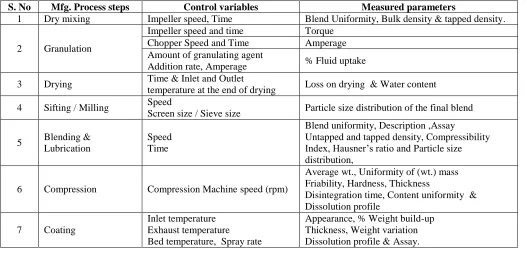
Critical Process Steps
Critical process control variables at each critical
manufacturing step and measured parameters are as follows
RESULTS AND DISCUSSION
All the input raw materials were reviewed as per batch manufacturing record and found they all are approved. Raw materials initial sifting was done as per Batch
manufacturing record in all three batches. Dry mixing and Granulation were carried out in Rapid Mixer Granulator as per the parameters specified in Batch Manufacturing record. Dry mixing samples were collected from 10 different locations and analyzed for Blend Uniformity as per protocol. The results of 10 unit dose samples from three batches are shown that the blend is homogenous. Drying was carried out in Fluid Bed Processor. Inlet temperature, outlet temperature, LOD & Water contents are within the limits for all three batches [11-13].
The blend uniformity data of Pre Lubricated blend were found to be in the range of 97.5% to 100.7% with a RSD value of 1.03% for Batch No. VVSCBXXX01, 95.3% to 103.2 % with a RSD value of 2.69% for Batch No.VVSCBXXX02 and 96.5% to 102.6 % with a RSD value of 2.64% for Batch No.VVSCBXXX03. All the pre blend results are within the acceptance criteria of 90.0% to 110.0% with RSD Not More Than 5.0%.
Similarly, for Lubricated blend, the blend uniformity data ranges from 99.0% to 100.8 % with RSD value of 0.51% for Batch No.VVSCBXXX01, 96.2% to 101.2% with RSD value of 2.78 % for Batch No.VVSCBXXX02, 97.1 % to 102.9% with RSD value of 2.78 % for Batch No. VVSCBXXX03. All the final blend results are within the acceptance criteria. Particle size distribution, bulk density and compressibility index in all three batches are comparable. This shows that the intermediate processing steps viz sifting and milling operations were satisfactory. Final blend of all three batches were subjected for analysis as per in-process specification, and the results are found to be within the specification limit.
Compression of the Valacyclovir Hydrochloride Tablets 500mg was carried out at different speeds at the slow speeds of 50000 tablets/hour and high speed of 65000 tablets/hour for batch number VVSAXXXX01 and optimum speed considered as 55000 tablets/hour. Remaining blend of VVSAXXXX01 was compressed at the optimum speeds of 55000 tablets/hour. Compression of VVSAXXXXX02 & VVSAXXXXX03 batches was carried at 55000 tablets/Hour. Sample were collected from slow speed, medium and high speed and optimum initial, middle, end and pooled sample for VVSAXXXX01, initial, middle, end and pooled sample for VVSAXXXXX02& VVSAXXXXX03 and analyzed as per protocol. The results show that all physical and chemical characteristics of the tablets were within the acceptance limit.
8 |
P a g e
was observed 45.50C-50.0°C for lot-I , 46.8°C -49.2°C forLot-II of batch number VVSAXXXX01, 46.0°C-47.8°C for lot-I & 45.5°C-48.5°C for lot-II of batch number VVSAXXXXX02 and 46.0-46.8°C for lot-I & 45.2°-47.0°C for lot-II of batch number VVSAXXXXX03 . Bed temperature was observed 44.80C-48.0°C for lot-I & 45.3°C -48.0°C for Lot-II of batch number VVSAXXXX01, 43.9°C-51.1°C for lot-I & 44.2°C-47.6°C for lot-II of batch number VVSAXXXXX02 and 44.0°-47.2°C for lot-I &45.5°C -48.1° for lot-II of batch number VVSAXXXXX03 . Pan RPM 1.0-2.6 for the lot-I & 1.0-2.4 for Lot-II of batch number VVSAXXXX01, 1.5-2.2 for the lot-I & 1.5-2.5 for lot-II of batch number VVSAXXXXX02 and 1.2-1.5 for the lot-I & 1.2-2.0 for lot-II of batch number VVSAXXXXX03 was maintained during the coating process. % weight build-up was found 2.80% for the lot-I, 2.70% for Lot-II of batch number VVSAXXXX01, 2.77% for the lot-I & 2.65% for Lot-II of batch number VVSAXXXXX02and 2.85% for the lot-I & 2.80% for lot-II of batch number VVSAXXXXX03, which are within in the specified limit.
Compression of the Valacyclovir Hydrochloride Tablets 1 gram was carried out at different speeds at the slow speeds of 50000 tablets/hour, medium speed of 55000 tablets/hour and high speed of 60000 tablets/hour for batch number VVSBXXX01, optimum speed as considered 55000 tablet/hour and remaining blend of VVSBXXX01 & two batches (VVSBXXX02& VVSBXXX03) was carried at the optimum speeds 55000 tablets/Hour. Collected sample from slow speed, medium and high speed and optimum initial, middle, end and pooled sample for VVSBXXX01, initial, middle, end and pooled sample for VVSBXXX02
andVVSBXXX03 and analyzed as per protocol. The results show that all physical and chemical characteristics of the tablets were within the acceptance limit.
Coating was carried out at an inlet temperature of 59.30C-63.5°C for lot-I , 59.7°C -62°C for Lot-II of batch number VVSBXXX01 , 60.8°C-64.8°C for lot-I & 60.2°C-62.9°C for lot-II of batch number VVSBXXX02 and 59.8°C -62.0°C for lot-I and 61.7-63.9°C for lot-II of batch number VVSBXXX03. Outlet temperature was observed 45.40 C-49.5°C for lot-I , 46.2°C -47.4°C for Lot-II of batch number VVSBXXX01, 42.1°C-47°C for lot-I & 44.1°C-46.6°C for lot-II of batch number VVSBXXX02 and 45.7°-47.9°C for lot-I & 44.2°-46.3°C for lot-II of batch number VVSBXXX03 . Bed temperature was observed 45.20 C-49.1°C for lot-I & 44.8°C -47.0°C for Lot-II of batch number VVSBXXX01, 42.4°C-46.2°C for lot-I & 45.7°C-47.2°C for lot-II of batch number VVSBXXX02 and 44.7°-47.0°C for lot-I &46.7°C -48.4° for lot-II of batch number VVSBXXX03 . Pan RPM 2.0-2.2 for the lot-I & 1.0-2.0 for Lot-II of batch number VVSBXXX01, 1.2-2.3 for the lot-I & 1.2-1.8 for lot-II of batch number VVSBXXX02 and 1.0-2.0 for the lot-I & lot-II of batch number VVSBXXX03 was maintained during the coating process. % weight build-up was found 2.58% for the lot-I, 2.67% for Lot-II of batch number VVSBXXX01, 2.47% for the lot-I & 2.65% for Lot-II of batch number VVSBXXX02and 2.89% for the lot-I & 2.60% for lot-lot-Ilot-I of batch number VVSBXXX03, which are within in the specified limit [14,15].
Short term stability study was performed for all batches. The samples were analyzed for percent drug content and in vitro drug release studies.
Table 1. Critical Process Steps
S. No Mfg. Process steps Control variables Measured parameters
1 Dry mixing Impeller speed, Time Blend Uniformity, Bulk density & tapped density.
2 Granulation
Impeller speed and time Torque Chopper Speed and Time Amperage Amount of granulating agent
Addition rate, Amperage % Fluid uptake
3 Drying Time & Inlet and Outlet
temperature at the end of drying Loss on drying & Water content
4 Sifting / Milling Speed
Screen size / Sieve size Particle size distribution of the final blend
5 Blending & Lubrication
Speed Time
Blend uniformity, Description ,Assay
Untapped and tapped density, Compressibility Index, Hausner’s ratio and Particle size distribution,
6 Compression Compression Machine speed (rpm)
Average wt., Uniformity of (wt.) mass Friability, Hardness, Thickness
Disintegration time, Content uniformity & Dissolution profile
7 Coating
Inlet temperature Exhaust temperature Bed temperature, Spray rate
9 |
P a g e
Table 2. Test Program and Acceptance CriteriaStage Sampling procedure, location, time &
quantity Test Parameters
Acceptance
criteria Remarks
Dry mixing
Collect 10 unit samples(x-3x) in duplicate with a unit dose sampler.
Sampling time – After 15 minutes of mixing. Theoretical weight is 681.5 mg
(681.5-2044.5 mg)
Die size : For 1X= 2.2 ml ,2X= 4.4 ml and 3X= 6.6 ml
Blend Uniformity For data generation only.
-
Collect about 2 – 3 g of dry mixed samples from three different locations
Water by KF To report results Collect 100 gm of dry mixed samples from
three different locations
Bulk density & Tapped density
For data generation
Granulation No sampling - -
Record speeds of impeller, chopper, amt of granulating agent added and
methodology of addition, Amperage at the end point at the granulation.
Drying
Collect about 2 – 3 g of dried granules at the end of the drying from 3 different locations and pool the sample.
LOD in IR Moisture Balance at auto mode at 105 °C
6.0 – 8.0 %
w/w -
Collect about 2 – 3 g of dried granules at the end of the drying from 3 different locations and pool the sample.
Water by KF To report results
Sifting/
Milling No sampling - -
Record screen size & milling speed, sieve size.
Blending (Before addition of magnesium stearate)
Collect 10 unit samples(x-3x) in duplicate with a unit dose sampler.
Sampling time – After 15 minutes of mixing. Theoretical weight is 696.0 mg
(696.0-2088 mg)
Die size : For 1X= 1.03 ml ,2X= 2.07 ml and 3X= 3.1 ml
Blend uniformity Individual values between 90.0 – 110.0% RSD NMT 5%
-
Lubrication (After addition
of magnesium stearate)
Collect 10 unit samples(x-3x) in duplicate with a unit dose sampler.
Sampling time – After 8 minutes of mixing. Theoretical weight is 700.0 mg
(700.00– 2100.00)
Die size : For 1X= 1.04 ml ,2X= 2.08 ml and 3X= 3.12 ml
Blend uniformity Individual values between 90.0 – 110.0 %
RSD NMT 5.0 %
-
In process bulk
Collect 50gm As per in-process
Specifications
As per In-Process specifications.
-
Collect 100 gm-150 gm of lubricated blend and perform the physical characteristics.
Particle size distribution, Bulk density, Tapped density and
compressibility index Hausner’s ratio.
10 |
P a g e
CONCLUSIONFrom the present study following conclusions can be drawn. Valacyclovir tablets prepared by wet granulation method were found to be good without any chipping, capping and sticking.Dry mixing duration of 10 minutes in Rapid Mixer Granulator at the impeller slow speed can be considered as satisfactory to get the uniform blend. Drying of wet mass at an inlet temperature of 60±50C is considered satisfactory to get desired loss on Drying.Blending time of 10 minutes and Lubrication time of 5 minutes in Matcon bin blender at 8 RPM considered satisfactory to get the uniform blend characteristics. The similarity in the particle size distribution & the compressibility index values indicates that the intermediate stages between the dry mixing & lubrication (viz drying, milling) are consistent & produce an output of similar characteristics.Based on the observations and analysis data, it is concluded that compression machine speed of 50000Tablets/Hour to 65000 tablet/hour, can be considered as guidance value for 500mg tablets further batches on 51 station Kilian compression machine. Based on the observations and inlet temperature 60±5°C, Outlet temperature 45±5°C and bed temperature 45±5°C and pan rpm 2±1, peristaltic pump rpm 8.0-30 can be considered as guidance value for further batches.Finished product 500mg tablets samples were analyzed as per product release
specification and found complying with the specification limits. Based on the review of various parameters as stated therein the process is validated. Based on the observations and analysis data, it is concluded that compression machine speed of 50000Tablets/Hour to 65000tablet/hour, can be considered as guidance value for 1000mg tablets further batches on 51 stations Kilian compression machine.
Based on the observations and inlet temperature 60±5°C, Outlet temperature 45±5°C and bed temperature 45±5°C and pan rpm 2±1, peristaltic pump rpm 11 ±2 can be considered as guidance value for further batches. Finished product 1000mg tablet samples were analyzed as per product release specification and found complying with the specification limits. IR-spectroscopic studies on the prepared Valacyclovir tablets indicated that there is no drug–excipient interaction. Short-term stability studies of promising formulations indicated that there are no significant changes in drug content and in vitro drug release.
ACKNOWLEDGEMENT
The authors express their deep gratitude towards the Aurobindo Pharma Ltd. and Management and the Department of Pharmaceutics, Smt. Sarojini Ramulamma College of Pharmacy, Mahabubnagar, AP (India) for providing facilities to carry out this research.
REFERENCES
1. Robert A. Nash, Alfred H. Wachter. Pharmaceutical process validation. Third edition, Library of Congress Cataloging-in-Publication Data 2008, 1-30.
2. Food and Drug Administration, guidelines on general principles of process validation 1987.
3. Tripathi KD. Jaypee. Essentials of Medical pharmacology .6thed.Jaypee Brothers Medical Publisher: New Delhi, 2006, 767.
4. Raymond C Rowe, Paul J Sheskey and Paul J Weller. Handbook of Pharmaceutical Exceipients. The Pharmaceutical Press, sixth edition London. 2003: 129-135, 208-210. 581-585, 404-406.
5. Rohokale BS, Jadhav VM, Kadam VJ. Studies in Prospective Process Validation of Metformin HCl Tablet Dosage Formulation. International Journal of Pharmtech Research, 2(3), 2010, 1673-1678.
6. Karl R. Beutner. Valacyclovir: A Review of Its Antiviral Activity, Pharmacokinetic Properties, And Clinical Efficacy.
Elsevier Antiviral Research, 28, 1995, 281-290.
7. Faurea A, York B, Rowe RC. Process Control and Scale-Up of Pharmaceutical Wet Granulation Processes. European
Journal of Pharmaceutics and Biopharmaceutics, 52, 2001, 269–277.
8. Satyabrata Jena, Arjun G, Anil Kumar Ravipati NV, Satish Kumar D, Vinod KR. David Banji. Industrial Process Validation of Solid Dosage Forms. International Journal of Pharmaceutical Sciences Review and Research, 4(2), 2010. 9. Sinka C, Motazedian F, Cocks ACF, Pitt KG. The Effect Of Processing Parameters On Pharmaceutical Tablet Properties.
Powder Technology, 189, 2009, 276–284.
10. Jukka Rantanen, Anna Jørgensen, Eetu Räsänen, Pirjo Luukkonen, Sari Airaksinen, Johanna Raiman, Kaisa Hänninen, Osmo Antikainen, and Jouko Yliruusi. Process Analysis of Fluidized Bed Granulation. Aaps Pharmscitech, 2(4), 2001, 21. 11. Rajesh K. Parida. Overview of Pharmaceutical Validation and Process Controls in Drug Development. Pharmacia
Sinica, 1 (1), 2010, 11-19.
12. Rao Patnaik KSK and Sriharsha K. Granule Growth Mechanism Studies in a Fluidized Bed Granulation. International
Journal of Chemical Engineering and Applications, 1(3), 2010, 282-286.
13. Tejas B Patel, Patel LD, Timir B Patel, Sunil H Makwana, Tushar R Patel. Influence of Process Variables on Physicochemical Properties of the Granulation Mechanism of Diclofenac Sodium In Fluid Bed Granulation. International
Journal of Pharmaceutical Sciences Review and Research. 3(1), 2010, 61-65.
14. Tarak J. Mehta, Mukesh R. Patel, Kanu R. Patel, Natvarlal M. Patel and Alpesh D. Patel. Formulation and process optimization of Etodolac extended release tablet. J. Chem. Pharm. Res., 2011, 3(2), 2011, 747-75