IJEDR1903101 International Journal of Engineering Development and Research (www.ijedr.org) 583
Effect of Training and Development Program on
Employee performance
1Dr. Sanjeevni Gangwani, 2Misha Jain 1Professor and Researcher, 2Assistant Professor
1Princess Nora Bint Abdul Rehman University,Riyadh,Kingdom of Saudi Arabia, 2Medicaps University, Indore
_____________________________________________________________________________________________________
Abstract - Due to fast pace global and technological development the firms are now facing new changes as well as challenges. Technological advancements have molded the need of capabilities and competencies required to perform a particular task. Thus, to cope with these challenges, more improved and effective training and development programs are required by all corporates because the investment in training and development programs helps in improving employee performance. This research had been conducted to explore the relationship between training & development program and employees’ job performances at various sectors in Indore region. Both primary and secondary data had been utilized. Data for the paper have been collected through primary source through questionnaires surveys this paper is quantitative in nature. There were two variable training & development program (Independent) and employees’ performance (Dependent). Two hundred and fifty questionnaires were distributed for the collection of data. Descriptive statistic tools SPSS 16 were applied on the questionnaire to see the reliability and consistency. The result showed that there was significant relationship between the variables, the Pearson correlation and linear regression was used in study and Cronbach alpha for each scale was obtained. Frequency distribution was used to see the individual result of t he study.
keywords - Training & Development Program, Employee Performance.
_____________________________________________________________________________________________________
I.INTRODUCTION
One of the important functions of human resource department is organizing employee training and development programs. Training is a necessity in the workplace. Without it, employees don't have a firm grasp on their responsibilities. There might be various reasons for poor performance of the employees such as workers may not feel motivated to use their competencies, or may not be confident on their capabilities, or they may be facing work- life conflict. Effective training and development programs help in improving the employees’ performance. Training is beneficial to both employers and employees of an organization. An employee will become more efficient and productive if he is trained well. Firms can develop and enhance the quality of the current employees by providing comprehensive training and development programs. Training programs not only develops employees but also help an organization to make best use of their human resources in favor of gaining competitive advantage. The general benefits received from employee training are: increased job satisfaction and morale, increased motivation, increased efficiencies in processes, resulting in financial gain, increased capacity to adopt new technologies and methods, increased innovation in strategies and products and reduced employee turnover. Employee training refers to programs that provide workers with information, new skills, or professional development opportunities. Training refers to bridging the gap between the current performance and the standard desired performance. Training could be given through different methods such as on the coaching and mentoring, peers cooperation and participation by the subordinates. The objectives of training & development program are to improve employee ability by telling them what is expected from them, as for now and in the future, and to prepare them with suitable knowledge and skills needed to achieve the company’s predetermined goals. It can be concluded that the objectives of training and development program is to improve employee’s ability so that their performance is improved as well; and give a positive impact on organizational performance.
IJEDR1903101 International Journal of Engineering Development and Research (www.ijedr.org) 584 Hence most of the firms are required to invest in developing new skills for their workforce. On the other hand, when employees recognize their organization interest in them through offering training programs, they in turn apply their best efforts to achieve organizational goals, and show high performance on job.
II.LITERATURE REVIEW
TRAINING AND DEVELOPMENT (INDEPENDENT VARIABLE)
Training refers to a planned intervention aimed at enhancing the elements of individual job performance” (Chiaburu and Tekleab, 2005). It is all about improving the skills that seems to be necessary for the achievement of organizational goals. It is very necessary for any organization to give its employees training to get overall goals of the organization in a better way (Flynn e t al., 1995; Kaynak, 2003; Heras, 2006). Training develops self-efficacy and results in superior performance on job (Svenja, 2007), by replacing the traditional weak practices by efficient and effective work-related practices (Kathiravan, Devadason and Zakkeer, 2006).
Pfeffer (1994) highlights that well-trained workforce is more capable of achieving performance targets and gaining competitive advantage in the market. The importance of training on the employee performance, through accelerating the learning process, is mentioned in many researches (e.g. McGill and Slocum, 1993; Ulrichet al., 1993; Nonaka and Takeuchi, 1995; DiBella et al., 1996). According to Guest (1997) mentioned in his study that training and development programs, as one of the vital human resource management practice, positively affects the quality of the workers knowledge, skills and capability and thus results in higher employee performance on job. This relation ultimately contributes to supreme organizational performance. As depicted by the work of Harrison (2000), learning through training influence the organizational performance by greater employee performance, and is said to be a key factor in the achievement of corporate goals. However, implementing training programs as a solution to covering performance issues such as filling the gap between the standard and the actual performance is an effective way of improving employee performance (Swart et al., 2005). According to Wright and Geroy (2001), employee competencies changes through effective training programs. It not only improves the overall performance of the employees to effectively perform the current job but also enhance the knowledge, skills an attitude of the workers necessary for the future job, thus contributing to superior organizational performance. Through training the employee competencies are developed and enable them to implement the job-related work efficiently, and achieve firm objectives in a competitive manner.
Bartel (1994), reports that there is a positive correlation between effective training program and employee productivity, however to make it possible, (Swart et al., 2005), it is the responsibility of the managers to identify the factors that hinders training program effectiveness and should take necessary measures to neutralize their effect on employee performance. Scott, Clothier and Spriegel (1977) argued that training is the crux of better organizational management, as it makes employees more efficient and effective. Moreover, training supports to shape employees’ job related behavior and facilitate them to participate for the success of the organization and ultimately firm gets higher return due to superior performance of its employees. Those employees who receive periodical effective training sessions are more able to perform well on the job by increasing the qualit y of work, hence achieving organizational goals and gaining competitive advantage. (Wei-Tai, 2004). Training and development of Employees’ is the most important function of human resource department. Employee development refers to the capacity and capability building on an employee, and thus as of whole organization, to meet the standard performance level (Elena P. 2000). More the developed employees, more they are satisfied with their job, hence increasing the firm productivity and profitabilit y. (Champathes, 2006). Development program aims to improve employee managerial competencies; specifically, soft competencies related to each company needs. It describes the process from which managers learn and improve their skills not only to benefit themselves but also their employing organizations. Investment in training and development can have a direct economic benefit to the organization (Sakthvel, 2005). As it has a significant impact on the success of an organization through enhancing employee performance as well as, organizational performance (Azara Shaheen et al., 2013 and Nelson Jagero et al., 2012).Every organization should develop its employees according to the need of that time so that they could compete with their competitors (Carlos A. Primo Braga, 1995).All these contributions lead to a achieving competitive advantage (Youndtet al., 1996) and to an enhancement in employee performance and organizational productivity (Bartel, 1994; Knoke and Kalleberg, 1994; Huselid, 1995; Delery and Doty, 1996). Therefore, it seems mandatory by the firm to plan for such training and development programs for its employees to enhance their abilities and competencies that are needed at the workplace, (Jie and Roger, 2005)
EMPLOYEEPERFORMANCE (DEPENDENT VARIABLE):
IJEDR1903101 International Journal of Engineering Development and Research (www.ijedr.org) 585 Heras, 2006.Therefore the purpose of the study is to prove the strong association between training and development programs organized by the organization and the employee overall performance.
III.OJECTIVES
The main purpose of this study was to investigate the effect of training and development program on employee performance and to make recommendations on how training & development program can be improved to support employee performance.
IV.HYPOTHESIS
Ho:"There does not exist a significant relationship between employees training & development program me and employees’ performance ".
H1: "There is a significant relationship between employees training and development program me and employees’ performance ".
V.RESEARCHMETHODOLOGY
DATAANDDATASOURCE: Both primary and secondary data were used in this research. Secondary data was gathered by referring research journal and suitable websites; while primary data was gathered through a structured questionnaire.
SAMPLE SIZE OF THE STUDY: Population means the totality of individuals from which some sample is drawn. (Ostle, 1963). The population of this study was various sector in Indore region. To achieve the objectives of the research 250 questionnaires were distributed among the employees of various sector in Indore region. In response 250 questionnaires were returned. The response rate was 100%. The questionnaire was designed on Likert 5 rating scale (1=Strongly Disagree, 2= Disagree, 3=Neutral, 4= Agree and 5=Strongly Agree). To test the impact of the variables the data were analyzed through SPSS 16.
SELECTION OFSAMPLE: To conduct the research, respondents were selected from banking and financial institutions, hotel industry, IT sector, hospital and education industry in Indore. The organizations where the questionnaires were circulated included Medicaps university, Choithram hospital, Papaya tree hotel, Amarvillas hotel, CDN solutions, Bank of Baroda, ICICI Bank, Punjab national bank,Quazma solutions, Bajaj Allianz, Central bank of India, Swastika Investmart, Impetus, Cure well hospital, Infobeans, Apna avenue, Red Maple Mashal,Sayaji Enrise ,SGK associates, IIM Indore, Prestige institute, Life line hospital. Simple random sampling technique was used in the study.
THEORETICAL FRAMEWORK: To implement the study various dependent, independent and moderating variables will be defined for theoretical framework. The independent variable is training & development program and employee performance is the dependent variable. The reason why these two variables have been chosen is to see the relationship between them. The questionnaire was designed to study the effect of training and development program on employee performance. The questionnaire included a total of 33 questions and was designed on Likert scale type from 1 to 5 such as strongly disagree, disagree, neutral, agree, and strongly agree.
DATA ANALYSIS: The data received from the respondents was analyzed with help of statistical software program SPSS-16. To test the hypothesis Pearson Correlation analysis and linear regression was conducted to examine whether the hypothesis was accepted or rejected.
VI. ANALYSISAND INTERPRETATION FREQUENCY TABLE
Table 1.1 Gender
Frequency Percent Valid Percent
Cumulative Percent
Valid 5 1 .4 .4 .4
FEMALE 149 58.7 59.6 60.0
MALE 100 39.4 40.0 100.0
Total 250 98.4 100.0
Missing System 4 1.6
Total 254 100.0
IJEDR1903101 International Journal of Engineering Development and Research (www.ijedr.org) 586 Table 1.2 Age
Frequency Percent Valid Percent
Cumulative Percent
Valid 36 + 121 47.6 48.4 48.4
30-35 81 31.9 32.4 80.8
26-30 37 14.6 14.8 95.6
20-25 11 4.3 4.4 100.0
Total 250 98.4 100.0
Missing System 4 1.6
Total 254 100.0
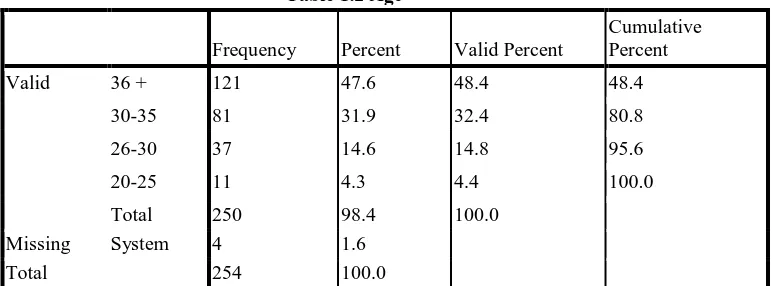
It was found that 47.6% respondents were of age group 36 years and about 31.9% were within the age group of 30-35.14.6% were of age group of 26-30 years and 4.3% lie within the range of 20-25 years. So, respondents from the age group of 36 years & above were the highest.
Table 1.3 Education
Frequency Percent Valid Percent
Cumulative Percent
Valid DOCTORATE 89 35.0 35.6 35.6
POST-GRADUATE 51 20.1 20.4 56.0
GRADUATE 106 41.7 42.4 98.4
UNDERGRADUATE 4 1.6 1.6 100.0
Total 250 98.4 100.0
Missing System 4 1.6
Total 254 100.0
This table represents that 35% of respondents have doctorate education.20.1% respondents have post-graduate
education.41.7% were graduate and 1.6% were undergraduate. So the maximum respondents were graduate in education.
Table 1.4 Experience
Frequency Percent Valid Percent Cumulative Percent
Valid 15+ 129 50.8 51.6 51.6
11-15YRS 26 10.2 10.4 62.0
6-10 YRS 73 28.7 29.2 91.2
1-5 YS 22 8.7 8.8 100.0
Total 250 98.4 100.0
Missing System 4 1.6
Total 254 100.0
This table showed that 50.8% of respondents were above 15 years of experience.10.2 % of respondents are within the range of 11-15 years of experience.28.7% of respondents were in the range of 6-10 years of experience.8.7% of the respondents have an experience of 1-5 years. Hence it was found that most of the respondents had experience of 15 years & above.
Table 1.5 Organization
Frequency Percent Valid Percent
Cumulative Percent
Valid 4 4 1.6 1.6 1.6
GOVERNMENT 59 23.2 23.6 25.2
PRIVATE 187 73.6 74.8 100.0
Total 250 98.4 100.0
Missing System 4 1.6
IJEDR1903101 International Journal of Engineering Development and Research (www.ijedr.org) 587 It was found that 23.2% of respondents were from government sector while 73.6% of the respondents were from private sector. So, number of Respondents from private organization were more.
Table 1.6 Experience in Current Organization
Frequency Percent Valid Percent
Cumulative Percent
Valid 10YRS + 175 68.9 70.0 70.0
6-10 YRS 18 7.1 7.2 77.2
1-5 YRS 34 13.4 13.6 90.8
LESS THAN 1 23 9.1 9.2 100.0
Total 250 98.4 100.0
Missing System 4 1.6
Total 254 100.0
It was observed that 68.9% respondents had experience of 10 years and above in current organization.7.1% respondents were within the range of 6-10 years.13.4% of respondents were in range of 1-5 years and 9.1% of respondents had an experience of less than 1 year. Hence the maximum number of respondents had experience of 10 Years & above in current organization.
Table1.7 Type of Training
Frequency Percent Valid Percent
Cumulative Percent
Valid 4 2 .8 .8 .8
OFF THE JOB 26 10.2 10.4 11.2
ON THE JOB 222 87.4 88.8 100.0
Total 250 98.4 100.0
Missing System 4 1.6
Total 254 100.0
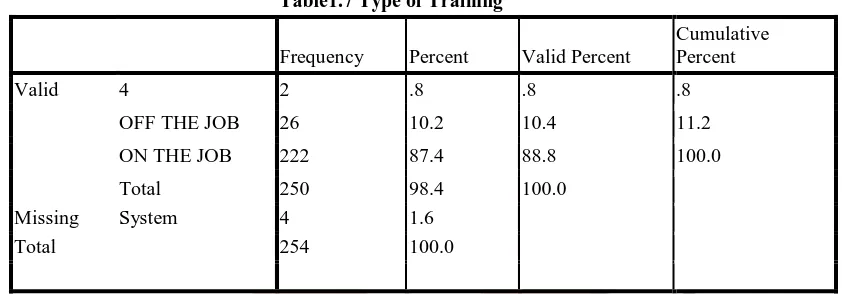
It is evident from the above table that 10.2 % of the respondents preferred on the job training and 87.4% of the respondents preferred off the job training. Respondents who preferred off the job training were more. It was observed that 79.9% of the respondents found 15 days & above training duration sufficient,8.3% of the respondents were satisfied with 11-15 days training.4.7% of respondents had undergone 6-10 days training and only 5.5% of the respondents found 1days training effective.
Table 1.8 Training Duration
Frequency Percent Valid Percent
Cumulative Percent
Valid 15+ 203 79.9 81.2 81.2
11-15 DAYS 21 8.3 8.4 89.6
6-10 DAYS 12 4.7 4.8 94.4
1-5 DAYS 14 5.5 5.6 100.0
Total 250 98.4 100.0
Missing System 4 1.6
Total 254 100.0
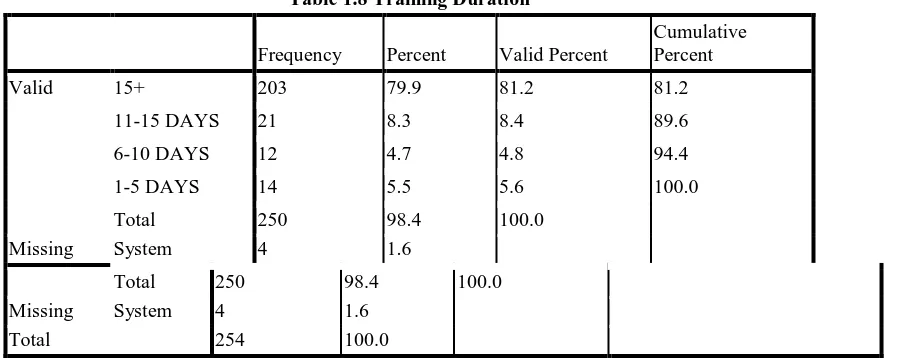
It has been observed that 79.9% of the respondents found 15 days & above training duration sufficient,8.3% of the respondents were satisfied with 11-15 days training.4.7% of respondents had undergone 6-10 days training and only 5.5% of the respondents found 1-5 days training effective.
Table 1.9 Training Seriously
Frequency Percent Valid Percent Cumulative Percent
Valid 4 1 .4 .4 .4
NO 26 10.2 10.4 10.8
IJEDR1903101 International Journal of Engineering Development and Research (www.ijedr.org) 588 Table 1.8 Training Duration
Frequency Percent Valid Percent
Cumulative Percent
Valid 15+ 203 79.9 81.2 81.2
11-15 DAYS 21 8.3 8.4 89.6
6-10 DAYS 12 4.7 4.8 94.4
1-5 DAYS 14 5.5 5.6 100.0
Total 250 98.4 100.0
Missing System 4 1.6
Total 250 98.4 100.0
Missing System 4 1.6
Total 254 100.0
The table revealed that 10.2% of the employees don’t takes organization training seriously while 87.8% of employees takes organization training seriously.
Table 2.0 Organization Type
Frequency Percent Valid Percent
Cumulative Percent
Valid HOTEL INDUSTRY 50 19.7 20.0 20.0
IT 50 19.7 20.0 40.0
PHARMACEUTICAL
INDUSTRY 50 19.7 20.0 60.0
ACADEMICS 50 19.7 20.0 80.0
BANKING 50 19.7 20.0 100.0
Total 250 98.4 100.0
Missing System 4 1.6
Total 254 100.0
Out of 250 respondents 50 were taken from each industry such as hotel, IT, hospital sector, academics and banking sector.19.7 % was participation from each sector.
Table 3 Descriptive Statistics
Mean Std. Deviation N HIGHEREMPLOYEEPRODUCTIVITYFINANCIALRETURN 4.22 .752 250
TRAININGDEVELOPMENTCONDUCTED 4.01 .794 250
TRAININGNEEDS 4.14 1.064 250
TRAININGDURATIONSESSION 3.96 .791 250
TRAINERINFORMATION 4.22 .899 250
TRAININGMATERIAL 3.98 .838 250
TRAININGENVIRONMENT 4.10 .970 250
TRAINEECANASKQUESTION 4.01 .850 250
TAININGOPPORTUNITY 4.02 .942 250
TRAININGFEEDBACK 4.08 .774 250
TRAININGPRIORITY 4.24 .885 250
IJEDR1903101 International Journal of Engineering Development and Research (www.ijedr.org) 589 to all trainees to discuss various issues openly with the trainer. It is also suggested that unbiased training opportunity must be given to all employees at various levels.
Table 3.1 Item Statistics
Mean Std. Deviation N
EMPLOYEEPERFORMANCEQUANTITYQUALITY 4.08 .654 250
WORKCOMIITMENTSPLANNINGSKILLSKNOWLEDGE 4.28 .822 250
TASKCOMPLETION 4.26 .855 250
NEWIDEAS 4.08 .738 250
WASTAGEOFTIMEANDRESOURCES 4.02 .766 250
DECISIONPROBLEMSOLVING 4.18 .844 250
COMMUNICATIONSKILLSCONFIDENCEENTHUSIASM 4.17 .743 250
STRONGWEAKPOINTS 4.14 .817 250
COOPERATEPERFORMANCE 4.09 .846 250
PROMOTIONTRAININGPROGRAMME 3.98 1.064 250
EMPLOYEETURNOVER 3.88 .926 250
HIGHEREMPLOYEEPRODUCTIVITYFINANCIALRETURN 4.22 .752 250
ORGANIZATIONALGOALS 4.26 .775 250
It was found that training & development program organized by various sectors had a great impact on improved work commitments, planning & implementation skills and knowledge of employees. These programs also helped in completion of task as per schedule. It also resulted in higher employee performance, higher productivity and financial return for organization. Employees were able to make decision faster, their problem-solving skills, communication skills and enthusiasm also improved after training and development program. Employees were able to identify their strong and weak characteristics and were able to cooperate with others due to training and development program. Quantity and quality of work output increased, it also improved planning, commitments and implementation skills of employees. Training and development also helped to decrease wastage of time. However, it was found that these programs did not significantly helped in increase in pay & promotion of employees. But it reduced employee turnover in organization to some extent.
Table 4.2 Reliability Statistics
Cronbach's Alpha Cronbach's Alpha Based on Standardized Items N of Items
.865 .868 10
Reliability of training & development was done through Cronbach’s Alpha.10 items were included and Cronbach’s alpha was determined as. 865.The alpha value which was detected as higher than the threshold value of 0.7 proves that research scale was clearly understood by the participants and the question in the scale were not inaccurate.
Table 4.3 Reliability Statistics
Cronbach's Alpha Cronbach's Alpha Based on Standardized Items N of Items
.827 .829 13
Reliability of Employee performance was done through Cronbach’s alpha was determined as. 827.The alpha value which was detected as higher than the threshold value of 0.7, proves that the research scale was clearly understood by the participant and the question in the scale were not inaccurate.
Table 5 Correlation Analysis
TOTALTRAININGDEVELOPME NT SCALE
TOTALEMPLOYEEPERFORMAN CE
TOTALTRAININGDE VELOPMENT
SCALE
Pearson Correlation 1 .619**
Sig. (2-tailed) .000
N 250 250
TOTALEMPLOYEEP ERFORMANCE
Pearson Correlation .619** 1
Sig. (2-tailed) .000
N 250 250
**. Correlation is significant at the 0.01 level (2-tailed).
IJEDR1903101 International Journal of Engineering Development and Research (www.ijedr.org) 590 Table 6 Model Summary
Model R R Square Adjusted R Square Std. Error of the Estimate Durbin-Watson
1 .619a .383 .380 4.79497 1.661
a. Predictors: (Constant), TOTALTRAININGDEVELOPMENT SCALE b. Dependent Variable: TOTALEMPLOYEEPERFORMANCE
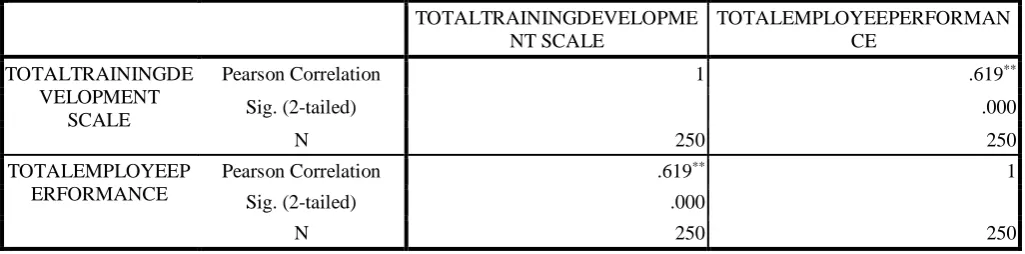
The above model summary table shows the R value which is. 619.same as correlation matrix. And the value of R Square is denoted as .383 which means that the independent variable training & development explained 38.3% of the dependent variable that is employee performance. Therefore, there exists a significant relationship between the two variables training & development and employee performance, hence null hypothesis is rejected. After applying the linear regression on the collected data to check the cause and effect relationship between the Training and Development (independent variable) and Employees Performance and (dependent variable) the above-mentioned result has been drawn.
Table 6.1 ANOVA
Model Sum of Squares Df Mean Square F Sig.
1 Regression 3538.198 1 3538.198 153.890 .000a
Residual 5701.946 248 22.992
Total 9240.144 249
a. Predictors: (Constant), TOTALTRAININGDEVELOPMENT SCALE b. Dependent Variable: TOTALEMPLOYEEPERFORMANCE
The above table interprets that the null hypothesis is rejected as the significance value of ANOVA turns out to be .000 which is greater than the probability standard 0.05. The probability of f-statistic shows the significance of the research. According to the standard if the p value is < 0.05 so than it is significant. In this study the above given table demonstrates the p value is 0.000 which is < 0.05 thus the model of the research is statistically significant. So, the independent variable of the study, training and development, has significant relationship with dependant variable of the study, employees’ performance.
Table 6.2 Coefficients
Model
Unstandardized Coefficients
Standardized Coefficients
t Sig.
Collinearity Statistics
B Std. Error Beta Tolerance VIF
1 (Constant) 27.818 2.103 13.228 .000
TOTALTRAININGDEVELOPMENT
SCALE .633 .051 .619 12.405 .000 1.000 1.000
a. Dependent Variable: TOTALEMPLOYEEPERFORMANCE
The above table coefficient entails the value B, Beta which is known as rate of change. Significance value is denoted as .000 which means there is a significant relationship between these two variables. By keeping other things constant, if there is 1 % variance in training & development it would result a change of 63.3% in employee performance which is a significant score. The un-standardized value of the mentioned table illustrates obviously that independent variable training and development has a positive impact on employees’ performance in this study.
IJEDR1903101 International Journal of Engineering Development and Research (www.ijedr.org) 591 VII.CONCLUSION
Based on preceding analysis and discussion, it can be concluded that training & development program organized by the institute in various sectors affect overall employee performance. Training and development are an important aspect of HRM. It is important for organization to get skilled and capable employees for better performance, and employees will be than competent when they have the knowledge and skill of doing the task. Training and development would provide opportunities to the employees to make a better career life and get better position in organization. In doing so, organizations efficiency would be increased. On the other hand, employees are the resources and assets of an organization if they are skilled and trained would perform better than those who are unskilled and untrained. Therefore, the purpose of this study was to find out the association between training and development and employees’ performance. The study was aimed to examine impact of training & development program on employee performance and the study supports a strong positive relationship between them. On the other, training and development benefits individual employees through improved work commitments, planning & implementation skills and knowledge of employees. These programs also helped in completion of task as per schedule. It also resulted in higher employee performance, higher productivity and financial return for organization. Employees were able to make decision faster, their problem-solving skills, communication skills and enthusiasm also improved after training and development program. Employees were able to identify their strong and weak characteristics and were able to cooperate with others due to training and development program. Quantity and quality of work output increased, it also improved planning, commitments and implementation skills of employees. Training and development also helped to decrease wastage of time. However, it was found that these programs did not significantly helped in increase in pay & promotion of employees. But it reduced employee turnover in organization to some extent. It was found that most of the organization provides credit or priority to the trained employees as it has got highest mean of 4.24. In most of the organizations, adequate information was provided by the trainer during the session, its mean value was found to be 4.01. It was found that training needs were identified through formal training mechanism. Organization uses training layout and training environment according to training purpose was ranked next. Organization gives feedback on performance before and after training. However, unbiased training opportunity was comparatively less provided in various sectors that was revealed during the research analysis. It was found that most of the trainees cannot discuss openly at various issues. It was revealed that organizations did not conducted extensive training program for new & old employees at regular intervals. Most of the trainees were not fully satisfied with the training material provided by the organizations. Training duration was rated as insufficient by maximum respondents. Hence it is strongly recommended to various sectors to improve the training duration, provide adequate training material, opportunity must be given to all trainees to discuss various issues openly with the trainer. It is also suggested that unbiased training opportunity must be given to all employees at various levels.
VIII. RECOMMENDATION:
IJEDR1903101 International Journal of Engineering Development and Research (www.ijedr.org) 592 IX. LIMITATION OF THE STUDY
Major limitation of the study was that due to the time constraint only Indore region was studied.
X.FUTURE IMPLICATION OF RESERACH
This study focuses on the association between training and development program and its influence on employee job performance. However, the design and implementation of training and development programs was not studied therefore this study can be further enhanced to explore that how training and development programs can be strategically designed and aligned with organizational goals to meet the desired performance. As training and development is a form of investment towards the employees to improve productivity, therefore this study can also be performed keeping in view the details of each variable which can be further explored in terms of return on investment on human capital and overall productivity of the firm. This research can be further explored in terms of impact of training and development on psychological factors such as attitude and behavior. Also, this study can be enhanced to see the role of training and development to create learning organizations. Finally concluding the whole research conducted it was found that training and development programs should be planned and implemented by organization for increasing skills in employees to increase overall employee performance.
XI. REFERENCES
[1] Hashim, N. T. (2014). The Impact of Training and Development on Employees Performance and Productivity A case study of United Bank Limited Peshawar City, KPK, Pakistan . International Journal of Academic Research in Business and Social
Sciences , Vol. 4, No. 4 .
[2] Imran, D. .. (2013 ). The Effect of Training on Employee Performance . European Journal of Business and Management , Vol.5, No.4, .
[3] Mozael, B. M. (2015). Impact of Training and Development Programs on Employee Performance. International Journal of
Scientific and Research Publications, Volume 5, Issue 11.
[4] Panjaitan, E. N. (2015). The Impact of Management Development Program to Employees’ Job Perfomances of a Telecommunication Company in Indonesia . European Journal of Business and Management Vol.7, No.11,.
[5] Raja Abdul Ghafoor Khan, F. A. (2011 ). Impact of Training and Development on Organizational Performance . Global
Journal of Management and Business Research , Volume 11 Issue 7 .
[6] Yakoob, Q. A. (2009). Effect of Leadership Development on Employee Performance inPakistan. Pakistan Economic and