Patient Related Outcome Measures 2016:7 109–125
Patient Related Outcome Measures
Dovepress
submit your manuscript | www.dovepress.com
109
O R I G I N A L R E S E A R C H
open access to scientific and medical research
Open Access Full Text Article
The Long-Term Conditions Questionnaire:
conceptual framework and item development
Michele Peters
1Caroline M Potter
1Laura Kelly
1Cheryl Hunter
1Elizabeth Gibbons
1Crispin Jenkinson
1Angela Coulter
1Julien Forder
2Ann-Marie Towers
2Christine A’Court
3,4Ray Fitzpatrick
11Health Services Research Unit,
Nuffield Department of Population Health, University of Oxford, Oxford,
2Personal Social Services Research
Unit, University of Kent, Canterbury,
3Nuffield Department of Primary
Health Care Sciences, University of Oxford, Oxford, 4Broadshires Health
Centre, Carterton, UK
Purpose: To identify the main issues of importance when living with long-term conditions to refine a conceptual framework for informing the item development of a patient-reported outcome measure for long-term conditions.
Materials and methods: Semi-structured qualitative interviews (n=48) were conducted with people living with at least one long-term condition. Participants were recruited through primary care. The interviews were transcribed verbatim and analyzed by thematic analysis. The analysis served to refine the conceptual framework, based on reviews of the literature and stakeholder consultations, for developing candidate items for a new measure for long-term conditions. Results: Three main organizing concepts were identified: impact of long-term conditions, experience of services and support, and self-care. The findings helped to refine a conceptual framework, leading to the development of 23 items that represent issues of importance in long-term conditions. The 23 candidate items formed the first draft of the measure, currently named the Long-Term Conditions Questionnaire.
Conclusion: The aim of this study was to refine the conceptual framework and develop items for a patient-reported outcome measure for long-term conditions, including single and multiple morbidities and physical and mental health conditions. Qualitative interviews identified the key themes for assessing outcomes in long-term conditions, and these underpinned the development of the initial draft of the measure. These initial items will undergo cognitive testing to refine the items prior to further validation in a survey.
Keywords: long-term conditions, conceptual framework, qualitative interviews, patient-reported outcome measure
Introduction
Patient-reported outcome measures (PROMs) have been proposed as a means to measure
what matters to patients to strengthen patient involvement in their care, to enable
indi-vidualization of care,
1and to evaluate the performance and quality of care.
2It is generally
agreed that a PROM should have a clear underlying conceptual framework,
3–5which
specifies the specific goal of the measure, its intended use, and the target population.
3,4Although these criteria have been highlighted in particular for PROMs used in clinical
trials, it is equally important that PROMs developed for use in other contexts, such as
clinical practice or performance monitoring, are also developed to a high standard. It is
recommended that an initial hypothesized conceptual framework be based on a
litera-ture review and expert opinion, and that this framework be further refined as domains
and items are developed on the basis of in-depth qualitative and cognitive interviews.
5 Correspondence: Michele PetersHealth Services Research Unit, Nuffield
Department of Population Health, University of Oxford, Old Road Campus, Oxford OX3 7LF, UK
Telephone +44 1865 289 428 Email [email protected]
Journal name: Patient Related Outcome Measures Article Designation: ORIGINAL RESEARCH Year: 2016
Volume: 7
Running head verso: Peters et al
Running head recto: Long-Term Conditions Questionnaire DOI: http://dx.doi.org/10.2147/PROM.S104552
Patient Related Outcome Measures downloaded from https://www.dovepress.com/ by 118.70.13.36 on 26-Aug-2020
For personal use only.
This article was published in the following Dove Press journal: Patient Related Outcome Measures
30 August 2016
Dovepress
Peters et al
Long-term chronic conditions are the main challenge
fac-ing health and social care services today, due to their increasfac-ing
prevalence, complexity, and impact on quality of life.
6–10Mul-timorbidity adds further to this challenge. Enhancing quality of
life for people with long-term conditions (LTCs) by monitoring
PROM scores is a key goal of health and social care policy
in England and in other countries.
11–14The use of PROMs has
been pilot-tested for six LTCs in primary care.
15This pilot study
highlighted a number of challenges, including the reporting of
PROM data (for one generic and six disease-specific PROMs)
in a meaningful and concise manner across multiple LTCs.
16As no PROM exists to capture outcomes across all LTCs, the
EuroQol five-dimension questionnaire (EQ-5D) is used in
England to assess LTC outcomes, eg, as part of the GP Patient
Survey.
17However, the EQ-5D may not capture all issues of
importance to patients and clinicians. Therefore, professional
and lay stakeholders support the development of a new measure
for LTCs.
18The intention of this measure would be to capture
issues of importance across LTCs and to offer a practical, easily
interpretable, and useful method to assess outcomes across a
range of health and social care services.
The aim was to develop a short self-completed
question-naire about issues of importance when living with LTCs. The
intention was to develop a measure for use by adults with
single and multiple morbidities, including both physical and
mental health conditions. We intend it to be used for
indi-vidual care and for population monitoring across all health
and social care settings. The domains and items are intended
to be complementary to those of the EQ-5D, and to reflect
both traditional domains (ie, aspects of quality of life) and
less traditional domains of importance in LTCs (eg,
empower-ment) that can be assessed by patient self-report. Following
scoping reviews of the literature covering 12 key domains
that can be assessed through patient reports and a stakeholder
consultation,
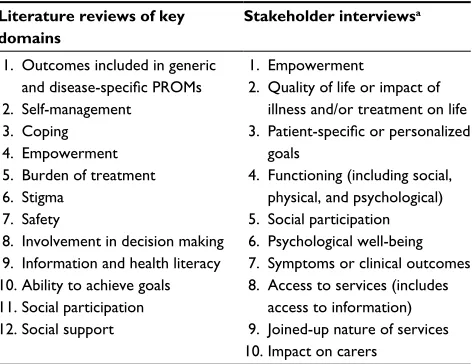
18an initial conceptual framework was
devel-oped (see Table 1 for the initial framework).
3,4This article
describes the refinement of the conceptual framework and
the development of the thematic domains and initial items.
Materials and methods
Qualitative interviews
Recruitment
Eight primary care practices in England (four in
Oxford-shire and four in London) agreed to recruit people with at
least one of ten specified LTCs from their patient database.
The ten LTCs were selected by a panel composed of the
authors, PROM experts, and lay advisors. The aim was to
select maximally diverse LTCs (in terms of symptoms,
bodily systems, disease trajectory, prevalence, likelihood
of comorbidities, burden of disease and care, and level
of self-management). To aid this process, the panel was
provided with information on bodily systems, the World
Health Organization Global Burden of Disease study,
19a study on multimorbidity,
7and the LTCs included in
the Quality and Outcomes Framework (
http://www.nice.
org.uk/aboutnice/qof/qof.jsp
). The following LTCs were
selected: cancer, chronic obstructive pulmonary disease
(COPD), ischemic heart disease (IHD), diabetes,
depres-sion, inflammatory bowel disease (IBD), multiple sclerosis
(MS), osteoarthritis, schizophrenia, and stroke. Seven of
these were selected by over half the panel, and three (IBD,
MS, and schizophrenia) were selected by at least one panel
member and included to contrast maximally with the other
seven LTCs.
Practice staff conducted a search on the database
com-prised of the electronic patient record of all individuals
registered with the practice. Search criteria were followed
according to instructions developed and tested by one of
the authors (CA). This search produced a list of patients
with the relevant LTCs. Practices fed back the number of
patients identified per LTC. The researchers used an online
randomization tool (
www.random.org
) to generate random
patient numbers per LTC. Practice staff then selected patients
according to the randomization numbers from the list, and
checked each patient against the inclusion and exclusion
criteria. A total of 360 eligible patients were invited into the
study. For LTCs with lifelong implications (COPD, diabetes,
IBD, IHD, MS, osteoarthritis, and stroke), eligibility was
defined as the presence of the LTC. Where full prolonged
Table 1 Initial domains in the conceptual framework for thedevelopment of the Long-Term Conditions Questionnaire
Literature reviews of key domains
Stakeholder interviewsa
1. Outcomes included in generic
and disease-specific PROMs
2. Self-management 3. Coping 4. Empowerment 5. Burden of treatment 6. Stigma
7. Safety
8. Involvement in decision making 9. Information and health literacy 10. Ability to achieve goals 11. Social participation 12. Social support
1. Empowerment
2. Quality of life or impact of illness and/or treatment on life
3. Patient-specific or personalized
goals
4. Functioning (including social, physical, and psychological) 5. Social participation 6. Psychological well-being 7. Symptoms or clinical outcomes 8. Access to services (includes
access to information) 9. Joined-up nature of services 10. Impact on carers
Notes: aAdapted from Hunter C, Fitzpatrick R, Jenkinson C, et al. Perspectives
from health, social care and policy stakeholders on the value of a single self-report outcome measure across long-term conditions: a qualitative study. BMJ Open. 2015;5(5):e006986.18
Abbreviation: PROMs, patient-reported outcome measures.
Patient Related Outcome Measures downloaded from https://www.dovepress.com/ by 118.70.13.36 on 26-Aug-2020
Dovepress Long-Term Conditions Questionnaire
remission or cure is possible (cancer, depression, and
schizo-phrenia), additional criteria in relation to duration of disease
and/or current treatment were determined, similarly to the
approach taken by Barnett et al.
7Additionally, the diagnosis
needed to have been confirmed more than 12 months ago,
to ensure that patients had time to adjust to their diagnosis
and had experienced a range of services and strategies for
the management of their LTC(s). Only adult patients were
included (ie, 18 years of age and above). There was no
upper age limit.
No participants with schizophrenia were recruited
through primary care; therefore, the data were supplemented
with interviews from a study conducted in 2013–2014 by
RF and MP on outcomes valued by people with
schizo-phrenia.
20Participants had been recruited through an email
invitation by Rethink Mental Illness (
https://www.rethink.
org/about-us
) and snowball sampling. The exact number
of people receiving the invitation is not known, but 47
people made contact to participate. Of these 47, 13 were
excluded due to not reporting a diagnosis of schizophrenia
or schizoaffective disorder, five people refused to be
inter-viewed, and seven failed to respond to emails after their
initial contact. For the purposes of the study presented here,
six transcripts of diverse participants (in terms of age and
sex) were selected for secondary analysis.
Data collection
Eligible patients were sent a letter of invitation by the primary
care practice and were asked to contact the researchers if they
were interested in participating. Following initial contact that
included confirmation of eligibility, the researchers arranged
an interview time and location according to the preference
of the participant; most interviews took place in
partici-pants’ homes, their workplace, or the University of Oxford.
All participants gave written consent. The semi-structured
interviews were conducted by CH, LK, and CP. All interviews
were digitally audio-recorded.
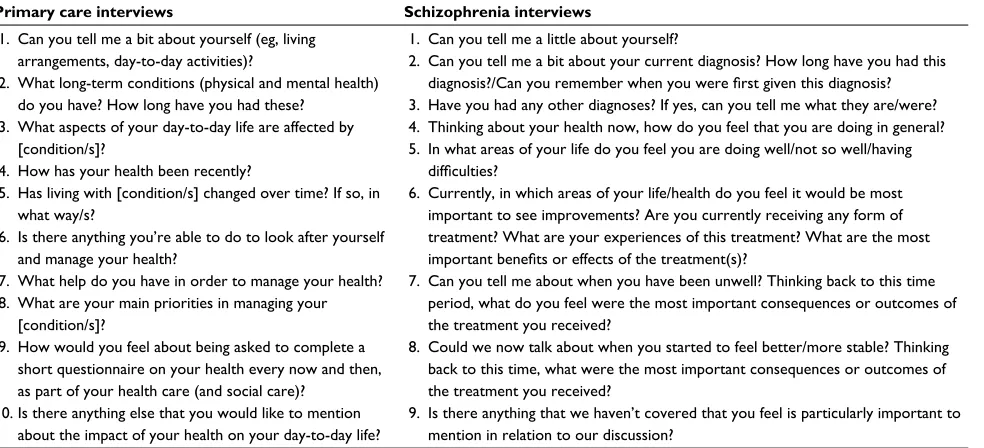
The topic guide for the primary care participants (Table 2)
was informed by our previous scoping literature reviews on
PROMs and the key domains (Table 1), health care-policy
docu-ments (such as the National Health Service Outcomes
Frame-work and the Social Care Outcomes FrameFrame-work),
21,22and the
stakeholder interviews.
18It focused on impacts and outcomes
of LTCs, personal self-care strategies, help needed or received
in managing LTCs (including experiences of health, social
care, or community/voluntary services), and goals or problems
regarding LTC management. In later interviews, participants
were also invited to comment on emerging themes that were
being considered as candidate items for a new PROM for LTCs.
The schizophrenia topic guide (Table 2) was developed on the
basis of a stakeholder consensus meeting and the literature.
Table 2 Topic guide for interviews
Primary care interviews Schizophrenia interviews
1. Can you tell me a bit about yourself (eg, living arrangements, day-to-day activities)?
2. What long-term conditions (physical and mental health) do you have? How long have you had these?
3. What aspects of your day-to-day life are affected by [condition/s]?
4. How has your health been recently?
5. Has living with [condition/s] changed over time? If so, in what way/s?
6. Is there anything you’re able to do to look after yourself and manage your health?
7. What help do you have in order to manage your health? 8. What are your main priorities in managing your
[condition/s]?
9. How would you feel about being asked to complete a short questionnaire on your health every now and then, as part of your health care (and social care)?
10. Is there anything else that you would like to mention about the impact of your health on your day-to-day life?
1. Can you tell me a little about yourself?
2. Can you tell me a bit about your current diagnosis? How long have you had this
diagnosis?/Can you remember when you were first given this diagnosis?
3. Have you had any other diagnoses? If yes, can you tell me what they are/were? 4. Thinking about your health now, how do you feel that you are doing in general? 5. In what areas of your life do you feel you are doing well/not so well/having
difficulties?
6. Currently, in which areas of your life/health do you feel it would be most important to see improvements? Are you currently receiving any form of treatment? What are your experiences of this treatment? What are the most
important benefits or effects of the treatment(s)?
7. Can you tell me about when you have been unwell? Thinking back to this time period, what do you feel were the most important consequences or outcomes of the treatment you received?
8. Could we now talk about when you started to feel better/more stable? Thinking back to this time, what were the most important consequences or outcomes of the treatment you received?
9. Is there anything that we haven’t covered that you feel is particularly important to mention in relation to our discussion?
Patient Related Outcome Measures downloaded from https://www.dovepress.com/ by 118.70.13.36 on 26-Aug-2020
Dovepress
Peters et al
Data analysis and development of items
The interviews were transcribed verbatim by a professional
transcription company. All transcripts were verified and
anonymized by the interviewers before analyzing the data in
QSR NVivo 10, a qualitative software package. An iterative
framework analysis was used.
23According to this approach,
eight interviews were analyzed according to an initial coding
framework drawing on the literature review and the
stake-holder interviews.
18After discussion among the authors, the
coding framework was expanded to take account of emerging
themes, particularly those relating to social care; a further
18 interviews were analyzed using the expanded framework.
CH, CP, and LK conducted the analysis, and MP and RF
analyzed ten interview transcripts (five each). These ten
transcripts were selected to represent a range of LTCs. The
analysis framework was then discussed and further refined,
before the remaining 22 interview transcripts (including
the six schizophrenia transcripts) were analyzed. Once all
transcripts had been coded, the framework was reviewed
again, with no further changes made. Earlier transcripts
were then recoded to incorporate the additional codes from
the final framework.
A data-saturation table was created to evaluate if thematic
saturation had been achieved. Saturation was defined as “the
point in the data collection process when no new
concept-relevant information is being elicited from individual
inter-views or focus groups”.
4The interview data were analyzed
systematically and subsequently, and concurrently with data
collection, using a constant comparison method moving
between the codebook, the saturation table, and full
tran-scripts,
24to determine if new themes emerged. Data collection
was considered complete when no new relevant themes were
emerging. As described earlier, the analysis framework was
established following a review of the framework based on
the analysis of 18 interviews. No further themes were added
to the framework during the subsequent analysis.
Individual team members (MP, CH, LK, RF, CJ, and
AMT) drafted candidate items based on a number of
dimensions. Each dimension represented either one theme
or subtheme from the qualitative analysis or two merged
themes/ subthemes. All the dimensions represented the
refined conceptual framework underpinning the new
mea-sure. The candidate items were discussed in team meetings
to identify and reach consensus on individual candidate
items. Criteria for retaining candidate items included that
they represented issues identified as important in the
inter-views (either to all the participants or important subgroups,
such as social care users) and that they were deemed clear
and easy to understand. Usually, duplicate items or those
that significantly overlap (ie, represent similar underlying
concepts) would also be removed in this process. However,
the first draft of the questionnaire included a small number
of items that were duplicates (as they were either worded
positively and negatively) or that represented similar
concepts. While this meant some items were very similar,
it allowed pretesting differently worded items with people
with LTCs in cognitive interviews.
Ethical approval
For the primary care participants, ethical approval was
obtained through the National Research Ethics Service
Committee London – Bromley. Ethical approval for the
schizophrenia study had been gained through the East of
Scotland Research Ethics Service. All participants signed
an informed consent form.
Results
Participants
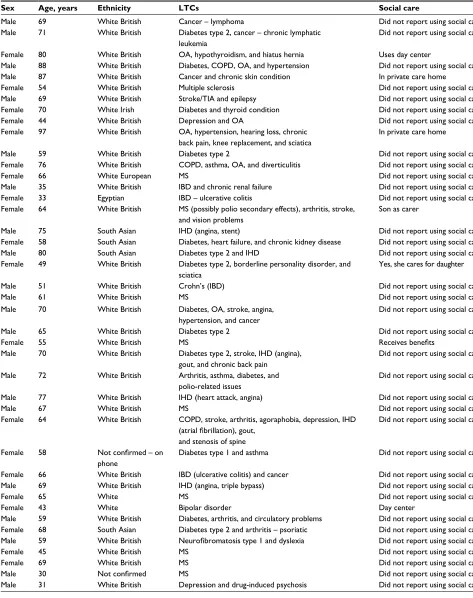
A total of 48 people with LTCs (42 recruited through
pri-mary care and six through the schizophrenia study) were
interviewed (Tables 3 and S1 for details on participants).
Participants reported a wide range of LTCs, in addition
to the index LTC. Information on the use of social care
was only available for the participants recruited through
primary care, as the schizophrenia study did not directly
ask about this.
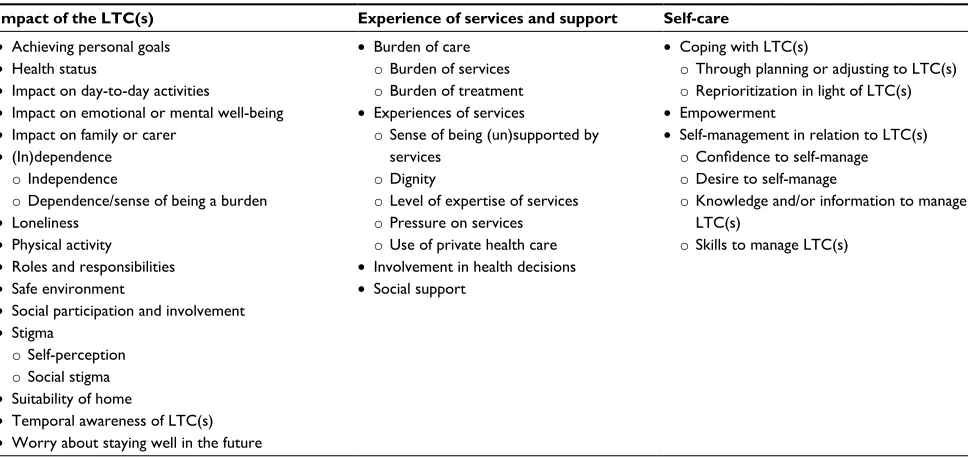
The overarching concepts and themes
Following the analysis, three overarching organizing
con-cepts were identified to focus thinking about the emerging
patterns of data in relation to living with LTCs: impact of
LTC(s), experiences of services and support, and self-care.
The three overarching concepts contained 22 themes; 16
themes were analyzed at this level only, and six themes
contained 17 subthemes (Table 4). Impact of LTC(s)
encompassed the largest range of themes with 15 themes,
experience of services and support included four themes,
and self-care was composed of three themes. The majority
of the participants discussed aspects of each of the three
overarching concepts.
Impact of LTC(s)
Participants described how their lives had been affected by
their LTCs (Table 4). This included such issues as impact
on day-to-day activities, emotional or mental well-being,
and social participation, mentioned by more than 75% of
Patient Related Outcome Measures downloaded from https://www.dovepress.com/ by 118.70.13.36 on 26-Aug-2020
Dovepress Long-Term Conditions Questionnaire
participants, to such themes as impact on family or carers
and loneliness, discussed by fewer than 35% of participants
(Table 5).
A 64-year-old woman with COPD, stroke, arthritis,
ago-raphobia, depression, IHD, gout, and stenosis of the spine
described the impact of her LTC(s) on her physical health
and daily activities:
[...] I can dress myself, except for when it comes to my feet, because I can’t get that far on my back, and my knees don’t move properly [...] so I can’t do that [...]. I’ll cook
with a microwave, but I can’t prepare vegetables, but I can cook, but I can’t hold hot saucepans, and hot things, so if it’s just a matter of putting something in a microwave, I can do that. I just look to do the things I can do, like I can dust, my husband hoovers, I can’t manage the Hoover [...].
The ability to achieve personal goals was discussed by
over half of the participants. Personal goals could relate to
anything that participants valued; however, mostly it centered
on work and family, but could also focus on the ability to
look after pets or keep up with hobbies or physical activity.
Table 3 Characteristics of interview participantsPrimary care recruitment Schizophrenia study
Number of interviews 42 6
Sex 22 men, 20 women Four men, two women
Age range (years) 30–97 29–60
Ethnicity 36 white British or Irish. Also one white European, one Egyptian, four South Asian
Four white British, one white European, one black British LTCs
Single morbidity (n) Multimorbidity (n)
Participants per LTC determining recruitment (n)
All other LTCs reported
18
24 (range 2–8 LTCs)
COPD (three), diabetes (14), IHD (six), cancer (five), depression (three), schizophrenia (zero), stroke/TIA (five), IBD (four), MS (seven), OA (ten)
Agoraphobia, asthma, bipolar disorder, borderline personality disorder, chronic kidney disease, chronic back pain/sciatica, chronic renal failure, chronic skin condition, diverticulitis, gout, hearing loss, heart failure, epilepsy, dyslexia, hypertension, hypothyroidism or other thyroid condition,
neurofibromatosis type 1, peripheral vascular disease, psoriatic arthritis,
psychosis (drug-induced), spinal stenosis, and visual loss
3
3 (range 2–4 LTCs) A type of schizophrenia (six)
Anxiety, spinal stenosis, depression, breast cancer, and long-term hepatitis C
Social care use Seven with some form of social care experience Participants were not asked about use of social care
Abbreviations: LTCs, long-term conditions; COPD, chronic obstructive pulmonary disease; IHD, ischemic heart disease; TIA, transient ischemic attack; IBD, inflammatory
bowel disease; MS, multiple sclerosis; OA, osteoarthritis.
Table 4 The three main overarching concepts, with their themes (•) and subthemes (o) identified within the interviews
Impact of the LTC(s) Experience of services and support Self-care
• Achieving personal goals
• Health status
• Impact on day-to-day activities
• Impact on emotional or mental well-being
• Impact on family or carer
• (In)dependence
oIndependence
oDependence/sense of being a burden
• Loneliness
• Physical activity
• Roles and responsibilities
• Safe environment
• Social participation and involvement
• Stigma
oSelf-perception
oSocial stigma
• Suitability of home
• Temporal awareness of LTC(s)
• Worry about staying well in the future
• Burden of care
oBurden of services
oBurden of treatment
• Experiences of services
oSense of being (un)supported by services
oDignity
oLevel of expertise of services
oPressure on services
oUse of private health care
• Involvement in health decisions
• Social support
• Coping with LTC(s)
oThrough planning or adjusting to LTC(s)
oReprioritization in light of LTC(s)
• Empowerment
• Self-management in relation to LTC(s)
oConfidence to self-manage
oDesire to self-manage
oKnowledge and/or information to manage LTC(s)
oSkills to manage LTC(s)
Abbreviation: LTCs, long-term conditions.
Patient Related Outcome Measures downloaded from https://www.dovepress.com/ by 118.70.13.36 on 26-Aug-2020
Dovepress
Peters et al
A 58-year-old woman explained how schizophrenia impacted
on her work:
[...] I have a degree in psychology, I am a qualified coun-selor; I wanted to become an analyst. I mean, my career: every time I had a breakdown, it falls apart [...].
Maintenance of independence or becoming dependent formed
a significant part of the impact of LTC(s). A 65-year-old
woman with MS explained how a parking permit for disabled
drivers helped her keep mobile and independent:
[...] I have a condition which is incurable, and in general what happens is you just get worse until you end up in a wheelchair, so I mean obviously my priority is keeping mobile, keeping independent, so independence and mobility is what would be my aim [...]. I think I’m independent, but frankly my blue badge is important to me for independence [...].
Table 5 Themes, subthemes, numbers, and rank of interviews endorsing theme
Theme Subtheme Schizophrenia
(n=6)
LTC (n=42)
Total (n=48)
Rank
Experiences of services Sense of being (un)supported by services 6 41 47 1
Impact on day-to-day activities 5 41 46 2
Social support 6 38 44 3
Social participation and involvement
6 37 43 4
Impact on emotional or mental well-being
6 36 42 5
Coping with LTC(s) 5 35 40 6
Self-management Knowledge and/or information to manage LTC(s)
4 36 40 6
Burden of care Treatment burden 6 32 38 8
Achieving personal goals 6 30 36 9
Self-management Skills to manage LTC(s) 3 32 35 10
Empowerment: a sense of control over one’s daily life
5 28 33 11
Self-management Desire to self-manage 2 30 32 12
Physical activity 2 28 30 13
Self-management Confidence to manage LTC(s) 3 26 29 14
Burden of care Service burden 3 25 28 15
Stigma Social stigma 5 22 27 16
Roles and responsibility 2 25 27 16
(In)dependence Independence 2 25 27 16
Stigma Self-perception 4 19 23 19
Health-status ratings 2 21 23 19
Experience of services Level of expertise from services 3 19 22 21
Coping with LTC(s) Coping through planning or adjusting way of living 3 18 21 22
Worry about staying well in future 2 17 19 23
Experience of services Dignity (how you are treated by services) 1 17 18 24
Safe environment 3 15 18 24
(In)dependence Dependence or being a burden 1 16 17 26
Involvement in health decisions 4 13 17 26
Impact on family or carer 2 13 15 28
Suitability of home 0 15 15 28
Self-management (especially relating to LTC[s])
1 13 14 30
Temporal awareness of LTC(s) 1 13 14 30
Loneliness 0 12 12 32
Experience of services Services as pressured – sense of responsibility 2 9 11 33
Experience of services Using private health care – reasons 0 11 11 33
Coping with LTC(s) Reprioritization in light of LTC(s) 2 8 10 35
Note: Themes/subthemes in bold were considered for item development.
Abbreviation: LTCs, long-term conditions.
Patient Related Outcome Measures downloaded from https://www.dovepress.com/ by 118.70.13.36 on 26-Aug-2020
Dovepress Long-Term Conditions Questionnaire
Experiences of services and support
In this concept, participants described the types of health
and/or social care services they had used, their various
types of support, and the burden caused by the services
and care needed to manage their LTC(s). Support included
help given by people or organizations outside health and
social services, such as family members, friends or
chari-ties. The most frequently discussed themes (by over 75%
of participants) were support by either services or others,
and burden of treatment (Table 5). A 77-year-old man with
IHD explained how hospital appointments could be difficult
to manage:
[...] and it’s also planning sort of like work around hospital [...]. I seem to have so many hospital appointments these days, just seem to be [...] I get the impression that once they get hold of you, they’re never going to let you go [...].
In contrast, a 69-year-old man with cancer had found the
input by health services helpful:
[...] impressed with the health service. One of the things that’s difficult I personally think is, like most others I sus-pect, it’s difficult to get a GP appointment when you actually want one, but I think once you’ve been identified as having something they have to treat, or believe that they will be able to help with treatment, I have to say I haven’t looked back. The treatment and care and the response I get from even the GP, I was transformed by that [...].
Additionally, as to whether services provide adequate
support, participants also talked about how they were treated
by health care professionals. A 66-year-old woman with
cancer and IBD talked about contrasting experiences when
consulting different doctors:
[...] there was only the two main doctors: the first one [doctor], he seemed very abrupt, very “doctorerfied” if that makes sense, whereas the other one was very casual in his mannerisms, and you felt you could talk to him [...].
However, it is not only health services that provide support.
The importance of social support is explained by a
35-year-old male with IBD and chronic renal failure:
[...] we travel a lot. That’s partly because actually my wife forces me to, or has forced me to, and now I do it a lot more, and I enjoy it and I get a lot out of it. One role of the partner I think is potentially quite interesting: you know, I’ve had some amazing travel experiences over the last 4 years, partly because I’m with somebody I don’t worry as much about
what might happen if I were ill and I was away, and also she absorbs [...] quite a lot of my angst, so that enables me to do those things [...].
Self-care
Self-care focused on actions or strategies that participants used
to look after themselves and their LTC(s) or strategies to cope
with their LTC(s). This included both active strategies, such
as planning around the LTC(s), or passive strategies, such
as acceptance of their limitations and reframing priorities.
The most widely discussed theme (by over 75% of
partici-pants) was coping with LTC(s). Self-care had the potential
to influence positively or negatively the impact of LTC(s).
Participants differed in the extent to which they felt able to
take positive actions, such as adopting healthier behaviors.
There was also a time impact, with participants discussing
variations in how well they could self-care during different
time periods. When participants struggled with self-care, other
problems could occur or the impact of LTC(s) could increase,
or worsen the impact of the LTC(s), as explained by a
31-year-old man with depression and medication-induced psychosis:
[...] I’ve still got depression, I fight every day, I do fight it every day, but before where I’d let it sort of overtake me [...]. I could sit indoors for 2 weeks. I think there was about a time of 2–3 months where I was going to bed at 12 o’clock in the day and sleeping until 9 o’clock at night and then I’d wake up, and I’d sit the whole night like just watching TV, and all I’d eat was a bowl of Weetabix. I went down to 9 stone, I looked anorexic, and it just spiraled out of control [...].
A certain degree of own judgment and flexibility was
often needed to find the best way to deal with the LTC(s). A
68-year-old woman described how she adapted to cope with
the dietary changes needed to manage her diabetes:
[...] Initially I had to reeducate myself diet-wise [...] by nature I have a very bad sweet tooth, so I had to restrict my intake of sweets. But otherwise it wasn’t [...] but I’m somebody [that] once I know I have to do something, I condition my mind and just get on with it [...].
Acceptance of LTC(s), and the limitations this might
impose, was explained by a 72-year-old man with four
dif-ferent morbidities, including diabetes and arthritis:
[...] I’ve had these various problems, starting with polio and asthma when I was very young. I’ve missed a fair bit of schooling through the polio, you just get sort of used to it,
Patient Related Outcome Measures downloaded from https://www.dovepress.com/ by 118.70.13.36 on 26-Aug-2020
Dovepress
Peters et al
and you get one more thing to put up with and you get on with it. There’s no point in sitting around: you’ve got to make the best of things and you know, and fight back basically [...].
Item development
As it is the intention to develop a short measure for LTCs, it
was not feasible to include items for each theme or subtheme
from the interviews, although the three organizing concepts
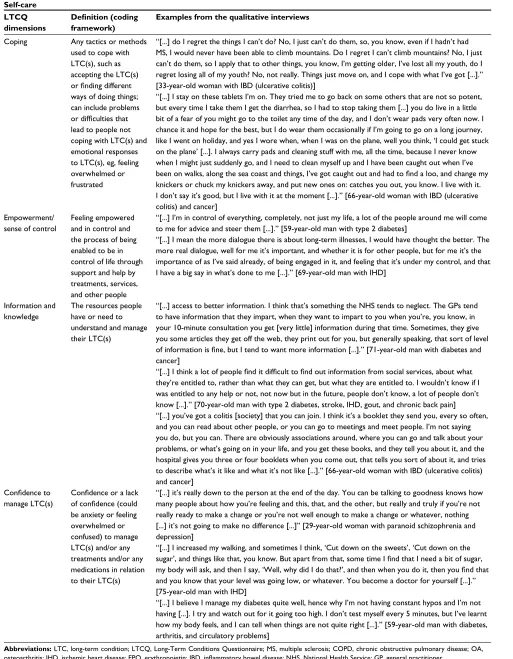
are represented in the items. Twenty themes or subthemes were
taken into account in item development. These 20 themes or
subthemes mostly ranked highly in terms of the number of
interviews in which they were discussed. The lowest level of
analysis was used for the ranking, meaning 18 themes and
17 subthemes. The 20 themes/subthemes selected for item
development are highlighted in bold in Table 5, and they
underpinned 17 dimensions (some themes collapsed for
item development, eg, “Impact on day-to-day activities” and
“Impact on emotional or mental well-being” were collapsed
into “Impact of LTCs”) that were used to develop items
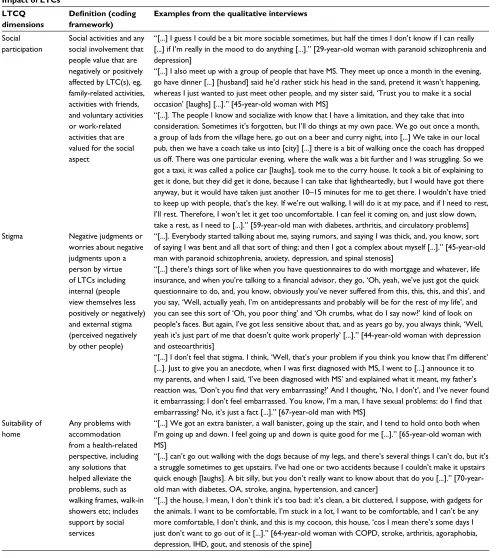
(Table 6). The dimensions, representing the refined conceptual
Table 6 LTCQ dimensions, qualitative themes, and illustrative quotes
Impact of LTCs LTCQ dimensions
Definition (coding
framework)
Examples from the qualitative interviews
Achieving personal goals
Any personal goals (ie, something participants talk about valuing or wishing they could do) and how LTC(s) impact on ability to achieve personal goals or how goals have changed due to the LTC(s)
“[...]. The arthritis, yes, it does, at the moment, with the damp weather and things. I’m waiting for a knee replacement, and my knee is giving me so much [...] restricting my movement quite a bit. I’m in quite a bit of agony and it restricts my movement, which is annoying me, because I’m not someone who can sit for long periods doing nothing, but this is forcing me to do that, which I really am not enjoying at all [...].” [68-year-old woman with diabetes and psoriatic arthritis]
“[...]. I want to be able to carry on walking the dogs properly and we have – believe it not – there’s a swimming pool out there. I’d like to be able to keep swimming, because that’s such good exercise [...].” [54-year-old woman with MS]
Dependence and being a burden
Feelings of being too dependent on others for basic or other needs, eg, feeling like a burden, unhappiness about having to rely on others, future fears of dependence
“[...]. Pretty much I look after myself. I do all my own cooking and stuff, so I manage the diabetes, nobody else gets involved with that. I do all the injections and put all my tablets out, and so I do all that myself [...].” [59-year-old man with diabetes]
“[...]. It’s just been the same. I don’t think anything’s really changed, except for the fact that as time goes by I seem to get less and less independent [...]. I’ve been used to being independent, and losing that independence has been the hardest thing in the world [...].” [64-year-old woman with MS, arthritis, stroke, and problems with vision]
“[...]. As long as I live, I want to be fairly healthy for them [family], so I’m not a burden [...].” [76-year-old woman with COPD, asthma, OA, diverticulitis, and depression]
“[...] we have done holidays with friends, and you just feel very conscious that if I’m there, I’m restricting what they can all do. It’s not just me, it affects everybody else [...] you know we’re aware that all the others are thinking that they’d like to go off and see this thing, or do that thing, and you tend to really hold back and try and persuade – ‘Just go, don’t worry about us going, you do it’ – you know, and I feel hard done by, but I don’t want to put the extra burden on other people [...].” [55-year-old woman with MS]
Impact of LTC(s) Impact LTC(s) have on ability to complete day-to-day activities (like cooking, cleaning, work, self-care, looking after family/pets) and impact on emotional health and mental state, including LTCs causing anxiety/worry, feeling depressed as a result
of LTCs, difficulties
concentrating, etc.
“[...]. [It] made me think, ‘If I don’t take my medicines this time, I’m going to have a newborn and a 5-year-old at home, and I’m going to be in hospital, and there’s no one to take care of them.” Do you know what I mean? So since then, since that one attack during pregnancy, I’ve been taking my remission medication like it’s a religion [...].” [33-year-old woman with IBD (ulcerative colitis)] “[...]. I do arrow words and crosswords just to keep my brain going, because I’ve got this stupid memory that drives me absolutely silly, and I keep thinking, ‘Well, I don’t know, as long as do things like that, it’ll keep my brain moving’, and I do tend to do a lot of those. It makes me relax, to be
quite honest, because I used to be really, really fit, really, really busy, you know, I never had time to
sit around or anything, but now I’m stuck because I’ve got all this time and I don’t really want it, so
I’ve got to fill it in or else I get depressed [...].” [64-year-old woman with COPD, stroke, arthritis,
agoraphobia, depression, IHD, gout, and stenosis of the spine]
“[...] perhaps when I was at university, various things where I was convinced that I really wasn’t, you know, I was the lowest of the low, and I had absolutely no self-esteem whatsoever and I couldn’t believe it if, you know, a bloke chatted me up, I thought he was only after my good-looking friend, or whatever, and times when I’ve, you know, just been convinced that people have only sort of put up with having me around for one reason or another, rather than actually being genuine friends, and I look back on that and think, ‘Well, yeah, that’s [...] you were depressed at that point’ [...].” [44-year-old woman with depression and OA]
Patient Related Outcome Measures downloaded from https://www.dovepress.com/ by 118.70.13.36 on 26-Aug-2020
Dovepress Long-Term Conditions Questionnaire
Impact of LTCs LTCQ dimensions
Definition (coding
framework)
Examples from the qualitative interviews
Loneliness Perceptions of whether social contact is adequate or potential loneliness as a result of LTC(s), worries about loneliness and the impact of LTCs on social contact and loneliness
“[...]. I’m very lucky, I say, in having [neighbor] next door to me. That’s because there is nobody else up here that could be the same as him next door, you know, where I can go in, have a little chat, discuss what’s in the paper, and that sort of thing, and that, believe me, is a big thing when you’re stuck up here all day long [...].” [97-year-old woman with OA, hypertension, hearing loss, chronic back pain, knee replacement, and sciatica]
“[...]. It’s quite funny, really. And if it wasn’t for my son visiting twice a day, and my dog and my cat, there’d be nothing in my life, really, you’d just be sitting here looking out the window or watching the television, and that’d be it [...].” [64-year-old woman with MS, arthritis, stroke, and problems with vision]
“[...] I must admit I am quite, um, content with my own company when I’m not doing anything [...]. But I do like company from time to time [...].” [45-year-old man with paranoid schizophrenia, anxiety, depression, and spinal stenosis]
Physical activity Impact of LTC(s) on physical activity levels; this might overlap with impact on day-to day-activities, as these often require physical activity, but additionally includes exercise as a physical activity undertaken for health or leisure purposes
“[...] I have a friend who lives very high up and there are no lifts. There’s 84 steps, and it’s just too much for me, I am out of breath at the top of that. Steep hills are a bit of a problem [...].” [76-year-old woman with COPD, asthma, OA, diverticulitis, and depression]
“[...] I used to walk miles. I ended up walking with the aid of a stick, but before that I could walk miles. I think it sort of descended on me suddenly, and I don’t know why, and I couldn’t walk without the aid of a stick or a frame, and that reduced my activity right down [...].” [87-year-old man with cancer and chronic skin condition]
“[...] ‘cos you feel like you want to do some exercise, just to keep some sort of fitness, but because
of the fatigue side of things, it just took over too much of life, because I would do the gym, then come home, be completely wiped out, couldn’t do anything [...] so [gym] three times [a week]. I think the MS physio, I think she said she thought that was too much, so I’ve cut it down now to once a week, and that’s only about half an hour, which half of me thinks, ‘Is there any point me doing that?’, ‘cos it’s such a tiny thing, I sort of half feel it’s not worth doing [...].” [55-year-old woman with MS]
Roles and responsibilities
Impact of LTC(s) on a person’s ability to undertake valued social roles and where LTC(s) affects their ability
to take on or fulfill
responsibilities, eg, parenting, family duties, work, or community responsibilities
“[...] I didn’t want to leave work, but since 2007 I’ve just not been well, one thing after another, and I just had to give up my job, which wasn’t great for me, because I loved my job [...]. Loved it, really loved it, but then I started to get sick, this, that, and the other, and in the end it wasn’t fair on them and it wasn’t fair on me. So my husband’s struggling a bit, so I thought, ‘No, this has got to stop’, so I was of retirement age anyway, well nearly, so, you know, I just had to bite the bullet, as you do [...].” [64-year-old woman with COPD, stroke, arthritis, agoraphobia, depression, IHD, gout, and stenosis of the spine]
“[...] I have to take the wife to do the shopping. I can’t go in with her because it’s too far to walk, you know, so I have to sit in the car, and I can’t take the dogs round the park anymore, that upsets me quite a bit [...].” [70-year-old man with diabetes, OA, stroke, angina, hypertension, and cancer]
Safe environment The extent to which people feel safe or unsafe in relation to inside and outside their home, in particular when this is health-related, eg, falls in the home; from a social services perspective, people may also feel unsafe for other reasons, eg, fear of abuse, crime, etc
“[...] I’ve slowly but surely got worse over the years, my walking is a joke. I can’t [...] I do go out, but I’m very nervous the whole time, because this foot goes out to the side and I’ve got no muscles to keep it over [...]. I’ve not got the freedom I used to have, because I’m scared to go out on my own now. I have to go out, thank goodness, because I’ve got [dog] to walk in the mornings, and my son comes in, takes him out at night for a long run, but I’ve found I need to keep my head up and look where I want to go, because if I look down or look around, I can get dizzy and lose where I am [...].” [64 year old woman with MS, arthritis, stroke, and problems with vision]
“[...] I had had a fall down these three steps, and I couldn’t get to my phone. I had to loaf around on
the floor all night. I got to the fridge, I got a pint of milk out of there, and I waited for the paperboy to
come in the morning [...].” [88-year-old man with diabetes, COPD, OA, and hypertension] “[...]. [It] depends where you live, doesn’t it? I feel quite safe round here. I know it’s a bad area, but it’s what I’m used to. I would feel less safe in somewhere like somewhere posh, because of people’s attitudes [...].” [49-year-old woman with diabetes, borderline personality disorder, and sciatica]
(Continued)
Patient Related Outcome Measures downloaded from https://www.dovepress.com/ by 118.70.13.36 on 26-Aug-2020
Dovepress
Peters et al
Table 6 (Continued)
Impact of LTCs LTCQ dimensions
Definition (coding
framework)
Examples from the qualitative interviews
Social participation
Social activities and any social involvement that people value that are negatively or positively affected by LTC(s), eg, family-related activities, activities with friends, and voluntary activities or work-related activities that are valued for the social aspect
“[...] I guess I could be a bit more sociable sometimes, but half the times I don’t know if I can really [...] if I’m really in the mood to do anything [...].” [29-year-old woman with paranoid schizophrenia and depression]
“[...] I also meet up with a group of people that have MS. They meet up once a month in the evening, go have dinner [...] [husband] said he’d rather stick his head in the sand, pretend it wasn’t happening, whereas I just wanted to just meet other people, and my sister said, ‘Trust you to make it a social occasion’ [laughs] [...].” [45-year-old woman with MS]
“[...]. The people I know and socialize with know that I have a limitation, and they take that into consideration. Sometimes it’s forgotten, but I’ll do things at my own pace. We go out once a month, a group of lads from the village here, go out on a beer and curry night, into [...] We take in our local pub, then we have a coach take us into [city] [...] there is a bit of walking once the coach has dropped us off. There was one particular evening, where the walk was a bit further and I was struggling. So we got a taxi, it was called a police car [laughs], took me to the curry house. It took a bit of explaining to get it done, but they did get it done, because I can take that lightheartedly, but I would have got there anyway, but it would have taken just another 10–15 minutes for me to get there. I wouldn’t have tried to keep up with people, that’s the key. If we’re out walking, I will do it at my pace, and if I need to rest, I’ll rest. Therefore, I won’t let it get too uncomfortable. I can feel it coming on, and just slow down, take a rest, as I need to [...].” [59-year-old man with diabetes, arthritis, and circulatory problems] Stigma Negative judgments or
worries about negative judgments upon a person by virtue of LTCs including internal (people view themselves less positively or negatively) and external stigma (perceived negatively by other people)
“[...]. Everybody started talking about me, saying rumors, and saying I was thick, and, you know, sort of saying I was bent and all that sort of thing; and then I got a complex about myself [...].” [45-year-old man with paranoid schizophrenia, anxiety, depression, and spinal stenosis]
“[...] there’s things sort of like when you have questionnaires to do with mortgage and whatever, life
insurance, and when you’re talking to a financial advisor, they go, ‘Oh, yeah, we’ve just got the quick
questionnaire to do, and, you know, obviously you’ve never suffered from this, this, this, and this’, and you say, ‘Well, actually yeah, I’m on antidepressants and probably will be for the rest of my life’, and you can see this sort of ‘Oh, you poor thing’ and ‘Oh crumbs, what do I say now?’ kind of look on people’s faces. But again, I’ve got less sensitive about that, and as years go by, you always think, ‘Well, yeah it’s just part of me that doesn’t quite work properly’ [...].” [44-year-old woman with depression and osteoarthritis]
“[...] I don’t feel that stigma. I think, ‘Well, that’s your problem if you think you know that I’m different’
[...]. Just to give you an anecdote, when I was first diagnosed with MS, I went to [...] announce it to
my parents, and when I said, ‘I’ve been diagnosed with MS’ and explained what it meant, my father’s
reaction was, ‘Don’t you find that very embarrassing?’ And I thought, ‘No, I don’t’, and I’ve never found it embarrassing; I don’t feel embarrassed. You know, I’m a man, I have sexual problems: do I find that
embarrassing? No, it’s just a fact [...].” [67-year-old man with MS] Suitability of
home
Any problems with accommodation from a health-related perspective, including any solutions that helped alleviate the problems, such as walking frames, walk-in showers etc; includes support by social services
“[...] We got an extra banister, a wall banister, going up the stair, and I tend to hold onto both when I’m going up and down. I feel going up and down is quite good for me [...].” [65-year-old woman with MS]
“[...] can’t go out walking with the dogs because of my legs, and there’s several things I can’t do, but it’s a struggle sometimes to get upstairs. I’ve had one or two accidents because I couldn’t make it upstairs quick enough [laughs]. A bit silly, but you don’t really want to know about that do you [...].” [70-year-old man with diabetes, OA, stroke, angina, hypertension, and cancer]
“[...] the house, I mean, I don’t think it’s too bad: it’s clean, a bit cluttered, I suppose, with gadgets for the animals. I want to be comfortable, I’m stuck in a lot, I want to be comfortable, and I can’t be any more comfortable, I don’t think, and this is my cocoon, this house, ‘cos I mean there’s some days I just don’t want to go out of it [...].” [64-year-old woman with COPD, stroke, arthritis, agoraphobia, depression, IHD, gout, and stenosis of the spine]
Patient Related Outcome Measures downloaded from https://www.dovepress.com/ by 118.70.13.36 on 26-Aug-2020
Dovepress Long-Term Conditions Questionnaire
Experiences of services and support LTCQ
dimensions
Definition (coding
framework)
Examples from the qualitative interviews
Burden of treatment and services
Burden of treatment is whether treatment(s) creates burden or
difficulties, or whether
treatment(s) is easy and clear to manage; treatment(s) includes any interventions (eg, dietary, exercise, or social services) or medications Service burden refers to whether services
create difficulties (eg,
high frequency of consultations, expense,
difficulties with access); this is specific to
the process of using services, and relates to use of health, social care, and community services
“[...] I’m seen bimonthly by the renal team at [hospital], so I’m in hospital as an outpatient on average once a month because I go in, twice every 2 months, if you see what I mean. I’ll go in once to have some blood tests and then back again a week or so later for a clinic, so that’s 12 times a year. So I’m in hospital very regularly, go to my GP as needed, very regular blood tests, administration and medication that I can’t give myself, I’m on a range of medication that supports both how I feel but also to keep my kidney function as good as possible, so I have to inject myself weekly with a hormone called EPO, which you probably know about, on top of the tablets, then they give me injections of the iron when needed. That’s about it really [...].” [35-year-old man with IBD and chronic renal failure]
“[...] I don’t go to the doctors often, to be honest, but I have appointments up the [hospital] for the diabetes, every 6 months, and I go to the heart clinic once a year. That’s not too bad, but it can be annoying when you have to go to the doctors, but it’s not too bad [...].” [70-year-old man with diabetes, stroke, IHD, gout, and chronic back pain]
“[...] It’s just the side effects of it, and it’s a bit, it’s annoying because I have actually [...] you know, I have asked whether my medication can be changed to something completely different but they’re [...] their feeling is that they don’t, they think the [um], they don’t think that’s a very good idea. They don’t think the side effects of that are severe enough for me to change [...].” [29-year-old woman with paranoid schizophrenia and depression]
Dignity Dignity experienced within health and social care; includes how respected and valued people feel when accessing services and whether they feel treated as an individual (or not) by services
“[...] the worst thing for me was after I had my operation – this was another bug bear of mine – I was told beforehand that there were cancerous nodes, and that’s why they had to be removed [...] from the day I was diagnosed, the doctor sent to me to the specialist. I was like a hamster on a wheel: I couldn’t get off, you know it’s going to happen, but you can’t stop it [laughs], and after the operation was done, this woman came in and she pulled the curtains round me, and she said, “By the way, you’re diagnosed with cancer”, and she walked out and she left me with that, and for me it was just a brick that she had hit me with, and I was so angry, I really was. I saw red and afterwards I just cried and cried and cried, and when somebody asked me “Why?” and I tried to tell them, they went “What?” I said “yes”. I sincerely hope and trust that they take them to task about it, because that’s an awful thing to do to anybody [...].” [70-year-old woman with diabetes and thyroid problems]
“[...] there was a time a little while ago when I was starting to feel really quite down by it, and I just had a great chat with my GP about it, and about what to do and you know, and possible therapy options and what we could do if things got worse, which they didn’t. Yeah, they’re very, very pleasant people working in an imperfect system, but they are excellent in that they understand [...]. I think they understand very well the nature of chronic conditions [...].” [35-year-old man with IBD and chronic renal failure]
Support Any support people with LTC(s) receive or do not receive, including help by health and social services and
support by significant
others, such as family, friends, neighbors, work colleagues
“[...] I get tired [...] I’m trying to take it easier, ‘cos I like working hard and doing it all myself [laughs], but I have to let others do stuff for me [...]” [45-year-old woman with MS]
“[...] you come away from somewhere like the doctor or a consultant, and you think, ‘What was the
flaming point of all that?’ He doesn’t [...] he’s [...] they’re only interested in what is physically wrong,
they don’t want to probe what impact it’s had on you [...].” [64-year-old woman with MS, arthritis, stroke, and problems with vision]
“[...]. There’s some people who know about the chinks in my armor, and that’s fine, and strangely enough
I was with one yesterday afternoon, who I hadn’t seen for a while, because we used to sit next to each other when we worked [together] [...]. She knew, just by my mood, if there was something [...] if my blood sugars were dropping or if there was something wrong and she would say, ‘Have you checked your blood sugar?’, and I actually said to her yesterday how I miss that so much, but she just knew by how I was what was going on, but, you know, we don’t work together anymore, and it was funny, at the time, I kept saying, ‘Oh, [name], don’t fuss’, but I realize I did really appreciate that a lot [...].” [58-year-old woman with diabetes and asthma]
(Continued)
Patient Related Outcome Measures downloaded from https://www.dovepress.com/ by 118.70.13.36 on 26-Aug-2020
Dovepress
Peters et al
Table 6 (Continued)
Self-care LTCQ dimensions
Definition (coding
framework)
Examples from the qualitative interviews
Coping Any tactics or methods used to cope with LTC(s), such as accepting the LTC(s)
or finding different
ways of doing things; can include problems
or difficulties that
lead to people not coping with LTC(s) and emotional responses to LTC(s), eg, feeling overwhelmed or frustrated
“[...] do I regret the things I can’t do? No, I just can’t do them, so, you know, even if I hadn’t had MS, I would never have been able to climb mountains. Do I regret I can’t climb mountains? No, I just can’t do them, so I apply that to other things, you know, I’m getting older, I’ve lost all my youth, do I regret losing all of my youth? No, not really. Things just move on, and I cope with what I’ve got [...].” [33-year-old woman with IBD (ulcerative colitis)]
“[...] I stay on these tablets I’m on. They tried me to go back on some others that are not so potent, but every time I take them I get the diarrhea, so I had to stop taking them [...] you do live in a little bit of a fear of you might go to the toilet any time of the day, and I don’t wear pads very often now. I chance it and hope for the best, but I do wear them occasionally if I’m going to go on a long journey, like I went on holiday, and yes I wore when, when I was on the plane, well you think, ‘I could get stuck on the plane’ [...]. I always carry pads and cleaning stuff with me, all the time, because I never know when I might just suddenly go, and I need to clean myself up and I have been caught out when I’ve
been on walks, along the sea coast and things, I’ve got caught out and had to find a loo, and change my
knickers or chuck my knickers away, and put new ones on: catches you out, you know. I live with it. I don’t say it’s good, but I live with it at the moment [...].” [66-year-old woman with IBD (ulcerative colitis) and cancer]
Empowerment/ sense of control
Feeling empowered and in control and the process of being enabled to be in control of life through support and help by treatments, services, and other people
“[...] I’m in control of everything, completely, not just my life, a lot of the people around me will come to me for advice and steer them [...].” [59-year-old man with type 2 diabetes]
“[...] I mean the more dialogue there is about long-term illnesses, I would have thought the better. The more real dialogue, well for me it’s important, and whether it is for other people, but for me it’s the importance of as I’ve said already, of being engaged in it, and feeling that it’s under my control, and that I have a big say in what’s done to me [...].” [69-year-old man with IHD]
Information and knowledge
The resources people have or need to understand and manage their LTC(s)
“[...] access to better information. I think that’s something the NHS tends to neglect. The GPs tend to have information that they impart, when they want to impart to you when you’re, you know, in your 10-minute consultation you get [very little] information during that time. Sometimes, they give you some articles they get off the web, they print out for you, but generally speaking, that sort of level
of information is fine, but I tend to want more information [...].” [71-year-old man with diabetes and
cancer]
“[...] I think a lot of people find it difficult to find out information from social services, about what
they’re entitled to, rather than what they can get, but what they are entitled to. I wouldn’t know if I was entitled to any help or not, not now but in the future, people don’t know, a lot of people don’t know [...].” [70-year-old man with type 2 diabetes, stroke, IHD, gout, and chronic back pain]
“[...] you’ve got a colitis [society] that you can join. I think it’s a booklet they send you, every so often, and you can read about other people, or you can go to meetings and meet people. I’m not saying you do, but you can. There are obviously associations around, where you can go and talk about your problems, or what’s going on in your life, and you get these books, and they tell you about it, and the hospital gives you three or four booklets when you come out, that tells you sort of about it, and tries to describe what’s it like and what it’s not like [...].” [66-year-old woman with IBD (ulcerative colitis) and cancer]
Confidence to
manage LTC(s)
Confidence or a lack of confidence (could
be anxiety or feeling overwhelmed or confused) to manage LTC(s) and/or any treatments and/or any medications in relation to their LTC(s)
“[...] it’s really down to the person at the end of the day. You can be talking to goodness knows how many people about how you’re feeling and this, that, and the other, but really and truly if you’re not really ready to make a change or you’re not well enough to make a change or whatever, nothing [...] it’s not going to make no difference [...]” [29-year-old woman with paranoid schizophrenia and depression]
“[...] I increased my walking, and sometimes I think, ‘Cut down on the sweets’, ‘Cut down on the
sugar’, and things like that, you know. But apart from that, some time I find that I need a bit of sugar, my body will ask, and then I say, ‘Well, why did I do that?’, and then when you do it, then you find that
and you know that your level was going low, or whatever. You become a doctor for yourself [...].” [75-year-old man with IHD]
“[...] I believe I manage my diabetes quite well, hence why I’m not having constant hypos and I’m not having [...]. I try and watch out for it going too high. I don’t test myself every 5 minutes, but I’ve learnt how my body feels, and I can tell when things are not quite right [...].” [59-year-old man with diabetes, arthritis, and circulatory problems]
Abbreviations: LTC, long-term condition; LTCQ, Long-Term Conditions Questionnaire; MS, multiple sclerosis; COPD, chronic obstructive pulmonary disease; OA,
osteoarthritis; IHD, ischemic heart disease; EPO, erythropoietin; IBD, inflammatory bowel disease; NHS, National Health Service; GP, general practitioner.
Patient Related Outcome Measures downloaded from https://www.dovepress.com/ by 118.70.13.36 on 26-Aug-2020
Dovepress Long-Term Conditions Questionnaire
framework on which item development was based, are defined
in Table 6, together with further illustrative quotes from the
interviews. Themes that ranked less highly either significantly
overlapped (ie, represented a similar underlying concept) with
a more highly ranked theme (such as loneliness overlapping
with social participation) or they were considered important
for less represented groups in the sample. In line with the aim
to develop a short measure, a small number of items (one to
three) were developed per dimension to give a total of 23
initial items. These 23 items will undergo cognitive testing
in further interviews with people with LTCs.
Discussion
The aim of this study was to develop a measure for LTCs.
The aim of this new PROM is to be relevant to adults with
single or multiple LTCs (both physical and mental health
conditions) and is intended for use at both an individual and
a population-based level across all health and social care
services. This qualitative study served to refine further the
conceptual framework that was initially developed on the
basis of literature reviews and stakeholder interviews. The use
of in-depth qualitative interviews serves to enhance content
validity of a newly developed measure.
25The in-depth interviews identified outcomes of
impor-tance to people with single and multiple morbidities. Due to
the sampling strategies, the ten preselected LTCs were more
commonly represented, but 23 additional morbidities were
reported by the participants. The ten LTCs were chosen on
the basis of their diversity, and together with other reported
morbidities, a good spread of LTCs was reported by the 48
participants. The interviews generated rich data on a wide
range of issues of importance to outcomes in LTC(s). These
themes and subthemes formed three concepts: impact of
LTC(s), experiences of services and support, and self-care.
Many of the themes, in particular those coded in “Impact
of LTC(s)”, resonate with those that are often included in
PROMs;
26however, some themes, such as self-management,
empowerment, experiences of services, suitability of housing,
or safety, may be explored less frequently as part of a PROM.
These latter outcomes represent outcomes of care, rather than
the more traditional outcomes of the condition or disease, but
they are nonetheless important in LTCs. Also, these are
fre-quently assessed by patient self-report, eg, self-management
can be assessed by the Self-Management Ability Scale
(SMAS)-30 questionnaire.
27Empowerment, on the other hand,
is still considered ill-defined, and the need for a specific PROM
to assess empowerment has been identified.
28Some would
argue that experience of services is a process, not an outcome;
however, recently it is becoming more widely recognized that
health care and treatment, in particular in multimorbidity, can
place a burden on people.
29Therefore, as the new measure
intends to cover a broad range of issues of relevance in
poten-tially very diverse LTCs, these issues have been included in
the item development. The majority of themes/subthemes that
underpinned item development ranked highly in terms of the
number of participants who discussed them. There were some
exceptions, eg, loneliness, safety, and suitability of housing,
were talked about by fewer participants. However, these are
considered important, either due to their impact on LTCs or
due to their relevance to specific groups of people with LTCs.
For example, such issues as suitability of housing and safety
are of high importance for social care recipients, as
demon-strated by the fact that such items are included in the Adult
Social Care Outcomes Toolkit (ASCOT).
30Therefore, items
based on these themes were also developed for the Long-Term
Conditions Questionnaire (LTCQ).
While some PROMs, such as the SMAS-30 or the
ASCOT, give scope to assess specific outcomes
(self-management and outcomes in social care, respectively) in
more depth, the ambition of the new measure is to be short
and practical while assessing issues of importance in a wide
range of LTCs. If outcomes in LTCs are to be assessed within
clinical care or on a routine basis, it would not be practical
if multiple different tools needed to be used with the same
patient and across health and social care services. The items
developed for the measure include less traditional but
impor-tant outcomes. It is hoped that this approach will result in
making the LTCQ a measure that is practical for use in the
context of clinical care and routine PROM data collection.
The candidate items for the new measure will be pretested in
cognitive interviews before a large-scale survey is conducted
to test the psychometric properties of the measure.
Some limitations of the study need to be acknowledged.
First, although the sample included participants with a wide
range of LTCs, there were proportionally fewer participants
with mental health problems and few participants with
experience of social care. This was not unexpected, as they
represent smaller groups of people. In the process of selecting
themes and refining the conceptual framework, it was ensured
that themes that were valued by participants who were less
represented were not excluded on the basis that they were not
discussed by the majority of the participants. Also, the mental
health sample was supplemented by interviews from a study on
outcomes in schizophrenia, as no patient with schizophrenia
invited through primary care agreed to participate. Although
the method of recruitment and interview-topic guides differed
Patient Related Outcome Measures downloaded from https://www.dovepress.com/ by 118.70.13.36 on 26-Aug-2020