
Stellar neutron capture rates – key data for the
s
process
F. Käppeler1,a
1Karlsruhe Institute of Technology, Campus North, IKP,76021 Karlsruhe, Germany
Abstract. Neutron reactions are responsible for the formation of the elements heavier than iron. The corre-sponding scenarios relate to the He- and C- burning phases of stellar evolution (sprocess) and to supernova explosions (randpprocesses). Thesprocess, which is characterized by low neutron densities, operates in or near the valley of stability and has produced about half of the elemental abundances between Fe and Bi in the solar system and in the Universe. Because thesabundances are essentially determined by the (n, ) cross sections along the reaction path, accurate neutron data constitute the key input forsprocess studies. Important constraints for the physical conditions at the stellar sites can be inferred by comparison of the abundance pat-terns from currents-process models with solar system material or presolar grains. The experimental methods for the determination of stellar (n, ) rates are outlined at the example of recent cross section measurements and remaining quests will be discussed with respect to existing laboratory neutron sources and new developments.
1 Introduction
The concept of neutron capture nucleosynthesis as the ori-gin of the heavy elements beyond the Fe group has been formulated half a century ago in the pioneering work of
Burbidge, Burbidge, Fowler and Hoyle (B2FH) [1] and of
Cameron [2]. Accordingly, the elements heavier than iron
are predominantly produced either by the slow (s) or the
rapid (r) neutron capture process, which are characterized
by their typical neutron capture times with respect to the average -decay half lives. Both processes are contribut-ing about half of the observed solar abundances between
Fe and U. A third process, the so-calledp
(photodissocia-tion) process, is responsible for the origin of about 30 rare, proton-rich nuclei, but does not contribute significantly to
the synthesis of the elements in general (<1%).
Since the formulation of these concepts, considerable progress has been achieved in the quantitative description
of thesprocess, which meanwhile provides rather detailed
information of thescomponent in the solar system
abun-dances as well as of the role thesprocess plays in galactic
chemical evolution. Twoscomponents have been
identi-fied, the main and the weaksprocess, which are connected
with the specific burning phases in stars of di↵erent mass.
Initially, a third component, the strongsprocess, had been
invoked for explaining part of the observed 208Pb
abun-dance, but was eventually ascribed to the mainsprocess
in low-metallicity stars [3].
The main s process, by far the most studied
pro-cess, occurs in the He-rich intershell of thermally pulsing
asymptotic giant branch (AGB) stars withM3M (M
denotes the mass of the sun) and produces predominantly
nuclei between90Zr and209Bi. At this stage, energy
gen-ae-mail: [email protected]
eration occurs by alternate episodes of radiative H burn-ing and convective He burnburn-ing in a comparably thin shell
around the inert C/O core. Along with H burning, neutrons
are liberated by the13C(↵,n)16O reaction at temperatures
of T8 ⇡ 1 (T8 means T in units of 108K), yielding
neu-tron densities of about 107cm 3. Because there are only
few seed nuclei in this thin shell, the neutron/seed ratio
is high and the sprocess operates very efficiently over a
long period of time. During the subsequent convective He flashes, the freshly synthesized material is mixed and di-luted with the He intershell and is again exposed to
neu-trons liberated by the22Ne(↵,n)25Mg reaction at
temper-aturesT8 ⇡ 2.5. The second neutron exposure is rather
weak and not sufficient to producesisotopes on a grand
scale but strong enough to determine the isotope ratios
of s-process branchings. After the He flash, where peak
neutron densities of 1010 cm 3 are reached, part of the
freshly synthesized material is mixed with the envelope and brought to the surface of the star, where it is detectable by optical spectroscopy. A famous example is the early discovery of Tc lines by Merrill [4], which confirmed that heavy elements are produced during the red giant phase of stellar evolution.
The weak scomponent, which is responsible for the
production of nuclei between iron and yttrium (56<A<
90), takes place during convective core-He burning in
mas-sive stars (M 8M ), where temperatures reach (2.2
-3.5)⇥108K, thus marginally activating the22Ne(↵,n)25Mg
neutron source. Because the resulting neutron exposure
is rather limited, thes-process reaction flow cannot
over-come the bottleneck caused by the small cross sections
of the isotopes with closed neutron shells at N = 50.
However, most of the material in the core is reprocessed by the following burning stages and only a part survives
C
Owned by the authors, published by EDP Sciences, 2013
in the outer layers and is ejected during the final su-pernova explosion. A second neutron exposure occurs during convective carbon shell burning in massive stars [5, 6], where neutrons are produced mostly by the
re-maining 22Ne(↵,n)25Mg, but also via 17O(↵,n)20Ne and
13C(↵,n)16O. The high temperatures during carbon
burn-ing ofT9 ⇡1 cause high neutron densities, which start at
about 1011 1012cm 3and then decrease exponentially.
The nucleosynthesis yields of the weak component in
massive stars are also important for the rprocess, since
they determine the composition of a star before the
super-nova explosion. In contrast to the sprocess, where
neu-tron capture times of the order of days to years confine the
reaction path to or close to the valley of stability,
ex-tremely high neutron densities of 1022cm 3are reached
in therprocess, giving rise to capture times of the order of
milliseconds. These parameters are clearly indicating an
explosive scenario for therprocess either related to
super-novae or neutron star mergers. In either case, the extreme
neutron densities imply that (n, ) reactions are becoming
much more rapid than decays, thus driving the reaction path to the region of very neutron-rich nuclei at the limits of stability. The initial reaction products of the explosive
r process, which lasts for about a second, are highly
-unstable and decay after the explosion back to the valley
of stability, where they mix with thesabundances.
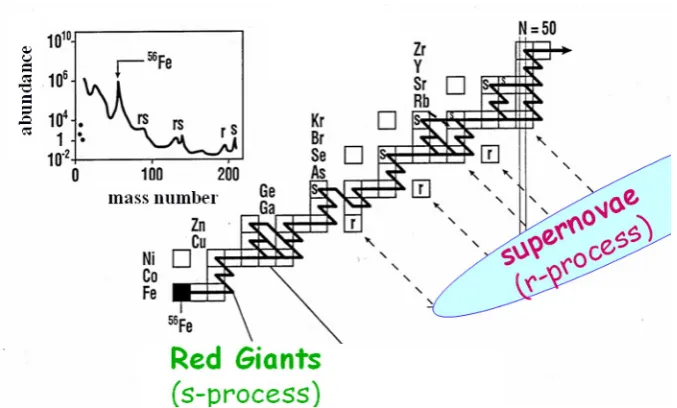
The reaction paths of thesandrprocess are sketched
in Fig. 1. The neutron-rich isotopes outside thespath can
be ascribed to therprocess. Apart from theser-only
iso-topes the rprocess contributes also to most of the other
isotopes, provided that they are not shielded by stable
iso-bars. The corresponding ensemble of the r-shielded, s
-only isotopes is important for the separation of the respec-tive abundance distributions and, more importantly, to set
constraints for the overalls-process efficiency and for the
parameters governing the abundance pattern in s-process
branchings. The subset ofr-only nuclei can be used for
calibration of the abundance contributions from ther
pro-cess. About 32 stable isotopes on the proton-rich side, which cannot be produced by stellar neutron reactions, are
attributed to thepprocess, which is likely to occur also in
supernova explosions [7]. With very few exceptions, these
p abundances are much smaller than the sandr
compo-nents.
2 Stellar neutron capture cross sections
Presently, experimental techniques for (n, )
measure-ments have reached a stage, where the 1-2% accuracy level
required for sufficiently detailed analyses of thes-process
abundance patterns can be met [8, 9]. While this level has been achieved so far only for a minority of the relevant iso-topes, a large number of cross sections with uncertainties in excess of 10% await improvement, still including many remaining key nuclei. With a few exceptions, experimen-tal data for the important unstable branch point isotopes are still completely missing.
In contrast to the favorable situation of the sprocess,
where mostly stable isotopes are involved, explosive
nu-cleosynthesis scenarios of the r and p processes imply
complex reaction paths far from stability, which must be described by huge networks including several thousand reactions. By far most of these reaction rates have to be obtained by statistical model calculations [10, 11]. Never-theless, experimental data for stable and as many unstable isotopes as possible are required for testing the necessary extrapolation to the region of unstable nuclei.
To cover the range ofs-process temperatures between
T8 = 1 to 9, experimental neutron capture cross sections
are needed over an energy range from about 300 eV to several hundred keV, which then have to be folded with the fully thermalized neutron energy distribution in the stellar plasma. These Maxwellian averaged cross sections (MACS) are defined as
h ikT =h vi vT =
2
p
⇡ R1
0 R (En)Ene En/kT dEn
1
0 Ene En/kT dEn
, (1)
whereEn=Elabn (A/(A+1) denotes the total kinetic energy
in the center-of-mass system,Elab
n the laboratory neutron
energy, vT = p2kT/mthe mean thermal velocity, andm
the reduced mass for the neutron-target system.
MACS values are required for all nuclei and all tem-peratures involved in a particular scenario, essentially
from 12C up to the Pb/Bi region. It is important to note
that the highs-process temperatures imply that excited
nu-clear states are in thermal equilibrium by the intense and energetic thermal photon bath, resulting in a significant
population of low-lying states. The e↵ect of neutron
cap-tures in these excited states has to be determined by theory and may require significant corrections to the experimental data [12].
The thermal environment can have also a considerable impact on the weak decays of the unstable branch point
isotopes along the reaction chain: The rate for -decays
may be dramatically enhanced if the excited states have much shorter half-lives than the ground state. The rates
for EC-decay are a↵ected by the high degree of ionization
in two ways: a reduction due to the loss of K-shell elec-trons is partly compensated by capture of free elecelec-trons. Bound beta decay, where electrons are emitted in unoccu-pied atomic orbits, can result in a dramatic enhancement
as well. For a full discussion ofs-process beta decays see
Refs. [13, 14].
3 Experimental methods
3.1 Time-of-flight experiments
Time-of-flight (TOF) measurements are essential for
ob-taining energy-di↵erential neutron capture cross sections
over a sufficiently large energy range so that MACS values
can be determined from these data for any stellar temper-ature of interest. Recent developments and improvements in pulsed neutron sources and detection techniques have
led to (n, ) cross section measurements with improved
Figure 1. Illustration of the main neutron-capture processes responsible for the formation of the nuclei between iron and the actinides. The reaction path of thesprocess follows the stability valley because the neutron capture times are much slower than decay on average. The abundance contributions from ther process (dashed arrows) are mixing with thes component, except where thes -only isotopes are shielded by stable isobars. Note also the occurrence of branchings in thes-process path at sufficiently long-lived
unstable nuclei. The branching points give rise to a local abundance pattern that carries important information on neutron density and temperature at thes-process site. The small cross sections at magic neutron numbers introduce another important constraint for thes process because they act as bottle necks for the reaction flow.
constitute the most prolific pulsed sources of fast neutrons for TOF measurements. Presently, spallation sources in routine operation are LANSCE at Los Alamos [15], the n_TOF facility at CERN [16, 17], and ANNRI at J-PARC [18]. The main advantage of these facilities is the
out-standing efficiency for neutron production due to the high
primary proton beam energies, reaching 300 neutrons per incident proton at n_TOF, for example. Spallation sources are providing a wide neutron energy range and are oper-ated at rather low repetition rates, typically between 0.4 and 50 Hz, while still maintaining high average
intensi-ties. Rather high intensities can also be achieved via ( ,n)
reactions at electron linear accelerators, such as GELINA at Geel, Belgium, by bombarding heavy metal targets with electron beams of typically 50 MeV. All these facilities provide very good resolution in neutron energy and have been extensively used to study the resolved resonance re-gion.
The spectrum of keV neutron facilities includes also small accelerators, where neutrons are produced by
nu-clear reactions, such as the 7Li(p,n)7Be reaction, which
o↵er the possibility of tailoring the neutron spectrum
ex-actly to the stellar energy range. Limitations in source strength can be compensated by low backgrounds and the use of comparably short neutron flight paths [19, 20].
Current TOF measurements of (n, ) cross sections
are based on two types of detectors. Total absorption calorimeters are designed to detect the full energy sum of the -ray cascade emitted in the decay of the compound nucleus, which corresponds essentially to the neutron sep-aration energy of the captured neutron. Because this
en-ergy represents the best signature of a capture event, 4⇡
detector arrays with an efficiency close to 100% are the
most direct way to unambiguously identify (n, ) reactions
and to determine capture cross sections with good accu-racy. Such calorimeters are designed either in spherical
geometry, using BaF2crystals arranged in a fullerene-type
configuration with each module covering the same solid angle with respect to the central sample [21–23], or in a barrel-type geometry, where the sample is surrounded by layers of hexagonal crystals [24, 25].
The main problem in using calorimeter type detectors arises from their response to neutrons scattered in the
sam-ple. Although the BaF2 scintillator is selected to consist
of nuclei with small (n, ) cross sections, about 10% of
the scattered neutrons are still captured in the scintillator. While the related background can be handled in most mea-surements, it may complicate the analysis of resonances with very small capture-to-scattering ratios.
The problem of neutron sensitivity is largely avoided by using comparably small, hydrogen-free liquid scintilla-tors in combination with the pulse-height weighting tech-nique (PHWT) [26], in particular since the second gener-ation of detectors, which are based on deuterated benzene
(C6D6), has been designed to minimize backgrounds due
Figure 2. Left: Schematic sketch of the activation setup. Right: The quasi-stellar neutron spectrum obtained with the
7Li(n, )7Be reaction (histogram and symbols) compared to a
true Maxwell-Boltzmann distribution for a thermal energy of kT=25 keV [32].
efficiency of C6D6 detectors is only about 20%, they are
clearly of advantage in studies of resonance-dominated cross sections with very small capture-to-scattering ratios.
3.2 Activation with quasi-stellar neutrons
The activation method represents a well established and accurate approach for MACS measurements at a
ther-mal energy ofkT = 25 keV by irradiating samples in a
quasi-stellar neutron spectrum that can be produced via
the7Li(p,n)7Be reaction [32, 33]. Such a spectrum is
ob-tained by using a proton beam energy ofEp =1912 keV,
30 keV above the reaction threshold. With this choice of
Ep, neutrons are kinematically collimated into a forward
cone of 120 deg opening angle. The e↵ect of fluctuations
in beam intensity during the irradiations can be corrected by continuously monitoring the neutron yield by means of
a6Li-glass detector.
With typical beam intensities of 100µA, neutron
inten-sities of 3⇥109 s 1can be reached, orders of magnitude
higher than in TOF experiments. Accordingly, the
activa-tion method o↵ers unique sensitivity. Further advantages
are (i) that isotopically enriched samples are not required, because the reaction products are identified by their char-acteristic radiation, and (ii) that contributions from the direct radiative capture (DRC) channel are automatically considered. A sketch of the experimental setup and the comparison of the resulting quasi-stellar neutron spectrum with a true Maxwell-Boltzmann distribution are shown in Fig. 2. Note that the experimental spectrum in the right panel of Fig. 2 falls below the Maxwell-Boltzmann distri-bution above 80 keV and is truncated at a neutron energy of 106 keV. Meanwhile, it has been found that the high-energy part of the spectrum can be better approximated by using an energy-broadened proton beam with a spread of about 20 keV [34, 35].
4 The role of key cross sections
The key isotopes142Nd and147Pm, which are included in
the s-process reaction flow shown in Fig. 3, are used to
illustrate the crucial role of stellar (n, ) cross sections for
Figure 3.Thes-process reaction flow in the mass region 140
A 150 including the crucial s-only isotope 142Nd and the
branchings atA=147,148.
testing the validity of stellar s-process models related to
He shell burning in thermally pulsing AGB stars. In addi-tion, the measurement of the small cross sections of abun-dant light isotopes and their role as neutron poisons are
discussed at the example of13C.
4.1 142Nd: confirming the stellar model for the
mainsprocess
The s-only isotope 142Nd belongs to the stable
neutron-magic nuclei with N=82, which act as bottle necks for the
reaction flow. The small MACS values of these isotopes prevent that flow equilibrium is locally achieved in the
mass rangeA=138 142. Because thes-abundance
dis-tribution below and above that critical region is well
con-strained by the importants-only isotopes124Te and150Sm,
the N=82 region provides a crucial test for the mean
neu-tron exposure of the main s-process component,⌧0 [36].
In particular, the resulting142Nd abundance is sensitively
probing the way ans-process model is treating the reaction
flow across the bottle-neck region.
The classical steadys-process model [36, 37] has long
been considered a useful tool for describing thes-process
abundances and for estimating the physical conditions
dur-ing thesprocess via the abundance pattern of the various
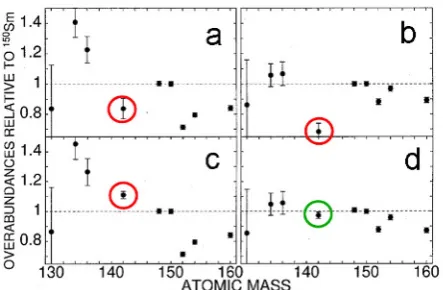
branchings. The left panels of Fig. 4 illustrate the
abun-dances of thes-only isotopes between130Xe and160Dy as
obtained with the classical model before and after an
ac-curate cross section of142Nd became available. The new
MACS of142Nd [38], which was 25% lower than the value
used before, gave rise to a significant 12% excess of142Nd
compared to the solar abundance. In view of the 2% un-certainty of the quoted value, this discrepancy revealed the first convincing inherent inconsistency of the classical model, indicating that the simplifying assumptions of this approach are not adequate for describing the true stellar scenario.
Although necessarily more complex, realistic
prescrip-tions on the basis stellars-process scenarios have been
Figure 4.The overproduction factors of thes-only isotopes rel-ative to solar material (normalized at150Sm) in the mass region
130 A 160. While a perfect model would always yield factors of unity, the upper panels ("a" for the classical and "b" for the stellar model) indicate an underproduction of142Nd when
the previous cross section was used for this key isotope, regard-less of thes-process model. The lower panels illustrate the e↵ect
of the improved, accurate cross section of142Nd [38], which is
clearly favoring the physical stellar model (d) over the purely phenomenological, classical approach (c).
episodes in low mass AGB stars have been shown to
repro-duce thesabundances to better than 10% [39]. Contrary
to the classical picture, this rather complex model is char-acterized by two neutron sources operating with very
dif-ferent strength and at di↵erent neutron densities and
tem-peratures.
The success of the stellar model compared to the clas-sical approach is illustrated in the right panels of Fig. 4,
showing that the new142Nd cross section [38] resulted in
a perfect reproduction of the solar value (panel d). More-over, there is clearly an improved overall agreement for
the others-only isotopes as well.
4.2 Branchings as diagnostic tools:147Pm
Branchings in the reaction path are the result of the com-petition between neutron capture and -decay whenever an isotope with a half-life comparable to the neutron cap-ture time is encountered. This competition is expressed
by a branching factor f = +
n that depends formally on
the -decay rate =ln2/t1/2 and on the neutron capture
rate n=nnvTh iwithnnbeing the neutron density,vTthe
mean thermal velocity, andh ithe MACS for the
radioac-tive branch point nucleus.
The s-process branchings are producing a local
abun-dance pattern that includes ans-only nucleus, which is
par-tially bypassed by the reaction flow. Accordingly, these
nuclei exhibit a smaller h iN value than what is
charac-teristic of the full reaction flow and thus provide a
mea-sure for the strength of the branching. The di↵erent ratios
of neutron capture and -decay in the various branchings
along the s-process path from Fe to Bi represent viable
and stringent tests of s-process prescriptions and, hence,
for models of the He and C burning phases of stellar evo-lution.
So far, most branching analyses are based on solar iso-tope patterns [8, 39], but it should be noted that important
information on the s-process neutron density can be
de-rived directly from spectroscopic data of individual AGB
stars via the branchings at85Kr and93Zr [40] or from
anal-yses of presolar grains preserved in primitive meteorites [41].
The branching at 147Pm (Fig. 3) is part of a series
of important branchings in the lanthanide region. Apart
from the "normal" branch point isotopes147Nd,147,148Pm,
which are only sensitive to the stellar neutron density, the
half-lives of151Sm,152,154Eu exhibit a temperature
depen-dence [13], which makes these branchings potential
ther-mometers for thes-process environment [42, 43].
The measurement of neutron capture cross sections on unstable isotopes is complicated by the radioactivity of the sample. For many of the branch point isotopes, this results
in an immense background that can hardly be handled
by the detectors and hampers the safe identification of cap-ture events in the sample. Also, the required samples are most often not available in amounts needed for TOF exper-iments. Therefore, measurements have resorted to the ac-tivation technique. The excellent sensitivity of this method
permitted the use of samples in theµg range, thus reducing
the radiation hazards by several orders of magnitude.
The example of147Pm is quite illustrative in this
re-spect, because the activation was performed with only 28
ng of material, the smallest sample used in (n, ) studies
at keV energies so far. To compensate for the low induced activities that can be obtained with such a small sample, an optimized setup for counting had to be used by plac-ing the irradiated sample between two large Clover-type HPGe detectors in very close geometry. For suppression
of the still dominant background from the decay of147Pm
(t1/2 = 2.62 yr), one had to go a step further, using the
eight-fold geometry of the two Clover detectors for the
co-incident detection of the (915+550) keV cascade in the
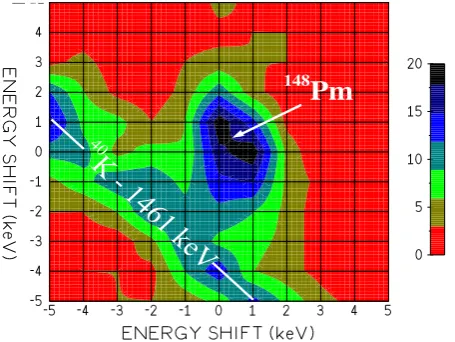
decay of148Pm. In this way, the dominant40K background
could be sufficiently reduced to determine the stellar cross
section of147Pm with an uncertainty of 14%, leading to a
mean neutron density ofnn =4.9±0.6 cm 3[44].
4.3 13C: a potential neutron poison
Limits of MACS measurements with the activation method refer to cases where the induced activity is very low,
un-certain, or difficult to detect. For such reactions,
accelera-tor mass spectrometry (AMS) o↵ers a powerful alternative
with the important advantage compared to decay counting that it is independent of the half-lives and decay properties of the reaction products. The main feature of AMS is the unsurpassed sensitivity for specific nuclides, much higher than can be obtained with conventional mass spectrome-try, disadvantages are often elaborate sample preparation and the destruction of the sample by the measurement.
AMS has first been applied to neutron capture
reac-tions ins-process environments for62Ni by Nassaret al.
[45] and subsequently to a number of target nuclei
148
Pm
40
K -
146
1 ke
V
Figure 5. Discrimination of the induced148Pm activity against
the 1461 keV background from40K by coincident detection the
(915+550) keV cascade in the decay of148Pm (from Ref. [44]).
reaction was studied as part of a recently completed series of measurements [49] and represents a typical example for combining activation at keV neutron energies with subse-quent AMS detection of the long-lived reaction product
14C.
An interesting feature of this reaction is the strength of
the resonance atEn =143 keV (Fig. 6), which interferes
with the p-wave contribution of the direct capture
compo-nent. At temperatures aboveT8 = 3 the reaction rate is
dominated by the 143 keV resonance, at lower tempera-tures by the p-wave and s-wave contributions. The calcu-lations [50] are in reasonable agreement with two previ-ous experiments [51, 52], but exhibit a significant discrep-ancy compared to the most recent evaluation of JEFF-3.1, which is consistently higher than the calculation, culmi-nating in a 25 times higher peak value for the 143 keV resonance.
This discrepancy, which is important for the role of13C
as ans-process neutron poison, was studied using the
acti-vation technique [53]. The samples were irradiated at the Karlsruhe Institute of Technology in the quasi-stellar neu-tron spectrum for the direct determination of the MACS
atkT =25 keV, and also using neutron spectra with 123
and 178 keV mean energy to investigate the e↵ect of the
143 keV resonance. After the irradiations the produced
amount of14C was quantitatively determined by AMS. In
this experiment, the cross sections could be obtained with uncertainties of 7 to 12%.
Fig. 6 shows that the results of the AMS measure-ment at 25 keV are in fair agreemeasure-ment with the previous experimental [51, 52] and theoretical [50] data, but about two times higher than the JEFF-3.1 evaluation. For the two higher neutron energies a striking discrepancy was found with respect to the strength of the 143 keV reso-nance, which turned out to be a factor of 10 lower than
the calculation of Herndlet al.[50] (indicated by the
hor-izontal bars in Fig. 6). Accordingly, the poisoning e↵ect
the b regime:
13C(n, )
an example for activation + AMSWallner et al., Pub. Astron. Soc. Australia 29 (2012) 115
Figure 6. Experimental cross sections for the13C(n, )14C
re-actions in the keV neutron energy region together with calcu-lated values [50] and recent evaluations from the JEFF-3.1 data library. The width of the experimental neutron energy distribu-tions are indicated by horizontal bars. The shaded areas corre-spond to spectrum-averaged cross sections derived from the cal-culated data of Ref. [50].
of that resonance is much less significant than previously assumed.
5 Status and Outlook
The current MACS status is collected in the KADoNiS database [54], which contains an almost complete set of experimental MACS values for the 279 stable isotopes on
the s-process path. KADoNiS also includes data for 77
radioactive nuclei, albeit this subset still has to rely on theoretical calculations with the HF statistical model (e.g. [10]). An important aspect of the MACS data refers to the accuracy needed for meaningful abundance predictions. On average, cross sections should be available with an ac-curacy of 5% or better, but uncertainties as low as 1-2% are mandatory for a number of key isotopes, e.g., for the
33s-only nuclei on thes-process path. Examples for this
species are148,150Pm in Fig. 3.
Similarly accurate data are needed for the
interpre-tation of the s-process signatures of presolar grains [41]
that concern about 70 isotopes. The discovery of preso-lar grains in primitive meteorites opened a new window to stellar nucleosynthesis and galactic chemical evolu-tion, because they represent material from individual stars, which survived the high temperature phase during the for-mation of the solar system. Accordingly, analyses of such
grains provide insight into the sensitivity of the sprocess
to stellar mass and metallicity.
Although experimental data exist for most stable
iso-topes of interest for thesprocess, the criteria of
Figure 7. Presently quoted uncertainties for the stellar (n, ) cross sections forkT=25 keV (data from the KADoNiS compi-lation [54].
are clearly required, especially in the mass regions below
A = 120 and above A = 180, where a large number of
cross sections with uncertainties in excess of 10% await improvement. The situation sketched in Fig. 7 refers to
thermal energies ofkT =25 30 keV, which are
charac-teristic for He burning temperatures, but is generally worse
for C shell burning in massive stars withkT =90 keV.
Recent improvements for s-process related neutron
capture measurements are based on the development of ex-perimental techniques with optimized sensitivity and high granularity [8, 55]. Prominent examples mentioned
be-fore are 4⇡arrays for TOF measurements, large segmented
HPGe detectors for counting, and the use of AMS tech-niques. In the field of laboratory neutron sources, signif-icant progress has been achieved with respect to neutron flux and luminosity. High intensity, low-energy pulsed
RFQ accelerators using the7Li(p,n)7Be reaction for
neu-tron production are under construction at Frankfurt [56] and Jerusalem [57], which will provide more than 100
times higher fluxes that previous Van de Graa↵machines.
In many complementary ways, high-energy spallation fa-cilities have been demonstrated over the last decade to pro-vide intense pulsed “white” neutron spectra. The latest success in this field is the construction of a new short flight path at CERN [58]. The development of high-flux facili-ties opens completely new opportunifacili-ties for measurements on unstable branch point isotopes, where samples are ex-tremely rare and sample activities have to be kept at a man-ageable level.
6 Summary
The slow time scale of the sprocess, which implies
neu-tron capture times of typically a year, restrains the reac-tion flow within the valley of beta stability with the
con-sequence that the resulting sabundances are determined
by the neutron capture cross sections averaged over the thermal neutron spectra of the respective stellar scenar-ios. Therefore, laboratory measurements of neutron cap-ture cross sections in the keV-energy range allows one to deduce the stellar Maxwellian average cross sections ei-ther via time-of-flight techniques or directly by activation in quasi-stellar neutron fields. Examples of such
measure-ments including the opportunities o↵ered by accelerator
mass spectrometry were used to illustrate the direct impact
of neutron capture studies on thes-process contribution to
galactic chemical evolution as well as the unbiased
infor-mation on the physical properties of the stellar s-process
sites that can be derived froms-process branchings.
References
[1] E. Burbidge, G. Burbidge, W. Fowler, F. Hoyle, Rev.
Mod. Phys.29, 547 (1957)
[2] A. Cameron, Tech. rep., A.E.C.L. Chalk River, Canada (1957)
[3] R. Gallino, C. Arlandini, M. Busso, M. Lugaro,
C. Travaglio, O. Straniero, A. Chieffi, M. Limongi,
Ap. J.497, 388 (1998)
[4] S. Merrill, Science115, 484 (1952)
[5] C. Raiteri, R. Gallino, M. Busso, D. Neuberger,
F. Käppeler, Ap. J.419, 207 (1993)
[6] T. Rauscher, A. Heger, R. Ho↵man, S. Woosley, Ap.
J.576, 323 (2002)
[7] M. Arnould, S. Goriely, Phys. Rep.384, 1 (2003)
[8] F. Käppeler, R. Gallino, S. Bisterzo, W. Aoki, Rev.
Mod. Phys.83, 157 (2011)
[9] M. Wiescher, F. Käppeler, K. Langanke, Ann. Rev.
Astron. Astrophys.50, 165 (2012)
[10] T. Rauscher, F.K. Thielemann, Atomic Data Nucl.
Data Tables75, 1 (2000)
[11] S. Goriely,The role of nuclear models in providing
nuclear data for astrophysics, in Long term needs for nuclear data development, edited by M. Her-man (IAEA, Vienna, 2001), pp. 83 – 94, report INDC(NDS)-428
[12] T. Rauscher, Ap. J. Lett.755, L10 (2012)
[13] K. Takahashi, K. Yokoi, Atomic Data Nucl. Data
Ta-bles36, 375 (1987)
[14] K. Yokoi, K. Takahashi, Nature305, 198 (1983)
[15] P. Lisowski, C. Bowman, G. Russell, S. Wender,
Nucl. Sci. Eng.106, 208 (1990)
[16] U. Abbondanno, G. Aerts, H. Alvarez, S. Andria-monje, A. Angelopoulos, P. Assimakopoulos, C.O. Bacri, G. Badurek, P. Baumann, F. Becvar et al., Tech. rep., CERN, Geneva, Switzerland (2003), re-port CERN-SL-2002-053 ECT
[17] C. Guerrero, A. Tsinganis, E. Berthoumieux,et al.,
Eur. Phys. J. A49, 27 (2013)
[18] http://j-parc.jp/, Tech. rep., JAERI and KEK (2004)
[19] K. Wisshak, F. Käppeler, Nucl. Sci. Eng. 77, 58
(1981)
[20] Y. Nagai, M. Igashira, N. Mukai, T. Ohsaki, F. Ue-sawa, K. Takeda, T. Ando, H. Kitazawa, S. Kubono,
T. Fukuda, Ap. J.381, 444 (1991)
[21] K. Wisshak, K. Guber, F. Käppeler, F. Voss, Nucl.
Instr. Meth. A299, 60 (1990)
[22] M. Heil, R. Reifarth, M. Fowler, R. Haight, F. Käp-peler, R. Rundberg, E. Seabury, J. Ullmann, J.
Wil-helmy, K. Wisshak et al., Nucl. Instr. Meth. A459,
[23] R. Reifarth, T.A. Bredeweg, A. Alpizar-Vicente, J.C. Browne, E.I. Esch, U. Greife, R.C. Haight, R. Hatarik, A. Kronenberg, J.M. O’Donnell et al.,
Nucl. Instr. Meth. A531, 530 (2004)
[24] K. Guber, R. Spencer, P. Koehler, R. Winters, Nucl.
Phys.A621, 254c (1997)
[25] J. Klug, E. Altstadt, C. Beckert, R. Beyer, H. Freiesleben, V. Galindo, E. Grosse, A. Junghans, D. Legrady, B. Naumann et al., Nucl. Instr. Meth. A
577, 641 (2007)
[26] R. Macklin, Nucl. Sci. Eng.95, 200 (1987)
[27] R. Plag, M. Heil, F. Käppeler, P. Pavlopoulos, R.
Rei-farth, K. Wisshak, Nucl. Instr. Meth. A 496, 425
(2003)
[28] P. Koehler, R. Spencer, R. Winters, K. Guber, J.
Har-vey, N. Hill, M. Smith, Phys. Rev. C54, 1463 (1996)
[29] J. Tain, F. Gunsing, D. Cano-Ott, C. Domingo, J.
Nucl. Sci. Tech. Suppl.2, 689 (2002)
[30] U. Abbondanno, G. Aerts, H. Alvarez, S. Andria-monje, A. Angelopoulos, P. Assimakopoulos, C.O. Bacri, G. Badurek, P. Baumann, F. Becvar et al.,
Nucl. Instr. Meth. Phys. Res. A521, 454 (2004)
[31] A. Borella, G. Aerts, G. F., A. Moens, R. Wynants,
P. Schillebeeckx,Determination of Weighting
Func-tions and Neutron Sensitivity for C6D6 Detectors by MCNP, in Nuclear Data for Science and
Technol-ogy, edited by R. Haight, M. Chadwick, T. Kawano,
P. Talou (AIP, New York, 2005), pp. 652–655, AIP Conference Series 769
[32] W. Ratynski, F. Käppeler, Phys. Rev. C 37, 595
(1988)
[33] H. Beer, F. Käppeler, Phys. Rev. C21, 534 (1980)
[34] P. Mastinu, G. Martín Hernández, J. Praena, Nucl.
Instr. Meth. A601, 333 (2009)
[35] G. Feinberg, M. Friedman, A. Krasa, A. Shor, Y. Eisen, D. Berkovits, G. Giorginis, T. Hirsh,
M. Paul et al., Phys. Rev. C85, 055810 (2012)
[36] F. Käppeler, H. Beer, K. Wisshak, Rep. Prog. Phys.
52, 945 (1989)
[37] P. Seeger, W. Fowler, D. Clayton, Ap. J. Suppl.11,
121 (1965)
[38] K. Wisshak, F. Voss, F. Käppeler, L. Kazakov,
G. Re↵o, Phys. Rev. C57, 391 (1998)
[39] C. Arlandini, F. Käppeler, K. Wisshak, R. Gallino,
M. Lugaro, M. Busso, O. Straniero, Ap. J.525, 886
(1999)
[40] D. Lambert, V. Smith, M. Busso, R. Gallino,
O. Straniero, Ap. J.450, 302 (1995)
[41] M. Busso, R. Gallino, G. Wasserburg, Ann. Rev.
As-tron. Astrophys.37, 239 (1999)
[42] S. Marrone,et al., Phys. Rev. C73, 034604 (2006)
[43] K. Wisshak, F. Voss, F. Käppeler, M. Krtiˇcka, S.
Ra-man, A. Mengoni, R. Gallino, Phys. Rev. C 73,
015802 (2006)
[44] R. Reifarth, C. Arlandini, M. Heil, F. Käppeler, P. Sedyshev, M. Herman, T. Rauscher, R. Gallino,
C. Travaglio, Ap. J.582, 1251 (2003)
[45] H. Nassar, M. Paul, I. Ahmad, D. Berkovits, M. Bet-tan, P. Collon, S. Dababneh, S. Ghelberg, J. Greene,
A. Heger et al., Phys. Rev. Lett.94, 092504 (2005)
[46] G. Rugel, I. Dillmann, T. Faestermann, M. Heil, F. Käppeler, K. Knie, G. Korschinek, W. Kutschera,
M. Poutivtsev, A. Wallner, Nucl. Inst. Meth. B259,
683 (2007)
[47] I. Dillmann, M. Heil, F. Käppeler, A. Wallner, W. Kutschera, A. Priller, P. Steier, M. Paul, Phys.
Rev. C.79, 065805 (2009)
[48] I. Dillmann, T. Faestermann, G. Korschinek, J. Lach-ner, M. Maiti, M. Poutivtsev, G. Rugel, S. Walter, F. Käppeler, M. Erhard et al., Nucl. Instr. Meth. B
268, 1283 (2010)
[49] A. Wallner, Nucl. Instr. Meth B268, 1277 (2010)
[50] H. Herndl, R. Hofinger, J. Jank, H. Oberhum-mer, J. Goerres, W. Wiescher, F.K. Thielemann,
B. Brown, Phys. Rev. C60, 064614 (1999)
[51] T. Shima, F. Okazaki, T. Kikuchi, T. Kobayashi,
T. Kii, T. Baba, N. Y., M. Igashira, Nucl. Phys.A621,
231c (1997)
[52] S. Raman, M. Igashira, Y. Dozono, S. H. Kitazawa,
M. Mizumoto, J. Lynn, Phys. Rev. C41, 458 (1990)
[53] A. Wallner, K. Buczak, I. Dillmann, J. Feige, F. Käp-peler, G. Korschinek, C. Lederer, A. Mengoni, U. Ott, M. Paul et al., Publications of the
Astronom-ical Society of Australia29, 115 (2012)
[54] I. Dillmann, R. Plag, F. Käppeler, T. Rauscher,
KADoNiS v0.3 - The third update of the Karlsruhe Astrophysical Database of Nucleosynthesis in Stars, inEFNUDAT Fast Neutrons, Sci. Workshop on Neu-tron Measurements, Theory, and Applications, edited
by F.J. Hambsch (Publications Office of the
Eu-ropean Union, Luxembourg, 2010), pp. 55 – 58,
http://www.kadonis.org
[55] F. Käppeler, Prog. Part. Nucl. Phys.66, 390 (2011)
[56] O. Meusel, L. Chau, I. Mueller, U. Ratzinger, A. Schempp, K. Volk, C. Zhang, S. Minaev,
Development of an intense neutron source FRANZ in Frankfurt, in Linac 2006, Knoxville,
USA (http://accelconf.web.cern.ch/
Accel-Conf/106/PAPERS/MO051.PDF, 2006), p. 159
[57] A. Nagler, I. Mardor, D. Berkovits, K. Dunkel,
M. Pekeler, C. Piel, P. vom Stein, H. Vogel,Status of
the SARAF Project, in2006 Linear Accelerator Con-ference, (Joint Accelerator Conferences Website,
JA-CoW, CERN, 2006), p. 168, http://www.JACoW.org/
[58] E. Chiaveri for the CERN n_TOF facility, Neutron
![Figure 2.Left: Schematic sketch of the activation setup.Right: The quasi-stellar neutron spectrum obtained with the7Li(n, �)7Be reaction (histogram and symbols) compared to atrue Maxwell-Boltzmann distribution for a thermal energy ofkT = 25 keV [32].](https://thumb-us.123doks.com/thumbv2/123dok_us/8641731.1431439/4.595.309.540.98.231/schematic-activation-spectrum-histogram-compared-maxwell-boltzmann-distribution.webp)
![Figure 7.Presently quoted uncertainties for the stellar (n, �)cross sections for kT = 25 keV (data from the KADoNiS compi-lation [54].](https://thumb-us.123doks.com/thumbv2/123dok_us/8641731.1431439/7.595.68.280.89.203/figure-presently-quoted-uncertainties-stellar-sections-kadonis-lation.webp)
