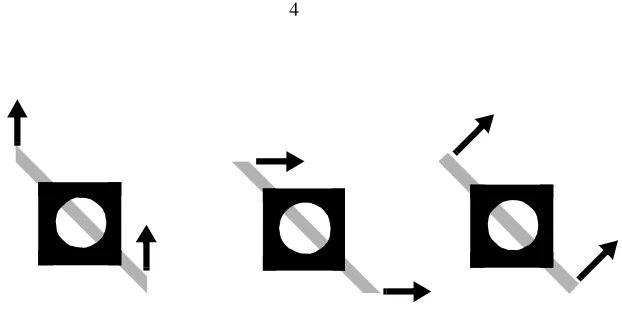
Segmentation: A Neural Network Model
Lars Lidén1 Christopher Pack2*
1Department of Cognitive and Neural Systems
Boston University 677 Beacon St. Boston, MA 02215
2Department of Neurobiology
Harvard Medical School 220 Longwood Ave.
Boston, MA 02115
*To whom correspondence should be addressed
email [email protected] FAX: 617-734-7557
Key Words: motion integration, motion segmentation, MT, terminators, occlusion, modeling
Running head: Motion integration and segmentation
February, 1999
Acknowledgments - The authors wish to thank two anonymous reviewers for helpful
Abstract
The perceptual interaction of terminators and occlusion cues with the functional processes
of motion integration and segmentation is examined using a computational model.
Inte-gration is necessary to overcome noise and the inherent ambiguity in locally measured
motion direction (the aperture problem). Segmentation is required to detect the presence
of motion discontinuities and to prevent spurious integration of motion signals between
objects with different trajectories. Terminators are used for motion disambiguation, while
occlusion cues are used to suppress motion noise at points where objects intersect. The
model illustrates how competitive and cooperative interactions among cells carrying out
these functions can account for a number of perceptual effects, including the chopsticks
illusion and the occluded diamond illusion. Possible links to the neurophysiology of the
Introduction
The processing of motion is perhaps the most fundamental visual task of any biological
system. When an object in the environment moves, an observer must be able to estimate
its trajectory in three-dimensions in order to initiate or avoid contact. Physiological and
theoretical work suggests that the extraction of motion information takes place in at least
two stages (Adelson & Movshon, 1982, Yuille & Grzywacz, 1988). The first stage
extracts local motion measurements, which typically correspond to a small part of an
object in motion. The second stage combines local motion measurements to form a
glo-bally coherent motion percept.
There are several problems inherent to the detection of local motion that invariably
result in inaccurate and non-unique motion measurements. In general, motion
computa-tion falls into the category of problems which are ill-posed (Poggio & Koch 1985). A key
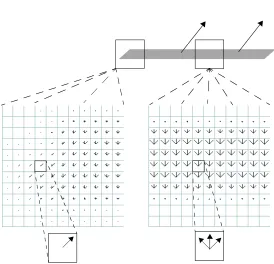
problem for local motion estimation is what is known as the aperture problem (Marr &
Ullman 1981), which states that any localized motion sensor can only detect motion
orthogonal to a local contour. Such motion measurements are ambiguous, in the sense that
any direction within a 180° range is equally compatible with the local motion
measure-ment (Figure 1). A local motion detector, therefore, cannot generally compute the
direc-tion of modirec-tion of an object that is bigger than its own field of view. Since early detecdirec-tion
of motion is carried out by neurons with relatively small receptive fields, the aperture
problem is an immediate difficulty for biological visual systems. In contrast to motion
measurements along a contour, motion measurements at the termination of a contour are
con-tour’s terminators. An effective motion processing system must use unambiguous motion
signals in one region of the image to constrain the interpretations of ambiguous local
motion directions in other regions.
In order to address the problems inherent to the first stage of motion computation, it is
advantageous to subdivide the second stage into two parallel computations, one for
inte-gration and the other for segmentation (Braddick, 1993). Inteinte-gration is a process that
combines noisy local motion signals in such a way that spurious estimates are averaged
out, and the local aperture problem is overcome. Segmentation detects the presence of
motion discontinuities and prevents integration of motion signals between objects with
different trajectories. Physiological (Allman & McGuinness, 1985; Tanaka, Hikosaka,
Saito, Yukie, Fukada & Iwai, 1986; Born & Tootell, 1992; Saito, 1993) and psychological
studies (Vaina & Grzywacz, 1992; Vaina, Grzywacz & Kinkinis, 1994) support the idea
that global motion processing is subdivided into these two computational processes.
Psychophysical evidence suggests that the integration of motion signals takes time
(hundreds of milliseconds) and can have effects across the entire visual field (Williams &
Sekuler, 1984; Ramachandran & Anstis, 1986a; Watanabe & Cole 1995). While the
detection of local motion signals can be viewed as essentially instantaneous, the global
motion percept develops as a consequence of interactions across time and space. These
interactions are likely to consist of excitation and inhibition which can be detected at the
level of individual neurons (Snowden and Braddick, 1989), but propagate across large
regions of visual space (Watanabe and Cole, 1995).
An additional factor to consider is the influence of static surfaces on motion
percep-tion. An array of psychophysical data suggests that surface perception profoundly alters
the integration of motion signals (Stoner & Albright, 1993). Information from object
shape (Tse, Cavanagh & Nakayama, 1998) and static depth cues (Ramachandran and
Anstis, 1986b; Shimojo, Silverman, & Nakayama, 1989) can strongly influence the
per-ception of motion. In particular, static cues are extremely useful for distinguishing
between intrinsic terminators, which signal the physical end of an edge of an object, and
extrinsic terminators, which are caused by occlusion. Intrinsic terminators provide an
unambiguous motion signal regarding the true direction of object motion, while extrinsic
terminators provide a locally ambiguous signal which must be suppressed for accurate
motion computation (Shimojo, Nakayama, & Silverman, 1989). The perception of
occlu-sion is therefore crucial to the processing of motion (Castet et al., in press; Lidén, 1998).
An important cue for occlusion is the presence of a T-junction where object edges
inter-sect (Cavanagh, 1987).
This paper describes a model which demonstrates how perceptual phenomena of
propa-gate motion signals across cells representing different regions of space. Global percepts
emerge as a result of excitatory and inhibitory interactions among cells encoding motion
direction in local regions of space. The model illustrates how the two computational
requirements of integration and segmentation of motion signals can be implemented by a
single motion processing system, and how these systems can interact with static form
information concerning occlusion. Interactions between integration and segmentation
processes allow the system to eliminate noise and overcome the aperture problem, while
preserving useful information at motion discontinuities. A series of model simulations
shows that many perceptual phenomena can be explained in terms of the interactions
between the proposed motion processing subsystems.
A Neural Network Model
The model consists of a neural network with two primary systems, each composed of
interconnected cells. Model cells respond preferentially to stimuli moving in a particular
direction within a specific region of space, known as the receptive field center. A
concen-tric region outside the receptive field center is called the surround, by analogy with
center-surround cells found in motion processing areas such as middle temporal (MT) cortex.
The first system comprises a set of integration cells, which respond best when motion in
both the center and surround are in the same direction. This type of cell performs a
smoothing or averaging process which is used to overcome noise and the aperture
prob-lem by propagating motion signals across visual space.
that is active when stimuli move opposite to the directional preference of the center. The
surround also inhibits cell activity when stimuli move in the center’s preferred direction.
As a result, segmentation cells do not respond well to large fields of coherent motion.
Instead, this type of cell signals the presence of motion discontinuities and is used to
con-strain the interactions of the integration cells.
The recurrent connectivity between model cells is crucial to the processing of motion
signals. Cooperative interactions between integration cells at different spatial locations
enhance the activity of disambiguated motion signals and propagate these signals across
visual space. Although the sizes of the receptive fields are relatively small with respect to
the size of the image, disambiguating signals travel across space through connections
among nearby nodes. The interaction between segmentation and integration cells is also
recurrent, and equally important. The spread of signal from integration cells is constrained
by the activity of segmentation cells, which signal motion boundaries. However, the
activ-ity of segmentation cells depends critically on input from integration cells. The dynamics
of these interactions determines the evolution of the global motion percept.
Input Nodes (LMDs)
The model requires as input an analog value corresponding to the evidence for motion in
each direction. Since the details of the initial motion extraction mechanism are of little
importance in this context, a simple correlation scheme (e.g., Reichardt, 1961; Van Santen
& Sperling, 1984, 1985) was chosen for it computational simplicity. More complex
1985; Grossberg & Rudd, 1989, 1992) could also serve as a front-end to the current
model. For the simulations described below, two successive image frames were used to
compute correlation. For each position in space, a small window of pixels was chosen
from the first frame. The grey-level pixel values for the window in the first frame were
compared to the grey-level values for shifted windows in the second frame. The
correla-tion between the two grey-levels was used as a measurement of the mocorrela-tion in the direccorrela-tion
of the shift. For each position eight shift directions were employed. For each direction,
shifts of one and two pixels were measured and the resulting correlation values summed.
The use of multiple shift sizes was employed to capture a larger range of speeds. Details
of these calculations can be found in Appendix 1. In the following model description, the
input cells are referred to as local motion detectors (LMDs).
Integration (I) Cells
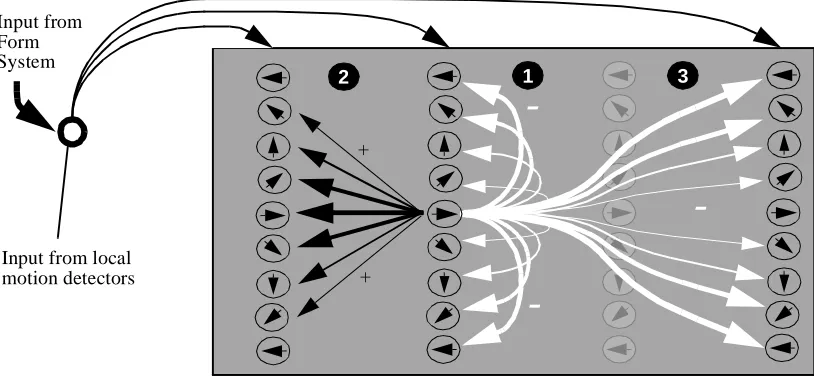
The dynamics of the integration (I) cells depend on three computational principles (See
Figure 2):
[1] A directionally dependent inhibition exists between cells with different direction
tuning at a given spatial location weighted by the directional difference. In this way, cells
in ambiguous locations (areas containing multiple active directions) are preferentially
sup-pressed with respect to cells in unambiguous locations (areas with one or few active
direc-tions). It has been suggested that such preferential weighting of unambiguous motion
signals is used by the visual system to overcome the aperture problem (Shiffrar & Pavel,
[2] A directionally dependent excitation across space, weighted by the magnitude of
directional difference, operates between nearby cells. In the model this excitation signal is
used to propagate disambiguated motion signals across space. Motion signals that are
propagated to regions lacking direct LMD input will be referred to as sub-threshold
inputs, since the allowed maximal activation level of these nodes is less than when LMD
input is present. This sub-threshold activity allows disambiguating motion signals from
one area of space to influence motion in another even when the motion signals are
spa-tially disconnected.
[3] A directionally dependent long range inhibition, weighted by the magnitude of
directional difference, operates between cells of different directional tuning. This
inhibi-tion indirectly implements the constraint propagainhibi-tion proposed by Marr (1982), by
sup-pressing integration cell activity across neighboring regions containing conflicting motion
estimates. In this way the model can still achieve a rudimentary segmentation even when
only the I cells are included (Lidén 1997). The importance of long range inhibition has
been demonstrated for the early stages of motion processing in both the retina (Barlow &
Levick, 1965) and the primary visual cortex (Sillito, 1975), and in other modeling work
(Qian, Andersen & Adelson, 1994; Grunewald, 1996; Chey et al., 1997). Details of
com-putations for the integration cells can be found in Appendix 2.
Segmentation (S) Cells
The second model system is a segmentation system, consisting of cells with inhibitory
sur-rounds. For each position in visual space there is a set of segmentation (S) cells tuned for
three sources of excitatory input for the S cells:
[1] Center-Surround Excitation: S cells receive center-surround input from the
inte-gration cells. They are excited by I cells of the same preferred direction in their receptive
field center and by I cells that possess the opposite preferred direction in their receptive
field surround. In this way, S cells are excited by direction discontinuities in the pattern of
I cell activity.
[2] Excitation from nearby segmentation (S) cells: S cells also receive excitatory input
from other nearby S cells of the same directional tuning. This allows for the development
of motion borders in regions of the image where there is support for a motion
discontinu-ity.
+
2 1 3
-Figure 2 : Integration Cell Architecture: Each position in space in indicated by a vertical column. Note the three processes: [1] inhibition within spatial location across directions, [2] excitation between nearby nodes with similar directional tuning and [3] far-reaching inhibition to nodes with different directional tuning. All connections are weighted by the directional difference.
Input from local Input from Form System
+
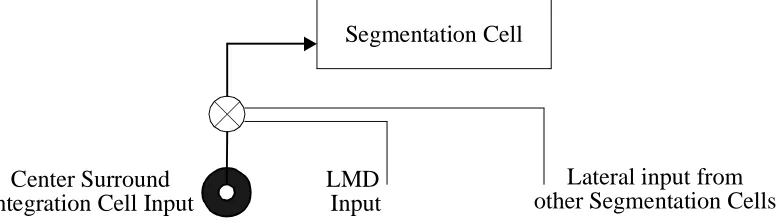
[3] Local Motion Detectors (LMDs): S cells also receive a non-direction specific
gat-ing signal from local motion direction cells. A S cell cannot be activated by surround
input unless it also receives a gating signal from LMD cells or from other S cells (See
Figure 3). This is in contrast to the I system, which allows sub-threshold activity even
when there is no underlying activity in the LMDs. The gating mechanism ensures that
motion borders only develop in the presence of visual activation or when the existence of
such a border is supported by a motion discontinuity in another location where visual
activity exists.
Inhibition: S cells are inhibited by I cells preferring the same motion direction,
located in the surround region of the receptive fields. Unlike the excitatory input, the
inhibitory input is not gated. Details of these calculations can be found in Appendix 3.
Segmentation & Integration Systems Interaction
One way in which the S and I cells interact has already been discussed. Namely, the
activ-ity of the S cells is determined by I cell activactiv-ity arranged spatially into a center-surround Segmentation Cell
Center Surround Integration Cell Input
LMD Input
Lateral input from other Segmentation Cells
Figure 3: Gating of Segmentation Cell Input: Segmentation cells only receive center-surround input if
receptive fields structure. A second type of interaction involves cooperation between S
cells to form motion borders which serve as barriers to prevent the spread of motion
sig-nals by the I cells.
The total output of the S cells at a given spatial location is used to block the spread of
activity of I cells at that location. This is achieved through a simple inhibitory connection
from each S cell to each I cell at each spatial location (Appendix 1). Although there is a
set of S cells representing the full array of preferred directions at each spatial position, the
suppression is directionally non-specific, as any discontinuity (regardless of its direction)
is relevant. Perceptual analogues to the suppression of motion integration by
segmenta-tion processes have been described elsewhere (Watanabe & Cavanagh, 1991). Although
such interactions are not strictly necessary to process all motion stimuli, they become
crit-ical for processing the motion of multiple overlapping objects in the visual array, since
integration should not occur across distinct objects.
Static Form Input
One of the purposes of the current study was to examine how much can be accomplished
within the motion system to disambiguate motion signals with the least amount of external
input. However, it is not possible to study the motion processing system in isolation, since
static form cues clearly play an important role in generating motion percepts. Thus it is
also important to consider the influence of interactions between form and motion signals.
In the interest of reducing computational complexity, the current model operates only on
system. The network mechanisms by which form information can be generated from
reti-nal input have been modeled elsewhere (Grossberg & Mingolla 1985; Grossberg 1994,
Grossberg 1997), and are beyond the scope of this model.
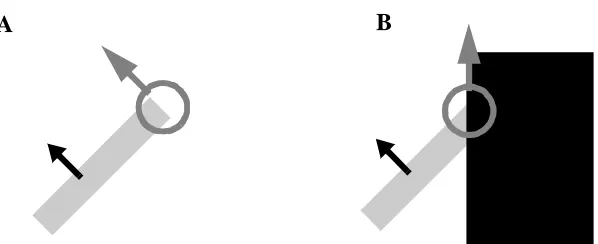
At a minimum, it is critical that any motion processing system suppress motion
sig-nals from spatial locations where occlusion is present, as occlusion produces spurious
motion signals. When any part of an object passes beneath another, all motion signals
orthogonal to the orientation of the occluding contour are lost. Only motion signals
paral-lel to the edge are preserved (Figure 4). Furthermore, such spurious motion signals are
unambiguous as the aperture problem only applies when a single edge is present. If such
signals were allowed to survive, they might lead to an incorrect disambiguation of object
motion.
The simulations described herein used T-junctions as indications for occlusion.
Rather than simulate the form processing involved in identifying T-junctions, the
localiza-tion and identificalocaliza-tion of T-junclocaliza-tions was performed manually. A mask was composed
representing the location and position of T-junctions and then used to suppress LMD input
to I cells in the presence of T-junctions. It is not difficult to imagine a process by which
Figure 4: Real terminators unambiguously signal the true direction of motion (A) whereas terminators which result from occlusion unambiguously signal noise (B).
T-junctions are identified and localized (Guzman 1969).
It is important to point out that junctions are not the only cues to occlusion.
T-junctions were used in the simulations described herein because they are easy to localize
and have a strong impact on motion perception (Cavanagh, 1987; Lidén and Mingolla,
1998). This provided a straightforward means of examining the interaction of form and
motion cues. Other cues for occlusion (e.g. accretion/deletion) could also be used to
sup-press LMD input within the model’s motion processing network.
Simulation Techniques - Model Output
The output of the model is conceptualized using a continuous gray-scale semicircle
repre-senting motion directions along a 180o continuum. The orientation of the semicircle determines the motion direction indicated by each level of gray. This scheme allows
indi-vidual regions of the image to be encoded with a particular motion direction, as assigned
by the model, and for the evolution of this representation to be displayed in a series of
snapshots. This technique was not used for simulations that require the full 360o of motion directions.
Simulation Results
Translating line
As illustrated by the aperture problem (Figure 1), the direction of motion of a translating
motion can only be obtained at the line’s terminators. A number of experiments (c.f.,
Lorenceau, Shiffrar, Wells & Castet 1993) have shown that human perception of
translat-ing line segments depends on the duration of stimulus display. For short durations (100 to
400 msec) observers perceive a translating line moving in a direction normal to the line
orientation rather than in the veridical direction of motion. Only at longer durations is the
line seen to move in the direction of its terminators. Based on these results, it has been
proposed that the true direction of line motion is recovered by propagating unambiguous
signals from terminators along the contour of the line (Wallach, 1976; Hildreth, 1983;
Nakayama & Silverman, 1988a,b; Lorenceau, Shiffrar, Wells, & Castet 1993).
Figure 5 depicts the output of model LMDs for a horizontal line translating at 45°
relative to its orientation. Motion of the line is ambiguous along the edge of the line as
cells with upward, up-to-the-left and up-to-the-right directional preferences are equally
active. Along the terminators, however, unambiguous information about the true direction
of motion is available in some locations where only cells coding motion up-to-the-right
are active.
The model recovers the true direction of ambiguous line motion by propagating
unambiguous motions signals generated by the terminators along the contour of the line.
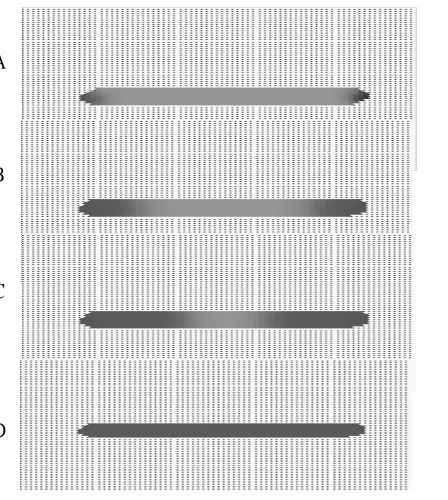
An examination of the evolving activity of the I cells demonstrates how the unambiguous
motion information available from LMDs centered over the line’s terminators is able to
disambiguate the motion of the entire line. Initially, the activity of I nodes mirrors that of
the LMDs (Figure 6A). However, over time the activity of nodes at the terminators is
directional competition among I nodes within each spatial location. The long-range
inhi-bition and short-range excitation interactions of the I nodes gradually propagate the
unam-biguous activation along the length of the entire line. Eventually the activity of all nodes
along the line are disambiguated and the entire line is coded as moving up and to the right
(Figure 6D).
Line Capture
The introduction of an occluding surface into an image can have a pronounced effect on
the perceived motion within that image. If the terminators of a translating line are
obscured, the true motion of the line is undefined. However, the perceived motion of the
ambiguous line can be captured by unambiguous motion in a different region of the image,
even when the unambiguously moving area is not spatially connected to the ambiguous
moving area (Ben-Av & Shiffrar, 1995). Line capture is an example of the more general
phenomenon known as motion capture.
Two examples of line capture are shown in Figure 7. The motion of the line on the
left (Figure 7A) is ambiguous, since the white diamonds obscure motion of the
termina-tors. However, when the same line is paired with a rightward moving line (Figure 7B) the
C
Figure 6: Translating Line - I cell activation: The activity of I cells in response to a translating line at the different time steps, A, B, C & D. Actual motion is up and to the right. The model successfully computes the true motion direction in step D.
A
B
D
perceived direction of the ambiguous line is also rightward. On the other hand, if the
ambiguously moving line is paired with an upwardly moving line (Figure 7C), the
ambig-uous line appears to move upward. The only difference between the stimuli depicted in
parts B and C is the motion of the terminators of the paired line; line edge motion is the
same in both. Despite the small area of change, the perceived direction of motion of both
lines as a whole is noticeably different.
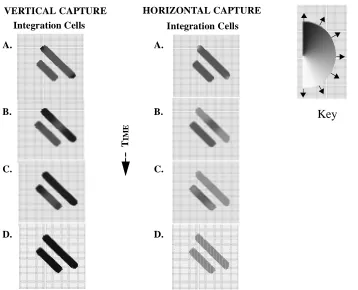
Figure 8 shows the evolving activity of I cells for the vertical (left column) and
hori-zontal (right column) line capture examples. Initially, as seen in snapshot A, there is little
difference in I cell activity for horizontal and vertical line capture. The only distinction
occurs for the terminators of the non-occluded line, one of which shows rightward motion
and the other upward motion. As in the single line example, motion along center of the
lines is ambiguous. I cell output for the two occluded lines is initially identical. Notice
also that there is no motion information at the tips of the occluded lines as LMD input near
the occluded terminators is suppressed.
As network activity evolves, disambiguated terminator motion at the ends of the
non-Figure 7 : Line Capture Stimuli. (A) Ambiguous line motion. (B) Horizontal line capture. (C) Vertical line capture. Perceived motion of the ambiguous line is horizontal in (B) and vertical and (C).
occluded bar gradually disambiguates the rest of the non-occluded bar (Figure 8, A-C).
The occluded bar remains unchanged, since no disambiguation signal is present (snapshot
B). Disambiguating sub-threshold activation from non-occluded bar begins to reach the
occluded bar by snapshot C. This signal begins disambiguating the occluded bar. By the
final snapshot (D), both bars have been entirely disambiguated. The occluded bars appear
to move in the same direction as their non-occluded neighbors.
Divided Diamonds
The previous example showed how unambiguous motion signals can spread to nearby
regions in which motion direction is ambiguous. Other experimental evidence suggests
Figure 8 : Line Capture Model Output: Eight snapshots of the evolving sub-threshold and threshold I cell activity for vertical (left column) and horizontal (right column) line capture.
Integration Cells Integration Cells
T
IM
E
VERTICAL CAPTURE HORIZONTAL CAPTURE
Key
A.
B.
C.
D.
A.
B.
C.
that the spread of unambiguous signals can be blocked by information which reliably
sig-nals the existence of a terminator. Lorenceau and Shiffrar (1992) found that subjects
exhibited poor performance in judging the direction of rotation of a diamond shaped
fig-ure viewed through four (invisible) apertfig-ures. However, when terminator information was
made ambiguous through changes in contrast, length, or eccentricity, subjects were able to
perform the direction discrimination task. Similarly, Shiffrar and Lorenceau (1996) found
that decreasing terminator information increased integration across contours.
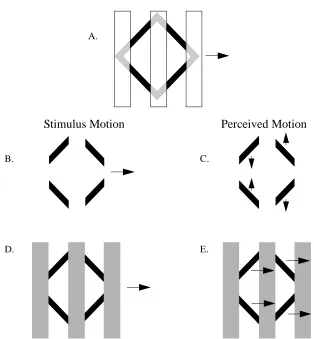
These effects can be examined using two stimuli. One stimulus is generated by
plac-ing opaque bars over a rightward translatplac-ing diamond (Figure 9A). When the opaque bars
are part of the background, the individual parts of the diamond appear to break into four
separately moving pieces. The left two pieces appear to move down and up, approaching
each other. The right two pieces appear to move up and down, away from each other. The
second stimulus employs visible opaque bars (Figure 9D). The perception of motion for
the second stimulus is of a rigid structure moving rightward (Figure 9E).
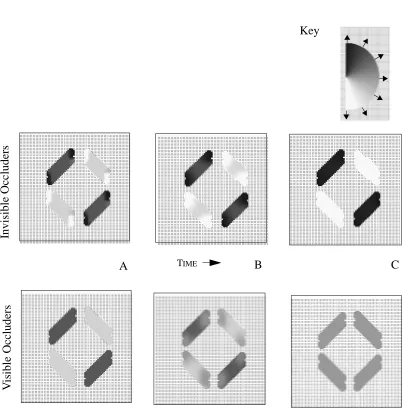
The model’s evolving activity supports Lorenceau and Shiffrar’s (1992) suggestion
that unambiguous motion of terminators inhibits the integration of motion signals across
contours. When the occluders are invisible, the model output along the edge of each line
is initially in a direction orthogonal to the orientation of the line (Figure 10A - top), as a
result of the aperture problem. At the terminators, however, the output follows the
direc-tion of modirec-tion for the terminators. As in the translating line example, activity of I nodes
along the edge of the line is suppressed, since motion along the edge is ambiguous and
unam-biguous and thus enhanced. The dynamics of the model lead to a propagation of motion
signals, and eventually the output for each line is in the direction of its terminators.
Because the terminators for each individual line possess different motion signals, each line
is perceived as moving in a different direction (Figure 10C, top).
The results are quite different when the occluders are visible (Figure 9B). Since LMD
input to the I cells is suppressed when occlusion information (T-junctions) is present,
Figure 9: Diamond with Bar Occluders: Stimuli are generated by translating a diamond pattern behind opaque bars. Invisible portions of the diamond are shown in light grey (A). When occluders are invisible, (B), the visible portions of the diamond are seen to move incoherently (C). When visible occluders (D) are employed, the visible portions are seen to move together in the true direction of motion (E)
A.
B. C.
D. E.
unambiguous motion information at the terminators is no longer present and propagation
to the ambiguous centers no longer occurs (Figure 10, bottom). In the simulations
dis-cussed thus far, terminators have been the source of unambiguous motion signals.
How-ever, unambiguous motion signals can also be generated through the combination of
motion signals across space. When motion signals from different areas of space are
com-bined, the competitive dynamics of the model may only allow a subset of the combined
TIME
Key
A B C
Invis
ible Occ
luder
s
V
isi
bl
e Occl
uder
s
motions to survive (Figure 11). In the diamond example, only rightward motion is
com-patible with the motion signals propagating from all four lines. This new rightward
unam-biguous signal serves to disambiguates the motion of all four line segments. The model’s
behavior is in agreement with Lorenceau and Shiffrar’s (1992) suggestion that the
integra-tion of mointegra-tion across contours is facilitated when terminators are ambiguous.
Crossing Lines
The motion simulations presented thus far have involved only single objects or cases in
which there were no discontinuities in the motion signals arising within objects. Although
segmentation (S) cells were present in the model, they played an insignificant role as their
Space
Ti
m
e
Signal propagating rightward
Signal propagating leftward
Disambiguated motion signal
activation was minimal. This section presents an example in which the activity of the
seg-mentation cells is critical in explaining the perceptual effect.
One of the most fundamental and difficult problems in motion processing occurs
when multiple conflicting motion signals are present in an image. A simple example of
this problem is what is known as ‘the cross problem’ (Weiss & Adelson, 1994), which
arises when two orthogonal lines translate horizontally past each another (Figure 12A).
This is also referred to as the ‘chopstick illusion.’ (Anstis, 1990). Unlike in the previous
examples, there are two conflicting sources of unambiguous motion information in the
display. Motion signals at the line terminators indicate the true direction of motion, while
motion at the intersection signals upward motion.
A variation on the cross problem occurs when occluding patches are added to the top
and bottom of the moving lines (Figure 12C). When occluders are present, the veridical
motion of the lines is no longer perceived. Instead, the two lines appear to move upward
as a single rigid object (Figure 12D). Taken together, these phenomena suggest that the
visual system relies on terminator information when it is reliable, and intersection
infor-mation when it is not.
The model segmentation system uses cells with center-surround receptive fields to
discover motion discontinuities in the image. Their activity in turn suppresses the activity
of the I cells at nearby locations, preventing the integration of motion signals in the
pres-ence of motion discontinuities. For the cross stimulus, there are strong motion
discontinu-ities at the intersection of the two lines (Figure 13). S cells are activated by this
suppres-sion prevents unambiguous upward motion signals at the intersection from propagating
outward. Scells which receive propagated input signals from sub-threshold I cells are also
activated via the gating signal from active S cells. This allows a motion border to grow
outward separating the different motion areas and preventing the integration of
sub-thresh-old I cells. Consequently, unambiguous motion signals propagating inward from the line
Figure 12 : Crossing Lines: Stimuli consist of two intersecting lines translating in opposite directions When occluders are absent (A), the visible portions of the diamond are seen to move in their veridical direction (B). When occluders are present (C), the lines are seen to move coherently upward as a single rigid object (D).
A. B.
C. D.
Stimulus Motion Perceived Motion
Unambiguous motion at intersection
Figure 13 : Initial motion measurements from LMDs are shown for a small portion of the cross stimulus. Unambiguous upward motion signals at the intersection of the cross stimulus are accompanied by nearby motion discontinuities.
terminators eventually dominate the network activity. The evolving activity of the S and I
cells for the unoccluded cross stimulus is depicted in the left two columns of Figure 14. S
cell activity is depicted in the first column. I cell activity, as shown in the second column,
is suppressed at locations where S cells are active. The model output depicts the two lines
moving in separate directions.
When occluders are present (Figure 14, right two columns), unambiguous motion
sig-nals from the terminators are unavailable. As the intersection is disambiguated, the
motion discontinuity disappears and consequently S cell activity is reduced. This allows I
cells at the intersection to be active. The final model output depicts a rigid cross moving
upwards.
Discontinuities within an object
The previous example demonstrated how the localization of motion discontinuities
pre-vents spurious integration between different objects. In some cases, however,
discontinui-ties are present within a single rigid object. For example, a translating diamond or
rectangle contains motion discontinuities near each corner (Figure 15) However, the
per-ceived object motion, when properly disambiguated should consist of one, not four
sepa-rate pieces.
The model readily handles such cases. For the example given in Figure 15, initially
motion along each side of the square is locally ambiguous. Discontinuities between edges
near the corners activate the S cells. Segmentation borders grow inward along each edge
sig-Segmentation Integration Segmentation Integration
Figure 14 : Model output for the non-occluded (left) and occluded (right) cross stimulus. Both segmenta-tion and integrasegmenta-tion node activity is shown. See text for details.
T
IM
E
nals at each corner cause nearby S cell activity to collapse. The sides are disambiguated
and finally, motion borders collapse entirely, and the entire square is disambiguated as one
moving object.
The Diamond Problem: What to Disambiguate?
An especially difficult problem for motion processing models occurs when multiple
objects move in different directions in contiguous locations in space. For instance, when
two diamond-shaped objects pass each other in the visual field, each diamond contains
motion which is locally ambiguous, as a consequence of the aperture problem. For the
case of a single object, it is sufficient to integrate motion signals near the edges to obtain
the true global motion direction. However, when two objects are present, it is important to
avoid integrating across objects (Figure 16). For example, when an upward and down-Discontinuous
Motion Signals
Figure 15: Within-Object Discontinuities: Many objects, such as a translating rectangle, contain disconti-nuities. In the pictured example, motion discontinuities exist at each of the four corners of the rectangle (discontinuities are illustrated at only two of the corners).
Discontinuous Motion
ward moving diamond pass each other there are various ways in which the motion signals
can be integrated. If the left and right motion pairs are combined, a correct
disambigua-tion results. On the other hand combining the top and bottom modisambigua-tion pairs results in
spu-rious motion directions.
The model demonstrates that the passing diamond problem is overcome when
termi-nator motion and motion discontinuities are taken into account (Figure 17). As in the
pre-vious example, S cells are initially activated by motion discontinuities at the corners of
each object (Figure 17A). The discontinuity between the diamonds begins to activate
other S cells between the two diamonds (B-C). Disambiguation results in a collapse of S
cell activity as motion discontinuities in the corners fade (D). At the same time,
segmen-=
+
=
+
+
=
=
+
Correct Disambiguation Incorrect Disambiguation
tation activity along the border between the two diamonds continues to grow as no
disam-biguating signal is present (E). Finally both diamonds are disambiguated. The remaining
active segmentation cells divide the space into two separate regions, one for each diamond
(G).
Figure 17 : Two Passing Diamonds: Evolving network activity for the segmentation and integration cells is shown for two passing diamonds. The increasing activity in the segmentation system prevents integra-tion of mointegra-tion signals between objects. Note that unlike previous diagrams figure lightness does not rep-resent direction.
Segmentation Integration
Segmentation Integration
A.
B.
C.
D.
E.
F.
Multiple Object Displays
This section demonstrates how the model can cope with multiple overlapping objects,
using an example consisting of two approaching rectangles (Figure 18A). The initial
motion measurement by the LMDs at each line-edge pair is distinct and ambiguous.
Fur-thermore, no motion signals exist in the interior of the two objects as their surfaces are
uniform (Figure 18B). Correctly disambiguating the motion of these two objects is
criti-cally dependent on two mechanisms (Figure 18C). First, spurious motion signals from
LMDs near the T-junctions at the intersection of the two objects must be suppressed. This
was accomplished as before by constructing a mask at the location of T-junctions in the
image. Secondly, the segmentation system must suppress I cell activity in the presence of
motion discontinuities.
Figure 19 shows how the model is able to segment the motion of the two rectangles.
Initially (snapshots A) S cells are activated by discontinuities at the corners of the
rectan-gles and at the intersections between the rectanrectan-gles. As sub-threshold motion signals are
propagated across the image, motion borders grow inward to the center of and between the
Figure 18: Two approaching rectangles. For this input (A), LMD output (B) contains spurious motion directions. When either T-junction masking (for occlusion) or the segmentation system is not employed, the model’s output for multiple objects is incorrect (C).
two rectangles (snapshots B). When the corners of the rectangles are disambiguated, the
motion discontinuity disappears, and S cells at the corners are deactivated. Motion
bor-ders within the rectangles are no longer supported and begin to degrade (snapshots C). By
the final snapshot, both rectangles have been completely disambiguated. Note that the
remaining segmentation border divides the space into two regions containing the two
dif-ferent object motions (D).
Summary
A motion processing model with sub-systems for integration and segmentation can
inter-pret a wide range of motion stimuli. The integration system serves to overcome the
aper-ture problem and to eliminate noise in the image. The segmentation system prevents the
integration of motion signals between objects. Despite their seemingly contradictory
roles, the model demonstrates how they complement each other to produce a unified
inter-pretation of motion stimuli. While the integration system is sufficient to explain human
motion perception for the barber pole illusion (Lidén, 1998), motion capture and crossing
lines, both the segmentation and integration systems are required for stimuli involving
multiple objects with different trajectories.
Discussion
The model presented in this paper consists of two computational processes implemented
by two separate, but interacting sets of nodes. It explains how two seemingly
of visual motion. Integration nodes smooth over noise in the input image, overcome the
aperture problem, and propagate motion signals across visual space. Segmentation nodes
detect motion discontinuities through the use of motion center-surround receptive fields.
The interaction of these two processes with local motion signals explains how global
motion percepts evolve over time. Simulations demonstrate that the model explains a A.
B.
C.
D.
Segmentation Integration
number of perceptual illusions as consequences of mechanisms which compensate for
noise and ambiguity in the measurement of local motion.
Neurophysiological Interpretation Local Motion Detection
The initial extraction of motion signals takes place in the primary visual cortex (V1).
Layer 4b of the primary visual cortex contains a particularly large number of
direction-selective neurons (Dow, 1974; Blasdel & Fitzpatrick 1984). These cells could fill the
roles of the local motion detectors (LMDs) in the model. Direction-selective cells in V1
give rise to the greatest number of projections to the middle temporal (MT) area (Maunsell
& Van Essen 1983). MT also receives input from thick stripes in the secondary visual
cor-tex (V2) where a large proportion of neurons are direction-selective (DeYoe & Van Essen,
1985; Shipp & Zeki 1985).
Integration and Segmentation in MT
Rodman & Albright (1989) suggest that the middle temporal cortical area (MT) is the first
cortical area in which the individual components of a complex stimulus are combined to
form a representation of the global motion. Similarly, Qian & Anderson (1994) argue that
MT is the first cortical region in which the suppression of local motion signals is
employed to achieve a reduction in the noise of a motion stimulus. Area MT would
there-fore seem to be the first likely candidate for a neural area capable of simultaneously
selective cells (Zeki, 1974a&b) with a full topographical representation of the visual field
(Gattass & Gross, 1981). Inhibition between cells encoding opposite directions, as
hypoth-esized in the current model, are important for generating MT response properties
(Snowden, Treue, Erickson & Andersen, 1991; Bradley et al., 1995).
Physiological studies of MT reveal two cell types analogous to the integration and
segmentation cells used in the model (Allman, Miezin & McGuinness, 1985; Tanaka,
Hikosaka, Saito, Yukie, Fukada & Iwai, 1986; Saito, 1993). Cells in one group respond to
a bar moving in a specific direction in the receptive field center, and are suppressed by a
dot pattern moving in the same direction in the surround. These cells are similar, in terms
of response properties and inhibitory receptive field surrounds, to the segmentation (S)
cells in the model. Another class of cells has no surround suppression, and show
increas-ing responses to increasincreas-ing stimulus sizes. These cells are similar to the integration (I)
cells in the model. Born and Tootell (1992) found that these two cell types are segregated
in a columnar fashion in MT.
Anatomical studies of MT report numerous fibers oriented laterally with respect to
cor-tical surface (Van Essen, Maunsell, Bixby 1981). These connections could serve as a basis
for the recurrent spatial interactions used in the model. Other anatomical work has
dem-onstrated that inhibitory surrounds in MT segmentation cells are likely to arise from
con-nections among MT cells, rather than from the pattern of inputs from V1, since cells with
center-surround receptive field structure in the input layer of MT are rare (Raiguel, Van
Hulle, Xiao, Marcar & Orban 1995). This provides further support for the model’s use of
It is also known that opponent cells in MT are capable of signalling a kinetic
bound-ary, as would be important for the segmentation nodes in the model (Marcar, Xiao,
Raiguel, Maes & Orban, 1995). However, these MT cells cannot accurately encode the
orientation of a kinetic boundary or the position of the boundary within their receptive
fields. The model, however, demonstrates that such coding of orientation and position
within the receptive field of segmentationcells is not necessary for object segmentation. It
is only necessary for the presence of a motion discontinuity to suppress the activity of
integration nodes. Such suppression in the model is directionally non-specific and
spa-tially diffuse.
Global Motion Processing in MST
One of the major output areas for MT is another cortical area known as the medial
supe-rior temporal (MST) area (Maunsell & Van Essen, 1983). MST appears to be further
sub-divided into at least two areas (Komatsu & Wurtz, 1988). The ventral part of MST
(MSTv) contains cells which respond best to small fields of motion in a preferred
direc-tion, and are inhibited by large-field motion (Tanaka, Sugita, Moriya & Saito, 1993). Cells
in the dorsal part of MST (MSTd) respond to large motion stimuli, and are presumably
used for the analysis of self-motion (Wurtz, Yamasaki, Duffy & Roy, 1990; Duffy &
Wurtz, 1991a&b) or complex object motion (Graziano, Andersen & Snowden, 1994;
Gee-saman & Anderson, 1996; Ferrera & Lisberger, 1997), or both (Pack, 1998). Thus, it
appears that the distinction between motion integration and segmentation is preserved at
that this distinction is important for controlling smooth pursuit eye movements (Pack et
al., 1998).
Comparison with Other Models Segmentation or Integration
The processes of integration and segmentation have contradictory goals. Integration
elim-inates local motion signals creating uniform motion in a region. Segmentation, on the
other hand, enhances local motion differences within a region. While previous models
have focused on one of these computations, the current model demonstrates how the two
processes can be combined.
Integration Models
Models that perform motion integration often fail to achieve adequate image
segmenta-tion. One method for overcoming noise and the aperture problem is to integrate motion
signals over a spatial neighborhood of a fixed distance (Hildreth and Koch, 1987;
Bulthoff, Little & Poggio, 1989a & 1989b), but this approach does not account for distinct
objects moving in nearby regions of space. As a result incorrect motion estimates often
occur when integration proceeds across objects. Regularization methods (Horn &
Schunck, 1981; Yuille & Grzywacz, 1988; Wang, Mathur, &Koch, 1989; Koch, Wang &
Mathur, 1989) are particularly susceptible to smoothing over multi-image displays
(Pog-gio, Torre & Koch. 1985).
and integration. Hutchinson, Koch, Luo and Mead (1988) presented a hardware
imple-mentation of a regularization approach which specifically allows for the smoothness
assumption to be discarded across adjacent regions when there is evidence for the
pres-ence of a motion discontinuity. This is accomplished by incorporating information about
luminance edges from zero-crossings and motion discontinuities. However, the
relation-ship between modified regularization processes and human motion perception is unclear
(Braddick, 1993)
Segmentation Models
Nakayama & Loomis (1974) propose the idea of a convexity function which compares
motion direction over its center and surround in different directions. Other models, such as
that of Sachtler & Zaidi (1995) use similar center-surround receptive fields to detect
motion discontinuities. These center-surround models are limited in scope to motion
seg-mentation. As a result, they do not address important problems which are solved by
inte-gration approaches, including the aperture problem.
Another way to view the problem of resolving motion ambiguities and the detection
of motion boundaries involves the propagation of constraints on motion signals. Marr
(1982) noted that although the aperture problem results in ambiguous motion signals, it
also provides a range of motions which are inconsistent with the local motion. By
combin-ing these so-called “forbidden” directions of motion with forbidden directions in
neigh-boring locations, a smaller subset of motions can be found which are compatible with the
it is likely that the initial measurements of the two regions belong to different objects.
Although such a method might be effective for performing motion segmentation in a
lim-ited domain, like center-surround models, it fails to address motion integration.
One model which achieves a crude segmentation is that of Nowlan & Sejnowski
(1994). Their filter selection model segments an image into multiple regions of support
for each motion in the image. However, it does so by ignoring bad estimates of motion.
Thus, the support regions for each object are a small fraction of the local-velocity
mea-surements. The final output of the model has no spatial resolution as it consists of one set
of units which represents the entire visual field. Some additional process would be
required for true object segmentation.
Chey, Grossberg & Mingolla (1997) present a model that extracts initial motion
mea-surements, accounts for much of the psychophysical data on speed tuning, and some data
on the coherence and incoherence of plaid patterns. However, the model’s segmentation
system works only with static form input, and does not contain a mechanism for
segment-ing motion discontinuities. As a result, it does not compute the motion of multiple objects
in a scene.
Temporal Aspects of Integration and Segmentation
A second criticism of most motion models is that they fail to deal with the temporal
aspects of motion integration and propagation. The importance of temporal integration is
lost on the regularization models discussed in the previous section. Such methods fail to
ran-dom dots (Watamaniuk, McKee & Grzywacz 1995). Regularization results in the
obliter-ation of a single signal dot in noise.
Of the models discussed thus far, only the model of Chey et al. (1997) includes the
potential to model some important aspects of the temporal integration of motion. The
model incorporates neurons which act as leaky integrators, summing their inputs over
time, as well as lateral recurrent feedback. Together these mechanisms allow motion
prop-agation to occur, notably from feature tracking locations that compute unambiguous
motion directions to locations where only ambiguous computations occur due to the
aper-ture problem.
Future Work
A number of important issues in motion processing have not been addressed by the current
model. First, the masking of local motion cues in the presence of T-junctions could be
expanded to include other cues to occlusion. Furthermore, rather than using an
all-or-none masking process, the strength of local motion suppression could reflect the strength
of the occlusion cue. This would be useful for studying phenomena such as the barber
pole illusion, in which local T-junctions caused by the intersection of individual grating
bars with an occluding surface have a minimal impact relative to the T-junctions caused
by the intersection of the entire grating patch with the occluder (Shimojo et al., 1989;
Lidén & Mingolla, 1998). This issue has been addressed in other work (Lidén, 1998).
In addition to utilizing occlusion information, it would be useful to model the
for many MT cells, the inhibition between cells encoding opposite directions is strongly
modulated by disparity. Specifically, the inhibition is stronger between cells that encode
similar disparities. This suggests a natural extension of the model to three dimensions,
wherein binocular disparity inputs modulate the inhibition between cells encoding
oppo-site directions. Such a scheme could be used to preserve the smoothing aspects of the
inte-grative system, while segmenting the motion of different objects or surfaces according to
their depths. An interesting test of this approach would be to examine if depth could be
perceived from transparent motion stimuli, as occurs even when no disparity cues are
present (Hiris and Blake, 1996).
Conclusion
The model presented in this paper demonstrates how a number of puzzling perceptual
phe-nomena emerge as a consequence of interactions among neural units attempting to create a
globally coherent motion percept from a possible noisy image representation. These
inter-actions consist of processes which integrate and segment motion information in the image,
and account for depth interactions. In particular, occlusion cues such as T-junctions are
shown to be crucial to the understanding of motion perception. Simulations indicate that
model cell activity evolves over time and space in a manner that is consistent with human
motion perception. It therefore seems likely that the model can be used to guide future
References
Adelson, E. & Bergen, J. (1985). Spatiotemporal energy models for the perception of mo-tion. Journal of the Optical Society of America: A, 2(2), 284-299.
Adelson, E. & Movshon, A. (1982). Phenomenal coherence of moving visual patterns.
Na-ture, 300, 523-525.
Allman, J., Miezin, F. & McGuinness, E. (1985). Direction- and velocity-specific respons-es from beyond the classical receptive field in the middle temporal visual area (MT).
Perception, 14, 105-126.
Anstis, S. (1990) Imperceptible intersections: The chopstick illusion. In Blake, A. & Tros-cianko, T. (Ed.), AI and the Eye, John Wiley & Sons Ltd., New York, pp.105-117.
Barlow, H. & Levick, W. (1965). The mechanism of directionally selective units in rabbit’s retina. Journal of Physiology, 178, 477-504.
Ben-Av, MB & Shiffrar, M. (1995) Disambiguating velocity estimates across image space.
Vision Research, 35, 2889-2995.
Blasdel, G. & Fitzpatrick, D. (1984). Physiological organization of layer 4 in macaque stri-ate cortex. Journal of Neuroscience, 4(3), 880-895.
Born, R. & Tootell, R. (1992). Segregation of global and local motion processing in primate middle temporal visual area. Nature, 357, 497-499.
Braddick, O. (1993). Segmentation versus integration in visual motion processing. Trends
in Neurosciences, 16(7), 263-268.
Bradley, D., Qian, N. & Anderson, R. (1995). Integration of motion and stereopsis in mid-dle temporal cortical area of macaque. Nature, 373, 609-611.
Bulthoff, H., Little, J. & Poggio, T. (1989a). A parallel algorithm for real-time computation of optical flow. Nature, 337, 549-553.
Bulthoff, H., Little, J. & Poggio, T. (1989b). A parallel motion algorithm consistent with psychophysics and physiology. Proceedings: Workshop on Visual Motion, Irvine, California, 165-172.
Castet, E., Charton, V., & Dufour A. (In Press). The extrinsic/intrinsic classification of 2D motion signals with barber-pole stimuli. Vision Research.
Cavanagh, P. (1987). Reconstructing the third dimension: Interactions between color, tex-ture, motion, binocular disparity, and shape. Computer Vision, Graphics, and Image
Chey, J., Grossberg, S. & Mingolla, E. (1997). Neural dynamics of motion grouping: From aperture ambiguity to object speed and direction. Journal of the Optical Society of
America, 14(10), 2570-2594.
DeYoe, E. & Van Essen, D. (1985). Segregation of efferent connections and receptive field properties in visual area V2 of the macaque. Nature, 317, 58-61.
Dow, B. (1974). Functional classes of cells and their laminar distribution in monkey visual cortex. Journal of Neurophysiology, 37, 927-945.
Duffy, C. & Wurtz, R. (1991a). Sensitivity of MST neurons to optic flow stimuli. I. A con-tinuum of response selectivity to large-field stimuli. Journal of Neurophysiology, 65(6), 1329-1345.
Duffy, C. & Wurtz, R. (1991b). Sensitivity of MST neurons to optic flow stimuli. II.Mech-anisms of response selectivity revealed by small-field stimuli. Journal of
Neurophys-iology, 65(6), 1346-1359.
Fennema, C. & Thompson, W. (1979). Velocity determination in scenes containing several moving objects. Computer Graphics and Image Processing, 9, 301-315.
Ferrera, V. & Lisberger, S. (1997). Neuronal responses in visual areas MT and MST during smooth pursuit target selection. Journal of Neurophysiology, 78, 1433-1446.
Gattass, R. & Gross, C. (1981). Visual topography of striate projection zone (MT) in pos-terior superior temporal sulcus of the macaque. Journal of Neurophysiology, 46(3), 621-638.
Geesaman, B. & Andersen, R. (1996). The analysis of complex motion patterns by form/ cue invariant MSTd neurons. Journal of Neuroscience, 16(15), 4716-4732.
Graziano, M., Andersen, R. & Snowden, R. (1994). Tuning of MST neurons to spiral mo-tions. Journal of Neuroscience, 14(1), 54-67.
Grossberg, S. (1994). 3-D vision and figure-ground separation by visual cortex. Perception
& Psychophysics, 55(1), 48-120.
Grossberg, S. (1997) Cortical dynamics of three-dimensional figure-ground perception of two-dimensional pictures. Psychological Review, 104(3), 618-658.
Grossberg, S. & Mingolla, E. (1985). Neural dynamics of form perception: Boundary com-pletion illusory figures and neon color spreading. Psychological Review, 92(2), 173-311.
Grossberg, S. & Rudd, M. E. (1992). Cortical dynamics of visual motion perception: Short-range and long-Short-range apparent motion. Psychological Review, 99(1), 78-121.
Grunewald, A. (1996). A model of transparent motion and non-transparent motion afteref-fects. Advances in Neural Information Processing Systems, 838-843.
Guzman, A. (1969). Decomposition of a visual scene into three-dimensional bodies. In Grasselli, A. (Ed.), Automatic Interpretation and Classification of Images (pp. 243-276). New York: Academic Press.
Hildreth, E. (1983). The measurement of visual motion. MIT Press, Cambridge, MA.
Hildreth, E. & Koch, C. (1987). The analysis of visual motion: From computational theory to neuronal mechanisms. Annual Reviews in Neuroscience, 10, 477-633.
Hiris, E. & Blake, R. (1996) Direction repulsion in motion transparency. Visual
Neuro-science, 13, 187-197.
Horn, B. & Schunck, B. (1981). Determining optical flow. Artificial Intelligence, 17, 185-203.
Hutchinson, J., Koch, C., Luo, J. & Mead, C. (1988). Computing motion using analog and binary resistive networks. Computer, 21, 52-63.
Koch, C., Wang, T. & Mathur, B. (1989). Computing motion in the primate’s visual sys-tem. Journal of Experimental Biology, 146, 115-139.
Komatsu, H. & Wurtz, R. (1988). Relation of cortical areas MT and MST to pursuit eye movements. I. Localization and visual properties of neurons. Journal of
Neurophys-iology, 60(2), 580-603.
Lidén, L. (1997). A neural model of visual motion segmentation and integration.
Compu-tational Science Graduate Fellowship Conference, Washington D.C.
Lidén, L. (1998). A model of motion integration and segmentation in area MT.
Investiga-tive Ophthalmology and Visual Science, 38, 327.
Lidén, L. & Mingolla, E. (1998). Monocular occlusion cues alter the influence of termina-tor motion in the barber pole phenomenon. Vision Research, 38, 3883-3898.
Lorenceau, J. & Shiffrar, M. (1992). The influence of terminators on motion integration across space. Vision Research, 32(2), 263-273.
Lorenceau, J., Shiffrar, M., Wells, N. & Castet, E. (1993). Different motion sensitive units are involved in recovering the direction of moving lines. Vision Research, 33(9), 1207-1217.
defined boundaries in the cortical motion Area MT of the macaque monkey. Journal
of Neurophysiology, 74(3), 1258-1270.
Marr, D. (1982). “Directional selectivity” In Marr, D. (Ed.), Vision, Freeman and Compa-ny, San Francisco, pp.159-182.
Marr, D. & Ullman, S. (1981). Directional selectivity and its use in early visual process-ing”. Proceeding of the Royal Society of London: B, 211, 151-180.
Maunsell, J. & Van Essen, D. (1983). The connections of the middle temporal visual area (MT) and their relationship to a cortical hierarchy in the macaque monkey. Journal
of Neuroscience, 3(12), 2563-2586.
Nakayama, K. & Loomis, J. (1974). Optical velocity patterns, velocity-sensitive neurons, and space perception: A hypothesis. Perception, 3, 63-80.
Nakayama, K. & Silverman, G. (1988a). The aperture problem. I. Perception of nonrigidity and motion direction in translating sinusoidal lines. Vision Research, 28(6), 739-746.
Nakayama, K. & Silverman, G. (1988b). The aperture problem. II. Spatial integration of velocity information along contours. Vision Research, 28(6), 747-753.
Nowlan, S. & Sejnowski, T. (1994). Filter selection model for motion segmentation and ve-locity integration. Journal of the Optical Society of America: A, 11(12), 3177-3200.
Pack, C. (1998) Visual cortical mechanisms of motion perception and navigation: Exper-iments and models. Doctoral Thesis, Boston University.
Pack, C., Grossberg, S., & Mingolla, E. (1998) Cortical processing of visual motion for smooth pursuit eye movements. Society for Neuroscience Abstracts, 24:3440.
Poggio, T. & Koch, C. (1985). Ill-posed problems in early vision: From computational the-ory to analogue networks. Proceeding of the Royal Society of London: B, 226, 303-323.
Poggio, T., Torre, V. & Koch, C. (1985). Computational vision and regularization theory.
Nature, 317, 314-319.
Qian, N. & Andersen, R. (1994). Transparent motion perception as detection of unbalanced motion signals. II. Physiology. Journal of Neuroscience, 14(12), 7367-7380.
Qian, N., Andersen, R. & Adelson, E. (1994). Transparent motion perception as detection of unbalanced motion signals. III. Modeling. Journal of Neuroscience, 14(12), 7381-7392.
tem-poral area (V5) of the macaque. European Journal of Neuroscience, 7, 2064-2082.
Ramachandran, V. & Anstis, S. (1986a). The perception of apparent motion. Scientific
American, 254(6), 102-109.
Ramachandran, V. & Anstis, S. (1986b). Figure-ground segregation modulates apparent motion. Vision Research, 26(12), 1969-1975.
Reichardt, W. (1961). Autocorrelation, a principle for the evaluation of sensory informa-tion by the central nervous system. In Rosenblith, W. (Ed.), Sensory Communicainforma-tion, MIT Press, Cambridge, MA, pp.303-317.
Rodman, H. & Albright, T. (1989). Single-unit analysis of pattern-motion selective prop-erties in the middle temporal visual area (MT). Experimental Brain Research, 75, 53-64.
Sachtler, W. & Zaidi, Q. (1995). Visual processing of motion boundaries. Vision Research, 35(6), 807-826.
Saito, H. (1993). Hierarchical neural analysis of optical flow in the macaque visual path-way. In Ono, T., Squire, L., Raichle, M., Perrett, D. & Fukuda, M. (Ed.), Brain
mech-anisms of perception and memory: From neuron to Behavior, Oxford Press, New
York, pp.121-139.
Shiffrar, M. & Lorenceau, J. (1996). Increased motion linking across edges with decreased luminance contrast, edge width and duration. Vision Research, 36(14), 2061-2067.
Shiffrar, M. & Pavel, M. (1991). Percepts of rigid motion within and across apertures.
Journal of Experimental Psychology: Human Perception and Performance, 17(3),
749-761.
Shimojo, S., Silverman G.H., & Nakayama, K. (1989). Occlusion and the solution to the aperture problem for motion. Vision Research, 29, 619-626.
Shipp, S. & Zeki, S. (1985). Segregation of pathways leading from area V2 to areas V4 and V5 of macaque monkey visual cortex. Nature, 315, 322-325.
Sillito, A. (1975). The contribution of inhibitory mechanisms to the receptive filed proper-ties of neurones in the striate cortex of the cat. Journal of Physiology, 250, 305-329.
Snowden, R. & Braddick, O. (1989). The combination of motion signals over time. Vision
Research, 29(11), 1621-1630.
Stoner, G. & Albright, T. (1993). Image segmentation cues in motion processing: Implica-tions for modularity in vision. Journal of Cognitive Neuroscience, 5(2), 129-149.
Tanaka, K., Hikosaka, K., Saito, H., Yukie, M., Fukada, Y. & Iwai, E. (1986). Analysis of local and wide-field movements in the superior temporal visual areas of the macaque monkey. Journal of Neuroscience, 6(1), 134-144.
Tanaka, K., Sugita, Y., Moriya, M. & Saito, H. (1993). Analysis of object motion in the ventral part of the medial superior temporal area of the macaque visual cortex.
Jour-nal of Neurophysiology, 69(1), 128-142.
Tse, P., Cavanagh, P. & Nakayama, K. (1998). The role of parsing in high-level motion processing. In Watanabe, T. (Ed.), Visual Motion Processing: From Computational, Neurophysiological and Psychophysical Perspectives, MIT Press, Cambridge, MA.
Vaina, L. & Grzywacz, N. (1992). Testing computational theories of motion discontinui-ties: A psychophysical study. Second European Conference on Computer Vision, Santa Margherita Ligure, Italy, 212-216.
Vaina, L., Grzywacz, N. & Kikinis, R. (1994). Segregation of computations underlying perception of motion discontinuity and coherence. NeuroReport, 5, 2289-2294.
Van Essen, D., Maunsell, J. & Bixby, J. (1981). The middle temporal visual area in macaque: Myeloarchitecture, connections, functional properties and topographic or-ganization. Journal of Comparative Neurology, 199, 292-326.
Van Santen, J. & Sperling, G. (1984). Temporal covariance model of human motion per-ception. Journal of the Optical Society of America: A, 1(5), 451-473.
Van Santen, J. & Sperling, G. (1985). Elaborated reichardt detectors. Journal of the
Opti-cal Society of America: A, 2(2), 300-321.
Wallach, H. (1976). On Perception, Quadrangle, New York.
Wang, H., Mathur, B. & Koch, C. (1989). Computing optical flow in the primate visual sys-tem. Neural Computation, 1, 92-103.
Watamaniuk, S., McKee, S. & Grzywacz, N. (1995). Detecting a trajectory embedded in random-direction motion noise. Vision Research, 35(1), 65-77.
Watanabe, T. & Cavanagh, P. (1991). Texture and motion spreading, the aperture problem, and transparency. Perception & Psychophysics, 50(5), 459-464.
Watanabe, T. & Cole, R. (1995). Propagation of local motion correspondence. Vision
Re-search, 35(20), 2853-2861.
seg-mentation that combines information about form and motion. MIT Media laboratory
Perceptual Computing Section, Tech. Report #315.
Williams, D. & Sekuler, R. (1984). Coherent global motion percepts from stochastic local motions. Vision Research, 24(1), 55-62.
Wurtz, R., Yamasaki, D., Duffy, C. & Roy, J. (1990). Functional specialization for visual motion processing in primate cerebral cortex. In (Ed.), Cold Spring harbor
Sympo-sia on Quantitative Biology, Cold Spring Harbor Laboratory Press, pp.717-727.
Yuille, A. L. & Grzywacz (1988). A computational theory for the perception of coherent visual motion. Nature, 333(6168), 71-74.
Zeki, S. (1974a). Cells responding to changing image size and disparity in the cortex of rhesus monkey. Journal of Physiology, 242, 827-841.