INTRODUCTION
Study of the coordination of transition metal ions with different types of ligands has been amplified by the recent developments in the field of bioinorganic chemistry and medicines1. Metal Complexes of N,O-donor ligands in particular, have played a prominent role in this area because many of these complexes may serve as model for biologically important species such as
www.orientjchem.org
An International Open Free Access, Peer Reviewed Research Journal CODEN: OJCHEG
2014, Vol. 30, No. (4): Pg. 2029-2035
Synthesis and Characterization of Divalent Nickel, Copper
and Cadmium Complexes of N-(2-2-[1-(3-aminophenyl)
ethylidene] hydrazino-2-oxoethyl) Benzamide
TH. PROMILA DEVI
1and R. K. LONIBALA*
Department of Chemistry, Manipur University, Canchipur - 795003, Manipur, India 1Department of Chemistry, Liberal College, Luwangshangbam, Imphal, Manipur
*Corresponding author E-mail: [email protected] http://dx.doi.org/10.13005/ojc/300468
(Received: September 16, 2014; Accepted: November 03, 2014) ABSTRACT
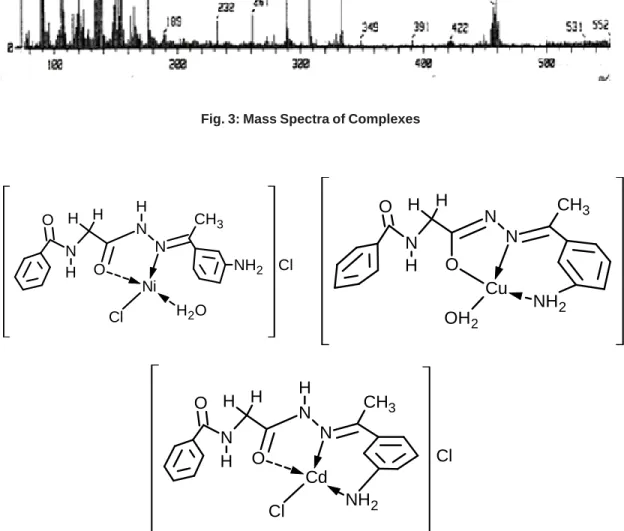
Complexes of Ni(II) (1), Cu(II) (2) and Cd(II) (3) with a novel Schiff base N-(2-2-[1-(3-aminophenyl) ethylidene] hydrazino-2-oxoethyl) benzamide (LH) have been prepared and characterized by elemental analysis, TG-DTA, magnetic, electronic, molar conductivity measurements, IR, SEM, NMR, ESR and mass studies. It is observed that all the complexes having 1:1 metal-ligand stoichiometry are tetracoordinated. The result shows that LH binds to Cu and Cd ions through the hydrazidic carbonyl oxygen, azomethine nitrogen and amine nitrogen as a tridentate ligand while with Ni ion, it coordinates as a bidentate species through the hydrazidic carbonyl oxygen and azomethine nitrogen. The ligand exhibits keto-enol tautomerism in 2 in which it acts as a uninegative ligand. Complexes 1 and 3 behave as 1:1 electrolytes in DMF solution while complex 2, as a nonelectrolyte. Complex 2 is diamagnetic and ESR inactive which suggest that copper ion is present in its cuprous form. SEM images are used to observe external morphology of the compounds.
Key words : Schiff base; Tautomerism; Spectral studies; SEM images.
acetyl, benzoyl or benzylo carbonyl group directly on the amino group, could reduce the ligand field of the in-plane donor thus diminishing the affinity of the amino group for the metal ion and permitting a variety of co-ordinating type. These aroyl hydrazones, moreover, not only possess many potential donor sites but there is also possibility of keto-enol toutomerism which may lead to varied bonding and stereochemical behavior in the complexes in which they act as neutral or mononegative or even as dianionic ligands depending on the aroyl substituents and the reaction conditions10,11. Their chemistry has also been intensely investigated owing to their cooperative capability12,13, pharmacological activity14-18 and use in analytical chemistry as metal extracting agents19.
Considering the above facts and in continuation to our work20-28, we have synthesized a novel Schiff base, N-(2-2-[1-(3-aminophenyl) ethylidene] hydrazino-2-oxoethyl) benzamide (LH, Fig. 1) and studied its ligational behavior towards Ni(II), Cu(II) and Cd(II) ions.
MATERIALS AND METHODS
N-benzoyl glycine, hydrazine hydrate, 3-aminoacetophenone and metal salts, MCl2.nH2O (M = Cu, Ni and Cd) were purchased from E-Merck and used as such. All the other chemicals and solvents used in the study were of AnalaR grade. The ligand N-(2-2-[1-(3-aminophenyl) ethylidene] hydrazino-2-oxoethyl)benzamide, LH was prepared by the condensation of N-benzoyl glycine with 3-aminoacetophenone as reported24.
The metal contents and chlorine were estimated gravimetrically using standard literature procedures29. Hydrazine was determined volumetrically29 by KIO
3 method after subjecting the ligand/complexes to acid hydrolysis with 6 N HCl for about 4 h.
Molar conductance of the 10-3 M solution of complexes in 10-3 M DMSO were measured using a Systronic Conductivitymeter 306 while C, H and N were microanalyzed on a Perkin-Elmer model 240C Analyzer. Magnetic susceptibility measurements of the complexes were carried out
on a Magnetic Susceptibility Balance, Sherwood Scientific Cambridge, UK. Electronic spectra of the complexes were taken on a Shimadzu 2450 UV-Vis Spectrophotometer. IR spectra of the ligand and the complexes were obtained using a Shimadzu Fourier Transform Infrared Spectrophotometer 8400S in KBr medium. 1H NMR spectra were recorded in DMSO-d6 on a Jeol AL 300 FT NMR Spectrometer. Mass spectra were obtained on a Jeol Sx102/Da-6000 Mass Spectrometer. Thermoanalytical (TG/DTA) measurements were carried out with Perkin Elmer Simultaneous Thermal analyzer STA 6000. SEM and EDAX images of the complexes were obtained using a Quanta 250 scanning electron microscope (SEM) fitted with an Ametek Energy Dispersive X-ray Analysis (EDAX) system.
Preparation of Ni (1), Cu (2) and Cd (3) complexes Ethanolic solution of ligand (1 mmol, 1 g in 20 mL ethanol) was refluxed with ethanolic solutions of the metal chloride (MCl2.nH2O) (2 mmol, 1.5 g in 10 mL ethanol) for 4 h and cooled. Complex 2 was obtained on keeping the reaction mixture overnight. However, in case of complexes 1 and 3, the reaction mixtures were refluxed for ~ 20 h and the solid complexes could be isolated only after vigorous stirring the concentrated reaction solution with ~20 mL of acetonitrile and THF. The precipitate obtained were filtered, washed with ethanol/solution mixture of acetonitrile and THF and dried in desicator (yield: 60-70%).
RESULTS AND DISCUSSION
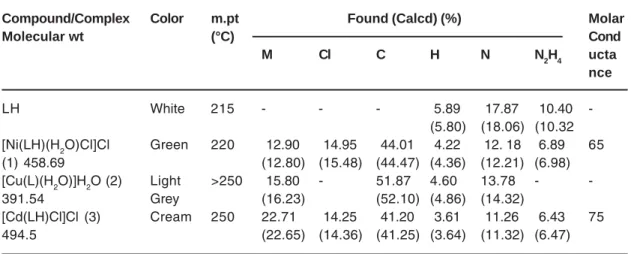
Table 1: Physical and analytical data of the ligand and the complexes
Compound/Complex Color m.pt Found (Calcd) (%) Molar
Molecular wt (°C) Cond
M Cl C H N N2H4 ucta
nce
LH White 215 - - - 5.89 17.87 10.40
-(5.80) (18.06) (10.32 [Ni(LH)(H2O)Cl]Cl Green 220 12.90 14.95 44.01 4.22 12. 18 6.89 65 (1) 458.69 (12.80) (15.48) (44.47) (4.36) (12.21) (6.98) [Cu(L)(H2O)]H2O (2) Light >250 15.80 - 51.87 4.60 13.78 -
-391.54 Grey (16.23) (52.10) (4.86) (14.32)
[Cd(LH)Cl]Cl (3) Cream 250 22.71 14.25 41.20 3.61 11.26 6.43 75
494.5 (22.65) (14.36) (41.25) (3.64) (11.32) (6.47)
Molar conductance* in -1cm2mol-1 in DMF
Table 2: IR spectral bands (cm-1)* of LH and the complexes with their assignments
Ligand/M: Hydrazidic moiety (CN) (NN) NH2 (MO) (MN) (MCl)
Complex Amide I Amide II bands
LH 1688 1577 1597 995 1026, 597 - -
-Ni:1 1658 1537 1546 1041 - 540 401 362
Cu:2 1681 - 1579 1024 989, 588 513 412
-Cd:3 1672 1546 1589 1016 989, 588 543 486 410
*Bands are recorded as KBr pellets
Table 3: 1H NMR spectral data* of LH and complex 3
Protons(s), LH complex 3
-N-NHCO 10.92s 10.63 s
C6H5CONH- 8.98d 8.83 t
-NC-CH3 2.50d 2.19 s
-CH2- 4.77s 4.44 s
-NH2 5.44s 5.14 s
Phenyl ring (6.93-8.22) (6.58-7.91)
*NMR spectra are recorded in dmso-d6, s singlet; d doublet; t triplet
solution at 30°C shows nonelectrolytic behavior of complex 2 and 1:1 electrolytic behavior of complexes 1 and 330.
Thermal Analysis
TG and DT analysis of 1 and 3 were carried out in the temperature range 40 - 940°C.
TG/DTA cur ves of 2 show that the complex decomposes in two steps. The weight loss observed in the temperature ranges 120 250°C and 342 -580°C, respectively, correspond to decomposition of one coordinated water and one ligand molecule. Thermogravimetry data reveals that 3 is thermally stable up to 245°C. The first decomposition of the complex occurs at 250 to 297°C and the second step starts at 503°C and completes at 744°C indicating the absence of any lattice/coordinated water molecule. Total weight loss of this complex corresponds to the decomposition of two Cl- ions and one ligand molecule. The residue left after complete decomposition of both the complexes are the stable metal oxides.
Magnetic Moment and Electronic Spectral studies The observed µeff value of 1 is 3.65 B.M. which falls in the range reported for tetrahedral Ni(II) complex31. A strong multiple band at 638 nm observed in the electronic spectrum of the complex is assignable to the transition 3T
1(F) 3T
Fig. 2: (A-1): SEM image & (A-2) EDAX image of Cd(II) complex, (B-1) SEM image & (B-2) EDAX image of Ni(II) complex
N
N
O
H
CH
3
N
O
H
H
NH
2
H
3'
5'
6' 4'
1' 2'
1 2
3
4
Fig. 3: Mass Spectra of Complexes
H
2O
Cl
N
O
N
N
O
H H
H
H
CH
3NH
2Ni
Cl
OH
2N
O
N
N
O
H H
H
CH
3Cu
NH
2Cl
N
O
N
N
O
H H
H
H
CH
3Cd
NH
2Cl
tetrahedral Ni(II) complex31,32. Complex 2 is diamagnetic, ESR inactive and exhibits no characteristic absorbance in the visible region and these observations indicate that the metal is present in the cuprous form.
IR Spectral Analysis
The IR frequencies of the selected groups of LH and its complexes are presented in Table 2. A broad band at 3250- 3300 cm-1 in the IR spectra of 1 and 2 indicate the presence of coordinated water in these complexes. The three amide bands at 1633, 1552 and 1313 cm-1 observed in the IR spectrum of LH due to the benzamidic carbonyl group do not undergo any significant shift in the spectra of the complexes showing non-coordination of the above group in bonding. Coordination of the hydrazidic carbonyl group to the metal ion has been inferred33 from the observed hypsochromic shift in the amide I (7-16 cm-1) and amide II (29-40 cm-1) bands. Negative shift (8 - 51 cm-1) in the n(CN) and positive shift (21 - 46 cm-1) in the n(NN) stretching frequencies indicate participation of the azomethine nitrogen34 in complexation. Shift of the amide I band and the appearance of a new medium intensity band at 1519 cm-1 in the spectrum of 2 suggest –C-O-M bonding. This also indicates enolization of the hydrazidic carbonyl through tautomerism and subsequent bonding of the imidol oxygen to the metal ion35 in its deprotonated form as reported in the aqueous medium24. However, enolization does not occur in 1 and 3. The bands at 1026 and 597 cm-1 in the spectrum of the ligand due to wagging and rocking NH2 show negative shift in the spectra of 2 and 3 showing its involvement in bonding. The new bands with medium to weak intensity in the ranges 401 - 486 and 513-543 cm-1 may be, respectively, attributed36 to the n(MN) and n(MO) modes showing that the carbonyl oxygen and azomethine nitrogen have formed coordinate bonds with the metal ions while A the bands at 362 and 410 cm-1 in the spectra of 1 and 3 are assigned to n(MCl) mode.
1H NMR Spectral Studies of Complex 3
The 1H NMR spectral data of the ligand and complex 3 along with the assignments are given in Table 3. The existence of more than one isomeric form of LH at room temperature is shown
by the splitting of peaks in the 1H NMR spectrum of the ligand and the bands are assigned as reported24. The observed downfield shift (d, 0.18) and upfield shift (d, 0.11) of -N-NHCO signals in the 1H NMR spectrum of the complex indicates participation of hydrazide >CO group in bonding. Coordination through the azomethine nitrogen37 in the above complex is further supported by the upfield shift (d, 0.11) of –NCH and (d, 0.11) of –NC-CH3 signals. Upfield shift (d, 0.30) of NH2 signal in the spectrum of the complex also indicates participation of this group in complexation.
SEM Images
Scanning electron micrography (SEM) is used to evaluate morphology and particle size of the Schiff base metal complex. The SEM micrographs of complexes 1 and 3 and EDAX images are shown in Fig. 2. An ice square-like shape is observed in 1 while the images of 3 are spongy. Mass Spectral Analysis
The FAB-mass spectra of complexes 2 and 3 are given in Fig. 3. The mass spectrum of 2 shows the molecular ion peak at m/z 391 corresponding to composition [Cu(L)(H2O)]. The mass spectrum of 3 does not show the molecular ion peak at m/z 494 corresponding to the composition [Cd(LH)Cl]Cl suggested based on elemental and thermal analysis data. However, the peak at m/z 459 corresponds to the species [Cd(LH)Cl] that might have been resulted from losing the ionic Cl- ion outside the coordination sphere.
CONCLUSION
1. Yam, V. W. W.; Lo, K. K. W. Coord. Chem. Rev. 1999, 184,
158-2. Hughes M. N., The Inorganic Chemistry of Biological Processes, 2nd ed; John Wiley & Sons, New York, (1981)
3. Angelique, Y. L.; Thomas, J. M. Chem. Rev. 1999, 99(9), 2711-2734
4. Richardson, D. R.; Bernhardt, P. V. J.B.I.C. 1999, 4, 266-273
5. Zheng-Yin, Y.; Ru-Dong, Y.; Fa-Shen, L.; Kai-Bei, Y. Polyhedron 2000, 19, 2599-2604 6. Buss, J. L.; Neuzil, J.; Ponka, P. Archives of
Biochemistry and Biophysics 2004, 421, 1-9 7. Sommer, L.; Maung-Gyee, W. P.; Ryan, D. E. Ser. Fac. Sci. Natur. Univ. Purkynianae 1972, 2(6), 115-128
8. Shargi, H.; Nasser, M. A. Bull. Chem. Soc. (Jpn.), 2003, 76, 137-142
9. Sone, K.; Fukuda, Y. Inorganic Thermochromism, Inorganic Chemistry Concept, Vol. 10, Springer, Heidelberg, 1987 10. Ainscough, E. W.; Brodie, A. M.; Dobbs, A. J.; Ranford, J. D.; Waters, J. M. Inorg. Chim. Acta. 1998, 267, 27-38
11. Lu, Z. L.; Xiao, W.; Yu, K. B.; Deng, L. R.; Kang, S.; Su, C. Y.; Liu. J. J. Mol. Struct. 2000, 553, 91-99
12. Hursthouse, M. B.; Jayaweera, S. A. A.; Smith, A. J. Chem. Soc. Dalton Trans. 1979, 279-13. Liang, Y. L.; Liu, C. M.; Ma, Y. X.; Li, Q. S.
Transition Met. Chem. 1998, 23, 97-99 14. Haran, R.; Gairin, J.; Commenges, G. Inorg.
Chim. Acta. 1980, 46, 63-67
15. Eyer, P.; Hell, W. Arch. Pharm. (Weinheim) 1986, 319, 558-566
16. Zishen, W.; Zigi, G.; Zhenhuan, Y. Synth. React. Inorg. Met.-Org. Chem. 1990, 20, 335-344 17. Rudolph, T.; Phillips, J. P. Anal. Chim. Acta.
1996, 34, 235-237
18. Parashar, R. K.; Sharma, R. C.; Anilkumar; Mohon, G. Inorg. Chim. Acta. 1998, 151, 201-208
19. Gallego, M.; Garcia- Vargas, M.; Valcaral, M. Analyst, 1979, 104, 613-619
20. Lonibala, R. K.; Rao, T. R. Proc. Indian Acad.
Sci. (Chem. Sci.), 1999, 111(5), 615-625
21. Lonibala, R. K.; Devi, N. I.; Devi, R. K. B.; Rao, T. R. Synth. React. Inorg. Met.- Org. Chem. 2001, 31(1), 179-194
22. Lonibala, R. K.; Rao, T. R.; Babita Devi, R. K. J. Chem. Sci. 2006, 118(4), 327-334 23. Sharmeli, Y.; Lonibala, R. k. J. Chem. Eng.
Data 2009, 54(1), 28-34
24. Promila Devi, Th.; Lonibala, R. K. J. Chem. Eng. Data 2010, 55, 1166-1172
25. Promila Devi, Th.; Lonibala, R. K. Asian J. Chem. 2010, 22(7), 5369-5379
26. Sharmeli, Y.; Lonibala, R. K. Asian J. Chem. 2010, 22(10), 7541-7550
27. Yuimi, V.; Lonibala, R.K. J. Chem. Eng. Data 2011, 56, 3552-3560
28. Sharmeli, Y.; Lonibala, R. K. J. Rare Earths 2012, 30, 367-373
29. Vogel, A. I., A Textbook of Quantitative Inorganic Analysis, 3rd ed.; Longman, England, (1961)
30. Geary, W. J. Coord. Chem. Rev1971, 7, 81-122
31. Lever, A. B. P., Inorganic electronic spectroscopy, Elsevier, Amsterdam, (1984) 32. Henke, W.; Kremer, S. Inorg. Chim. Acta. 1982,
65, L115-L117
33. El-Gayel, E.; Iskander, M. F. J. Inorg. Nucl. Chem. 1971, 33,
107-34. Braibanti, A,; Dallavale, F.; Pellinghelli, M. A.; Laporati, E. Inorg. Chem. 1968, 7, 1430-1433
35. Rao, C. N. R., Chemical Applications of Infrared Spectroscopy, Academic
Press, New York, (1963)
36. Inomata, T.; Moriwaki, T. Bull. Chem. Soc. Jpn. 1973, 46, 1148
37. Patil, S. A.; Kulkarni, V. H. Inorg. Chim. Acta. 1984, 95, 195