45
Volume LIX 6 Number 6, 2011
EVALUATION OF THE EFFECTIVENESS OF
A THERMAL HYGIENIZATION REACTOR
D. Borski
Received: July 11, 2011
Abstract
BORSKI, D.: Evaluation of the eff ectiveness of a thermal hygienization reactor. Acta univ. agric. et silvic. Mendel. Brun., 2011, LIX, No. 6, pp. 45–52
For reasons of limiting the spread of serious transmissible diseases, with regard to the requirement for reducing landfi ll of biodegradable waste (which may or contains animal by-products and thus presents a potential risk to human and animal health) and with a focus on supporting its separate collection, there has been created a legal framework for processing and hygienization of materials containing animal by-products. For the above reasons new technologies are being developed and implemented. These technologies are able to ensure the processing of biological waste containing animal by-products. As a practical result of the eff ort to ensure the hygienization of biowaste, a hygienization unit of own design, which uses the thermal way of hygienization, is presented in this work. The general part of the work defi nes a legislative framework for the assignment and gives technical parameters and minimum requirements for conversion that hygienization unit should be able to perform, including the limits for digestion residues and compost.
In the experimental section there are described operational tests which document the technological process of hygienization depending on the aeration of the contents of the reactor. Experiment III outlines the validation process which uses contamination by indicator organisms, including subsequent checking of their occurrence as well as processing of the results of experiments and evaluation of the process of hygienization.
animal by-products, hygienization, biodegradable waste
Council Directive 1999/31/EC on the landfi ll of waste in Article 5 imposes an obligation to the Member States to reduce biodegradable waste going to landfi lls. By implementing the Counsil Directive 1999/31/EC on the landfi ll of waste „Waste Management Plan of the Czech Republic” was announced by the Government Order No. 197/2003 Coll., of 4 June 2002, which sets out a strategy for 10 years for limiting of biodegradable municipal waste going to landfi lls. By the year 2010 the total amount (by weight) of biodegradable municipal waste in the Czech Republic leaving for the landfi ll must be reduced to 75%, by 2013 to 50% and by 2020 to 35% of the total amount of biodegradable municipal waste produced in 1995. The Czech Republic used the option to postpone the targets of progressive reduction of biodegradable municipal waste for four years. This option applied to those States which in 1995 collected more than 80% of municipal wastes.
waste which will be hygienised in the here presented unit. Catering waste containing products of animal origin may contain pathogenic microorganisms and their toxins, and other infectious agents that can contaminate the food chain and can become a cause of spreading disease. Biodegradable waste contains a high proportion of material allowing the massive growth of harmful pathogenic microorganisms that can present a potential risk to human and animal health and plants.
MATERIALS AND METHODS
With regard to compliance with legislative requirements (set out in the introduction of this article) new technologies capable of ensuring the processing of biodegradable (biological) waste and its hygienization are being introduced. Hygienization is a targeted process that leads to a reduction in the number of pathogenic organisms that can cause disease in humans or animals. The essence of hygienization is to create and provide for a certain period of time such an environment in which bacteria are not able to survive. The most common method which uses high temperature for hygienization is called thermal. The eff ectiveness of the technology lies in the ability to reduce the number of pathogenic organisms to the desired level.
Waste for hygienization
Waste for hygienization and subsequent processing at composting plants is defi ned in Decree No. 341/2008 Coll., of 26 August 2008 of the code on biowaste (on the disposal of biodegradable waste) in Annex 1 of the Decree and the Regulation (EC) No. 1069/2009 of the European Parliament and of the Council of 21 October 2009, laying down health rules as regards animal by-products and derived products not intended for human consumption,
in Article 10, and selected kinds of waste of category 2 intended for composting are set out in Article 9 of this Regulation.
Standard and technical parameters for the transformation
In the Commission Regulation (EU) No. 142/2011 implementing Regulation (EC) No. 1069/2009 of the European Parliament and of the Council laying down health rules as regards animal by-products and derived by-products not intended for human consumption, Article 10 – Requirements regarding the transformation of animal by-products and derived products into biogas and composting, it is required that the operators guarantee the establishments and plants under their control meet the general and hygiene requirements for equipment for the transformation of animal by-products and derived by-products and for composting and that these establishments comply with standard parameters for the transformation and conform to quality standards for compost and digestion residues. Specifi c requirements for standard and technical parameters for the transformation are set out in Annex V to this Regulation.
Standards for digestion residues and compost Evaluation of outputs from the establishment designed to use animal by-products is carried out according to the criteria for checking the effi ciency of hygienization set out in Commission Regulation (EU) No. 142/2011, Annex V or in Annex 5 to Decree No. 341/2008 Coll., of the code on biowaste.
Representative samples of the digestion residues or compost taken during or immediately a er composting at the composting plant in order to monitor the process must comply with the standards listed in Table I.
I: Standards for digestion residues and compost (according to Regulation (EU) No. 142/2011) Indicator
microorganism Units
Numer of tested samples at each output check
Limit (fi nding / CFU)
Salmonella spp. Finding in 25 g n = 5 c = 0 M = 0 (Neg)
d = 0 m = 0 (Neg)
Escherichia coli (E. coli) CFU in 1 gram n = 5 c = 1 M = 5 × 10
3
d = 4 m = 103
Enterococcaceae CFU in 1 gram n = 5 c = 1 M = 5 × 10
3
d = 4 m = 103
Glossary:
n ... number of samples to be tested
c... number of samples the bacterial count of which may be between m and M, the sample still being considered acceptable if the bacterial count of the other samples is m or less.
M ... maximum value for the number of bacteria; the result is considered unsatisfactory if the number of bacteria in one or more samples is M or more;
d .... number of samples the bacterial count of which may not be higher than m
m .... threshold value for the number of bacteria; the result is considered satisfactory if the number of bacteria in all samples does not exceed m
Hygienization unit of own design The composting plant in Třinec designed and built its own hygienization unit, using thermal method of the hygienization. The author of the article is also the author of the design of the hygienization unit. The basis for the construction of the hygienization unit forms a container of the Abroll system with a capacity of 40.0 cubic meters whose space was divided into three parts (Figure 1).
In the fi rst part of the container a heat distributor including substation and control unit is located. In the middle of the container there is the hygienization reactor itself of a capacity of 10 m3,
which is thermally insulated. The unit is fi lled from the top by two hydraulic top-up covers. Heating of the material in the reactor is carried out by heating panels around the perimeter. Heat is supplied by a heat exchanger unit of the hot-line station. The content of the hygienization reactor can be aerated. The hygienization unit is fi tted with six temperature sensors. Four sensors measure temperature in the reactor. Two others measure the temperature of the medium at the entrance and exit of the unit. In the third part of the container there is a space into which the hinged door of the reactor opens.
The hygienization unit was created in compliance with the requirements for this establishment and parameters for conversion referred to in Commission Regulation (EU) No. 142/2011 and so that its output meets standards for digestion residues and compost. If it fulfi lls these and other hygiene requirements for composting and if it introduces, implements and maintains procedures
based on Hazard Analysis and Critical Control Point (HACCP), the authority shall consent to the operation of the facility according to the Regulation (EC) No. 1069/2009 of the European Parliament and of the Council, Article 24 and 44.
RESULTS AND DISCUSION
During the trial operation specifi c technological procedures for the use of the unit have been defi ned, on the basis of which fi eld trials were conducted in order to better detail and verify the progress of hygienization process. A description of these fi eld tests is the content of experiment I and experiment II. Experiment III depicts the conduct and results of the validation of the hygienization unit while using contamination by indicator organisms (Escherichia coli, Enterococcaceae), which was conducted by an accredited laboratory.
Input parameters of experiments
• The content of the hygienization reactor was separately collected biodegradable waste from households from citizens, which could include secondary products of animal origin (animal by-product). These were mainly kitchen waste and garden waste. Catering waste from catering facilities and kitchens was not added to the batch reactor during the experiments.
• The waste was homogenized in the backfi ll mixing car Faresin. Stuctural material – wood chips – were added into the mixture in order to ensure
a suitable consistency. The resulting mixture was prepared damp.
• The fi lling of the reactor was about 6.5–7 Mg (tons). • Heating of the reactor was ensured by using heat
from hot water lines from nearby ironworks. • Monitoring of the hygienization process was
conducted in two ways, both by digital recording in the control unit and manually into the preprinted form.
• The pump switches off the heating of the reactor immediately a er achieving the targets. To better illustrate the process of the temperature (exceeding the treshold of 70 °C), the pump was manually turned on and thus preventing the shutdown. Therefore the temperature of the hygienised mixture exceeded 73 to 75 °C and the time of the heating was longer than was required.
Experiment I
The aim of the experiment was monitoring of the process and time of the hygienization operation in the hygienization unit without aeration of the reactor contents, which demonstrated the operability of the equipment and its ability to reach the required temperature of 70 °C and to maintain it for 60 minutes. The desired temperature was reached a er 67 hours of heating (Figure 2).
Experiment I brought confi rmation of the theoretical assumptions that the unit is capable of functioning and able to meet legislative requirements. By hygienization of the contents of two reactors per week we can say that the
performance of the hygienization unit is about 50 Mg × month−1. The heat consumption per one
hygienization was about 3.25 GJ (0.325 GJ × m−3, ca
0.5 GJ × Mg).
Experiment II
It describes an action when hygienised material was heated with hot water in the outer shell of the reactor, while the content of the reactor was aerated. It is an action that should be standard hygienization practice. The experiment showed that thanks to the aeration of the fi lling the required temperature of 70 °C was reached a er 32 hours of heating (Figure 3).
Experiment II confi rmed the reduction of the time needed to the hygienization of the material by aeration of the reactor contents. It is a shorter duration than hygienization experiment I by more than 50%. In this system of the hygienization it is possible to hygienise three reactors per week, which is 80 Mg × month−1. The heat consumption per cycle
with aeration of the hygienization reactor is about 2.00 GJ (0.2 GJ × m−3, ca 0.31 GJ × Mg).
Experiment III
Experiment III describes the real progress of each step of the validation of the hygienization process which uses contamination by indicator organisms in accordance with Commission Regulation (EU) No. 142/2011 implementing Regulation (EC) No. 1069/2009 of the European Parliament and of the Council laying down health rules as regards animal by-products and derived products not intended for human consumption.
Process of the temperatures of the hygienization of without
aeration
20 30 40 50 60 70 80 90 100 110
10 14 18 22 2 6 10 14 18 22 2 6 10 14 18 22 2 6 10 14
°C
Required temperature
Water temp. -input
Water temp. -output
Temperature sensor 1
Temperature sensor 2
Temperature sensor 3
Temperature sensor 4
1st day 2nd day 3rd day 4th day
The validation was carried out by an accredited laboratory and the validation process consisted of several parts:
1. homogenisation of the input materials and vaccination by indicator organisms,
2. material containing the indicator bacteria Escherichia coli was placed in cartridges, which were numbered and, along with other material, placed in the reactor of the hygienization unit. Twenty pieces of cartridges in total were placed in various places in the reactor and were covered by homogenised biodegradable waste,
3. the hygienization itself ran until the material reached the temperature of 70 °C for 60 minutes, 4. of the total number of 20 pieces 10 pieces of
cartridges were transported to the laboratory
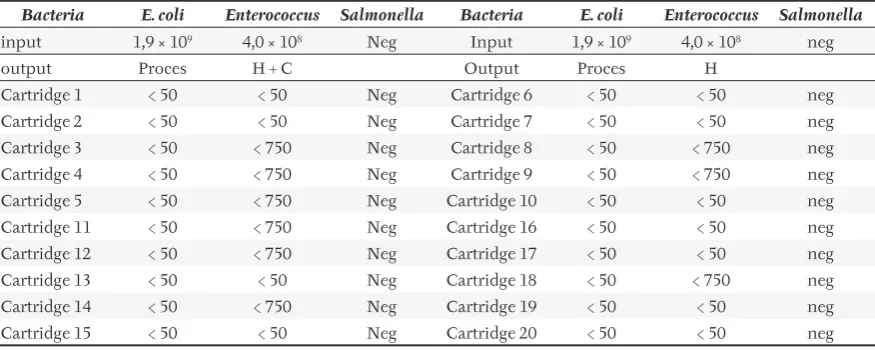
for analysis and the remaining 10 pieces were incorporated into the compost fi ll at the compost facility. The cartridges that were removed a er the hygienization directly to the laboratory and did not undergo windrow composting are shown in the right part of Table II and labeled “The process of H”,
5. a er three weeks of composting the cartridges of the windrow were transported to the laboratory for analysis. These cartridges are listed in the le part of Table II and labeled “Process H + C”. Table II shows the results of laboratory tests of contamination by indicator organisms, which were placed in cartridges. Based on these results, we can say that there has been a reduction of bacteria E. coli and Enterococcus 5 log below the desired value ≤ 1 000 CFU × g−1.
Process of the temperatures of the hygienization with aeration
30 40 50 60 70 80 90 100
11 13 15 17 19 21 23 1 3 5 7 9 11 13 15 17 19 21 23 1 3 5 6,5 °C
Required temperature
Water temp. -input
Water temp. -output
Temperature sensor 1
Temperature sensor 2
Temperature sensor 3
Temperature sensor 4
1st day of hygienization 2nd day of hygienization 3rd day of hygienization
3: Graph of the process of temperatures in Experiment II
II: Results of laboratory tests of contamination by indicator organisms
Bacteria E. coli Enterococcus Salmonella Bacteria E. coli Enterococcus Salmonella
input 1,9 × 10⁹ 4,0 × 10⁸ Neg Input 1,9 × 10⁹ 4,0 × 10⁸ neg
output Proces H + C Output Proces H
Cartridge 1 < 50 < 50 Neg Cartridge 6 < 50 < 50 neg
Cartridge 2 < 50 < 50 Neg Cartridge 7 < 50 < 50 neg
Cartridge 3 < 50 < 750 Neg Cartridge 8 < 50 < 750 neg
Cartridge 4 < 50 < 750 Neg Cartridge 9 < 50 < 750 neg
Cartridge 5 < 50 < 750 Neg Cartridge 10 < 50 < 50 neg
Cartridge 11 < 50 < 750 Neg Cartridge 16 < 50 < 50 neg
Cartridge 12 < 50 < 750 Neg Cartridge 17 < 50 < 50 neg
Cartridge 13 < 50 < 50 Neg Cartridge 18 < 50 < 750 neg
Cartridge 14 < 50 < 750 Neg Cartridge 19 < 50 < 50 neg
As described in experiment III above, the cartridges were placed into the reactor along with other homogenised biodegradable waste. Before the hygienization sampled material was taken for comparative testing. The results of the examination of this material input - output are shown in Table III. In this case, 10 samples were used to detect the presence of E. coli bacteria in the material. The results of the laboratory tests of the hygienization material along with the cartridges confi rmed reducing the number of E. coli bacteria by log 5 to the desired number of CFU ≤ 1 000 × g−1.
CONCLUSIONS
From the results of the experiments it can be stated that the technology of the hygienization of the animal by-product presented in this work proved its operability and eff ectiveness. The hygienization unit uses waste heat from nearby ironworks. By using waste heat there is a signifi cant reduction in the costs of heating of the hygienization unit. The good economy of the operation is due to the fact
that the heat consumption is linked to the agreed minimum heat consumption of 240 GJ, which must be paid regardless of the amount of heat removed. This condition was agreed with regard to the initial investment into the hot water line.
The results of the validation of the hygienization process in the hygienization unit of own production confi rmed that the fi nal product of the hygienization meets parameters for Escherichia coli and Salmonella spp. for output according to the Regulation (EC) No. 1069/2009 of the European Parliament and of the Council laying down health rules as regards animal by-products and derived products not intended for human consumption.
The hygienization unit and the validation of the process of hygienization, which are both described in this work, are part of a technological process chain of treating biodegradable waste and its subsequent converting into compost. This process line can be (due to the positive results of the validation of the unit and due to meeting other legislative requirements), granted an affi rmative decision to dispose of animal by-products – Category 3 material. III: Results of laboratory tests of hygienization material together with cartridges
Sample No. Unit Escherichia coli Salmonella
Input output Input Output
1
CFU × g−1
4,4 × 10⁶ < 50 Neg Neg
2 2,6 × 10⁶ < 50 Neg Neg
3 5,6 × 10⁶ < 50 Neg Neg
4 4,0 × 10⁶ < 50 Neg Neg
5 4,8 × 10⁶ < 50 Neg Neg
6 2,3 × 10⁶ < 50 Neg Neg
7 4,7 × 10⁶ < 50 Neg Neg
8 3,7 × 10⁶ < 50 Neg Neg
9 3,9 × 10⁶ < 50 Neg Neg
10 3,7 × 10⁶ < 50 Neg Neg
SUMMARY
This work deals with issues arising from the implementation of the requirements laid down in „Waste Management Plan“, which relate to reducing the storage of biodegradable municipal waste in landfi lls, in response to requests to improve the level of protection against risks that are associated with the use of animal by-products and derived products for human and animal health.
As a practical output of the eff ort to ensure hygienization of biodegradable waste (prior to further processing at a composting plant) this work presents a hygienization unit of own production, which uses thermal hygienization of the materials through heating the material by panels around the perimeter. The operation of the hygienization unit was experimentally verifi ed, and validation procedures and results of experiments are presented in this work.
reactor is aerated. Experiment III investigates the process of validation of the hygienization unit by contamination by indicator organisms (E. coli, Enterococci), including follow-up of their occurrence, processing the results of the experiments and the evaluation of the hygienization process.
Operating experiments revealed that the aeration of the fi lling can shorten the time required to achieve the desired temperature of 70 °C by more than 50%, while maintaining the input parameters. The positive outcome of the experiment of the validation of the hygienization process confi rms the correctness of the design solutions of the hygienization unit of own production and its operability.
REFERENCES
Council Directive 1999/31/EC of 26 April 1999 on the landfi ll of waste.
Government Order No. 197/2003 Coll., of 4 June 2002 on Waste Management Plan of the Czech Republic.
Regulation (EC) No. 1069/2009 of the European Parliament and of the Council of 21 October 2009 laying down health rules as regards animal by-products and derived by-products not intended for human consumption and repealing Regulation (EC) No. 1774/2002 (Animal by-products Regulation).
Commission Regulation (EU) No. 142/2011 of 25 February 2011 implementing Regulation (EC) No. 1069/2009 of the European Parliament and of the Council laying down health rules
as regards animal by-products and derived products not intended for human consumption and implementing Council Directive 97/78/ EC as regards certain samples and items exempt from veterinary checks at the border under that Directive.
Decree No. 341/2008 Coll., of 26 August 2008 of the code on biowaste (on the disposal of biodegradable waste)
TESAŘOVÁ, M. et al., 2010: Biological waste treatment, Mendel University in Brno, p. 130, ISBN 978-80-7375-420-4 (in Czech).
ZIMOVÁ, M., MATĚJŮ, L., 2009: Health hazards during biodegradable-waste handling, The National Institute of Public Health, Prague, Waste Management Forum 3/2009 (in Czech).
Address