Licensed under Creative Common Page 82
http://ijecm.co.uk/
BENCHMARKING HOTELS: APPLYING
ANALYTIC HIERARCHY PROCESS
Awin Jabar
Ishik University, Sulaimani, Kurdistan region of Iraq [email protected]
Savel Kamal
Ishik University, Sulaimani, Kurdistan Region of Iraq [email protected]
Twezhar Kamal
Ishik University, Sulaimani, Kurdistan Region of Iraq [email protected]
Cemil Top
Ishik University, Kurdistan Region of Iraq [email protected]
Abstract
The aim of this research was to benchmark hotel services among five- and four-star hotels in
Sulaimani, Kurdistan region of Iraq. To do this, we have obtained the hotel service
benchmarking criteria from the study of Min and Min (1997). The same survey questionnaire
has been conducted to the customers of each hotel simultaneously. The obtained results have
been calculated and the total grades of each hotel out of ten has been indicated. By this way,
the best and the worst service providing hotel has been explored. The model can be used to
benchmark various aspects of the services. Secondly, they can detect their weaknesses and
strengths and develop their strategic plans accordingly.
Keywords: Benchmarking, AHP, Service Quality, Hospitality Management, Hotel Management,
Licensed under Creative Common Page 83 INTRODUCTION
Hospitality is basically the connection between a host and a visitor. While this can happen in a variety of situations, it's regularly utilized by organizations to give clients and customers better services. Hotel industry maintains fundamental services. For example, lodging and food for tourists, in case they are on the move for reasons of necessity, leisure or luxury. Hospitality is an extensive aspect in every holiday and business travel and is thus, valuable to personal, clients and to businesses. If you manage a hotel, your essential concern is to implement the best available level of hospitality. Administering a hotel comprise an extensive scope of obligation. Who administer a hotel must be able to conform new contest, help various commissions in various conditions and secure the hotel by continue a standard of greatness for hotel. Administrators require a scope of comfortable and strong knowledge to become a prosperous hotel director.
Service quality became one of the most important tools to increase a market share in service organizations (Aydinli and Demir, 2015). Moreover, service quality can be defined as the measurement of fulfilling the demands, needs, and expectations of the customers of concerning service (Demir and Aydinli, 2016). From this point of view, service quality is important as much as the product quality is (Budur, Rashid, and Poturak, 2018; Demir and Mukhlis, 2017). Thus, as the hotels are a kind of service providing firms, their service quality are very important and must be measured periodically.
Comparing to the province, the visitor in Kurdistan Reign tripled in previous years, the hotels which are built in Sulaimani City has develop its power importantly or growing the number of visitor‟s suites either creating new hotels. For instance, development has managed to over build of hotels; also competition between hotels later on has expanded. Benchmarking shows to have the highest effect form as the hotel requires evaluating its service work proportionate to its contestant to uniformly intensify its market place and later profit a position is the best parts in the market. Commonly, endless quality development system which is benchmarking can aid an institution‟s interior strengths and weaknesses, test difference benefits of dominant contestants refer the best method of industry practical leaderships, and coordinate these are finding into a strategic operation plan arrangement to profit a position of supremacy.
Licensed under Creative Common Page 84 Regarding to the hotels experience, first of all, these questioners have been conducted to managers of these five- and four-stars hotels. The managers have evaluated the importance of each aspect of the hotels to one another. Then, we have conducted another survey questioner for the customers which they have evaluated each aspect from one to ten. Formerly, by using expert evaluation we have created weight for analytical hierarchy process (AHP) methodology. Secondly, we used data from the customer in order to calculate the points of each hotel from each aspect. Finally, benchmarking has been successfully applied to the hotels in Sulaimani City on November 26, 2018. We have written a conclusion about what we get from the result and which hotel performing better than others overall. So, it means the result of our project can be seen in conclusion part.
LITERATURE REVIEW
In the whole world many studies have been done about hotel service qualities and hotel hospitality. The importance of hotel industry forces many researchers to study on it and identify the main factors to improve the service quality of hotels in their country. The common point of following previous studies about hotel industry with our research can resulted in having better service quality lead to have customer loyalty.
Service Quality
Service quality can be defined as the measurement of fulfilling the customers‟ expectations and needs for the service that they purchase (Parasuraman et al., 1985; Ratanavaraha et al., 2015; Aydinli & Demir, 2015; Demir & Eray, 2015). As one of the most important tools to satisfy and retain customers, service quality must be given utmost care in every service corporation (Demir, Talaat, & Aydinli, 2015). Furthermore, a company must make market researches to understand customers‟ needs, expectations, etc. in order to satisfy the needs of the customers (Demir & Eray, 2015; Demir, 2017).
According to research in the United States hotel industry which focuses on the effect of employee performance on recognized quality establish the performance of front- office services, household management and parking employees had powerful impact on recognized overall quality (Hartline and Jones, 1996).
Licensed under Creative Common Page 85 The value of service quality to business work has been authorized in either hospitality (Bowen and Shoemaker, 1998) and in a vast business framework (Zeithaml et al., 1996). It is mostly accepted that service quality is a priority for clients to reach customer satisfaction (Caruana, 2002) and customer loyalty occur when clients reach customer satisfaction (McDougall and Levesque, 2000).
Identified service quality developed from the personal service encounter between the client and the one who provide service, whatever client analyze quality and builds dissatisfaction or satisfaction. During which the client will create these evaluation each service involvement is consist of a set of specific various service (Bitner, 1990).
In our study we have three categories which are facilities, room values, and front office services. We found that clearness the most important point for consumers, but authors (Choi, & Chu, 2001) in the Hong Kong hotel industry had seven categories : „Staff Service Quality‟, „Room Qualities‟, „General Amenities‟, „Business Services‟, „Value‟, „Security‟ and „IDD Facilities‟. Out of these hotel factors, „Staff Service Quality‟, „Room Qualities‟ and „Value‟ there is a similarity between our research and their research which is cleanness the most important point for consumers.
AHP
Analytic hierarchy process is a powerful and flexible multi-criteria decision-making analysis technique that sets priorities to select best decision among many options (Gilleard & Wong Yal-lung, 2004). Analytic hierarchy process has been developed by Saaty (1980) in order to help decision makers divide complex problems into smaller parts, range them and weight their importance for the decision maker and calculate their values under the concerning importance weights.
Moreover, the method has been applied recently in various sectors in Kurdistan Region of Iraq such as telecommunication sector (Demir, 2019), Pre-import inspection (Ozmen, Demir, & Celepli, 2013), site selections for water harvesting (Hameed), e-government adoption process (Shareef, (2012), and Sustainability (Wahab & Khayyat, 2014).
AHP objectives, criteria / sub-criteria and levels of importance for each problem, it uses a hierarchical model of matrices and is based on three basic principles. It has been established:
• The creation of hierarchies,
• Determination of superiority,
Licensed under Creative Common Page 86 The steps of the AHP method can be summarized as (Ulucan, 2004: 332-333; Budur, 2018):
• Identification of the problem,
• Determination of Criteria,
• The introduction of alternatives,
• Drawing a hierarchical tree diagram,
• Determination of criterion importance levels,
• Scoring alternatives according to each criterion,
• Obtaining multi-criteria scores for each alternative,
• Comparison of overall scores, and the best alternative by ranking is selected.
Table 1. 1-9 scale of Saaty (Saaty, 1980)
Intensity of
importance
Definition Explanation
1 Equal importance Two activities contribute equally to the objectives
3 Moderate importance Experience and judgment slightly favor one over another
5 Strong importance Experience and judgment strongly favor one over another
7 Very strong importance Activity is strongly favored and its dominance is demonstrated in practice
9 Absolute importance Importance of one over another affirmed on the highest possible order
2,4,6,8 Intermediate values Used to represent compromise between the priorities listed above
Reciprocal of
above
non-zero numbers
If activity i has one of the above non-zero numbers assigned to it when compared with activity j, then j has reciprocal value when compared with i
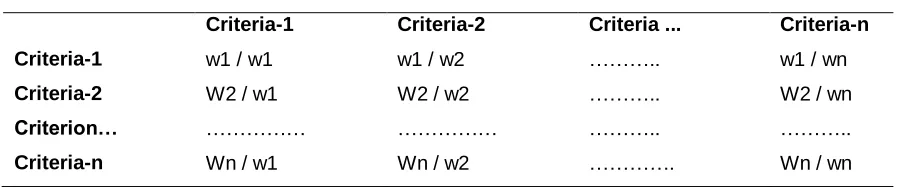
Binary comparisons of different criteria are seen in Table below. Where n criteria are rows and columns up to i = 1,2, ..., n, and j = 1, 2, …, n are arranged in columns to form the comparison matrix. Matrix wi/wj in the comparison matrix of importance in order to reach the aim by comparing i. criterion with j.
Table 2. AHP Matrix
Criteria-1 Criteria-2 Criteria ... Criteria-n
Criteria-1 w1 / w1 w1 / w2 ……….. w1 / wn
Criteria-2 W2 / w1 W2 / w2 ……….. W2 / wn
Criterion… ……… ……… ……….. ………..
Licensed under Creative Common Page 87 Properties of the binary comparison matrix (SAATY, 1980: 212);
• The diagonal of the matrix equals 1 (one).
• Matrix square matrix and all elements are positive numbers.
• If the matrix is completely consistent (CR = 0), aij.aijk = open equality is achieved.
• If the matrix is completely consistent, then from any row to all other factors of the matrix reached.
• The eigenvector, corresponding to the largest eigenvalue of the matrix, significance level or relative importance vector.
• Opening to evaluation can be done as a combination of the two numbers n.
In the mathematical model of the AHR, the relative importance of the alternatives / criteria being assessed was found and the matrix consistency It must be calculated. In order for a comparison matrix to be consistent, the eigenvalue (λmax) must be equal to the matrix size (n). (Saaty, 1980). To calculate the relative importance of the criteria, the average of each row and a "column vector" is created. Constructed column vector normalized to obtain the “relative significance vector”. Each line in the math weighted significance vector is obtained by multiplying by the relative significance vector. Later each element of this vector corresponds to the corresponding element in the vector of relative significance another vector is calculated. As a result, this vector is arithmetic while the average yields the largest eigenvalue "λmax". Later the consistency indicator and the consistency rate are calculated as follows the accuracy is checked.
Consistency Indicator (CI) =
Let Random Indicator be “RI”;
Consistency Ratio (CR) =
The consistency rate is based on each criterion of the decision maker and in terms of the quality and validity of the final decision is an important concept. In order to make it possible to test the consistency AHP method is more reliable than other multi-criteria decision-making methods It serves.
METHODOLOGY
front-Licensed under Creative Common Page 88 desk services and facilities contained four sub-criterions each. Initially, we have asked managers of hotels in Sulaimani to determine the importance of each criteria and sub -criteria comparing to one another using AHP grading method. Secondly, we have asked customers at each hotel to rate the hotel services by each sub-criterion. Twenty customers have been asked to fill the questionnaire. Finally, there has been approximately 120 data collected. However, after the initial inspection, thirty questionnaires were eliminated due to the incompleteness (missing values). There have been 90 data which have been used for the further studies.
Finally, we have benchmarked hotels by analytic hierarchy process and determined the best and the worst hotels in the market.
ANALYSIS AND FINDINGS
In this section, we have calculated importance weights and benchmarked hotels proposing analytic hierarchy process. Firstly, we have entered the importance matrix into Table 2 and 3. The importance matrix has been determined by hotel managers in consensus.
Table 3. Comparison matrix of main criterions
Room Values Front-Desk Services Facilities
Room Values 1 1/3 1/4
Front-Desk Services 3 1 1/2
Facilities 4 2 1
Inconsistency 0.02
Given in the Table 2, hotel managers have compared room values, front-desk services, and facilities with each other. They have determined that front-desk services and facilities of a hotel were more important than room values of it. Secondly, they have evaluated facilities of a hotel as slightly more important -which is close to equally important- than front-desk services. Of course, those parameters may show difference from a country to another based on the economic, cultural, and social differentiation.
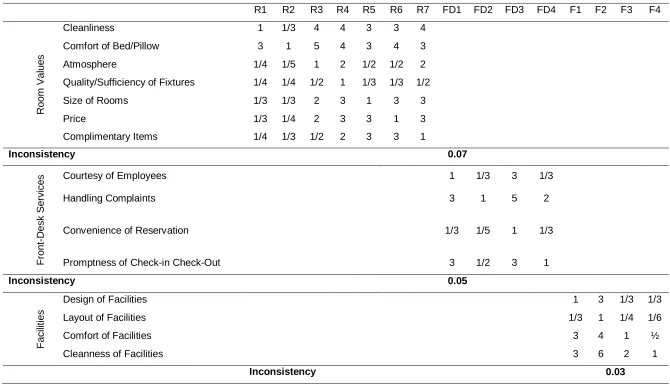
Licensed under Creative Common Page 89 Secondly, they have evaluated the front-desk services‟ sub-criterions. The managers have determined that handling complaints of customers have been the most important duty of front-desk services. Second important sub-criterion was promptness of check-in and check-out. Finally, courtesy of employees and convenience of reservation were the least important factors, respectively.
Third, hotel managers have compared the sub-criterions of facilities dimension. The results of evaluation in Table 4 shows that cleanness of the facilities have been the most important factor than all other sub-criterions of facilities. Second important sub-criterion has been comfort of the facilities. Finally, they have evaluated design and layout as the least important sub-criterions of facilities criterion.
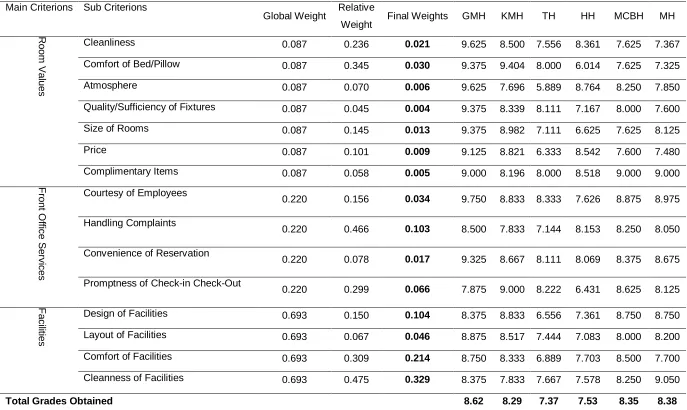
After determining the comparison matrix, global and final weights of each criterion and sub-criterion have been calculated. To do this, each value in comparison matrix for the concerning criterion has been divided by the total value of the column. By this way, importance matrix values have been normalized for each criterion. Secondly, average values for each criterion has been calculated. The averages determine the importance weights of the concerning criterion. All calculations have been proposed the same way for each criterion and the results have been shown on the Table 4.
Licensed under Creative Common Page 90 Table 4. Comparison matrix of sub-criterions
R1 R2 R3 R4 R5 R6 R7 FD1 FD2 FD3 FD4 F1 F2 F3 F4
R
o
o
m
Va
lu
e
s
Cleanliness 1 1/3 4 4 3 3 4
Comfort of Bed/Pillow 3 1 5 4 3 4 3
Atmosphere 1/4 1/5 1 2 1/2 1/2 2
Quality/Sufficiency of Fixtures 1/4 1/4 1/2 1 1/3 1/3 1/2
Size of Rooms 1/3 1/3 2 3 1 3 3
Price 1/3 1/4 2 3 3 1 3
Complimentary Items 1/4 1/3 1/2 2 3 3 1
Inconsistency 0.07
F
ro
n
t-D
e
sk
Se
rvi
ce
s Courtesy of Employees 1 1/3 3 1/3
Handling Complaints 3 1 5 2
Convenience of Reservation 1/3 1/5 1 1/3
Promptness of Check-in Check-Out 3 1/2 3 1
Inconsistency 0.05
F
a
ci
lit
ie
s
Design of Facilities 1 3 1/3 1/3
Layout of Facilities 1/3 1 1/4 1/6
Comfort of Facilities 3 4 1 ½
Cleanness of Facilities 3 6 2 1
Inconsistency 0.03
Licensed under Creative Common Page 91 Table 5. Benchmarking Results
Main Criterions Sub Criterions
Global Weight Relative
Weight Final Weights GMH KMH TH HH MCBH MH
R
o
o
m
Va
lu
e
s
Cleanliness 0.087 0.236 0.021 9.625 8.500 7.556 8.361 7.625 7.367
Comfort of Bed/Pillow 0.087 0.345 0.030 9.375 9.404 8.000 6.014 7.625 7.325
Atmosphere 0.087 0.070 0.006 9.625 7.696 5.889 8.764 8.250 7.850
Quality/Sufficiency of Fixtures 0.087 0.045 0.004 9.375 8.339 8.111 7.167 8.000 7.600
Size of Rooms 0.087 0.145 0.013 9.375 8.982 7.111 6.625 7.625 8.125
Price 0.087 0.101 0.009 9.125 8.821 6.333 8.542 7.600 7.480
Complimentary Items 0.087 0.058 0.005 9.000 8.196 8.000 8.518 9.000 9.000
F
ro
n
t O
ffi
ce
Se
rvi
ce
s
Courtesy of Employees
0.220 0.156 0.034 9.750 8.833 8.333 7.626 8.875 8.975
Handling Complaints
0.220 0.466 0.103 8.500 7.833 7.144 8.153 8.250 8.050
Convenience of Reservation
0.220 0.078 0.017 9.325 8.667 8.111 8.069 8.375 8.675
Promptness of Check-in Check-Out
0.220 0.299 0.066 7.875 9.000 8.222 6.431 8.625 8.125
F
a
ci
lit
ie
s
Design of Facilities 0.693 0.150 0.104 8.375 8.833 6.556 7.361 8.750 8.750
Layout of Facilities 0.693 0.067 0.046 8.875 8.517 7.444 7.083 8.000 8.200
Comfort of Facilities 0.693 0.309 0.214 8.750 8.333 6.889 7.703 8.500 7.700
Cleanness of Facilities 0.693 0.475 0.329 8.375 7.833 7.667 7.578 8.250 9.050
Total Grades Obtained 8.62 8.29 7.37 7.53 8.35 8.38
Licensed under Creative Common Page 92 CONCLUSIONS
The aim of this research was to benchmark hotel services among five- and four-star hotels in Sulaimani, Kurdistan region of Iraq. To do this, we have obtained the hotel service benchmarking criteria from the study of Min and Min (1997). Initially, we have discussed with the hotel managers and indicated the importance matrix that compares each criterion with one another. Secondly, we have calculated the importance weights of each criterion and sub-criterion based on the initial comparison matrix. Third, we have conducted a survey questionnaire to the customers of each hotel and the average value obtained from this criterion has become the value of the concerning hotel. Finally, we have calculated the final grades of each hotel by multiplying the values of each hotel from each criterion with the weight of the concerning criterion.
The results have shown us that Grand Millennium was the best service providing hotel in the market. By this was, hotels can benchmark their service quality, financial performance, quality management systems…etc. periodically in the market comparing with the competitors. However, government of Kurdistan Region of Iraq can start a competition among hotels in the region in order to increase the performances and service quality. This way, we believe that the continuous improvement can be achieved.
The hotels can see their weaknesses and strengths comparing to other hotels in the market. By this way, hotels can develop strategies to improve their weaknesses and retain their strengths.
Various limitations respecting in our project, first of all, we could have better comparison than now if we obtained data of Ramada hotel. Second, interviewing with 50 consumers rather than 10 could give us better result which is near to real life to fulfill the gap of customers‟ satisfaction. Third, data of Sulaimani City didn‟t satisfy our project, getting data from all Kurdistan Region is much better instead of data of only one city because it helped us to see a problem in whole Kurdistan Region. Finally, in order to indicate the importance of factors in managers‟ perspective accurately we could interview with more than 6 managers.
REFERENCES
Aydinli, C., & Demir, A. (2015). Impact of non-technical dimensions of service quality on the satisfaction, loyalty, and the willingness to pay more: a cross-national research on GSM operators. International Journal of Economics, Commerce and Management, 3(11), 1-16.
Licensed under Creative Common Page 93 Budur, T. (2018). Analytic Hierarchy Process to Evaluate Corporate Image, Trust, and Switching Cost of GSM Operators: A Case of Kurdistan Region of Iraq. International Journal of Social Sciences & Educational Studies. 5(2) 241-250
Budur, T., Rashid, C. A., & Poturak, M. (2018). Students Perceptions on University Selection, Decision Making Process: A Case Study in Kurdistan Region of Iraq. International Journal of Social Sciences & Educational Studies, 5(1), 133-144.
Caruana, A. (2002). Service loyalty: The effects of service quality and the mediating role of customer satisfaction. European journal of marketing, 36(7/8), 811-828.
Choi, T. Y., & Chu, R. (2001). Determinants of hotel guests‟ satisfaction and repeat patronage in the Hong Kong hotel industry. International Journal of Hospitality Management, 20(3), 277-297.
Demir, A. (2019) A Benchmarking of Service Quality in Telecommunication Services: Case Study in Kurdistan Region of Iraq. International Journal of Social Sciences & Educational Studies. 5(3) 216-231
Demir, A., & Aydinli, C. (2016). Exploring the Quality Dimensions of Mobile Instant Messaging Applications and Effects of Them on Customer Satisfaction. International Journal of Computer Theory and Applications, 9(22), 1-15. Demir, A., Talaat, K., & Aydinli, C. (2015). The Relations among Dimensions of Service Quality, Satisfaction, Loyalty, and Willingness to pay more: Case of GSM Operators Service at Northern-Iraq. International Journal of Academic Research in Accounting, Finance and Management Sciences, 5(4), 146-154.
Demir, A., & Eray, O. (2015). Effect of Non-Technical Dimensions of Service Quality on “Satisfaction”, “Loyalty”, and “Willingness to Pay More” of the Customers: the Case of Georgian Internet Service Providing Companies. Journal of Research in Business, Economics and Management, 5(1), 500-508.
Demir, A., Eray, O., & Erguvan, M. M. (2015). How non-technical dimensions of service quality effects satisfaction and loyalty of customers at GSM service sector in Georgia. International Journal of Engineering Technology and Scientific Innovation, 1(02), 150-162.
Demir, A. (2017). Importance of Data Analysis on Achieving the Organizational Goals during the Short Term Strategic Plan: Case of Service Quality and Students‟ Satisfaction Level at Ishik University. International Journal of Social Sciences and Educational Studies, 3(3), 110-121.
Demir, A., & Mukhlis, M. (2017). An evaluation of gated communities as a product: An empirical study in Sulaimaniyah, Iraq. Theoretical and Empirical Researches in Urban Management, 12(3), 63-84.
Gilleard, J. D., & Wong Yat-lung, P. (2004). Benchmarking facility management: applying analytic hierarchy process. Facilities, 22(1/2), 19-25.
McDougall, G. H., & Levesque, T. (2000). Customer satisfaction with services: putting perceived value into the equation. Journal of services marketing, 14(5), 392-410.
Min, H., & Min, H. (1997). Benchmarking the quality of hotel services: managerial perspectives. International Journal of Quality & Reliability Management, 14(6), 582-597.
Özmen, Ö., Demir, A., & Celepli, M. (2013). An Analysis of Iraq's Pre-import Inspection, Testing & Certification Program: A‟WOT Analysis. Procedia-Social and Behavioral Sciences, 99, 85-93.
Saaty T. L. (1980). The Analytic Hierarchy Process, McGraw-Hill, New York, NY
Ulucan, Aydın. (2004). YöneylemAraştırmasıİşletmecilikUygulamalıBilgisayarDestekliUygulama. Ankara: SisyasalKitabevi.
Shareef, S. M. (2012). Electronic government adoption based on citizen-centric approach in regional government in developing countries: the case of Kurdistan Region of Iraq (KRI) (Doctoral dissertation, University of East London). Wahab, S. D., & Khayyat, A. H. (2014). Modeling the suitability analysis to establish new fire stations in Erbil City using the analytic hierarchy process and geographic information systems. Journal of Remote Sensing and GIS, 2, 1-10.
Parasuraman, A., Zeithaml, V. A., & Berry, L. L. (1985). A conceptual model of service quality and its implications for future research. Journal of marketing, 49(4), 41-50.
Ratanavaraha, V., Jomnonkwao, S., Khampirat, B., Watthanaklang, D., & Iamtrakul, P. (2016). The complex relationship between school policy, service quality, satisfaction, and loyalty for educational tour bus services: A multilevel modeling approach. Transport Policy, 45, 116-126.
Licensed under Creative Common Page 94 Baines, T., & W. Lightfoot, H. (2013). Servitization of the manufacturing firm: Exploring the operations practices and technologies that deliver advanced services. International Journal of Operations & Production Management, 34(1), 2-35.
Bowen, J., & Shoemaker, S. (1998). The antecedents and consequences of customer loyalty. Cornell Hotel Restaurant and Administration Quarterly, 39(1), 12-25.