IJSRR, 7(2) April – June, 2018 Page 713
Case Study
Available online www.ijsrr.org
ISSN: 2279–0543
International Journal of Scientific Research and Reviews
Influencing Effective Library use and Students Perception in Assam University:
A Case Study
Uraon Amit
*Assistant Librarian, Assam University, Silchar (Assam, India)
ABSTRACT
This study is based on the user survey to investigate the user perception about library service provided by Rabindra Library, Assam University, Silchar. The factors which influence the library environment have been critically examined by user's feed back through a questionnaire and analysed to understand the users’ expectation and to find out the possible solutions to overcome with the problems. 150 students from different courses have been surveyed in Assam University library and the findings revealed that academic libraries are less used because of the poor library environment, inadequate user education programs and gap between the users’ expectation and librarians understanding. It is recommended that an academic library must work hard on library environment, user awareness programs and quality of service for increasing the effective library use.
KEYWORDS: Library usage; User perception; Library service; Assam University; Rabindra
Library; Environmental factor.
*Corresponding Author
Amit Uraon
Assistant Librarian
IJSRR, 7(2) April – June, 2018 Page 714
INTRODUCTION
Are there any aspects of the library which can hinder the effective use? Or is there any aspect which is helpful in effective use of library resources? Such questions in library research are not new, but as the modern academic libraries are adopting new technologies in their library for fastening their services, there is need to answer such questions by surveying the users on regular intervals.
Academic libraries or University libraries in Indian higher education institutions are facing the challenge of underutilization of its resources available for its stake holders. This issue of
underutilization of library resources in University libraries now a day becomes the matter of concern for the library management. In present IT-driven world it is a big challenge for the librarians to justify their role and the huge investment in libraries. The present study aims to find the answers to these questions by student’s perception of Assam University Library.
Assam University library was established in the year of 1994 with the establishment of the
university as a central facility for meeting the information requirement of the academic community of the university. The university has good number of information resource including books, journals, theses, reference materials etc. available in open access mode. To enhance the better library use the library organizes different awareness programs time to time to aware the students and faculty members about the library services and facilities provided by the library like E-resource facility, Internet access for users, Library Orientation after the admission of new students, Lecture on
Plagiarism, Reference management etc. The Central Library of Assam University is devoted to serve the users with its best effort.
What could change user’s perception of the University library include, but not limited to, the library environment, library use instruction, and user-librarian collaboration. (Amusa and Iyoro,)1. According to Amusa and Iyoro the academic library-environment encompasses all the
circumstances, people, things, and events around the library and can have potential effects, positive or negative, on the library usage. The design of a library can influence users’ behavior and satisfaction in the same way that the physical environment and organization of a library can. Attitudes of library staff also count as they will make users comfortable or uncomfortable in using library services.
Similarly Library-instruction is to teach users necessary skills to make good use of library resources.
IJSRR, 7(2) April – June, 2018 Page 715 Briden, Burns, and Marshall2 have stated that library instruction programs conducted in the library
have the benefit of introducing students to the library’s physical space as well as intangible services. Students can also be convinced that the library is a comfortable and friendly place to work and that can provide convenient help for all their information needs.
OBJECTIVE OF THE STUDY
The purpose of present study is to investigate the factors influencing the library use by Assam University Library users. It includes library environment, library instruction, and user-librarian
collaboration on the use of university library by AUS students.
The specific objectives of the study are as follows:
To know how the awareness programs (user awareness about library resources) affects the
library use pattern;
Perceived influence of library environment on the library use,
Perceived influence of library instructions on the library use,
To determine the students level of familiarity with the library resources, and
Influence of user-librarian collaboration on the library use
RESEARCH QUESTIONS
Arising from the above objectives, this study aimed to answer the following questions:
To what extent do students utilize the library resources and services provided to them by
Assam University Library?
What are the respondents perception regarding their library environment to their use of
library?
What is the perceived relevance of library instructions to their use of libraries?
What are their views on user-librarian collaboration activities in Central Library of Assam
University, Silchar?
What are the variables that constitute impediments to effective user-librarian collaborations?
LITERATURE REVIEW
IJSRR, 7(2) April – June, 2018 Page 716 and factors influencing the users regarding utilization of their library and its resources.
According to Lubans and others3, the main problem with information seekers remains with users’ characteristics of lack of awareness of information source, idea about their organization and the idea about how to access these information. In their study it is suggested to the librarians that they should teach the users how to evaluate and access information themselves.
Goggin4 defined library orientation as introduction of students and faculty to the library, its resources
and the services available to them. He strongly believes that library orientation should be taken as first impression of new users in the library.
Campbell and Shlecter5 have studied about the effect of environment on the use of library and user perception. They have mentioned in their study that how the environmental factors can influence user behavior and their perception. As per their findings even the design of a library can influence
user perception. Their study was more focused on the physical environment, library organization, availability of resource and staff behavior in the library.
Leighton and Weber6 opined that academic library is not only a book repository but it is more than that. Academic library also provides study space in an environment that is conducive to serious thinking and learning. They believed that the library environment has an important role to play with
user learning and thinking innovative idea.
Lombardo and Condic7 in their study, have revealed about a serious threat that the libraries must be a comfortable place to study, otherwise students will use alternative places to access the required information in this electronic age.
Lushington8 stated in his study that libraries should be designed with individuals in mind. According
to him libraries must be designed in the manner that it should provide maximum assistance to the users in utilizing library resources and fulfilling their needs in easy way.
Jiao and Onwuegbuzie9 stated that new students who received library instructions at the time of
admission in the college are more comfortable with the library. It is important for library instructors to be friendly and approachable. They should address the issue of library anxiety in a candid way so that students understand that they are not alone with this feeling.
IJSRR, 7(2) April – June, 2018 Page 717 Toner10 says that libraries in modern age need to market and advertise its services well among the
students who are not frequent visitors to the library. She emphasized that if teachers bring their students to the library for instructions or orientation once a semester, the librarians will get a good number of audience for marketing the library services and its advantages.
Vondracek11 observed that students seek comfort and convenience when searching for a place to study or conduct research. Comfort being the most important factor for studying alone is indicated by
such characteristics as the ability to spread out, listen to music, and the level of privacy. Convenience, on the other hand, is the most important for studying in a group.
Marshall, Burns, and Briden12 asserted that library instruction would help students perceive libraries as a credible resource. Students see faculty as the subject expert and interact with them almost every day. On the other hand, they view librarians as people who work in the library with
whom they almost never interact. They do not think of librarians as subject experts, or even research experts, but only people managing library collections.
METHODOLOGY
The survey method is adopted for the study.
Target Population : The population of interest for this study was the students of Assam University who uses Rabindra Library which is also known as the Central Library of Assam University, Silchar, as their main source of information to support their learning and academic activities. The university
has total population of 4081 students comprising 3307 UG/PG, 21 Diploma and 753 Research Scholars (PhD M.Phil) (Assam University IQAR Report 2016)
Sample Size and Sample Procedure: Out of 4081 student population, the author used a random sample of 150 which was statistically generated.
Data Collection Method: For the present study survey method was adopted for getting the
meaningful data from the students. The instrument used to gather data is a questionnaire. The questionnaire has four sections. Section-A focuses on demographic information of the respondent, Section-B on academic library use and impact, Section-C on library instruction, and Section-D user-librarian collaboration.
IJSRR, 7(2) April – June, 2018 Page 718 DATA ANALYSIS AND DISCUSSION
Response rate
The library users, in this case, the respondents were the unit of analysis. 136 completed responses were received which shows 90.67% of the total sample of 150. The participants were also asked to identify their status by the courses they are studying in the Assam University. The category wise distribution of respondents is given in Table -01 and represented in Fig-01 below.
Table-01. Number of respondents by their categories.
CATEGORY OF USERS UG and PG RS DIP/CER TOTAL
RESPONSE 91 43 2 136
*UG= Undergraduate, PG= Postgraduate, RS= Research Scholar, DIP/CER= Diploma/Certificate
Visits to the Library
Respondents were asked about the frequency of their library visit to understand the pattern of their library visit. The responses received from the students have been presented in the Table 02 below.
Table-02. Frequency of Visits to the Library
Frequency UG and PG RS DIP/CER TOTAL
Daily - 3 3 (2%)
Once a week 17 15 2 34 (25%)
More than once per
week
14 23 37 (27%)
Monthly 26 1 27 (20%)
More than once in a
month
IJSRR, 7(2) April – June, 2018 Page 719
Total 91 43 2 136 (100%)
From the above table it is clear that most of the students (27%) visit the library more than once per week and this trend is even more among the research scholars. Assam University students have very less tendency of daily visit to the library. The percentage of daily visitors is only 2% in
total and that too are only research scholars. Maximum undergraduate students have tendency of visit the library more than once in a month. Diploma/Certificate students used to visit the library on weekly basis.
Preferred place of study
Every individual have their own preferred place of study. The participants were asked to
indicate the place where mostly they like to go for their assignments or research. Table 03 shows the category wise distribution of students and their preferred venue of serious study.
Table 03. Venue of serious study
Frequency UG and PG RS DIP/CER TOTAL
Central Library 34 23 - 57 (42%)
Departmental Library 7 - 1 8 (6%)
Residence 47 20 1 68 (50%)
Internet cafe 3 3 (2%)
Total 91 43 2 136
The above table shows that most of the undergraduate students prefer to study at home for their assignments whereas most of the research scholars prefer Central library for their research work.
Apart from these two places departmental libraries are also consulted by the undergraduates and diploma/certificate students.
LIBRARY SERVICES
Awareness regarding library activities
IJSRR, 7(2) April – June, 2018 Page 720
Table 04. Frequency of awareness and participation in library activities
Library activities Aware and
Participated
Aware but Not Participated
Not Aware
Library Orientation program 127 (93 %) 9 (7 %) -
Awareness program (library use) 105 (77 %) 17 (13 %) 14 (10 %)
E resources awareness 95 (70 %) 24 (18 %) 17 (12 %)
Web OPAC 136 (100 %) - -
Exhibition 0 32 (24 %) 104 (76 %)
Extension activity 0 19 (14 %) 117 (86 %)
Ask Reference librarian 29 (21 %) 87 (64 %) 20 (15 %)
Table 04 above reveals that most of the students are well aware about library orientation, awareness program, e-resource awareness and OPAC. Web OPAC is most popular among the users and it is used by them very well. But still there are some library activities like exhibition, extension activity and ask from reference librarian, which are less known to the students and it is strongly needed to make more awareness for better result.
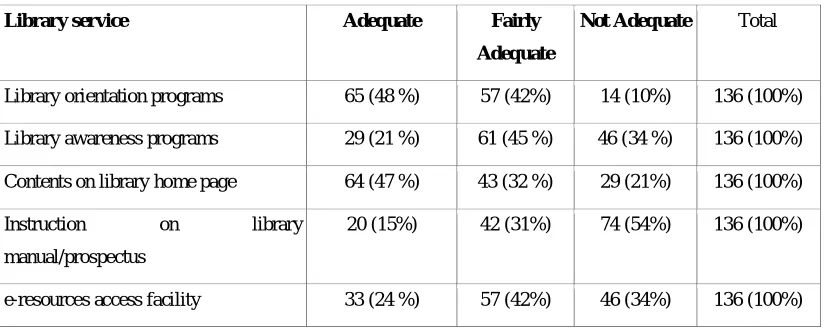
Adequacy of library services
The library services provided to the students must be useful and the size of content to be presented before them also should be adequate. To examine the adequacy of library services and activities provided and presented before the students, a question was asked from the students that the services and programs are how much adequate for them. The responses received from participants
have been presented in Table 05 below.
Table 05. Frequency of adequacy of library service
Library service Adequate Fairly
Adequate
Not Adequate Total
Library orientation programs 65 (48 %) 57 (42%) 14 (10%) 136 (100%)
Library awareness programs 29 (21 %) 61 (45 %) 46 (34 %) 136 (100%)
Contents on library home page 64 (47 %) 43 (32 %) 29 (21%) 136 (100%)
Instruction on library
manual/prospectus
20 (15%) 42 (31%) 74 (54%) 136 (100%)
IJSRR, 7(2) April – June, 2018 Page 721 Library orientation programmes and Contents on library home page are more or less getting good response but not enough. It needs to make more user oriented. The response regarding Instruction on library manual and prospectus is very poor and needs immediate attention. The awareness programmes also getting bad response which Assam University Library should improve immediately.
Effectiveness of library services for users
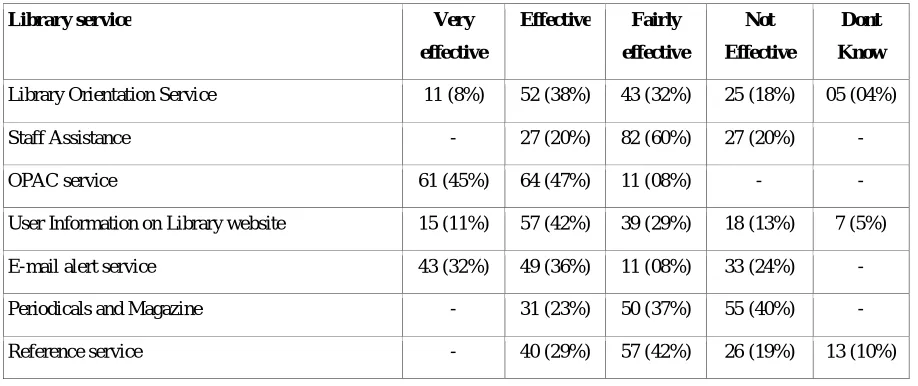
To understand the effectiveness of any library service it is important to get feedback from its target users. It helps to improve the quality of service. Hence participants in this survey were asked some feed backs regarding effectiveness of the services and their responses are presented in a table below (Table 06).
Table 06. Rating of library services
Library service Very
effective
Effective Fairly effective
Not Effective
Dont Know
Library Orientation Service 11 (8%) 52 (38%) 43 (32%) 25 (18%) 05 (04%)
Staff Assistance - 27 (20%) 82 (60%) 27 (20%) -
OPAC service 61 (45%) 64 (47%) 11 (08%) - -
User Information on Library website 15 (11%) 57 (42%) 39 (29%) 18 (13%) 7 (5%)
E-mail alert service 43 (32%) 49 (36%) 11 (08%) 33 (24%) -
Periodicals and Magazine - 31 (23%) 50 (37%) 55 (40%) -
Reference service - 40 (29%) 57 (42%) 26 (19%) 13 (10%)
Table 06 shows that most of the respondents found Library Orientation Service effective
where as some of the respondents (25%) say it is not effective. Similarly Staff assistance provided to the users are fairly effective for most of the respondents (82%) and equal number of respondents (27 %) reported as effective and also not effective. OPAC services in Assam University library is reported highly effective (45% very effective and 47 % effective) which is a good feedback for
library. Very few students (8 %) says it as fairly effective. User Information on library website gets mix response i.e. 11% very effective, 42% effective, 29% fairly effective, 13 % not effective where as 5% of the respondents are confused regarding it. E-mail alert also got good response. Maximum
IJSRR, 7(2) April – June, 2018 Page 722 has received very poor response which alarming situation for Assam University Library authority.
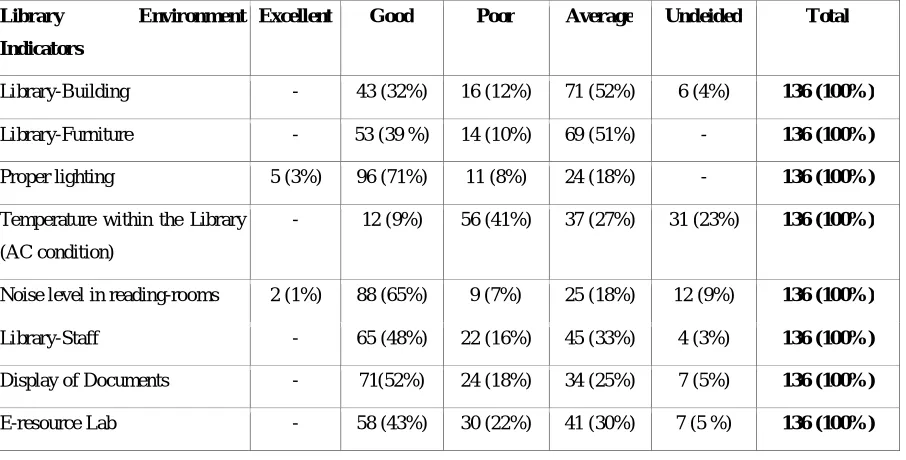
Library environment
Library environment plays a very important role for attracting users towards library. The students were asked to give their feedback on library environment on different indicators. The responses are presented in the table 07 below.
Table 07. Library environment indicators
Library Environment
Indicators
Excellent Good Poor Average Undeided Total
Library-Building - 43 (32%) 16 (12%) 71 (52%) 6 (4%) 136 (100%)
Library-Furniture - 53 (39 %) 14 (10%) 69 (51%) - 136 (100%)
Proper lighting 5 (3%) 96 (71%) 11 (8%) 24 (18%) - 136 (100%)
Temperature within the Library
(AC condition)
- 12 (9%) 56 (41%) 37 (27%) 31 (23%) 136 (100%)
Noise level in reading-rooms 2 (1%) 88 (65%) 9 (7%) 25 (18%) 12 (9%) 136 (100%)
Library-Staff - 65 (48%) 22 (16%) 45 (33%) 4 (3%) 136 (100%)
Display of Documents - 71(52%) 24 (18%) 34 (25%) 7 (5%) 136 (100%)
E-resource Lab - 58 (43%) 30 (22%) 41 (30%) 7 (5 %) 136 (100%)
Regarding library building more than 50% students reported it as average building. Same way regarding Library furniture in the reading room more than 50 % finds it as average type of furniture where as 39 % reported as good. Talking about lighting facility maximum respondents agreed it very
good and good (71%). The temperature within library is good as maximum users (41%) find it poor and 27% says average. Regarding Noise level inside reading-rooms good number of students (65%) agreed it as good. Staff attitude towards the library users is reported as 48 % good and 33 % average. Display of documents in the library which helps to locate and get access is also reported good by 52% of students’ and average by 25% of respondents. The opinion about E-resource lab is 43% good and 30% as average.
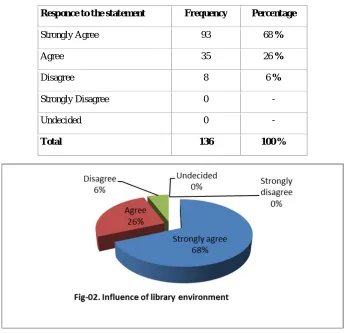
Influence of library environment
IJSRR, 7(2) April – June, 2018 Page 723 presented in the table 08 below.
Table 08. Influence of library-environment on library use
Responce to the statement Frequency Percentage
Strongly Agree 93 68 %
Agree 35 26 %
Disagree 8 6 %
Strongly Disagree 0 -
Undecided 0 -
Total 136 100 %
Regarding influence of library-environment on library use maximum respondents (68%) strongly agree followed by 26% agree that library-environment influences the library use. And only 6% are disagreeing that library-environment make any influence on library use.
FINDINGS AND SUGGESTIONS
From the above discussion it is analysed that Assam University students have very less
tendency of daily visit to the library but they mostly visit the library once in a week. This is also found that over all preferred place of study is residence but research scholars like central library
more convenient than their home or any other place. Regarding awareness of library activities among the users it is found that the students are well aware about most of the library activities like Orientation programmes, E-resource awareness programmes and OPAC service. But still there are some library activities like exhibition, extension activity and ask from reference librarian, which are
IJSRR, 7(2) April – June, 2018 Page 724 information on library web portal are more effective where as some of the services like Current
periodical service, Staff assistance and Reference service are less effective and needs more attention of library management to make it more effective for the users. Over all reading environment in Rabindra Library is average which requires a little effective initiative to be taken like air-conditioning of reading room and arrangement of comfortable furniture to make the reading environment more suitable for the users. Rabindra Library also needs to improve their services and library staffs should be easily approachable and more helpful to the students.
CONCLUSION
Libraries now a day are losing their credibility and trend of library use is decreasing day by day in India because of whatever the reason, librarians must understand the situation and work hard for retaining its importance in the present electronic age. Librarians have to be prepared for every expectation of users in this rapidly changing environment. The most important thing is to make the
library environment more comfortable in every aspect so that users will be attracted towards the library. Meyer13 has argued that libraries must broaden their understanding of what they should do and must align their personnel policy to take the technologically adapt. His vision is that librarians who were "once cataloguers, book buyers and reference searchers, will become network managers, database integrators, fuzzy logic applicators and artificial intelligence experts, and graphical interface designers". User-librarian collaboration can take place during the library instruction
sessions or when users seek information during the search process. Kulthau14 referred to this
process as “Information Mediation Process”, which is a process where a particular question
determines the establishment of dialogue between the user and the librarian.
Off course all these adaptation are not possible in a single day, but step by step initiative will be effective in long run.
REFERENCES
1. Amusa, O. I. & Iyoro, A. O. Influence of Library Environments, Instructional Programs, and
User-Librarian Collaborations on Library Use by Undergraduate Students in Nigeria. Chinese
Librarianship. 2013; 35: 72-86.
2. Briden, Burns, and Marshall. Knowing Our Students: Undergraduates in Context. ACRL
Thirteenth National Conference held during March 29–April 1, 2007, Baltimore, Maryland. 3. Lubans, J. “Educating the library user”. New York: R.R. Bowker, 1974;104-110.
IJSRR, 7(2) April – June, 2018 Page 725 edited by Lubans J. New York, R.R. Bowker, 1974;104 -110
5. Campbell and Shlecter (1979). THE JAY REPORT. Journal of the Institute of Mental Subnormality (APEX), 7: 34-35.
6. Leighton and Weber (1999). Planning Academic and Research Library Buildings. 3rd ed. Chicago: American Library Association, 1999: 928p.
7. Lombardo, S. V. and Condic, K. S. “Convenience or content: a study of undergraduate periodical use” [online]. 2001 [cited 2018 March 15]. Reference Services Review. Vol. 29
Issue: 4, pp.327-338. Available from https://doi.org/10.1108/EUM0000000006494.
8. Lushington, N. Libraries designed for users: a 21st century guide. New York: Neal-Schuman Publishers, 2002.
9. Jiao, Q. G. and Onwuegbuzie, A. Factors Associated with Library Anxiety. 1997. Paper
presented at the Annual American Educational Research Association Conference. Chicago, IL, March 24-28, 1997.
10.Toner, L. Non-use of library services by students in a UK academic library. Evidence Based Library and Information Practice, 2008: 3(2), pp.18-31.
11.Vondracek, R. Comfort and Convenience? Why Students Choose Alternatives to the Library. portal: Libraries and the Academy. 7:3. 2018.
12.Marshall, A; Burns, V. and Briden, J. Know Your Students: Rochester's Two-Year Ethnographic Study Reveals What Students Do on Campus and How the Library Fits In.
Library Journal, v. 132 no. 18, 2007: p26-29.
13.Meyer (1997) "Surviving the Change: The Economic Paradigm of Higher Education in
Transformation." Journal of Academic Librarianship 1997, 23 (4): 291-301.
14.Kuhlthau, C. C. A principle of uncertainty for information seeking. Journal of
Documentation 1993, 49 (4), 339-355.
15.Skiadas, C. H. "The role of libraries in a changing academic environment." [online]. 1999.
[cited 2018 Jan 28]. Available from Proceedings of the IATUL Conferences.
http://docs.lib.purdue.edu/iatul/1999/papers/32.
16. Chen, Y.-H., & Chengalur-Smith, I. (2015). Factors influencing students’ use of a library Web portal: Applying course-integrated information literacy instruction as an intervention.
The Internet and Higher Education, 26, 42–55.
IJSRR, 7(2) April – June, 2018 Page 726 17. Debroy, T. C. Development and use of library services in Assam University since 1994: a
Case Study. [online]. Silcahr: Assam University, 2013. Available from
http://shodhganga.inflibnet.ac.in/handle/10603/93359.
18. Gyanchandani, C, Nandini, B. & Uraon, A. Use and awareness of E-resources among the
users of IPS Academy Libraries: A study. Proceedings of the Bilingual International Conference on Information Technology: Yesterday, Today, and Tomorrow. Defence Scientific Information & Documentation Centre, Defence Research and Development Organization, New Delhi, Feb 19-21, 2015.(p178-185).
19.Mwatela, W. M. Factors influencing utilization of library services and Resources: the case of
university of Nairobi Mombasa campus library [Research Project]. Mombasa: University of
Nairobi, 2013.
20. Uraon, A. & Gyanchandani, C. Mobile technology and library services: application and
awareness among the readers of National Library of India, Kolkata. Proceedings of the 6th National Conference ECO-CGL 2016 on Emerging Challenges and Opportunities of Central
Government Libraries in Digital Era organised by Central Government Library
Association.(p. 93-100).
21. About Central Library, Assam University, Silchar [online]. 2018 [cited 2018 Feb 07]