E-Learning Analysis And Design Based On
Technology Acceptance Model
Hilmi Aulawi, Abdusy Syakur Amin
Abstract: E-Learning is one of the information systems technology that should be owned by educational institutions in Industrial era 4.0 or the era of Internet of Things. Aim of this study is to analyze and design e-Learning completely and systematically based on Technology Acceptance Model (TAM). In this case, TAM is associated with software reuse approach begin from adapting the existing e-Learning models and being given different touches as needed on the new system. We used Unified Modeling Language (UML) as software analysis and design model. The experiment of this study was conducted in Sekolah Tinggi Teknologi Garut. The results show that TAM can accelerate and simplify e-Learning analysis and designs processes, as all the needs are adapted from existing systems and improvised according to the needs of new e-Learning systems.
Index Terms: E-Learning, Software Engineering, Software Reuse, Technology Acceptance Model, Unified Modeling Language
——————————
——————————
1 I
NTRODUCTIONIN the “Internet of Things” era, almost all of human activity
utilize internet technology, including in education. The role of
e-Learning is very important to help all teaching and learning
activities more efficient [1]–[4] Technological devices are
designed to enhance a quality of human’s life [5], one of those
which is enable efficiency and effectiveness in business
process is information systems. Information systems (IS) is a
combination of information technology utilizations and
human activity upon a set of agreed procedure [6], generally is
used to support management and operation [7]. IS is an
organized data process [8], IS has a high level of flexibilities to
develop and scalable [9]. Refers to several research, an
information system has a high capability in decision making,
the system has an accurate data accessibility and efficient
run-time [10], high accuracy [11], and to support a proper decision
[12], low cost [13], extended accessibility [14], intensify user
knowledge [15], increase productivity [16], provide a better
data and information [17],and in the certain cases are
potentially used as data storage [18].
Analysis and design activities for e-Learning as IS take
more time to produce quality e-Learning. All of stakeholder
needs and system requirements must be met, so that
e-Learning works according to the business process of teaching
and learning activities. In the study of software engineering,
there is reuse approach where system is developed by
composing existing system, either the whole of existing system
is reused (without changing), component reuse, or object and
function reuse [19], [20]. Other sources group software reuse
in two categories, among others higher level abstraction reuse
and implementation level reuse [21]. With software reuse we
can decrease the development time significantly, decrease the
time required to identify infeasible tasks, and improve sense
and ability of developer to manage the risk tasks [22].
In the software reuse process (describe in Figure 1), there
are “adapt existing system” process. In this study we propose
TAM to adapt the existing Learning to develop new
e-Learning. We used TAM because it had been proven capable
and highly cited model to create new technology efficiently
and effectively based on existing technology [23], [24]. TAM
model continues to evolve with the development of
technology and case study that implements it such as
information technology. In TAM, it is important to consider
what should be maintained, what to dispose of, and what
needs to be added as needed by the beneficiaries of the
technology [25]. Basically the usefulness of technology, in this
case e-Learning or whatever the technology, relates and
depends on the needs of its users [26], [27].
Therefore, the aim of this study is to combine TAM and
software reuse approach to analyze and design e-Learning. To
develop new e-Learning based on TAM, we need to adapt the
widely used and well-used e-Learning models today, such as
Google Classroom, Moodle, and some college e-Learning. We
used UML for modelling the result of e-Learning analysis and
design process. In this case, we do not adapt the whole of the
existing e-Learning into new e-Learning. We adapt the higher
level abstraction of existing e-Learning and still based on user
requirements.
2
R
ESEARCHM
ETHODThe concept of TAM has system feature and capabilities as
stimulus, user’s motivation to use system as organism, and
actual system use as response (described in Figure 2) [24], [28].
Whereas, software reuse approach process, among others elicit
stakeholder requirements, choose closest-fit system instance
that can renegotiate or adapt, and deliver new system instance
(described in Figure 1) [20]. Actually, TAM and software reuse
approach have a similarity, that is both adapting existing
technology to produce new technology. So, in this study, TAM
and software reuse are combined as research methodology.
Fig. 1. Conceptual model for technology acceptance [24], [28]
————————————————
Hilmi Aulawi is lecturer in Department of Industrial Engineering, Sekolah Tinggi Teknologi Garut, Indonesia. E-mail: [email protected] Abdusy Syakur Amin is lecturer in Department of Industrial Engineering,
127
Fig. 2. Process of software reuse approach [20]
Fig. 3. Combination of TAM and software reuse approach
Figure 3 describes the combination between TAM and
software reuse approach for this study. e-Learning in this
study is developed based on research methodology in Figure
3. Starting from elicit stakeholder requirements where
requirement elicitation should be as complete as possible to
reduce the risk of the system does not run as expected [29].
Then, after collecting all of stakeholder requirements, we do
requirement analysis and choose which requirements are
important and in accordance with the system. In software
engineering development it is possible to change the
requirement, the change can be influenced by many factors,
whether it is a direct request from stakeholders, changing
business processes, and rules and laws that directly affect the
changing requirements. Because of that, renegotiate process of
requirement could be happen. If renegotiation of the
requirement is agreed, then the next process is to adapt the
existing system, but if there is no renegotiation then the
adaptation process to existing system can be done directly.
However, after renegotiation process, it is also possible to
develop new system without adapt existing system. The main
point of TAM is in adapt existing system. As explain before,
this study uses higher level abstraction of software reuse, so
that in adapt existing system process, we analyze an
architecture of existing system, analyze all of system features,
and analyze functionalities or capabilities of existing system.
The adaptation of existing system do not until implementation
level, such as component, class, object, or function (method)
reuse. The difference between basic software reuse with
combination of software reuse and TAM is user’s motivation
to use system evaluation process. So, we re-analyze all of
software features and capabilities based on user’s motivation.
And the last, conducting the actual system use process until
deliver new system.
3 R
ESULT ANDD
ISCUSSIONBased on proposed research methodology of combine TAM
and software reuse approach that explained in section 2 above,
this study grouping the process of analysis and design of
Learning into 3 parts, among others: pradapt existing
Learning, adapt existing Learning, and post-adapt
e-Learning. In pre-adapt existing e-Learning, there are
conducted elicit the stakeholder requirement process, choose
closest-fit system instance process, and renegotiate
requirements process. In adapt existing e-Learning, all of TAM
process is conducted. Then, in post-adapt e-Learning produce
deliverable of analysis and design process of new e-Learning
that are modelled using UML. This study uses Google
Classroom, Moodle, and several college e-Learning as existing
system and e-Learning of Sekolah Tinggi Teknologi Garut as
new system.
3.1 Pre-adapt Existing e-Learning
Requirement elicitation process is conducted with several
stakeholders of e-Learning such as lecturers, students, and
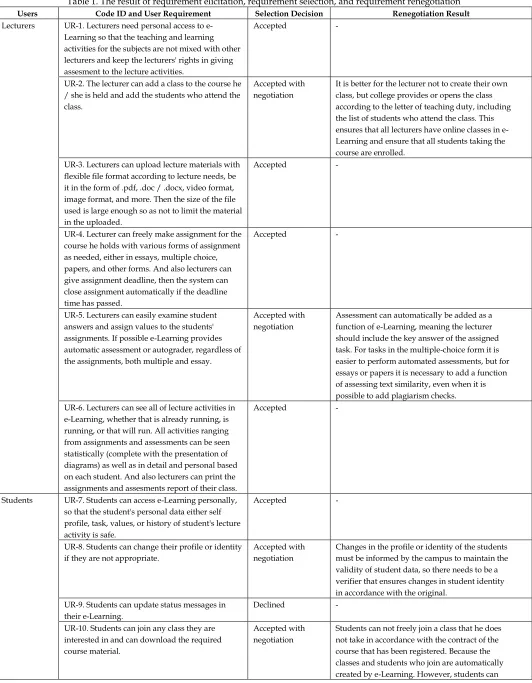
administrative staff. The result of requirement elicitation is
explain in Table 1 that is grouped based on stakeholders or
users requirements. In Table 1 also describes about which one
the requirement is choosen and which requirement is
eliminated because not in accordance with the requirement of
the system. Because not all of user requirements is choosen as
system or software requirements [19], [20], [29], [30].
Renegotiation process is conducted based on user
requirement, if user requirement is beyond system boundary
or not accordance with system requirement then it possible to
renegotiate for the best decision.
Table 1. The result of requirement elicitation, requirement selection, and requirement renegotiation
Users Code ID and User Requirement Selection Decision Renegotiation Result Lecturers UR-1. Lecturers need personal access to
e-Learning so that the teaching and learning activities for the subjects are not mixed with other lecturers and keep the lecturers' rights in giving assesment to the lecture activities.
Accepted
-UR-2. The lecturer can add a class to the course he / she is held and add the students who attend the class.
Accepted with negotiation
It is better for the lecturer not to create their own class, but college provides or opens the class according to the letter of teaching duty, including the list of students who attend the class. This ensures that all lecturers have online classes in e-Learning and ensure that all students taking the course are enrolled.
UR-3. Lecturers can upload lecture materials with flexible file format according to lecture needs, be it in the form of .pdf, .doc / .docx, video format, image format, and more. Then the size of the file used is large enough so as not to limit the material in the uploaded.
Accepted
-UR-4. Lecturer can freely make assignment for the course he holds with various forms of assignment as needed, either in essays, multiple choice, papers, and other forms. And also lecturers can give assignment deadline, then the system can close assignment automatically if the deadline time has passed.
Accepted
-UR-5. Lecturers can easily examine student answers and assign values to the students' assignments. If possible e-Learning provides automatic assessment or autograder, regardless of the assignments, both multiple and essay.
Accepted with negotiation
Assessment can automatically be added as a function of e-Learning, meaning the lecturer should include the key answer of the assigned task. For tasks in the multiple-choice form it is easier to perform automated assessments, but for essays or papers it is necessary to add a function of assessing text similarity, even when it is possible to add plagiarism checks. UR-6. Lecturers can see all of lecture activities in
e-Learning, whether that is already running, is running, or that will run. All activities ranging from assignments and assessments can be seen statistically (complete with the presentation of diagrams) as well as in detail and personal based on each student. And also lecturers can print the assignments and assesments report of their class.
Accepted
-Students UR-7. Students can access e-Learning personally, so that the student's personal data either self profile, task, values, or history of student's lecture activity is safe.
Accepted
-UR-8. Students can change their profile or identity if they are not appropriate.
Accepted with negotiation
Changes in the profile or identity of the students must be informed by the campus to maintain the validity of student data, so there needs to be a verifier that ensures changes in student identity in accordance with the original.
UR-9. Students can update status messages in their e-Learning.
Declined
-UR-10. Students can join any class they are interested in and can download the required course material.
Accepted with negotiation
129
Users Code ID and User Requirement Selection Decision Renegotiation Result
freely access material from any course according to students’ interests and needs.
UR-11. Students need open communication facilities both between students and lecturers as well as between students and students, so there needs to be discussion media. In addition, students also need personal communication media with lecturers.
Accepted with negotiation
Discussion forums are provided open on each course, so the discussion is focused on for each course. If there is a distorted discussion, the lecturer or the campus can throw it away. This is to maintain the quality of the discussion in accordance with the activities of the lecture. UR-12. Students can see the assigment given by
the lecturer. It is better if e-Learning gives notification of a assignments and gives a warning if the deadline of collecting assigments will be end. Students can also do their tasks on e-Learning directly in accordance with the type of assignment.
Accepted
-UR-13. Students can see the value of the assignments that he did, either directly after the assignment done or the history of assigments that have been done. And the report of assesment ban be printed.
Accepted
-Admnistrative Staff
UR-14. Administrative staff can control the authentification of lectures and students.
Accepted
-UR-15. Administrative staff can see the logbook or e-Learning activity history, and also they can print report of assignments and assesments without changing anything.
Accepted
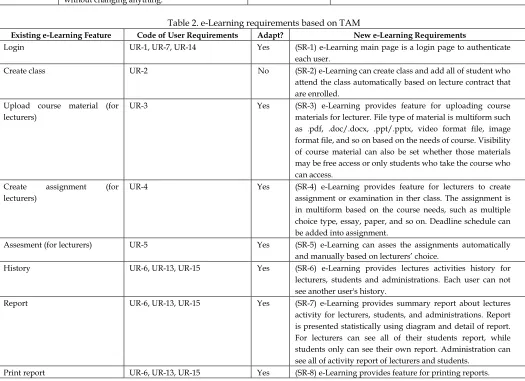
-Table 2. e-Learning requirements based on TAM
Existing e-Learning Feature Code of User Requirements Adapt? New e-Learning Requirements
Login UR-1, UR-7, UR-14 Yes (SR-1) e-Learning main page is a login page to authenticate each user.
Create class UR-2 No (SR-2) e-Learning can create class and add all of student who attend the class automatically based on lecture contract that are enrolled.
Upload course material (for lecturers)
UR-3 Yes (SR-3) e-Learning provides feature for uploading course materials for lecturer. File type of material is multiform such as .pdf, .doc/.docx, .ppt/.pptx, video format file, image format file, and so on based on the needs of course. Visibility of course material can also be set whether those materials may be free access or only students who take the course who can access.
Create assignment (for lecturers)
UR-4 Yes (SR-4) e-Learning provides feature for lecturers to create assignment or examination in ther class. The assignment is in multiform based on the course needs, such as multiple choice type, essay, paper, and so on. Deadline schedule can be added into assignment.
Assesment (for lecturers) UR-5 Yes (SR-5) e-Learning can asses the assignments automatically and manually based on lecturers’ choice.
History UR-6, UR-13, UR-15 Yes (SR-6) e-Learning provides lectures activities history for lecturers, students and administrations. Each user can not see another user's history.
Report UR-6, UR-13, UR-15 Yes (SR-7) e-Learning provides summary report about lectures activity for lecturers, students, and administrations. Report is presented statistically using diagram and detail of report. For lecturers can see all of their students report, while students only can see their own report. Administration can see all of activity report of lecturers and students.
Existing e-Learning Feature Code of User Requirements Adapt? New e-Learning Requirements
Update profile (for student) UR-8 Yes (SR-9) e-Learning can be update students’ profil if administration or campus has been verified new profile that submitted by students.
Update status (for students) UR-9 No
-Join class (for student) UR-10 No Same as SR-2
Discussion UR-11 Yes (SR-10) e-Learning provides group discussion media that categorized based on the course. This group is open for lecturers and students.
Personal Message UR-11 Yes (SR-11) e-Learning provides personal message feature that make communication between lecturers, students, and administration easy.
Notification and alert (for students)
UR-12 Yes (SR-12) e-Learning can give assignment notification for students and give an alert if the deadline of collecting assigments will be end.
131
3.2. Adapt Existing e-Learning
The result of user requirements elicitation process, choosing
closest-fit system instance, and renegotiate process, in adapt
existing e-Learning, all of features of existing e-Learning will
be analyzed and adapted to the user's motivations and needs.
Next, it will be generated system or software requirements
adaptation from the existing system. Table 2 explains about
features of existing e-Learning (based on Google Classroom,
Moodle, and several collage e-Learning) and what the relation
of these features to the motivation or user requirements that
have been presented in Table 1. The existing e-Learning
features are adapted if in accordance with the results of user
requirements in Table 1, then changed it into software
requirements. Software requirement of e-Learning is actual
system used and result of TAM process that adapt higher level
abstraction of existing e-Learning.
3.3. Post-adapt Existing e-Learning
Post-adapt existing e-Learning is the last stage that produce
new e-Learning. The deliverable of new e-Learning using
combination of TAM and software reuse approach is analysis
and design model with UML. UML is used because until now
object-oriented programming is still a tren [39], so the model
of analysis and design of e-Learning in this study can be
implemented easily. In addition, object-oriented analysis and
design with UML is modular so it can be easily maintained
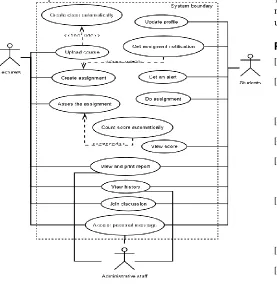
[40]–[43]. The analysis and design of e-Learning is modelled
using Use Case Diagram in Figure 4 and Class Diagram in
Figure 5 (Class Diagram is still abstraction/prototype, it has
not been implemented yet). Those model is created based on
software requirements.
Fig. 4. Use Case Diagram of e-Learning based on TAM
Fig. 5. Class Diagram of e-Learning based on TAM
4
C
ONCLUSIONTAM is an approach to adapt existing technology efficiently
and easily to create new technology. And also with software
reuse approach that reuse and adapt existing software to
develop new software. This study combines TAM and
software reuse approach to build e-Learning. Adaptation is
done at higher level abstraction reuse. The realization of TAM
and reuse approach software was successfully done by
dividing the process into pre-adapt, adapt, and post adapt of
existing e-Learning. Based on Focus Group Discussion with
some experts in Sekolah Tinggi Teknologi Garut where
e-Learning is built, TAM method combined with software reuse
approach is quite easy to understand and applied. With the
TAM, ensuring all the user's motivation as stated in user
requirements can be fulfilled as needed. So with TAM can
reduce the possibility of changes both in software
requirements and on e-Learning as a whole. For future
research can be done quality measurement to combination of
TAM and software reuse approach. Similarly, quality
measurements of the new e-Learning analysis and design
using TAM can be measured.
R
EFERENCES[1] Epignosis LLC, “e-learning Concepts, Trends, Applications,”
Book, 2014.
[2] M. Sofyan, “Pengembangan Koreksi Esai Otomatis Pada E-Learning Di SMK PLUS AN-NABA SUKABUMI Dengan Menggunakan Metode Latent Semantic Analysis ( LSA ),” pp. 45–52, 2015.
[3] M. Aparicio, F. Bacao, and T. Oliveira, “An e-learning theoretical framework,” Educ. Technol. Soc., 2016.
[4] M. S. Mazaya, “Logical framework for smart discussion in learning process,” J. Phys. Conf. Ser., vol. 1157, p. 42002, Feb. 2019. [5] M. A. Ramdhani, H. Aulawi, A. Ikhwana, and Y. Mauluddin, “Model of green technology adaptation in small and medium-sized tannery industry,” J. Eng. Appl. Sci., vol. 12, no. 4, pp. 954– 962, 2017.
[6] A. Pamoragung, K. Suryadi, and M. A. Ramdhani, “Enhancing the implementation of e-Government in indonesia through the high-quality of virtual community and knowledge portal,” in
Proceedings of the European Conference on e-Government, ECEG, 2006, pp. 341–348.
[7] M. A. Ramdhani, Metodologi Penelitian untuk Riset Teknologi Informasi. Bandung: UIN Sunan Gunung Djati Bandung, 2013. [8] D. S. Maylawati, W. Darmalaksana, and M. A. Ramdhani,
“Systematic Design of Expert System Using Unified Modelling Language,” IOP Conf. Ser. Mater. Sci. Eng., vol. 288, no. 1, p. 012047, 2018.
Design in Higher Education Institution,” Int. Soft Comput., vol. 12, no. 2, pp. 132–141, 2017.
[10] C. Slamet, A. Rahman, A. Sutedi, W. Darmalaksana, M. A. Ramdhani, and D. S. Maylawati, “Social Media-Based Identifier for Natural Disaster,” IOP Conf. Ser. Mater. Sci. Eng., vol. 288, no. 1, p. 012039, 2018.
[11] C. Slamet, R. Andrian, D. S. Maylawati, W. Darmalaksana, and M. A. Ramdhani, “Web Scraping and Naïve Bayes Classification for Job Search Engine,” IOP Conf. Ser. Mater. Sci. Eng., vol. 288, no. 1, p. 012038, 2018.
[12] Y. A. Gerhana, W. B. Zulfikar, A. H. Ramdani, and M. A. Ramdhani, “Implementation of Nearest Neighbor using HSV to Identify Skin Disease,” in IOP Conference Series: Materials Science and Engineering, 2018, vol. 288, no. 1, p. 012153.
[13] A. Rahman, C. Slamet, W. Darmalaksana, Y. A. Gerhana, and M. A. Ramdhani, “Expert System for Deciding a Solution of Mechanical Failure in a Car using Case-based Reasoning,” IOP Conf. Ser. Mater. Sci. Eng., vol. 288, no. 1, p. 012011, 2018. [14] C. Slamet, A. Rahman, M. A. Ramdhani, and W. Darmalaksana,
“Clustering the Verses of the Holy Qur’an Using K-Means Algorithm,” Asian J. Inf. Technol., vol. 15, no. 24, pp. 5159–5162, 2016.
[15] D. S. Maylawati, M. A. Ramdhani, W. B. Zulfikar, I. Taufik, and W. Darmalaksana, “Expert system for predicting the early pregnancy with disorders using artificial neural network,” 2017 5th Int. Conf. Cyber IT Serv. Manag. CITSM 2017, 2017.
[16] W. B. Zulfikar, Jumadi, P. K. Prasetyo, and M. A. Ramdhani, “Implementation of Mamdani Fuzzy Method in Employee Promotion System,” IOP Conf. Ser. Mater. Sci. Eng., vol. 288, no. 1, p. 012147, 2018.
[17] D. S. Maylawati, M. A. Ramdhani, A. Rahman, and W. Darmalaksana, “Incremental technique with set of frequent word item sets for mining large Indonesian text data,” in 5th International Conference on Cyber and IT Service Management, CITSM 2017, 2017, pp. 1–6.
[18] A. Taofik, N. Ismail, Y. A. Gerhana, K. Komarujaman, and M. A. Ramdhani, “Design of Smart System to Detect Ripeness of Tomato and Chili with New Approach in Data Acquisition,” in
IOP Conference Series: Materials Science and Engineering, 2018, vol. 288, no. 1, p. 012018.
[19] R. S. Pressman, Software Engineering: A Practitioner’s Approach, 7th ed. New York: McGraw-Hill, 2011.
[20] I. Sommerville, Software Engineering. 2010.
[21] C. W. Krueger, “Software reuse,” ACM Comput. Surv., 1992. [22] R. Holmes and R. J. Walker, “Systematizing pragmatic software
reuse,” ACM Trans. Softw. Eng. Methodol., 2012.
[23] P. Surendran, “Technology Acceptance Model : A Survey of Literature,” Int. J. Bus. Soc. Res., 2012.
[24] M. Chuttur, “Overview of the Technology Acceptance Model: Origins , Developments and Future Directions,” Sprouts Work. Pap. Inf. Syst., 2009.
[25] F. D. Davis, “User acceptance of information technology: system characteristics, user perceptions and behavioral impacts,” Int. J. Man. Mach. Stud., 1993.
[26] V. Venkatesh and H. Bala, “Technology acceptance model 3 and a research agenda on interventions,” Decis. Sci., 2008.
[27] V. Venkatesh, J. Thong, and X. Xu, “Consumer acceptance and user of information technology: Extending the unified theory of acceptance and use of technology,” MIS Q., 2012.
[28] F. D. Davis, “Perceived Usefulness, Perceived Ease of Use, and User Acceptance of Information Technology,” MIS Q., 1989. [29] M. A. Ramdhani, D. S. Maylawati, A. S. Amin, and H. Aulawi,
“Requirements Elicitation in Software Engineering,” Int. J. Eng. Technol., vol. 7, no. 2.29, pp. 772–775, 2018.
[30] M. S. Mazaya, “Effective practical learning model for the subject of basic information technology,” J. Phys. Conf. Ser., vol. 1157, p. 42003, Feb. 2019.
[31] S. Sari, D. M. Aryana, C. Z. Subarkah, and M. A. Ramdhani, “Multimedia Based on Scientific Approach for Periodic System of Element,” IOP Conf. Ser. Mater. Sci. Eng., vol. 288, no. 1, p. 012137,
2018.
[32] I. Farida, I. Helsy, I. Fitriani, and M. A. Ramdhani, “Learning Material of Chemistry in High School Using Multiple Representations,” IOP Conf. Ser. Mater. Sci. Eng., vol. 288, no. 1, p. 012078, 2018.
[33] R. Aisyah, I. A. Zakiyah, I. Farida, and M. A. Ramdhani, “Learning Crude Oil by Using Scientific Literacy Comics,” J. Phys. Conf. Ser., vol. 895, no. 1, p. 012011, 2017.
[34] Sari, F. S. Irwansyah, I. Farida, and M. A. Ramdhani, “Using Android-Based Educational Game for Learning Colloid Material Using Android-Based Educational Game for Learning Colloid Material,” J. Phys. Conf. Ser., vol. 895, no. 1, p. 012012, 2017. [35] F. S. Irwansyah, Y. M. Yusuf, I. Farida, and M. A. Ramdhani,
“Augmented Reality (AR) Technology on the Android Operating System in Chemistry Learning,” IOP Conf. Ser. Mater. Sci. Eng., vol. 288, no. 1, p. 012068, 2018.
[36] I. Helsy, Maryamah, I. Farida, and M. A. Ramdhani, “Volta-Based Cells Materials Chemical Multiple Representation to Improve Ability of Student Representation,” J. Phys. Conf. Ser., vol. 895, no. 1, 2017.
[37] M. A. Ramdhani and E. R. Wulan, “The Analysis of Determinant Factors in Software Design for Computer Assisted Instruction,”
Int. J. Sci. Technol. Res., vol. 1, no. 8, pp. 69–73, 2012.
[38] F. S. Irwansyah, I. Lubab, I. Farida, and M. A. Ramdhani, “Designing Interactive Electronic Module in Chemistry Lessons,”
J. Phys. Conf. Ser., vol. 895, no. 1, p. 012009, Sep. 2017.
[39] D. S. Maylawati, M. A. Ramdhani, and A. S. Amin, “Tracing the Linkage of Several Unified Modelling Language Diagrams in Software Modelling Based on Best Practices,” Int. J. Eng. Technol., vol. 7, no. 2.29, pp. 776–780, 2018.
[40] G. Booch, Object-Oriented Analysis and Design, 2nd ed. Santa Clara, California: Addison-Wesley, 1998.
[41] G. Booch, “Object-Oriented Development,” IEEE Trans. Softw. Eng., vol. SE-12, no. 2, pp. 211–221, 1986.
[42] P. Coad and E. Yourdon, “Object Oriented Analysis,” Comput. Aided Archit. Des., 1991.
![Fig. 1. Conceptual model for technology acceptance [24], [28]](https://thumb-us.123doks.com/thumbv2/123dok_us/8632269.1421977/1.612.313.572.682.720/fig-conceptual-model-for-technology-acceptance.webp)
![Fig. 2. Process of software reuse approach [20]](https://thumb-us.123doks.com/thumbv2/123dok_us/8632269.1421977/2.612.37.297.58.254/fig-process-software-reuse-approach.webp)