Summary In the sub-tropical grain region of Aus-tralia, cotton and grains systems are now dominated by flaxleaf fleabane (Conyza bonariensis (L.) Cron-quist), feathertop Rhodes grass (Chloris virgata Sw.) and awnless barnyard grass (Echinochloa colona (L.) Link). While control of these weed species is best achieved when they are young, previous studies have shown a potential for reducing seed viability and minimising seed bank replenishment by applying herbicides when plants are reproductive.
Pot trials were established over two growing sea-sons to examine the effects of 2,4-D, 2,4-D + picloram, glyphosate and glufosinate which had been successful on other species, along with paraquat and haloxyfop (grasses only). Herbicides were applied at ¾ field rates in an attempt not to kill the plants. Flaxleaf fleabane plants were sprayed at two growth stages (budding and flowering) and the grasses were sprayed at two stages (late tillering/booting and flowering).
Spraying flaxleaf fleabane at flowering reduced seed viability to 0% (of untreated) in all treatments except glyphosate (51%) and 2,4-D + picloram (8%). Seed viability was not reduced with the first and sec-ond regrowths with the exception of 2,4-D + picloram where viability was reduced to 20%. When sprayed at budding only 2,4-D + picloram reduced seed viability in both trials.
Spraying the grasses at late tillering/booting did not reduce viability except for glufosinate on awnless barnyard grass (50%). Applying herbicides at flower-ing resulted in 0% seed viability in awnless barnyard grass from glufosinate, paraquat and glyphosate and 0% viability in feathertop Rhodes grass for glufosinate. These herbicides were less effective on heads that emerged and flowered after spraying, only slightly reducing seed viability.
These trials have shown that attempts to reduce seed viability have potential, however flaxleaf fleabane and feathertop Rhodes grass are able to regrow and will need on-going monitoring and control measures.
Keywords Seed viability, feathertop Rhodes grass, awnless barnyard grass, flaxleaf fleabane, herbicides.
Reducing seed viability of flaxleaf fleabane, feathertop Rhodes grass and
awnless barnyard grass
Michelle D. Keenan1, Jeff Werth1, David Thornby2 and Steve Walker1
1 Department of Agriculture, Fisheries and Forestry, Leslie Research Facility, PO Box 2282, Toowoomba, Qld 4350, Australia
2 Innokas Intellectual Services, 7 Purlingbrook Street, Upper Coomera, Qld 4209, Australia ([email protected])
INTRODUCTION
Flaxleaf fleabane, feathertop Rhodes grass and awnless barnyard grass now dominate cotton and grains systems in the sub-tropical grain region of Australia (Werth et al. 2013). While their control is best achieved when they are young, it is common for growers to be unable to spray them at this stage.
Previous studies have shown that seed viability and seed bank replenishment can be reduced by ap-plying herbicides when plants are reproductive. In the case of the first generation of glyphosate-resistant cotton, applications of glyphosate after the fourth node growth stage resulted in the deformation of pollen and flowers (Pline et al. 2003). Gauvrit and Chauvel (2010) found that glyphosate and glufosinate affected pollen and seed production in common ragweed (Am-brosia artemisiifolia L.). It is also known that auxinic herbicides applied late in the growing season, while cereals are undergoing reproductive development, can dramatically reduce yield in cereals. Rinella et al. (2010) explored this effect to investigate if auxinic herbicides could be applied to reduce seed production in weeds. They subsequently showed that picloram reduced Japanese brome (Bromus japonicus Thunb.) seed production by almost 100% when applied at internode elongation, booting or heading.
The objective of this study was to examine if seed viability of flaxleaf fleabane, awnless barnyard grass and feathertop Rhodes grass could be reduced by applying commonly used herbicides 2,4-D, 2,4-D + picloram, glyphosate, glufosinate, paraquat and haloxyfop.
MATERIALS AND METHODS
Two pot trials were established for each of the three species during the 2012/2013 and 2013/2014 growing seasons at the Leslie Research Facility in Toowoomba, Queensland.
Seeds of each species were surface sown into individual 14 cm pots filled with potting mix topped with approximately 2 cm of seed raising mix. The experiment was a randomised complete block design with five replicates. After emergence plants were thinned to one plant per pot. Plants were allocated to replicates prior to spraying based on plant size, rang-ing from smaller plants (replicate one) to larger plants (replicate five).
Flaxleaf fleabane plants were sprayed at two growth stages (budding and flowering) and the grasses were sprayed at two stages (late tillering/booting and flowering). As the plants had been grown in optimum conditions the herbicides were applied at ¾ field rates in an attempt not to kill them. Glufosinate, 2,4-D, 2,4-D + picloram, glyphosate, paraquat and haloxyfop were applied to the plants at their respective growth stages in a spray cabinet using a DG95015EVS even flat fan nozzle at 2 bar delivering 147 L ha−1.
Plants from each species had distinct regrowth phases after herbicide application. For flaxleaf flea-bane, the phases were referred to as existing heads, regrowth one (R1) (inflorescences produced on lateral branches off the main stem) and regrowth two (R2) (inflorescences produced on secondary lateral stems branching off R1). In the grasses the growth phases were referred to as existing heads and new heads. Up to five heads were collected from each growth phase per plant for each of the treatments. Heads from the differ-ent phases were not combined but collected separately. Seed production was calculated for each growth phase for the three species (data not presented). For flaxleaf fleabane, the seeds from one replicate of each growth phase were counted and 100 of the seeds were weighed. The remaining seed collections were weighed and the number of seeds calculated by multiplying the total weight by the weight of the 100 seeds for the relevant treatment. Seed production was then estimated by multiplying the average of these values by the number of buds produced in each growth phase. For the grasses seed production was estimated by multiplying the average number of seeds (actual counts) by the total number of heads per plant.
Seed viability for each treatment was determined by conducting germination tests on seeds from each growth phase. Flaxleaf fleabane seeds do not possess innate dormancy (Wu et al. 2007) so were tested on completion of seed collection. As the seeds of awn-less barnyard grass (Holm et al. 1977) and feathertop Rhodes grass (Osten 2008) have short periods of dormancy following harvest, germination tests were not conducted until 12 months after seed collection.
Two replicates, each containing 100 seeds, were
and 30°C/20°C (grasses) on a 12 hour day/night cycle. Germinations were based on the emergence of coty-ledons and continued until no new emergences had occurred for 10 days.
Flaxleaf fleabane data for each growth stage was analysed separately using a two-way ANOVA for year and treatment, whereas the data for awnless barnyard grass and feathertop Rhodes grass is awaiting comple-tion of the second trial before full data analyses.
Any replicates that had died were not included in the analyses but all surviving plants were included regardless of whether they had produced heads from which seed could be collected.
RESULTS
Flaxleaf fleabane Two years of data from the flaxleaf fleabane trials are presented. When sprayed at flowering, there were no significant differences between years for R1 and R2, as a result the data was pooled for analysis (Figure 1). Data for the existing heads at the time of spraying could not be analysed due to a large number of zeroes, however is averaged for both years in Figure 1.
When sprayed at flowering, the viability of seed from existing heads was totally reduced in all treat-ments except glyphosate (51%) and 2,4-D + picloram (8%).
Seed viability was not reduced in regrowth 1 (R1) except for the 2,4-D (41%), glyphosate (13%) and 2,4-D + picloram (1%) treatments. In regrowth 2 (R2) only 2,4-D + picloram reduced viability (20%).
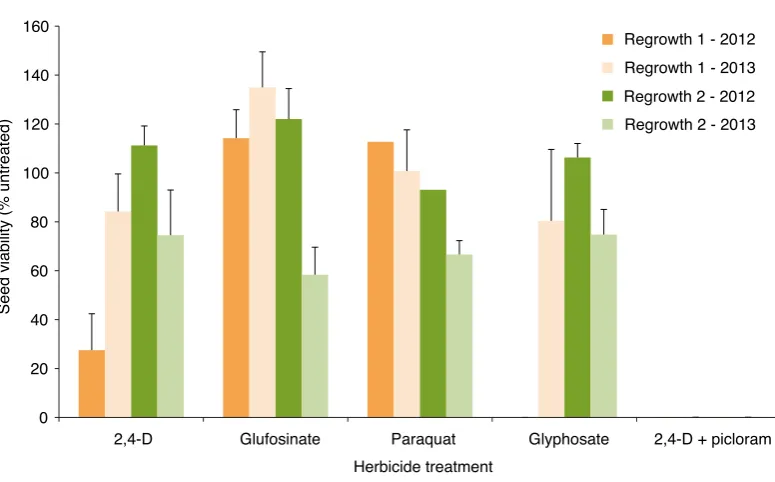
There were significant differences between seed viability and treatments when flaxleaf fleabane was sprayed at budding in years one and two. Therefore re-sults for each year are presented separately (Figure 2). In both trials only 2,4-D + picloram consistently reduced seed viability. While 2,4-D and glyphosate reduced viability in R1 in year one (28% and 0% respectively), this was not duplicated in year two with both treatments having seed viability above 80% (Figure 2).
Seed viability in R2 decreased in all treatments from year one (93% to 100%) to year two (58% to 75%) with the exception of 2,4-D + picloram. Feathertop Rhodes grass and awnless barnyard grass The results from the first trial are presented for the grasses in Figure 3 for feathertop Rhodes grass, and Figure 4 for awnless barnyard grass. Data for the existing heads on the feathertop Rhodes grass at the time of spraying could not be analysed due to a large number of zeroes, however is averaged in Figure 3.
Figure 1. Average viability of flaxleaf fleabane seeds (% untreated control) for each growth phase (existing, R1, R2) from plants sprayed at flowering (FL) in two trials (LSDs for the R1 and R2 are shown in the last two columns).
Figure 2. Average viability of flaxleaf fleabane seeds (% untreated control) from plants sprayed at budding. Data presented includes the viability of seed in two distinct regrowth phases.
0 20 40 60 80 100 120 140
2,4-D Glufosinate Paraquat Glyphosate 2,4-D
+ picloram LSD - R1 LSD - R2
Se
ed
v
ia
bi
lit
y (
%
un
tre
at
ed
)
Herbicide treatment
Existing heads (FL) Regrowth 1 (FL) Regrowth 2 (FL)
0 20 40 60 80 100 120 140 160
2,4-D Glufosinate Paraquat Glyphosate 2,4-D + picloram
Seed viability (% untreated)
Herbicide treatment
Figure 3. Average viability of feathertop Rhodes grass seeds (% untreated control) from plants sprayed at late tillering/booting (TB) and flowering (FL).
Figure 4. Average viability of awnless barnyard grass seeds (% untreated control) from plants sprayed at late tillering/booting (TB) and flowering (FL).
0 50 100 150 200 250 300
2,4-D Glufosinate Paraquat Glyphosate 2,4-D
+ picloram Haloxyfop
Seed viability (% untreated)
Herbicide treatment New heads (TB)
Existing heads (FL) New heads (FL)
0 10 20 30 40 50 60 70 80 90 100
2,4-D Glufosinate Paraquat Glyphosate 2,4-D
+ picloram Haloxyfop
Seed viability (% untreated)
Herbicide treatment New heads (TB)
71% in the paraquat and haloxyfop treatments. When sprayed at flowering, the seed viability of seed from existing heads was 0% for glufosinate increasing to 0.7% in the new heads. The viability of seed on existing heads also decreased for 2,4-D (16%) and paraquat (35%). Seed viability for the seed on new heads in these two treatments increased (72% and 93% respectively) compared to a decrease in viability for the remaining treatments (Figure 3).
Spraying at late tillering/booting did not reduce viability in awnless barnyard grass seeds to under 60% except for glufosinate (50%). When sprayed at flower-ing, the viability of seeds in existing heads was reduced to 0% for glufosinate, paraquat and glyphosate, and 0.8% for haloxyfop. For new heads that emerged after spraying seed viability ranged from 25% (glufosinate) to 85% (paraquat). With the exception of 2,4-D + piclo-ram the viability of seeds in the new heads increased compared to the viability of seeds in the old heads.
DISCUSSION
Spraying flaxleaf fleabane at flowering reduced seed viability in all treatments except glyphosate and 2,4-D + picloram. However, seed viability was not reduced with the first regrowth of flaxleaf fleabane except for 2,4-D + picloram, glyphosate and 2,4-D. Only 2,4-D + picloram reduced viability in the second regrowth.
Spraying the grasses at late tillering/booting did not reduce viability. Paraquat and haloxyfop provided the best results but seed viability was still in excess of 70%.
Applying herbicides at flowering was more suc-cessful than at late tillering/booting. Seed viability was reduced to zero in existing heads of awnless barnyard grass for glufosinate, paraquat and glyphosate treat-ments and zero in feathertop Rhodes grass for glufosi-nate treatments. These chemicals were less effective, only slightly reducing viability for awnless barnyard grass heads that emerged and flowered after herbicide application. For new heads on feathertop Rhodes grass, viability was reduced for glufosinate and haloxyfop.
The auxinic herbicides (2,4-D and 2,4-D + piclo-ram) had little effect on seed viability at both growth stages on awnless barnyard grass and feathertop Rhodes grass, this was contrary to previous studies on Japanese brome. However 2,4-D + picloram decreased seed viability in flaxleaf fleabane as well as retarding and reducing the production of new heads.
Preliminary experiments have shown that seed viability of flaxleaf fleabane, feathertop Rhodes grass and awnless barnyard grass can be reduced with a range of herbicides. Glufosinate showed the greatest potential in this experiment for the grasses and 2,4-D
+ picloram provided the best reduction for flaxleaf fleabane seed viability.
Further testing in the field will determine if reduc-ing seed viability usreduc-ing herbicides is a viable tactic for growers. However, species such as flaxleaf fleabane and feathertop Rhodes grass have the capacity to regrow and produce viable seeds. In such situations, plants will need to be monitored and controlled before regrowth occurs.
ACKNOWLEDGMENTS
The authors gratefully acknowledge the financial support of the Cotton Research and Development Corporation.
REFERENCES
Pline, W.A., Edmisten, K.L., Wilcut, J.W., Wells, R. and Thomas, J. (2003). Glyphosate-induced reduc-tions in pollen viability and seed set in glyphosate-resistant cotton and attempted remediation by gibberellic acid (GA(3)). Weed Science 53, 19-27. Gauvrit, C. and Chauvel, B. (2010). Sensitivity of Am-brosia artemisiifolia to glufosinate and glyphosate at various development stages. Weed Research 50, 503-10.
Holm, L.G., Plucknett, D.L., Pancho, J.V. and Her-berger, J.P. (1977). ‘The world’s worst weeds: distribution and biology’, pp. 32-45. (University Press Hawaii, Honolulu).
Osten, V. (2008) Managing feathertop Rhodes grass: A best weed management guide. (Department of Agriculture, Fisheries and Forestry: Bris-bane, Qld). http://www.daff.qld.gov.au/plants/ field-crops-and-pastures/broadacre-field-crops/ weed-management-in-field-crops/feathertop-rhodes-grass.
Rinella, M.J., Hagerkamp, M.R., Masters, R.A., Muscha, J.M., Bellows, S.E. and Vermeire, L.T. (2010). Growth regulator herbicides prevent inva-sive annual grass seed production. Invainva-sive Plant Science and Management 3, 12-16.
Werth, J., Boucher, L., Thornby, D., Charles, G. and Walker, S. (2013). Changes in weed species since the introduction of glyphosate-resistant cotton. Crop and Pasture Science 64, 791-8.
Wu, H., Walker, S., Rollin, M.J., Tan, D.K.Y., Robin-son, G. and Werth, J. (2007). Germination, persist-ence, and emergence of flaxleaf fleabane (Conyza bonariensis (L.) Cronquist). Weed Biology and Management 7, 192-9.